《2024年高考英语名校二模真题三轮冲刺训练》(源自八省全国通用)
专题 48 阅读理解说明文最新押题 40 题(技法+模拟)原卷版
技能专区:冲刺备考名师提醒,洞悉高考命题规律,提供高效提分干
货
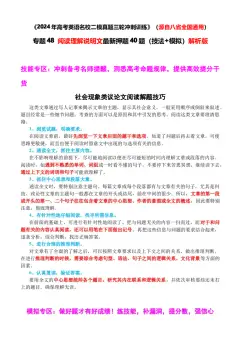
社会现象类议论文阅读解题技巧
这类文章通过写人记事来揭示文章的主题,显示其社会意义,一般采用顺序或倒叙来叙述。
题目经常是一些细节问题。考查的方面可以是原因和其中引发的思考。阅读这类文章要理清思
路。
1、浏览试题,明确要求。
在阅读文章前,最好先浏览一下文章后面的题干和选项。知道了问题后再去看文章,可使
思路更敏捷,而且也便于阅读时留意文中出现的与选项有关的信息。
2、通读全文,抓住主要内容。
在不影响理解的前提下,尽可能地阅读以便在尽可能短的时间内理解文章或段落的内容。
阅读时,如遇到不熟悉的单词、词组或一时看不懂的句子,不要停下来苦思冥想,继续读下去,
通过上下文的词语和句子可能就理解了。
3、抓住中心思想和段落大意。
通读全文时,要特别注意主题句。每篇文章或每个段落都有与文章有关的句子,尤其是科
技、政论性文章的主题句一般都在文章的开头或结尾,插在中间的很少。所以,文章的第一段
或开头的第一、二个句子往往包含着文章的中心思想、作者的意图或全文的概述,因此要特别
注意,彻底理解。
4、有针对性地仔细阅读,找寻所需信息。
在前面的基础上,可进行有针对性地阅读了。把与问题无关的内容一扫而过,而对于和问
题有关的内容认真阅读,还可以用笔在下面做出记号。再把这些信息与问题的要求结合起来,
逐条分析,综合判断,找出正确答案。
5、进行合理的推理判断。
对文章有了全面的了解之后,可以按照文章要求以及上下文之间的关系,做出推理判断。
在进行推理判断的时候,需要综合考虑句型、语法、句子之间的逻辑关系、文化背景等方面的
因素。
6、认真复读,验证答案。
要用全文的中心思想统帅各个题目,研究其内在联系和逻辑关系,并依次审核那些还未打
上的题目,确保理解无误。
模拟专区:做好题才有好成绩!练技能,补漏洞,提分数,强信心(2024·山东菏泽·三模)The hottest year on record is coming to a close, emissions of planet-warming gases
are still rising globally, and the most ambitious climate goal set by world leaders is all but impossible to meet,
according to a new analysis by the United Nations.
Between 2021 and 2022, global greenhouse gas emissions grew about 1%, the analysis finds. Emissions need
to fall as quickly as possible to avoid catastrophic climate impacts such as uncontrollable sea level rise, unsurvivable
heat in some areas and mass extinction of plants and animals.
Right now, the world is headed for at least 4.5℉ of warming this century compared to global temperatures in
the late 1800s. It is assumed that countries will do everything they have currently promised under the Paris
Agreement, including things that some governments have said they’ll only do if wealthy countries follow through on
promises to help foot the bill, for example, helping to pay for renewable energy infrastructure in less wealthy
nations. If such conditions aren’t met, the planet is headed for more than 5°F of warming, the analysis finds.
The new range is ever so slightly lower than predicted in last year’s analysis, which reflects the very slow
progress that humanity is making on slowing emissions and controlling future warming. Even the lower end of the
current projected temperature range — 4.5°F of warming — is extremely high. And the lower target is likely out of
reach entirely at this point — a finding that is backed up by another recent study.
The new analysis emphasizes once again that controlling oil, gas and coal operations is key to controlling
global warming. It finds that, if humans extract (提取) and burn all the oil, gas and coal currently in development
worldwide, countries would collectively emit enough greenhouse gases to basically hit the higher temperature target
under the Paris Agreement. That means all new oil, gas and coal extraction is essentially incompatible (对立的) with
avoiding harmful warming later this century. Right now, many countries including the United States are still
allowing new fossil fuel extraction.
1.What does the underlined word “catastrophic” in paragraph 2 probably mean?
A.Limited. B.Invisible. C.Ruinous. D.Controllable.
2.What is a worrying situation the world faces now according to the text?
A.Solutions to global warming aren’t clear.
B.The world is heading to a warmer future.
C.Countries are unwilling to make promises.
D.The temperature target is unrealistically high.
3.What is the author’s attitude towards the USA’s current move?
A.Indifferent. B.Optimistic. C.Cautious. D.Critical.
4.What is the text mainly about?
A.A new analysis is calling for all the countries to reach an agreement.B.Fossil fuel extraction control is far from a solution to pollution.
C.The huge impacts of global warming are predictable but uncontrollable.
D.The world is far behind on controlling planet-warming pollution.
(2024·浙江·二模)Almost all humans acquire at least one language before the age of five. How do young
children understand and produce complex sentences with complicated meanings? Do adults learn language
differently from children? Most linguistic (语言学的) researchers agree that both nature and nurture (后天) are
involved in language acquisition. They disagree, however, about how much linguistic knowledge children have from
birth — and thus whether genetics or experience is more important in language acquisition.
For many linguists, biological factors are the most important in language learning. Some argue that some
linguistic knowledge must exist in our brains from birth because children cannot possibly experience every feature of
their language before the age of five. These linguists point out that nearly all children can produce the same kinds of
complex sentence structures by the age of five, even without having heard them before.
Many researchers have theorized what this innate (先天的) linguistic knowledge must look like. One popular
theory (理论) is universal grammar. This theory believes that all languages have the same basic structural
foundation. That foundation is the innate knowledge universal to all humans. While children are not genetically
tending to speak a particular language, a universal grammar gives them certain linguistic information as a starting
point, which allows them to readily acquire the rules and patterns of whichever language they are exposed to.
Not all linguists, however, believe that an inborn ability for language is the most important factor in language
acquisition. These researchers place greater emphasis on the influence of usage and experience. They argue that
children are exposed to a wealth of linguistic structures over the course of five years. They gather data and determine
language patterns and structures from what they have observed.
Linguists on both sides of the debate are still working to explain the different language learning abilities of
adults and children. Early childhood seems to be an important period for mastering certain aspects of language.
Children also tend to have a heightened ability to learn second languages. While adults may have some advantages
when studying in a formal classroom, they usually do not learn second languages. While adults may have some
advantages when studying in a formal classroom, they usually do not learn as quickly and easily as children. Are
these different abilities a result of differences in how adults and children are exposed to a new language? Are they
the result of biological changes, or do both biology and experience come into play?
While our understanding of language acquisition is incomplete, this pursuit is well worth the effort. “We still
don’t understand how a child learns its first language, why some children have language disorders, or how children
and adults learn a second language,” explains Professor Joan Ma ling.Explaining the process of language acquisition promises not only to help scientists answer these questions, but
also to explain fundamental features of learning and the human brain.
5.What does the passage mainly talk about?
A.The control of nurture over nature in language acquisition.
B.The influence of universal grammar in language acquisition.
C.The best methods for children and adults to acquire language.
D.The role of biological and environmental factors in language acquisition.
6.What is covered in the second part of this article?
A.Studying language acquisition will help understand language and the brain better.
B.Some experts believe innate factors explain children’s language development.
C.Some experts focus on the role of environmental factors in language acquisition.
D.Acquiring a language is complicated, and it involves both nature and nurture.
7.What can we know about what the author wants from the 2 and 3 paragraph?
A.Present a general argument and then explain a specific theory.
B.Present a specific theory and then propose a new study to prove it.
C.Present a general argument and then disprove an opposite argument.
D.Present a scientific debate and then discuss what all linguists agree on.
8.What is the author’s purpose of writing Paragraph 5 and Paragraph 6?
A.To raise open questions that all linguists have.
B.To present two different viewpoints on language learning.
C.To stress the importance of experience in language learning.
D.To introduce adult language acquisition and show why it’s unpopular.
(2024·湖南长沙·模拟预测)“Woman reading book, under a night sky, dreamy atmosphere,” I type into
Deep Dream Generator’s Text 2 Dream feature. In less than a minute, an image is returned tom e showing what I’ve
described.
Welcome to the world of AI image generation, where you can create what on the surface looks like top-rank
artwork using just a few text prompts (提示). But closer examination shows oddities. The face of the woman in my
image has very odd features, and appears to be holding multiple books. And, while there’s an initial thrill at seeing an
image appear, there’s no creative satisfaction.
AI image generation could impact everything from film to graphic novels and more. Children’s illustrators
were quick to raise concerns about the technology. They say AI-generated art is the exact opposite of what art is
believed to be. Fundamentally, art is all about translating something that you feel internally into something that existsexternally. Whatever form it takes, true art is about the creative process much more than it’s about the final piece.
And simply pressing a button to generate an image is not a creative process.
Beyond creativity, there are deeper issues. To create images from prompts, AI generator s rely on databases of
already existing art and text. This could lead to the creation of images that are intentionally meant to imitate the style
of other artists, without their agreement. There is an argument that Al generators work no differently to humans when
it comes to being influenced by others’ work, However, a human artist is also adding emotion and nuance (细微差
别) into the mix. AI doesn’t do the same — it can only copy.
The increasing use of AI will also lead to a devaluing of the work of artists. There’s already a negative
prejudice towards the creative industry. People will begin to think that their “work” is as valid as that created by
someone who has spent a career making art. It’s nonsense, of course. You can use your mobile phone to take a nice
picture of your daughters, but you are no match for professionals.
9.What does the writer think of his image creation?
A.Exciting. B.Appealing. C.Unsatisfying. D.Shocking.
10.What do children’s illustrators value most about art?
A.The creating process. B.The final work.
C.Personal feelings. D.External forms.
11.What is Paragraph 4 of the text mainly about?
A.The styles of human artworks and AI ones.
B.Human artists’ influence on AI generators.
C.Different means used in human and AI art creation.
D.The drawbacks of drawing from existing art and text.
12.Which of the following best summarizes the last paragraph?
A.Art is the mirror of life. B.Rome is not built in a day.
C.No man can do two things at once. D.Jack of all trades, master of none.
(2024·河北·三模)Troy Vettese has a parrot in his family. She gets a lot of attention, but she wants more.
Parrots are clever and social. Vettese says: “She needs to be entertained all the time, otherwise she really is
suffering.”He sees a possible different life for her: She could be living with her friends and family in a forest, very
happy—but she’s not, and that’s unfair to her.
When it comes to owning pets, there are varying shades of grey. On one end of the spectrum: the poor snake I
spotted at a party recently, being worn as a necklace. At the other might be your rescue pup, or my rescue cat, one
with a damaged brain and the other with one eye; they wouldn’t have survived long on the streets. But I still find
myself wondering whether it is fair keeping them at all.We may think that we are giving our companions rounded lives and putting them first when we rise early for
walkies. But Vettese, an environmental historian who specialises in animal studies and pays more attention to animal
ethics now, says the suffering of his family’s much-loved bird is evidence that pet ownership is not about the
animals.
“If people really cared about animals, we would only engage in rescues and helping wildlife rehabilitation (野
生动物康复)—things that we find fulfilling, but that also help the animal,” Vettese says. “Instead, we only like
relationships where they are easy, where the pets are well maintained, where we can hire a dog walker, where the
pets impact as little as possible on our life and we are extracting as much emotional support as we want from them”.
To his mind, it is definitely a very selfish relationship.
“But, at least in the tradition, keeping animals such as dogs and cats seems to be the norm,” says Jessica du
Toit, a doctoral student in philosophy at Western University in Ontario who studies animal ethics. She grew up with
pet s and takes every chance she can to spend time with her parents’ elderly dog, Oliver. In fact, she says, “So many
people nowadays consider these animals to be their companions, or a part of their families, that we have things such
as restaurants, hotels and workplaces stating that are pet-friendly; and people earning good incomes as pet walkers,
pet sitters and pet psychologists.”
13.What concerns Vettese during the course of keeping his parrot?
A.The animal ethics. B.The bird species.
C.The sense of bird’s territory. D.The hidden diseases of pet birds.
14.What is the author’s attitude towards keeping pets?
A.Supportive. B.Critical. C.Tolerant. D.Uncertain.
15.What can be inferred from the last paragraph?
A.The pet industry is still promising.
B.The status of pets in family has changed a lot.
C.The necessity of keeping pets increased for children.
D.The tradition of keeping pets has consumed many resources.
16.What is the best title for the text?
A.An emotional support: can we find pet s fulfilling?
B.The relationship with pets: are they our family members?
C.An environmental historian: is he an animal rights activist?
D.The case against pets: is it time to give up our cats and dogs?
(2024·云南昆明·模拟预测)Have you ever noticed how much nicer you are to your friends than to
yourself?We comfort our friends and cheer on their achievements, yet we constantly criticize ourselves. We regret
making mistakes. We compare ourselves to others. We don’t feel we are worthy enough. It’s endless.
Self-criticism actually serves a purpose. It helps people survive by adapting ourselves to social standards.
Follow the standards and you will remain secure; step outside the lines and you will risk potential danger. This is
why the negative self-talk is critical—it’s trying to keep you safe.
Strangely enough, as the brain circuit forces us to reflect what we did wrong, it responds with support for our
friends. So how can we treat ourselves with the care we give our friends? We start by understanding how self-
criticism operates.
When we are not concentrated on something, the brain circuit runs. We passively listen to these negative
thoughts which interrupt our ability to focus and sleep. The self-criticism creates over thinking. For example,
someone who loses a love done might think, “I’m so down. Why can’t I get over this?” and then, “I can’t handle
anything.” When trying to make meaning from self-criticism, we slip into a cycle, which makes us feel we are not
enough: not successful enough, not lovable enough, not worthy enough...It convinces us that we will be happy and
safe when we achieve something. Yet when we achieve that, our wish to equal the achievements of others finds us
some new in security. Nothing will ever be good enough.
Only when we stop the self-criticism can we hear our inner voice. Let go of the desire to “keep up with the
Joneses” and then step more fully into ourselves. Next, think about what you would say to friends in a similar
situation. It helps us out of the negative cycle and access our caring and supportive side. It is time for us to treat
ourselves like we treat our friends.
17.Why does self-criticism matter?
A.It adapts people to critical standards. B.It helps people avoid potential risks.
C.It ensures people’s security in society. D.It assists people to achieve life purpose.
18.What in mainly talked about in paragraph 5?
A.How the brain circuit is formed. B.How self-criticism affects people.
C.How it feels to lose a love done. D.How criticism creates over thinking.
19.What might the underlined sentence “keep up with the Joneses” in paragraph 6 mean?
A.Handle difficulties with case. B.Possess abundant wealth.
C.Get rid of the heavy pressure. D.Match the success of others.
20.What does the author suggest us doing?
A.Making meaning from criticism. B.Treating ourselves with kindness.
C.Reflecting on mistakes regularly. D.Offering nice comments to others.
(2024·山东日照·模拟预测)Over the past few months, I’ve been invited to speak with well-known writers,musicians and film producers regarding my recent book, Extraterrestrial. Prior to these conversations, I was on the
receiving (and admiring) end of their artistic work, but now they were curious about my own research as a scientist.
The reverse led me to recognize the similarities between innovation in the arts and the sciences.
In sciences and arts alike, creativity appears magically as an unpredictable fountain of inspiration from the
subconscious (潜意识). Its unexpected content breaks routines within traditional thinking. It delivers something new
that is distinct from common practices, often taking people out of their comfort zone because it is ahead of its time.
As a result, many innovators are laughed at and denied the recognition they deserve when they need it the most.
There are many examples of such circumstances. In 1933 Fritz Zwicky inferred the existence of “dark
matter”, but it took four decades for this concept to gain recognition within the astronomy community. Vincent van
Gogh was considered a madman and a failure throughout his life. Today, his paintings are among the most expensive
ever sold, though.
Typically, life offers two ways of acquiring objects. One is by collecting available items, and the other is by
creating things that never existed before. Whereas most items on the shelves of supermarkets are mass-produced,
products that are newly created by artists or scientists are originally unique. Just like aging wine, a product of
creative work acquires quality over time. It is colored by the response of the audience as well as by imitations. The
initial circumstances are a reminder of an admirable baby. It is fascinating for a scientist or an artist to watch the
interaction of their creation with the world, just as it is for parents to watch their children.
Creativity in arts and sciences establishes a backdrop for human existence, as the content it invents gives
pleasure and meaning to our lives. The human act of creation is an infinite-sum game, from which all of us benefit.
And we can all participate in the creative process.
21.Which can best replace the underlined word “reverse” in paragraph 1?
A.Priority. B.Assumption. C.Shift. D.Preference.
22.What can best describe creativity in sciences and arts?
A.It tends to be forecastable. B.It mirrors common beliefs.
C.It usually leads the times. D.It enjoys instant acceptance.
23.What can be inferred from paragraph 4?
A.Creative works withstand the test of time.
B.Mass-produced items are preferable.
C.Old wine can’t be put into new bottles.
D.Inventiveness starts from childhood.
24.What’s the purpose of the last paragraph?
A.To clarify a concept. B.To launch an appeal.
C.To offer an entertainment. D.To advocate a lifestyle.(2024·湖南长沙·三模)When consuming information, we try to acquire more signals and less noise. We
feel like the more information we consume the more signals we receive. While this is probably true on an absolute
basis, Nassim Taleb argues in the book Antifragile that it is not true on a relative basis. As you consume more data
and the ratio (比率) of noise to signals increases, you know less about what’s going on and you are likely to cause
more unintentional trouble.
The supply of information to which we are exposed under modernity is transforming humans from a calm
person to a neurotic (神经质的) one. For the purpose of our discussion, the first person only reacts to real
information, and the second largely to noise. The difference between the two will show us the difference between
noise and signals. Noise is what you are supposed to ignore; signals are what you need to heed.
In science, noise is a generalization beyond the actual sound to describe random information that is totally
useless for any purpose, and that you need to clean up to make sense of what you are listening to. You can use and
take advantage of noise and randomness, but noise and randomness can also use and take advantage of you,
particularly with the data you get on the Internet or through other media. The more frequently you look at data, the
more noise you are likely to get, and the higher the noise-to-signal ratio is.
Say you look at information on a yearly basis—the changes you see will all be large ones. The ratio of signals
to noise is about one to one—this means that about half the changes are real improvements or degradations, and the
other half come from randomness. But if you look at the very same data on a daily basis, the composition would
change to 95 percent noise and 5 percent signals, and the changes you see daily will certainly be small.
25.What opinion does Nassim Taleb probably hold?
A.It’s hard to know the real truth. B.The noise-to-signal ratio is changing.
C.The information explosion can be harmful. D.More information brings more signals.
26.What does the underlined word “heed” probably mean in paragraph 2?
A.Notice. B.Analyse. C.Solve. D.Describe.
27.What does paragraph 3 mainly talk about?
A.Causes and harms of more noise. B.The meaning and impact of noise.
C.The relationship between noise and signals. D.Advantages and disadvantages of noise.
28.How should we handle information according to the author?
A.Check it frequently. B.Make use of online data.
C.Look at key changes. D.Focus on all changes in it.
(2024·黑龙江哈尔滨·三模)Pity the poor traffic policeman. He’s the last guy you want to see when you’re
speeding down the highway. But according to a major research by scientists in Canada and California, thatpoliceman just might be saving your life or the life of someone else.
The researchers have found that a traffic ticket reduces a driver’s chance of being involved in a disastrous
accident greatly. The effect doesn’t last long, however. Within months, the lead foot is back on the pedal and the risk
of killing yourself or someone else is back up to where it was before that policeman stared you in the eye and wrote
out that expensive ticket. It is back to business as usual for most motorists.
Traffic tickets save thousands of lives every year. Yet traffic laws are applied infrequently, almost as if by
whim (心血来潮), partly because people just don’t like traffic policemen, and there are lots of other things for the
government to spend money on than applying highway safety laws.
Researches looked at the month prior to a disastrous accident, and the number of traffic convictions (定罪),
and then the same month in the year before. They found there were fewer tickets in the month before a disastrous
accident than there were a year before, which suggests there’s a protective effect of having a ticket.
The scientists also turned up some surprising results. “Most of the crashes did not involve alcohol,” they
reported. “The relative risk reduction associated with traffic convictions was remarkably consistent among women
and men, regardless of age, prior driving record, and other personal data. Men, however, were involved in far more
disastrous accidents than women and the most accident-prone (有倾向的) age was between 30 and 50.”
They also pointed out that most crashes could have been prevented by a small difference in driver behavior.
So the next time you see that policeman in your rear-view mirror, give him or her a broad smile.
29.How will the drivers probably behave months after having traffic tickets?
A.Drive more attentively than before. B.Return to where accidents happened.
C.Escape a spot check for alcohol. D.Drive as fast as they did before.
30.Which statement about traffic laws is correct?
A.They have saved thousands of lives so far.
B.They are not favored by traffic policemen.
C.They are carried out consistently and sufficiently.
D.They are not the priority of the government’s budget.
31.What can be learned from paragraph 4?
A.Traffic tickets can guarantee safe driving.
B.It is necessary to reduce traffic convictions.
C.Disastrous accidents will decline with more traffic tickets given.
D.Tickets’ protective effect can be found before disastrous accidents.
32.What can be inferred from the research?
A.Its results applied to both men and women.
B.None of the traffic crashes involved alcohol.C.Women aged 30 to 50 caused more disastrous accidents.
D.Drivers were used to looking at the mirrors while driving.
(2024·浙江·二模)In recent years, aggression on social media have become commonplace. More than half
of the victims said they didn’t know the identity of the perpetrator (作恶者). Most people agreed that the anonymity
(匿名) of the Internet provides cover for nasty and harassing (骚扰) behavior.
Does this growing aggression on social media give us a glimpse of our real human nature? Are we-at our core-
aggressive beasts? It’s true that hate crimes are on the rise, and political divisions app ear to be growing. The level of
public bitterness-especially online-is substantial. But I don’t believe that’s because social media has unlocked our
cruel human nature.
As an evolutionary anthropologist, I have spent years researching our transformation as a species. Over the
past two million years, we have evolved from groups of apelike beings armed with sticks and stones to the creators
of cars, rockets, and nations. Our bigger brains have allowed us to bond and cooperate in more complex and diverse
ways than any other animal. Meanwhile, “you are whom you meet.” How we perceive, experience, and act in the
world is shaped by who and what surround us on a daily basis. This process has deep evolutionary roots and gives
humans what we call a shared reality.
I would argue that the rise in online aggression is a product of our evolutionary social skills, the social media
boom, and the specific political, economic and social context where we find ourselves. This explosive combination
has opened up a space for increasingly more people to fan the flames of aggression and insult online. Aggressive
behavior-especially to those you don’t have to confront face-to-face-is easier than it’s ever been. And for the
aggressor, there are often no consequences.
Yes, it seems that the world is getting more aggressive, but that’s not because we are more aggressive at our
core. It’s because we haven’t been standing up against bullying, abuse, and aggressive harassment, and promoting
pro-social attitudes and actions our contemporary world demands. In person and on social media, we must do both.
33.What does the underlined word “that” in paragraph two refer to?
A.Hate crimes on the rise. B.Growing political divisions.
C.Considerable online bitterness. D.The transformation of humans.
34.What’s the author’s attitude toward social media?
A.Critical. B.Objective. C.Approving. D.Ironic.
35.What does the author propose to address the issue of growing aggression?
A.Embracing our aggressive nature to compete in today’s world.
B.Strengthening laws to hold perpetrators responsible for their online actions.C.Promoting positive behaviors and interactions in both real-life and digital spaces.
D.Focusing only on reducing anonymity on the internet to reduce offensive behavior.
36.What is mainly discussed in this passage?
A.The impact of social media on society.
B.The influence of evolution on our behavior.
C.The reasons behind rising online aggression.
D.The factors in the social media development.
(2024·山西晋中·二模)Socially, few things are more annoying than someone repeatedly checking their
phone in the middle of your conversation with them. Soon enough, you’re having unhappy thoughts, thinking of
their way like, I’m boring you; you’re more concerned with whoever’s on that phone than me; you don’t care about
me. None of that is necessarily true, but this is: “If someone is engaged in a great conversation, they wouldn’t care
about their phones,” says Leslie, a psychologist and researcher at NYU.
Do you sometimes wonder: What should I have said to a rude person like this? What if we have to talk to such
maddening persons? Experts have advice about how to deal with this.
Whether you say something or not, remember that the cell-addict’s annoying habits aren’t about you. “It’s
rude, for sure, but sometimes we mistake the behavior for more than what it is,” says Leslie. “It’s possible that they
are facing something tough and merely experiencing nervousness or anxiety,” he adds. It’s also possible that their
partner is stuck with a flat tyre (轮胎) or their kid is sick in hospital. The point is that you don’t know.
So before you become angry at the cell-addict’s open rudeness, focus instead on building a better conversation
than whatever’s going down on Instagram. You might never be able to achieve this, given the power of today’s social
media, so if you’re close enough to a person, Leslie advises you to directly ask them: “What’s on that thing that’s so
interesting?” Chances are that they will apologise at once and quickly put the phone away. But if the answer is
something real, talk about it. Better yet, you can avoid the situation in advance by saying something like, “I’m really
interested in catching up properly, so how about we leave our phones in the car?” If they indeed have that flat tyre or
sick kid, at least you won’t have to assume that it’s because your stories are boring.
37.Why do people often check their phones according to Leslie?
A.They are anxious about something.
B.They are enjoying the conversation.
C.They are bored with the conversation.
D.They are interested in what’s on the phone.
38.What could be a reason for the cell-addicts’ annoying habits according to Leslie?
A.They may be nervous or anxious.B.They are being rude intentionally.
C.They are avoiding the conversation.
D.They are disinterested in social interactions.
39.What is a better way to deal with the rudeness?
A.Talking about something real.
B.Asking the other person directly.
C.Avoiding the situation in advance.
D.Asking the other person for explanation.
40.What’s the main idea of the text?
A.What is a cell-addict.
B.How to deal with a cell-addict.
C.Why people repeatedly check their phones.
D.When to cut in appropriately during a conversation.