2026 年吉林高考英语试题及答案
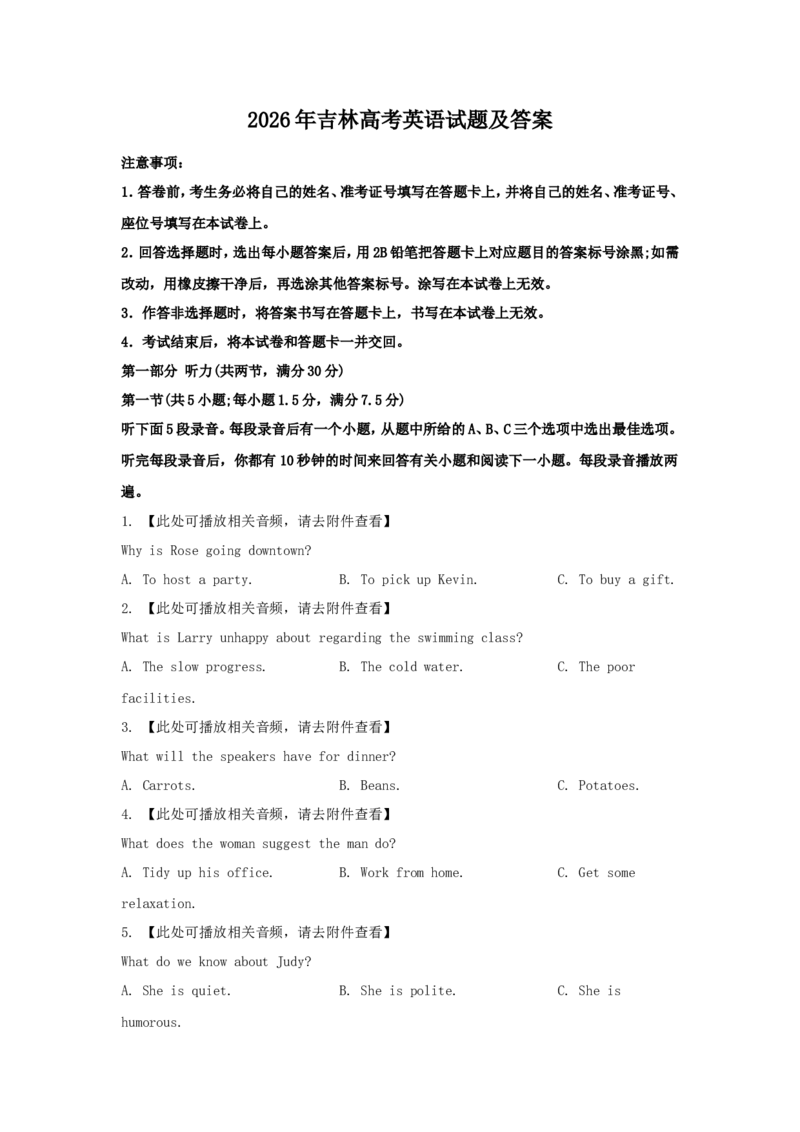
注意事项:
1.答卷前,考生务必将自己的姓名、准考证号填写在答题卡上,并将自己的姓名、准考证号、
座位号填写在本试卷上。
2.回答选择题时,选出每小题答案后,用2B 铅笔把答题卡上对应题目的答案标号涂黑;如需
改动,用橡皮擦干净后,再选涂其他答案标号。涂写在本试卷上无效。
3.作答非选择题时,将答案书写在答题卡上,书写在本试卷上无效。
4.考试结束后,将本试卷和答题卡一并交回。
第一部分 听力(共两节,满分30 分)
第一节(共5 小题;每小题1.5 分,满分7.5 分)
听下面5 段录音。每段录音后有一个小题,从题中所给的A、B、C 三个选项中选出最佳选项。
听完每段录音后,你都有10 秒钟的时间来回答有关小题和阅读下一小题。每段录音播放两
遍。
1. 【此处可播放相关音频,请去附件查看】
Why is Rose going downtown?
A. To host a party.
B. To pick up Kevin.
C. To buy a gift.
2. 【此处可播放相关音频,请去附件查看】
What is Larry unhappy about regarding the swimming class?
A. The slow progress.
B. The cold water.
C. The poor
facilities.
3. 【此处可播放相关音频,请去附件查看】
What will the speakers have for dinner?
A. Carrots.
B. Beans.
C. Potatoes.
4. 【此处可播放相关音频,请去附件查看】
What does the woman suggest the man do?
A. Tidy up his office.
B. Work from home.
C. Get some
relaxation.
5. 【此处可播放相关音频,请去附件查看】
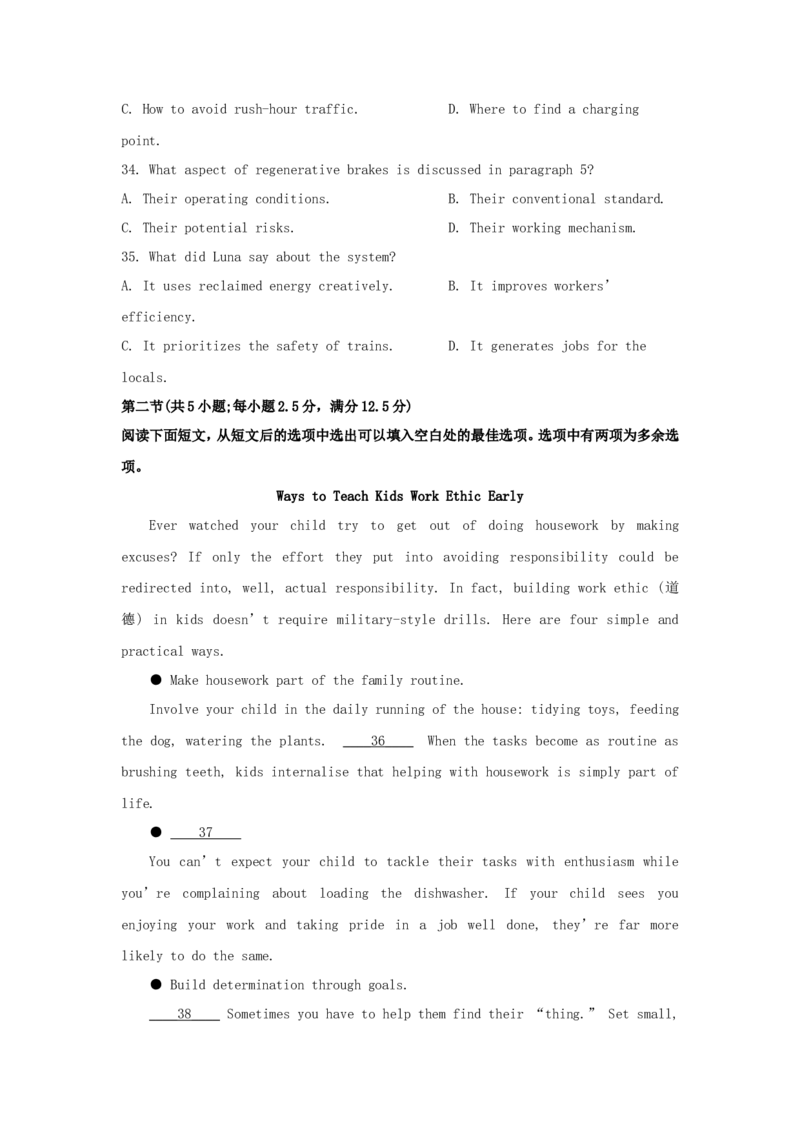
What do we know about Judy?
A. She is quiet.
B. She is polite.
C. She is
humorous.
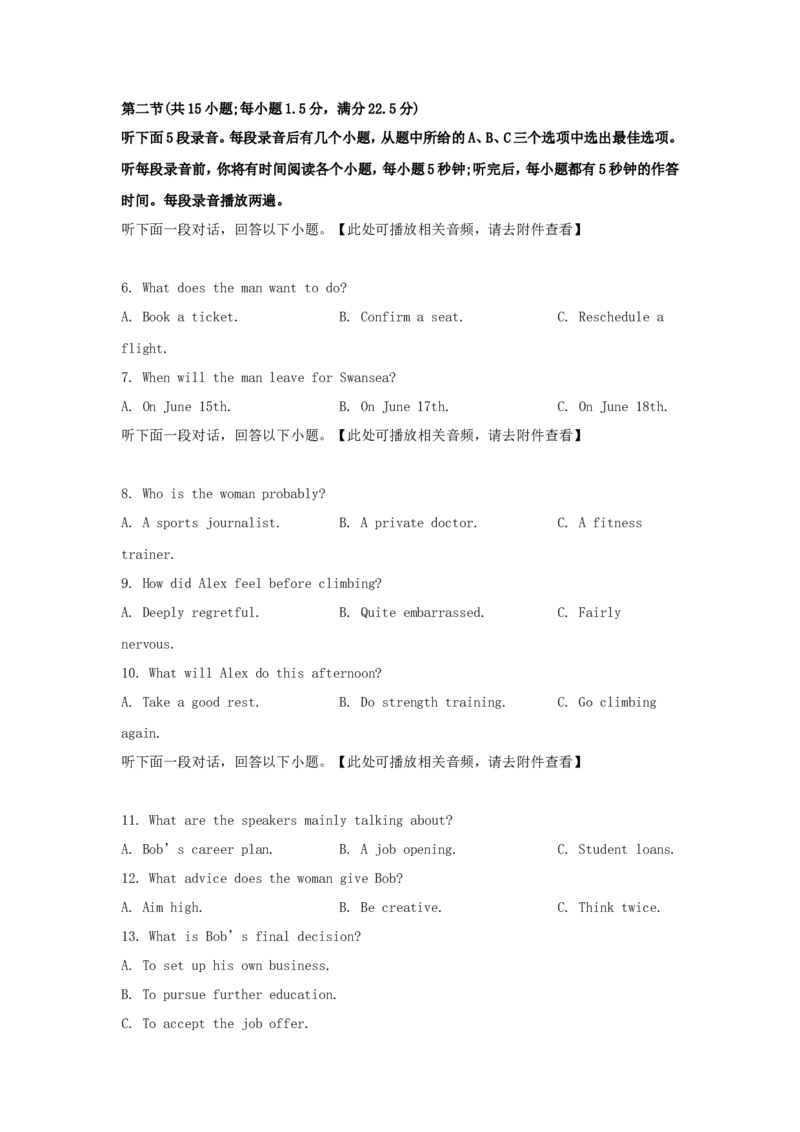
第二节(共15 小题;每小题1.5 分,满分22.5 分)
听下面5 段录音。每段录音后有几个小题,从题中所给的A、B、C 三个选项中选出最佳选项。
听每段录音前,你将有时间阅读各个小题,每小题5 秒钟;听完后,每小题都有5 秒钟的作答
时间。每段录音播放两遍。
听下面一段对话,回答以下小题。【此处可播放相关音频,请去附件查看】
6. What does the man want to do?
A. Book a ticket.
B. Confirm a seat.
C. Reschedule a
flight.
7. When will the man leave for Swansea?
A. On June 15th.
B. On June 17th.
C. On June 18th.
听下面一段对话,回答以下小题。【此处可播放相关音频,请去附件查看】
8. Who is the woman probably?
A. A sports journalist.
B. A private doctor.
C. A fitness
trainer.
9. How did Alex feel before climbing?
A. Deeply regretful.
B. Quite embarrassed.
C. Fairly
nervous.
10. What will Alex do this afternoon?
A. Take a good rest.
B. Do strength training.
C. Go climbing
again.
听下面一段对话,回答以下小题。【此处可播放相关音频,请去附件查看】
11. What are the speakers mainly talking about?
A. Bob’s career plan.
B. A job opening.
C. Student loans.
12. What advice does the woman give Bob?
A. Aim high.
B. Be creative.
C. Think twice.
13. What is Bob’s final decision?
A. To set up his own business.
B. To pursue further education.
C. To accept the job offer.
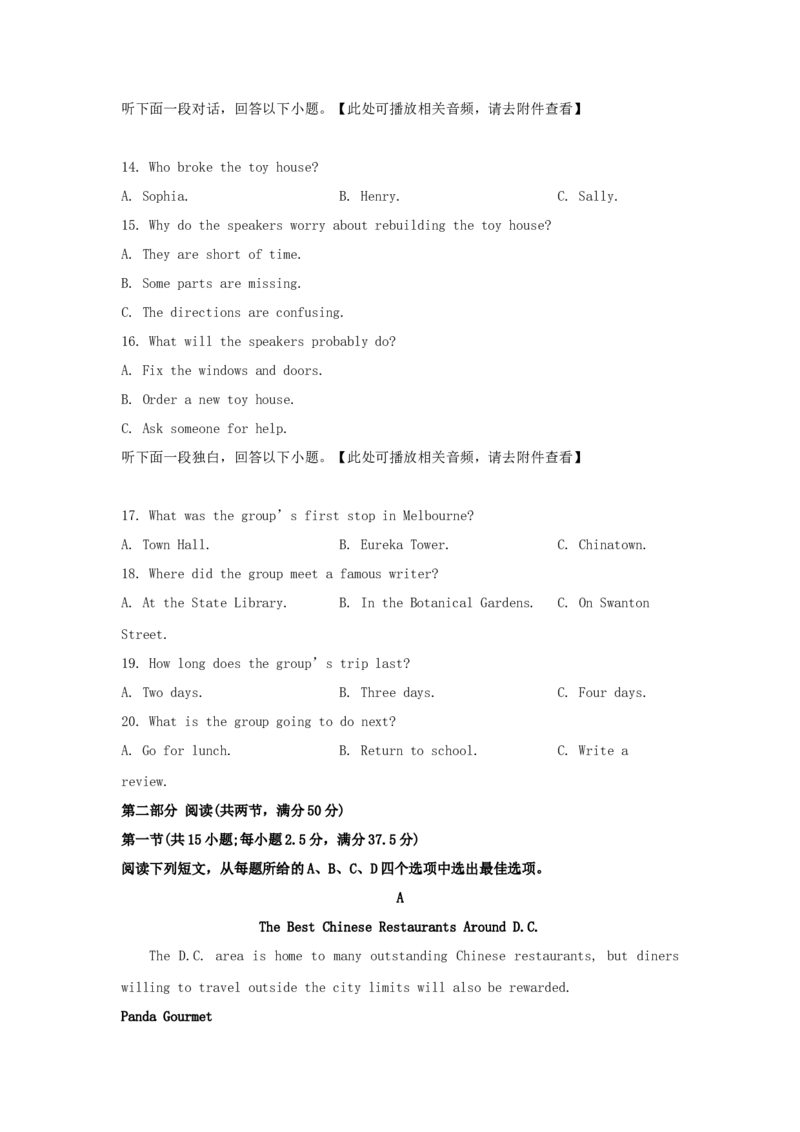
听下面一段对话,回答以下小题。【此处可播放相关音频,请去附件查看】
14. Who broke the toy house?
A. Sophia.
B. Henry.
C. Sally.
15. Why do the speakers worry about rebuilding the toy house?
A. They are short of time.
B. Some parts are missing.
C. The directions are confusing.
16. What will the speakers probably do?
A. Fix the windows and doors.
B. Order a new toy house.
C. Ask someone for help.
听下面一段独白,回答以下小题。【此处可播放相关音频,请去附件查看】
17. What was the group’s first stop in Melbourne?
A. Town Hall.
B. Eureka Tower.
C. Chinatown.
18. Where did the group meet a famous writer?
A. At the State Library.
B. In the Botanical Gardens.
C. On Swanton
Street.
19. How long does the group’s trip last?
A. Two days.
B. Three days.
C. Four days.
20. What is the group going to do next?
A. Go for lunch.
B. Return to school.
C. Write a
review.
第二部分 阅读(共两节,满分50 分)
第一节(共15 小题;每小题2.5 分,满分37.5 分)
阅读下列短文,从每题所给的A、B、C、D 四个选项中选出最佳选项。
A
The Best Chinese Restaurants Around D.C.
The D.C. area is home to many outstanding Chinese restaurants, but diners
willing to travel outside the city limits will also be rewarded.
Panda Gourmet
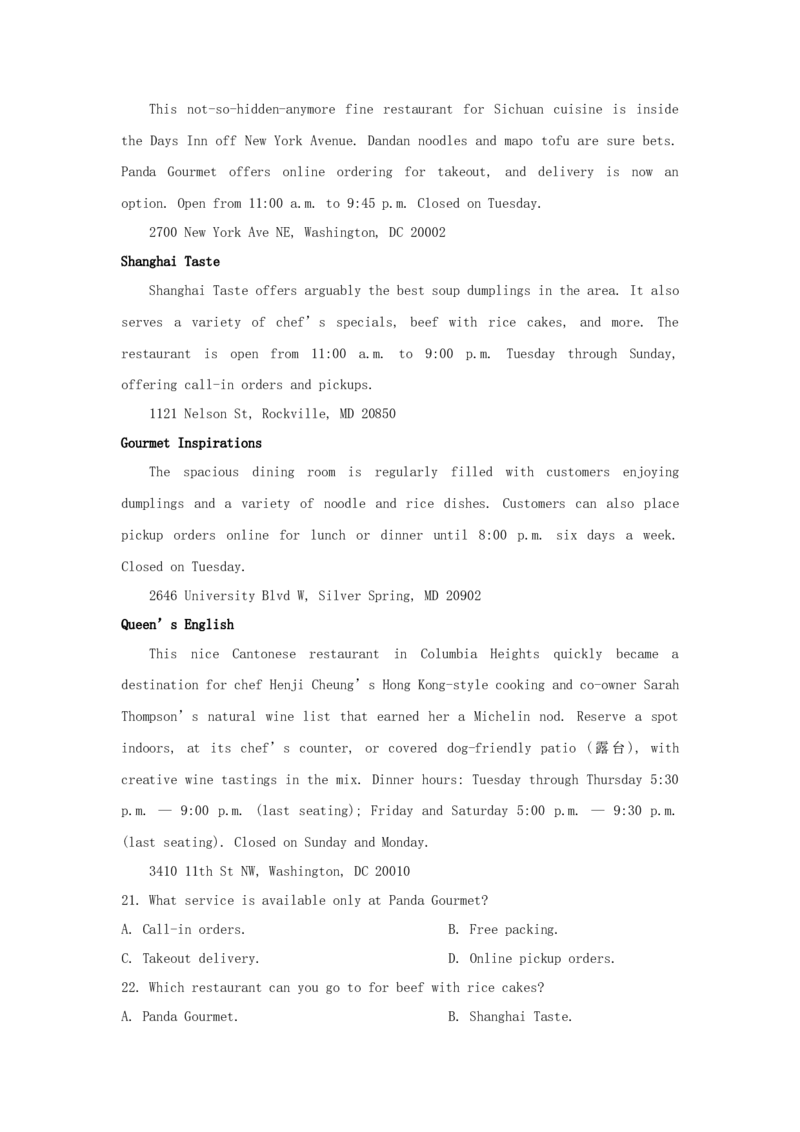
This not-so-hidden-anymore fine restaurant for Sichuan cuisine is inside
the Days Inn off New York Avenue. Dandan noodles and mapo tofu are sure bets.
Panda Gourmet offers online ordering for takeout, and delivery is now an
option. Open from 11:00 a.m. to 9:45 p.m. Closed on Tuesday.
2700 New York Ave NE, Washington, DC 20002
Shanghai Taste
Shanghai Taste offers arguably the best soup dumplings in the area. It also
serves a variety of chef’s specials, beef with rice cakes, and more. The
restaurant is open from 11:00 a.m. to 9:00 p.m. Tuesday through Sunday,
offering call-in orders and pickups.
1121 Nelson St, Rockville, MD 20850
Gourmet Inspirations
The spacious dining room is regularly filled with customers enjoying
dumplings and a variety of noodle and rice dishes. Customers can also place
pickup orders online for lunch or dinner until 8:00 p.m. six days a week.
Closed on Tuesday.
2646 University Blvd W, Silver Spring, MD 20902
Queen’s English
This nice Cantonese restaurant in Columbia Heights quickly became a
destination for chef Henji Cheung’s Hong Kong-style cooking and co-owner Sarah
Thompson’s natural wine list that earned her a Michelin nod. Reserve a spot
indoors, at its chef’s counter, or covered dog-friendly patio ( 露台), with
creative wine tastings in the mix. Dinner hours: Tuesday through Thursday 5:30
p.m. — 9:00 p.m. (last seating); Friday and Saturday 5:00 p.m. — 9:30 p.m.
(last seating). Closed on Sunday and Monday.
3410 11th St NW, Washington, DC 20010
21. What service is available only at Panda Gourmet?
A. Call-in orders.
B. Free packing.
C. Takeout delivery.
D. Online pickup orders.
22. Which restaurant can you go to for beef with rice cakes?
A. Panda Gourmet.
B. Shanghai Taste.
C. Gourmet Inspirations.
D. Queen’s English.
23. What do we know about the Cantonese restaurant in Columbia Heights?
A. It is open only on weekdays.
B. It adopts a no-pet policy.
C. It takes no reservations.
D. It serves only dinner.
B
Roland Reisley turned 101 years old in May and is in remarkable health. But
that’s not the thing he prides himself on. “I am the last original client of
Frank Lloyd Wright, still living in the home he designed for me,” Reisley
said, sitting in the bright open living room of the home designed by the famous
architect.
The house where Reisley has lived for 73 years is located in the woods of
Westchester County, New York, just 30 miles north of Manhattan. It’s one of 47
that make up the peaceful mid-20th-century modern village of Usonia.
Back in 1951, Reisley was just 26, newly married and ready to put down
roots. He and his wife began looking for a place in Manhattan. But what they
liked, they couldn’t afford on his sound engineer’s salary and what they
could, they didn’t like. Then they heard about Usonia. On their first trip
out, they were greeted with such enthusiasm from the 10 families who’d already
established homes there that they decided to join.
The house has signature Wright features. It is made with local materials,
has a flat roof, wood paneling, concrete floors and custom-made furniture. Over
the decades, Reisley has opened his doors to visitors. The house is now listed
on the National Register of Historic Places. Reisley said he’s tried his best
to be a good steward (管家) not just of the Wright creation he lives in, but
all others as well. He co-founded the Frank Lloyd Wright Building Conservancy,
an organization engaged in the preservation of all of Wright’s remaining
buildings. Reisley believes that his devotion to the home and the community are
what have kept him in such good health all of these years.
24. How does Reisley feel about having Wright as his house designer?
A. Honored.
B. Amused.
C. Stressed.
D.
Inspired.
25. What made Reisley finally decide to settle down in Usonia?
A. Its natural environment.
B. Its large-sized houses.
C. The convenience of its location.
D. The warmth of its residents.
26. What can we learn about Reisley’s house?
A. It is older than its owner.
B. It uses local materials.
C. It has a pointed roof.
D. It is put up for sale.
27. What can be inferred about Reisley from the last paragraph?
A. He is very attached to Wright buildings.
B. He is devoted to health education.
C. He is an expert in home decoration.
D. He is passionate about tourism.
C
The peak of Mount Qomolangma, 8,849 meters above sea level. Chimborazo,
6,263 m; Mont Blanc, 4,806 m; Pradidali hut, at the foot of the Pala group in
the Dolomites, 2,278 m. It is common practice to provide the elevation (高度)
of a place. Simple readings are now readily available on our phones and
wearables. But elevation is necessarily relative: only the choice of a
reference point allows us to express numerically the height of an object or a
location.
The idea of sea level as a reference point for elevations has by now been
around for so long as to go essentially unnoticed-we mention it without even
considering what it means. That the concept has a history is easily ignored. We
tend to forget that sea level is a product of technically and culturally
determined assumptions. In this book, I tell a story of these assumptions.
Appropriately, the book took shape during a summer spent between sea and
mountains. A month after visiting the French Riviera and enjoying the sandy
beaches of Nice and Menton, I went hiking with friends in the Pala group.
Resting on a pass near the Pradidali hut, we began discussing the readings
offered by our altimeters (测高仪). Why did they vary ever so slightly from one
instrument to the next? This sense of uncertainty led me to think about the
meaning of zero. This is how I began my search for the conceptual history of
sea level.
In this book I examine three crucial stages in the history of mean sea
level. These stages mirror the development of human conceptions of the sea.
Since I began thinking about this project in August 2011, the issue of sea-
level rise and the need to place it historically have only become more urgent:
between then and the end of 2022 the global sea rose by almost 5 centimeters,
about half of the overall rise recorded by satellites since 1993.
28. What does the author point out at the beginning of the text?
A. Some mountains are getting higher.
B. Data on wearables are
misleading.
C. The concept of elevation is relative.
D. The reference point is hard
to locate.
29. What is paragraph 3 mainly about?
A. How the altimeter was invented.
B. What initiated the author’s
research.
C. Why the digital readings varied.
D. Where the author spent his
holiday.
30. What does the underlined word “it” refer to in the last paragraph?
A. The book.
B. The project.
C. The issue.
D. The
development.
31. What can be the title of the book mentioned in the text?
A. The Altimeter: A Must-Have
B. Sea Level: A History
C. Meaning of Zero: Nothing or Everything
D. Mountains to Seas: Ups and
Downs
D
The Barcelona subway pulls into the station, the doors slide open and
passengers pour out to go about their daily business. Little do they know that
as they do so, a burst of energy is sent up to street level to help charge an
electric car.
Barcelona has put together a package of clean energy technologies to help
public transportation go greener, while also doing its part to tackle climate
change and aid Europe’s difficult shift to the privately owned electric
vehicle market.
Sixteen stations of Barcelona’s subway system are part of its new
MetroCharge project, whereby the energy from the underground trains’ brakes
( 刹车) is used to power the trains and the stations themselves, while the
remainder is sent snaking through cables (电缆) to the surface to power plug-in
stations for privately owned vehicles.
Bernardo Espinoza, an engineer who takes the subway every day, owns an
electric car. “I am pleasantly surprised, because I am always looking for
where to plug it in,” Espinoza said before catching the subway in a working-
class area of southern Barcelona. “And if it is from energy from the trains’
brakes, then even better.”
Regenerative brakes have been in trains for decades and are also used in
some cars. They consist of an electric motor which collects energy used in the
braking action that would be lost as heat by conventional brakes. That energy
can be immediately used to accelerate (加速) the vehicle or, in the case of the
Barcelona subway system, sent along cables to supply electricity for the
station or for electric car chargers.
Alvaro Luna, a professor of electrical engineering, said that the system is
innovative in so far as it allows for recycled energy to be redirected to
specific local uses — in this case powering electric cars parked nearby. That,
he said, boosts efficiency.
32. Why does Barcelona launch the MetroCharge project?
A. To fuel the city’s economy.
B. To enhance passengers’
experience.
C. To promote green transportation.
D. To raise the quality of
electric cars.
33. What is Espinoza’s concern?
A. How to cut his travel expenses.
B. Where to get a parking space.
C. How to avoid rush-hour traffic.
D. Where to find a charging
point.
34. What aspect of regenerative brakes is discussed in paragraph 5?
A. Their operating conditions.
B. Their conventional standard.
C. Their potential risks.
D. Their working mechanism.
35. What did Luna say about the system?
A. It uses reclaimed energy creatively.
B. It improves workers’
efficiency.
C. It prioritizes the safety of trains.
D. It generates jobs for the
locals.
第二节(共5 小题;每小题2.5 分,满分12.5 分)
阅读下面短文,从短文后的选项中选出可以填入空白处的最佳选项。选项中有两项为多余选
项。
Ways to Teach Kids Work Ethic Early
Ever watched your child try to get out of doing housework by making
excuses? If only the effort they put into avoiding responsibility could be
redirected into, well, actual responsibility. In fact, building work ethic (道
德) in kids doesn’t require military-style drills. Here are four simple and
practical ways.
● Make housework part of the family routine.
Involve your child in the daily running of the house: tidying toys, feeding
the dog, watering the plants. ____36____ When the tasks become as routine as
brushing teeth, kids internalise that helping with housework is simply part of
life.
● ____37____
You can’t expect your child to tackle their tasks with enthusiasm while
you’re complaining about loading the dishwasher. If your child sees you
enjoying your work and taking pride in a job well done, they’re far more
likely to do the same.
● Build determination through goals.
____38____ Sometimes you have to help them find their “thing.” Set small,
achievable goals together with them and celebrate progress, not perfection. The
trick is to let them struggle a bit — resist the urge to help fix things the
moment they experience a setback.
● Treat mistakes as opportunities.
Few things strike fear into a child’s heart like the prospect of failing.
The best way is to normalise mistakes as a natural part of learning. When kids
mess up, don’t jump in with a rescue mission. ____39____
Teaching kids work ethic is to gently and consistently push them toward
responsibility, determination, and pride in their efforts. ____40____ No worry.
Those habits you’re building now are setting your child up for a lifetime of
resilience (韧性) and satisfaction.
A. The key is consistency.
B. Help kids develop analytical skills.
C. Model the work ethic you want to see.
D. Instead, encourage them to do differently next time.
E. Sometimes, a cleaner living room is the best reward.
F. Progress can be slow, and you’ll wonder if it’s all sinking in.
G. Not every child is born with the willpower of a marathon runner.
第三部分 语言运用(共两节,满分30 分)
第一节(共15 小题;每小题1 分,满分15 分)
阅读下面短文,从每题所给的A、B、C、D 四个选项中选出最佳选项。
I never thought I could be a writer. I didn’t come from a family connected
to the ____41____ world, which I perceived as a major ____42____. After my
undergraduate degree, convinced that writing wasn’t for me, I ____43____ to
study teaching.
Then came an afternoon that ____44____ everything. I was teaching poetry,
encouraging students to write about their ____45____. And then, at the end of
the lesson, one child asked me a question: “Have you always wanted to be
a ____46____, Miss?” I explained that when I was his age, I actually wanted
to be a writer, but I didn’t think I quite had what it ____47____. The boy
replied with a ____48____ look, “Well, you are telling us to live our dreams
when you haven’t even done it yourself. Have you even ____49____?”
I was struck speechless — he was ____50____. Who was I to ____51____ them
on bravery and risk when I had never taken myself for my own ____52____
seriously?
On the basis of that ____53____, I applied to go back to university and
study creative writing. There were times when I found myself wondering if I
should pack it all in, but the boy’s words kept ringing in my ears: I knew I
needed nothing else to succeed but a bit of ____54____ and hard work. I
____55____ to find a way out of my shame and into a pattern of work that I
loved.
41. A. medical
B. artistic
C. scientific
D.
literary
42. A. subject
B. problem
C. event
D.
breakthrough
43. A. stepped aside
B. got up
C. went off
D. turned
back
44. A. changed
B. ruined
C. revealed
D.
interrupted
45. A. hobbies
B. families
C. dreams
D.
lessons
46. A. writer
B. teacher
C. reporter
D.
publisher
47. A. kept
B. left
C. held
D. took
48. A. satisfied
B. guilty
C. grateful
D.
disapproving
49. A. tried
B. noticed
C. asked
D. waited
50. A. rude
B. right
C. shy
D. silent
51. A. examine
B. congratulate
C. lecture
D.
consult
52. A. values
B. imagination
C. inspiration
D.
desires
53. A. cooperation
B. conversation
C. administration
D.
explanation
54. A. self-belief
B. know-how
C. brainstorming
D.
teamwork
55. A. remembered
B. agreed
C. managed
D.
hesitated
第二节(共10 小题;每小题1.5 分,满分15 分)
阅读下面短文,在空白处填入1 个适当的单词或括号内单词的正确形式。
My first time doing tai chi
For the first 15 minutes of my tai chi (太极) class, we remain ____56____
(entire) in one spot to warm up. Angela, a tai chi ____57____ (instruct) with
twenty-eight years of experience, says that a successful hour of tai chi is an
hour with no negative thoughts. “Your mind ____58____ body go together.
That’s all that matters.”
Although not a morning person, I begin my lesson with Angela and about
twenty others at a Sydney community centre courtyard at 7 am. “Put your
____59____ (foot) parallel ( 平行), and use your dan tian to hold up your
body,” she says.
In tai chi, the dan tian is your qi core and qi in Chinese means life
force. Now, I ____60____ (suppose) to feel the weight on my legs and sink my
dan tian.
We move on to tai chi positions, of ____61____ there are forty-two in the
style that Angela teaches. Today, we will only be doing the first nine. The
movements have ____62____ (describe) names like “holding the bowl” and
“grabbing the bird’s tail.”
During most of the class, we follow Angela and concentrate on making tiny,
isolated (单独) movements. Then, Angela gets us to try the nine movements on
our own. I keep my eyes ____63____ a woman to my right and try to copy her
movements, but unfortunately I soon lose focus.
At the end of the lesson, I feel wide awake, despite it still ____64____
(be) early at 8 am. It’s time for my dan tian ____65____ (meet) another life
force: coffee.
第四部分 写作(共两节,满分40 分)
第一节(满分15 分)
66. 假定你是李华,外教Kate 计划将你们班的英语作文汇编成册。请给Kate 写封邮件,内容
包括:
(1)建议配图。
(2)自荐承担画图工作。
注意:
(1)写作词数应为80 个左右。
(2)请按如下格式在答题卡的相应位置作答。
Dear Kate,
It’s a great idea to make a collection of our English essays.
_______________________________________________________________________________
_______________________________________________________________________________
_______________________________________________________________________________
_______________________________________________________________________________
_______________________________________________________________________________
_______________________________________________________
Yours,
Li Hua
第二节(满分25 分)
67. 阅读下面材料,根据其内容和所给段落开头语续写两段,使之构成一篇完整的短文。
As far as I can remember, I’ve always been a night owl. Even in middle
school I would stay up very late. I would feel completely at ease doing my
homework in bed, with light music on. I found comfort in keeping myself awake
when everyone else had gone to bed, and I loved the silence of the night. My
parents urged me to get out of this so-called unhealthy habit, but their
repeated requests fell on deaf ears.
Fast forward to my first year of college. I still loved the night and would
stay up until unruly hours for no apparent reason, chatting online and watching
videos. When I finally started to study, I would race through the assigned
work, often well past midnight. My roommates would tell me to go to bed and get
up early the following morning to do it instead. Get up early to do my
homework? No way! I would never do that.
Then, one day last term, I did exactly that. Bent over my laptop while
sitting on the bed in the corner of my room, I suddenly felt a pounding
headache, and had to lie down. Unable to keep my eyes open, I decided I had no
choice but to finish my homework the next morning. I woke up at 6am. Hardly had
I written half a page when I felt a sharp pain in my chest.
At the school clinic, a doctor, with a serious expression on his face,
handed me a medical report. “You’re 20, but your heart is 40!” he said. A
cold wave went through me. I realized that years of living as a late-night
person had turned my heart into an overworked engine.
注意:
(1)续写词数应为150 个左右。
(2)请按如下格式在答题卡的相应位置作答。
Struck by the doctor’s warning, I knew I had to make a change.
_______________________________________________________________________________
_______________________________________________________________________________
_______________________________________________________________________________
_______________________________________________________________________________
_______________________________________________________________________________
_______________________________________________________
Slowly but surely, my efforts to adjust to the new routine paid off.
_______________________________________________________________________________
_______________________________________________________________________________
_______________________________________________________________________________
_______________________________________________________________________________
_______________________________________________________________________________
_______________________________________________________
英语试卷
注意事项:
1.答卷前,考生务必将自己的姓名、准考证号填写在答题卡上,并将自己的姓名、准考证号、
座位号填写在本试卷上。
2.回答选择题时,选出每小题答案后,用2B 铅笔把答题卡上对应题目的答案标号涂黑;如需
改动,用橡皮擦干净后,再选涂其他答案标号。涂写在本试卷上无效。
3.作答非选择题时,将答案书写在答题卡上,书写在本试卷上无效。
4.考试结束后,将本试卷和答题卡一并交回。
第一部分 听力(共两节,满分30 分)
第一节(共5 小题;每小题1.5 分,满分7.5 分)
听下面5 段录音。每段录音后有一个小题,从题中所给的A、B、C 三个选项中选出最佳选项。
听完每段录音后,你都有10 秒钟的时间来回答有关小题和阅读下一小题。每段录音播放两
遍。
【1 题答案】
【答案】C
【2 题答案】
【答案】A
【3 题答案】
【答案】B
【4 题答案】
【答案】C
【5 题答案】
【答案】A
第二节(共15 小题;每小题1.5 分,满分22.5 分)
听下面5 段录音。每段录音后有几个小题,从题中所给的A、B、C 三个选项中选出最佳选项。
听每段录音前,你将有时间阅读各个小题,每小题5 秒钟;听完后,每小题都有5 秒钟的作答
时间。每段录音播放两遍。
【6~7 题答案】
【答案】6. C    7. B
【8~10 题答案】
【答案】8. A    9. C    10. B
【11~13 题答案】
【答案】11. A    12. C    13. A
【14~16 题答案】
【答案】14. B    15. A    16. C
【17~20 题答案】
【答案】17. B    18. A    19. B    20. B
第二部分 阅读(共两节,满分50 分)
第一节(共15 小题;每小题2.5 分,满分37.5 分)
阅读下列短文,从每题所给的A、B、C、D 四个选项中选出最佳选项。
A
【21~23 题答案】
【答案】21. C    22. B    23. D
B
【24~27 题答案】
【答案】24. A    25. D    26. B    27. A
C
【28~31 题答案】
【答案】28. C    29. B    30. C    31. B
D
【32~35 题答案】
【答案】32. C    33. D    34. D    35. A
第二节(共5 小题;每小题2.5 分,满分12.5 分)
阅读下面短文,从短文后的选项中选出可以填入空白处的最佳选项。选项中有两项为多余选
项。
【36~40 题答案】
【答案】36. A    37. C    38. G    39. D    40. F
第三部分 语言运用(共两节,满分30 分)
第一节(共15 小题;每小题1 分,满分15 分)
阅读下面短文,从每题所给的A、B、C、D 四个选项中选出最佳选项。
【41~55 题答案】
【答案】41. D    42. B    43. C    44. A    45. C    46. B    47. D    48. D
49. A    50. B    51. C    52. D    53. B    54. A    55. C
第二节(共10 小题;每小题1.5 分,满分15 分)
【56~65 题答案】
【答案】56. entirely
57. instructor
58. and    59. feet
60. am supposed
61. which    62. descriptive
63. on    64. being
65. to meet
第四部分 写作(共两节,满分40 分)
第一节(满分15 分)
【66 题答案】
【答案】Dear Kate,
It’s a great idea to make a collection of our English essays. This
compilation will surely be a wonderful showcase of our English learning
achievements. I have a suggestion that might enhance the overall quality of
this collection — adding relevant pictures.
Pictures can play a vital role in making the essays more engaging. For
example, if an essay is about a travel experience, a vivid picture of the
described scenery can bring the story to life, helping readers better visualize
the places and emotions.
I’m quite interested in contributing to this project. As I have been
learning drawing for years and have a good command of various drawing
techniques, I believe I can create pictures that perfectly match the themes of
the essays.
Looking forward to your reply.
Yours,
Li Hua
第二节(满分25 分)
【67 题答案】
【答案】
Struck by the doctor’s warning, I knew I had to make a change. That very
night, I initiated my battle against my deep-rooted habits. I forcibly switched
off my laptop and phone at 10 p.m., placing them completely out of reach.
However, my rebellious biological clock refused to cooperate. I tossed and
turned in the darkness, the silence of the room amplifying my anxiety. The urge
to grab my phone and drown in videos was overwhelmingly tempting. Just as my
willpower was about to crumble, the doctor's stern voice and that terrifying
sharp pain in my chest echoed in my mind, anchoring me back to reality. I
squeezed my eyes shut, practicing deep breathing until exhaustion finally
claimed me.
Slowly but surely, my efforts to adjust to the new routine paid off. The
mornings, which used to be my greatest enemy, gradually transformed into a
welcoming friend. Instead of racing through assignments with a foggy brain at
midnight, I found myself tackling them with a clear and focused mind in the
golden sunlight. Not only did the heavy burden on my chest vanish, but an
unprecedented sense of vitality also flowed through my veins. When I proudly
showed my parents my improved medical report during the holiday, their relieved
smiles were my best reward. I finally realized that true comfort isn't found in
the unruly hours of the night, but in the vibrant rhythm of a disciplined life.