2025 年辽宁高考英语试题及答案
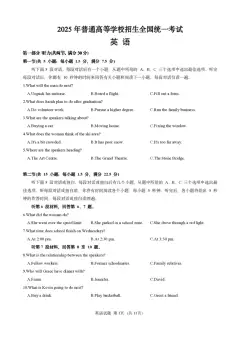
本试卷共150 分,共12 页。考试结束后,将本试题和答题卡一并交回。
注意事项:
1. 答题前,考生先将自己的姓名、准考证号码填写清楚,将条形码准确粘贴在条形码区域内。
2. 选择题必须使用2B 铅笔填涂;非选择题必须使用0. 5 毫米黑色字迹的签字笔书写,字体
工整,笔记清楚。
3. 请按照题号顺序在答题卡各题目的答题区域内作答,超出答题区域书写的答案无效;在
草稿纸、试卷上答题无效。
4. 作图可先使用铅笔画出,确定后必须用黑色字迹的签字笔描黑。
5. 保持卡面清洁,不要折叠、不要弄破、弄皱,不准使用涂改液、修正带、刮纸刀。
第一部分  听力(共两节,满分30 分)
做题时,先将答案标在试卷上。录音内容结束后,你将有两分钟的时间将试卷上的答案转涂
到答题卡上。
第一节(共5 小题;每小题1. 5 分,满分7. 5 分)
听下面5 段对话。每段对话后有一个小题,从题中所给的 A、B、C 三个选项中选出最佳选项。
听完每段对话后,你都有10 秒钟的时间来回答有关小题和阅读下一小题。每段对话仅读一
遍。
例: How much is the shirt?
A. £19. 15.         B. £9. 18.         C. £9. 15.
答案是C.
1. How will the woman probably get to Baxley?
A. On foot.         B. By taxi.         C. By bus.
2. What is the man going to do?
A. Have some dessert.     B. Pay the bill.         C. Cancel the trip.
3. What are the speakers talking about?
A. Buying a computer.     B. Doing research.         C. Saving money.
4. What is the man’s major?
A. Psychology.         B. Biology.         C. English.
5. What does Linda suggest?
A. Buying a sports watch.     B. Borrowing Mary’s watch.     C. Getting the
watch repaired.
第二节(共15 小题;每小题1. 5 分,满分22. 5 分)
听下面5 段对话或独白。每段对话或独白后有几个小题,从题中所给的 A、B、C 三个选项中选
出最佳选项。听每段对话或独白前,你将有时间阅读各个小题,每小题5 秒钟;听完后,各小
题将给出5 秒钟的作答时间。每段对话或独白读两遍。
听第6 段材料,回答第6、7 题。
6. Why does Peter make the call?
A. To arrange a visit.     B. To extend an invitation.     C. To confirm an
appointment.
7. Where will the speakers meet on Tuesday evening?
A. At the theatre.         B. At a snack bar.         C. At Delia’s office.
听第7 段材料,回答第8、9 题。
8. What does Sam say about his daughter?
A. She dislikes doing homework.     B. She overuses her smartphone.     C. She
feels lonely at school.
9. What is Sam’s attitude towards the school policies?
A. Supportive.         B. Uncertain.         C. Disapproving.
听第8 段材料,回答第10 至12 题。
10. What is the probable relationship between the speakers?
A. Tourist and guide.     B. Husband and wife.     C. Trainer and trainee.
11. Who came up with the idea of going rock climbing?
A. Billy.         B. Karen.         C. Max.
12. What is Jessie’s plan for tomorrow?
A. Going horseback riding.     B. Playing table tennis.     C. Rowing on the
lake.
听第9 段材料,回答第13 至16 题。
13. What did Frank do before coming to Susanna?
A. He went to a tech fair.     B. He signed a contract.     C. He had a job
interview.
14. What does Frank hope to get?
A. A promotion.         B. A vacation.         C. A bonus.
15. When will Frank know the result from his company?
A. Wednesday.         B. Thursday.         C. Friday.
16. Who is Susanna?
A. Frank’s client.         B. Frank’s lawyer.         C. Frank’s boss.
听第10 段材料,回答第17 至20 题。
17 Who is the Mini Camp intended for?
A. Four-year-olds.         B. Five-year-olds.         C. Six-year-olds.
18. Which activity does the Older Summer Camp organize?
A. Museum visits.         B. Bowling games.     C. Family gatherings.
19. What is a requirement for joining the field trips?
A. Camping experience.     B. Parental permission.     C. Swimming skills.
20. What will the speaker do next?
A. Collect fees.         B. Answer questions.     C. Show a short video.
第二部分  阅读(共两节,满分50 分)
第一节(共15 小题;每小题2. 5 分,满分37. 5 分)
阅读下列短文,从每题所给的A、B、C、D 四个选项中选出最佳选项。
A
English Market Towns to Visit in the UK
English market towns come in many shapes and sizes. Each has a personality
shaped by the goods and services produced and traded for centuries. But each
town has more to do than shop.
Hereford, Herefordshire
Hereford has remained a lively market town since 1189. Skirting the town
square, you’ll find lovely shops, eateries, and the Black and White House
Museum. The Hereford Cathedral is the most impressive building in town. It’s
also home to an ancient library. One of the four original copies of the Magna
Carta is displayed there.
Ludlow, Shropshire
Ludlow is known as the Foodie Center of England. Butcher shops,
greengrocers, bakeries, and cheese shops line the town square. Bordering the
square, the Ludlow Castle is a “must explore” medieval stronghold. The three-
day Ludlow Food Festival is held each September.
Shrewsbury, Shropshire
Getting to Shrewsbury Town Center from London is challenging but worth the
anxiety. The River Severn has a significant turn through town, almost making an
island of Shrewsbury Town Center. The shape creates a perfect market where
goods could be shipped and received using the river as a highway. Flowers are
everywhere-hanging baskets, window boxes, and planters-just what you imagine in
an attractive English market town.
Mevagissey, Cornwall
Even if you haven’t been to the small fishing village Mevagissey, you’ve
probably seen it in a movie or British TV show. The working harbor(港口) took
shape in 1774. Fishermen go out to sea daily and sell their fish in harbor-side
markets. Don’t leave the harbor without a traditional Comish pie. It’s
delicious.
1. Where can you find an original copy of the Magna Carta?
A. In the Ludlow Castle.
B. In the Foodie Center of
England.
C. In the Hereford Cathedral.
D. In the Black and White House
Museum.
2. What is a feature of Shrewsbury Town Center?
A. It’s situated near a big island.
B. It’s almost surrounded by
water.
C. It’s known for its flower festival.
D. It’s easily accessible from
London.
3. What does the author suggest visitors do in Mevagissey?
A. Try the Cornish pie.
B. Watch a British TV show.
C. Go fishing in the sea.
D. Take pictures of the harbor.
B
Kathy Ho teaches high school inside Lucile Packard Children’s Hospital
Stanford(LPCH). “Sometimes I don’t like saying that I’m a teacher, ” says
Ho. “People get in their minds an idea of what teachers do, but that’s not
really what it is here.”
“Here” is room 386, where each year, about 500 LPCH patients also become
students. The hospital school is free of parents, doctors, and medical
procedures. It’s a place of learning. About half of Ho’s students stay for a
week or less; others are there for more than a year. Most of Ho’s students
will recover, which means that preparing them to return to school is an
increasingly important component of care.
Still, in room 386, academics don’t come first. Physical health and mental
health are the priority. “If you’re scared about something and thinking only
about that, there’s no way you’re going to be able to learn, ” Ho says.
“I’m a coach, an adviser, and a comforter, and that’s what it means to be a
hospital teacher. ”
There are up to 30 students at any given time in Ho’s class. She generally
works with their regular teachers to get lessons and tests being used at their
home schools. Some teachers don’t give the kids any assignments; they express
sympathy instead. “I feel like it is a disservice to the kids, ” Ho says.
“They think their teachers don’t care about their schoolwork. ”
Ho recognizes the psychological benefit of helping kids keep up with their
peers(同龄人)outside the hospital. “I actually think the medicine is only a
small piece for some problems,” says Julie Good, director of pain management
services at LPCH. “It’s about problem-solving around what it means to have a
full life. Those kids have dreams. School can keep those dreams alive by giving
kids a way to learn and grow. ”
4. Who does Ho teach at LPCH?
A. Sick children.
B. Young nurses.
C. Medical students.
D. Patients’ parents.
5. What is a characteristic of Ho’s job?
A. Prioritizing academics.
B. Encouraging innovation.
C. Treating various diseases.
D. Playing multiple roles.
6. What does the underlined word “it” refer to in paragraph 4?
A. Offering regular lessons.
B. Paying extra attention.
C. Assigning no schoolwork.
D. Showing no sympathy.
7. How does the hospital school benefit the students according to Good?
A. It eases peer pressure.
B. It helps them live in hope.
C. It frees them from aches.
D. It entertains them with
stories.
C
When Sonja Detrinidad opened her online shop selling houseplants, she
didn’t have high hopes for it. But the opposite happened: She was flooded,
shipping out 1, 200 orders in June of2020 alone. In the past year, Detrinidad
sent out more than 70, 000 plants. Her success is just one example of increased
time at home leading to an explosion in the houseplant industry.
“Plants are in fashion right now, ” says Dr. Melinda Knuth, a researcher
from the University of Florida. “People who live in plant-rich environments
report a higher life satisfaction rating, ” she says. “Adding more nature to
our environment can change our mood and how we think.” Plants can improve our
state of mind in a few ways but the biggest is by decreasing our level of
cortisol, the stress hormone(激素) in our body.
“Students who are around plants perform better academically than students
who are in a classroom without plants, ” says Knuth. “This productivity also
translates into the workplace for adults. Our study showed that there was a 30%
decrease in sick leave for people who were in plant-rich workplaces. ”
If you’re among the groups of people who are enjoying the mental and
physical health benefits of surrounding yourself with plants, don’t beat
yourself up if one (or a few!) doesn’t make it. “Doctors practice medicine
and lawyers practice law and you should allow yourself the practice it takes to
sustain a plant. Tending to plants is an exercise in patience and learning. Be
invested in taking care of it, but if it dies, go get another one, ”
Detrinidad says.
8. How was Detrinidad’s business when it started?
A. It faced tough competition.
B. It suffered a great loss.
C. It got lots of financial support.
D. It went surprisingly well.
9. What is one of Knuth’s findings about plants?
A. They appeal more to students.
B. They purify the environment.
C. They raise the cortisol level.
D. They enhance productivity.
10. What does Detrinidad try to explain by mentioning doctors and lawyers?
A. The necessity of social skills.
B. The meaning of
sustainability.
C. The importance of repeated efforts.
D. The value of professional
opinions.
11. What can be a suitable title for the text?
A. Time to Replace Houseplants
B. Plants Boost Your Mood
C. Tips on Choosing Houseplants
D. Plants Brighten Your Home
D
Does your soul die a little every time you throw away unused food? Mine
does. Maybe that feeling comes from growing up in South Africa, where the
phrase “there are children starving in Africa” was more of an uncomfortable
reminder of fact than a prayer at dinner time.
Food waste is a growing concern in the restaurant, supermarket, and supply
chain industries. From technological solutions to educational campaigns, food
producers and sellers are looking for ways to use more of what we’re already
growing. But last month, one popular New York City restaurant tried a different
way: It changed its menu to exclusively (专门) offer food that would otherwise
be thrown away.
For two weeks in March, Greenwich Village’ s Blue Hill restaurant was
renamed wastED, and served items like fried skate cartilage, a juice pulp
burger, and a dumpster diver’s vegetable salad. Each dish was tailor-made to
raise awareness regarding food waste.
A study by the Food Waste Alliance determined that the average restaurant
generates 33pounds of food waste for every S1, 000 in revenue (收入), and of
that waste only 15.7% is donated or recycled. Up to 84. 3% is simply thrown
out. Restaurants like Silo in the UK have experimented with zero-waste systems,
but wastED took the concept to its logical conclusion.
It should be noted that none of the items on wastED’s menu was technically
made from garbage. Instead, all the ingredients (配料) used were examples of
meat cuts and produce that most restaurants would never consider serving.
Things like kale ribs, fish collars, rejected sweet potatoes, and cucumber
butts were all re-appropriated and, with the help of a number of good chefs,
turned into excellent cuisine.
Though wastED received enthusiastic reviews, it was designed from the start
as a short-lived experiment; Blue Hill has since returned to its regular menu.
Nevertheless, it serves as a reminder that there are many ways to address
problems of sustainability, and that you can make an amazing meal out of almost
anything.
12. What can be inferred about the author’s early life?
A. He witnessed food shortage.
B. He enjoyed the local cuisine.
C. He donated food to Africans.
D. He helped to cook at home.
13. Why did Blue Hill carry out the experiment?
A. To customize dishes for guests.
B. To make the public aware of
food waste.
C. To test a food processing method.
D. To improve the UK’s zero-
waste systems.
14. What is paragraph 5 mainly about?
A. Why the ingredients were used.
B. Which dishes were best liked.
C. What the dishes were made of.
D. Where the ingredients were
bought.
15. What can we learn about wastED?
A. It has ended as planned.
B. It is creating new jobs.
C. It has regained popularity.
D. It is criticized by top
chefs.
第二节(共5 小题;每小题2. 5 分,满分12. 5 分)
阅读下面短文,从短文后的选项中选出可以填入空白处的最佳选项。选项中有两项为多余选
项。
Unexpected Benefits of Volunteering as a Family
Are you looking for a way to bring your family together? Hoping to find a
hobby that can be shared by both the little ones and adults? ___16___ You may
know the “feel-good” emotions that come with helping others, but there are
even more unexpected ways volunteering will positively affect the whole family.
●You’ll feel like you have more time.
People often feel they are too busy to volunteer. Yet, research has found
that giving your time to community causes actually makes you feel like you have
more of it. ___17___
●You can live longer if you volunteer regularly.
___18___ Washington University found that adults 55 and older who
volunteered had better memory and maintained overall health longer than others
their age. Volunteers are also more likely to look after their own health and
are more focused on adding physical activity into their lives.
● ___19___
Volunteering during teenage years has been linked to some major positive
effects such as improved grades and increased self-confidence. These effects
aren’t just short-term but have been proved to affect a teen’s well-being in
the years to come.
●You’ll have more time with family.
Families who volunteer together have the unique experience of working
toward a common goal. ___20___ Everyone brings something unique to the table
and can connect with each other in a new way. And, there are tasks for every
age and ability, so all your children can feel proud of their work.
A. Helping the community lowers rates of depression.
B. Volunteering as a family may be just the thing you need.
C. Volunteering has a lifelong effect on kids and teenagers.
D Volunteering can be the first step in breaking down prejudice.
E. For adults, volunteering can provide significant physical health benefits.
F. You may even learn that your kid has a talent you didn’t know about before.
G. Volunteering makes you feel capable and inspires you to make the most of
each day.
第三部分  语言运用(共两节,满分30 分)
第一节(共15 小题;每小题1 分,满分15 分)
阅读下面短文,从每题所给的A、B、C、D 四个选项中选出最佳选项。
Evelyn Donohue is a 65-year-old grandma. She only started to ___21___ seven
years ago after having a ___22___ call. She’d been struggling with eating
disorders and health issues, which ___23___ led her to getting surgery. After
that experience, she knew that she needed to make a ___24___. Determined to
turn her life around, Ms Donohue began to work out and follow a ___25___
lifestyle, before discovering a ___26___ for weightlifting.
Since setting out on the journey, the ___27___ lover has not only managed
to ___28___ an impressive set of muscles — but also a huge following on social
media.
The well-liked grandma regularly posts workout content, explaining there’s
no ___29___ others can’t look this good. She said it was all down to some key
aspects.
“Hold on: Consider failure as a ___30___ to success and never give up.
Stick to your plan,” she said. “___31___ others: Lift others up on your
journey. Success is sweeter when ___32___.” She previously explained that
“you do not need to have an amazing body to exercise... the ___33___ is to
feel good, not look good.”
Ms Donohue used to be laughed at for being too old to work out, but she has
proved the ___34___ wrong in the best possible way and has indeed become an
___35___ or many social media users.
21. A. write
B. travel
C. exercise
D.
recover
22. A. goodwill
B. timeout
C. long-distance
D. wake-
up
23. A. normally
B. ultimately
C. suddenly
D.
automatically
24. A. change
B. fortune
C. wish
D. deal
25. A. risky
B. traditional
C. comfortable
D.
healthy
26. A. demand
B. secret
C. passion
D. cure
27. A. peace
B. fitness
C. fun
D. nature
28. A. grow
B. control
C. activate
D. relax
29. A. need
B. choice
C. reason
D.
difference
30. A. green light
B. road block
C. passing mark
D.
stepping stone
31. A. Help
B. Consult
C. Follow
D.
Forgive
32. A. accepted
B. shared
C. expected
D.
celebrated
33. A. goal
B. case
C. duty
D. cost
34. A. instructors
B. admirers
C. beginners
D.
doubters
35. A. authority
B. excuse
C. inspiration
D. option
第二节(共10 小题;每小题15 分,满分15 分)
阅读下面短文,在空白处填入1 个适当的单词或括号内单词的正确形式。
I was born and raised in Cleveland, Ohio in the United States. Yet now, I
live in the countryside of Zhejiang, China with my Chinese husband and his
family, ____36____ bamboo and tea bushes (灌木) grow wild in the mountains,
chickens are always free-range, and ____37____ (center) heating doesn’t exist.
Nothing in my life before prepared me ____38____ this one-and to be sure,
the first time I came here I never imagined I would ever feel comfortable in
this area. But it’s amazing how you can adapt ____39____ learn in a new
environment. Over time, I’ve found ____40____ (I) feeling extremely at home
here. And in the process, I’ve experienced things that really surprise me at
times. The “sunshine scent (香味)” of freshly sunned clothes ____41____ (be)
one of them.
Growing up, my family and our neighbors never used clotheslines to dry
clothing. denying me the chance ____42____ (discover) one of the great wonders
of sunshine — the sweet “sunshine scent” after sunning clothes for an entire
day. The sun-dried clothes smell especially pleasant where I live, thanks to
the ____43____ (absent) of smog and plenty of blue sky ____44____ (afternoon)
with lots of fresh air.
If you’ve never experienced the “sunshine scent” from a sheet or shirt
____45____ (leave) to sun for a day, well, you’re missing out on one of
life’s wonders.
第四部分  写作(共两节,满分40 分)
第一节(满分15 分)
46. 假定你是校英文报编辑李华,外教Chris 上个月答应写一篇介绍加拿大体育运动的文章。
请给 Chris 写一封邮件,内容包括:
(1)询问进展;
(2)提醒交稿时间。
注意:
(1)写作词数应为80 个左右;
(2)请按如下格式在答题卡的相应位置作答。
Dear Chris
_______________________________________________________________________________
_______________________________________________________________________________
_______________________________________________________________________________
_______________________________________________________________________________
_______________________________________________________________________________
_______________________________________________________________________________
_
Best wishes,
Li Hua
第二节(满分25 分)
47. 阅读下面材料,根据其内容和所给段落开头语续写两段,使之构成一篇完整的短文。
“What is your name? ” is a question most frequently asked when people
meet for the first time. But for me, it was the first challenge I encountered
as an international student in Ireland.
The pronunciation system of the Chinese language is quite different from
that of English. For native speakers of English, some Chinese words are rather
difficult to pronounce. My given name Qiuyu (秋雨), for instance, happened to
be a great challenge for many of them. Every time I gave a self-introduction, I
had to explain how to pronounce my name at least five times, yet they still
could not say it the way I did.
Once in a lecture, the professor tried repeating my name after me over and
over in front of thirty classmates. I really did not know whether I should
continue correcting him or simply drop the matter. I feared that my classmates
might grow tired of my efforts or even lose patience with me. After all, I did
care about how others would think of me. I realized that if I didn’t stop, the
entire lecture would be ruined. “It’s okay, professor,” I shrugged (耸肩).
The awkward moment ended with the class erupting into laughter. I forced a
smile, unsure how to respond further.
After that incident, I stopped acting as a “Chinese teacher.” Instead of
correcting others when they were struggling to pronounce my name, I just smiled
and nodded approvingly. This approach spared me the discomfort of having to
over-explain. However, I soon found that by doing so, I might be losing
something more important: the opportunity to share a small part of my cultural
identity.
注意:
(1)续写词数应为150 个左右;
(2)请按如下格式在答题卡的相应位置作答。
In a class discussion, I was invited to explain the meaning of my name.
_______________________________________________________________________________
_______________________________________________________________________________
_______________________________________________________________________________
_______________________________________________________________________________
_______________________________________________________________________________
_______________________________________________________________________________
_
Many of my classmates got interested and came up to me after class.
_______________________________________________________________________________
_______________________________________________________________________________
_______________________________________________________________________________
_______________________________________________________________________________
_______________________________________________________________________________
_______________________________________________________________________________
_
参考答案
本试卷共150 分,共12 页。考试结束后,将本试题和答题卡一并交回。
注意事项:
1. 答题前,考生先将自己的姓名、准考证号码填写清楚,将条形码准确粘贴在条形码区域内。
2. 选择题必须使用2B 铅笔填涂;非选择题必须使用0. 5 毫米黑色字迹的签字笔书写,字体
工整,笔记清楚。
3. 请按照题号顺序在答题卡各题目的答题区域内作答,超出答题区域书写的答案无效;在
草稿纸、试卷上答题无效。
4. 作图可先使用铅笔画出,确定后必须用黑色字迹的签字笔描黑。
5. 保持卡面清洁,不要折叠、不要弄破、弄皱,不准使用涂改液、修正带、刮纸刀。
第一部分  听力(共两节,满分30 分)
做题时,先将答案标在试卷上。录音内容结束后,你将有两分钟的时间将试卷上的答案转涂
到答题卡上。
第一节(共5 小题;每小题1. 5 分,满分7. 5 分)
听下面5 段对话。每段对话后有一个小题,从题中所给的 A、B、C 三个选项中选出最佳选项。
听完每段对话后,你都有10 秒钟的时间来回答有关小题和阅读下一小题。每段对话仅读一
遍。
例: How much is the shirt?
A £19. 15.         B. £9. 18.         C. £9. 15.
答案是C.
1. How will the woman probably get to Baxley?
A. On foot.         B. By taxi.         C. By bus.
2. What is the man going to do?
A. Have some dessert.     B. Pay the bill.         C. Cancel the trip.
3. What are the speakers talking about?
A. Buying a computer.     B. Doing research.         C. Saving money.
4. What is the man’s major?
A. Psychology.         B. Biology.         C. English.
5. What does Linda suggest?
A. Buying a sports watch.     B. Borrowing Mary’s watch.     C. Getting the
watch repaired.
第二节(共15 小题;每小题1. 5 分,满分22. 5 分)
听下面5 段对话或独白。每段对话或独白后有几个小题,从题中所给的 A、B、C 三个选项中选
出最佳选项。听每段对话或独白前,你将有时间阅读各个小题,每小题5 秒钟;听完后,各小
题将给出5 秒钟的作答时间。每段对话或独白读两遍。
听第6 段材料,回答第6、7 题。
6. Why does Peter make the call?
A. To arrange a visit.     B. To extend an invitation.     C. To confirm an
appointment.
7. Where will the speakers meet on Tuesday evening?
A. At the theatre.         B. At a snack bar.         C. At Delia’s office.
听第7 段材料,回答第8、9 题。
8. What does Sam say about his daughter?
A. She dislikes doing homework.     B. She overuses her smartphone.     C. She
feels lonely at school.
9. What is Sam’s attitude towards the school policies?
A. Supportive.         B. Uncertain.         C. Disapproving.
听第8 段材料,回答第10 至12 题。
10. What is the probable relationship between the speakers?
A. Tourist and guide.     B. Husband and wife.     C. Trainer and trainee.
11. Who came up with the idea of going rock climbing?
A. Billy.         B. Karen.         C. Max.
12. What is Jessie’s plan for tomorrow?
A. Going horseback riding.     B. Playing table tennis.     C. Rowing on the
lake.
听第9 段材料,回答第13 至16 题。
13 What did Frank do before coming to Susanna?
A. He went to a tech fair.     B. He signed a contract.     C. He had a job
interview.
14. What does Frank hope to get?
A. A promotion.         B. A vacation.         C. A bonus.
15. When will Frank know the result from his company?
A. Wednesday.         B. Thursday.         C. Friday.
16. Who is Susanna?
A. Frank’s client.         B. Frank’s lawyer.         C. Frank’s boss.
听第10 段材料,回答第17 至20 题。
17. Who is the Mini Camp intended for?
A. Four-year-olds.         B. Five-year-olds.         C. Six-year-olds.
18. Which activity does the Older Summer Camp organize?
A. Museum visits.         B. Bowling games.     C. Family gatherings.
19. What is a requirement for joining the field trips?
A. Camping experience.     B. Parental permission.     C. Swimming skills.
20. What will the speaker do next?
A. Collect fees.         B. Answer questions.     C. Show a short video.
第二部分  阅读(共两节,满分50 分)
第一节(共15 小题;每小题2. 5 分,满分37. 5 分)
阅读下列短文,从每题所给的A、B、C、D 四个选项中选出最佳选项。
A
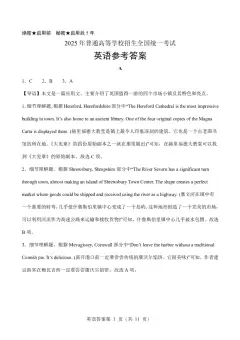
【1~3 题答案】
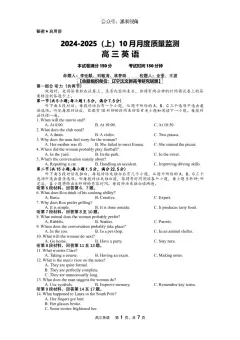
【答案】1. C    2. B    3. A
B
【4~7 题答案】
【答案】4. A    5. D    6. C    7. B
C
【8~11 题答案】
【答案】8. D    9. D    10. C    11. B
D
【12~15 题答案】
【答案】12. A    13. B    14. C    15. A
第二节(共5 小题;每小题2. 5 分,满分12. 5 分)
阅读下面短文,从短文后的选项中选出可以填入空白处的最佳选项。选项中有两项为多余选
项。
【16~20 题答案】
【答案】16. B    17. G    18. E    19. C    20. F
第三部分  语言运用(共两节,满分30 分)
第一节(共15 小题;每小题1 分,满分15 分)
阅读下面短文,从每题所给的A、B、C、D 四个选项中选出最佳选项。
【21~35 题答案】
【答案】21. C    22. D    23. B    24. A    25. D    26. C    27. B    28. A
29. C    30. D    31. A    32. B    33. A    34. D    35. C
第二节(共10 小题;每小题15 分,满分15 分)
【36~45 题答案】
【答案】36. where
37. central
38. for    39. and
40. myself    41. is
42. to discover
43. absence
44. afternoons
45. left
第四部分  写作(共两节,满分40 分)
第一节(满分15 分)
【46 题答案】
【答案】One possible version:
Dear Chris,
Hope this email finds you well! Last month, you kindly agreed to write an
article about sports in Canada, and we’re all looking forward to reading it.
I’m writing to politely inquire about the progress of the article. Would
you mind letting me know how it’s going? Also, could I remind you that the
deadline for submission is this Friday, June 14th? Your insights into Canadian
sports will surely enrich our readers’understanding of global sports culture,
which will be of benefit to us.
Thank you again for your support!
Best wishes,
Li Hua
第二节(满分25 分)
【47 题答案】
【答案】One possible version:
In a class discussion, I was invited to explain the meaning of my name.
Standing up, I felt a mix of nervousness and excitement. “ My name, Qiuyu,
combines the characters for autumn and rain in Chinese,” I began, my voice
steady. “ Autumn represents harvest and maturity, while rain symbolizes
nourishment and growth. Together, they embody a time of abundance and
renewal.” As I spoke, I noticed the rapt attention of my classmates, their
eyes reflecting curiosity and respect. It was a moment of connection, a bridge
built between cultures through the simple act of sharing my name.
Many of my classmates got interested and came up to me after class. They
surrounded me, their questions pouring out like a stream. “What other names
have beautiful meanings in Chinese?” “Can you teach us how to write our names
in Chinese characters?” I smiled, feeling a warmth spread through me. I took
out a piece of paper and began to sketch out characters, explaining each stroke
and its significance. Through this interaction, I realized that by embracing my
cultural identity, I was not only preserving my heritage but also enriching the
lives of those around me. It was a small yet meaningful step towards fostering
cultural understanding and appreciation.