2025 年福建莆田中考英语试题及答案
Ⅰ. 听力(共三节,20 小题;每小题1.5 分,满分30 分)
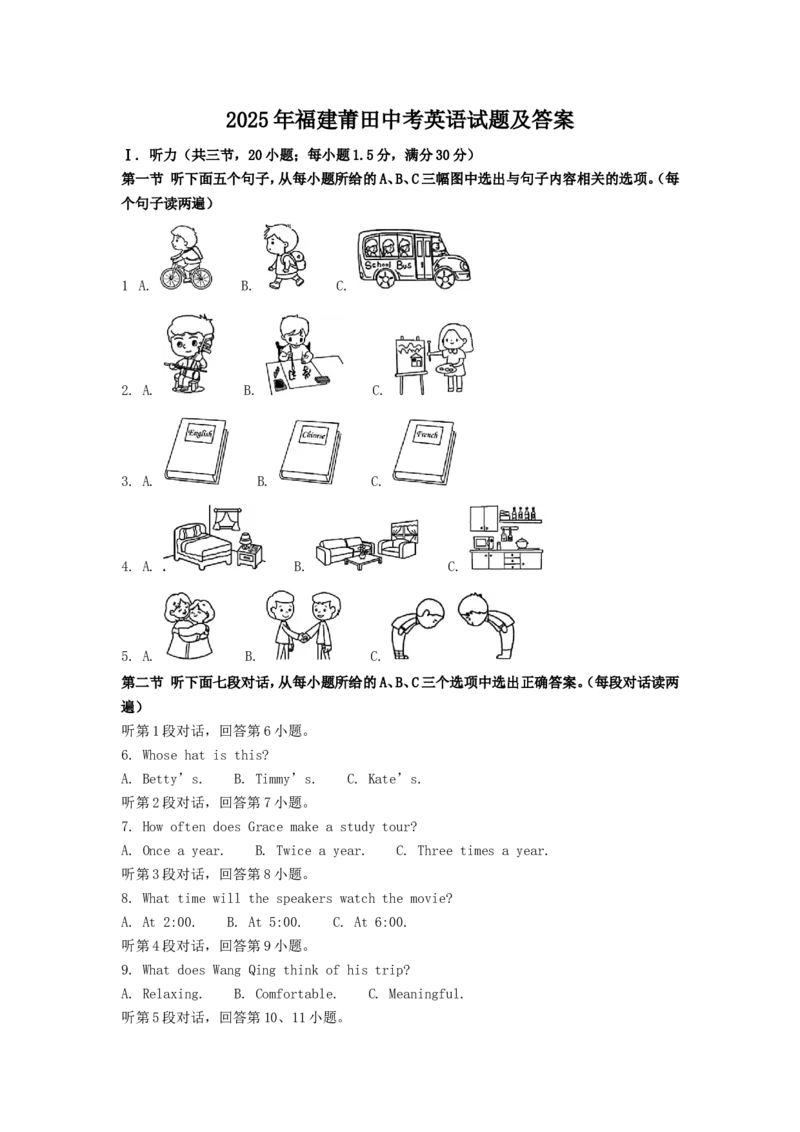
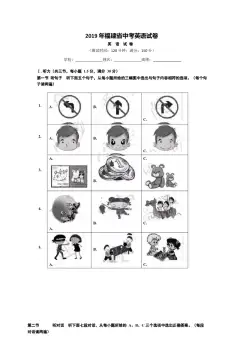
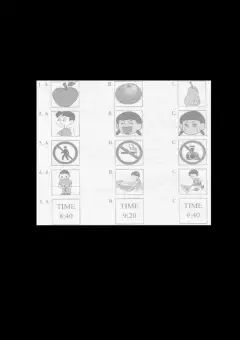
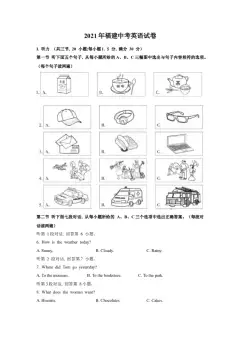
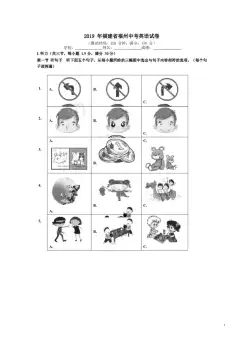
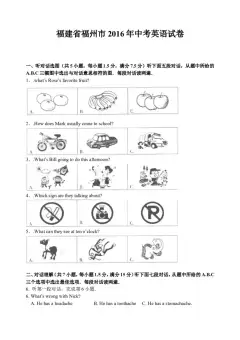
第一节 听下面五个句子,从每小题所给的A、B、C 三幅图中选出与句子内容相关的选项。(每
个句子读两遍)
1 A.
    B.
    C.
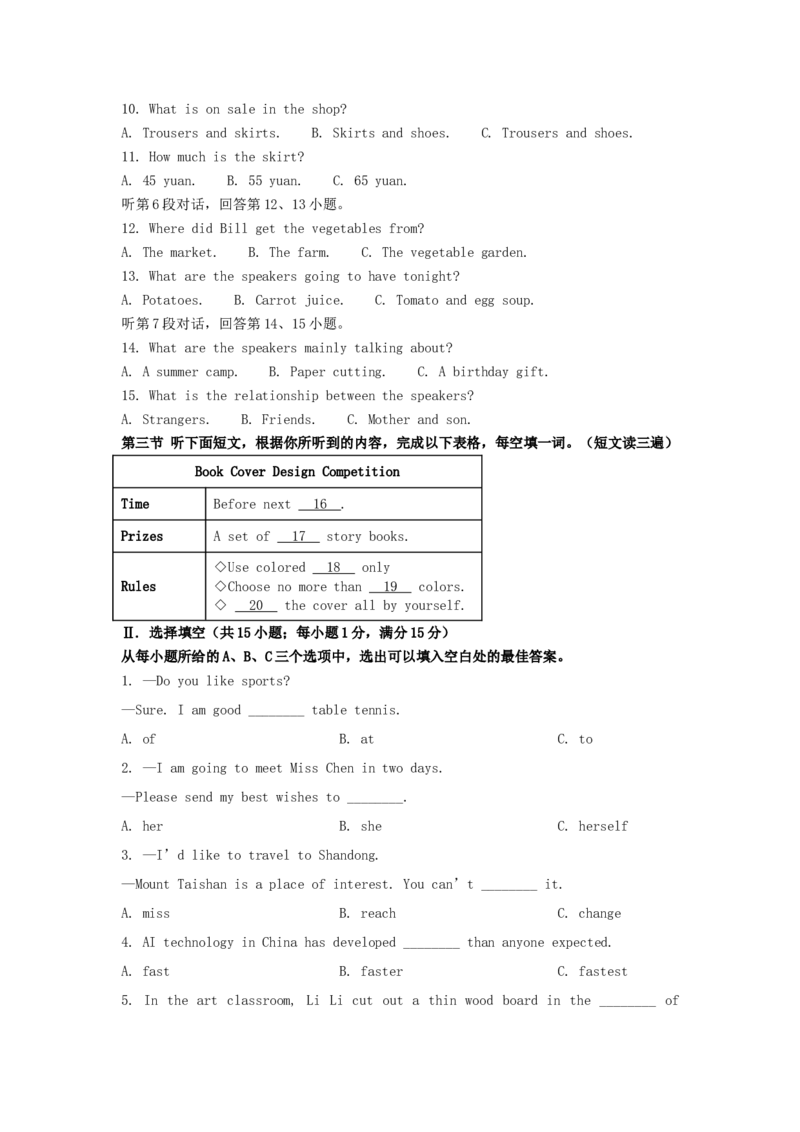
2. A.
    B.
    C.
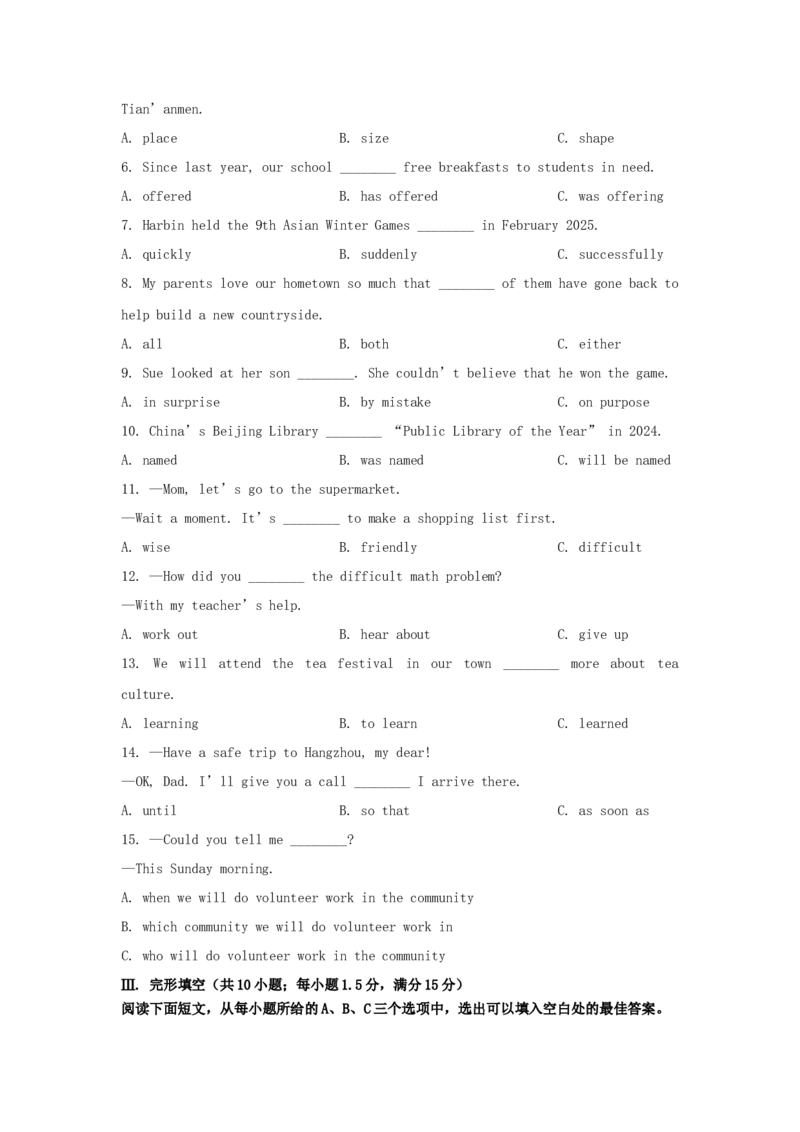
3. A.
    B.
    C.
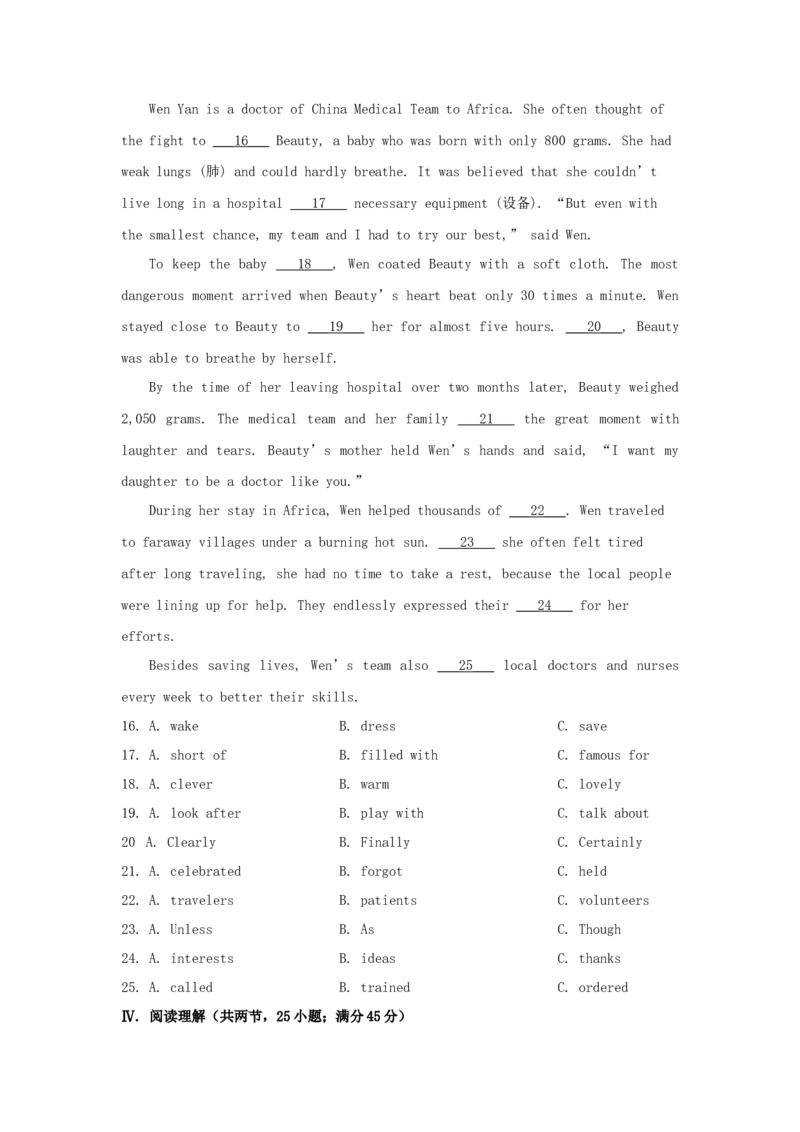
4. A.
    B.
    C.
5. A.
    B.
    C.
第二节 听下面七段对话,从每小题所给的A、B、C 三个选项中选出正确答案。(每段对话读两
遍)
听第1 段对话,回答第6 小题。
6. Whose hat is this?
A. Betty’s.    B. Timmy’s.    C. Kate’s.
听第2 段对话,回答第7 小题。
7. How often does Grace make a study tour?
A. Once a year.    B. Twice a year.    C. Three times a year.
听第3 段对话,回答第8 小题。
8. What time will the speakers watch the movie?
A. At 2:00.    B. At 5:00.    C. At 6:00.
听第4 段对话,回答第9 小题。
9. What does Wang Qing think of his trip?
A. Relaxing.    B. Comfortable.    C. Meaningful.
听第5 段对话,回答第10、11 小题。
10. What is on sale in the shop?
A. Trousers and skirts.    B. Skirts and shoes.    C. Trousers and shoes.
11. How much is the skirt?
A. 45 yuan.    B. 55 yuan.    C. 65 yuan.
听第6 段对话,回答第12、13 小题。
12. Where did Bill get the vegetables from?
A. The market.    B. The farm.    C. The vegetable garden.
13. What are the speakers going to have tonight?
A. Potatoes.    B. Carrot juice.    C. Tomato and egg soup.
听第7 段对话,回答第14、15 小题。
14. What are the speakers mainly talking about?
A. A summer camp.    B. Paper cutting.    C. A birthday gift.
15. What is the relationship between the speakers?
A. Strangers.    B. Friends.    C. Mother and son.
第三节 听下面短文,根据你所听到的内容,完成以下表格,每空填一词。(短文读三遍)
Book Cover Design Competition
Time
Before next   16  .
Prizes
A set of   17   story books.
Rules
◇Use colored   18   only
◇Choose no more than   19   colors.
◇   20   the cover all by yourself.
Ⅱ. 选择填空(共15 小题;每小题1 分,满分15 分)
从每小题所给的A、B、C 三个选项中,选出可以填入空白处的最佳答案。
1. —Do you like sports?
—Sure. I am good ________ table tennis.
A. of
B. at
C. to
2. —I am going to meet Miss Chen in two days.
—Please send my best wishes to ________.
A. her
B. she
C. herself
3. —I’d like to travel to Shandong.
—Mount Taishan is a place of interest. You can’t ________ it.
A. miss
B. reach
C. change
4. AI technology in China has developed ________ than anyone expected.
A. fast
B. faster
C. fastest
5. In the art classroom, Li Li cut out a thin wood board in the ________ of
Tian’anmen.
A. place
B. size
C. shape
6. Since last year, our school ________ free breakfasts to students in need.
A. offered
B. has offered
C. was offering
7. Harbin held the 9th Asian Winter Games ________ in February 2025.
A. quickly
B. suddenly
C. successfully
8. My parents love our hometown so much that ________ of them have gone back to
help build a new countryside.
A. all
B. both
C. either
9. Sue looked at her son ________. She couldn’t believe that he won the game.
A. in surprise
B. by mistake
C. on purpose
10. China’s Beijing Library ________ “Public Library of the Year” in 2024.
A. named
B. was named
C. will be named
11. —Mom, let’s go to the supermarket.
—Wait a moment. It’s ________ to make a shopping list first.
A. wise
B. friendly
C. difficult
12. —How did you ________ the difficult math problem?
—With my teacher’s help.
A. work out
B. hear about
C. give up
13. We will attend the tea festival in our town ________ more about tea
culture.
A. learning
B. to learn
C. learned
14. —Have a safe trip to Hangzhou, my dear!
—OK, Dad. I’ll give you a call ________ I arrive there.
A. until
B. so that
C. as soon as
15. —Could you tell me ________?
—This Sunday morning.
A. when we will do volunteer work in the community
B. which community we will do volunteer work in
C. who will do volunteer work in the community
Ⅲ. 完形填空(共10 小题;每小题1.5 分,满分15 分)
阅读下面短文,从每小题所给的A、B、C 三个选项中,选出可以填入空白处的最佳答案。
Wen Yan is a doctor of China Medical Team to Africa. She often thought of
the fight to ___16___ Beauty, a baby who was born with only 800 grams. She had
weak lungs (肺) and could hardly breathe. It was believed that she couldn’t
live long in a hospital ___17___ necessary equipment (设备). “But even with
the smallest chance, my team and I had to try our best,” said Wen.
To keep the baby ___18___, Wen coated Beauty with a soft cloth. The most
dangerous moment arrived when Beauty’s heart beat only 30 times a minute. Wen
stayed close to Beauty to ___19___ her for almost five hours. ___20___, Beauty
was able to breathe by herself.
By the time of her leaving hospital over two months later, Beauty weighed
2,050 grams. The medical team and her family ___21___ the great moment with
laughter and tears. Beauty’s mother held Wen’s hands and said, “I want my
daughter to be a doctor like you.”
During her stay in Africa, Wen helped thousands of ___22___. Wen traveled
to faraway villages under a burning hot sun. ___23___ she often felt tired
after long traveling, she had no time to take a rest, because the local people
were lining up for help. They endlessly expressed their ___24___ for her
efforts.
Besides saving lives, Wen’s team also ___25___ local doctors and nurses
every week to better their skills.
16. A. wake
B. dress
C. save
17. A. short of
B. filled with
C. famous for
18. A. clever
B. warm
C. lovely
19. A. look after
B. play with
C. talk about
20 A. Clearly
B. Finally
C. Certainly
21. A. celebrated
B. forgot
C. held
22. A. travelers
B. patients
C. volunteers
23. A. Unless
B. As
C. Though
24. A. interests
B. ideas
C. thanks
25. A. called
B. trained
C. ordered
Ⅳ. 阅读理解(共两节,25 小题;满分45 分)
第一节 阅读下列短文,根据短文内容,从题中所给的A、B、C、D 四个选项中,选出最佳答案。
(共20 小题;每小题2 分,满分40 分)
A
The earth is our home. There are some ways that you and your family can use
to help the planet and make a difference.
①Use

less
water.
Take shorter showers. A 10-minute shower or a full
bathtub (浴缸) can waste a lot of water. Also, turn off the
tap as you brush your teeth. Use less water in the garden
and let the rain clean cars.
②Avoid wasting
food.
Don’t take more than you can eat. About one-third of
food in some areas is thrown out or wasted.
③Care

and
repair.
Take good care of things you own and they will get
along life. If they break, try to repair them. If you
can’t repair them, call a repairman. Producing new good
swill add CO₂ to the air.
④Use reusable
bags.
Use plastic and paper bags more than once. When you go
shopping, use cloth bags instead of plastic bags.
⑤Use

fewer
paper cups.
Use reusable cups instead of throwaway paper cups if
necessary. If you use more paper cups, you will produce
more rubbish.
26. What can you do to save water?
A. Take shorter showers.
B. Bathe in a full bathtub.
C. Stop using the tap.
D. Clean cars every day.
27. What should you do when something breaks?
A. Throw it away.
B. Repair it if possible.
C. Produce new goods.
D. Take good care of it.
28. What does the writer suggest?
A. Using fewer paper cups.
B. Using more plastic bags.
C. Using throwaway paper cups.
D. Using paper bags just once.
29. Which of the following is about reusing things?
A. ①④
B. ①⑤
C. ②③
D. ④⑤
30. In which section of a newspaper can you probably read the text?
A. Culture.
B. Health.
C. Sports.
D.
Environment.
B
Mary’s uncle Ted was an engineer. He told her great stories about the
rockets he helped design, and he often brought Mary science books. He also
taught her some knowledge about space. Mary loved technology and science, and
she was also adventurous ( 爱冒险的). For those reasons, Mary’s family kept
telling her she should be an astronaut when she grew up, but she just wasn’t
sure.
One Saturday, Mary and Uncle Ted went to visit the Science Museum. They
watched a show on space travel. Uncle Ted told her something interesting about
spaceships and space suits. But she was most interested in two model robot arms
and tried operating ( 操作) them. She stayed there all day and felt very
excited.
By the time they got on the bus to return home, Mary was very tired.
Closing her eyes, she was thinking about what it would be like to fly into
space. As she nearly fell asleep, Mary started to feel the weightlessness that
astronauts must feel when they are in zero gravity (重力). The next thing she
knew, she was looking out the window not of a bus but of a spaceship. Mary was
operating a huge robot arm outside the spaceship. She felt nervous. But she
kept at it. Soon she succeeded. She felt proud of herself.
Just then, Mary heard Uncle Ted’s voice. “Wake up, my dear! We’re back
home now.” When she opened her eyes, she realized she had been dreaming, but
she knew this for sure—she wanted to be an astronaut one day and couldn’t
wait for her first trip into space.
31. What did Uncle Ted do?
A. He was a writer.
B. He was an engineer.
C. He was an astronaut.
D. He was a teacher.
32. What interested Mary most in the museum?
A. Two model robot arms.
B. Amazing space suits.
C. A long show on space.
D. An interesting spaceship.
33. How did Mary feel in the museum that Saturday?
A. Excited.
B. Tired.
C. Nervous.
D. Proud.
34. What happened to Mary on her way home?
A. She was sent into space.
B. She operated a robot arm.
C. She had a wonderful dream.
D. She experienced zero gravity.
35. At last Mary decided to be an astronaut because of ________.
A. her science books
B. her parents’ wish
C. her uncle’s encouragement
D. her trip to the museum
C
As we often use eyes to touch nature, most of us “lose” the ability to
listen to the world.
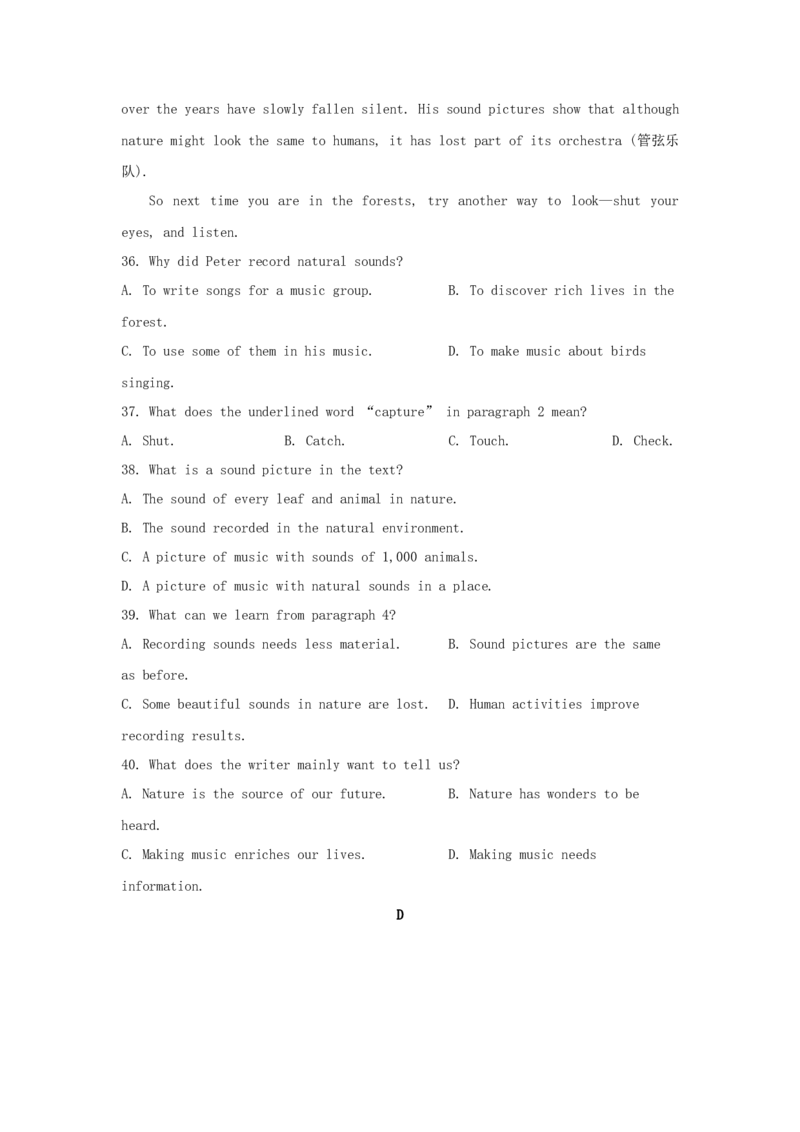
Peter writes music. He likes sounds and uses natural sounds as part of his
music. He often went out to the wild with his microphone and recorded
interesting sounds to put in movies or to use in his own songs. Instead of
trying to capture just the sound of one animal or bird, he recorded the sound
of everything all together—the animals, the trees, the wind and the earth. He
called these recordings “soundscapes”—the sound of a certain place. Every
soundscape Peter recorded had a lot of information.
Back in his workshop, Peter used a computer to make a picture of all the
sounds going on in a place. Each animal, bird and insect had its own place on
the picture—its own notes in the music. The busier the picture, the richer the
life in that place. “While a picture may be worth 1,000 words, a soundscape is
worth 1,000 pictures,” Peter said. “Our ears tell us the sound of every leaf
and animal and speak to the natural sources (来源) of our lives, which may hold
the secrets of love for all things, especially our own humanity.”
But not everything is satisfying. When Peter began recording over forty
years ago, he could record for ten hours and get one hour of usable material
good enough for a movie. Now, because of human activities, it can take up to
1,000 hours or more to get the same thing. Some of the places he has recorded
over the years have slowly fallen silent. His sound pictures show that although
nature might look the same to humans, it has lost part of its orchestra (管弦乐
队).
So next time you are in the forests, try another way to look—shut your
eyes, and listen.
36. Why did Peter record natural sounds?
A. To write songs for a music group.
B. To discover rich lives in the
forest.
C. To use some of them in his music.
D. To make music about birds
singing.
37. What does the underlined word “capture” in paragraph 2 mean?
A. Shut.
B. Catch.
C. Touch.
D. Check.
38. What is a sound picture in the text?
A. The sound of every leaf and animal in nature.
B. The sound recorded in the natural environment.
C. A picture of music with sounds of 1,000 animals.
D. A picture of music with natural sounds in a place.
39. What can we learn from paragraph 4?
A. Recording sounds needs less material.
B. Sound pictures are the same
as before.
C. Some beautiful sounds in nature are lost.
D. Human activities improve
recording results.
40. What does the writer mainly want to tell us?
A. Nature is the source of our future.
B. Nature has wonders to be
heard.
C. Making music enriches our lives.
D. Making music needs
information.
D
Deep under the Pacific Ocean lie coral reefs colored by some algae that
live with corals. Corals usually provide nitrogen (氮) to algae, and in return
they get carbon (碳), which gives them energy.
In the early 1980s, a huge heat wave turned more than 90 percent of these
corals a pale, lifeless white. And it was believed that about 50 percent of
reefs with beautiful corals might disappear by 2030. Heat waves warmed up the
same Pacific waters in the late 1990s and again in 2015—2016, but scientists
noticed that these heat waves didn’t influence the reefs as badly as the
first. Maybe corals have found a way to adapt (适应).
Swimming to cooler waters is not a good choice for corals, for it makes
them easily hurt by the changing climate. But corals are able to adapt. Some
turn to those algae that can deal well with heat. Others can use rows of tiny
hairs on their bodies to “fan” away too much harmful oxygen  (O2) let out by
stressed-out algae. Certain baby corals change their own metabolisms (新陈代谢)
in order to fight the warming waters. But all these adaptations can protect
themselves only to some degree.
After studying and understanding these adaptations, scientists are trying
to find ways to help corals fight. If researchers can make corals accept algae
that can deal with heat pressure or if they energize genes (基因) that can deal
with heat pressure, it will raise the corals’ chance of living through future
ocean heat waves.
“When I go down to the sea and see a beautiful healthy reef with these
colorful corals, I feel this pleasure of being in this underwater world,” a
famous biologist says. “It will be really sad to see it dead. But that does
drive you to want to use your skills and your love to help fight.”
41. What can we know from paragraph 1?
A. Corals make algae more colorful.
B. Algae provide room for corals
to live in.
C. Corals and algae depend on each other.
D. Algae produce nitrogen to
influence corals.
42. What does the underlined part “the first” in paragraph 2 refer to?
A. The heat wave in the early 1980s.
B. The heat wave in the late
1990s.
C. The Pacific waters in 2015—2016.
D. The reefs’ disappearance by
2030.
43. What difficulty do corals face?
A. They cannot completely adapt to heat waves.
B. They cannot change their own metabolisms.
C. They have no ability to swim to cooler waters.
D. They have no ability to drive away harmful oxygen.
44. What can we infer from the last paragraph?
A. It’s necessary to live with corals.
B. The ocean has become
unhealthy.
C. We should try our best to save corals.
D. Making a study of the ocean
is a must.
45. Which would be the best title for the text?
A. Corals Die Out
B. Corals Fight Back
C. Corals Break Down
D. Corals Come into Being
第二节(共5 小题;每小题1 分,满分5 分)
E
阅读下面短文,从短文后所给的五个选项中选出能填入短文空白处的最佳选项,使短文通顺、
连贯,意思完整。
Hobbies lead to better health, more sleep, lower pressure and greater life
satisfaction. Get joy from your hobby, and you’ll be a better person. ___46___
Here are some suggestions from experts.
● ___47___
Hobbies can help you calm down. An expert suggests asking yourself how you
want an activity to make you feel. Relaxed or socially connected?
It’s also helpful to consider what your life is missing, like creativity
or art skills.
● Start small.
___48___ Wait for a while to find out if it’s right for you. You can
always do more later.
It’s also smart not to do something more than you can. If you don’t want
to do that, just stop. ___49___
●Take a trip back in time.
Recall activities you loved when you were young, like singing or collecting
things. It’s a really helpful place to start, and it allows you to feel
comfortable.
Also, consider going back to school. ___50___ Or sign up for a lesson at a
local community center and learn more about a potential (潜在的) hobby.
Always keep in mind that if a hobby makes you healthier and happier,
everyone around you will benefit.
A. But where do we start?
B. Check out classes at university.
C. Ask yourself: How do I want to feel?
D. You get fun from hobbies, not pressure.
E. Don’t spend a lot of time on a new hobby at once.
Ⅴ. 情景交际(共5 小题;每小题2 分,满分10 分)
根据情景提示,用得体的英语完成下列对话。
51. A: Happy New Year!
B: ________________!
52. A: Which sport do you like better, running or swimming?
B: ________________.
53. A: ________________ is it from your home to school?
B: About five kilometers.
54. A: ________________?
B: Fine, thank you.
55. A: ________________?
B: I come from Fujian.
Ⅵ. 看图写话(共5 小题;每小题2 分,满分10 分)
根据每小题所提供的图画情景和提示词,写出一个与图画情景相符的句子。
56. now
________________________
57. pick, next weekend
________________________
58. should
________________________
59. there, next to
________________________
60. because
________________________
Ⅶ. 短文填空(共10 小题;每小题1 分,满分10 分)
阅读下面短文,根据语境或所给单词的提示,在每个空格内填入一个恰当的词,要求所填的
词意义准确、形式正确,使短文意思完整、行文连贯。
The Great Wall, which is a symbol of our history, snakes across a mountain
area of Tianzhu, Gansu province. Thirty-nine protectors work ___61___ (careful)
in the area to protect the great wonder.
With ___62___ history of over 2,000 years, the wall in Gansu wasn’t in
good condition. Nature did great harm to the wall. Some ___63___ (part) of the
wall were washed away by heavy rains and blown away by strong winds. People in
some places also harmed it.
But things started to change. In 2006, Great Wall Protection Regulations
(条例) ___64___ (come) into effect. After that, more and more people started to
take part ___65___ caring for the wall. In recent years, the government of
Tianzhu has spent more and more money ___66___ (protect) the wall. Modern
technology like self-driven sensing technology ___67___ drones (无人机) have
also been used to watch the wall.
With all these efforts, the protectors are still busy with the work. Every
week they guard the wall, and any changes are well recorded and ___68___
(report) to the government. They also help people realize it’s important to
protect cultural heritage (遗产). Luckily, with ___69___ (they) hard work, much
greater changes have taken place.
“As long as we are here, we will protect this wall. It is our job and our
____70____ (proud),” said one of the protectors.
Ⅷ. 书面表达(满分15 分)
71. 假定你是某校学生李华,近日你校开展了以“共植诚信之树”为主题的活动。请你
结合以下提示,用英语给笔友Henry 写一封电子邮件,分享活动内容及感受。词数80 左右。
Time:
Plant an Honest Tree Together
June 10th, 2025
Activities:
●watch a video
●listen to a speech
●have a discussion
●plant an honest tree
Feeling (s):
...
注意事项:1. 必须包含所有提示信息,可适当发挥,开头和结尾已给出,不计入总词数;
2. 意思清楚,表达通顺,行文连贯,书写规范;
3. 请勿在文中使用真实的姓名、校名和地名。
Dear Henry,
I’m glad to share with you the event “Plant an Honest Tree Together” in
our school.
_______________________________________________________________________________
_______________________________________________________________________________
_______________________________________________________________________________
_______________________________________________________________________________
_______________________________________________________________________________
_______________________________________________________________________________
_______________________________________________________________________________
_______________________________________________________________________________
_______________________________________________________________________________
_______________________________________________________________________________
_______________________________________________________________________________
_____________________________
Yours,
Li Hua
参考答案
Ⅰ. 听力(共三节,20 小题;每小题1.5 分,满分30 分)
第一节 听下面五个句子,从每小题所给的A、B、C 三幅图中选出与句子内容相关的选项。(每
个句子读两遍)
1. A.
    B.
    C.
2. A.
    B.
    C.
3. A.
    B.
    C.
4. A.
    B.
    C.
5. A.
    B.
    C.
第二节 听下面七段对话,从每小题所给的A、B、C 三个选项中选出正确答案。(每段对话读两
遍)
听第1 段对话,回答第6 小题。
6. Whose hat is this?
A. Betty’s.    B. Timmy’s.    C. Kate’s.
听第2 段对话,回答第7 小题。
7. How often does Grace make a study tour?
A. Once a year.    B. Twice a year.    C. Three times a year.
听第3 段对话,回答第8 小题。
8. What time will the speakers watch the movie?
A. At 2:00.    B. At 5:00.    C. At 6:00.
听第4 段对话,回答第9 小题。
9. What does Wang Qing think of his trip?
A. Relaxing.    B. Comfortable.    C. Meaningful.
听第5 段对话,回答第10、11 小题。
10. What is on sale in the shop?
A. Trousers and skirts.    B. Skirts and shoes.    C. Trousers and shoes.
11. How much is the skirt?
A. 45 yuan.    B. 55 yuan.    C. 65 yuan.
听第6 段对话,回答第12、13 小题。
12. Where did Bill get the vegetables from?
A. The market.    B. The farm.    C. The vegetable garden.
13. What are the speakers going to have tonight?
A. Potatoes.    B. Carrot juice.    C. Tomato and egg soup.
听第7 段对话,回答第14、15 小题。
14. What are the speakers mainly talking about?
A. A summer camp.    B. Paper cutting.    C. A birthday gift.
15. What is the relationship between the speakers?
A. Strangers.    B. Friends.    C. Mother and son.
第三节 听下面短文,根据你所听到的内容,完成以下表格,每空填一词。(短文读三遍)
Book Cover Design Competition
Time
Before next   16  .
Prizes
A set of   17   story books.
Rules
◇Use colored   18   only.
◇Choose no more than   19   colors.
◇   20   the cover all by yourself.
Ⅱ. 选择填空(共15 小题;每小题1 分,满分15 分)
从每小题所给的A、B、C 三个选项中,选出可以填入空白处的最佳答案。
【1 题答案】
【答案】B
【2 题答案】
【答案】A
【3 题答案】
【答案】A
【4 题答案】
【答案】B
【5 题答案】
【答案】C
【6 题答案】
【答案】B
【7 题答案】
【答案】C
【8 题答案】
【答案】B
【9 题答案】
【答案】A
【10 题答案】
【答案】B
【11 题答案】
【答案】A
【12 题答案】
【答案】A
【13 题答案】
【答案】B
【14 题答案】
【答案】C
【15 题答案】
【答案】A
Ⅲ. 完形填空(共10 小题;每小题1.5 分,满分15 分)
阅读下面短文,从每小题所给的A、B、C 三个选项中,选出可以填入空白处的最佳答案。
【16~25 题答案】
【答案】16. C    17. A    18. B    19. A    20. B    21. A    22. B    23. C
24. C    25. B
Ⅳ. 阅读理解(共两节,25 小题;满分45 分)
第一节 阅读下列短文,根据短文内容,从题中所给的A、B、C、D 四个选项中,选出最佳答案。
(共20 小题;每小题2 分,满分40 分)
A
【26~30 题答案】
【答案】26. A    27. B    28. A    29. D    30. D
B
【31~35 题答案】
【答案】31. B    32. A    33. A    34. C    35. D
C
【36~40 题答案】
【答案】36. C    37. B    38. D    39. C    40. B
D
【41~45 题答案】
【答案】41. C    42. A    43. A    44. C    45. B
第二节(共5 小题;每小题1 分,满分5 分)
E
【46~50 题答案】
【答案】46. A    47. C    48. E    49. D    50. B
Ⅴ. 情景交际(共5 小题;每小题2 分,满分10 分)
根据情景提示,用得体的英语完成下列对话。
【51 题答案】
【答案】Happy New Year
【52 题答案】
【答案】Running/Swimming
【53 题答案】
【答案】How far
【54 题答案】
【答案】How are you
【55 题答案】
【答案】Where do you come from
Ⅵ. 看图写话(共5 小题;每小题2 分,满分10 分)
【56~60 题答案】
【答案】56 The girl is dancing now.
57. They will pick apples next weekend.
58. You shouldn’t take photos.
59. There is a cinema next to the hotel.
60. The boy had a toothache because he ate too many candies.
Ⅶ. 短文填空(共10 小题;每小题1 分,满分10 分)
【61~70 题答案】
【答案】61. carefully
62 a    63. parts
64. came    65. in
66. protecting
67. and    68. reported
69. their    70. pride
Ⅷ. 书面表达(满分15 分)
【71 题答案】
【答案】例文
Dear Henry,
I’m glad to share with you the event “Plant an Honest Tree Together” in
our school.
It was held on June 10th, 2025. First, we watched a video about our school
model students, who always tell the truth and help others. Then, we listened to
a speech about the importance of being honest. After that, we had a discussion
on how to take action in our daily life and all promised to be honest in
competitions and examinations. At last, we planted an honest tree in our
school.
We all think the event is educational and we will take good care of the
tree.
Best wishes!
Yours,
Li Hua