@小红书:苏苏老师精品资料——原创制作
2026秋人教PEP版六年级上册英语课文精讲精练
Unit 1 Amazing landmarks
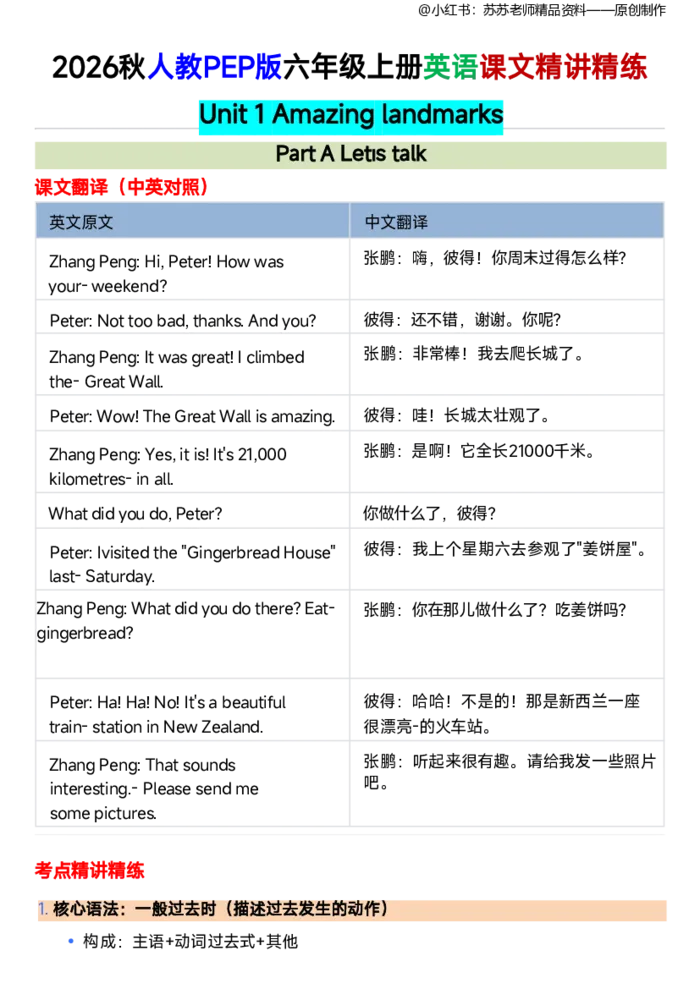
Part A Letıs talk
课文翻译(中英对照)
英文原文
中文翻译
Zhang Peng: Hi, Peter! How was
your- weekend?
张鹏:嗨,彼得!你周末过得怎么样?
Peter: Not too bad, thanks. And you?
彼得:还不错,谢谢。你呢?
Zhang Peng: It was great! I climbed
the- Great Wall.
张鹏:非常棒!我去爬长城了。
Peter: Wow! The Great Wall is amazing.
彼得:哇!长城太壮观了。
Zhang Peng: Yes, it is! It's 21,000
kilometres- in all.
张鹏:是啊!它全长21000千米。
What did you do, Peter?
你做什么了,彼得?
Peter: Ivisited the "Gingerbread House"
last- Saturday.
彼得:我上个星期六去参观了"姜饼屋"。
Zhang Peng: What did you do there? Eat-
gingerbread?
张鹏:你在那儿做什么了?吃姜饼吗?
Peter: Ha! Ha! No! It's a beautiful
train- station in New Zealand.
彼得:哈哈!不是的!那是新西兰一座
很漂亮-的火车站。
Zhang Peng: That sounds
interesting.- Please send me
some pictures.
张鹏:听起来很有趣。请给我发一些照片
吧。
考点精讲精练
1. 核心语法:一般过去时(描述过去发生的动作)
• 构成:主语+动词过去式+其他
@小红书:苏苏老师精品资料——原创制作
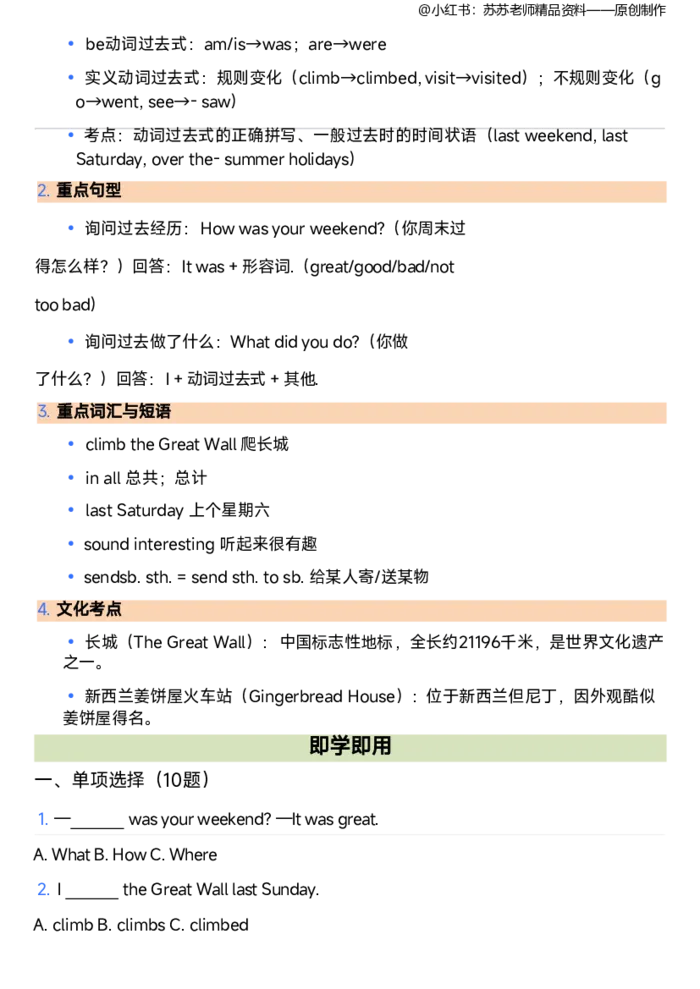
• be动词过去式:am/is→was;are→were
• 实义动词过去式:规则变化(climb→climbed, visit→visited);不规则变化(g
o→went, see→- saw)
• 考点:动词过去式的正确拼写、一般过去时的时间状语(last weekend, last
Saturday, over the- summer holidays)
2. 重点句型
• 询问过去经历:How was your weekend?(你周末过
得怎么样?)回答:It was + 形容词.(great/good/bad/not
too bad)
• 询问过去做了什么:What did you do?(你做
了什么?)回答:I + 动词过去式+ 其他.
3. 重点词汇与短语
• climb the Great Wall 爬长城
• in all 总共;总计
• last Saturday 上个星期六
• sound interesting 听起来很有趣
• sendsb. sth. = send sth. to sb. 给某人寄/送某物
4. 文化考点
• 长城(The Great Wall):中国标志性地标,全长约21196千米,是世界文化遗产
之一。
• 新西兰姜饼屋火车站(Gingerbread House):位于新西兰但尼丁,因外观酷似
姜饼屋得名。
即学即用
一、单项选择(10题)
1. —
was your weekend? —It was great.
A. What B. How C. Where
2. I
the Great Wall last Sunday.
A. climb B. climbs C. climbed
@小红书:苏苏老师精品资料——原创制作
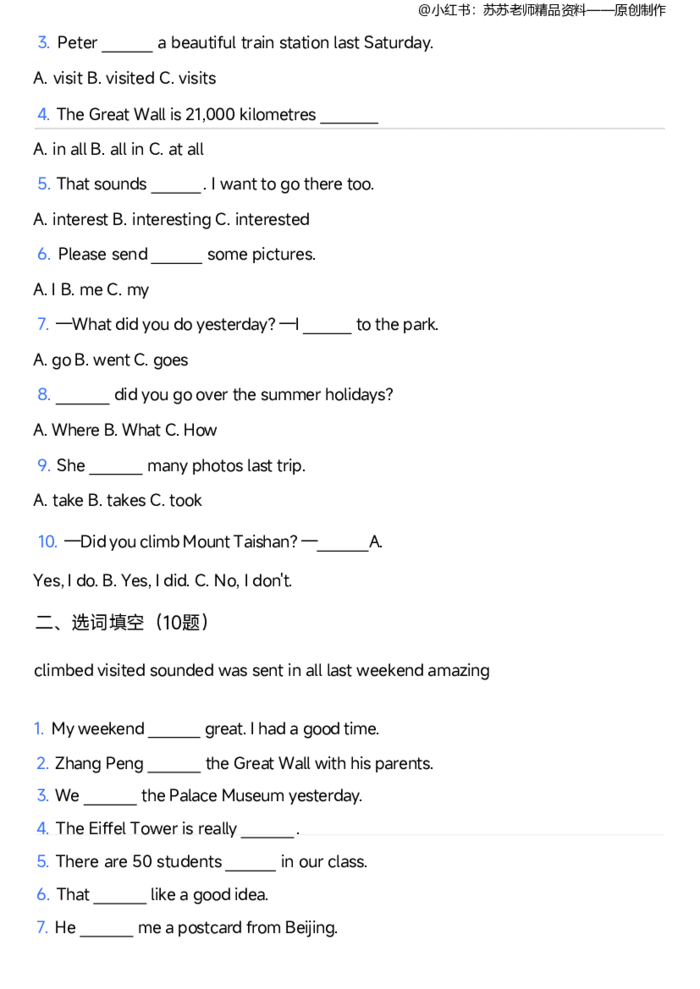
3. Peter
a beautiful train station last Saturday.
A. visit B. visited C. visits
4. The Great Wall is 21,000 kilometres
A. in all B. all in C. at all
5. That sounds
. I want to go there too.
A. interest B. interesting C. interested
6. Please send
some pictures.
A. I B. me C. my
7. —What did you do yesterday? —I
to the park.
A. go B. went C. goes
8.
did you go over the summer holidays?
A. Where B. What C. How
9. She
many photos last trip.
A. take B. takes C. took
10. —Did you climb Mount Taishan? —
A.
Yes, I do. B. Yes, I did. C. No, I don't.
二、选词填空(10题)
climbed visited sounded was sent in all last weekend amazing
1. My weekend
great. I had a good time.
2. Zhang Peng
the Great Wall with his parents.
3. We
the Palace Museum yesterday.
4. The Eiffel Tower is really
.
5. There are 50 students
in our class.
6. That
like a good idea.
7. He
me a postcard from Beijing.
@小红书:苏苏老师精品资料——原创制作
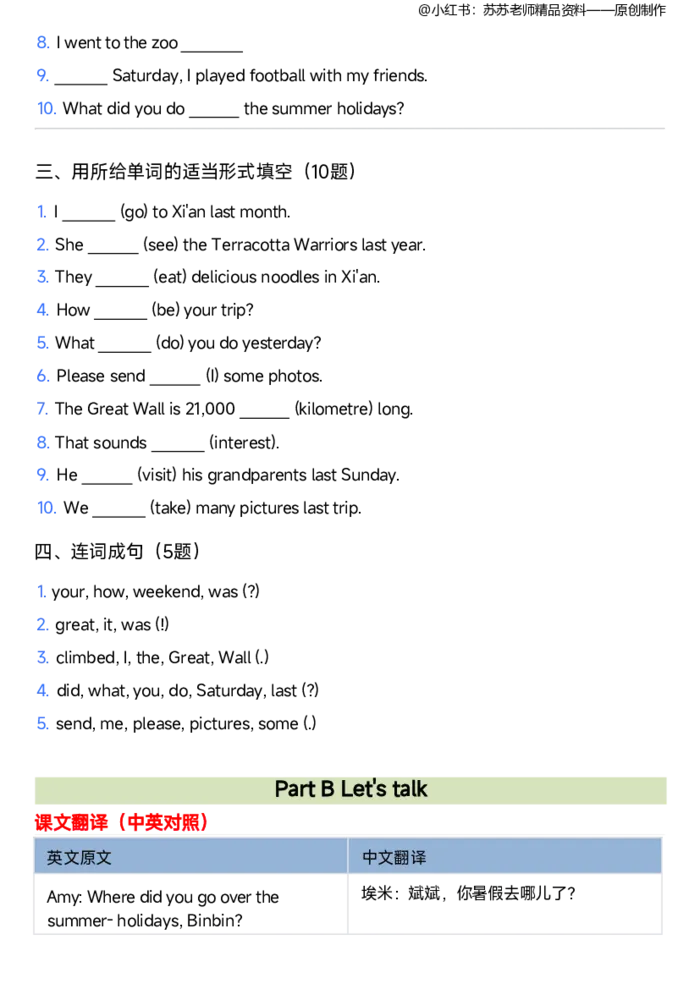
8. I went to the zoo
9.
Saturday, I played football with my friends.
10. What did you do
the summer holidays?
三、用所给单词的适当形式填空(10题)
1. I
(go) to Xi'an last month.
2. She
(see) the Terracotta Warriors last year.
3. They
(eat) delicious noodles in Xi'an.
4. How
(be) your trip?
5. What
(do) you do yesterday?
6. Please send
(I) some photos.
7. The Great Wall is 21,000
(kilometre) long.
8. That sounds
(interest).
9. He
(visit) his grandparents last Sunday.
10. We
(take) many pictures last trip.
四、连词成句(5题)
1. your, how, weekend, was (?)
2. great, it, was (!)
3. climbed, I, the, Great, Wall (.)
4. did, what, you, do, Saturday, last (?)
5. send, me, please, pictures, some (.)
Part B Let's talk
课文翻译(中英对照)
英文原文
中文翻译
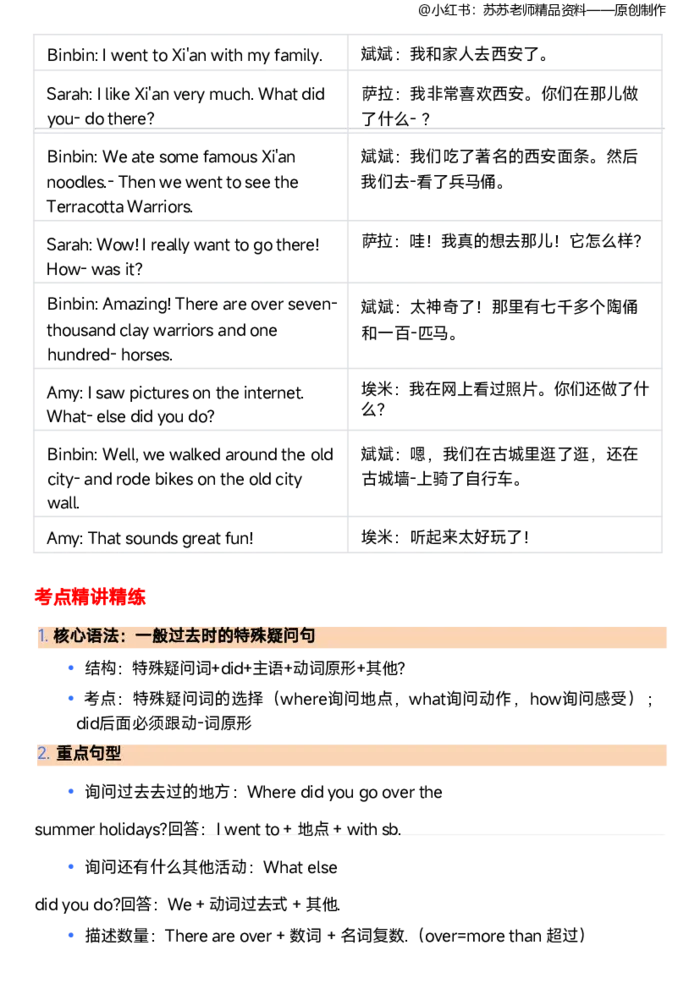
Amy: Where did you go over the
summer- holidays, Binbin?
埃米:斌斌,你暑假去哪儿了?
@小红书:苏苏老师精品资料——原创制作
Binbin: I went to Xi'an with my family.
斌斌:我和家人去西安了。
Sarah: I like Xi'an very much. What did
you- do there?
萨拉:我非常喜欢西安。你们在那儿做
了什么- ?
Binbin: We ate some famous Xi'an
noodles.- Then we went to see the
Terracotta Warriors.
斌斌:我们吃了著名的西安面条。然后
我们去-看了兵马俑。
Sarah: Wow! I really want to go there!
How- was it?
萨拉:哇!我真的想去那儿!它怎么样?
Binbin: Amazing! There are over seven-
thousand clay warriors and one
hundred- horses.
斌斌:太神奇了!那里有七千多个陶俑
和一百-匹马。
Amy: I saw pictures on the internet.
What- else did you do?
埃米:我在网上看过照片。你们还做了什
么?
Binbin: Well, we walked around the old
city- and rode bikes on the old city
wall.
斌斌:嗯,我们在古城里逛了逛,还在
古城墙-上骑了自行车。
Amy: That sounds great fun!
埃米:听起来太好玩了!
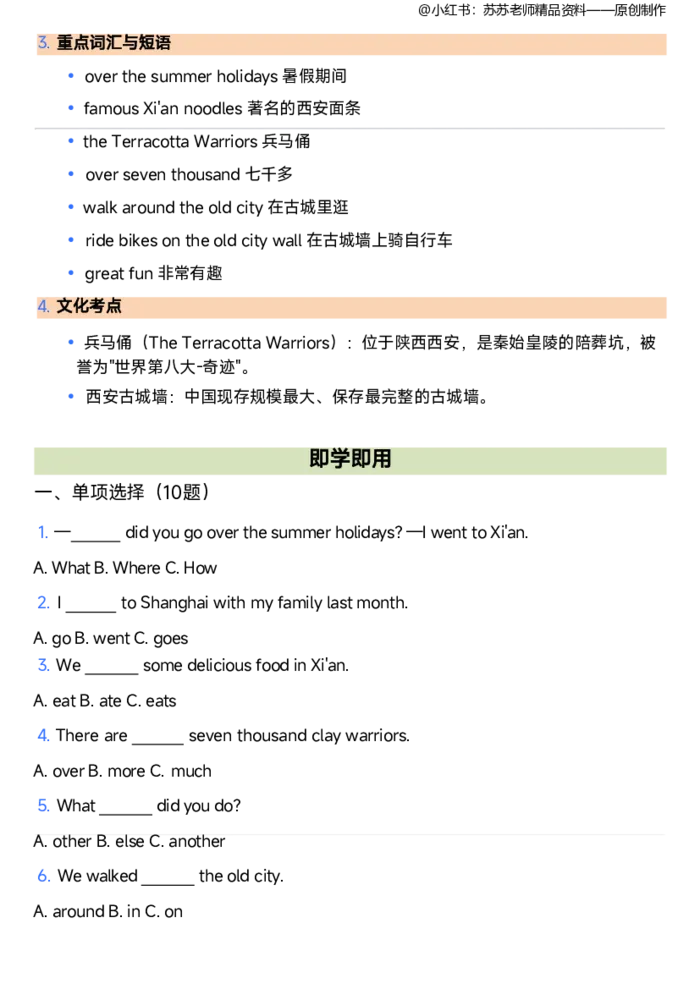
考点精讲精练
1. 核心语法:一般过去时的特殊疑问句
• 结构:特殊疑问词+did+主语+动词原形+其他?
• 考点:特殊疑问词的选择(where询问地点,what询问动作,how询问感受);
did后面必须跟动-词原形
2. 重点句型
• 询问过去去过的地方:Where did you go over the
summer holidays?回答:I went to + 地点+ with sb.
• 询问还有什么其他活动:What else
did you do?回答:We + 动词过去式+ 其他.
• 描述数量:There are over + 数词+ 名词复数.(over=more than 超过)
@小红书:苏苏老师精品资料——原创制作
3. 重点词汇与短语
• over the summer holidays 暑假期间
• famous Xi'an noodles 著名的西安面条
• the Terracotta Warriors 兵马俑
• over seven thousand 七千多
• walk around the old city 在古城里逛
• ride bikes on the old city wall 在古城墙上骑自行车
• great fun 非常有趣
4. 文化考点
• 兵马俑(The Terracotta Warriors):位于陕西西安,是秦始皇陵的陪葬坑,被
誉为"世界第八大-奇迹"。
• 西安古城墙:中国现存规模最大、保存最完整的古城墙。
即学即用
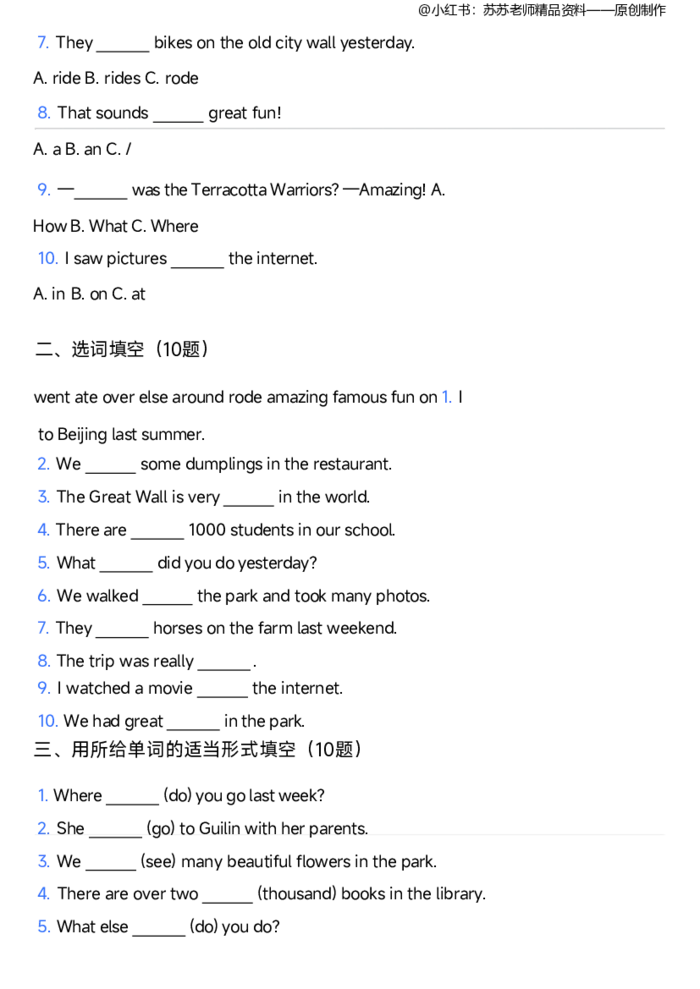
一、单项选择(10题)
1. —
did you go over the summer holidays? —I went to Xi'an.
A. What B. Where C. How
2. I
to Shanghai with my family last month.
A. go B. went C. goes
3. We
some delicious food in Xi'an.
A. eat B. ate C. eats
4. There are
seven thousand clay warriors.
A. over B. more C. much
5. What
did you do?
A. other B. else C. another
6. We walked
the old city.
A. around B. in C. on
@小红书:苏苏老师精品资料——原创制作
7. They
bikes on the old city wall yesterday.
A. ride B. rides C. rode
8. That sounds
great fun!
A. a B. an C. /
9. —
was the Terracotta Warriors? —Amazing! A.
How B. What C. Where
10. I saw pictures
the internet.
A. in B. on C. at
二、选词填空(10题)
went ate over else around rode amazing famous fun on 1. I
to Beijing last summer.
2. We
some dumplings in the restaurant.
3. The Great Wall is very
in the world.
4. There are
1000 students in our school.
5. What
did you do yesterday?
6. We walked
the park and took many photos.
7. They
horses on the farm last weekend.
8. The trip was really
.
9. I watched a movie
the internet.
10. We had great
in the park.
三、用所给单词的适当形式填空(10题)
1. Where
(do) you go last week?
2. She
(go) to Guilin with her parents.
3. We
(see) many beautiful flowers in the park.
4. There are over two
(thousand) books in the library.
5. What else
(do) you do?
@小红书:苏苏老师精品资料——原创制作
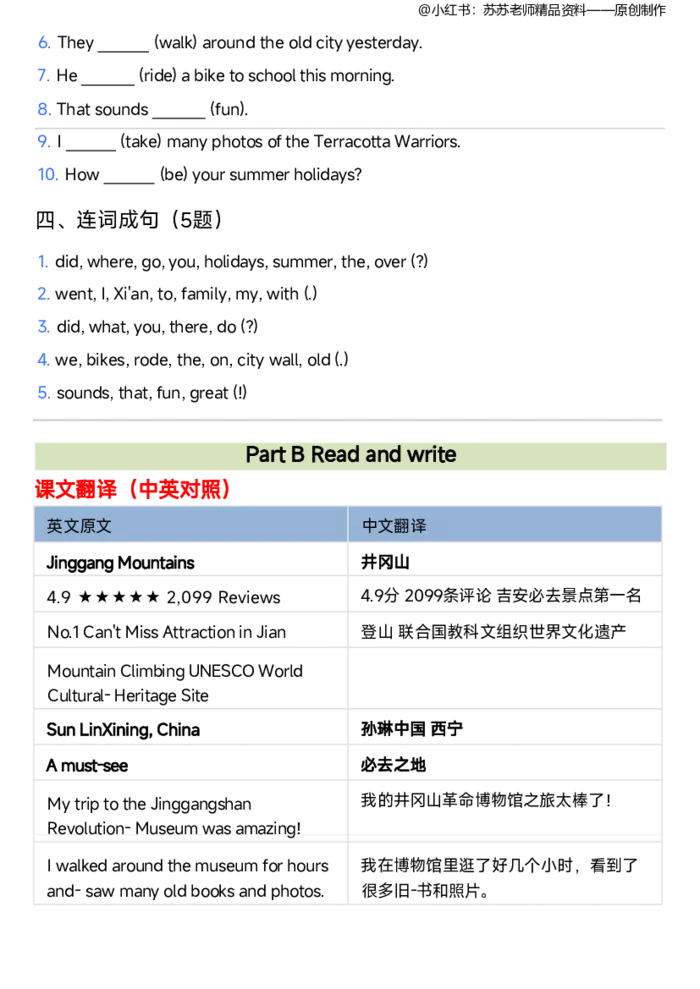
6. They
(walk) around the old city yesterday.
7. He
(ride) a bike to school this morning.
8. That sounds
(fun).
9. I
(take) many photos of the Terracotta Warriors.
10. How
(be) your summer holidays?
四、连词成句(5题)
1. did, where, go, you, holidays, summer, the, over (?)
2. went, I, Xi'an, to, family, my, with (.)
3. did, what, you, there, do (?)
4. we, bikes, rode, the, on, city wall, old (.)
5. sounds, that, fun, great (!)
Part B Read and write
课文翻译(中英对照)
英文原文
中文翻译
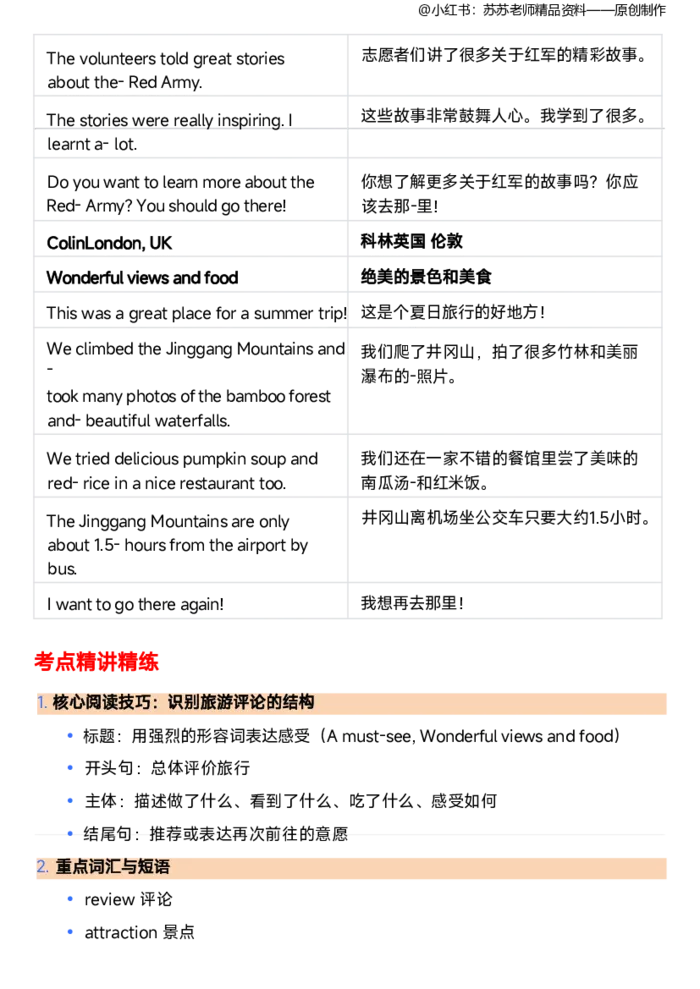
Jinggang Mountains
井冈山
4.9 ★★★★★2,099 Reviews
4.9分2099条评论吉安必去景点第一名
No.1 Can't Miss Attraction in Jian
登山联合国教科文组织世界文化遗产
Mountain Climbing UNESCO World
Cultural- Heritage Site
Sun LinXining, China
孙琳中国西宁
A must-see
必去之地
My trip to the Jinggangshan
Revolution- Museum was amazing!
我的井冈山革命博物馆之旅太棒了!
I walked around the museum for hours
and- saw many old books and photos.
我在博物馆里逛了好几个小时,看到了
很多旧-书和照片。
@小红书:苏苏老师精品资料——原创制作
The volunteers told great stories
about the- Red Army.
志愿者们讲了很多关于红军的精彩故事。
The stories were really inspiring. I
learnt a- lot.
这些故事非常鼓舞人心。我学到了很多。
Do you want to learn more about the
Red- Army? You should go there!
你想了解更多关于红军的故事吗?你应
该去那-里!
ColinLondon, UK
科林英国伦敦
Wonderful views and food
绝美的景色和美食
This was a great place for a summer trip! 这是个夏日旅行的好地方!
We climbed the Jinggang Mountains and
-
took many photos of the bamboo forest
and- beautiful waterfalls.
我们爬了井冈山,拍了很多竹林和美丽
瀑布的-照片。
We tried delicious pumpkin soup and
red- rice in a nice restaurant too.
我们还在一家不错的餐馆里尝了美味的
南瓜汤-和红米饭。
The Jinggang Mountains are only
about 1.5- hours from the airport by
bus.
井冈山离机场坐公交车只要大约1.5小时。
I want to go there again!
我想再去那里!
考点精讲精练
1. 核心阅读技巧:识别旅游评论的结构
• 标题:用强烈的形容词表达感受(A must-see, Wonderful views and food)
• 开头句:总体评价旅行
• 主体:描述做了什么、看到了什么、吃了什么、感受如何
• 结尾句:推荐或表达再次前往的意愿
2. 重点词汇与短语
• review 评论
• attraction 景点
@小红书:苏苏老师精品资料——原创制作
• must-see 必看的地方
• the Jinggangshan Revolution Museum 井冈山革命博物馆
• the Red Army 红军
• inspiring 鼓舞人心的
• bamboo forest 竹林
• waterfall 瀑布
• pumpkin soup 南瓜汤
• red rice 红米饭
• by bus 乘公交车
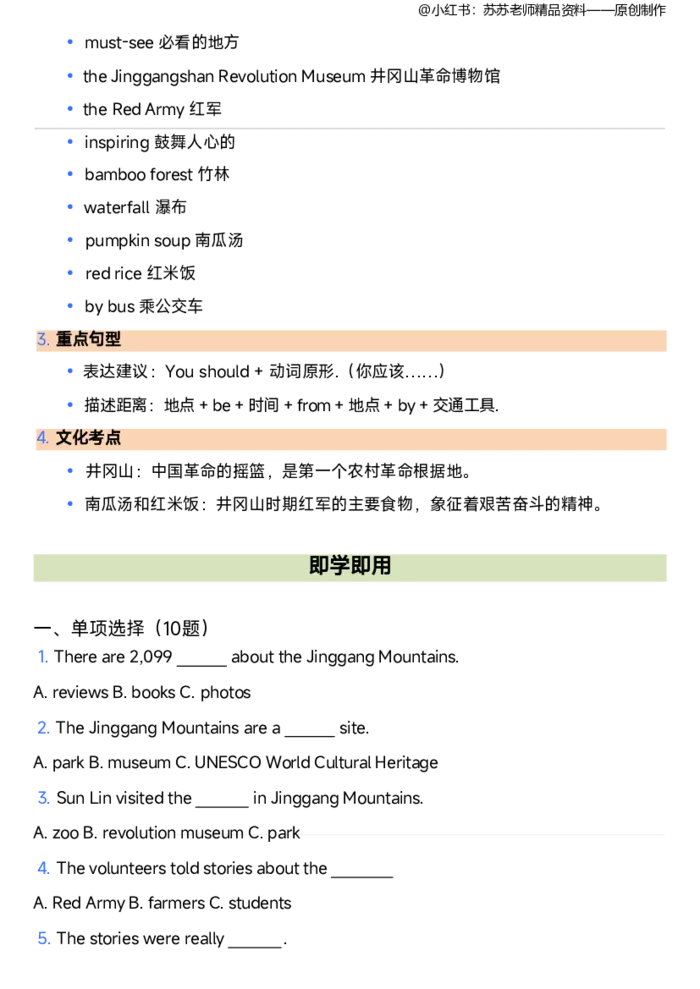
3. 重点句型
• 表达建议:You should + 动词原形.(你应该……)
• 描述距离:地点+ be + 时间+ from + 地点+ by + 交通工具.
4. 文化考点
• 井冈山:中国革命的摇篮,是第一个农村革命根据地。
• 南瓜汤和红米饭:井冈山时期红军的主要食物,象征着艰苦奋斗的精神。
即学即用
一、单项选择(10题)
1. There are 2,099
about the Jinggang Mountains.
A. reviews B. books C. photos
2. The Jinggang Mountains are a
site.
A. park B. museum C. UNESCO World Cultural Heritage
3. Sun Lin visited the
in Jinggang Mountains.
A. zoo B. revolution museum C. park
4. The volunteers told stories about the
A. Red Army B. farmers C. students
5. The stories were really
.
@小红书:苏苏老师精品资料——原创制作
A. boring B. inspiring C. sad
6. Colin took many photos of the
.
A. bamboo forest B. museum C. city
7. They tried delicious _______ and red rice.
A. tomato soup B. pumpkin soup C. chicken soup
8. The Jinggang Mountains are about 1.5 hours from the airport
.
A. by car B. by bus C. by train
9. You
go there if you want to learn about the Red Army.
A. should B. shouldn't C. can't
10. I want to go there
.
A. too B. again C. also
二、选词填空(10题)
reviews amazing inspiring learnt climbed took delicious by should again
1. There are many good
about this restaurant.
2. My trip to Beijing was
.
3. The stories about the Red Army are
.
4. I
a lot from the museum.
5. We
Mount Huangshan last summer.
6. They
many photos of the waterfalls.
7. The food there is very
.
8. I go to school
bike every day.
9. You
see the Terracotta Warriors when you are in Xi'an.
10. I hope to visit the Great Wall
.
三、用所给单词的适当形式填空(10题)
1. There are many
(review) about this place.
@小红书:苏苏老师精品资料——原创制作
2. It is a
(must-see) attraction in China.
3. I
(walk) around the museum for hours yesterday.
4. The volunteers
(tell) us many interesting stories.
5. The stories are very
(inspire).
6. We
(climb) the mountains last weekend.
7. They
(take) many photos of the bamboo forest.
8. The pumpkin soup is
(deliciously).
9. How far
(be) it from the airport?
10. I want
(go) there again.
四、连词成句(5题)
1. trip, my, was, amazing, the, to, museum (.)
2. told, volunteers, the, stories, great, the, Red Army, about (.)
3. we, many, took, photos, the, of, waterfalls (.)
4. tried, we, delicious, pumpkin, soup (.)
5. should, you, there, go (.)
Part C Reading time
课文翻译(中英对照)
英文原文
中文翻译
Landmarks you shouldn't miss!
你不容错过的地标!
Eye-opening findings in Sanxingdui
三星堆的惊人发现
My last trip to Sanxingdui was great!
我上次的三星堆之旅太棒了!
In the Sanxingdui Museum, I saw strange
-
在三星堆博物馆,我看到了奇怪的面具、"
大立-
masks, the "big guy" statue and a life-
size "- fruit" tree lamp.
人"雕像和真人大小的"神树"灯。
Some believed people from
Sanxingdui- were aliens. But it's
有些人认为三星堆人是外星人。但这不是
真的-
@小红书:苏苏老师精品资料——原创制作
not true.
。
They might eat hotpot three thousand
years- ago, just like we do today.
他们可能在三千年前就吃火锅了,就像
我们今-天一样。
(Chen Li, history teacher)
(陈丽,历史老师)
The pearl of Hangzhou
杭州的明珠
I visited the West Lake last autumn.
我去年秋天去了西湖。
On the first night, my friends and I
watched- the moon rising from a boat
on the lake.
第一天晚上,我和朋友们在湖上的小船
里看月-亮升起。
We ate mooncakes and drank Longjing
tea.
我们吃了月饼,喝了龙井茶。
The next day we walked along the
lake. It- was such a nice trip.
第二天我们沿着湖边散步。这真是一次
美好的-旅行。
(Jessica, nurse)
(杰西卡,护士)
A magical island
一座神奇的岛屿
On Easter Island, I saw huge statues
called- Moai.
在复活节岛上,我看到了叫做摩艾的巨大
雕像-
。
The Rapa Nui people made them
thousands- of years ago.
拉帕努伊人在几千年前建造了它们。
I loved the food on the island. The
locals- cooked fresh food on rocks!
我喜欢岛上的食物。当地人在岩石上烹
饪新鲜-的食物!
We had fish. It was so delicious!
我们吃了鱼。太美味了!
(Lucy, 10-year-old student)
(露西,10岁学生)
An unusual "table"
一张不寻常的"桌子"
I climbed many mountains on my trips,
but-
我在旅行中爬过很多山,但南非的桌山很
特别-
Table Mountain in South Africa was a
special- one.
。
@小红书:苏苏老师精品资料——原创制作
Its name comes from its top. It is flat
like a- table!
它的名字来源于它的山顶。它平得像一
张桌子- !
But I found it only looks flat from one
side.
但我发现它只有从一边看才是平的。
I went to the top by cable car. The first
cable- car opened in 1929.
我坐缆车到了山顶。第一辆缆车于1929年
开放-
。
The view was so amazing!
景色太壮观了!
(William, mountain lover)
(威廉,登山爱好者)
考点精讲精练
1. 核心阅读技巧:提取不同人物的旅行经历和感受
• 关注每段的作者身份和地点
• 提取关键信息:看到了什么、做了什么、感受如何
2. 重点词汇与短语
• eye-opening 令人大开眼界的
• strange mask 奇怪的面具
• statue 雕像
• life-size 真人大小的
• alien 外星人
• hotpot 火锅
• the West Lake 西湖
• watch the moon rising 看月亮升起
• Longjing tea 龙井茶
• walk along the lake 沿着湖边散步
• Easter Island 复活节岛
• huge statue 巨大的雕像
• local 当地人
• Table Mountain 桌山
@小红书:苏苏老师精品资料——原创制作
• flat 平坦的
• cable car 缆车
• view 景色
3. 重点句型
• 表达推测:They might + 动词原形.(他们可能……)
• 描述事物特征:It is + 形容词+ like +名词.(它像……一样……)
4. 文化考点
• 三星堆:位于四川广汉,是古蜀文明的遗址,出土了大量青铜文物。
• 西湖:位于浙江杭州,是世界文化遗产,被誉为"人间天堂"。
• 复活节岛:位于南太平洋,以巨大的摩艾石像闻名。
• 桌山:位于南非开普敦,因山顶平坦如桌得名,是世界新七大自然奇观之一。
即学即用
一、单项选择(10题)
1. Chen Li is a
A. student B. nurse C. history teacher
2. In Sanxingdui Museum, you can see
.
A. strange masks B. the West Lake C. Moai statues
3. Some people thought people from Sanxingdui were
.
A. teachers B. aliens C. farmers
4. They might eat
three thousand years ago.
A. noodles B. hotpot C. rice
5. Jessica visited the West Lake
A. last spring B. last summer C. last autumn
6. They watched the moon rising
.
A. on the mountain B. from a boat C. in the museum
7. They ate mooncakes and drank
.
@小红书:苏苏老师精品资料——原创制作
A. Longjing tea B. coffee C. juice
8. The Moai statues were made by
people.
A. Rapa Nui B. Chinese C. South African
9. Table Mountain is in
A. China B. New Zealand C. South Africa
10. William went to the top of Table Mountain
.
A. on foot B. by cable car C. by bus
二、选词填空(10题)
amazing strange flat huge along might by rising delicious life-size
1. There are many
masks in Sanxingdui Museum.
2. The "big guy" statue is
.
3. They
eat hotpot three thousand years ago.
4. We watched the sun
from the mountain top.
5. We walked
the river and took many photos.
6. The food on the island is very
.
7. There are
statues on Easter Island.
8. The top of Table Mountain is
like a table.
9. I went to the top
cable car.
10. The view from the mountain is
三、用所给单词的适当形式填空(10题)
1. My trip to Sanxingdui was
(great).
2. I
(see) many strange masks in the museum.
3. Some people
(believe) they were aliens.
4. They might
(eat) hotpot long ago.
5. I
(visit) the West Lake last autumn.
@小红书:苏苏老师精品资料——原创制作
6. We watched the moon
(rise) from the boat.
7. The Rapa Nui people
(make) the statues thousands of years ago.
8. The locals
(cook) food on rocks.
9. Table Mountain is a very
(specially) mountain.
10. The view from the top is
(amaze).
四、连词成句(5题)
1. saw, I, masks, strange, many, the, museum, in (.)
2. visited, I, the, West, Lake, autumn, last (.)
3. ate, we, mooncakes, drank, and, Longjing, tea (.)
4. huge, saw, I, statues, called, Moai (.)
5. went, I, the, top, by, to, cable, car (.)
Unit 1 单元答案
Part A Let's talk 即学即用答案
一、1-5 BCBAB 6-10 BBACB
二、1. was 2. climbed 3. visited 4. amazing 5. in all 6. sounded 7. sent 8. last weekend
9. Last 10.- over
三、1. went 2. saw 3. ate 4. was 5. did 6. me 7. kilometres 8. interesting 9. visited 10.
took
四、1. How was your weekend?
2. It was great!
3. I climbed the Great Wall.
4. What did you do last Saturday?
5. Please send me some pictures.
Part B Let's talk 即学即用答案
@小红书:苏苏老师精品资料——原创制作
一、1-5 BBBAB 6-10 ACCAB
二、1. went 2. ate 3. famous 4. over 5. else 6. around 7. rode 8. amazing 9. on 10. fun
三、1. did 2. went 3. saw 4. thousand 5. did 6. walked 7. rode 8. fun 9. took 10. were
四、1. Where did you go over the summer holidays?
2. I went to Xi'an with my family.
3. What did you do there?
4. We rode bikes on the old city wall.
5. That sounds great fun!
Part B Read and write 即学即用答案
一、1-5 ACBAB 6-10 ABBAB
二、1. reviews 2. amazing 3. inspiring 4. learnt 5. climbed 6. took 7. delicious 8. by 9.
should 10.- again
三、1. reviews 2. must-see 3. walked 4. told 5. inspiring 6. climbed 7. took 8. delicious 9.
is 10. to go
四、1. My trip to the museum was amazing.
2. The volunteers told great stories about the Red Army.
3. We took many photos of the waterfalls.
4. We tried delicious pumpkin soup.
5. You should go there.
Part C Reading time 即学即用答案
一、1-5 CABBC 6-10 BAACB
二、1. strange 2. life-size 3. might 4. rising 5. along 6. delicious 7. huge 8. flat 9. by
10. amazing三、1. great 2. saw 3. believed 4. eat 5. visited 6. rising 7. made 8. cook
9. special 10. amazing
@小红书:苏苏老师精品资料——原创制作
四、1. I saw many strange masks in the museum.
2. I visited the West Lake last autumn.
3. We ate mooncakes and drank Longjing tea.
4. I saw huge statues called Moai.
5. I went to the top by cable car.
@小红书:苏苏老师精品资料——原创制作
2026秋人教PEP版六年级上册英语课文精讲精练
Unit 2 Getting together
Part A Let's talk
课文翻译(中英对照)
英文原文
中文翻译
Mike: How was your Mid-Autumn
Festival- holiday, Binbin?
迈克:斌斌,你中秋假期过得怎么样?
Binbin: It was great! My family and I
had a- really nice day.
斌斌:非常棒!我和家人度过了非常愉
快的一-天。
Mike: What did you do? Did you take a
trip?
迈克:你们做什么了?去旅行了吗?
Binbin: No, we didn't. My aunt's
family- visited us.
斌斌:没有,我们没去。我姑姑一家来
看我们-了。
Mike: Did you eat mooncakes?
迈克:你们吃月饼了吗?
Binbin: Yes, we did. We enjoyed
some- mooncakes and fruit.
斌斌:是的,吃了。我们吃了一些月饼和
水果-
。
Grandpa told us some stories about
the- festival.
爷爷给我们讲了一些关于这个节日的故事
。
Mike: Wow! Can I join you next year?
迈克:哇!明年我能和你们一起过吗?
Binbin: Sure. You can also join us
for the- Spring Festival.
斌斌:当然可以。你还可以和我们一起过
春节-
。
We can paste fu and eat jiaozi together.
我们可以一起贴福字、吃饺子。
Mike: Great! I can't wait!
迈克:太好了!我都等不及了!
考点精讲精练
1. 核心语法:一般过去时的一般疑问句
@小红书:苏苏老师精品资料——原创制作
• 结构:Did + 主语+ 动词原形+ 其他?
• 肯定回答:Yes, 主语+ did.
• 否定回答:No, 主语+ didn't.
• 考点:did后面必须跟动词原形;回答时要用did/didn't,不能用实义动词的过去
式
2. 重点句型
• 询问节日活动:Did you + 动词原形+
其他?回答:Yes, I did. / No, I didn't.
• 邀请他人:Can I join you?(我能加入你
们吗?)回答:Sure. / Of course.
3. 重点词汇与短语
• Mid-Autumn Festival 中秋节
• take a trip 去旅行
• aunt's family 姑姑一家
• enjoy mooncakes and fruit 吃月饼和水果
• tell stories about the festival 讲关于节日的故事
• next year 明年
• Spring Festival 春节
• paste fu 贴福字
• eat jiaozi 吃饺子
• can't wait 等不及了
4. 文化考点
• 中秋节:中国传统节日,在农历八月十五,人们会赏月、吃月饼、家人团聚。
• 春节:中国最重要的传统节日,人们会贴春联、贴福字、吃饺子、放鞭炮。
即学即用
一、单项选择(10题)
@小红书:苏苏老师精品资料——原创制作
1. —
was your Mid-Autumn Festival? —It was great.
A. What B. How C. Where
2. —Did you take a trip? —
A. Yes, I do. B. Yes, I did. C. No, I don't.
3. My aunt's family
us last weekend.
A. visit B. visits C. visited
4. Did you
mooncakes?
A. eat B. ate C. eats
5. Grandpa
us some stories about the festival.
A. tell B. told C. tells
6. Can I join
next year?
A. you B. your C. yours
7. We can
fu and eat jiaozi together.
A. paste B. pasted C. pasting 8. I
wait!
A. can B. can't C. am not
9. —Did they watch the moon? —
A. Yes, they did. B. Yes, they do. C. No, they don't. 10.
What did you do
the Spring Festival?
A. in B. on C. at
二、选词填空(10题)
great told visited eat paste join can't next did didn't 1.
My holiday was
.
2. We
take a trip last weekend.
3. My uncle's family
us yesterday.
@小红书:苏苏老师精品资料——原创制作
4. Did you
mooncakes?
5. Grandma
me a story last night.
6. Can I
you for dinner?
7. We
fu on the door every Spring Festival.
8. I
wait to see you.
9.
you go to the park yesterday?
10. We are going to Beijing
year.
三、用所给单词的适当形式填空(10题)
1. How
(be) your holiday?
2. We
(have) a nice day yesterday.
3. Did you
(take) a trip?
4. My aunt
(visit) us last week.
5. We
(enjoy) some delicious food.
6. Grandpa
(tell) us many stories.
7. Can I
(join) you?
8. We can
(paste) fu together.
9. I can't wait
(see) you.
10. What
(do) you do last Spring Festival?
四、连词成句(5题)
1. was, your, how, Mid-Autumn, Festival, holiday (?)
2. did, you, a, take, trip (?)
3. we, mooncakes, ate, fruit, and (.)
4. told, grandpa, stories, us, the, about, festival (.)
5. can, I, you, join, year, next (?)
@小红书:苏苏老师精品资料——原创制作
Part B Let's talk
课文翻译(中英对照)
英文原文
中文翻译
Chen Jie: How was your weekend, Amy?
陈杰:埃米,你周末过得怎么样?
Amy: It was great. My mother and I
went to- a marathon on Sunday.
埃米:非常棒。我和妈妈周日去参加了
一场马-拉松活动。
She worked as a volunteer. I
watched the- race.
她当志愿者。我看了比赛。
Chen Jie: What did you like about it?
陈杰:你喜欢这个活动的哪个方面?
Amy: I liked watching the runners.
They ran- very fast. I cheered for
them.
埃米:我喜欢看参赛者跑步。他们跑得
非常快- 。我为他们加油。
Binbin: Nice! And you, Chen Jie?
What did- you do last weekend?
斌斌:真好!那你呢,陈杰?你上周末
做什么-了?
Chen Jie: I joined an online book fair. I
liked- it very much.
陈杰:我参加了一个线上书市。我非常喜
欢它-
。
Binbin: What did you like about it?
斌斌:你喜欢它的哪个方面?
Chen Jie: We shared ideas and talked
about- different books online.
陈杰:我们在网上分享想法,讨论不同的
书。
Binbin: That sounds fun!
斌斌:听起来很有趣!
考点精讲精练
1. 核心语法:一般过去时的特殊疑问句(询问喜欢的方面)
• 句型:What did you like about it?(你喜欢它的哪个方面?)
• 回答:I liked + 动词-ing形式+ 其他.
2. 重点词汇与短语
• marathon 马拉松赛跑
• work as a volunteer 当志愿者
@小红书:苏苏老师精品资料——原创制作
• watch the race 看比赛
• runner 参赛者;跑步者
• run very fast 跑得非常快
• cheer for sb. 为某人加油
• join an online book fair 参加线上书市
• share ideas 分享想法
• talk about different books 讨论不同的书
3. 重点句型
• 描述职业/身份:主语+ work as +职业.
• 表达喜欢的活动:I liked + 动词-ing形式.
即学即用
一、单项选择(10题)
1. —
was your weekend? —It was great.
A. What B. How C. Where
2. My mother and I
to a marathon last Sunday.
A. go B. went C. goes
3. She worked
a volunteer.
A. as B. for C. in
4. I
the race yesterday.
A. watch B. watched C. watches
5. I liked
the runners.
A. watch B. watched C. watching
6. They ran very
.
A. fast B. fastly C. faster
7. I cheered
them.
@小红书:苏苏老师精品资料——原创制作
A. for B. to C. at
8. I
an online book fair last weekend.
A. join B. joined C. joins
9. We
ideas and talked about books.
A. share B. shared C. shares
10. That sounds
!
A. fun B. funny C. funnily
二、选词填空(10题)
great went as watched watching cheered joined shared fast fun 1.
My weekend was
.
2. We
to the park yesterday.
3. He works
a teacher.
4. I
a football game last night.
5. I liked
the players.
6. They ran very
.
7. We
for our team.
8. She
the music club last term.
9. We
our food with each other.
10. The party was very
.
三、用所给单词的适当形式填空(10题)
1. How
(be) your weekend?
2. They
(go) to a marathon last Sunday.
3. She
(work) as a volunteer last year.
4. I
(watch) the race yesterday.
5. I liked
(cheer) for the runners.
@小红书:苏苏老师精品资料——原创制作
6. They
(run) very fast in the race.
7. We
(cheer) for them loudly.
8. I
(join) an English club last month.
9. We
(share) our stories yesterday.
10. That sounds
(interest).
四、连词成句(5题)
1. was, your, how, weekend (?)
2. went, I, a, to, marathon, Sunday, last (.)
3. liked, I, watching, the, runners (.)
4. joined, I, an, online, book, fair (.)
5. sounds, that, fun (!)
Part B Read and write
课文翻译(中英对照)
英文原文
中文翻译
Sunday, 22 June
6月22日星期日
The notice about the dragon boat
race- finally came out last Friday.
关于龙舟赛的通知上周五终于出来了。
I was excited because my father was
on a- race team!
我很兴奋,因为我爸爸在一个参赛队里!
In the morning, my dad woke up early.
早上,爸爸很早就醒了。
We went to the river later and waited
for the- race.
后来我们去了河边,等待比赛开始。
Then the judge counted down and the
race- began!
然后裁判倒计时,比赛开始了!
I ran and cheered for my dad.
我跑着为爸爸加油。
@小红书:苏苏老师精品资料——原创制作
His boat was very fast. Finally, his team
won- the race!
他的船非常快。最后,他的队赢得了比赛
!
They all sang their team song together.
They- were so happy!
他们一起唱了队歌。他们太开心了!
In the evening, our family made zongzi
and- had a big dinner for the festival,
晚上,我们全家包了粽子,为这个节日
吃了一-顿丰盛的晚餐,
and for the winner, my dad!
也为了获胜者—我的爸爸!
It was the best Dragon Boat Festival
ever!
这是有史以来最棒的端午节!
考点精讲精练
1. 核心阅读技巧:区分事实(Fact)和观点(Opinion)
• 事实:可以被证明是真实的陈述(如:My father was on a race team.)
• 观点:个人的感受或判断(如:It was the best Dragon Boat Festival ever!)
2. 重点词汇与短语
• notice 通知
• dragon boat race 龙舟赛
• come out 发布;出版
• excited 兴奋的
• race team 参赛队
• wake up early 早起
• wait for the race 等待比赛
• judge 裁判
• count down 倒计时
• begin 开始
• cheer for sb. 为某人加油
• finally 最后
• win the race 赢得比赛
@小红书:苏苏老师精品资料——原创制作
• team song 队歌
• make zongzi 包粽子
• have a big dinner 吃一顿丰盛的晚餐
• winner 获胜者
• ever 有史以来
3. 重点句型
• 表达原因:I was excited because...(我很兴奋,因为……)
• 描述事件顺序:First... Then... Finally...(首先……然后……最后……)
4. 文化考点
• 端午节:中国传统节日,在农历五月初五,人们会赛龙舟、吃粽子,纪念屈原。
即学即用
一、单项选择(10题)
1. The notice about the dragon boat race came out
.
A. last Monday B. last Friday C. last Sunday
2. I was
because my father was on a race team.
A. excited B. sad C. tired
3. My dad
early in the morning.
A. wake up B. wakes up C. woke up
4. We went to the
and waited for the race.
A. park B. river C. school
5. The
counted down and the race began.
A. teacher B. judge C. student
6. I
and cheered for my dad.
A. run B. ran C. runs
7. Finally, his team
the race.
@小红书:苏苏老师精品资料——原创制作
A. win B. won C. wins
8. They sang their
together.
A. school song B. team song C. birthday song
9. Our family made
in the evening.
A. jiaozi B. mooncakes C. zongzi
10. It was the
Dragon Boat Festival ever!
A. good B. better C. best
二、选词填空(10题)
notice excited woke waited began cheered won sang made best 1.
The
about the race came out yesterday.
2. I was very
when I heard the news.
3. He
up early this morning.
4. We
for the bus at the stop.
5. The class
at 8 o'clock.
6. We
for our team loudly.
7. Our team
the football game.
8. They
a beautiful song together.
9. My mother
a cake for my birthday.
10. This is the
movie I have ever seen.
三、用所给单词的适当形式填空(10题)
1. The notice
(come) out last Friday.
2. I was
(excite) because my dad was on the team.
3. My dad
(wake) up early yesterday.
4. We
(wait) for the race for an hour.
5. The race
(begin) at 9 o'clock.
@小红书:苏苏老师精品资料——原创制作
6. I
(run) and cheered for my dad.
7. Finally, his team
(win) the race.
8. They
(sing) their team song together.
9. We
(make) zongzi last night.
10. It was the
(good) festival ever.
四、连词成句(5题)
1. came, the, notice, out, last, Friday (.)
2. was, I, excited, very (.)
3. we, the, waited, for, race (.)
4. won, his, team, finally, the, race (.)
5. made, we, zongzi, evening, the, in (.
Part C Reading time
课文翻译(中英对照)
英文原文
中文翻译
The story of Nian
年的故事
Scene 1
第一幕
Narrator: One night, an old man came
to a- village.
旁白:一天晚上,一位老人来到一个村庄
。
He saw the local people running away.
他看到当地人正在逃跑。
Old man: Excuse me, why are you
running?- What happened?
老人:打扰一下,你们为什么跑?发生
什么事-了?
Villager: The monster Nian will come!
Last- year, it ate many animals.
村民:年兽要来了!去年,它吃了很多动
物。
We are all afraid of it.
我们都很害怕它。
@小红书:苏苏老师精品资料——原创制作
Old man: Wait! I have a good idea. I can
help- you!
老人:等等!我有个好主意。我可以帮你
们!
Villager: The monster is very strong. You
-
should run away to the mountains with
us!
村民:这个怪兽非常强壮。你应该和我
们一起-跑到山里去!
Old man: No. I will stay alone in the
village- and face Nian.
老人:不。我要一个人留在村里,面对年
兽。
Scene 2
第二幕
Narrator: The old man stayed in the
village.- Then, at midnight, the
monster came.
旁白:老人留在了村里。然后,在午夜
,怪兽-来了。
Nian: What is that red paper on the
doors- and windows? I hate the
colour red!
年:门窗上的红纸是什么?我讨厌红色!
Why are the windows so bright? I hate
bright- lights!
窗户为什么这么亮?我讨厌亮光!
Old man: Aha! He looks worried.
老人:啊哈!他看起来很担心。
Narrator: Then the old man set off
fireworks- . Bang! Bang! Bang!
旁白:然后老人放了烟花。砰!砰!砰!
Nian: Oh no! I hate loud noises! No, no!
年:哦不!我讨厌巨大的噪音!不,不!
Scene 3
第三幕
Narrator: Nian was very afraid and ran
back- to the sea.
旁白:年非常害怕,跑回了海里。
The next day, the villagers came back
to the- village.
第二天,村民们回到了村里。
Villager 1: I can't believe it! All our
animals- are safe!
村民1:我简直不敢相信!我们所有的
动物都-安全了!
Villager 2: How did you do it?
村民2:你是怎么做到的?
@小红书:苏苏老师精品资料——原创制作
Old man: Last night, I pasted red
paper on- the doors and windows
老人:昨晚,我在门窗上贴了红纸,
and I also lit many candles. Finally, I
set off- fireworks. He ran away!
还点了很多蜡烛。最后,我放了烟花。
他就跑-了!
Villagers: Hooray! We are safe!
村民们:万岁!我们安全了!
Narrator: From then on, on New Year's
Eve,-
旁白:从那以后,在除夕,人们聚在一起
庆祝-
people get together to celebrate the
coming- new year.
新年的到来。
They paste fu and Spring Festival
couplets- on their doors and set off
fireworks.
他们在门上贴福字和春联,放烟花。
This is why the Spring Festival is also
called- guonian.
这就是为什么春节也叫"过年"。
考点精讲精练
1. 核心阅读技巧:理解故事的情节发展和寓意
• 故事的起因:年兽每年来村里吃动物
• 故事的经过:老人用红色、亮光和烟花赶走了年兽
• 故事的结果:人们形成了过年的习俗
2. 重点词汇与短语
• monster 怪兽
• local people 当地人
• run away 逃跑
• be afraid of 害怕
• stay alone 独自留下
• face 面对
• midnight 午夜
• hate 讨厌
@小红书:苏苏老师精品资料——原创制作
• bright light 亮光
• set off fireworks 放烟花
• loud noise 巨大的噪音
• run back to 跑回
• safe 安全的
• paste red paper 贴红纸
• light candles 点蜡烛
• from then on 从那以后
• New Year's Eve 除夕
• get together 聚在一起
• celebrate the coming new year 庆祝新年的到来
• Spring Festival couplets 春联
• set off fireworks 放烟花
3. 重点句型
• 询问原因:Why are you running?(你们为什么跑?)
• 表达建议:You should + 动词原形.(你应该……)
• 解释原因:This is why...(这就是为什么……)
4. 文化考点
• 年兽的传说:中国古代关于春节由来的传说,人们通过贴红、放鞭炮来驱赶年兽
。
• 除夕:农历一年的最后一天,人们会守岁、吃年夜饭。
即学即用
一、单项选择(10题)
1. An old man came to a
one night.
A. city B. village C. town
2. The people were running away because
would come.
@小红书:苏苏老师精品资料——原创制作
A. the monster Nian B. the old man C. the villagers
3. Last year, Nian ate many
.
A. people B. animals C. plants
4. The old man said he could
the villagers.
A. help B. hurt C. leave
5. The old man stayed
in the village.
A. alone B. with his family C. with the villagers
6. Nian came at
A. morning B. afternoon C. midnight
7. Nian hates the colour
A. red B. blue C. green
8. The old man set off
to scare Nian.
A. candles B. fireworks C. red paper
9. Nian ran back to the
A. mountains B. sea C. forest
10. From then on, people
on New Year's Eve.
A. run away B. stay at home C. get together and celebrate
二、选词填空(10题)
village monster afraid alone midnight hates set off safe pasted celebrate
1. The old man came to a small
2. The
Nian is very scary.
3. We are all
of the dark.
4. He stayed
at home last night.
5. The party began at
.
6. She
eating vegetables.
7. We
fireworks on New Year's Eve.
@小红书:苏苏老师精品资料——原创制作
8. All the children are
now.
9. We
fu on the door every Spring Festival.
10. We
the Spring Festival with our family.
三、用所给单词的适当形式填空(10题)
1. An old man
(come) to the village last night.
2. He saw the people
(run) away.
3. The monster
(eat) many animals last year.
4. I can
(help) you.
5. You should
(run) away to the mountains.
6. The old man
(stay) in the village.
7. Nian
(hate) the colour red.
8. The old man
(set) off fireworks.
9. Nian
(run) back to the sea.
10. People
(get) together on New Year's Eve.
四、连词成句(5题)
1. came, an, old, man, the, to, village (.)
2. are, why, you, running (?)
3. I, can, you, help (.)
4. hates, Nian, the, colour, red (.)
5. we, fireworks, set, off (.)
Unit 2 单元答案
Part A Let's talk 即学即用答案
一、1-5 BBCAB 6-10 AABAA
@小红书:苏苏老师精品资料——原创制作
二、1. great 2. didn't 3. visited 4. eat 5. told 6. join 7. paste 8. can't 9. Did 10. next
三、1. was 2. had 3. take 4. visited 5. enjoyed 6. told 7. join 8. paste 9. to see 10. did
四、1. How was your Mid-Autumn Festival holiday?
2. Did you take a trip?
3. We ate mooncakes and fruit.
4. Grandpa told us stories about the festival.
5. Can I join you next year?
Part B Let's talk 即学即用答案
一、1-5 BBABC 6-10 AABBA
二、1. great 2. went 3. as 4. watched 5. watching 6. fast 7. cheered 8. joined 9. shared
10. fun
三、1. was 2. went 3. worked 4. watched 5. cheering 6. ran 7. cheered 8. joined 9.
shared 10.- interesting
四、1. How was your weekend?
2. I went to a marathon last Sunday.
3. I liked watching the runners.
4. I joined an online book fair.
5. That sounds fun!
Part B Read and write 即学即用答案
一、1-5 BACBB 6-10 BBBCC
二、1. notice 2. excited 3. woke 4. waited 5. began
6. cheered 7. won 8. sang 9. made 10. best
三、1. came 2. excited 3. woke 4. waited 5. began 6. ran 7. won 8. sang 9. made 10.
best
四、1. The notice came out last Friday.
@小红书:苏苏老师精品资料——原创制作
2. I was very excited.
3. We waited for the race.
4. Finally, his team won the race.
5. We made zongzi in the evening.
Part C Reading time 即学即用答案
一、1-5 BABAA 6-10 CABBC
二、1. village 2. monster 3. afraid 4. alone 5. midnight 6. hates 7. set off 8. safe 9.
pasted 10.- celebrate
三、1. came 2. running 3. ate 4. help 5. run 6. stayed 7. hates 8. set 9. ran 10. get
四、1. An old man came to the village.
2. Why are you running?
3. I can help you.
4. Nian hates the colour red.
5. We set off fireworks.
@小红书:苏苏老师精品资料——原创制作
2026秋人教PEP版六年级上册英语课文精讲精练
Unit 3 Healthy life
Part A Let's talk
课文翻译(中英对照)
英文原文
中文翻译
Mike: Hello?
迈克:喂?
Binbin: Hi, Mike. It's Binbin. I'm going to
the- science museum tomorrow. Are
you coming?
斌斌:嗨,迈克。我是斌斌。我明天要
去科学-博物馆。你要来吗?
Mike: I'm afraid not, Binbin. I have a bad
cold.
迈克:恐怕不行,斌斌。我得了重感冒。
Binbin: Oh dear! How do you feel?
斌斌:哦天啊!你感觉怎么样?
Mike: I feel ill. My head hurts and I
have a- runny nose.
迈克:我感觉不舒服。我头痛还流鼻涕。
Binbin: I'm sorry to hear that. Maybe
you- should see a doctor.
斌斌:听到这个消息我很难过。也许你
应该去-看医生。
Mike: I know. My mum is going to take
me to- hospital this afternoon.
迈克:我知道。我妈妈今天下午要带我去
医院-
。
Binbin: That's good. Take care and get
well- soon!
斌斌:那就好。保重身体,早日康复!
Mike: Thanks.
迈克:谢谢。
考点精讲精练
1. 核心语法:一般现在时(描述身体状况);一般将来时(be going to结构)
• 一般现在时:主语+ 动词原形/第三人称单数+ 其他(描述经常性的状态或客观事
实)
@小红书:苏苏老师精品资料——原创制作
• 一般将来时:主语+ be going to +动词原形+ 其他(描述计划或打算做的事)
• 情态动词should:表示建议,后面跟动词原形
2. 重点句型
• 询问身体状况:How do you feel?(你感觉怎
么样?)回答:I feel + 形容词.(ill/better/sad/happ
y)
• 描述病症:I have a + 病症.(a bad cold, a fever, a
cough)身体部位+ hurts.(My head hurts.)
• 表达建议:Maybe you should + 动词原形.
• 表达关心:I'm sorry to hear that. Take care and get well soon!
3. 重点词汇与短语
• science museum 科学博物馆
• be afraid not 恐怕不行
• have a bad cold 得了重感冒
• feel ill 感觉不舒服
• head hurts 头痛
• have a runny nose 流鼻涕
• see a doctor 看医生
• take sb. to hospital 带某人去医院
• take care 保重
• get well soon 早日康复
即学即用
一、单项选择(10题)
1. I'm going
the science museum tomorrow. A.
to B. in C. at
@小红书:苏苏老师精品资料——原创制作
2. I have
bad cold.
A. a B. an C. /
3. —
do you feel? —I feel ill.
A. What B. How C. Where
4. My head
.
A. hurt B. hurts C. hurting
5. I have a runny
.
A. nose B. mouth C. eye
6. Maybe you should
a doctor.
A. see B. saw C. seeing
7. My mum
going to take me to hospital.
A. am B. is C. are
8. Take
and get well soon!
A. care B. careful C. carefully 9. I'm
sorry
hear that.
A. to B. for C. at
10. —Are you coming to the party? —
A. Yes, I do. B. No, I'm not. C. No, I can't.
二、选词填空(10题)
to a How hurts nose see is care to coming 1.
I'm going
the park tomorrow.
2. She has
fever.
3.
do you feel today?
4. My leg
.
5. I have a runny
.
6. You should
a doctor.
@小红书:苏苏老师精品资料——原创制作
7. He
going to school now.
8. Take
of yourself.
9. I'm sorry
hear that.
10. Are you
to my birthday party?
三、用所给单词的适当形式填空(10题)
1. I
(go) to the zoo tomorrow.
2. He
(have) a bad cold.
3. How
(do) you feel?
4. My head
(hurt).
5. Maybe you should
(see) a doctor.
6. My mum
(be) going to take me to hospital.
7. I hope you get
(good) soon.
8. I'm sorry
(hear) that.
9. Take
(careful) of yourself.
10. He
(feel) ill today.
四、连词成句(5题)
1. going, I'm, to, the, science, museum, tomorrow (.)
2. have, I, a, bad, cold (.)
3. do, how, you, feel (?)
4. should, you, a, see, doctor (.)
5. take, care, get, well, and, soon (!)
@小红书:苏苏老师精品资料——原创制作
Part B Let's talk
课文翻译(中英对照)
英文原文
中文翻译
Miss White: Class, now we're
going to- discuss health.
怀特老师:同学们,现在我们来讨论健康
。
First, what is health?
首先,什么是健康?
Chen Jie: Health is having a good body
and- feeling happy.
陈杰:健康就是拥有健康的身体和快乐的
心情-
。
Miss White: Good, Chen Jie. So, how
can we- live a healthy life?
怀特老师:说得好,陈杰。那么,我们
怎样才-能过健康的生活呢?
Sarah: We need to eat healthy food.
We- should exercise too.
萨拉:我们需要吃健康的食物。我们也
应该运-动。
Miss White: That's right. What do you
think,- Binbin?
怀特老师:没错。斌斌,你怎么看?
Binbin: I think our family and friends are-
also important for a healthy life.
斌斌:我认为家人和朋友对健康的生活也
很重要
Chen Jie: Yes, it's always good to talk
to our- family and friends.
陈杰:是的,和家人朋友聊天总是很好的
。
Miss White: Good job, everyone!
怀特老师:大家做得都很好!
考点精讲精练
1. 核心语法:情态动词need和should的用法
• need to + 动词原形:表示需要做某事
• should + 动词原形:表示应该做某事,语气比need to更强
2. 重点句型
• 询问健康的定义:What is health?(什么是健康?)
@小红书:苏苏老师精品资料——原创制作
• 询问如何保持健康:How can we live a healthy life?(我们怎样才能过健康的生
活?)
• 表达观点:I think...(我认为……)
3. 重点词汇与短语
• discuss health 讨论健康
• have a good body 拥有健康的身体
• feel happy 感到快乐
• live a healthy life 过健康的生活
• eat healthy food 吃健康的食物
• exercise 运动
• family and friends 家人和朋友
• important 重要的
• talk to sb. 和某人聊天
即学即用
一、单项选择(10题)
1. We are going to
health.
A. discuss B. discussing C. discusses
2. Health is having a good body and
happy.
A. feel B. feeling C. feels
3.
can we live a healthy life?
A. What B. How C. Where
4. We need
healthy food.
A. eat B. to eat C. eating
5. We should
too.
A. exercise B. exercises C. exercising
@小红书:苏苏老师精品资料——原创制作
6. Family and friends are important
a healthy life. A.
for B. to C. in
7. It's good
talk to our family.
A. to B. for C. at
8. What do you
?
A. think B. thinks C. thinking
9. We should sleep
every night.
A. good B. well C. nice
10.
job, everyone!
A. Good B. Well C. Nice
二、选词填空(10题)
discuss feeling How to eat exercise for to think well
1. Let's
our holiday plan.
2. I am
happy today.
3.
can we learn English well?
4. We need
more vegetables.
5. You should
every day.
6. Water is important
us.
7. It's good
read books every day.
8. What do you
of this movie?
9. She sings very
.
10.
morning!
三、用所给单词的适当形式填空(10题)
1. We are going to
(discuss) health.
2. Health is
(have) a good body.
@小红书:苏苏老师精品资料——原创制作
3. How can we
(live) a healthy life?
4. We need
(eat) healthy food.
5. We should
(exercise) often.
6. Family and friends are
(importance) for us.
7. It's good
(talk) to our friends.
8. What do you
(think)?
9. He plays football very
(good).
10.
(good) job!
四、连词成句(5题)
1. we, going, are, to, health, discuss (.)
2. is, health, having, a, body, good (.)
3. can, how, we, live, healthy, a, life (?)
4. need, we, to, food, healthy, eat (.)
5. should, we, exercise, too (.)
Part B Read and write
课文翻译(中英对照)
英文原文
中文翻译
Liu Jia was crying. So Miss White
asked her,- "What's the matter, Liu
Jia? You look sad."
刘佳正在哭。于是怀特老师问她:"刘佳
,怎么-了?你看起来很难过。"
Liu Jia answered, "I'm feeling down.
My- good friend Lucy moved to
another city."
刘佳回答说:"我心情不好。我的好朋友
露西搬-到另一个城市去了。"
Miss White listened carefully and told
Liu Jia- , "Think about happy things.
怀特老师认真地听着,然后告诉刘佳:"
想想开-心的事情。
Call your friend or send her some
emails."
给你的朋友打电话或者给她发一些电子邮
件。"
@小红书:苏苏老师精品资料——原创制作
"I tried that, but I still feel unhappy,"
said Liu- Jia.
"我试过了,但我还是不开心,"刘佳说。
Miss White gave her a glass ofwater.
"Maybe- you can do some exercise.
怀特老师给了她一杯水。"也许你可以做
一些运-动。
Exercise may cheer you up!"
运动可能会让你振作起来!"
"Join some after-school clubs and
make- new friends.
"参加一些课后俱乐部,交一些新朋友。
You can talk and have fun with them,"
added- Miss White.
你可以和他们聊天、一起玩,"怀特老师补
充道-
。
"I will try. Thank you, Miss White,"
said Liu- Jia.
"我会试试的。谢谢你,怀特老师,"刘佳
说。
Dear Miss White,
亲爱的怀特老师:
I often make video calls with my friend
now.
我现在经常和我的朋友打视频电话。
I also joined a ping-pong club and
made- some new friends.
我还参加了一个乒乓球俱乐部,交了一
些新朋-友。
I feel much better. Thank you so much!
我感觉好多了。非常感谢你!
Liu Jia
刘佳
考点精讲精练
1. 核心阅读技巧:识别问题和解决方案
• 问题:Liu Jia's good friend moved to another city. She felt sad.
• 解决方案:1. Think about happy things. 2. Call or send emails. 3. Do some
exercise. 4. Join- clubs and make new friends.
2. 重点词汇与短语
• cry 哭
• What's the matter? 怎么了?
• looksad 看起来难过
@小红书:苏苏老师精品资料——原创制作
• feel down 心情不好
• move to another city 搬到另一个城市
• listen carefully 认真地听
• think about happy things 想想开心的事情
• send emails 发电子邮件
• try 尝试
• still 仍然
• unhappy 不开心的
• a glass of water 一杯水
• do some exercise 做一些运动
• cheersb. up 让某人振作起来
• join after-school clubs 参加课后俱乐部
• make new friends 交新朋友
• have fun with sb. 和某人一起玩
• add 补充说
• make video calls 打视频电话
• ping-pong club 乒乓球俱乐部
• feel much better 感觉好多了
• 询问怎么了:What's the matter? = What's wrong?
• 表达建议:Maybe you can + 动词原形.
• 描述变化:I feel much better now.(我现在感觉好多了。)
即学即用
一、单项选择(10题)
1. Liu Jia was
A. crying B. laughing C. singing
2. —What's the
? —She feels sad.
A. wrong B. matter C. thing
@小红书:苏苏老师精品资料——原创制作
3. She looks
A. sad B. happy C. excited
4. Her good friend
to another city.
A. move B. moves C. moved
5. Miss White listened
A. careful B. carefully C. care
6. Maybe you can
some exercise.
A. do B. did C. doing
7. Exercise may cheer you
.
A. up B. on C. off
8. She joined a
club.
A. ping-pong B. basketball C. football
9. She made some new
A. friend B. friends C. friendly
10. She feels
better now.
A. many B. much C. more
二、选词填空(10题)
crying matter sad moved carefully do up joined friends much 1.
The baby is
because he is hungry.
2. What's the
with you?
3. You look
. What happened?
4. My family
to Beijing last year.
5. Please listen
to the teacher.
6. You should
some exercise every day.
7. The good news cheered me
.
8. He
the music club last term.
@小红书:苏苏老师精品资料——原创制作
9. We have many good
.
10. I feel
better today.
三、用所给单词的适当形式填空(10题)
1. Liu Jia was
(cry).
2. What's the
(matter)?
3. She
(look) sad.
4. Her friend
(move) to another city.
5. Miss White
(listen) carefully.
6. Maybe you can
(do) some exercise.
7. Exercise may
(cheer) you up.
8. She
(join) a ping-pong club.
9. She made some new
(friend).
10. I feel much
(good) now.
四、连词成句(5题)
1. was, Liu Jia, crying (.)
2. what's, the, matter (?)
3. friend, my, moved, another, to, city (.)
4. can, you, some, do, exercise (.)
5. feel, I, better, much, now (.)
Part C Reading time
课文翻译(中英对照)
英文原文
中文翻译
We're helping hands!
我们是好帮手!
@小红书:苏苏老师精品资料——原创制作
1. My name is Right Hand. This is my
twin- brother, Left Hand.
1. 我的名字叫右手。这是我的双胞胎兄
弟,左-手。
2. One day, our master didn't wash us
and- ate his food.
2. 有一天,我们的主人没洗我们就吃东西
了。
He felt ill the next day. Now he
washes us- before every meal.
第二天他就生病了。现在他每顿饭前都洗
我们-
。
3. On another day, our master had a
bad- cold.
3. 还有一天,我们的主人得了重感冒。
He had a runny nose and a cough.
他流鼻涕还咳嗽。
We wiped his nose and covered his
mouth- with a tissue.
我们帮他擦鼻子,用纸巾捂住他的嘴。
We're important for his physical health.
我们对他的身体健康很重要。
4. We're also important for his mental
and- social health.
4. 我们对他的心理健康和社交健康也很重
要。
One day, our master felt unhappy.
有一天,我们的主人不开心。
But we helped him make handicrafts.
He felt- happy again.
但我们帮他做手工艺品。他又开心起来了
。
5. Our master also cooked food
for his- parents and sister.
5. 我们的主人还为他的父母和妹妹做饭。
They thanked him and said, "You have
really- great hands!"
他们感谢他说:"你的手真巧!"
6. We're important for our master
and his- friends.
6. 我们对我们的主人和他的朋友都很重要
。
He uses us to give them a high five.
他用我们和他们击掌。
We really are helping hands!
我们真的是好帮手!
考点精讲精练
1. 核心阅读技巧:理解文章的主旨大意
@小红书:苏苏老师精品资料——原创制作
• 主旨:手对我们的身体健康、心理健康和社交健康都非常重要,是我们的好帮手
。
2. 重点词汇与短语
• twin brother 双胞胎兄弟
• master 主人
• wash hands 洗手
• before every meal 每顿饭前
• have a runny nose 流鼻涕
• have a cough 咳嗽
• wipe one's nose 擦鼻子
• cover one's mouth 捂住嘴
• tissue 纸巾
• physical health 身体健康
• mental health 心理健康
• social health 社交健康
• make handicrafts 做手工艺品
• cook food for sb. 为某人做饭
• thanksb. 感谢某人
• give sb. a high five 和某人击掌
• helping hands 好帮手
3. 重点句型
• 描述过去发生的事情:One day, ...(有一天,……)
• 表达重要性:We're important for...(我们对……很重要。)
即学即用
一、单项选择(10题)
1. Right Hand and Left Hand are
.
@小红书:苏苏老师精品资料——原创制作
A. friends B. twin brothers C. classmates
2. The master felt ill because he
A. didn't wash his hands B. ate too much C. stayed up late
3. Now he washes his hands
every meal.
A. before B. after C. during
4. The master had a
cold.
A. bad B. good C. nice
5. They wiped his
and covered his mouth.
A. face B. nose C. eyes
6. Hands are important for our
health.
A. physical B. mental C. physical, mental and social
7. They helped the master make
.
A. cakes B. handicrafts C. noodles
8. The master cooked food for his
A. friends B. teachers C. parents and sister
9. He uses his hands to give others a
.
A. high five B. gift C. card
10. Hands are really
hands!
A. helping B. help C. helpful
二、选词填空(10题)
twin wash before bad nose physical mental make cooked high 1.
I have a
sister.
2. Please
your hands before eating.
3. We should brush our teeth
going to bed.
4. I have a
cold today.
5. I have a runny
.
@小红书:苏苏老师精品资料——原创制作
6. Exercise is good for our
health.
7. Reading books is good for our
health.
8. We can
many things with our hands.
9. My mother
delicious food for us every day.
10. Let's give a
five!
三、用所给单词的适当形式填空(10题)
1. They are twin
(brother).
2. The master
(not wash) his hands and ate food.
3. He
(feel) ill the next day.
4. Now he
(wash) his hands before every meal.
5. He
(have) a bad cold yesterday.
6. We
(wipe) his nose for him.
7. Hands are
(importance) for our health.
8. We helped him
(make) handicrafts.
9. He
(cook) food for his family last night.
10. They
(thank) him for the food.
四、连词成句(5题)
1. are, we, brothers, twin (.)
2. he, ill, felt, next, the, day (.)
3. had, he, a, bad, cold (.)
4. we, him, helped, handicrafts, make (.)
5. are, we, helping, hands (!)
Unit 3 单元答案
Part A Let's talk 即学即用答案
@小红书:苏苏老师精品资料——原创制作
一、1-5 AABBA 6-10 ABAAB
二、1. to 2. a 3. How 4. hurts 5. nose 6. see 7. is 8. care 9. to 10. coming
三、1. am going 2. has 3. do 4. hurts 5. see 6. is 7. better 8. to hear 9. care 10. feels
四、1. I'm going to the science museum tomorrow.
2. I have a bad cold.
3. How do you feel?
4. You should see a doctor.
5. Take care and get well soon!
Part B Let's talk 即学即用答案
一、1-5 ABBBA 6-10 AAABA
二、1. discuss 2. feeling 3. How 4. to eat 5. exercise 6. for 7. to 8. think 9. well 10. Good
三、1. discuss 2. having 3. live 4. to eat 5. exercise 6. important 7. to talk 8. think 9.
well 10. Good
四、1. We are going to discuss health.
2. Health is having a good body.
3. How can we live a healthy life?
4. We need to eat healthy food.
5. We should exercise too.
Part B Read and write 即学即用答案
一、1-5 ABACB 6-10 AAABB
二、1. crying 2. matter 3. sad 4. moved 5. carefully 6. do 7. up 8. joined 9. friends 10.
much
三、1. crying 2. matter 3. looks 4. moved 5. listened 6. do 7. cheer 8. joined 9. friends
10. better
四、1. Liu Jia was crying.
@小红书:苏苏老师精品资料——原创制作
2. What's the matter?
3. My friend moved to another city.
4. You can do some exercise.
5. I feel much better now.
Part C Reading time 即学即用答案
一、1-5 BAAAB 6-10 CBCAA
二、1. twin 2. wash 3. before 4. bad 5. nose 6. physical 7. mental 8. make 9. cooks 10.
high
三、1. brothers 2. didn't wash 3. felt 4. washes 5. had 6. wiped 7. important 8. make 9.
cooked 10- . thanked
四、1. We are twin brothers.
2. He felt ill the next day.
3. He had a bad cold.
4. We helped him make handicrafts.
5. We are helping hands!
@小红书:苏苏老师精品资料——原创制作
2026秋人教PEP版六年级上册英语课文精讲精练
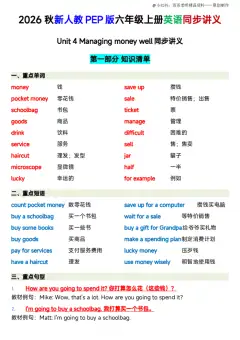
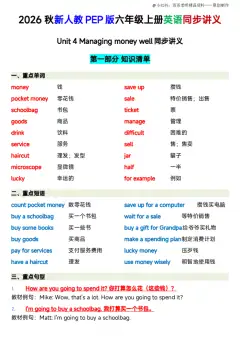
Unit 4 Managing money well
Part A Let's talk
课文翻译(中英对照)
英文原文
中文翻译
Mike: Are you counting your pocket
money,- Matt?
迈克:马特,你在数你的零花钱吗?
Matt: Yes. I have three hundred and
fifty-- seven yuan.
马特:是的。我有三百五十七元。
Mike: Wow, that's a lot. How are you
going to- spend it?
迈克:哇,好多啊。你打算怎么花它?
Matt: I'm going to buy a schoolbag.
马特:我打算买一个书包。
Mike: Yes, you need a new one.
迈克:是啊,你需要一个新的。
Matt: I also want to buy some books.
马特:我还想买一些书。
Mike: Nice. Maybe you can buy some
animal- books. They're interesting.
迈克:不错。也许你可以买一些动物书
。它们-很有趣。
Matt: Great idea! I like animals. Should I
also- buy some ice cream?
马特:好主意!我喜欢动物。我也应该
买一些-冰淇淋吗?
Mike: Sure, but don't eat too much.
迈克:当然可以,但不要吃太多。
Matt: You're right. I won't.
马特:你说得对。我不会吃太多的。
考点精讲精练
1. 核心语法:一般将来时(be going to结构);区分need和want
• be going to结构:表示计划或打算做某事
• need:表示需要(必要的东西)
@小红书:苏苏老师精品资料——原创制作
• want:表示想要(不是必要的东西)
2. 重点句型
• 询问打算如何花钱:How are you going to spend it?(你打算怎么花它?
)回答:I'm going to buy...(我打算买……)
• 表达建议:Maybe you can... / You should...
• 表达同意:Great idea! / You're right.
3. 重点词汇与短语
• count pocket money 数零花钱
• three hundred and fifty-seven yuan 三百五十七元
• spend 花费
• buy a schoolbag 买一个书包
• need a new one 需要一个新的
• want to buy some books 想买一些书
• animal books 动物书
• ice cream 冰淇淋
• too much 太多
即学即用
一、单项选择(10题)
1. Are you
your pocket money?
A. count B. counting C. counts
2. I have three
and fifty-seven yuan.
A. hundred B. hundreds C. hundreds of
3. How are you going to
it?
@小红书:苏苏老师精品资料——原创制作
A. spend B. spends C. spending
4. I'm going to
a schoolbag.
A. buy B. buys C. buying
5. You need a new
A. one B. it C. that
6. I also want
some books.
A. buy B. to buy C. buying
7. Maybe you can buy some animal
.
A. book B. books C. bookes
8. Should I also
some ice cream?
A. buy B. buys C. buying
9. Don't eat too
A. many B. much C. more 10. I
eat too much.
A. won't B. will C. am not
二、选词填空(10题)
counting hundred spend buy one to buy books buy much won't 1.
He is
his money.
2. There are two
students in our school.
3. How do you
your pocket money?
4. I want to
a new pen.
5. This pen is broken. I need a new
.
6. I want
some storybooks.
7. There are many
in the library.
8. Should I
some fruit?
9. Don't eat too
candy.
@小红书:苏苏老师精品资料——原创制作
10. I
be late for school.
三、用所给单词的适当形式填空(10题)
1. Are you
(count) your pocket money?
2. I have two
(hundred) yuan.
3. How are you going to
(spend) it?
4. I'm going to
(buy) a new schoolbag.
5. You need a new
(one).
6. I want
(buy) some books.
7. These
(book) are very interesting.
8. Should I
(buy) some ice cream?
9. Don't eat too
(many) ice cream.
10. I
(will) eat too much.
四、连词成句(5题)
1. are, you, counting, pocket, your, money (?)
2. going, I'm, to, a, schoolbag, buy (.)
3. want, I, to, some, books, buy (.)
4. should, I, some, ice cream, buy (?)
5. don't, too, eat, much (.)
Part B Let's talk
课文翻译(中英对照)
英文原文
中文翻译
Mum: How much pocket money doyou
have- ?
妈妈:你有多少零花钱?
@小红书:苏苏老师精品资料——原创制作
Sarah: I have one hundred and
forty-six- yuan.
萨拉:我有一百四十六元。
Mum: What else are you going to buy?
妈妈:你还打算买什么?
Sarah: A lot. But first I'm going to buy a
pair- of sunglasses for Grandpa.
萨拉:很多东西。但首先我打算给爷爷
买一副-太阳镜。
Mum: Why?
妈妈:为什么?
Sarah: Because he lost his old pair
last- weekend.
萨拉:因为他上周末把旧的弄丢了。
Mum: That's so nice of you!
妈妈:你真是太贴心了!
Sarah: I also want to buy a microscope.
萨拉:我还想买一个显微镜。
Mum: Good idea! But microscopes
are- expensive.
妈妈:好主意!但显微镜很贵。
Sarah: I also have some lucky money
from-
萨拉:我还有一些春节的压岁钱,但我还
需要-
the Spring Festival, but I still need to
save- more.
攒更多钱。
Mum: Maybe we can wait for a sale!
妈妈:也许我们可以等打折!
考点精讲精练
1. 核心语法:一般将来时;because引导的原因状语从句
• because:用来回答why引导的疑问句,表示原因
• a pair of:表示"一双/一副/一对",后面跟复数名词
2. 重点句型
• 询问数量:How much + 不可数名词+ do you have?(你有多少……?)
• 询问还有什么打算:What else are you going to buy?(你还打算买什么?)
• 表达原因:Because...(因为……)
• 表达赞美:That's so nice of you!(你真是太贴心了!)
3. 重点词汇与短语
• how much 多少(询问不可数名词的数量)
@小红书:苏苏老师精品资料——原创制作
• one hundred and forty-six yuan 一百四十六元
• what else 还有什么
• a pair of sunglasses 一副太阳镜
• lose 丢失(过去式lost)
• old pair 旧的一副
• nice 贴心的;友好的
• microscope 显微镜
• expensive 昂贵的
• lucky money 压岁钱
• Spring Festival 春节
• save more 攒更多钱
• wait for a sale 等打折
即学即用
一、单项选择(10题)
1.
pocket money do you have?
A. How many B. How much C. How
2. I have one
and forty-six yuan.
A. hundred B. hundreds C. hundreds of
3. What
are you going to buy?
A. other B. else C. another
4. I'm going to buy a
of sunglasses. A.
pair B. pairs C. piece
5. He
his old pen last week.
A. lose B. loses C. lost
6. That's so nice
you!
A. for B. to C. of
@小红书:苏苏老师精品资料——原创制作
7. Microscopes
expensive.
A. is B. are C. am
8. I have some lucky money
the Spring Festival. A.
from B. to C. for
9. I need to save
A. more B. much C. many
10. Maybe we can wait
a sale.
A. for B. to C. at
二、选词填空(10题)
much hundred else pair lost of are from more for
1.
water do you drink every day?
2. There are one
trees in the park.
3. What
do you want to eat?
4. I need a
of shoes.
5. I
my keys yesterday.
6. It's very kind
you.
7. These books
very interesting.
8. I got a gift
my mother.
9. You should eat
vegetables.
10. Wait
me, please.
三、用所给单词的适当形式填空(10题)
1. How
(many) pocket money do you have?
2. I have two
(hundred) yuan.
3. What else
(be) you going to buy?
4. I want to buy a pair of
(sunglass).
@小红书:苏苏老师精品资料——原创制作
5. He
(lose) his bag last weekend.
6. That's so nice of
(your)!
7. The computer is very
(expensive).
8. I have some
(luck) money.
9. I need to save
(much) money.
10. Let's wait for the
(sell).
四、连词成句(5题)
1. much, how, money, do, have, you (?)
2. going, I'm, to, sunglasses, buy, a, of, pair (.)
3. he, his, lost, old, pair (.)
4. want, I, to, a, microscope, buy (.)
5. can, we, for, wait, a, sale (.)
Part B Read and write
课文翻译(中英对照)
英文原文
中文翻译
How can you manage money well?
你怎样才能管好钱?
Many children get pocket money from
their- parents.
很多孩子从父母那里得到零花钱。
But some of them don't know how to
use it- well.
但他们中的一些人不知道如何好好使用它
。
Here are some tips to help you manage
your- money well.
这里有一些小贴士可以帮助你管好你的钱
。
Tip 1: Make a spending plan
小贴士1:制定消费计划
Before you buy something, think
about: Do- I need it? Do I want it?
在你买东西之前,想一想:我需要它吗
?我想-要它吗?
@小红书:苏苏老师精品资料——原创制作
Buy the things you need first. Then
you can- buy the things you want.
先买你需要的东西。然后你可以买你想
要的东-西。
Write down your spending plan. It can
help- you save money.
写下你的消费计划。它可以帮助你省钱。
Tip 2: Wait for a sale
小贴士2:等打折
Many things are cheaper during a sale.
很多东西在打折期间更便宜。
You can save a lot of money if you wait
for a- sale.
如果你等打折,你可以省很多钱。
Tip 3: Save money for the future
小贴士3:为未来存钱
Don't spend all your pocket money.
不要把你所有的零花钱都花光。
Save some money in your piggy bank.
把一些钱存在你的存钱罐里。
You can use it to buy big things later,
like a- bike or a computer.
你以后可以用它买大件物品,比如自行
车或电-脑。
Tip 4: Use your money to help others
小贴士4:用你的钱帮助别人
You can use some of your money to
help- people in need.
你可以用你的一部分钱帮助有需要的人。
For example, you can buy books for
poor- children.
例如,你可以给贫困儿童买书。
Helping others makes you feel happy
too.
帮助别人也会让你感到快乐。
考点精讲精练
1. 核心阅读技巧:提取文章的主旨和分论点
• 主旨:介绍了四种管好钱的方法
• 分论点:1. 制定消费计划2. 等打折3. 为未来存钱4. 用零花钱帮助别人
2. 重点词汇与短语
• manage money well 管好钱
• get pocket money from sb. 从某人那里得到零花钱
@小红书:苏苏老师精品资料——原创制作
• use sth. well 好好使用某物
• tip 小贴士;建议
• make a spending plan 制定消费计划
• think about 考虑
• need 需要
• want 想要
• write down 写下
• save money 省钱
• wait for a sale 等打折
• cheaper 更便宜的
• during a sale 在打折期间
• save a lot of money 省很多钱
• for the future 为未来
• spend all your money 花光你所有的钱
• piggy bank 存钱罐
• big things 大件物品
• help others 帮助别人
• people in need 有需要的人
• for example 例如
• poor children 贫困儿童
• make sb. feel happy 让某人感到快乐
3. 重点句型
• 提出建议:Here are some tips to help you...(这里有一些小贴士可以帮助你……)
• 条件状语从句:If you..., you can...(如果你……,你就能……)
即学即用
一、单项选择(10题)
@小红书:苏苏老师精品资料——原创制作
1. Many children get pocket money
their parents.
A. from B. to C. for
2. Some children don't know how to
money well. A.
use B. uses C. using
3. Here
some tips to help you.
A. is B. are C. am
4. Before you buy something, think
it.
A. about B. of C. over
5. Buy the things you need
.
A. first B. last C. then
6. Write
your spending plan.
A. down B. up C. on
7. Many things are
during a sale.
A. cheap B. cheaper C. cheapest
8. Don't spend
your pocket money.
A. all B. both C. none
9. Save some money
your piggy bank.
A. in B. on C. at
10. Helping others makes you
happy.
A. feel B. feels C. feeling
二、选词填空(10题)
from use are about first down cheaper all in feel
1. I get a gift
my father.
2. We should
water well.
3. Here
some books for you.
4. Think
your answer carefully.
@小红书:苏苏老师精品资料——原创制作
5. You should finish your homework
.
6. Please write
your name.
7. This shirt is
than that one.
8. Don't eat
the cake.
9. There is some money
the box.
10. The good news makes me
happy.
三、用所给单词的适当形式填空(10题)
1. Many children
(get) pocket money from their parents.
2. Some of them
(not know) how to use money well.
3. Here are some
(tip) to help you.
4. Before you
(buy) something, think about it.
5. Buy the things you
(need) first.
6. Write down your
(spend) plan.
7. Many things are
(cheap) during a sale.
8. Don't
(spend) all your money.
9. Save some
(money) in your piggy bank.
10. Helping others
(make) you happy.
四、连词成句(5题)
1. get, children, pocket, many, money, their, from, parents (.)
2. are, here, tips, some, you, for (.)
3. make, a, spending, plan (.)
4. wait, for, a, sale (.)
5. help, others, we, should (.)
@小红书:苏苏老师精品资料——原创制作
Part C Reading time
课文翻译(中英对照)
英文原文
中文翻译
Money: Past, now and future
货币:过去、现在和未来
1. A long time ago, people exchanged
goods- or services.
1. 很久以前,人们交换商品或服务。
Sometimes it was difficult to get the
things- they wanted.
有时候很难得到他们想要的东西。
2. Later, people used different
forms of- money.
2. 后来,人们使用不同形式的货币。
But what did the money look like? Look!
但货币是什么样子的呢?看!
There is shell money, knife money,
copper- coins, ...
有贝壳币、刀币、铜币……
3. But metal coins were heavy to carry.
3. 但金属硬币携带起来很重。
So people used paper money.
所以人们使用纸币。
4. We still use paper money today.
4. 我们今天仍然使用纸币。
We also have bankbooks and cards.
我们还有存折和银行卡。
5. Now we can use our mobile phones to
pay.
5. 现在我们可以用手机支付。
It is so quick and easy!
它又快又方便!
6. How will we buy things in future?
What are- your ideas?
6. 未来我们将如何买东西?你有什么想法
?
You can write them down or draw them
here.
你可以把它们写下来或者画在这里。
考点精讲精练
1. 核心阅读技巧:了解货币的发展历史
@小红书:苏苏老师精品资料——原创制作
• 过去:物物交换→贝壳币、刀币、铜币→纸币
• 现在:纸币、银行卡、手机支付
• 未来:未知(学生可以发挥想象)
2. 重点词汇与短语
• a long time ago 很久以前
• exchange goods or services 交换商品或服务
• difficult 困难的
• later 后来
• different forms of money 不同形式的货币
• look like 看起来像
• shell money 贝壳币
• knife money 刀币
• copper coins 铜币
• metal coins 金属硬币
• heavy 重的
• carry 携带
• paper money 纸币
• still 仍然
• bankbook 存折
• card 银行卡
• mobile phones 手机
• pay 支付
• quick and easy 又快又方便
• in future 在未来
• write down 写下
• draw 画
3. 重点句型
• 描述过去的事情:A long time ago, people...(很久以前,人们……)
@小红书:苏苏老师精品资料——原创制作
• 描述现在的事情:Now we can...(现在我们可以……)
• 询问未来的事情:How will we... in future?(未来我们将如何……?)
即学即用
一、单项选择(10题)
1. A long time ago, people
goods or services.
A. exchange B. exchanged C. exchanges
2. Sometimes it was
to get the things they wanted.
A. easy B. difficult C. interesting
3. Later, people used different
of money.
A. form B. forms C. forming
4. There is
money, knife money and copper coins.
A. shell B. paper C. metal
5. Metal coins were
to carry.
A. light B. heavy C. small
6. So people used
money.
A. paper B. shell C. knife
7. We
use paper money today.
A. still B. not C. never
8. We can use our
to pay now.
A. books B. mobile phones C. pens
9. It is so quick and
!
A. difficult B. easy C. hard
10.
will we buy things in future?
A. How B. What C. Where
@小红书:苏苏老师精品资料——原创制作
二、选词填空(10题)
exchanged difficult forms shell heavy paper still mobile easy How 1.
They
books with each other.
2. It is
to learn English well.
3. There are many
of music.
4.
money was used a long time ago.
5. The box is too
. I can't carry it.
6. We use
money every day.
7. I
live in this city.
8. We can use
phones to take photos.
9. The test is very
.
10.
do you go to school?
三、用所给单词的适当形式填空(10题)
1. A long time ago, people
(exchange) goods.
2. It was
(difficulty) to get what they wanted.
3. There are different
(form) of money.
4. What did the money
(look) like?
5. Metal coins were
(heavy) than paper money.
6. So people
(use) paper money later.
7. We still
(use) paper money today.
8. We can use mobile phones
(pay).
9. It is very
(quickly) and easy.
10. How
(will) we buy things in future?
四、连词成句(5题)
1. ago, a, long, time, people, goods, exchanged (.)
2. used, people, different, of, forms, money (.)
@小红书:苏苏老师精品资料——原创制作
3. were, heavy, coins, metal, to, carry (.)
4. use, we, paper, still, money, today (.)
Unit 4 单元答案
Part A Let's talk 即学即用答案
一、1-5 BAAAA 6-10 BBABA
二、1. counting 2. hundred 3. spend 4. buy 5. one 6. to buy 7. books 8. buy 9. much 10.
won't
三、1. counting 2. hundred 3. spend 4. buy 5. one 6. to buy 7. books 8. buy 9. much 10.
won't
四、1. Are you counting your pocket money?
2. I'm going to buy a schoolbag.
3. I want to buy some books.
4. Should I buy some ice cream?
5. Don't eat too much.
Part B Let's talk 即学即用答案
一、1-5 BABAC 6-10 CBAAA
二、1. How much 2. hundred 3. else 4. pair 5. lost 6. of 7. are 8. from 9. more 10. for
三、1. much 2. hundred 3. are 4. sunglasses 5. lost 6. you 7. expensive 8. lucky 9.
more 10. sale
四、1. How much money do you have?
2. I'm going to buy a pair of sunglasses.
3. He lost his old pair.
4. I want to buy a microscope.
@小红书:苏苏老师精品资料——原创制作
5. We can wait for a sale.
Part B Read and write 即学即用答案
一、1-5 AABAA 6-10 ABAAA
二、1. from 2. use 3. are 4. about 5. first 6. down 7. cheaper 8. all 9. in 10. feel
三、1. get 2. don't know 3. tips 4. buy 5. need 6. spending 7. cheaper 8. spend 9.
money 10. makes
四、1. Many children get pocket money from their parents.
2. Here are some tips for you.
3. Make a spending plan.
4. Wait for a sale.
5. We should help others.
Part C Reading time 即学即用答案
一、1-5 BBBAB 6-10 AABBA
二、1. exchanged 2. difficult 3. forms 4. Shell 5. heavy 6. paper 7. still 8. mobile 9.
easy 10. How三、1. exchanged 2. difficult 3. forms 4. look 5. heavier 6. used 7. use 8.
to pay 9. quick 10. will
四、1. A long time ago people exchanged goods.
2. People used different forms of money.
3. Metal coins were heavy to carry.
4. We still use paper money today.
5. We can use mobile phones to pay.
@小红书:苏苏老师精品资料——原创制作
2026秋人教PEP版六年级上册英语课文精讲精练
Unit 5 Exploring space
Part A Let's talk
课文翻译(中英对照)
英文原文
中文翻译
Mr Liu: Hi, children. Let's talk about
our- planet Earth today.
刘老师:嗨,孩子们。今天我们来谈谈
我们的-行星地球。
What can you see in the sky?
你们在天空中能看到什么?
Mike: The sky is often blue in the
daytime.- We can see the Sun and
the clouds.
迈克:白天天空通常是蓝色的。我们能
看到太-阳和云。
We can also see birds and planes.
我们还能看到鸟和飞机。
Amy: At night, we can see the Moon
and the- stars.
埃米:在晚上,我们能看到月亮和星星。
Mr Liu: Very good. But what can we see
from- outer space?
刘老师:非常好。但从外太空我们能看
到什么- ?
Let's look at some photos from a
space- station.
让我们看一些来自空间站的照片。
Binbin: Wow! We can see mountains,
oceans- and clouds. How wonderful!
斌斌:哇!我们能看到山脉、海洋和云
。太美-妙了!
Chen Jie: There are large oceans on
Earth. It- looks like a big blue marble.
陈杰:地球上有大片的海洋。它看起来
像一颗-蓝色的大弹珠。
Mr Liu: Right. Earth also has some
beautiful- names.
刘老师:对。地球还有一些美丽的名字。
For example, the Blue Planet and
Mother- Earth.
例如,蓝色星球和地球母亲。
@小红书:苏苏老师精品资料——原创制作
Mike: I like those names. I want to
know- more about our Mother
Earth!
迈克:我喜欢那些名字。我想了解更多
关于我-们的地球母亲!
考点精讲精练
1. 核心语法:情态动词can的用法;there be句型
• can:表示能力或可能性,后面跟动词原形
• there be句型:表示"某地有某物",be动词的单复数由后面的名词决定
2. 重点句型
• 询问能看到什么:What can you see in the sky?(你们在天空中能看
到什么?)回答:We can see...(我们能看到……)
• 描述事物的外观:It looks like...(它看起来像……)
• 举例说明:For example,...(例如……)
3. 重点词汇与短语
• planet Earth 行星地球
• in the sky 在天空中
• in the daytime 在白天
• the Sun 太阳
• cloud 云
• bird 鸟
• plane 飞机
• at night 在晚上
• the Moon 月亮
• star 星星
• outer space 外太空
• space station 空间站
• mountain 山脉
• ocean 海洋
@小红书:苏苏老师精品资料——原创制作
• wonderful 美妙的;精彩的
• large 大的
• look like 看起来像
• a big blue marble 一颗蓝色的大弹珠
• the Blue Planet 蓝色星球
• Mother Earth 地球母亲
4. 文化考点
• 地球:太阳系八大行星之一,是目前已知唯一存在生命的星球。
• 空间站:一种在近地轨道长时间运行的载人航天器,可供多名航天员巡访、长期
工作和生活。
即学即用
一、单项选择(10题)
1. Let's talk
our planet Earth.
A. about B. to C. with
2. What can you
in the sky?
A. see B. sees C. seeing
3. The sky is often blue
the daytime.
A. in B. on C. at
4. We can see the Sun and the
A. cloud B. clouds C. cloudes
5.
night, we can see the Moon.
A. In B. On C. At
6. What can we see
outer space?
A. from B. to C. in
7. There
large oceans on Earth.
A. is B. are C. am
@小红书:苏苏老师精品资料——原创制作
8. It looks
a big blue marble.
A. like B. as C. for
9. Earth also has some beautiful
A. name B. names C. naming
10. I want to know more
our Mother Earth. A.
about B. to C. for
二、选词填空(10题)
about see in clouds At from are like names about
1. Let's talk
our holiday.
2. I can
many birds in the tree.
3. We have four classes
the morning.
4. There are many white
in the sky.
5.
night, the stars are bright.
6. What can you see
the window?
7. There
many books on the desk.
8. It looks
a cat.
9. There are many
for this place.
10. I want to learn more
English.
三、用所给单词的适当形式填空(10题)
1. Let's
(talk) about Earth.
2. What can you
(see) in the sky?
3. The sky
(be) blue in the daytime.
4. We can see many
(cloud) in the sky.
5. At night, we can see the
(star).
6. What can we see from
(outer) space?
@小红书:苏苏老师精品资料——原创制作
7. There
(be) a big ocean on Earth.
8. It
(look) like a big blue marble.
9. Earth has some beautiful
(name).
10. I want
(know) more about Earth.
四、连词成句(5题)
1. talk, let's, about, Earth, our (.)
2. can, what, see, you, the, in, sky (?)
3. can, we, the, see, Sun, the, and, clouds (.)
4. are, there, oceans, large, Earth, on (.)
5. looks, it, a, blue, like, marble, big (.)
Part B Let's talk
课文翻译(中英对照)
英文原文
中文翻译
Mike: Hey, Chen Jie. What are you
reading- about?
迈克:嘿,陈杰。你在读什么?
Chen Jie: Mars.
陈杰:火星。
Matt: Mars? What does it say?
马特:火星?上面说什么了?
Chen Jie: It talks about things on Mars.
陈杰:它讲了火星上的东西。
Matt: Wow! Is there any water on Mars?
马特:哇!火星上有水吗?
Chen Jie: Yes, there is. There is soil too.
陈杰:是的,有。还有土壤。
Matt: Oh! Are there any aliens?
马特:哦!有外星人吗?
Chen Jie: I don't think so. They say
there- aren't any living things.
陈杰:我不这么认为。据说那里没有任何
生物-
。
Matt: I see.
马特:我明白了。
Chen Jie: Look! This is the sunrise on
Mars.
陈杰:看!这是火星上的日出。
@小红书:苏苏老师精品资料——原创制作
Mike: How beautiful! I really want to
travel- to Mars.
迈克:太美了!我真的想去火星旅行。
Chen Jie: Maybe you can go one day.
China- already put a rover on Mars.
陈杰:也许有一天你能去。中国已经在
火星上-放置了探测器。
We learn more about the "red planet"
every- year.
我们每年都在了解更多关于这颗"红色星
球"的-信息。
考点精讲精练
1. 核心语法:there be句型的一般疑问句
• 结构:Is there + 不可数名词/单数可数名词+ 地点?
肯定回答:Yes, there is. 否定回答:No, there isn't.
• Are there + 复数可数名词+ 地点?
肯定回答:Yes, there are. 否定回答:No, there aren't.
2. 重点句型
• 询问正在读什么:What are you reading about?(你在读什么?)
• 询问某地是否有某物:Is there any...? / Are there any...?
• 表达观点:I don't think so.(我不这么认为。)
• 表达愿望:I really want to...(我真的想……)
3. 重点词汇与短语
• Mars 火星
• read about 读关于……的内容
• water 水
• soil 土壤
• alien 外星人
• living things 生物
• sunrise 日出
• travel to Mars 去火星旅行
@小红书:苏苏老师精品资料——原创制作
• one day 有一天
• already 已经
• put a rover on Mars 在火星上放置探测器
• the "red planet" 红色星球(指火星)
• every year 每年
4. 文化考点
• 火星:太阳系八大行星之一,因表面呈红色而被称为"红色星球"。
• 祝融号火星车:中国首个火星探测器,于2021年成功着陆火星。
即学即用
一、单项选择(10题)
1. What are you reading
?
A. about B. to C. with
2. Is there
water on Mars?
A. some B. any C. many
3. Yes, there
A. is B. are C. am
4. There is
too.
A. soil B. soils C. soiles
5. Are there
aliens?
A. some B. any C. much
6. I don't think
A. it B. so C. that
7. There aren't any
things.
A. live B. living C. lives
8. This is the
on Mars.
A. sunrise B. sunset C. moon
@小红书:苏苏老师精品资料——原创制作
9. I really want to
to Mars.
A. travel B. travels C. travelling
10. China
put a rover on Mars.
A. already B. yet C. still
二、选词填空(10题)
about any is soil any so living sunrise travel already
1. What are you talking
?
2. Is there
milk in the bottle?
3. Yes, there
4. Plants grow in the
.
5. Are there
apples on the tree?
6. I don't think
7. There are many
things on Earth.
8. The
is very beautiful.
9. I want to
around the world.
10. He has
finished his homework.
三、用所给单词的适当形式填空(10题)
1. What are you
(read) about?
2. Is there any
(water) on Mars?
3. There
(be) soil too.
4. Are there any
(alien) on Mars?
5. I don't think
(so).
6. There aren't any
(live) things there.
7. The
(sunrise) on Mars is beautiful.
@小红书:苏苏老师精品资料——原创制作
8. I want
(travel) to Mars.
9. China
(put) a rover on Mars already.
10. We
(learn) more about Mars every year.
四、连词成句(5题)
1. are, what, reading, you, about (?)
2. there, is, water, any, Mars, on (?)
3. is, there, yes (.)
4. are, there, any, aliens (?)
5. want, I, to, Mars, to, travel (.)
Part B Read and write
课文翻译(中英对照)
英文原文
中文翻译
What do astronauts do?
宇航员做什么?
Chinese astronauts are called
taikonauts.-
中国宇航员被称为航天员。他们在太空的
生活-
Their life in space is special.
很特别。
The taikonauts get up early in the
morning.
航天员早上起床很早。
But getting ready is different. They
can't use- water to wash their faces.
但准备工作不一样。他们不能用水洗脸。
So taikonauts have to use a wet cloth.
所以航天员必须用湿布。
They brush their teeth with a
special- toothpaste and have to
"eat" it!
他们用一种特殊的牙膏刷牙,而且必须
把它"吃- "掉!
Each day the taikonauts are very busy.
They- do a lot of work.
航天员每天都很忙。他们做很多工作。
For example, they grow vegetables and
rice.
例如,他们种植蔬菜和水稻。
@小红书:苏苏老师精品资料——原创制作
Sometimes, they also give classes to-
children and answer questions about
space.
有时候,他们还给孩子们上课,回答关
于太空-的问题。
It is hard work. The taikonauts must
stay- healthy.
这是一项艰苦的工作。航天员必须保持健
康。
Every afternoon they do exercise to
keep- healthy and strong.
每天下午他们都做运动来保持健康和强壮
。
But their job is also very interesting.
但他们的工作也很有趣。
They can see the sunrise and
sunset 16- times a day.
他们一天能看到16次日出和日落。
The view is amazing! There is no
other job- like this one.
景色太壮观了!没有其他工作像这样。
考点精讲精练
1. 核心阅读技巧:提取文章的关键信息
• 中国宇航员的称呼:taikonauts
• 太空生活的特别之处:不能用水洗脸,用湿布;用特殊牙膏刷牙并"吃"掉
• 航天员的工作:种植蔬菜和水稻;给孩子们上课;回答太空问题
• 保持健康的方式:每天下午做运动
• 有趣的事情:一天能看到16次日出和日落
2. 重点词汇与短语
• astronaut 宇航员
• taikonaut 中国航天员
• in space 在太空
• special 特别的
• get up early 早起
• get ready 准备
• different 不同的
• use water to wash faces 用水洗脸
@小红书:苏苏老师精品资料——原创制作
• have to 必须
• wet cloth 湿布
• brush teeth 刷牙
• special toothpaste 特殊的牙膏
• each day 每天
• busy 忙碌的
• do a lot of work 做很多工作
• grow vegetables and rice 种植蔬菜和水稻
• give classes to children 给孩子们上课
• answer questions about space 回答关于太空的问题
• hard work 艰苦的工作
• must 必须
• stay healthy 保持健康
• do exercise 做运动
• keep healthy and strong 保持健康和强壮
• interesting 有趣的
• sunrise and sunset 日出和日落
• view 景色
• amazing 壮观的;令人惊叹的
3. 重点句型
• 被动语态:Chinese astronauts are called taikonauts.(中国宇航员被称为航天员。
)
• 描述必须做的事情:They have to...(他们必须……)
即学即用
一、单项选择(10题)
1. Chinese astronauts are
taikonauts.
@小红书:苏苏老师精品资料——原创制作
A. call B. called C. calling
2. Their life in
is special.
A. space B. school C. hospital
3. They get up
in the morning.
A. early B. late C. quickly
4. They can't use water to
their faces.
A. wash B. washes C. washing
5. So they have to use a
cloth.
A. dry B. wet C. clean
6. They brush their teeth with a
toothpaste.
A. special B. common C. cheap
7. They do a lot of _______ every day.
A. work B. works C. working
8. They grow vegetables and
.
A. rice B. rices C. ricees
9. They do exercise to
healthy.
A. stay B. stays C. staying
10. They can see the sunrise and sunset
times a day. A.
6 B. 16 C. 60
二、选词填空(10题)
called space early wash wet special work rice stay 16
1. He is __ "Little Tiger" by his friends.
2. We can see many stars in __ .
3. I get up
every morning.
4. I
my face every morning.
5. Use a
cloth to clean the table.
@小红书:苏苏老师精品资料——原创制作
6. This is a
gift for you.
7. He has a lot of
to do.
8. We eat
every day.
9. We should
healthy.
10. There are
students in the classroom.
三、用所给单词的适当形式填空(10题)
1. Chinese astronauts
(call) taikonauts.
2. Their life in space
(be) special.
3. They
(get) up early every day.
4. They can't
(use) water to wash faces.
5. They have to
(use) a wet cloth.
6. They brush their
(tooth) with special toothpaste.
7. They do a lot of
(work) every day.
8. They grow
(vegetable) and rice.
9. They must
(stay) healthy.
10. The view is
(amaze).
四、连词成句(5题)
1. are, called, taikonauts, Chinese, astronauts (.)
2. life, their, in, space, special, is (.)
3. can't, they, water, use, wash, to, faces, their (.)
4. do, they, a, lot, work, of (.)
5. do, exercise, they, to, healthy, stay (.)
@小红书:苏苏老师精品资料——原创制作
Part C Reading time
课文翻译(中英对照)
英文原文
中文翻译
Some fun facts about our solar system
关于我们太阳系的一些有趣事实
1. The closest planet to the Sun is not
the- hottest.
1. 离太阳最近的行星不是最热的。
The hottest planet is Venus. It
has a- temperature of about
467°C.
最热的行星是金星。它的温度大约是
467摄氏-度。
2. Jupiter's storm may be more than
300- years old.
2. 木星上的风暴可能已经有300多年的历
史了-
。
The name of the big storm on Jupiter
is the- Great Red Spot.
木星上这个大风暴的名字叫大红斑。
It is wider than Earth.
它比地球还宽。
3. Neptune has the fastest wind in the
solar- system.
3. 海王星有太阳系中最快的风。
Neptune's winds can reach over
2,000- kilometres per hour.
海王星的风速可以达到每小时2000多千米
。
4. Saturn has over ten moons. It may
have- more!
4. 土星有十多颗卫星。它可能还有更多!
Scientists are still looking for them.
科学家们仍在寻找它们。
5. Footprints on the Moon could stay
there- for a very long time.
5. 月球上的脚印可以在那里停留很长时间
。
They could be there for thousands of
years!
它们可能会在那里存在数千年!
6. There are thousands of pieces of
space- junk floating around Earth.
6. 有成千上万块太空垃圾漂浮在地球周围
。
@小红书:苏苏老师精品资料——原创制作
Space junk is man-made objects
left in- space.
太空垃圾是留在太空中的人造物体。
And the number is growing!
而且数量还在增加!
考点精讲精练
1. 核心阅读技巧:提取数字信息和比较级/最高级信息
• 最高级:the hottest planet, the fastest wind
• 比较级:wider than Earth
• 数字信息:467°C, 300 years old, 2,000 kilometres per hour, over ten moons,
thousands of- years, thousands of pieces
2. 重点词汇与短语
• fun facts 有趣的事实
• solar system 太阳系
• closest 最近的
• planet 行星
• hottest 最热的
• Venus 金星
• temperature 温度
• Jupiter 木星
• storm 风暴
• the Great Red Spot 大红斑
• wider 更宽的
• Neptune 海王星
• fastest 最快的
• wind 风
• reach 达到
• per hour 每小时
• Saturn 土星
@小红书:苏苏老师精品资料——原创制作
• moon 卫星
• scientist 科学家
• look for 寻找
• footprint 脚印
• the Moon 月球
• stay 停留
• thousands of 成千上万的
• space junk 太空垃圾
• float around 漂浮在……周围
• man-made objects 人造物体
• left in space 留在太空中
• number 数量
• grow 增加
3. 重点句型
• 最高级:The + 形容词最高级+ 名词+ is...(最……的……是……)
• 比较级:A is + 形容词比较级+ than B.(A比B更……)
即学即用
一、单项选择(10题)
1. The closest planet to the Sun is
the hottest.
A. not B. also C. still
2. The hottest planet is
.
A. Venus B. Jupiter C. Neptune
3. Venus has a temperature of about
°C.
A. 467 B. 300 C. 2000
4. Jupiter's storm may be more than
years old.
A. 100 B. 300 C. 1000
@小红书:苏苏老师精品资料——原创制作
5. The big storm on Jupiter is called _ .
A. the Great Red Spot B. the Great Blue Spot C. the Great Yellow Spot
6. It is
than Earth.
A. wider B. smaller C. colder
7.
has the fastest wind in the solar system.
A. Venus B. Jupiter C. Neptune
8. Neptune's winds can reach over
kilometres per hour.
A. 1000 B. 2000 C. 3000
9. Saturn has over
moons.
A. ten B. twenty C. thirty
10. Footprints on the Moon could stay there for
of years.
A. hundreds B. thousands C. millions
二、选词填空(10题)
not Venus 467 300 wider Neptune 2000 ten thousands man-made 1.
He is
a student. He is a teacher.
2.
is the hottest planet.
3. The temperature is about
°C.
4. The tree is more than
years old.
5. This river is
than that one.
6.
is the farthest planet from the Sun.
7. The car can run over
kilometres per hour.
8. I have
pens.
9. There are
of stars in the sky.
10. This is a
object.
@小红书:苏苏老师精品资料——原创制作
三、用所给单词的适当形式填空(10题)
1. The
(close) planet to the Sun is Mercury.
2. Venus is the
(hot) planet.
3. It has a
(temperate) of about 467°C.
4. Jupiter's storm may be 300
(year) old.
5. It is
(wide) than Earth.
6. Neptune has the
(fast) wind.
7. The wind can reach 2000 kilometres per
(hour).
8. Saturn has many
(moon).
9. There are thousands of
(piece) of space junk.
10. Space junk is
(man-made) objects.
四、连词成句(5题)
1. hottest, the, Venus, planet, is (.)
2. is, it, than, wider, Earth (.)
3. has, Neptune, fastest, the, wind (.)
4. has, Saturn, moons, ten, over (.)
Unit 5 单元答案
Part A Let's talk 即学即用答案
一、1-5 AAABC 6-10 ABABA
二、1. about 2. see 3. in 4. clouds 5. At 6. from 7. are 8. like 9. names 10. about
三、1. talk 2. see 3. is 4. clouds 5. stars 6. outer 7. is 8. looks 9. names 10. to know
四、1. Let's talk about our Earth.
2. What can you see in the sky?
3. We can see the Sun and the clouds.
@小红书:苏苏老师精品资料——原创制作
4. There are large oceans on Earth.
5. It looks like a big blue marble.
Part B Let's talk 即学即用答案
一、1-5 ABAAB 6-10 BBAAA
二、1. about 2. any 3. is 4. soil 5. any 6. so 7. living 8. sunrise 9. travel 10. already
三、1. reading 2. water 3. is 4. aliens 5. so 6. living 7. sunrise 8. to travel 9. has put 10.
learn
四、1. What are you reading about?
2. Is there any water on Mars?
3. Yes, there is.
4. Are there any aliens?
5. I want to travel to Mars.
Part B Read and write 即学即用答案
一、1-5 BAAAB 6-10 AAAAB
二、1. called 2. space 3. early 4. wash 5. wet 6. special 7. work 8. rice 9. stay 10. 16
三、1. are called 2. is 3. get 4. use 5. use 6. teeth 7. work 8. vegetables 9. stay 10.
amazing
四、1. Chinese astronauts are called taikonauts.
2. Their life in space is special.
3. They can't use water to wash their faces.
4. They do a lot of work.
5. They do exercise to stay healthy.
Part C Reading time 即学即用答案
@小红书:苏苏老师精品资料——原创制作
一、1-5 AAABA 6-10 ACBAB
二、1. not 2. Venus 3. 467 4. 300 5. wider 6. Neptune 7. 2000 8. ten 9. thousands 10.
man-made
三、1. closest 2. hottest 3. temperature 4. years 5. wider 6. fastest 7. hour 8. moons 9.
pieces 10.- man-made
四、1. Venus is the hottest planet.
2. It is wider than Earth.
3. Neptune has the fastest wind.
4. Saturn has over ten moons.
5. There are thousands of pieces of space junk.
@小红书:苏苏老师精品资料——原创制作
Unit 6 Energy, nature and us
Part A Let's talk
课文翻译(中英对照)
英文原文
中文翻译
Binbin: Hi, Mike.Any ideas about our
project?
斌斌:嗨,迈克。关于我们的项目有什
么想法-吗?
Mike: Maybe we can talk about water
power.
迈克:也许我们可以谈谈水能。
Binbin: OK. We use water every day.
Let's- find out more about water
power.
斌斌:好的。我们每天都用水。让我们
了解更-多关于水能的知识吧。
Mike: What do you know about it?
迈克:关于它你知道些什么?
Binbin: Running water can make
electricity.- We can get power from the
sea too.
斌斌:流水可以发电。我们也可以从海
洋中获-取能量。
Mike: What else do you want to know
about- water?
迈克:关于水你还想了解些什么?
Binbin: Well, where does water come
from?- How do we make power from
water?
斌斌:嗯,水从哪里来?我们如何用水发
电?
Mike: Good questions. Let's go to the
library- . We can work on it together.
迈克:好问题。我们去图书馆吧。我们
可以一-起做。
Binbin: Good idea!
斌斌:好主意!
考点精讲精练
1. 核心语法:一般现在时(描述客观事实)
• 描述客观真理或科学事实时,用一般现在时,不受时间状语影响
@小红书:苏苏老师精品资料——原创制作
2. 重点句型
• 询问想法:Any ideas about...?(关于……有什么想法吗?)
• 询问知道什么:What do you know about...?(关于……你知道些什么?)
• 询问还想了解什么:What else do you want to know about...?(关于……你还想了
解些什么?)
• 提出建议:Let's...(让我们……)
3. 重点词汇与短语
• project 项目
• water power 水能
• use water every day 每天用水
• find out more about 了解更多关于……
• running water 流水
• make electricity 发电
• get power from the sea 从海洋中获取能量
• come from 来自
• good questions 好问题
• go to the library 去图书馆
• work on it together 一起做
即学即用
一、单项选择(10题)
1. Any ideas
our project?
A. about B. to C. with
2. Maybe we can talk
water power.
A. about B. to C. with
3. We use water
day.
A. every B. each C. all
@小红书:苏苏老师精品资料——原创制作
4. Let's find out more
water power.
A. about B. to C. with
5.
water can make electricity.
A. Run B. Running C. Runs
6. We can get power
the sea too.
A. from B. to C. in
7. What else do you want
about water?
A. know B. to know C. knowing
8. Where does water
from?
A. come B. comes C. coming
9. Let's
to the library.
A. go B. goes C. going
10. We can work
it together.
A. on B. in C. at
二、选词填空(10题)
about about every about Running from to know come go on 1.
What do you think
this movie?
2. Let's talk
our holiday plan.
3. I go to school
day.
4. I want to learn more
English.
5.
water can make electricity.
6. We get light
the Sun.
7. I want
more about space.
8. Where do you
from?
9. Let's
to the park.
10. He is working
his homework.
@小红书:苏苏老师精品资料——原创制作
三、用所给单词的适当形式填空(10题)
1. Any
(idea) about our project?
2. Maybe we can
(talk) about water power.
3. We
(use) water every day.
4. Let's
(find) out more about it.
5.
(run) water can make electricity.
6. We can
(get) power from the sea.
7. What else do you want
(know)?
8. Where
(do) water come from?
9. Let's
(go) to the library.
10. We can
(work) on it together.
四、连词成句(5题)
1. ideas, any, our, about, project (?)
2. can, we, talk, water, about, power (.)
3. running, make, water, can, electricity (.)
4. want, what, you, to, know, else, do (?)
5. go, let's, library, the, to (.)
Part B Let's talk
课文翻译(中英对照)
英文原文
中文翻译
Miss Green: We use energy every
day. But- many resources are
running out.
格林老师:我们每天都使用能源。但很
多资源-正在耗尽。
What should we do?
我们该怎么办?
@小红书:苏苏老师精品资料——原创制作
Mike: We should save energy. Then
we will- use fewer resources.
迈克:我们应该节约能源。这样我们就
会使用-更少的资源。
Miss Green: How can we save energy?
格林老师:我们怎样才能节约能源?
Binbin: We should change our energy
use.
斌斌:我们应该改变我们的能源使用方式
。
Miss Green: Can you give us an
example,- Binbin?
格林老师:斌斌,你能给我们举个例子吗
?
Binbin: Sure. We can take quick
showers.- That will save energy and
water.
斌斌:当然。我们可以快速淋浴。那样
会节约-能源和水。
Mike: I agree. We can also use LED
lighting.
迈克:我同意。我们还可以使用LED照明
。
Binbin: And we should always unplug
our- computers and TVs.
斌斌:而且我们应该总是拔掉电脑和电
视的电-源插头。
Miss Green: Great! Small changes can
make- a big difference.
格林老师:太棒了!小小的改变可以带
来很大-的不同。
考点精讲精练
1. 核心语法:情态动词should的用法(提出建议)
• should + 动词原形:表示应该做某事,用于提出建议或表达责任
2. 重点句型
• 询问应该做什么:What should we do?(我们该怎么办?)
• 询问如何做某事:How can we...?(我们怎样才能……?)
• 举例说明:Can you give us an example?(你能给我们举个例子吗?)
• 表达观点:I agree.(我同意。)
• 总结:Small changes can make a big difference.(小小的改变可以带来很大的
不同。)
3. 重点词汇与短语
• use energy 使用能源
@小红书:苏苏老师精品资料——原创制作
• every day 每天
• resource 资源
• run out 耗尽
• save energy 节约能源
• use fewer resources 使用更少的资源
• change our energy use 改变我们的能源使用方式
• give an example 举个例子
• take quick showers 快速淋浴
• save energy and water 节约能源和水
• agree 同意
• use LED lighting 使用LED照明
• unplug computers and TVs 拔掉电脑和电视的电源插头
• small changes 小小的改变
• make a big difference 带来很大的不同
即学即用
一、单项选择(10题)
1. We use energy
day.
A. every B. each C. all
2. Many resources are
out.
A. run B. running C. runs
3. What
we do?
A. should B. would C. could
4. We should
energy.
A. save B. saves C. saving
5.
can we save energy?
@小红书:苏苏老师精品资料——原创制作
A. What B. How C. Where
6. We should change our energy
.
A. use B. using C. uses
7. Can you give us an
?
A. example B. examples C. example's
8. We can take
showers.
A. quick B. quickly C. slow
9. We can also
LED lighting.
A. use B. uses C. using
10. Small changes can make a big
.
A. different B. difference C. differences
二、选词填空(10题)
every running should save How use example quick use difference 1.
I get up early
morning.
2. The water is
out.
3. We
help others.
4. We should
water.
5.
do you go to school?
6. We should
our time well.
7. Can you give me an
?
8. He had a
breakfast and went to school.
9. We can
solar power.
10. The
between them is very big.
三、用所给单词的适当形式填空(10题)
1. We
(use) energy every day.
@小红书:苏苏老师精品资料——原创制作
2. Many resources are
(run) out.
3. What should we
(do)?
4. We should
(save) energy.
5. How can we
(save) energy?
6. We should change our energy
(use).
7. Can you give us an
(example)?
8. We can take
(quickly) showers.
9. We can also
(use) LED lighting.
10. Small changes can make a big
(different).
四、连词成句(5题)
1. use, we, energy, every, day (.)
2. should, we, energy, save (.)
3. can, how, we, energy, save (?)
4. can, we, quick, take, showers (.)
5. changes, small, big, a, make, can, difference (.)
Part B Read and write
课文翻译(中英对照)
英文原文
中文翻译
Save energy, save our Earth!
节约能源,拯救我们的地球!
Mother Earth is running out of
resources!- What should we do?
地球母亲的资源正在耗尽!我们该怎么办
?
Here are our top three ideas. We
should all- try to save energy and save
our Earth!
这里是我们的三大建议。我们都应该努
力节约-能源,拯救我们的地球!
@小红书:苏苏老师精品资料——原创制作
Idea 1: Useful tips to save water
建议1:节约用水的实用小贴士
- Take a quick shower.
- 快速淋浴。
- Wash all your dirty clothes together,
not- one at a time.
- 把你所有的脏衣服一起洗,不要一次洗
一件。
- Wash fruit and vegetables, then
use the- water again.
- 洗水果和蔬菜,然后把水再利用。
Think: How does a quick shower
save- energy?
思考:快速淋浴如何节约能源?
Idea 2: Useful tips to use less electricity
建议2:节约用电的实用小贴士
- Use LED lighting.
- 使用LED照明。
- Turn off your TV or computer and
unplug it.
- 关掉你的电视或电脑并拔掉电源插头。
- Set your air conditioner to 26°C or
more in- summer.
- 夏天把空调调到26摄氏度或更高。
Think: How can you use air conditioners
less?
思考:你怎样才能少用空调?
Idea 3: Great tips to save and
recycle- resources
建议3:节约和回收资源的好建议
- Use both sides of paper.
- 使用纸的两面。
- Use old bottles again. You can put
noodles- or pencils in them.
- 重复使用旧瓶子。你可以把面条或铅
笔放在-里面。
Think: What are your ideas for
following the- "3R" rules?
思考:你有什么遵守"3R"原则的想法?
考点精讲精练
1. 核心阅读技巧:提取文章的分论点和具体建议
• 分论点:节约用水、节约用电、节约和回收资源
• 每个分论点下的具体建议:3条节约用水的方法,3条节约用电的方法,2条节约和回
收资源的方法
@小红书:苏苏老师精品资料——原创制作
2. 重点词汇与短语
• save energy 节约能源
• save our Earth 拯救我们的地球
• top three ideas 三大建议
• try to do sth. 努力做某事
• useful tips 实用小贴士
• save water 节约用水
• take a quick shower 快速淋浴
• wash dirty clothes 洗脏衣服
• together 一起
• one at a time 一次一件
• wash fruit and vegetables 洗水果和蔬菜
• use the water again 再利用水
• use less electricity 节约用电
• turn off 关掉
• unplug 拔掉电源插头
• set air conditioner to 26°C 把空调调到26摄氏度
• in summer 在夏天
• use air conditioners less 少用空调
• save and recycle resources 节约和回收资源
• use both sides of paper 使用纸的两面
• use old bottles again 重复使用旧瓶子
• follow the "3R" rules 遵守"3R"原则
3. 重点句型
• 提出建议:Here are our top three ideas.(这里是我们的三大建议。)
• 祈使句:用于给出建议,直接以动词原形开头
即学即用
@小红书:苏苏老师精品资料——原创制作
一、单项选择(10题)
1. Mother Earth is running out
resources.
A. of B. in C. at
2. Here
our top three ideas.
A. is B. are C. am
3. We should all try
save energy.
A. to B. for C. at
4. Take a
shower.
A. quick B. quickly C. slow
5. Wash all your dirty clothes
.
A. together B. one by one C. alone
6. Use the water
A. again B. too C. also
7. Use
lighting.
A. LED B. CFL C. incandescent
8. Turn
your TV when you leave.
A. off B. on C. up
9. Set your air conditioner to 26°C
more in summer. A.
or B. and C. but
10. Use
sides of paper.
A. both B. all C. either
二、选词填空(10题)
of are to quick together again LED off or both
1. He is running out
money.
2. Here
some books for you.
@小红书:苏苏老师精品资料——原创制作
3. I try
study hard.
4. He had a
lunch.
5. Let's go to the park
.
6. You can use the pen
.
7. We use
lighting at home.
8. Please turn
the light.
9. You can have an apple
an orange.
10. There are trees on
sides of the road.
三、用所给单词的适当形式填空(10题)
1. Mother Earth is
(run) out of resources.
2. Here are our top three
(idea).
3. We should try
(save) energy.
4. Take a
(quickly) shower.
5. Wash all your
(dirty) clothes together.
6. Use the water
(one) again.
7. We can use
(LED) lighting.
8. Turn off your TV and
(plug) it.
9. Set your air
(condition) to 26°C.
10. Use both
(side) of paper.
四、连词成句(5题)
1. save, energy, save, our, and, Earth (.)
2. take, a, quick, shower (.)
3. wash, clothes, your, dirty, together (.)
4. use, LED, lighting (.)
5. use, both, of, sides, paper (.)
@小红书:苏苏老师精品资料——原创制作
Part C Reading time
课文翻译(中英对照)
英文原文
中文翻译
A handmade solar oven
一个手工制作的太阳能烤箱
1. It was a sunny day. Grandpa, Binbin
and- Robin played outside.
1. 这是一个晴天。爷爷、斌斌和罗宾在外
面玩-
。
2. They didn't want to go back to the
kitchen- to cook lunch.
2. 他们不想回厨房做午饭。
So, what could they do?
那么,他们能做什么呢?
3. Grandpa had an idea.
3. 爷爷有了一个主意。
"The sun is very hot. We can use solar
power- to cook our lunch here," he
said.
"太阳很热。我们可以用太阳能在这里做
午饭,- "他说。
"Let's make a solar oven!"
"让我们做一个太阳能烤箱吧!"
So, they did.
于是,他们就做了。
4. "Wow! How does the box keep the
heat?- Why do we use black paper?"
4. "哇!这个盒子是如何保温的?我们
为什么-要用黑纸?"
Binbin wanted to know.
斌斌想知道。
5. Soon their meal was ready.
5. 很快他们的饭就做好了。
"The food is delicious! And we cooked
with-
"食物太美味了!而且我们没有用煤气或电
!太-
no gas or electricity! That's super cool!"
said- Binbin.
酷了!"斌斌说。
6. "Sunlight is a great source of energy.
It can- help light our house.
6. "阳光是一种很好的能源。它可以帮
助我们-照亮房子。
It can run cars. And we can use it to cook
too-
它可以驱动汽车。我们也可以用它来做饭
!"罗-
!" said Robin.
宾说。
@小红书:苏苏老师精品资料——原创制作
"Yes, we should use energy in smart
ways,"- said Grandpa with a smile.
"是的,我们应该聪明地使用能源,"爷
爷笑着-说。
考点精讲精练
1. 核心阅读技巧:理解故事的发展顺序和太阳能烤箱的原理
• 故事顺序:晴天在外面玩→不想回厨房做饭→爷爷提议做太阳能烤箱→制作太阳
能烤箱→饭做好-了→讨论太阳能的用途
• 太阳能烤箱的原理:利用太阳能(太阳光)来加热食物,不需要煤气或电
2. 重点词汇与短语
• handmade 手工制作的
• solar oven 太阳能烤箱
• sunny day 晴天
• play outside 在外面玩
• go back to the kitchen 回厨房
• cook lunch 做午饭
• have an idea 有了一个主意
• solar power 太阳能
• keep the heat 保温
• black paper 黑纸
• soon 很快
• meal 饭;一餐
• ready 准备好的
• delicious 美味的
• gas 煤气
• electricity 电
• super cool 太酷了
• sunlight 阳光
• a great source of energy 一种很好的能源
@小红书:苏苏老师精品资料——原创制作
• light our house 照亮我们的房子
• run cars 驱动汽车
• use energy in smart ways 聪明地使用能源
• with a smile 笑着
3. 重点句型
• 描述天气:It was a sunny day.(这是一个晴天。)
• 提出建议:Let's make a solar oven!(让我们做一个太阳能烤箱吧!)
• 感叹句:That's super cool!(太酷了!)
即学即用
一、单项选择(10题)
1. It was a
day.
A. sunny B. rainy C. cloudy
2. They played
.
A. inside B. outside C. at home
3. They didn't want to go back to the
to cook lunch. A.
bedroom B. kitchen C. living room
4. Grandpa had
idea.
A. a B. an C. the
5. We can use
power to cook lunch.
A. solar B. water C. wind
6. Let's
a solar oven.
A. make B. makes C. making
7. How does the box keep the
?
A. heat B. hot C. cold
8. Soon their
was ready.
@小红书:苏苏老师精品资料——原创制作
A. meal B. meals C. food
9. The food is
!
A. delicious B. deliciously C. bad
10. We should use energy in
ways.
A. smart B. stupid C. bad
二、选词填空(10题)
sunny outside kitchen an solar make heat meal delicious smart 1.
It is a
day today.
2. The children are playing
.
3. My mother is cooking in the
.
4. I have
good idea.
5. We can use
power to make electricity.
6. Let's
a model plane.
7. The sun gives us
and light.
8. We have three
a day.
9. The cake is very
.
10. He is a
boy.
三、用所给单词的适当形式填空(10题)
1. It
(be) a sunny day yesterday.
2. They
(play) outside last weekend.
3. They didn't want
(go) back to the kitchen.
4. Grandpa
(have) an idea.
5. We can use solar power
(cook) lunch.
6. Let's
(make) a solar oven.
7. How does the box
(keep) the heat?
8. Soon their meal
(be) ready.
@小红书:苏苏老师精品资料——原创制作
9. The food is very
(delicious).
10. We should use energy in
(smartly) ways.
四、连词成句(5题)
1. was, a, it, sunny, day (.)
2. played, they, outside (.)
3. had, grandpa, an, idea (.)
4. let's, a, solar, make, oven (!)
5. food, the, is, delicious (!)
Unit 6 单元答案
Part A Let's talk 即学即用答案
一、1-5 AAAAB 6-10 ABAAA
二、1. about 2. about 3. every 4. about 5. Running 6. from 7. to know 8. come 9. go 10.
on
三、1. ideas 2. talk 3. use 4. find 5. Running 6. get 7. to know 8. does 9. go 10. work
四、1. Any ideas about our project?
2. We can talk about water power.
3. Running water can make electricity.
4. What else do you want to know?
5. Let's go to the library.
Part B Let's talk 即学即用答案
一、1-5 ABAAB 6-10 AAAAB
@小红书:苏苏老师精品资料——原创制作
二、1. every 2. running 3. should 4. save 5. How 6. use 7. example 8. quick 9. use 10.
difference三、1. use 2. running 3. do 4. save 5. save 6. use 7. example 8. quick 9.
use 10. difference
四、1. We use energy every day.
2. We should save energy.
3. How can we save energy?
4. We can take quick showers.
5. Small changes can make a big difference.
Part B Read and write 即学即用答案
一、1-5 ABAAA 6-10 AAAAA
二、1. of 2. are 3. to 4. quick 5. together 6. again 7. LED 8. off 9. or 10. both
三、1. running 2. ideas 3. to save 4. quick 5. dirty 6. once 7. LED 8. unplug 9.
conditioner 10. sides
四、1. Save energy and save our Earth.
2. Take a quick shower.
3. Wash your dirty clothes together.
4. Use LED lighting.
5. Use both sides of paper.
Part C Reading time 即学即用答案
一、1-5 ABBBA 6-10 AAAAA
二、1. sunny 2. outside 3. kitchen 4. an 5. solar 6. make 7. heat 8. meals 9.
delicious 10. smart三、1. was 2. played 3. to go 4. had 5. to cook 6. make 7. keep 8.
was 9. delicious 10. smart
@小红书:苏苏老师精品资料——原创制作
四、1. It was a sunny day.
2. They played outside.
3. Grandpa had an idea.
4. Let's make a solar oven!
5. The food is delicious!
@小红书:苏苏老师精品资料——原创制作,更多精品资料关注小红书