2025 年高考押题预测卷
英 语
(考试时间:120分钟 试卷满分:140分)
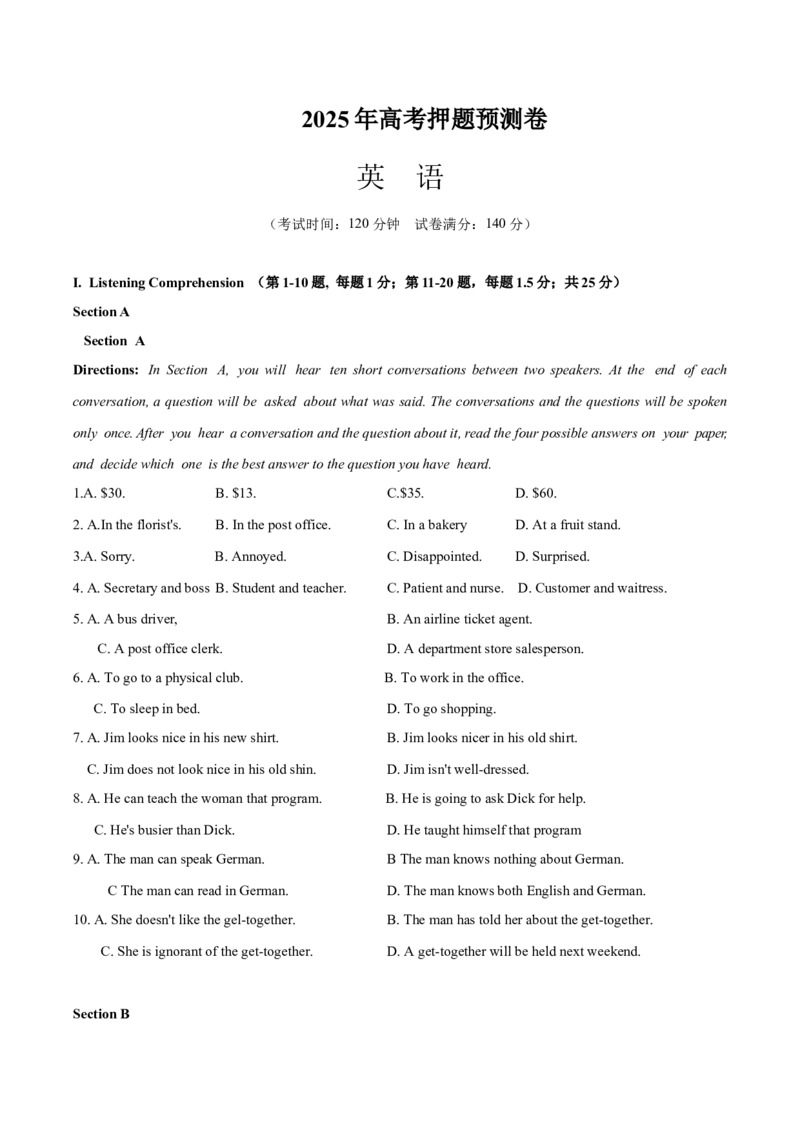
I. Listening Comprehension (第1-10题, 每题1分;第11-20题,每题1.5分;共25分)
Section A
Section A
Directions: In Section A, you will hear ten short conversations between two speakers. At the end of each
conversation, a question will be asked about what was said. The conversations and the questions will be spoken
only once. After you hear a conversation and the question about it, read the four possible answers on your paper,
and decide which one is the best answer to the question you have heard.
1.A. $30. B. $13. C.$35. D. $60.
2. A.In the florist's. B. In the post office. C. In a bakery D. At a fruit stand.
3.A. Sorry. B. Annoyed. C. Disappointed. D. Surprised.
4. A. Secretary and boss B. Student and teacher. C. Patient and nurse. D. Customer and waitress.
5. A. A bus driver, B. An airline ticket agent.
C. A post office clerk. D. A department store salesperson.
6. A. To go to a physical club. B. To work in the office.
C. To sleep in bed. D. To go shopping.
7. A. Jim looks nice in his new shirt. B. Jim looks nicer in his old shirt.
C. Jim does not look nice in his old shin. D. Jim isn't well-dressed.
8. A. He can teach the woman that program. B. He is going to ask Dick for help.
C. He's busier than Dick. D. He taught himself that program
9. A. The man can speak German. B The man knows nothing about German.
C The man can read in German. D. The man knows both English and German.
10. A. She doesn't like the gel-together. B. The man has told her about the get-together.
C. She is ignorant of the get-together. D. A get-together will be held next weekend.
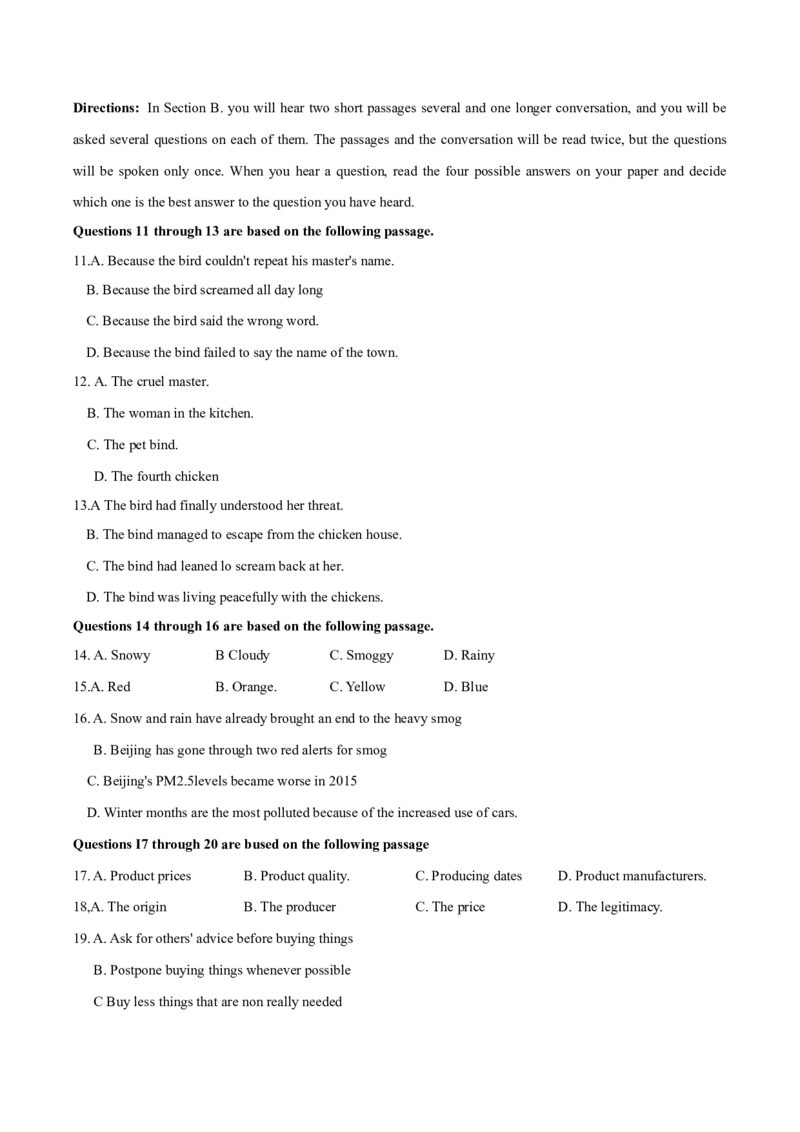
Section BDirections: In Section B. you will hear two short passages several and one longer conversation, and you will be
asked several questions on each of them. The passages and the conversation will be read twice, but the questions
will be spoken only once. When you hear a question, read the four possible answers on your paper and decide
which one is the best answer to the question you have heard.
Questions 11 through 13 are based on the following passage.
11.A. Because the bird couldn't repeat his master's name.
B. Because the bird screamed all day long
C. Because the bird said the wrong word.
D. Because the bind failed to say the name of the town.
12. A. The cruel master.
B. The woman in the kitchen.
C. The pet bind.
D. The fourth chicken
13.A The bird had finally understood her threat.
B. The bind managed to escape from the chicken house.
C. The bind had leaned lo scream back at her.
D. The bind was living peacefully with the chickens.
Questions 14 through 16 are based on the following passage.
14.A. Snowy B Cloudy C. Smoggy D. Rainy
15.A. Red B. Orange. C. Yellow D. Blue
16. A. Snow and rain have already brought an end to the heavy smog
B. Beijing has gone through two red alerts for smog
C. Beijing's PM2.5levels became worse in 2015
D. Winter months are the most polluted because of the increased use of cars.
Questions I7 through 20 are bused on the following passage
17. A. Product prices B. Product quality. C. Producing dates D. Product manufacturers.
18,A. The origin B. The producer C. The price D. The legitimacy.
19. A. Ask for others' advice before buying things
B. Postpone buying things whenever possible
C Buy less things that are non really neededD. Search for things that are less costly
20. A. Things in most second-hand shops are very good
B. People should always buy the cheapest products
C. Expensive things last longer than the cheap ones
D. The less you spend the more you can save
II. Grammar and Vocabulary (每题1分;共20分)
Section A
Directions: After reading the passage below, fill in the blanks to make the passage coherent and grammatically
correct. For the blanks with a given word, fill in each blank with the proper form of the given word; for the other
blanks, use one word that best fits each blank.
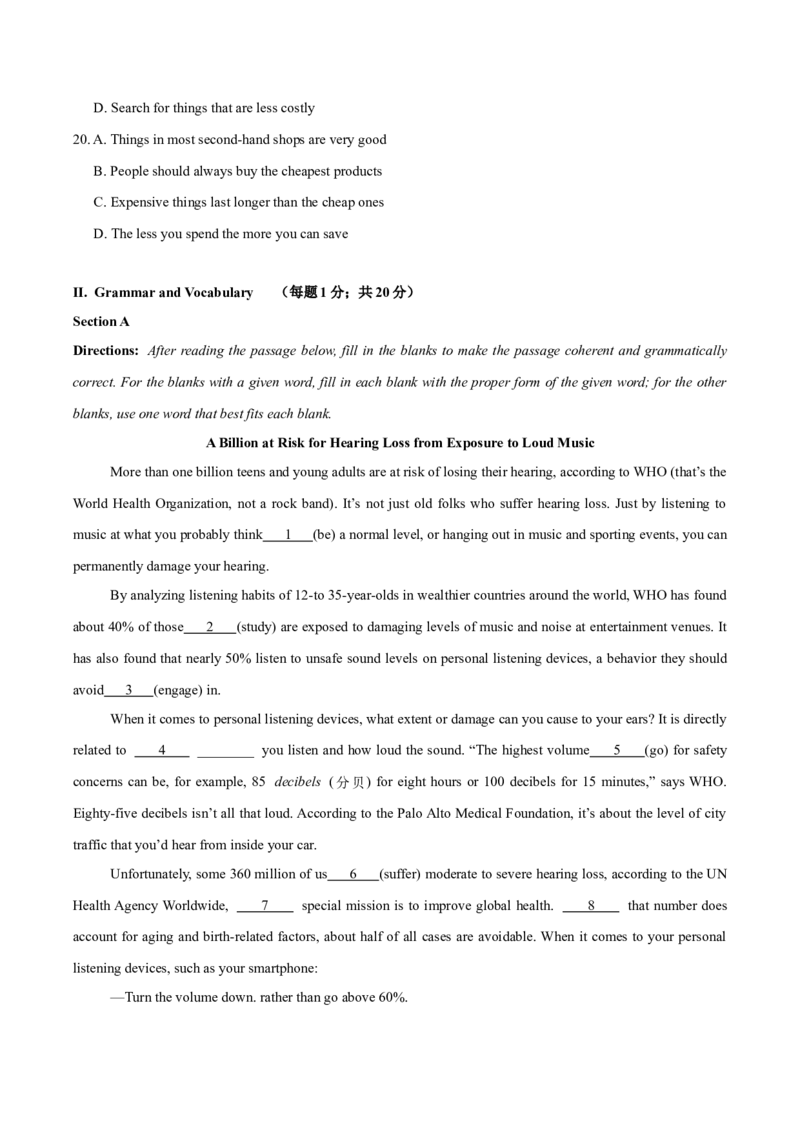
A Billion at Risk for Hearing Loss from Exposure to Loud Music
More than one billion teens and young adults are at risk of losing their hearing, according to WHO (that’s the
World Health Organization, not a rock band). It’s not just old folks who suffer hearing loss. Just by listening to
music at what you probably think 1 (be) a normal level, or hanging out in music and sporting events, you can
permanently damage your hearing.
By analyzing listening habits of 12-to 35-year-olds in wealthier countries around the world, WHO has found
about 40% of those 2 (study) are exposed to damaging levels of music and noise at entertainment venues. It
has also found that nearly 50% listen to unsafe sound levels on personal listening devices, a behavior they should
avoid 3 (engage) in.
When it comes to personal listening devices, what extent or damage can you cause to your ears? It is directly
related to 4 ________ you listen and how loud the sound. “The highest volume 5 (go) for safety
concerns can be, for example, 85 decibels (分贝) for eight hours or 100 decibels for 15 minutes,” says WHO.
Eighty-five decibels isn’t all that loud. According to the Palo Alto Medical Foundation, it’s about the level of city
traffic that you’d hear from inside your car.
Unfortunately, some 360 million of us 6 (suffer) moderate to severe hearing loss, according to the UN
Health Agency Worldwide, 7 special mission is to improve global health. 8 that number does
account for aging and birth-related factors, about half of all cases are avoidable. When it comes to your personal
listening devices, such as your smartphone:
—Turn the volume down. rather than go above 60%.—Wear noise 9 (cancel) earphones, or better yet, headphones.
—Take “listening breaks” or only listen for just an hour a day
—Learn about appropriate apps for that. Choose 10 to download on your phone to help monitor
safe listening levels.
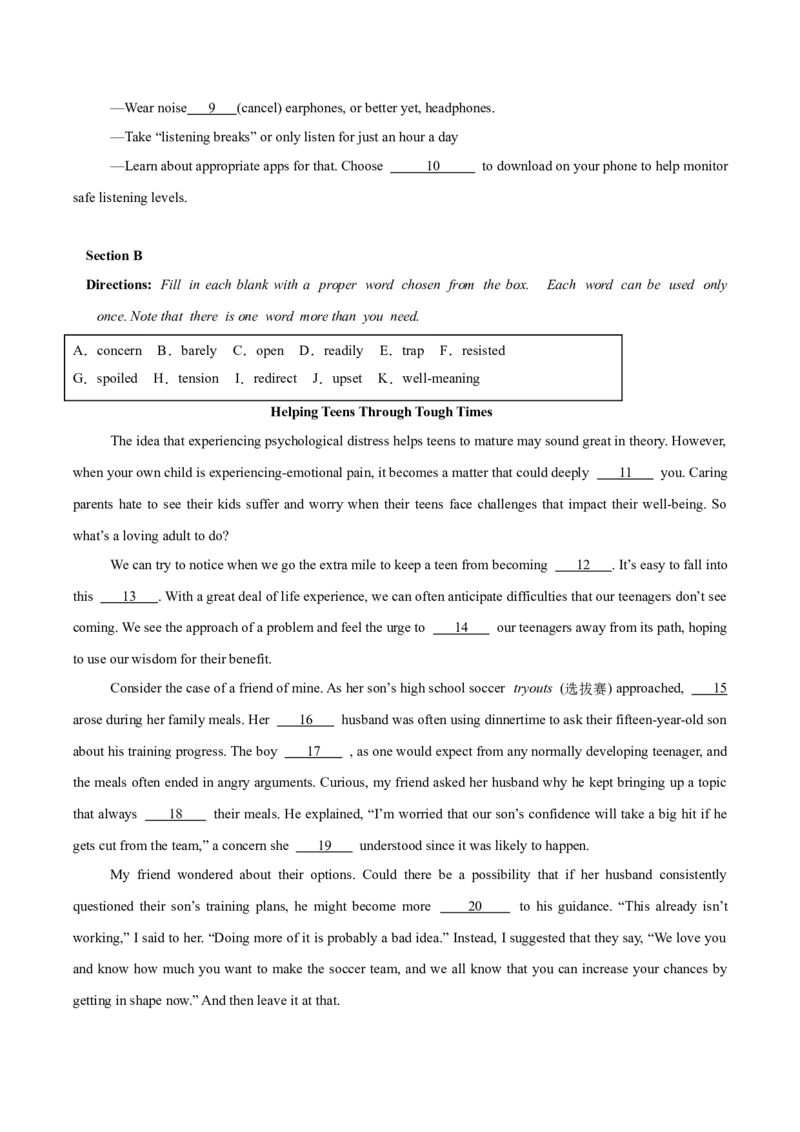
Section B
Directions: Fill in each blank with a proper word chosen from the box. Each word can be used only
once. Note that there is one word more than you need.
A.concern B.barely C.open D.readily E.trap F.resisted
G.spoiled H.tension I.redirect J.upset K.well-meaning
Helping Teens Through Tough Times
The idea that experiencing psychological distress helps teens to mature may sound great in theory. However,
when your own child is experiencing-emotional pain, it becomes a matter that could deeply 11 you. Caring
parents hate to see their kids suffer and worry when their teens face challenges that impact their well-being. So
what’s a loving adult to do?
We can try to notice when we go the extra mile to keep a teen from becoming 12 . It’s easy to fall into
this 13 . With a great deal of life experience, we can often anticipate difficulties that our teenagers don’t see
coming. We see the approach of a problem and feel the urge to 14 our teenagers away from its path, hoping
to use our wisdom for their benefit.
Consider the case of a friend of mine. As her son’s high school soccer tryouts (选拔赛) approached, 15
arose during her family meals. Her 16 husband was often using dinnertime to ask their fifteen-year-old son
about his training progress. The boy 17 , as one would expect from any normally developing teenager, and
the meals often ended in angry arguments. Curious, my friend asked her husband why he kept bringing up a topic
that always 18 their meals. He explained, “I’m worried that our son’s confidence will take a big hit if he
gets cut from the team,” a concern she 19 understood since it was likely to happen.
My friend wondered about their options. Could there be a possibility that if her husband consistently
questioned their son’s training plans, he might become more 20 to his guidance. “This already isn’t
working,” I said to her. “Doing more of it is probably a bad idea.” Instead, I suggested that they say, “We love you
and know how much you want to make the soccer team, and we all know that you can increase your chances by
getting in shape now.” And then leave it at that.III. Reading Comprehension
Section A
Directions: For each blank in the following passage there are four words or phrases marked A. B.C and D.
Fill in each blank with the word or phrase that best fits the context
By setting time aside to journal, teachers and learners have an in-depth moment with the subject they are
writing about. They get to reflect and write on a subject with no limitations and, by doing so, end up with a good
21 record of the constant progress made. One of the most valuable parts of journaling is honest personal
feedback.
Journaling helps collect, record, and properly 22 information. In our world, and more so due to the
internet and numerous books, there is much information. Students often think they can 23 the
information they get from various sources, only to realize they need to remember a lot of fine details. Journaling
can give students time to reflect on the 24 content and find ways to relate it to their lives. In a word,
journaling helps 25 students, making them active readers.
Journaling helps to nurture dreams and ideas and cultivate them into reality. Once something is penned
down, it starts its journey toward being realized. Every time it is reflected on, it improves and develops. In your
class, if students spend daily/weekly time journaling, the 26 makes them develop solid plans that they are
passionate about.
Since journaling helps keep track of things, it helps create a culture of problem-solving in students. Students
become more 27 solving problems, and while doing so, they get an in-depth understanding of the
subjects they take in school. Students also make many discoveries for themselves since they are more 28 .
It is a wonder how much can be accomplished when learners are intentional about learning.
Journaling and self-reflection develop self-esteem in students. The habits create a sense of freedom in
expressing one's thoughts and further a forum to correct and improve the thought process. 29 , high self-
esteem is formed in learners as they feel free to create, recreate, and improve.
Teachers should give students guiding questions to help them decide on the topics given for writing. Guiding
questions 30 the thinking process and encourage certain lines of thought. Teachers should ensure the
questions are 31 . The questions should trigger creative thinking, curiosity, and problem-solving skills.
Another way to build up the journaling habit is by throwing out the rule book. Most of the writing done in schools
is governed by rules and feels like an examination. Journaling is meant to 32 writing and the creativehabit. Getting rid of the rules in the initial stages allows for the 33 flow of ideas and the ability to express
oneself.
The process should be 34 . Teachers should ensure that students continuously write in their
journals. Journaling and self-reflection ensure that students keep track of their daily happenings and feelings. The
new daily task helps create a web of events, some of which are questions and other 35 to existing
problems.
21.A.class B.service C.travel D.track
22.A.accumulate B.centralize C.analyze D.confirm
23.A.disclose B.retain C.convey D.share
24.A.removed B.dumped C.learned D.digested
25.A.transform B.connect C.grade D.amaze
26.A.reflection B.performance C.guidance D.inspiration
27.A.satisfied with B.devoted to C.tired of D.confused about
28.A.bored B.relaxed C.thrilled D.focused
29.A.Moreover B.Instead C.Therefore D.However
30.A.accompany B.disrupt C.explore D.prompt
31.A.old-fashioned B.noble-minded C.far-sighted D.eye-opening
32.A.nurture B.publish C.recommend D.collect
33.A.rapid B.free C.rhythmic D.steady
34.A.consistent B.complete C.complex D.comprehensive
35.A.messages B.notes C.solutions D.paths
Section B
Directions: Read the following three passages. Each passage is followed by several questions or unfinished
statements. For each of them there are four choices marked A, B, C and D. Choose the one that fits best according
to the information given in the passage you have just read.
(A)
Research reveals that not only brain cells, but also cells from other body parts, can store memories. This
discovery offers new insights into memory function and potential treatments for memory-related issues, according
to New York University. The research aimed to explore whether non-brain cells contribute to memory by applying
the massed-spaced effect — a principle suggesting that information is remembered better when learned overmultiple periods rather than through intensive study in a single session.
In their study, published in Nature Communications, scientists investigated two types of non-brain human
cells in a laboratory setting. These cells were exposed to various chemical signals, similar to how brain cells
respond to neurotransmitters (神经递质) during learning. In response, the non-brain cells activated a “memory
gene”— the same gene that brain cells use for detecting patterns and restructure their connections to form
memories. To monitor this process, the researchers engineered the cells to produce a fluorescent protein, allowing
them to track when the memory gene was turned on or off.
The results showed that these cells could detect repeated chemical signals, similar to neurotransmitter bursts
in the brain, rather than extended ones. This mirrors how brain cells register learning with spaced breaks instead of
learning everything all at once. When signals were spaced out, the “memory gene” was activated more strongly and
for a longer time than when delivered all at once. “This reflects the massed-spaced effect,” says Kukushkin, a
clinical associate professor at NYU. “It shows that repeated learning is a fundamental property of all cells.”
“This discovery opens new doors for understanding how memory works and could lead to better ways to
enhance learning and treat memory-related issues,” observes Kukushkin. “It also suggests that in the future, we
may need to treat our body like the brain, considering how systems such as digestion or cancer cells ‘remember’
patterns to regulate blood sugar or respond to the pattern of cancer treatment. ”
36.What does the massed-spaced effect illustrate?
A.The brain stores memory during deep sleep.
B.Spacing learning over time improves memory.
C.Memory is stored only when repeated continuously.
D.Learning everything in one session reduces memory.
37.What does the underlined phrase “fluorescent protein” refer to?
A.A neurotransmitter produced by brain cells.
B.A type of chemical signal released by cells.
C.A protein found only in brain-related research.
D.A substance that indicates active memory genes.
38.What can be learned from the research in paragraph 3?
A.All cells possess the basic characteristic of repeated learning.
B.Cells do not respond to chemical signals during learning.
C.Intensive learning is more effective than spaced learning.
D.The brain only uses extended bursts of neurotransmitters.39.What could be a suitable title for this article?
A.Exploring Memory Function in the Brain.
B.The Role of Non-Brain Cells in Memory Storage.
C.How Brain Cells Detect Patterns during Learning.
D.The Impact of Chemical Signals on Memory Formation.
(B)
When Disaster Strikes, Be Prepared!
Don’t leave home without this survival kit!
When the going gets tough, you need to be
ready. Power cuts, floods, ice storms,
hurricanes and wildfires, have become the
usual. You should always be prepared. Our
Desert Camo Emergency Survival Kit will
help you to the challenge. Having the right
tool in the right place could save your bacon!
The powerful Overwatch Tactical Flashlight is
super bright for when the power goes out. The
stainless steel Heavy Duty Multi-Tool
contains a knife, can opener, pliers and
screwdriver. The Survival Multi-Function
Card has an escape rope, wrench, saw and
more. And when the heat goes out or the car is
stuck in a winter storm, the Endurance
Emergency Blanket will help keep you warm.
Knowing you’re prepared, where there’s the
Pioneer Compass Chronograph Watch, which
features a compass, temperature display and
flint in addition to keeping time.
“WITH THE RIGHT TOOLS, YOU CAN “Good buy. [It] has everything I need for
SURVIVE MOST ANYTHING.”- getting along in the wild.”
STANISLAUS BISCOGLIA, FOUNDER &
-says client John B.
CEO, STAUER
This could be your lifesaver. Secured in a Kit Specifications of Stauer’s Survival Kits-
handy Desert Camo Carrying Kit, these Overwatch Tactical Flashlight
tools are essential for tackling most any nature
-Three light modes
disaster.
-100 lumens
With safety at the top of everyone’s wish list,
this must - have kit is one of the fastest-selling -Pioneer Compass Chronograph
items in the company’s history with over
-Compass, Flint, Wrench
30,000 sold in the first 2 months. BACK IN
STOCK for the first time after overwhelming -Temperature display
demand, we had ONLY 733 KITS
-Endurance Emergency Blanket
AVAILABLE, for this ad and half havealready sold! We recommend buying three: -4.25×6.6
one for home, one for the office and one to
-Survival Multi-Function Card
keep in your car in case trouble kicks up. If
this kit doesn’t meet your expectations, send it -Rulers for measurement
back for a full refund.
-Can opener
“Your move, Mother Nature.”
-Bottle opener
Desert Camo Emergency Survival Kit
-Heavy Duty Multi-Tool
$199 $39+S&P Save $17.50
-Small-knife
“You must use Insider Offer Code DCC 154-
- Can opener
01 to get this price.”
-Pliers & Screwdriver
1-800-333-2045
40.Who are most likely the target buyers of the Desert Camo Emergency Survival Kit?
A.Enthusiasts of extreme sports looking for related products
B.Individuals who enjoy collecting military-style gear for display.
C.Those who are concerned about safety and preparedness for emergencies
D.People who are into designing nature reserves.
41.Which of the following strategies are used in the promotion of the Desert Camo Emergency Survival Kit?
① Highlighting the urgency of buying due to limited stock.
② Featuring reviews from celebrities to build trust.
③ Offering a money-back guarantee to ensure customer satisfaction.
④ Giving discounts to make the price more appealing.
A.①②③ B.①③④ C.①②④ D.②③④
42.What does the sentence “Your move, Mother Nature.” imply in the advertisement?
A.Mother Nature is powerless against the refund policy.
B.The kit is ready to handle any disasters or emergencies.
C.The kit is a gift for Mother Nature to help protect the environment.
D.The company won’t produce the kit any more unless nature demands it.
(C)
Every decision we make is arrived at through hugely complex neurological processing. Although it feels as
though you have a choice, the action that you ‘decide’ to take is entirely directed by automatic neural activity. Brain
imaging studies show that a person’s action can be predicted by their brain activity up to 10 seconds before they
themselves become aware they are going to act. Multiple neuroscientific studies show that even those important
decisions that feel worked out are just as automatic as knee-jerk reactions (膝跳反应) (although more complex).Decision-making starts with the amygdala: a set of two almond-shaped nuclei (杏仁状核) buried deep
within the brain, which generate emotion. The amygdala registers the information streaming in through our senses
and responds to it in less than a second, sending signals throughout the brain. These produce an urge to run, fight,
freeze or grab, according to how the amygdala values various stimuli.
Before we act on the amygdala’s signals, however, the information is usually processed by other brain areas,
including some that produce conscious thoughts and emotions. Areas concerned with recognition work out what’s
going on, those concerned with memory compare it with previous experiences, and those concerned with reasoning,
judging and planning get to work on constructing various action plans. The best plan—if we are lucky—is then
selected and carried out. If any of this process goes wrong, we are likely to hesitate, or do something silly.
The various stages of decision-making are marked by different types of brain activity. Fast (gamma)waves,
with frequencies of 25 to 100 Hz, produce a keen awareness of the multiple factors that need to be taken into
account to arrive at a decision. If you are trying to choose a sandwich, for instance, gamma waves generated in
various cells within the ‘taste’ area of the brain bring to mind and compare the taste of ham, hummus, wholemeal,
sourdough, and so on. Although it may seem useful to be aware of the full range of choice, too much information
makes decision-making more difficult, so irrelevant factors get dismissed quickly and unconsciously.
After this comparison stage, the brain switches to slow-wave activity (12 to 30 Hz). This extinguishes most
of the gamma activity, leaving just a single ‘hotspot’ of gamma waves which marks the chosen option.
Although there is no ‘you’ outside your brain to direct what it’s doing, you can help it to make good
decisions by placing yourself in a situation which is likely to make the process run more smoothly. Doing
something that is physically or mentally stimulating before making a decision will help your brain produce the
initial gamma waves that generate awareness of the competing options. Getting over-excited, on the other hand,
will prevent the switch to the slow brainwaves, making it much harder to single out a choice.
43.Why does the writer mention “knee-jerk reactions” in the first paragraph?
A.To introduce the finding of the latest brain imaging studies.
B.To illustrate that decisions are not consciously thought out.
C.To call attention to a kind of neural reaction that is not very complex.
D.To show the difference between decision-making and other brain activity.
44.What does the amygdala do according to the passage?
A.It works out conscious thoughts and emotions.
B.It selects the best action plan for a given situation.
C.It dismisses factors that are irrelevant to the decision to be made.D.It processes sensory information and generates emotional responses.
45.What can be concluded from paragraphs 4 and 5?
A.Slow-wave activity usually lasts longer than fast-wave activity.
B.The brain prioritizes information before settling on a final choice.
C.Decision-making is difficult when slow-wave activity occurs first.
D.The brain needs as much information as possible to make a decision.
46.How does engaging in stimulating activities help the decision-making process?
A.By preparing the brain to single out the most reasonable choice.
B.By helping the brain switch to slow-wave activity more quickly.
C.By getting the brain to focus on those most relevant alternatives.
D.By making the brain more aware of the factors and choices involved.
Section C
Directions: Complete the following passage by using the sentences in the box Each sentence can only be used
once. Note that there are two sentences more than you need.
The Call of Alcohol
People’s reactions to alcohol can vary widely—from those who enjoy it greatly to those who find it
unappealing. The difference, as scientists are discovering, may not just be a matter of personal choice but also
deeply rooted in genetics and physiological responses.
A fascinating case is that of Lars Igum Rasmussen and his friends. 47 Researchers discovered
that their levels of a hormone called FGF21, which typically helps regulate metabolism (新陈代谢), more than
doubled. Interestingly, this hormone might also play a role in controlling alcohol intake.
FGF21 is primarily produced in the liver (肝), but its effects extend to the brain, where it seems to play a
role in regulating desires for alcohol and sugar. 48 This finding opens up new possibilities for
developing treatments targeting FGF21 pathways to reduce heavy drinking.
But why would a hormone that evolved to control metabolism also affect alcohol consumption? One theory
suggests it might be tied to our evolutionary past. Early humans frequently consumed fermented (发酵的) foods
and drinks, which could damage the liver if consumed too much. 49
In human studies, variations in the FGF21 gene have been linked to differences in alcohol consumption.
Those with one variant are more likely to drink heavily, while others with a different variant are more likely to
drink moderately or even drink nothing. These genetic insights are part of a broader effort to reveal the complexrelationship between our biology and drinking behavior.
50 If FGF21 or similar pathways can be used for treatment purposes, it might become possible
to help individuals struggling with alcohol dependence. This could also provide new avenues for understanding
how our organs, like the liver, influence behaviors traditionally considered purely psychological.
A.But whatever happens, we are still left with the discovery that our livers influence our
behaviour in unexpected ways.
B.But, so far, research had only shown that it just works for a short period of time.
C.FGF21 could have evolved as a protective response to lessen this damage by reducing the
desire to drink more.
D.The implications of this research are significant.
E.They took part in a three-day drinking marathon—not just for fun, but as part of a study on the
effects of heavy drinking.
F.When animals are genetically modified to produce higher levels of FGF21, they show a
decreased preference for alcohol and sweetened food.
IV.Summary Writing
Directions: Read the following passage. Summarize the main idea and the main point( s)of the passage in no more
than 60 words. Use your own words as far as possible.
Teenagers should be pulled of the sofa
For many years, scientists thought that the human brain was fully mature before the teen years. They thought
that a person's brain growth was complete and the structure was more or less fixed by the age of 3. However, more
recent research shows that although the brain reaches its maximum size between the ages of 12 and 14, brain
development is not yet complete.
The brain's functionally different sections communicate with each other through synapses- connections
between nerve (神经) cells. Scientists have found that synapses grow or die away, depending on how much they are
used to process information,
The good news is that teenagers do have the potential, through choice and behavior, to shape their brain
development. The brain automatically gets rid of the synapses that it doesn't need in order to make the remaining
ones more efficient. During the time the brain is removing synapses, the cells and connections that are used survive,
while the ones that are not used die away. For example, if a teenager is doing music, sports or academic studies,
those are the cells and connections that will become part of the brain's operating system. But unfortunately, if he or
she is lying on the sofa, watching TV and playing computer games, those are the brain cells and connections that
will remain into adulthood. Therefore, what you do with your teenage years could have an effect on the rest of yourlife,
What is important is that learning how synapses grow or die away can help teenagers be better equipped to
make more intelligent choices, thus motivating them to take a moment before acting to consider the consequences
of their actions. If you don't want to become an adult who is buried in the sofa all day long, pull yourself out of it
when you are still a teenager.
51.__________________________________________________________________________________________
____________________________________________________________________________________________
____________________________________________________________________________________________
____________________________________________________________________________________________
____________________________________________________________________________________________
__
V.Translation (共15分。第1小题和第2小题,每题3分;第3题4分;第4题5分。)
Directions:Translate the following sentences into English, using the words given in the brackets
52.你今天下午方便抽空来跟我见个面吗?(convenient)
53.这栋大楼里有一家装配了高级音响系统的剧院。 (equip)
54.这个家庭主妇选了一些冷冻食品, 其中三分之一贴着可回收包装的标签。(which)
55.这个博物馆的奇妙之处在于将乡村的变迁,时光的痕迹,童年的回忆,融合到一个固定的空间里。
(what)
VI.Guided Writing (共25分)
Directions: Write an English composition in 120-150 words according to the instructions given below in Chinese
假如你是明启中学的学生李明,你校准备以班级为单位,在校园周边老年社区开展“爱满社区”的社会实
践活动,并在校园网公布了如下方案,征求师生意见。写一封邮件给活动组织者,内容须包括:
1)你认为方案中需要改进的地方;
2)你的修改建议及理由。活动方案
时间 重阳节(农历九月初九)周五
时长 半天
地点 社区图书馆
●组织老年人打太极
活动内容 ●组织老年人做剪纸
●学生才艺表演展示
____________________________________________________________________________________________
____________________________________________________________________________________________
____________________________________________________________________________________________
____________________________________________________________________________________________
______________________________________________________________________________________