热点 02 建设航天强国
(嫦娥六号、神舟十九号、航天精神等)
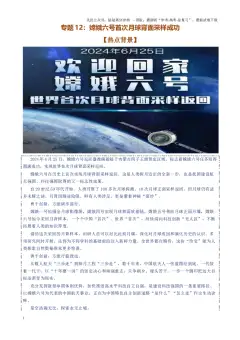
嫦娥六号探测器(Chang'e-6 lunar probe)是中国航天科技集团有限公司抓总研制的嫦娥探月计划第六
个探测器]。2024年5月3日17时27分,嫦娥六号探测器由长征五号遥八运载火箭在中国文昌航天发射场
成功发射,准确进入地月转移轨道,发射任务取得圆满成功;6月2日,嫦娥六号成功着陆在月球背面南
极-艾特肯盆地预选着陆区,开启人类探测器首次在月球背面实施的样品采集任务];6月4日7时38分,嫦
娥六号上升器携带月球样品自月球背面起飞,3000牛发动机工作约6分钟后,成功将上升器送入预定环月
轨道]。6月6日,嫦娥六号上升器成功与轨道器和返回器组合体完成月球轨道交会对接,随后将月球样品
容器安全转移至返回器中[7]。6月25日14时07分,嫦娥六号返回器准确着陆于内蒙古四子王旗预定区域,
工作正常,标志着探月工程嫦娥六号任务取得圆满成功,实现世界首次月球背面采样返回。
神舟十九号,简称“神十九”,为中国载人航天工程发射的第十九艘飞船。2023年10月,中国载人航
天工程办公室消息,经任务总指挥部决定,执行神舟十九号载人飞行任务的航天员乘组由蔡旭哲、宋令东、
王浩泽3名航天员组成,蔡旭哲担任指令长。2024年10月30日4时27分,搭载神舟十九号载人飞船的长
征二号F遥十九运载火箭在酒泉卫星发射中心点火发射,约10分钟后,神舟十九号载人飞船与火箭成功分
离,进入预定轨道,航天员乘组状态良好,发射取得圆满成功[4]。
我们培养造就了一支特别能吃苦、特别能战斗、特别能攻关、特别能奉献的高素质人才队伍,培育
铸就了伟大的载人航天精神。广大航天人展现出了坚定的理想信念、高昂的爱国热情、强烈的责任担当、
良好的精神风貌,你们不愧是思想过硬、技术过硬、作风过硬的英雄团队。——习近平(建议用时:40分钟)
嫦娥六号&嫦娥五号
China launches Chang’e-6 to retrieve samples from moon's far side
【嫦娥系列·01】 嫦娥六号发射升空!中国开启人类首次月球背面取样
阅读下面短文,在空白处填入1个适当单词或括号内单词的正确形式。
The Chang’e-6 lunar probe, 1 (name) after the Chinese mythical moon goddess, was carried aboard a
rocket that lifted off at 5:27 p.m. Friday from the Wenchang launch center on south China’s Hainan island. The
spacecraft 2 (carry) the lander separated from China’s Long March-5 rocket within about 35 minutes as
spectators gathered to watch the historic moment, which was also televised live by state 3 (broadcast) CCTV.
The country’s National Space Administration said the launch was 4 success, multiple outlets
reported.The anticipated 53-day mission comes after China became the first country in 2013 5 (achieve) a
robotic lunar landing in nearly four 6 (decade), and two years after the nation completed its own orbital space
station, the Tiangong, in 2022.The spacecraft carrying the Chang’e-6 lander 7 (expect) to take about five days
to reach the moon’s far side, which never faces Earth, 8 it will then orbit for another 20, according to reports.
Within 48 hours of touching down, the lander will drill into the surface and scoop up samples 9 a robotic arm
before preparing for a trip back to Earth, the Associated Press reported.
The mission follows another in 2020 when its predecessor, Chang’e-5, gathered 10 (approximate) four
pounds of regolith from the moon’s near side and brought it to Earth. By analyzing the samples, China scientists
hope to figure out why the two sides of the moon are so different.
China successfully lands Chang’e 6 sample-return probe on moon’s far side
【嫦娥系列·02】 中国成功将嫦娥六号样本返回探测器降落在月球背面
阅读下面短文,在空白处填入1个适当单词或括号内单词的正确形式。On Sunday, China landed an unmanned spacecraft on the far side of the moon. This 1 (history) mission
aims to collect the first rock and soil samples from the moon’s dark side.The Chang’e-6 craft, which 2
(equip) with its own launcher, landed in a large impact crater before 6:30 a.m. Beijing time, China’s state-run
Xinhua news agency reported.The mission “involves many engineering innovations, high risks 3 great
difficulty,” the China National Space Administration said, as translated. The craft 4 (collect) samples by
drilling into rocks and soil on the moon and taking samples from the lunar surface.“ 5 (land) on the far side of
the moon is very difficult because you don’t have line-of-sight communications, you’re relying on a lot of 6
(link) in the chain to control 7 is going on, or you have to make it automatic,” said Neil Melville-Kenney,
according to Reuters. Melville-Kenney, 8 technical officer at the European Space Agency, is working with
China 9 one of the Chang’e-6 payloads. The 10 (accomplish) is a leap for China in the lunar space race as
many countries, including the United States, are hoping to use lunar minerals for long-term astronaut missions
within the next decade.
Chang'e 6 brings 1,935.3 grams of lunar substances back to Earth for research
【嫦娥系列·03】 嫦娥六号带回 1935.3 克月球样品
阅读下面短文,在空白处填入1个适当的单词或括号内单词的正确形式。
China is getting set for future deep space missions, having retrieved(取回) nearly two kilograms of lunar
samples from the moon’s far side.
The Chang’e-6 reentry capsule landed back on Earth June 25, successfully 1. ______(end) a 53-day mission.
The capsule was recovered 2. ______ planned in grasslands of Siziwang Banner, Inner Mongolia.
The capsule 3. ______(send) to Beijing and opened June 26 to retrieve the sample canister, which contains
1,935.3 grams of samples, according to the China National Space Administration (CNSA).
The samples have been transported to a lunar sample lab in Beijing, 4. ______ the substances will be stored
and 5. ______(initial) processed, said the CNSA.
The samples, the first materials 6. ______(recover) from the moon's far side, have unique scientific value and
will further expand humans' knowledge of the moon's history and help to prepare for the 7. ______(explore) and
exploitation(开发) of lunar resources, the administration said, noting that they are 8. ______ "shared treasure" of
humanity. It is expected that domestic scientific research 9. ______(institution) will be able to make applications
for samples after six months. The samples will also be 10. ______(access) to foreign scientists in due course in the
near future.【嫦娥系列·04】(23-24高一下·广东广州·期末)阅读下面材料,在空白处填入适当的内容(1个单词)或
括号内单词的正确形式。
Beijing, China - China's Chang'e 6 lunar probe has successfully landed on the far side of the Moon, marking
a significant milestone(里程碑) in the country's space exploration program. The probe touched down in the South
Pole-Aitken (SPA) Basin on June 1,2024, becoming the second spacecraft 1 (land) on the Moon's far
side.
The Chang'e 6 mission is designed to collect lunar samples, conduct scientific experiments 2 pave
the way for future human exploration of the Moon. The probe 3 (equip) with a variety of instruments,
which will be used to study the composition of the lunar surface and atmosphere.
The successful landing of Chang'e 6 is a major achievement for China's space program, which 4
(make) rapid progress in recent years. The Chang'e 6 mission is expected to provide people with 5 (value)
new insights into the geological history of the Moon. The 6 (collect) samples will be studied by scientists
around the world to help us better understand 7 formation and evolution of the Moon. The mission is also
a significant step forward for China's plans to establish sites 8 a permanent human presence on the Moon
is possible.
China's growing space program is seen 9 a sign of the country's increasing technological advances
and its ambition to become a major player in the global space race. The success is a testament to China's 10
(commit) to space exploration and is sure to inspire future generations of Chinese scientists and engineers.
【嫦娥系列·05】 China's historic 23-day Chang'e 5 mission has not only obtained precious rock and soil
samples from the moon, but has also brought back a group of seeds that traveled the furthest in the nation's
agricultural and forestry histories. More than 30 kinds of seeds, including that of rice, oats etc., were placed inside
the multi-module Chang'e 5 spacecraft and orbited around the moon for about 15 days.
Scientists wished to check what would happen to the seeds after being exposed to extraterrestrial (地外的)
forces in lunar orbit and also hoped that they could develop beneficial mutations (突变). This mission offered good
opportunities to scientists, which enabled them to deepen their studies on the effect of cosmic rays on the growth
and evolution of life on Earth.
Space-based mutation breeding refers to the process of exposing seeds to forces such as microgravity,
vacuums and cosmic radiation during a spaceflight and then sending them back to Earth for further observation and
planting. Researchers observe and examine several generations of plants grown from space-bred seeds and
investigate their mutations-some are positive and desirable while others are negative. Those with positive mutationswill be kept and analyzed, and will be introduced to farmers after their certification and approval.
Space breeding can generate mutations faster and more conveniently than ground-based experiments and can
bring about some desirable traits that are otherwise hard to introduce. Compared with natural or conventionally
bred types of plants, space-developed versions with positive mutations usually feature higher nutritional content,
greater annual yields, shorter growth periods and better resistance to diseases and insect pests.
China conducted its first space breeding experiment in 1987, using a satellite to carry seeds into space. Since
then, hundreds of kinds of seeds and seedlings have traveled with dozens of Chinese spaceships. Space breeding
has helped to produce more than 200 new types of mutated plants in China that have been approved for large-scale
cultivation, ranging from grains to vegetables and fruits. The Chang'e 5 robotic mission returned 1,731 grams of
lunar rock and soil to Earth, marking a historic accomplishment 44 years after the last lunar substances were taken
back.
1.Why were the seeds placed inside Chang'e 5?
A.To pick out the fittest for mutations. B.To understand extraterrestrial forces.
C.To study the intensity of cosmic rays. D.To expose them to a special environment.
2.What do we know about space-based mutation breeding?
A.It is not a time-consuming process. B.Mutations develop in a random way.
C.It often brings about desirable effects. D.Approval will be granted to mutated plants.
3.What can we learn from the last paragraph?
A.It is a custom to put seedlings on a spacecraft.
B.China was the first to do a space breeding experiment.
C.It is some time since seeds were last taken into space.
D.Space breeding has brought us commercial benefits.
4.What is the best title of the passage?
A.Space-bred Seeds Offer Great Chances B.Chang'e 5 Returns with a Big Package
C.Plant Mutations Result in a Better Life D.Seeds from Space Mark a New History
【嫦娥系列·06】 China launched a large robotic spacecraft on Nov. 24, 2020 at the Wenchang Space
Launch Center in South China's Hainan province, tasking it with landing on the moon and bringing back lunar
samples, 44 years after the last time such substances were brought back to Earth.
If everything proceeds smoothly, about 2 kilograms of stones and soil will be collected and packed in a
vacuum metal container. The entire mission is scheduled to last about 23 days, according to the China National
Space Administration. Considering these highly sophisticated operations, Chang'e 5 will be more difficult andchallenging than previous Chinese lunar expeditions, designers have said.
According to a statement published by the space administration, the Chang'e 5 mission is intended to fulfill
several objectives. In terms of space engineering, it will demonstrate technical plans and apparatus for autonomous
lunar sampling and packing and moon-based launching, as well as lunar orbital docking. In the scientific field, it
will investigate the landing site's features, and enable scientists to analyze the lunar samples' structure and physical
traits so they can deepen their research into the moon's origin and evolution. It added that the mission also will help
to foster the country's knowledge, technology and talent pool for its future manned missions to the moon and other
deepspace expeditions.
Pei Zhaoyu, spokesman for the Chang'e 5 mission, said if the mission becomes successful, it will be a
milestone in the nation's lunar exploration and will show the world China's scientific, technological and engineering
capabilities.
Furthermore, Chang'e 5 will strengthen the nation's status and influence in the international space
community, pave the way for the country's future lunar expeditions and boost its space science, and will offer more
opportunities to lunar researchers around the world. Scientists around the world are welcome to participate in the
research related to the lunar samples brought back by the mission. China will publish a set of guidelines about the
use and distribution of the samples after the mission.
1.What can we learn about the mission of Chang'e 5?
A.It was exactly the same as 44 years ago.
B.It will help to complete space walking.
C.It aims to bring back lunar samples.
D.It will try to land on the moon for the first time.
2.What does the underlined word "sophisticated" mean in Para 2?
A.impossible B.complex
C.ambitious D.effective
3.What will the success of the Chang'e 5 convey to the world according to Pei?
A.The first nation to bring lunar samples back in the world.
B.A further step in understanding the evolution of the earth
C.More competition in lunar expeditions with other countries.
D.China's scientific, technological and engineering abilities.
4.What's the best title of the passage?
A.The landmark mission of Chang'e 5.B.A new guideline from the moon samples.
C.New opportunities to lunar researchers
D.China's scientific contributions.
【嫦娥系列·07】An exciting landing process of Chang'e-4 lunar probe (月球探测器 ) was seen through the
monitor at Beijing Aerospace Control Center in Beijing, Jan. 3, 2019. It touched down on the far side of the moon
at 10:26 a.m. Beijing Time, becoming the first spacecraft soft-landing on the moon's unknown side never visible
from Earth.
China's Chang'e-4 probe has started the exploration on the far side of the moon thanks to the relay satellite that
provides a communication link with ground control. The relay satellite, named Queqiao, meaning Magpie Bridge,
after a Chinese legend (传说 ) , was launched on May 21, 2018, and became the first communication satellite
operating in the halo orbit, nearly 500,000 km from the earth. It can also provide communication for probes from
other countries. The relay satellite will also be used for scientific and technological experiments. The maximum
distance between the satellite and the Chang'e-4 probe on the far side of the moon is 79,000 km. The satellite
processes data from the probe and sends it to Earth.
The satellite can stay in its orbit for a long time due to its relatively low fuel consumption, as the earth's and
moon's gravity balances its orbital moving. While in orbit, it can "see" both the earth and the far side of the moon.
The concept of using a relay satellite in the halo orbit was first put forward by U.S. space experts in the 1960s,
but was realized by Chinese space engineers.
Researchers hope to use the cameras on the satellite to record asteroids (小行星 ) hitting the far side of the
moon. To control the cost of the Chang'e-4 probe, the relay satellite was designed to be relatively small, weighing
about 400 kg.
Researchers had just 30 months to develop the satellite, putting them under high pressure. To promote public
interest in space exploration, the China National Space Administration invited people to write down their wishes for
lunar and space exploration, and the relay satellite carries the names of tens of thousands of participants and their
messages.
1.What do we learn from the second paragraph?
A.The relay satellite was launched on Jan. 3, 2019.
B.Chang'e-4 probe was the first communication satellite.
C.The relay satellite only explores the far side of the moon.
D.The relay satellite can handle data from Chang'e-4 probe.
2.Why was the size of the relay satellite relatively small?A.To reduce the cost as much as possible.
B.To make it circle Moon for a longer time.
C.To avoid being crashed by other satellites.
D.To follow American space experts' advice.’
3.What made researchers suffer from great stress?
A.Few people interested in the exploration on the moon.
B.The relay satellite carrying too much equipment.
C.Their lacking enough time to develop the relay satellite.
D.People's never being optimistic about the relay satellite.
4.What is the main idea of the text?
A.China is a new space power after the USA.
B.Chang'e-4 probe lands on Moon's far side.
C.Chinese space engineers make much progress.
D.Space exploration is a dangerous challenge.
A 24-year-old female space commander(指挥员) Zhou Chengyu has been a heated topic on Weibo since
Chinese state media highlighted her as one of the women involved in the successful launch of the Chang'e-5 lunar
probe(月球探测器) on 23 November. Social media users have been referring to her as a "source of pride" for the
country. 1 Several people jokingly reflected on their own achievements, commenting how far behind in
life they were in comparison.
Starting in 2004, the Chang'e Programme consists of three stages of "orbiting", "landing" and "returning". 2
In December 2013, the goal of China's first soft landing on the lunar surface and ground exploration on the Moon
was achieved by the lander and Yutu Lunar Rover of Chang'e-3. Last year, Chang'e-4 probe made the first-ever soft
landing on the far side of the moon.
The Chang'e-5 mission is China's third successful Moon landing in seven years. 3 If successful, China
would be the third country to bring lunar samples back to Earth after the United States and the Soviet Union.
Most Chinese know the story of the mythological Chang'e, the Chinese goddess of the moon. People can't hear
the word "Chang'e" without picturing romantic images of a moon goddess. 4 And so pictures of Zhou
Chengyu have been all over state media, with comments about how she is a "front-line soldier in the field of
aerospace" and a "big sister" that young Chinese can look up to.However, the huge amount of interest in the Guizhou Province native has not appeared to have had much of an
effect on her. 5
A.Her story in particular has inspired the public, considering her young age.
B.She refused repeated requests for interviews in order to focus on her work.
C.However, China has been trying to highlight strong female figures in the country.
D.Despite her young age, Zhou is now working at Wenchang Spacecraft Launch Site.
E.Its aim is to gather lunar rocks and soil to help scientists learn more about the moon.
F.For this reason, China's mission to the moon was calling out for a strong female figure(女性形象).
G.China completed the "orbiting" phase by launching Chang'e-1 and Chang'e-2 lunar probes in 2007 and 2010.
神舟十九号
Shenzhou XIX launches for space station mission
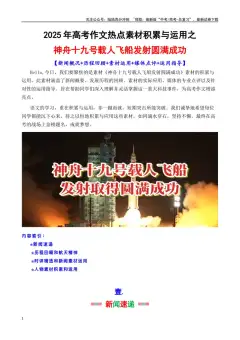
神舟十九号载人飞船发射取得圆满成功
阅读下面短文,在空白处填入1个适当的单词或括号内单词的正确形式。
China's Shenzhou-19 manned spacecraft was successfully launched atop a Long March-2F carrier
rocketat 4:27 a.m. on Wednesday from the Jiuquan Satellite Launch Center in northwest China.
Aboard the craft was 1. ______(it) crew, mission commander Senior Colonel Cai Xuzhe, Lieutenant Colonel
Song Lingdong, and Lieutenant Colonel Wang Haoze. The two men and one woman will replace the astronauts
who’ve lived on the Tiangong space station 2. ______ the last six months.
The new mission commander, Cai Xuzhe, 3. ______(go) to space in the Shenzhou-14 mission in 2022, while
the other two, Song Lingdong and Wang Haoze, are first-time space travelers both born in 4. ______ 1990s.
Song was an air force pilot and Wang an engineer with the China Aerospace Science and Technology
Corporation who will be the crew’s payload specialist. Wang will be the 5. ______(three) Chinese woman aboard a
crewed mission.
The three appeared at a brief news conference Tuesday behind 6. ______(protect) glass, declaring their
intention to carry out their scientific projects on the space station and “bring 7. ______(proud) to the fatherland.”
China built its own space station after being excluded( 排 除 ) from the International Space Station,
8. ______(large) due to the United States’ concerns.Besides 9. ______(put) a space station into orbit, the space agency has landed an explorer on Mars. It aims to
put a person on the moon before 2030, 10, ______would make China the second nation after the United States to do
so.
Shenzhou-19 Crewed Spaceship Launched Successfully!
神州19号载人飞船发射成功!
The Shenzhou-19 crewed spaceship was launched at 4:27 a.m., Oct. 30, Wednesday (Beijing Time) from the
Jiuquan Satellite Launch Center 1 northwest China. Chinese astronautsCai Xuzhe, Song Lingdong and
Wang Haoze are carrying out the Shenzhou-19 crewed spaceflight mission, with Cai 2 (be) the
commander, according to the China Manned Space Agency on Tuesday. Cai 3 (complete) the
Shenzhou-14 space mission in 2022. Song and Wang are newcomers to space. Both of them were born in the
1990s. Song was 4 former air force pilot before being selected as an astronaut. And Wang iscurrently
China's only female space flight engineer and has become the 5 (three) Chinese woman to embark on (开
始) a crewed spaceflight mission, the agency noted.
The Shenzhou-19 astronauts 6 (complete) in-orbit rotation(交接) with the Shenzhou-18 trio (三人组)
and stay at the space station for 7 (approximate) six months. They will witness the arrival of the
Tianzhou-8 cargo craft (货运飞船) and Shenzhou-20 crewed spaceship during the mission. Many tasks await the
new crew 8 (complete): conducting space science and application tests, performing extravehicular (舱外
的) activities, installing protective devicesagainst space debris(残骸), installing and recycling extravehicular
payloads (有效载荷) and equipment, all of 9 are full of challenges. They will also engage in science
education, public welfare (公共福利) activities, and other payload tests. The Shenzhou-19 astronauts are
scheduled to return to the Dongfeng landing site 10 (locate) in north China's Inner Mongolia Autonomous
Region in late April or early May next year, according to the agency.
王浩泽-神舟十九号女航天员
阅读下面短文,在空白处填入1个适当的单词或括号内单词的正确形式。Wang Haoze, a crew member of the Shenzhou XIX mission, is China's first female spaceflight engineer.
During her college years, she did well 1 (academic), ranking at the top of her class. Additionally, she
represented her school in sports competitions.
"It was my postgraduate mentor(导师) who led me to a career in the space industry. Professor Gu Fan is very
2 (interest) in spaceflight and often discussed relevant topics with us. He also encouraged his postgraduate
students 3 (apply) for jobs in the space industry," Wang Haoze recalled, explaining that she 4
(influence) by the professor and decided to join the spacecraft research community.
As her 5 (graduate) approached, Wang submitted her resume(简历) to the Beijing Aerospace
Propulsion Institute, China's major research body of liquid-propellant rocket engines.
At the institute, Wang was part of the research and development of new models of rocket engines, a new field
6 she had never been involved in. Faced 7 new challenges and knowledge, she enjoyed learning and
8 (overcome) difficulties, which appeared as an attractive game to her.
On October 30, 2024, she embarked on a space journey aboard Shenzhou-19. Her 9
(responsibility) include space experiments, material management, and station affairs. Wang Haoze is 10
inspiration, demonstrating courage, perseverance, and a passion for space exploration.
(24-25高三上·贵州·阶段练习)Wang Haoze, a crew member of the Shenzhou XIX mission and China’s
first female spaceflight engineer, studied energy and power engineering at Southeast University before receiving a
bachelor’s degree in 2012 and then continued to take part in a three-year postgraduate program in thermal
engineering at the same school. Before her graduation, Wang submitted her resume to the Beijing Aerospace
Propulsion Institute.
At the institute, Wang was part of the research and development of new models of rocket engines, a new
field that she had never been involved in. Faced with new challenges and knowledge, she enjoyed learning and
overcoming difficulties, which appeared as an intriguing game to her. Hard work and perseverance always pay off.
She gradually became the backbone of her team. Three years after working on rocket engines, she was told by
human resources colleagues that the country would recruit the third generation of astronauts.
Wang and 17 male candidates were selected and divided into three groups: seven spacecraft pilots, another
seven spaceflight engineers and four mission payload specialists.
At the Astronaut Center of China, Wang has faced grueling challenges. She has spent tough times with
teammates in survival drills in deserts and at sea, and has endured a 72-hour sleepless test. Despite the difficulties,
she said she has never considered quitting.Looking into her first orbital journey, the astronaut said: “I want to float inside Tiangong to experience the
excitement of weightlessness. I also hope that I can complete each and every task successfully and make our ‘space
home’ better. ”
1.What did Wang Haoze major in before 2012?
A.Space engineering. B.Thermal engineering.
C.Aerospace propulsion. D.Energy and power engineering.
2.What can be learned about Wang from paragraph 2?
A.She did research into rocket engines before.
B.She shrank from difficulties she encountered.
C.She played a key role in her team at the institute.
D.She saw an astronaut recruitment advertisement.
3.What can be used to describe Wang Haoze?
A.Courageous and humble. B.Determined and generous.
C.Perseverant and determined. D.Approachable and influential.
4.What can we infer about Wang?
A.Wang handles the test easily. B.Wang desires for her space mission.
C.Wang wants to abandon her training. D.Wang contributes a lot to space fields.
(24-25高二上·河南南阳·阶段练习)The Tianzhou 8 robotic cargo ship was launched on Friday night in
Hainan province, becoming the last spacecraft to visit China’s Tiangong space station this year.
With the cargo vessel on top of it, a Long March 7 carrier rocket lifted off at 11:13 pm local time from a
launch service tower at the Wenchang Space Launch Center, according to the China Manned Space Agency.
After a short flight, the rocket placed the Tianzhou 8 into its preset low-Earth orbit and the solar wings on the
cargo ship unfolded, marking the successful completion of the launch mission, the agency said.
The spacecraft is scheduled to approach and then dock with the space station’s Tianhe core module within
three hours after its launch.
As the 15th spaceship to visit Tiangong, Tianzhou 8 is tasked with resupplying propellants (n. [航]推进剂) to
the Chinese space station and delivering living and work necessities for the Shenzhou XIX astronauts, who have
been in orbit for two weeks.
The materials inside the cargo vessel are sufficient to support a three-member crew for nine months,
according to its designers at the China Academy of Space Technology.
Tianzhou 8’s predecessor, Tianzhou 7, was unlocked from the Tiangong space station on Sunday and starteda period of solo flight.
It is programmed to fall back to Earth soon, and most of the spaceship will burn up during reentry, although a
small amount of debris is expected to fall into secure areas in the South Pacific Ocean, according to the director Mr
Ma from the space agency.
Orbiting Earth at a distance of around 400 kilometers, Tiangong has three permanent parts — a core module
(n. [航天器的]舱) and two science capsules — and is regularly connected to several visiting crew and cargo
spaceships.
1.What is the sign that shows the success of this launch mission?
A.That the Long March 7 carrier rocket lifted off at 11:13 pm.
B.That Tianzhou 7 was unlocked from the Tiangong space station on Sunday.
C.That Tianzhou 7 entered a low-Earth orbit and the solar wings unfolded.
D.That Tianzhou 8 functioned well in planned orbit.
2.What is the attitude of the director Mr Ma towards the reentry of the Tianzhou 7?
A.Pessimistic. B.Optimistic. C.Neutral. D.Ambiguous.
3.We can infer from the passage that ________.
A.the best launch time for Tianzhou 7 is at night
B.Tianzhou 8 entering its preset low-Earth orbit is the last part of its mission
C.all the debris of the spaceship will be burnt during reentry
D.the supplies in Tianzhou 8 are enough to support a single member crew for over two years
4.What is the main idea of the passage?
A.China launches Tianzhou 8 cargo craft to send supplies.
B.Tianzhou 8 is safe to launch.
C.How the Tianzhou 8 cargo craft works.
D.The Tianzhou 8 cargo craft was last launched.
(24-25高一上·云南·期中)The three Shenzhou-18 crew members aboard the orbiting (轨道) China Space
Station (CSS), Ye Guangfu, Li Cong and Li Guangsu, celebrated the Paris Summer Olympics and China’s 16th
National Fitness Day on Thursday.
The space games began with a mock torch relay (模拟火炬接力), according to a video uploaded by the
China Manned Space Agency (CMSA). Commander (指挥官) Ye Guangfu, dressed in a spacesuit, handed a mock
torch to his crew member Li Cong, who floated over a hurdle (障碍) to pass it to his partner Li Guangsu. Li
Guangsu received the torch and showed an upright long jump before returning it to the commander, who finishedthe relay with a graceful back jump. Later, the orbital games began. Li Guangsu displayed impressive skills in the
men’s singles “table tennis match”.
While watching an exciting group stage match of China’s women’s volleyball team, Ye Guangfu and Li
Cong started playing “volleyball” in zero gravity (重力) In the video, the three in the 16-meter-long Tianhe core
module (模块) happily copied swimming movements in a “men’s mixed swimming”, racing against one another in
a mock pool, with Ye finally winning the competition by a slight advantage. They then continued to copy the
actions of Olympic divers. The final event of the space games was “weightlifting (举重)”. Commander Ye lifted a
bar carrying Li Guangsu and Li Cong off the “ground”, pretending to make great effort in their zero-gravity
environment, even stopping to wipe away “sweat”. At the end of the video, the three sent their best wishes to Team
China, encouraging them to accept challenges and go after their dreams. They encouraged the Chinese athletes to
go beyond limits, set new records and achieved excellent successes.
The Shenzhou-18 crew is more than halfway through a six-month space mission that started with their
launch in late April. Their days in orbit are a balanced mix of scientific experiments, spacewalks and personal
health. To stay their physical fitness, the crew exercise very hard and have finished a lot of weightlessness
protection experiments.
1.What did the mock relay race end with?
A.Li Guangsu’s skillful long jump. B.Li Cong’s floating over a hurdle.
C.Ye Guangfu’s graceful back jump. D.Ye Guangfu’s diaplaying his spacesuit.
2.What was the last thing the three crew members did during the celebration?
A.Playing “volleyball”. B.Playing “weightlifting”.
C.Copying “men’s mixed swimming”. D.Copying the actions of Olympic divers.
3.Why did the three crew members celebrate the Paris Olympics in space?
A.To show their colorful space life.
B.To show sports can be played everywhere.
C.To stress the important value of sports.
D.To encourage Chinese team to bravely face difficulties.
4.What is the function of the last paragraph?
A.To give a new topic to discuss. B.To sum up the above pararaphs.
C.To offer some information. D.To introduce the topic of the text.
【嫦娥系列·07】(24-25高一上·江苏宿迁·期中)Early on Wednesday morning, a big rocket called Long
March-2FY19 took off from Jiuquan in Northwest China. It carried three astronauts on a trip to the China SpaceStation.
After about 10 minutes, the Shenzhou-19 spacecraft separated from the rocket and entered its designated
orbit (轨道). This meant the launch was a success!
The China Space Station will welcome the new Shenzhou-19 crew, led by experienced astronaut Cai Xuzhe
and newcomers Song Lingdong and female astronaut Wang Haoze, about 6.5 hours after takeoff.
Commander (指令长) Cai is going back to space just 22 months after his last trip, which is a record for the
shortest time between missions in the history of Chinese astronauts. Song and Wang, both born in 1990, are on their
first space mission. Wang is also China’s first female spaceflight engineer.
This is the fourth time that astronauts have flown to the space station to work and do experiments, and it’s
the 33rd mission in China’s manned space program. The main tasks include switching crews with the Shenzhou-18
astronauts, staying on the station for six months, doing space experiments, going outside the spacecraft and
managing cargo (货物) and so on.
After launch, Shenzhou-19 will connect to the Tianhe module of the space station about 6.5 hours later.
During their stay, they will get supplies from the Tianzhou-8 cargo spacecraft and be visited by the Shenzhou-20
crew. They will come back to Earth in late April or early May.
The Shenzhou-18 crew will return to Earth on November 4 after the new crew arrives.
For this mission, the developers made the Shenzhou-19 spacecraft better by improving its design, so it can
carry more supplies. This helps the astronauts and makes the space station work more effectively.
1.What does the underlined word “designated” mean in the second paragraph?
A.Planned B.Named C.Changed D.Tested
2.What is Wang Haoze’s special achievement?
A.She is the young.
B.She is the first female leader.
C.She is China’s first female spaceflight engineer.
D.She has flown to the space station four times
3.Which of the following statements is TRUE?
A.Shenzhou-19 separated from the rocket after 20 minutes
B.Cai Xuzhe is on his first space mission.
C.The Shenzhou-18 will return on November 14.
D.Improvements in the spacecraft design allow it to carry more supplies.
4.Which of the following can be the best title for the passage?A.A Successful Launch of Shenzhou-19 B.The History of China’s Space Exploration
C.The Main Tasks of Shenzhou-19 Crew D.The Development of China’s Space Technology
(24-25高三上·山东·阶段练习)China’s space exploration has once again achieved a great success. The
launch of the Shenzhou-19 spacecraft was a memorable moment for all Chinese, marking the beginning of a new
1 in China’s space journey.
The Long March-2F rocket was the perfect 2 for this important mission with its impressive
appearance and stable technology, and the astronauts underwent 3 training.
At zero seconds, with everyone’s hearts 4 , the rocket soared into the sky, leaving a trail of fire and
smoke. Back on Earth, people watched the launch on TV and 5 the astronauts’ progress through live
broadcast. The successful launch and operation of the spacecraft 6 China’s ability to compete with the
world’s leading space agencies.
During the mission, the astronauts will have 7 tasks to accomplish. They will 8 scientific
experiments and prepare for future missions. They will also take time to enjoy the beautiful 9 of Earth from
space. The Shenzhou-19 spacecraft is supposed to 10 its mission after six months in space. The success of
the mission will inspire many young people to pursue their dreams of becoming astronauts.
Since 2003, with each new mission, China has shown its ability to 11 and push the boundaries of
human knowledge. And with its strong scientific and technological 12 , China is sure to make greater
achievements in the future.
The Shenzhou-19 mission is a constant 13 of China’s growing influence in space exploration. It
marks a new era in China’s space exploration and 14 the world’s attention to the country’s development. As
China continues to progress, we can only imagine what the future holds for this 15 nation.
1.A.framework B.chapter C.mode D.platform
2.A.option B.combination C.location D.definition
3.A.dramatic B.appealing C.flexible D.demanding
4.A.beating B.sinking C.racing D.melting
5.A.followed B.documented C.monitored D.noticed
6.A.facilitated B.identified C.clarified D.demonstrated
7.A.multiple B.urgent C.physical D.risky8.A.draw on B.carry out C.bring up D.deal with
9.A.images B.fields C.sights D.figures
10.A.summarize B.occupy C.interrupt D.complete
11.A.wonder B.innovate C.sustain D.apply
12.A.expansion B.background C.introduction D.competence
13.A.reminder B.warning C.operation D.factor
14.A.refer B.limits C.absorbs D.connects
15.A.humble B.powerful C.reliable D.generous
中国航天精神
China has made remarkable achievements in space exploration. The China Manned Space Agency
(CMSA)aims to land its astronauts on the moon before 2030 and has recently shown the spacesuit they plan to
use. However, the name of the suit is still up in the air.
As reported by Space News, the CMSA revealed their new extravehicular (舱外的)activity (EVA)
spacesuit at an event on September 28 in Chongqing, China. The suit was modeled by Wang Yaping, China’s
second woman in space, and Zhai Zhigang, another astronaut. The presentation mainly focused on the suit’s outer
features. In particular, the new suit is slimmer and lighter than the CMSA’s earlier Feitian EVA suit used for low
Earth orbit. It is covered in a protective fabric to guard against extreme temperatures and lunar dust. The suits also
havea wide-ranging, non-reflective shield (防护)and both short and long focus length cameras. Unlike the
earlier suits, these lunar suits allow for much more flexibility while moving on the moon.
Apart from the practicalities, representatives explained that aesthetics (美学)were also important during
the design phase. The appearance of the new spacesuit was emphasized. According to CNN, the mainly white
spacesuits have red stripes on their upper parts inspired by the “flying apsaras” from ancient Chinese art. “The
stripes on the legs are designed to look like ‘rocket launch flames,’ representing a strong-willed and determined
spirit, and that’s the key.” as Zhang Wanxin, director of the CMSA’s engineering office, told China’s CCTV. This
weekend’s announcement also saw the CMSA officials task the nation with helping name the new suits, which will
be chosen later.
This not only shows China’s remarkable achievements in space exploration but also reflects its cultural pride
and rapid advances in science and technology. By integrating traditional Chinese cultural elements into moderntechnology, China showcases its unique charm and great power to the world. Meanwhile, the public naming
initiative encourages citizens to engage with the space program, creating a closer link between the space and the
people.
1.What is one advantage of the new spacesuit?
A.It is more user-friendly. B.It is more cost- effective.
C.It is more pressure-resistant. D.It is more dust-proof.
2.Why is the appearance emphasized in the new design?
A.To follow the international trend. B.To adjust the lunar environment.
C.To highlight Chinese cultural elements. D.To downplay the aesthetic value.
3.What is the last paragraph mainly about?
A.The technical descriptions of the new spacesuits.
B.The cultural pride behind China’s space exploration.
C.The future prospect of the China Manned Space Agency.
D.The international development in space technology.
4.What is the writing purpose of the text?
A.To report China’s exploration progress and new spacesuit.
B.To introduce the manufacturing process of new spacesuit of the CMSA.
C.To involve more people in the public naming initiative.
D.To summarize China’s significant achievement.