主题语境:人与自然
主题群:动物与植物
语篇类型:新闻报道
来源:New York Times, 20200403
Word count:552
Flesch-Kincaid Grade Level:9.1

The Bronx Zoo Is Also Empty, but the Animals Don’t Mind
If a sea lion claps at the Bronx Zoo, and no one is around to hear it, does it
make a sound?
There is plenty of time to ponder koans these days at the animal park,
where the coronavirus pandemic has left the sea lions, and the rest of its
roughly 6,000 creatures, without an audience. In this busy season at the zoo,
5
when people typically pack in — children atop their parents’ shoulders — to
see the sea lions eat, there is no one standing at the pool railing.
Or walking the pathways of Astor Court, with its Beaux-Arts buildings.
Or sitting at the picnic tables. Or riding Wild Asia, the seasonal monorail that
tours the habitats of red pandas, elephants and rhinos.
10
Still, the life of the zoo goes on, as the sea lions perform their routines, no
doubt encouraged by the fish they swallow in a single gulp.
“The animals are blissfully unaware of what the rest of us have been
going through,” said Jim Breheny, the director of the Bronx Zoo. “What I
wouldn’t give for that innocence.”
15
Unlike Broadway theaters or museums, zoos cannot go dark. Chinchillas
need checkups. Penguin chicks might require help after they hatch. Captive
tigers, alligators and grizzly bears probably shouldn’t be left to their own
devices.
“The animals that we care for rely on us for everything,” said Mr. Breheny,
20
whose first job at age 14 was staffing the zoo’s camel rides.
So since it closed to the public on March 16, the Bronx Zoo has been
tending to animals while keeping its human employees as socially distant as
possible. Roughly 300 workers of its 700-plus staff were deemed “essential” to
care for animals and maintain the zoo’s operations. They are split in half into
25
two teams, which report on alternating weeks.
A spokeswoman for District Council 37, a union that represents zoo
employees, said there had been no reports of layoffs or furloughs.
Workers who still report find themselves following the routines they
always have: spreading hay out so the American bison can graze; offering fish
30
to Magellanic penguins eagerly snapping their beaks; and releasing the lions
to laze around on exhibit. Others, including maintenance workers, electricians
and plumbers, keep the sprawling campus operating.
Mr. Breheny said the zoo’s mission right now is to keep the animals on a
consistent routine. But its emptiness has not gone unnoticed, he added, by
35
some primates.
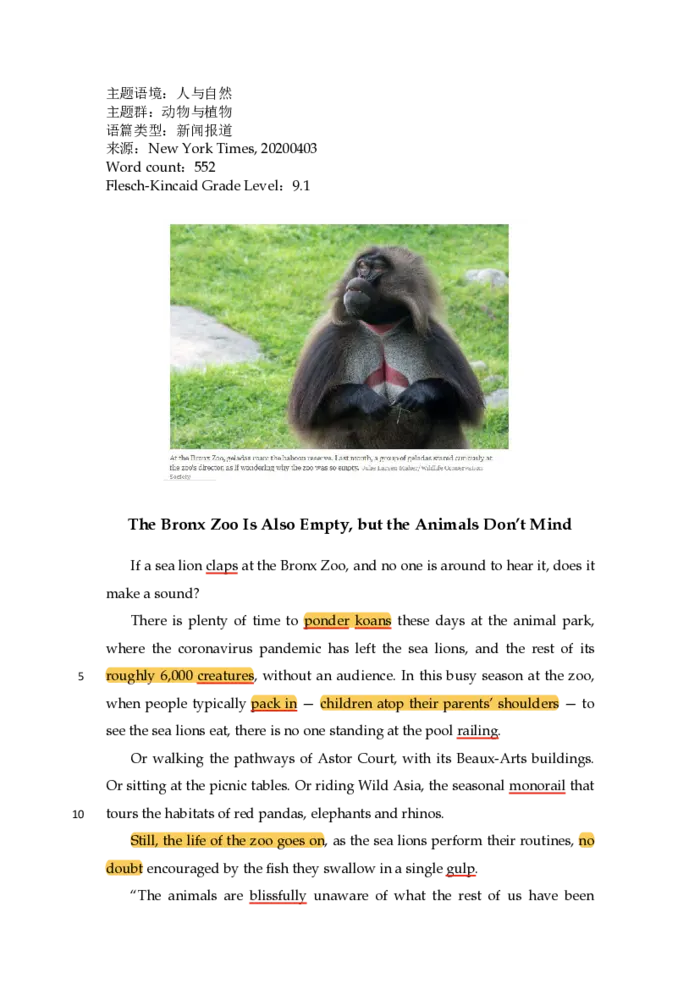
Last month, he took a moment to stop at one of the viewing spots for the
baboon reserve, a two-acre space amid the 265-acre zoo designed to simulate
the Ethiopian highlands. He said a group of geladas, monkeys with a crown
of coffee-colored hair and upper lips that often flip up, moved toward him.
40
He was likely the first human observer they had seen in a while, and they
stared curiously at him through the glass.
“They seemed to not understand why people aren’t here right now,” he
said.
The goats and alpacas in the children’s seasonal zoo are particularly
45
accustomed to interacting with visitors, said Patrick Thomas, the zoo’s
associate director, in an email. Now the only people those animals see are
employees.
“I don’t think our animals’ behavior has changed all that much,” he said,
“but I do think that they’re aware that things are not the same.”
50