文档文本内容
话题:人与社会(工作与就业)
体裁:记叙文
来源:1843magazine.com
Word count:534
Flesch-Kincaid Grade Level:6.3


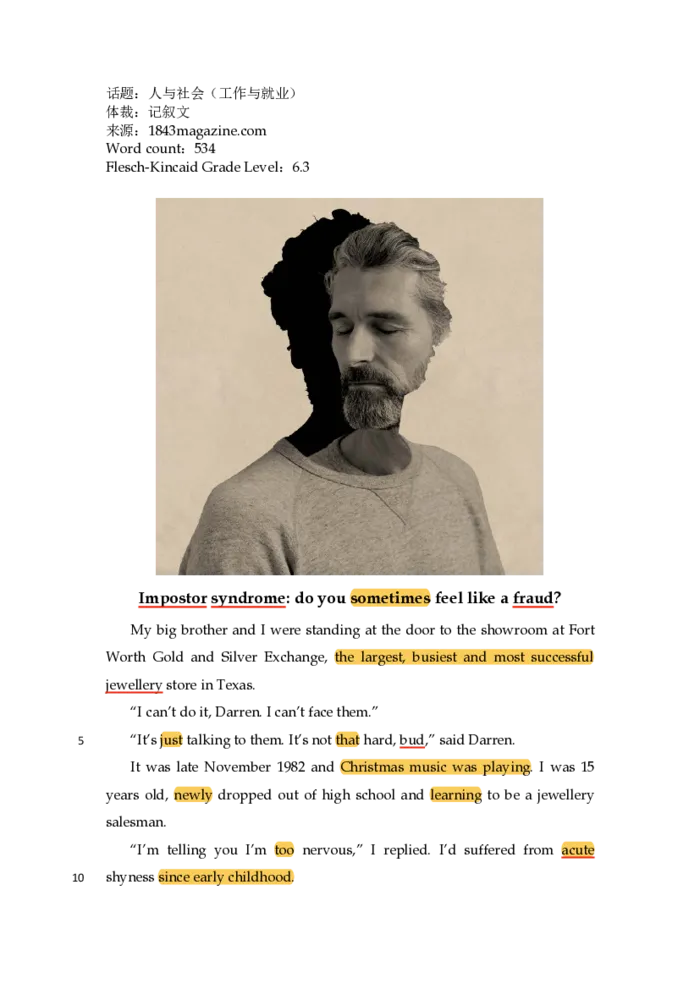
Impostor syndrome: do you sometimes feel like a fraud?
My big brother and I were standing at the door to the showroom at Fort
Worth Gold and Silver Exchange, the largest, busiest and most successful
jewellery store in Texas.
“I can’t do it, Darren. I can’t face them.”
“It’s just talking to them. It’s not that hard, bud,” said Darren.
5
It was late November 1982 and Christmas music was playing. I was 15
years old, newly dropped out of high school and learning to be a jewellery
salesman.
“I’m telling you I’m too nervous,” I replied. I’d suffered from acute
shyness since early childhood.
10
“Well you’re just going to have to pretend,” said Darren.
The store had started me selling on the phones because it was easier to
feign being older and more experienced. But it was almost Thanksgiving and
they needed more bodies on the floor. Darren took me by the arm and we
slipped behind the long row of twenty-something salespeople working the
15
brass-and-glass counters. We called a number and my first real customer
pushed her way through the crowd to the front.
I still remember that woman. She bought twister beads, a pair of very
small diamond studs on promotion, and a gold bracelet. I was shaking as I
showed her the goods, shaking as I took her money and still shaking as I
20
called the next customer. But by the end of the day I could look a shopper in
the eye and say, “I’m Clancy. What can I show you?”
That first Christmas season I didn’t believe I was a real jewellery salesman.
I was performing. But every day I’d prepare by reciting stock sales lines to
myself: “And what else can I show you?” or “Who else is on your Christmas
25
list?” I’d talk with the other members of staff about sales I’d made the day
before, or my targets for that week, or my plan to sell a Rolex. All of this
helped me persuade myself that I could go in front of customers and pretend
to know what I was doing.
To them I must have seemed barely a teenager, pimply in an oversized
30
suit and a cheap Tabasco tie. Trembling and pretending to know what I was
talking about, I acted as though I sold thousands of dollars of jewellery every
day.
But after a week or two, I was doing exactly that. I remember the first
Rolex I ever sold: a men’s President. The customer asked me if I was allowed
35
to sell the watch. I lied and said this was my third Rolex that day. By the time
he’d handed over his credit card, he told me that he had a car dealership, and
if I ever wanted to make real money, I could come and work for him.
Every time I wrote up another sale and saw my name near the top of the
day’s sales boards, I believed a little more that I actually was the salesman I
40
was pretending to be. But, though the evidence was clear that I really could
do this job, I still felt as though I was cheating, perpetually on the brink of
being found out.