主题语境:人与自我
主题群:生活与学习
语篇类型:演讲
来源:The Atlantic, April 29, 2020
Word count: 582
Flesch-Kincaid Grade Level:5.8
Lexile Range:810L - 1000L

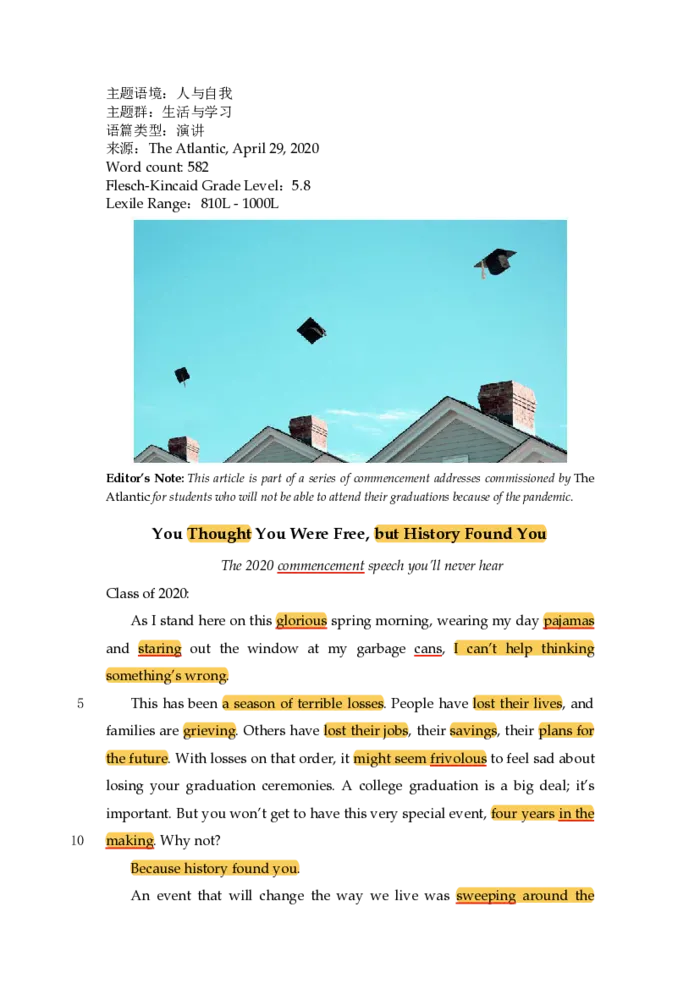
Editor’s Note: This article is part of a series of commencement addresses commissioned by The
Atlantic for students who will not be able to attend their graduations because of the pandemic.
You Thought You Were Free, but History Found You
The 2020 commencement speech you’ll never hear
Class of 2020:
As I stand here on this glorious spring morning, wearing my day pajamas
and staring out the window at my garbage cans, I can’t help thinking
something’s wrong.
This has been a season of terrible losses. People have lost their lives, and
5
families are grieving. Others have lost their jobs, their savings, their plans for
the future. With losses on that order, it might seem frivolous to feel sad about
losing your graduation ceremonies. A college graduation is a big deal; it’s
important. But you won’t get to have this very special event, four years in the
making. Why not?
10
Because history found you.
An event that will change the way we live was sweeping around the
globe, and it found you. As your long, strange spring break was extended
week after week, the truth began to settle in: You were never going back to
college. Not as a student, anyway. That part of your life had ended, and you
15
never got to say goodbye to it.
History also found my father when he was in college. He was a new
student at Amherst College, and he thought it was paradise. Those students
knew that the world was rumbling around them, but they were in a New
England college studying the poets and philosophers, and it was easy to
20
imagine that the world was far away. He thought he was finally free, but
history found him.
Did I mention it was 1941?
I had zero interest in my father’s war experience—and that was fine with
him. I think he spent the rest of his life trying to forget it.
25
But I did think about that story of all of the young men who walked away
from college and toward a war. Once I asked him about it: “Dad, on that day
when you went into town and enlisted in the Navy, what did you do after
that?”
He looked at me as though I’d asked a silly question, and said simply, “I
30
went to class.”
That’s what you did, too. You went to class.
You went to class in your childhood bedrooms and at your parents’
kitchen tables. You did it with computers and Zoom and group chats. You
wrote papers, you took notes during lectures, you did experiments in virtual
35
labs, and you tackled complex problem sets.
It would have been easy not to do this. But you—whom we celebrate
today—you didn’t give up. You kept going, and now in this strange situation,
without “Pomp and Circumstance”, you have become college graduates.
And we are grateful, because we need you.
40
We need the poets and philosophers, the scientists and artists, the
engineers, historians, writers, and businesspeople.
Most of all we need the free thinkers, because now more than ever before,
we need people who can look at the world in a rational way and make
decisions based on facts and reason.
45
I wish I could give all of you the graduation you deserve. I wish I could
give all your parents and grandparents and aunts and uncles the chance to
hear your name ring out, and see you walk across that stage and receive your
diploma.
But maybe you’ve gained something more important than any of that.
50
Maybe as very young people you know something powerful: that you have
been tested, and you did not falter. You kept going.