文档文本内容
主题语境:人与自然
主题群:地球与太空
语篇类型:新闻报道
来源:www.post-gazette.com, 2020/3/12
Word count: 333
Flesch-Kincaid Grade Level: 12.8
Lexile Range: 1210L - 1400L

Skull of smallest known dinosaur found preserved in
99M-year-old amber
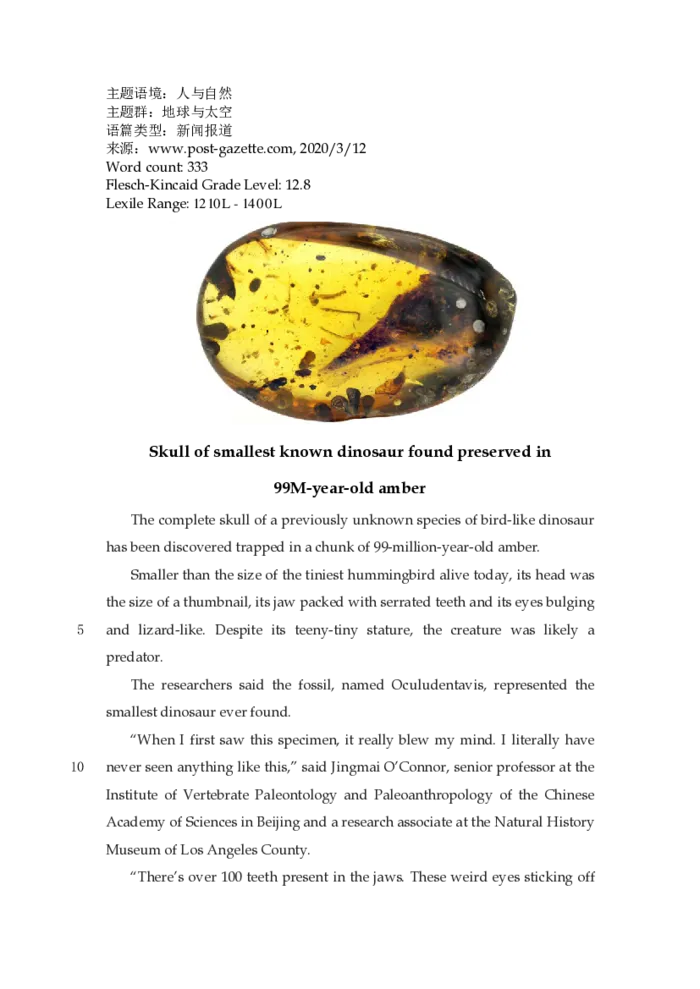
The complete skull of a previously unknown species of bird-like dinosaur
has been discovered trapped in a chunk of 99-million-year-old amber.
Smaller than the size of the tiniest hummingbird alive today, its head was
the size of a thumbnail, its jaw packed with serrated teeth and its eyes bulging
and lizard-like. Despite its teeny-tiny stature, the creature was likely a
5
predator.
The researchers said the fossil, named Oculudentavis, represented the
smallest dinosaur ever found.
“When I first saw this specimen, it really blew my mind. I literally have
never seen anything like this,” said Jingmai O’Connor, senior professor at the
10
Institute of Vertebrate Paleontology and Paleoanthropology of the Chinese
Academy of Sciences in Beijing and a research associate at the Natural History
Museum of Los Angeles County.
“There’s over 100 teeth present in the jaws. These weird eyes sticking off
looking to the side. There’s nothing like this alive today.”
15
While people tend to think of dinosaurs as huge, lumbering creatures, this
skull and other recent finds in amber suggest that life in dinosaur times was
probably more diverse than we think, with many more tiny dinosaurs and
other creatures that haven’t yet showed up in the fossil record.
“One of the key messages from this study is that we are probably missing
20
a big chunk of the ecosystem of the dinosaurs,” said Lars Schmitz, a biology
professor at Scripps College in Claremont, California, who along with
O'Connor, authored the paper that published Wednesday in the journal
Nature. “We don't know a lot about tiny things in the age of the dinosaurs.”
The fossilization of bones in sediments such as clay, silt and sand can
25
crush and destroy the remains of small animals, but amber, which forms from
the resin of coniferous trees, allows for their preservation in three dimensions.
“When you have an animal preserved in amber it looks like it just died
yesterday -- all the soft tissue in place trapped into this little window into an
ancient time,” said O’Connor.
30