主题语境:人与自然
主题群:自然生态
语篇类型:说明文
来源:chinaplus.cri.cn, 20200505
Word count:435
Flesch-Kincaid Grade Level:10.0
Lexile Range:1210L - 1400L

‘Murder Hornets,’ with sting that can kill, land in US
The giant Asian insect, with a sting that could be fatal to some people, is
just now starting to emerge from winter hibernation.
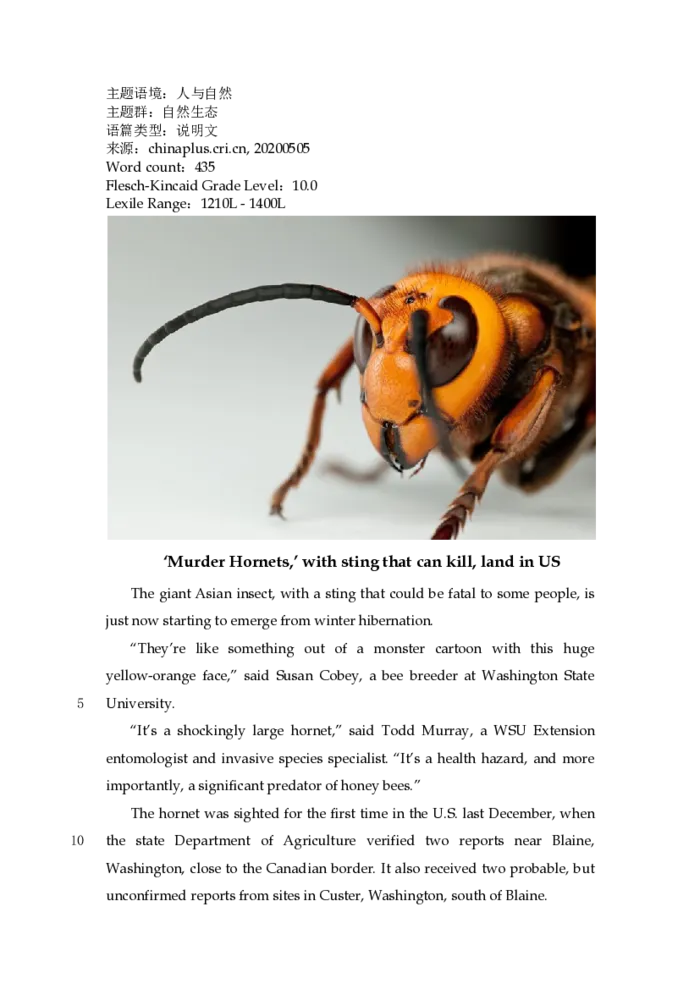
“They’re like something out of a monster cartoon with this huge
yellow-orange face,” said Susan Cobey, a bee breeder at Washington State
University.
5
“It’s a shockingly large hornet,” said Todd Murray, a WSU Extension
entomologist and invasive species specialist. “It’s a health hazard, and more
importantly, a significant predator of honey bees.”
The hornet was sighted for the first time in the U.S. last December, when
the state Department of Agriculture verified two reports near Blaine,
10
Washington, close to the Canadian border. It also received two probable, but
unconfirmed reports from sites in Custer, Washington, south of Blaine.
The hornet can sting through most beekeeper suits, deliver nearly seven
times the amount of venom as a honey bee, and sting multiple times, the
department said, adding that it ordered special reinforced suits from China.
15
The university said it isn’t known how or where the hornets arrived in
North America. It normally lives in the forests and low mountains of eastern
and southeast Asia and feeds on large insects, including wasps and bees. It
was dubbed the “Murder Hornet” in Japan, where it is known to kill people.
The hornet’s life cycle begins in April, when queens emerge from
20
hibernation, feed on plant sap and fruit, and look for underground dens to
build their nests. Hornets are most destructive in the late summer and early
fall. Like a marauding army, they attack honey bee hives, killing adult bees
and devouring larvae and pupae, WSU said.
Their stings are big and painful, with a potent neurotoxin. Multiple stings
25
can kill humans, even if they are not allergic, the university said.
Farmers depend on honey bees to pollinate many important northwest
crops such as apples, blueberries and cherries. With the threat from giant
hornets, “beekeepers may be reluctant to bring their hives here,” said Island
County Extension scientist Tim Lawrence.
30
An invasive species can dramatically change growing conditions, Murray
said, adding that now is the time to deal with the predators.
“We need to teach people how to recognize and identify this hornet while
populations are small, so that we can eradicate it while we still have a chance,’’
Murray said.
35
The state Department of Agriculture will begin trapping queens this
spring, with a focus on Whatcom, Skagit, San Juan, and Island counties.
Hunting the hornets is no job for ordinary people.
“Don’t try to take them out yourself if you see them,” Looney said. “If
you get into them, run away, then call us!”
40
加入慧享社群,零开销,尽享亲子成人精品课程,加微信 396014713