第三期初中英语外刊阅读
精讲直播课
主题:文化艺术
2020 年4-5 月
话题:人与自然(卫生与健康)
体裁:说明文
来源:theoaklandpress.com, 20200325
词数:371
FK Grade Level: 8.9


The psychology behind hoarding toilet paper: We're not that
different from squirrels
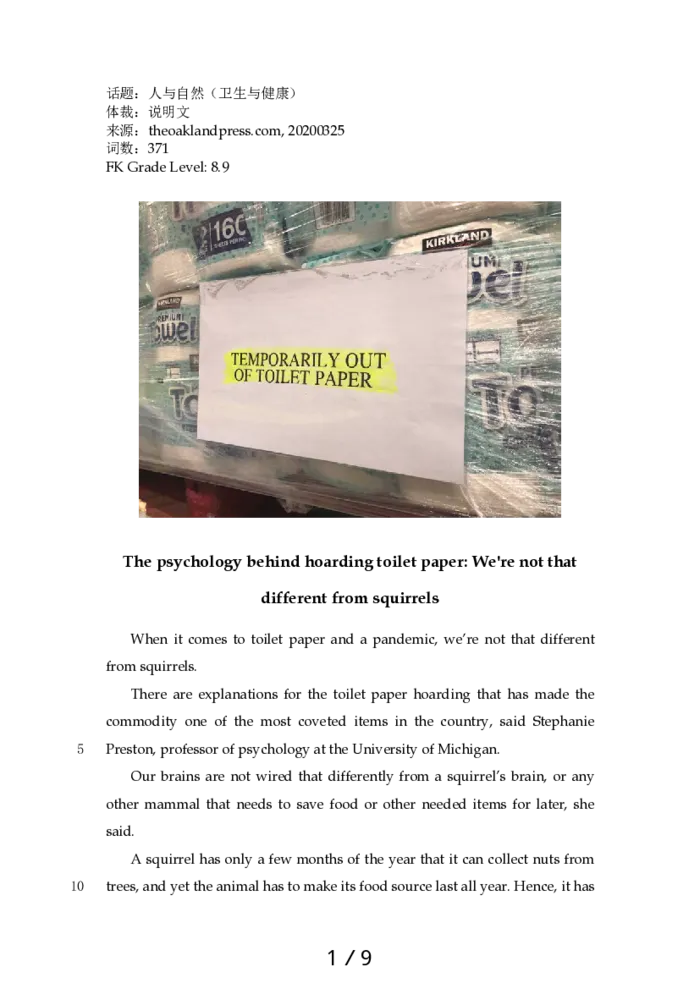
When it comes to toilet paper and a pandemic, we’re not that different
from squirrels.
There are explanations for the toilet paper hoarding that has made the
commodity one of the most coveted items in the country, said Stephanie
Preston, professor of psychology at the University of Michigan.
5
Our brains are not wired that differently from a squirrel’s brain, or any
other mammal that needs to save food or other needed items for later, she
said.
A squirrel has only a few months of the year that it can collect nuts from
trees, and yet the animal has to make its food source last all year. Hence, it has
10
1/9
the capacity to remember all the places where it hides them.
Similarly, when a pandemic puts humans under stress, a common
response is to clean and to hoard. “Toilet paper is the perfect storm of the two,”
Preston said, because of its association with cleanliness.
But why not hoard milk or bread or some other food?
15
Preston said if a food item is in short supply, people can make some
reasonable substitution for it. There are few good substitutes for toilet paper.
And people can hoard it without fear that it will go bad.
And when nobody can find it, it becomes even more important, she said.
“It’s not something we’re particularly interested in until we see the
20
shelves are empty,” Preston said. “And then you think if there isn’t any, it
must be something really good.”
It’s similar to the phenomenon of toys that become the most popular at
Christmastime. Remember the Cabbage Patch doll and Tickle Me Elmo?
Adding to all this fixation with toilet paper is that “it’s kind of taboo and
25
gross and funny,” Preston said. Just check out all the toilet paper memes
going around on social media.
Why aren’t people thinking that if they buy the last packages of toilet
paper in the store, that will mean someone else won’t have any?
“Under stress, we’re self-focused on our perceived needs,” Preston said.
30
If someone else approached the toilet paper display at the same time, the
shopper attempting to take all of it would most likely be confronted with that
person’s need and may offer to share the supply.
2/9
话题:人与自然(饮食)
体裁:说明文
来源:1843magazine.com
词数:379
FK Grade Level: 8.5

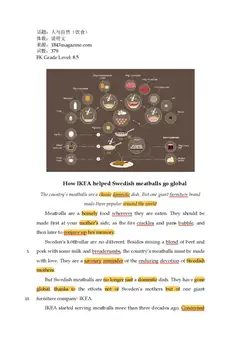
How IKEA helped Swedish meatballs go global
The country’s meatballs are a classic domestic dish. But one giant furniture brand
made them popular around the world
Meatballs are a homely food wherever they are eaten. They should be
made first at your mother’s side, as the fire crackles and pans bubble, and
then later to conjure up her memory.
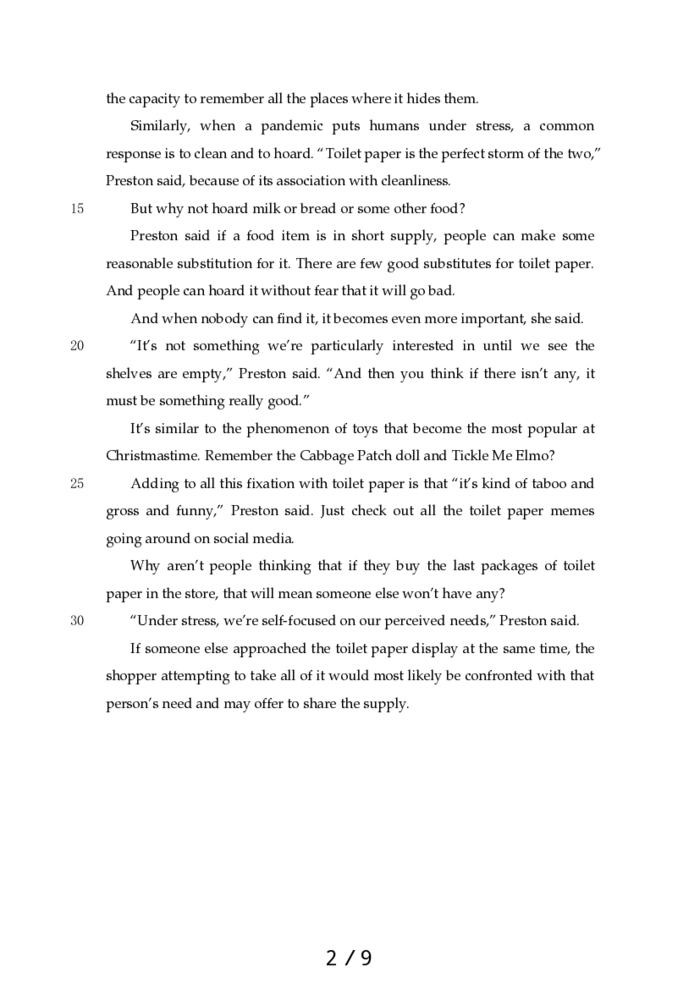
Sweden’s köttbullar are no different. Besides mixing a blend of beef and
pork with some milk and breadcrumbs, the country’s meatballs must be made
5
with love. They are a savoury reminder of the enduring devotion of Swedish
mothers.
But Swedish meatballs are no longer just a domestic dish. They have gone
global, thanks to the efforts not of Sweden’s mothers but of one giant
furniture company: IKEA.
10
IKEA started serving meatballs more than three decades ago. Concerned
3/9
that customers navigating its endless aisles of flat-pack furniture would grow
faint with hunger, the company opened restaurants in its stores. Severin
Sjöstedt, the chef who spent almost a year developing the original recipe for
IKEA, has said that the firm wanted to make something that was easy to serve,
15
tasty and affordable for most people.
It succeeded. The Swedish behemoth flogs more than a billion meatballs
each year at its stores around the world. IKEA serves meatballs in almost
every one of its restaurants and most are made to the same recipe. The sheer
number that it dishes up means it can keep the price of its meatballs as
20
competitive as that of its bookcases. Today, no trip to IKEA is complete
without the purchase of several hundred unnecessary tea lights, a vicious spat
with your spouse and a keenly priced plate of meatballs – served as mor used
to make them.
And yet, in a shocking revelation, in 2018 Sweden admitted that its
25
meatballs are in fact an import. Forget the Swedish mothers – köttbullar are
based on a recipe that King Charles XII brought back from Turkey in the early
18th century. “My whole life has been a lie,” mourned an official Twitter
account that promotes Sweden to the world. Such agonies are misplaced. The
Swedes have adopted the comfort food of another country, made it their own
30
and persuaded the rest of the world to love it too. Mother would approve.
4/9
话题:人与社会(文学艺术)
体裁:说明文
来源:mymodernmet.com, 20200414
Word count:320
Flesch-Kincaid Grade Level:8.4


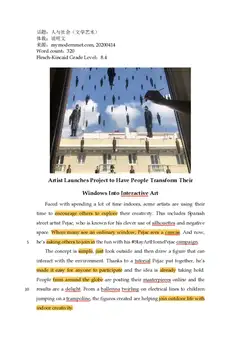
Artist Launches Project to Have People Transform Their
Windows Into Interactive Art
Faced with spending a lot of time indoors, some artists are using their
time to encourage others to explore their creativity. This includes Spanish
street artist Pejac, who is known for his clever use of silhouettes and negative
space. Where many see an ordinary window, Pejac sees a canvas. And now,
he’s asking others to join in the fun with his #StayArtHomePejac campaign.
5
The concept is simple, just look outside and then draw a figure that can
interact with the environment. Thanks to a tutorial Pejac put together, he’s
made it easy for anyone to participate and the idea is already taking hold.
People from around the globe are posting their masterpieces online and the
results are a delight. From a ballerina twirling on electrical lines to children
10
jumping on a trampoline, the figures created are helping join outdoor life with
indoor creativity.
5/9
“I always believed that everyone has an artist hidden inside and that if
you give them a good reason they are capable of doing wonderful things,”
shared Pejac, “and in these strange days of global lockdown, I believe that
15
creativity can be one of the best therapies to fight anxiety and boredom.”
How do you get started? First, examine the outdoor landscape and decide
what you’d like to create. Then, Pejac suggests taking a photo of yourself or
someone else acting out the desired pose. From there, simply put a piece of
paper over your phone or tablet and trace the outline. Once you’ve cut out
20
your figure, use it as a template on your window and, voilà, you have your
very
own
interactive
silhouette.
Just take
a
picture
and
tag it
#StayArtHomePejac to let the world see your masterpiece.
So why not give it a try? We’ll give you fair warning though, Pejac’s
project is highly addictive. Once you get started, you won’t be able to stop
25
seeing figures dancing about in the outdoor landscape.
6/9
话题:人与社会(工作与就业)
体裁:记叙文
来源:1843magazine.com
Word count:534
Flesch-Kincaid Grade Level:6.3


Impostor syndrome: do you sometimes feel like a fraud?
My big brother and I were standing at the door to the showroom at Fort
Worth Gold and Silver Exchange, the largest, busiest and most successful
jewellery store in Texas.
“I can’t do it, Darren. I can’t face them.”
“It’s just talking to them. It’s not that hard, bud,” said Darren.
5
It was late November 1982 and Christmas music was playing. I was 15
years old, newly dropped out of high school and learning to be a jewellery
salesman.
“I’m telling you I’m too nervous,” I replied. I’d suffered from acute
shyness since early childhood.
10
7/9
“Well you’re just going to have to pretend,” said Darren.
The store had started me selling on the phones because it was easier to
feign being older and more experienced. But it was almost Thanksgiving and
they needed more bodies on the floor. Darren took me by the arm and we
slipped behind the long row of twenty-something salespeople working the
15
brass-and-glass counters. We called a number and my first real customer
pushed her way through the crowd to the front.
I still remember that woman. She bought twister beads, a pair of very
small diamond studs on promotion, and a gold bracelet. I was shaking as I
showed her the goods, shaking as I took her money and still shaking as I
20
called the next customer. But by the end of the day I could look a shopper in
the eye and say, “I’m Clancy. What can I show you?”
That first Christmas season I didn’t believe I was a real jewellery salesman.
I was performing. But every day I’d prepare by reciting stock sales lines to
myself: “And what else can I show you?” or “Who else is on your Christmas
25
list?” I’d talk with the other members of staff about sales I’d made the day
before, or my targets for that week, or my plan to sell a Rolex. All of this
helped me persuade myself that I could go in front of customers and pretend
to know what I was doing.
To them I must have seemed barely a teenager, pimply in an oversized
30
suit and a cheap Tabasco tie. Trembling and pretending to know what I was
talking about, I acted as though I sold thousands of dollars of jewellery every
day.
But after a week or two, I was doing exactly that. I remember the first
Rolex I ever sold: a men’s President. The customer asked me if I was allowed
35
to sell the watch. I lied and said this was my third Rolex that day. By the time
he’d handed over his credit card, he told me that he had a car dealership, and
if I ever wanted to make real money, I could come and work for him.
Every time I wrote up another sale and saw my name near the top of the
day’s sales boards, I believed a little more that I actually was the salesman I
40
8/9
was pretending to be. But, though the evidence was clear that I really could
do this job, I still felt as though I was cheating, perpetually on the brink of
being found out.
9/9