文档文本内容
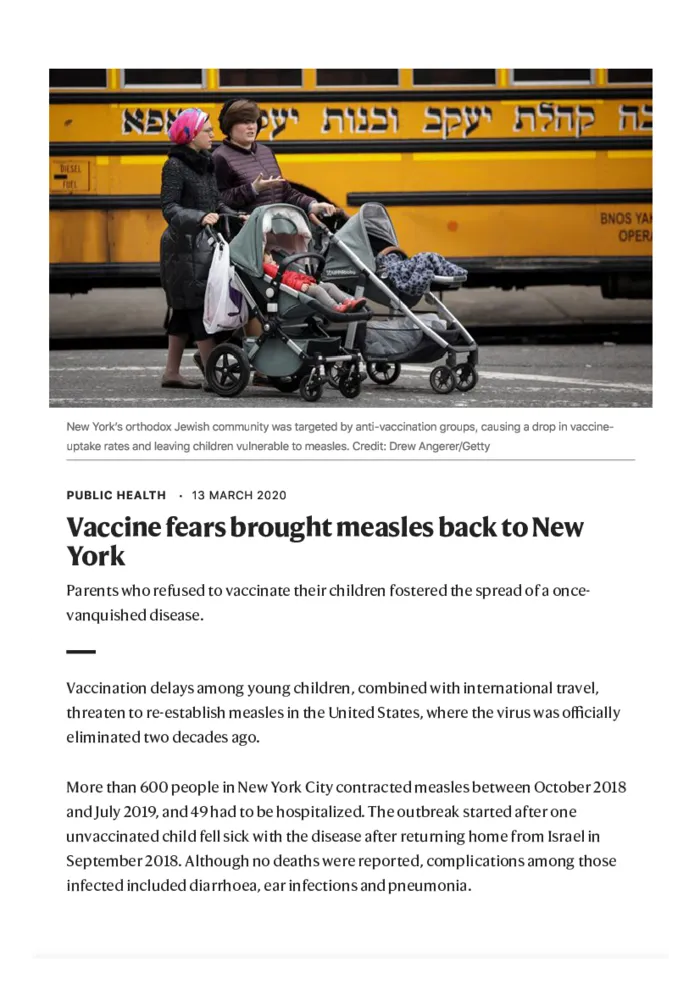
New Yorkʼs orthodox Jewish community was targeted by anti-vaccination groups, causing a drop in vaccine-
uptake rates and leaving children vulnerable to measles. Credit: Drew Angerer/Getty
PUBLIC HEALTH · 13 MARCH 2020
Vaccine fears brought measles back to New
York
Parents who refused to vaccinate their children fostered the spread of a once-
vanquished disease.
Vaccination delays among young children, combined with international travel,
threaten to re-establish measles in the United States, where the virus was officially
eliminated two decades ago.
More than 600 people in New York City contracted measles between October 2018
and July 2019, and 49 had to be hospitalized. The outbreak started after one
unvaccinated child fell sick with the disease after returning home from Israel in
September 2018. Although no deaths were reported, complications among those
infected included diarrhoea, ear infections and pneumonia.
Jane Zucker at the New York City Department of Health and Mental Hygiene and her
colleagues interviewed people who showed symptoms of measles and reviewed the
immunization records of affected children.
The authors found that reduced vaccination rates in some neighbourhoods
facilitated the spread of the disease. Among 37 children hospitalized with the virus,
35 had not received the measles, mumps and rubella vaccine. Most of those infected
belonged to New York City’s orthodox Jewish community, which had been targeted
by anti-vaccination groups — leading parents to shun immunization for their
children, the researchers say. The outbreak cost New York City at least US$8.4
million.
New Engl. J. Med. (2020)
Public health
MORE RESEARCH HIGHLIGHTS...
Get the most important science stories of the day, free in your inbox.
Sign up for Nature Briefing