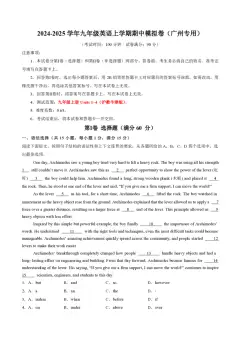
学校:___________姓名:___________班级:___________考号:___________
期中总复习Units 1-4
语法选择押题预测15 篇(紧贴新教材单元话题)(广州专用)
说明:此专题分三个难度层次,基础入门训练<进阶拓展训练< 能力综合实践,老师根据学生实际情
况进行针对性难度训练。
基础入门训练5 篇
阅读下面短文,按照句子结构的语法性和上下文连贯的要求,从各题所给的A、B、C 和D 项中选出最佳
选项。
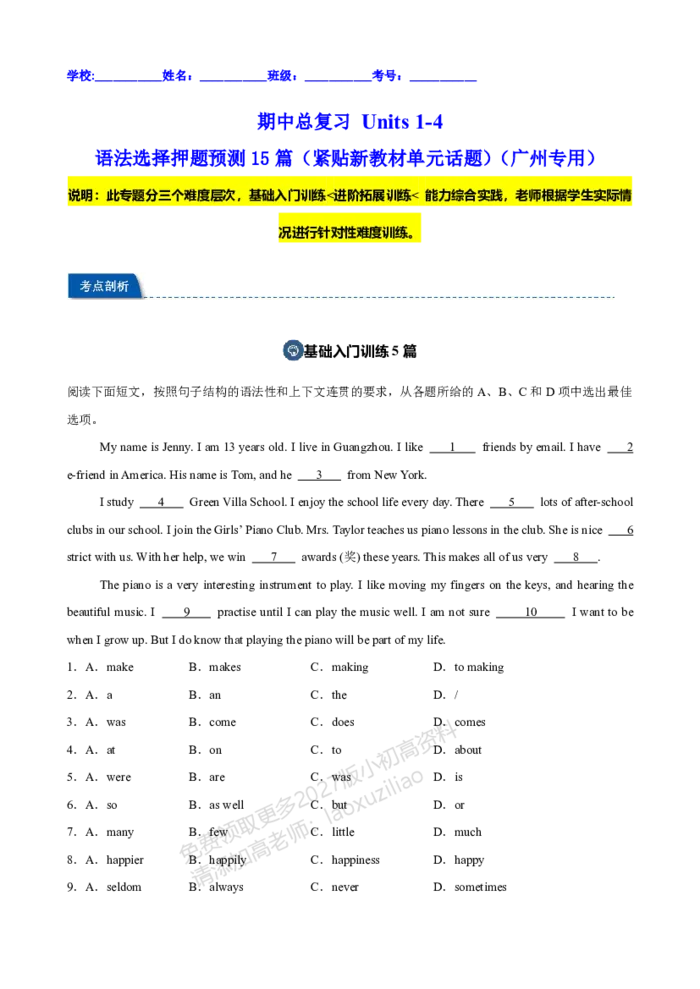
My name is Jenny. I am 13 years old. I live in Guangzhou. I like
1
friends by email. I have
2
e-friend in America. His name is Tom, and he
3
from New York.
I study
4
Green Villa School. I enjoy the school life every day. There
5
lots of after-school
clubs in our school. I join the Girls’ Piano Club. Mrs. Taylor teaches us piano lessons in the club. She is nice
6
strict with us. With her help, we win
7
awards (奖) these years. This makes all of us very
8
.
The piano is a very interesting instrument to play. I like moving my fingers on the keys, and hearing the
beautiful music. I
9
practise until I can play the music well. I am not sure
10
I want to be
when I grow up. But I do know that playing the piano will be part of my life.
1.A.make
B.makes
C.making
D.to making
2.A.a
B.an
C.the
D./
3.A.was
B.come
C.does
D.comes
4.A.at
B.on
C.to
D.about
5.A.were
B.are
C.was
D.is
6.A.so
B.as well
C.but
D.or
7.A.many
B.few
C.little
D.much
8.A.happier
B.happily
C.happiness
D.happy
9.A.seldom
B.always
C.never
D.sometimes
版小初高资料
2027
免费领取更多
laoxuziliao
:
请添加高老师
10.A.what
B.who
C.where
D.how
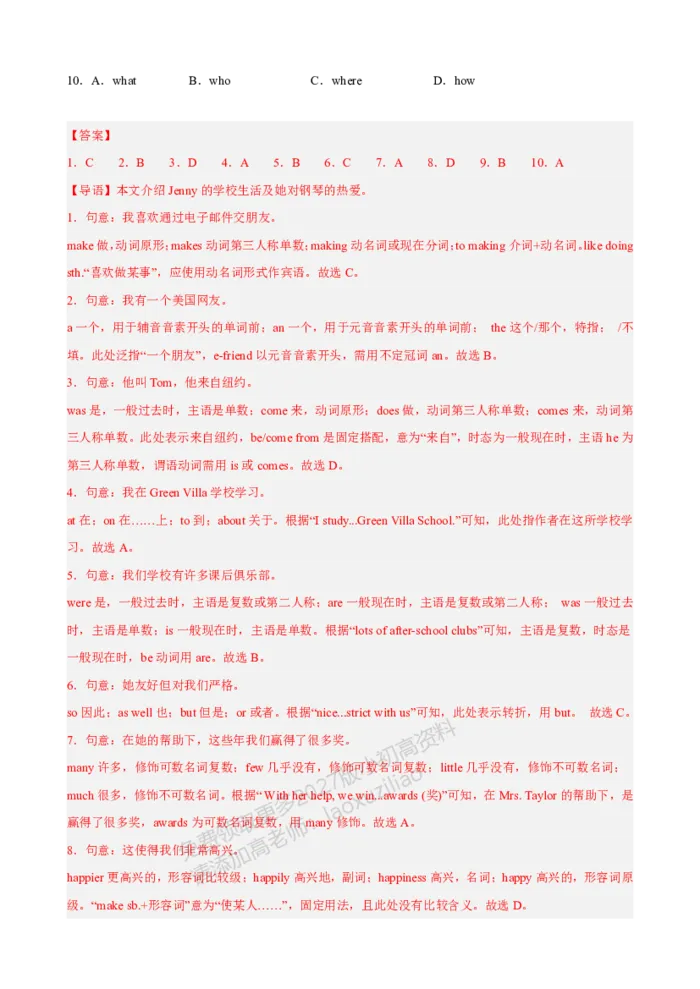
【答案】
1.C
2.B
3.D
4.A
5.B
6.C
7.A
8.D
9.B
10.A
【导语】本文介绍Jenny 的学校生活及她对钢琴的热爱。
1.句意:我喜欢通过电子邮件交朋友。
make 做,动词原形;makes 动词第三人称单数;making 动名词或现在分词;to making 介词+动名词。like doing
sth.“喜欢做某事”,应使用动名词形式作宾语。故选C。
2.句意:我有一个美国网友。
a 一个,用于辅音音素开头的单词前;an 一个,用于元音音素开头的单词前;the 这个/那个,特指;/不
填。此处泛指“一个朋友”,e-friend 以元音音素开头,需用不定冠词an。故选B。
3.句意:他叫Tom,他来自纽约。
was 是,一般过去时,主语是单数;come 来,动词原形;does 做,动词第三人称单数;comes 来,动词第
三人称单数。此处表示来自纽约,be/come from 是固定搭配,意为“来自”,时态为一般现在时,主语he 为
第三人称单数,谓语动词需用is 或comes。故选D。
4.句意:我在Green Villa 学校学习。
at 在;on 在……上;to 到;about 关于。根据“I study...Green Villa School.”可知,此处指作者在这所学校学
习。故选A。
5.句意:我们学校有许多课后俱乐部。
were 是,一般过去时,主语是复数或第二人称;are 一般现在时,主语是复数或第二人称;was 一般过去
时,主语是单数;is 一般现在时,主语是单数。根据“lots of after-school clubs”可知,主语是复数,时态是
一般现在时,be 动词用are。故选B。
6.句意:她友好但对我们严格。
so 因此;as well 也;but 但是;or 或者。根据“nice...strict with us”可知,此处表示转折,用but。故选C。
7.句意:在她的帮助下,这些年我们赢得了很多奖。
many 许多,修饰可数名词复数;few 几乎没有,修饰可数名词复数;little 几乎没有,修饰不可数名词;
much 很多,修饰不可数名词。根据“ With her help, we win...awards (奖)”可知,在Mrs. Taylor 的帮助下,是
赢得了很多奖,awards 为可数名词复数,用many 修饰。故选A。
8.句意:这使得我们非常高兴。
happier 更高兴的,形容词比较级;happily 高兴地,副词;happiness 高兴,名词;happy 高兴的,形容词原
级。“make sb.+形容词”意为“使某人……”,固定用法,且此处没有比较含义。故选D。
版小初高资料
2027
免费领取更多
laoxuziliao
:
请添加高老师
9.句意:我总是练习,直到我能把音乐弹好。
seldom 很少;always 总是;never 从不;sometimes 有时。根据“until I can play the music well”可知,作者总
是练习。故选B。
10.句意:我不确定长大后我想成为什么。
what 什么;who 谁;where 在哪里;how 怎样。根据“I am not sure...I want to be when I grow up.”可知,此处
是表达长大后想成为什么样的人。故选A。
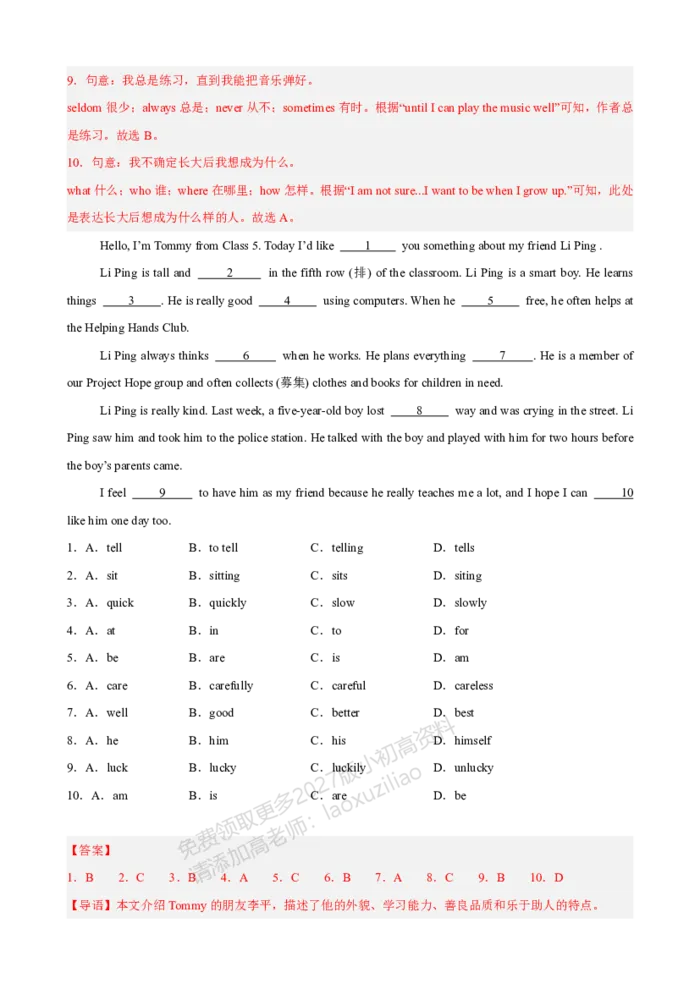
Hello, I’m Tommy from Class 5. Today I’d like
1
you something about my friend Li Ping .
Li Ping is tall and
2
in the fifth row (排) of the classroom. Li Ping is a smart boy. He learns
things
3
. He is really good
4
using computers. When he
5
free, he often helps at
the Helping Hands Club.
Li Ping always thinks
6
when he works. He plans everything
7
. He is a member of
our Project Hope group and often collects (募集) clothes and books for children in need.
Li Ping is really kind. Last week, a five-year-old boy lost
8
way and was crying in the street. Li
Ping saw him and took him to the police station. He talked with the boy and played with him for two hours before
the boy’s parents came.
I feel
9
to have him as my friend because he really teaches me a lot, and I hope I can
10
like him one day too.
1.A.tell
B.to tell
C.telling
D.tells
2.A.sit
B.sitting
C.sits
D.siting
3.A.quick
B.quickly
C.slow
D.slowly
4.A.at
B.in
C.to
D.for
5.A.be
B.are
C.is
D.am
6.A.care
B.carefully
C.careful
D.careless
7.A.well
B.good
C.better
D.best
8.A.he
B.him
C.his
D.himself
9.A.luck
B.lucky
C.luckily
D.unlucky
10.A.am
B.is
C.are
D.be
【答案】
1.B
2.C
3.B
4.A
5.C
6.B
7.A
8.C
9.B
10.D
【导语】本文介绍Tommy 的朋友李平,描述了他的外貌、学习能力、善良品质和乐于助人的特点。
版小初高资料
2027
免费领取更多
laoxuziliao
:
请添加高老师
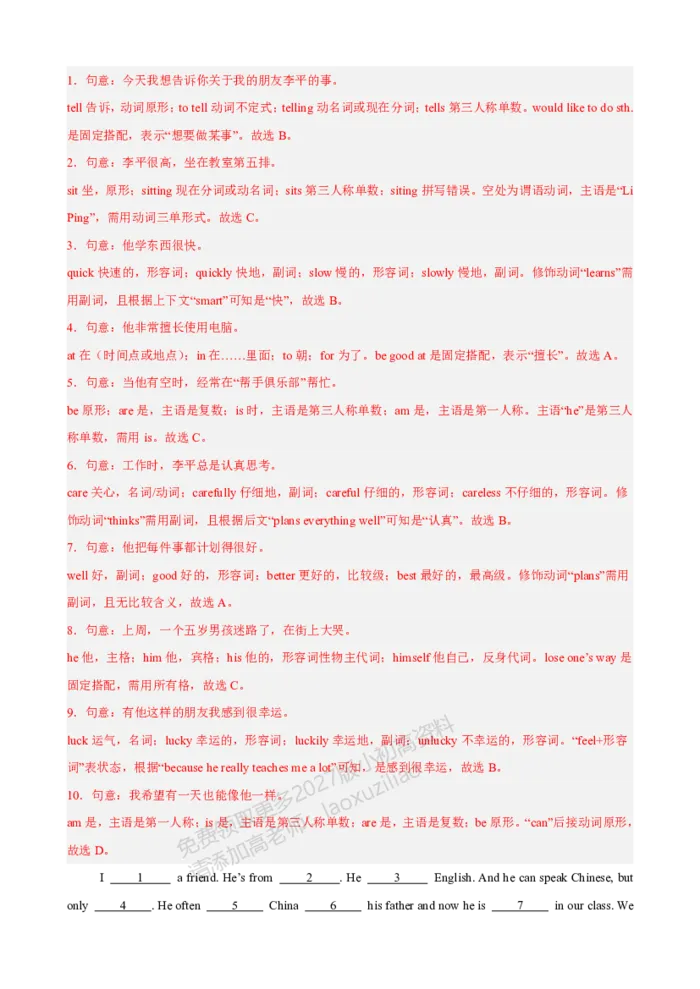
1.句意:今天我想告诉你关于我的朋友李平的事。
tell 告诉,动词原形;to tell 动词不定式;telling 动名词或现在分词;tells 第三人称单数。would like to do sth.
是固定搭配,表示“想要做某事”。故选B。
2.句意:李平很高,坐在教室第五排。
sit 坐,原形;sitting 现在分词或动名词;sits 第三人称单数;siting 拼写错误。空处为谓语动词,主语是“Li
Ping”,需用动词三单形式。故选C。
3.句意:他学东西很快。
quick 快速的,形容词;quickly 快地,副词;slow 慢的,形容词;slowly 慢地,副词。修饰动词“learns”需
用副词,且根据上下文“smart”可知是“快”,故选B。
4.句意:他非常擅长使用电脑。
at 在(时间点或地点);in 在……里面;to 朝;for 为了。be good at 是固定搭配,表示“擅长”。故选A。
5.句意:当他有空时,经常在“帮手俱乐部”帮忙。
be 原形;are 是,主语是复数;is 时,主语是第三人称单数;am 是,主语是第一人称。主语“he”是第三人
称单数,需用is。故选C。
6.句意:工作时,李平总是认真思考。
care 关心,名词/动词;carefully 仔细地,副词;careful 仔细的,形容词;careless 不仔细的,形容词。修
饰动词“thinks”需用副词,且根据后文“plans everything well”可知是“认真”。故选B。
7.句意:他把每件事都计划得很好。
well 好,副词;good 好的,形容词;better 更好的,比较级;best 最好的,最高级。修饰动词“plans”需用
副词,且无比较含义,故选A。
8.句意:上周,一个五岁男孩迷路了,在街上大哭。
he 他,主格;him 他,宾格;his 他的,形容词性物主代词;himself 他自己,反身代词。lose one’s way 是
固定搭配,需用所有格,故选C。
9.句意:有他这样的朋友我感到很幸运。
luck 运气,名词;lucky 幸运的,形容词;luckily 幸运地,副词;unlucky 不幸运的,形容词。“feel+形容
词”表状态,根据“because he really teaches me a lot”可知,是感到很幸运,故选B。
10.句意:我希望有一天也能像他一样。
am 是,主语是第一人称;is 是,主语是第三人称单数;are 是,主语是复数;be 原形。“can”后接动词原形,
故选D。
I
1
a friend. He’s from
2
. He
3
English. And he can speak Chinese, but
only
4
. He often
5
China
6
his father and now he is
7
in our class. We
版小初高资料
2027
免费领取更多
laoxuziliao
:
请添加高老师
are friends. He likes
8
things a lot. Look, he is making a paper bird.
He
9
me, “There
10
a lot of delicious food in China. I like it very much. ”
1.A.have
B.has
C.there’s
D.am
2.A.Australian
B.Australia
C.an Australian
D.an Australia
3.A.speak
B.speaks
C.talks
D.say
4.A.little
B.a little
C.a lot
D.much
5.A.come
B.comes
C.come to
D.comes to
6.A.and
B.or
C.with
D.to
7.A.study
B.studies
C.to study
D.studying
8.A.make
B.makes
C.to make
D.making
9.A.say
B.says
C.says to
D.say to
10.A.is
B.are
C.have
D.has
【答案】
1.A
2.B
3.B
4.B
5.D
6.C
7.D
8.D
9.C
10.A
【导语】本文是一篇记叙文。文章主要介绍了作者的一个来自澳大利亚的朋友,他会说英语和一点中文,
现在正在我们班学习,他很喜欢制作东西,也很喜欢中国的美食。
1.句意:我有一个朋友。
have 有;has 有(have 的第三人称单数形式);there’s 有;am 是。根据语境可知,此处表示“我有一个朋友”,
主语是I,谓语动词用原形have,故选A。
2.句意:他来自澳大利亚。
Australian 澳大利亚人;Australia 澳大利亚;an Australian 一个澳大利亚人;an Australia 错误形式。根据“He’s
from…”可知,此处表示“他来自澳大利亚”,介词from 后接地点名词,故选B。
3.句意:他说英语。
speak 说(某种语言);speaks 说(某种语言)(speak 的第三人称单数形式);talks 谈论;say 说(强调说话
内容)。根据“English”可知,此处表示“说英语”,主语是He,谓语动词用第三人称单数形式,故选B。
4.句意:并且他会说中文,但是只会说一点。
little 几乎没有;a little 一点;a lot 许多;much 许多。根据“but only…”可知,此处表示转折关系,即他会
说中文,但是只会说一点,a little 符合语境,故选B。
5.句意:他经常和他的爸爸一起来中国,现在他正在我们班学习。
come 来;comes 来(come 的第三人称单数形式);come to 来到;comes to 来到(come to 的第三人称单数
版小初高资料
2027
免费领取更多
laoxuziliao
:
请添加高老师
形式)。根据“China”可知,此处表示“来到中国”,主语是He,谓语动词用第三人称单数形式,故选D。
6.句意:他经常和他的爸爸一起来中国,现在他正在我们班学习。
and 和;or 或者;with 和……一起;to 到。根据“his father”可知,此处表示“和他的爸爸一起”,with 符合语
境,故选C。
7.句意:他经常和他的爸爸一起来中国,现在他正在我们班学习。
study 学习;studies 学习(study 的第三人称单数形式);to study 学习(study 的动词不定式形式);studying
学习(study 的现在分词形式)。根据“now he is…”可知,此处表示“现在他正在我们班学习”,现在进行时
态的结构为“be+doing”,故选D。
8.句意:他非常喜欢制作东西。
make 制作;makes 制作(make 的第三人称单数形式);to make 制作(make 的动词不定式形式);making
制作(make 的动名词形式)。根据“He likes…things a lot.”可知,此处表示“他非常喜欢制作东西”,表示一
般的爱好,用like doing sth.表示“喜欢做某事”,故选D。
9.句意:他对我说:“中国有很多美味的食物。我非常喜欢它。”
say 说(强调说话内容);says 说(强调说话内容)(say 的第三人称单数形式);says to 对……说(say to 的
第三人称单数形式);say to 对……说。根据“me”可知,此处表示“他对我说”,主语是He,谓语动词用第
三人称单数形式,故选C。
10.句意:他对我说:“中国有很多美味的食物。我非常喜欢它。”
is 是(be 的第三人称单数形式);are 是(be 的复数形式);have 有;has 有(have 的第三人称单数形式)。
根据“There…a lot of delicious food in China.”可知,此处表示“中国有很多美味的食物”,there be 句型表示“某
地有某物”,主语是a lot of delicious food,be 动词用is,故选A。
Winter is the season that comes after autumn and before spring. Winter is usually the coldest time of the
year. In some places, it
1
cold, snow and ice. Here are some ways to tell you that it’s winter.
In winter, the days are shorter and the nights are
2
than any other season. December 22nd is
3
first day of winter in 2023, because it is the shortest day of the whole year!
The Sun doesn’t shine
4
in winter, even on the brightest days. Winter is a wet season with a lot of
rain or snow. Winter makes people, animals and plants
5
their lives. Trees and plants often go dormant, just
like they’re sleeping, or go away.
6
you look outside, you can see more brown. There are no leaves on most
of the trees.
Some animals hibernate (冬眠), while other animals keep food at
7
“homes” in autumn. They do it so
that they
8
eat the food in winter. It is difficult for them
9
food in winter. Many birds fly from the
north
10
warmer places in the winter. This is called migration (迁徙). In warmer places, animals keep active
版小初高资料
2027
免费领取更多
laoxuziliao
:
请添加高老师
during the coldest time of the year. After the winter ends, these animals will fly back to the north.
1.A.brings
B.brought
C.is bringing
D.will bring
2.A.long
B.longer
C.longest
D.the longest
3.A.a
B.an
C.the
D./
4.A.warm
B.warmly
C.warmth
D.warmer
5.A.change
B.changes
C.changing
D.to change
6.A.Because
B.Before
C.Or
D.When
7.A.they
B.them
C.their
D.theirs
8.A.must
B.can
C.need
D.should
9.A.find
B.finding
C.found
D.to find
10.A.to
B.for
C.at
D.with
【答案】
1.A
2.B
3.C
4.B
5.A
6.D
7.C
8.B
9.D
10.A
【导语】本文主要介绍几种知晓冬天来临的方法。
1.句意:在某些地方,它带来了寒冷、冰雪。
brings 带来,一般现在时;brought 带来,一般过去时;is bringing 带来,现在进行时;will bring 带来,一
般将来时。根据“In some places, it…cold, snow and ice.”可知,该句描述事实,为一般现在时,主语是“it”,
动词填三单形式。故选A。
2.句意:冬天,白天比其他季节短,晚上比其他季节长。
long 长的;longer 更长的;longest 最长的;the longest 最长的。根据“than any other season”可知,此处填比
较级longer。故选B。
3.句意:12 月22 日是2023 年冬天的第一天,因为这是一年中最短的一天!
a 一,泛指,用于辅音音素开头的单词前;an 一,泛指,用于元音音素开头的单词前;the 特指;/不填。
根据“first day”可知,此处位于序数词前,填定冠词the,特指冬天的第一天。故选C。
4.句意:即使在最明亮的日子里,冬天的太阳也不会温暖地照耀。
warm 温暖的,形容词;warmly 温暖地,副词;warmth 温暖,名词;warmer 更温暖,比较级。修饰动词“shine”
需用副词形式warmly,故选B。
5.句意:冬天使人、动物和植物的生活受到了改变。
change 改变,动词原形;changes 改变,三单形式;changing 改变,现在分词或动名词;to change 改变,
不定式。根据“makes people, animals and plants…their lives.”可知,此处考查make sb do“使得某人做”,make
版小初高资料
2027
免费领取更多
laoxuziliao
:
请添加高老师
为使役动词,接动词原形。故选A。
6.句意:当你向外看时,你可以看到更多的棕色。
Because 因为;Before 在……之前;Or 或者;When 当……时。根据“..you look outside, you can see more brown.”
可知,此处指当往外看的时候,可以看到更多棕色。故选D。
7.句意:有些动物冬眠,而其他动物在秋天把食物放在它们的“家”里。
they 它们,主格;them 它们,宾格;their 它们的,形容词性物主代词;theirs 它们的,名词性物主代词。
根据“while other animals keep food at…‘homes’ in autumn.”可知,此处指把食物放在它们的家里,设空处后
有名词,填形容词性物主代词their。故选C。
8.句意:它们这样做是为了在冬天吃这些食物。
must 必须;can 能;need 需要;should 应该。根据“eat the food in winter.”可知,表示“能吃到食物”,需用
情态动词“can”,故选B。
9.句意:冬天它们很难找到食物。
find 找到,动词原形;finding 找到,动名词或现在分词;found 找到,动词过去式;to find 找到,不定式。
根据“It is difficult for them”可知,考查it is adj for sb to do sth 固定句型,因此设空处填不定式。故选D。
10.句意:冬天,许多鸟从北方飞到温暖的地方。
to 到;for 为了;at 在;with 和。根据“from the north…warmer places”可知,考查固定短语from…to“从……
到”,故选A。
There are four seasons in a year: spring, summer, autumn and winter. Each season has three
1
.
Spring is the
2
season of the year. The spring months are March, April and May. In spring, the
weather gets
3
and the fields turn green. Farmers are very busy.
Summer
4
in June. During the summer months, fruit, trees
5
flowers grow (生长)
well. Of course, the weather
6
usually very hot in summer. People like to go
7
in the sea.
Autumn is
8
September to November. It’s a wonderful season. The beautiful leaves often
9
to the ground. Fields are golden (金黄色的) with crops (庄稼).
Winter is
10
last season of the year. It's snowy and cold in many places. On New Year’s Day, we
wish each other a happy new year.
1.A.day
B.days
C.month
D.months
2.A.one
B.first
C.two
D.second
3.A.warm
B.warmly
C.cold
D.coldly
4.A.ends
B.end
C.starts
D.start
5.A.but
B.and
C.so
D.because
版小初高资料
2027
免费领取更多
laoxuziliao
:
请添加高老师
6.A.were
B.are
C.was
D.is
7.A.swimming
B.swim
C.skating
D.skate
8.A.at
B.with
C.for
D.from
9.A.falls
B.fall
C.are falling
D.fell
10.A.a
B.an
C.the
D./
【答案】
1.D
2.B
3.A
4.C
5.B
6.D
7.A
8.D
9.B
10.C
【导语】本文主要介绍了一年中四季的划分、各季节的特点及相关活动。
1.句意:每个季节有三个月。
day 天;days 天,复数;month 月;months 月,复数。根据“Each season has three…”可知,此处表示“每个
季节有三个月”,且“three” 后接可数名词复数,故选D。
2.句意:春天是一年中的第一个季节。
one 一,基数词;first 第一,序数词;two 二,基数词;second 第二,序数词。根据“Spring is the…season of
the year.”可知,此处表示“春天是第一个季节”,此处要用序数词first,故选B。
3.句意:在春天,天气变暖,田野变绿。
warm 温暖的,形容词;warmly 温暖地,副词;cold 寒冷的,形容词;coldly 寒冷地,副词。“get”为系动
词,后接形容词作表语,表示“春天天气变暖”,故选A。
4.句意:夏天在六月开始。
ends 结束,单三形式;end 结束,原形;starts 开始,单三形式;start 开始,原形。根据“Summer…in June. ”
可知,此处表示“六月是夏天的开始”,且句子时态是一般现在时,主语“Summer” 是第三人称单数,谓语
动词要用单三形式,故选C。
5.句意:在夏季的月份里,水果、树木和花朵生长得很好。
but 但是;and 和;so 所以;because 因为。“fruit, trees” 与“flowers” 是并列关系,用“and”连接,故选B。
6.句意:当然,夏天的天气通常非常炎热。
were 是,be 的过去式;are 是,主语为第二人称或复数名词;was 是,be 的过去式;is 是,主语为第三人
称或名词单数。描述客观事实用一般现在时,主语“the weather” 是不可数名词,谓语用单数is,故选D。
7.句意:人们喜欢去海里游泳。
swimming 游泳,动名词;swim 游泳,原形;skating 滑冰,动名词;skate 滑冰,原形。根据“People like to
go…in the sea.”可知,此处表示“人们喜欢去海里游泳”,“go + 动名词”表示从事某项活动,swimming 符合
语境,故选A。
版小初高资料
2027
免费领取更多
laoxuziliao
:
请添加高老师
8.句意:秋天是从九月到十一月。
at 在;with 和;for 为了;from 从。from...to...意为“从…… 到……”,固定搭配,此处表示“秋天是从九月
到十一月”,故选D。
9.句意:美丽的树叶经常落到地上。
falls 落下,单三形式;fall 落下,原形;are falling 正在落下,现在进行时;fell 落下,过去式。根据“often”
可知,本句时态为一般现在时,主语“leaves” 是复数,谓语用原形fall,故选B。
10.句意:冬天是一年中的最后一个季节。
a 一个,不定冠词,用于辅音音素开头;an 一个,不定冠词,用于元音音素开头;the 定冠词,表特指;/,
零冠词。根据“Winter is…last season”可知,此处是特指“最后一个季节”,需加定冠词the。故选C。
进阶拓展训练5 篇
阅读下面短文,按照句子结构的语法性和上下文连贯的要求,从各题所给的A、B、C 和D 项中选出最佳
选项,并在答题卡上将该项涂黑。
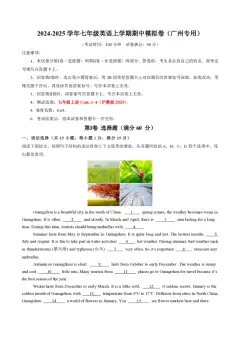
Guangzhou is a beautiful city in the south of China.
1
spring comes, the weather becomes warm in
Guangzhou. It is often
2
and cloudy. In March and April, there is
3
of rain lasting for a long time.
During this time, tourists should bring umbrellas with
4
.
Summer lasts from May to September in Guangzhou. It is quite long and hot. The hottest months are July
and August. It is fun to take part in water
5
in hot weather. During summer, bad weather
6
very
often, such as thunderstorms (暴风雨) and typhoons (台风). So it’s important to bring raincoats and umbrellas.
Autumn in Guangzhou is short. It lasts from October to early December. The weather is sunny and cool
7
little rain. Many tourists from
8
places go to Guangzhou for travel because it’s the best season of
the year.
Winter lasts from December to early March. It is a little cold,
9
it doesn’t snow often. January is
the coldest month of Guangzhou, with
10
temperature from 9℃to 17℃. Different from cities in North
China, Guangzhou becomes a world of flowers in January. You can see flower markets here and there.
1.A.Where
B.When
C.Why
D.What
2.A.rains
B.rained
C.rain
D.rainy
3.A.few
B.many
C.much
D.lots
4.A.them
B.they
C.their
D.theirs
5.A.activity
B.active
C.activities
D.actively
6.A.happening
B.to happen
C.happen
D.happens
版小初高资料
2027
免费领取更多
laoxuziliao
:
请添加高老师
7.A.by
B.for
C.with
D.into
8.A.other
B.another
C.others
D.the others
9.A.or
B.if
C.but
D.because
10.A.a
B.an
C.the
D./
【答案】
1.B
2.D
3.D
4.A
5.C
6.D
7.C
8.A
9.C
10.A
【导语】本文主要介绍了广州这座城市在春、夏、秋、冬四个季节的天气特点以及不同季节适合开展的活
动。
1.句意:当春天来临的时候,广州的天气变得温暖。
Where 在哪里;When 当……时候;Why 为什么;What 什么。根据“spring comes, the weather becomes warm
in Guangzhou”可知,此处表示当春天来临的时候,广州的天气变得温暖,应用when 引导时间状语从句。
故选B。
2.句意:它经常是多雨和多云的。
rains 下雨,动词三单形式;rained 下雨,动词过去式;rain 雨,名词;rainy 多雨的,形容词。根据“and cloudy”
可知,此处应用形容词与cloudy 并列作表语。故选D。
3.句意:在三月和四月,有很多雨持续很长时间。
few 很少,修饰可数名词复数;many 很多,修饰可数名词复数;much 很多,修饰不可数名词;lots 很多,
常与of 连用,修饰名词。根据“of rain”可知,此处应用lots of“很多”修饰不可数名词rain。故选D。
4.句意:在这段时间,游客应该随身带伞。
them 他们,人称代词宾格;they 他们,人称代词主格;their 他们的,形容词性物主代词;theirs 他们的,
名词性物主代词。根据“tourists should bring umbrellas with...”可知,此处指随身带伞,介词with 后应接人称
代词宾格them 作宾语。故选A。
5.句意:在炎热的天气里参加水上活动很有趣。
activity 活动,名词单数;active 积极的,形容词;activities 活动,名词复数;actively 积极地,副词。根据
“take part in water...”可知,此处指参加水上活动,应用名词activity,且此处应用复数形式表示泛指。故选
C。
6.句意:在夏天,坏天气经常发生,例如暴风雨和台风。
happening 发生,动名词;to happen 发生,动词不定式;happen 发生,动词原形;happens 发生,动词三单
形式。根据“During summer, bad weather...very often”可知,此处描述的是经常性发生的动作,应用一般现在
时,主语weather 为不可数名词,谓语动词应用三单形式。故选D。
版小初高资料
2027
免费领取更多
laoxuziliao
:
请添加高老师
7.句意:天气晴朗凉爽,很少下雨。
by 通过;for 为了;with 伴随;into 进入。根据“The weather is sunny and cool...little rain.”可知,此处指天气
晴朗凉爽,很少下雨,应用介词with 表示伴随。故选C。
8.句意:许多来自其他地方的游客去广州旅游,因为这是一年中最好的季节。
other 其他的,后接名词复数;another 另一个,后接名词单数;others 其他人或物,相当于“other+名词复数”;
the others 其余的,表示在一个范围内的其他全部。根据“Many tourists from...places”可知,此处指来自其他
地方的游客,应用other 修饰名词复数places。故选A。
9.句意:天气有点冷,但不常下雪。
or 或者;if 如果;but 但是;because 因为。根据“It is a little cold,...it doesn’t snow often.”可知,前后句之间
为转折关系,应用but 连接。故选C。
10.句意:一月是广州最冷的月份,气温在9℃到17℃之间。
a 一个,不定冠词,表泛指,用于辅音音素开头的单词前;an 一个,不定冠词,表泛指,用于元音音素开
头的单词前;the 定冠词,表特指;/零冠词。根据“temperature from 9℃to 17℃.”可知,此处泛指一个温度,
且temperature 以辅音音素开头,应用不定冠词a 修饰。故选A。
Dear Bob,
How’s everything? You asked me something about Starlight Middle School. As a reporter, I visited the
school last term and enjoyed their
1
kinds of activities. Now let me share how these acitivities help
students grow.
At the reading festival, students shared books and wrote
2
book reports. “Reading makes us
3
new ideas” a girl said. The library was full of laughter because they found the joy of sharing ideas.
The science and technology festival showed
4
creativity (创造力) . Students learned about
science by making robots. And one team even used some bottles to make a mini “space station”. A teacher
5
them, “Their skills make science come alive!”
During the art festival, Lily sold notebooks
6
her paintings on the covers (封面) . “I draw
flowers to show happiness,” she said. She gave all the money she made to a children’s home. Lily was happy that
her kindness could help
7
.
The red song competition moved everyone. When the students sang, they showed
8
love for our
country. They also knew they should study harder to make our country stronger and stronger.
On the school trip, students visited the City Wall. They learned
9
the ancient people built it.
“Going on a school trip is much more fun than just learning from books in the classroom!” one of my friends said
10
, looking forward to the next trip.
版小初高资料
2027
免费领取更多
laoxuziliao
:
请添加高老师
These activities don’t just teach knowledge—they help students become caring and confident. I believe
students will keep such experiences in their mind forever.
Best wishes,
Cindy Chen
1.A.different
B.differently
C.quick
D.quickly
2.A.on
B.up
C.down
D.off
3.A.thinks of
B.thinking of
C.think of
D.to think of
4.A.students’
B.students
C.student
D.student’s
5.A.praises
B.is praising
C.praise
D.praised
6.A.for
B.with
C.at
D.in
7.A.the other
B.others
C.another
D.other
8.A.theirs
B.them
C.their
D.they
9.A.who
B.what
C.where
D.why
10.A.hopefully
B.hopeless
C.hopeful
D.hopelessly
【答案】
1.A
2.C
3.C
4.A
5.D
6.B
7.B
8.C
9.D
10.A
【导语】本文介绍了星光中学的各种活动,这些活动不仅教授知识,而且帮助学生变得关心他人和自信。
1.句意:作为一名记者,上学期我参观了这所学校并欣赏了他们不同种类的活动。
different 不同的,形容词;differently 不同地,副词;quick 快的,形容词;quickly 快速地,副词。根据“kinks
of activities”可知,此处缺少形容词修饰名词,表示不同种类的活动,故选A。
2.句意:在阅读节上,学生们分享书籍,写下读书报告。
on 在……上;up 向上;down 向下;off 离开。根据“students shared books”可知,此处指写读书报告,write
down 写下,固定搭配,符合语境,故选C。
3.句意:阅读使我们想到了新的主意。
thinks of 想到,第三人称单数形式;thinking of 想到,动名词形式;think of 想到,动词原形;to think of 想
到;动词不定式。make sb. do sth.使某人做某事,故选C。
4.句意:科学技术节展示了学生们的创造力。
students’学生们的;students 学生们;student 学生;student’s 学生的。根据“creativity”可知,此处填写名词
所有格,根据“Students learned about science by making robots.”可知,此处指学生们的创造力,所以用名词
复数的所有格,故选A。
版小初高资料
2027
免费领取更多
laoxuziliao
:
请添加高老师
5.句意:一位老师表扬他们,“他们的技能使科学变得生动。”
praises 表扬,第三人称单数形式;is praising 表扬,现在进行时;praise 表扬,动词原形;praised 表扬,
动词过去式。根据“And one team even used some bottles to make…”可知,老师表扬他们这件事发生在过去,
用一般过去时,故选D。
6.句意:在艺术节期间,莉莉卖掉了封面上有她的画的笔记本。
for 为了;with 带有;at 在;in 在……里。根据“She gave all the money she made to a children’s home.”可知,
莉莉卖掉了封面上有她的画的笔记本,notebooks with her paintings on the coverswith 封面上带有她的画的笔
记本,符合语境,故选B。
7.句意:莉莉很高兴她的善良能帮助其他人。
the other 其他的,特指;others 其他的,泛指,代词;another 另一个,再一个;other 其他的,形容词。分
析句子可知此处缺少代词作宾语,泛指其他人,故选B。
8.句意:当学生们演唱时,他们展示了他们对我们祖国的爱。
theirs 他们的,名词性物主代词;them 他们,宾格;their 他们的,形容词性物主代词;they 他们,主格。
根据“love”可知,此处缺少形容词性物主代词作定语,故选C。
9.句意:他们了解了为什么古代的人们建造它。
who 谁;what 什么;where 在哪里;why 为什么。根据“the ancient people built it”可知,此处指为什么古代
的人们建造城墙,故选D。
10.句意:我的朋友满怀希望地说。
hopefully 有希望地;hopeless 没有希望的;hopeful 有希望的;hopelessly 无望地。根据“Going on a school trip
is much more fun than just learning from books in the classroom!”及“looking forward to the next trip”可知,朋友
是满怀希望地说的,故选A。
In America, junior high school students have a busy
1
fun life. Their school day usually
2
at 8:00 a.m. and ends at 3:00 p.m. There are many kinds of classes in
3
schools. Besides basic subjects
like math and English, they also have P.E., music, and art classes. In P.E., they play
4
like basketball or
soccer. In music class, they sing songs and learn to play instruments. During class, teachers encourage students
5
up and share their ideas.
After school, they have a lot of activities. Some students join sports like football or volleyball. They run
and play together
6
the playground to keep fit. Others join clubs like the science club or the art club.
They can
7
experiments and explore the wonderful world of science. They also have homework, but
not too much. They usually finish it in the evening.
On weekends, they relax and have fun. They
8
go to the movies, play video games, or hang out
版小初高资料
2027
免费领取更多
laoxuziliao
:
请添加高老师
with friends. Sometimes, they go
9
with their families and enjoy themselves too. They enjoy their life
and learn a lot at the same time.
The life of American junior high school students
10
full and happy.
1.A.but
B.and
C.or
D.with
2.A.has
B.have
C.starts
D.start
3.A.they
B.their
C.theirs
D.themselves
4.A.sports
B.cards
C.games
D.chess
5.A.speak
B.to speak
C.speaking
D.speaks
6.A.above
B.under
C.on
D.behind
7.A.did
B.doing
C.do
D.to do
8.A.can
B.must
C.should
D.can’t
9.A.sleep
B.sleeping
C.sightseeing
D.sightsee
10.A.is
B.are
C.was
D.were
【答案】
1.A
2.C
3.B
4.A
5.B
6.C
7.C
8.A
9.C
10.A
【导语】本文介绍了美国初中生的校园生活,包括课程安排、课外活动和周末休闲方式,展现了他们充实
而快乐的校园生活。
1.句意:美国初中生有忙碌但有趣的生活。
but 但;and 和;or 或;with 和……一起。“busy”和“fun”是转折关系。故选A。
2.句意:他们的上学日通常在上午8 点开始,下午3 点结束。
has 有,三单形式;have 有;starts 开始,三单形式;start 开始。主语“school day”是单数,且与“ends”并列。
故选C。
3.句意:在他们的学校里有各种各样的课程。
they 他们;their 他们的;theirs 他们的;themselves 他们自己。修饰名词“schools”需用形容词性物主代词。
故选B。
4.句意:在体育课上,他们打篮球或踢足球。
sports 运动;cards 纸牌;games 游戏;chess 国际象棋。根据“basketball or soccer”可知是运动。故选A。
5.句意:上课时,老师鼓励学生发言并分享想法。
speak 原形;to speak 不定式;speaking 动名词;speaks 三单。encourage sb. to do 是固定搭配。故选B。
6.句意:他们在操场上跑步和玩耍以保持健康。
版小初高资料
2027
免费领取更多
laoxuziliao
:
请添加高老师
above 在……上方;under 在……下方;on 在……上;behind 在……后面。on the playground 是固定搭配。
故选C。
7.句意:其他人喜欢加入俱乐部,像科技俱乐部或者美术俱乐部,他们可以做实验并探索科学世界。
did 过去式;doing 现在分词或动名词;do 原形;to do 不定式。can 后接动词原形。故选C。
8.句意:他们可以看电影、打游戏或和朋友出去玩。
can 可以;must 必须;should 应该;can’t 不能。根据“they relax and have fun”可知,是能够有休闲活动。故
选A。
9.句意:有时他们和家人一起去观光。
sleep 睡觉;sleeping 睡觉;sightseeing 观光;sightsee 观光,动词原形。go sightseeing 是固定搭配。故选C。
10.句意:美国初中生的生活充实而快乐。
is 单数;are 复数;was 过去式;were 过去式。主语“life”是单数,且全文为一般现在时。故选A。
Hello, I’m Li Ming. I’m
1
middle school student. Last Friday was our school’s Sports Day. The
playground was full of balloons and flowers. And the weather was fine. Everyone was happy.
There
2
many exciting activities on that day. For example, we all wanted
3
the
100-metre running race. Many
4
from different classes ran in it. They ran very fast. My friends took
part in the race too. They didn’t win,
5
they tried their best to run fast and enjoyed themselves.
We saw something very touching (感人的) when my friend Jack
6
to run. He fell down and got
hurt. To
7
surprise, he didn’t cry but kept running. It was a special memory.
8
race did I take part in? I took part in the swimming race. I was a little nervous (紧张的)
9
first. I
10
feel my heart beating (跳动) fast. But when I heard my friends calling my name, I swam fast
and won the first place successfully (成功地).
Sports Day isn’t just about winning. It’s about finding the happiness with friends.
1.A.a
B.an
C.the
D./
2.A.was
B.were
C.is
D.are
3.A.watch
B.watches
C.to watch
D.watching
4.A.student
B.students
C.farmer
D.farmers
5.A.and
B.because
C.so
D.but
6.A.start
B.starts
C.started
D.is starting
7.A.our
B.ours
C.we
D.us
8.A.When
B.Where
C.Why
D.What
9.A.on
B.at
C.in
D.under
版小初高资料
2027
免费领取更多
laoxuziliao
:
请添加高老师
10.A.can
B.can’t
C.could
D.couldn’t
【答案】
1.A
2.B
3.C
4.B
5.D
6.C
7.A
8.D
9.B
10.C
【导语】本文是一篇记叙文,主要内容是李明介绍了学校运动会当天的场景,包括各类活动、朋友参赛经
历及自己参加游泳比赛并夺冠的过程,还提及运动会的意义不仅在于获胜,更在于和朋友共享快乐。
1.句意:我是一名中学生。
a 一个(用于辅音音素开头的单词前);an 一个(用于元音音素开头的单词前);the 这个;/ 零冠词。根据
“middle school student”可知,此处表示“一名中学生”,“middle”是以辅音音素开头的单词,应用不定冠词“a”,
故选A。
2.句意:那天有很多令人兴奋的活动。
was 是(be 动词的过去式,用于单数主语或不可数名词);were 是(be 动词的过去式,用于复数主语);is
是;are 是(be 动词的一般现在时,用于复数主语)。根据“Last Friday”和“many exciting activities”可知,句
子时态为一般过去时,且主语“many exciting activities”是复数,应用“were”,故选B。
3.句意:例如,我们都想观看100 米赛跑。
watch 观看;watches 观看(动词第三人称单数形式);to watch 观看(动词不定式);watching 观看(动词
-ing 形式)。根据“we all wanted”可知,want to do sth“想要做某事”,此处应用动词不定式“to watch”,故选
C。
4.句意:许多来自不同班级的学生参加了赛跑。
student 学生;students 学生(复数);farmer 农民;farmers 农民(复数)。根据“from different classes”可知,
参加赛跑的应是来自不同班级的学生,且“many”后接可数名词复数,应用“students”,故选B。
5.句意:他们没有赢,但他们尽了最大努力跑得快,并且玩得很开心。
and 和;because 因为;so 所以;but 但是。根据“They didn’t win”和“they tried their best to run fast and enjoyed
themselves”可知,前后句之间是转折关系,故选D。
6.句意:当我的朋友杰克开始跑步时,我们看到了非常感人的一幕。
start 开始;starts 开始(动词第三人称单数形式);started 开始(动词过去式);is starting 开始(现在进行
时)。根据“We saw something very touching”可知,句子时态为一般过去时,此处应用“started”,故选C。
7.句意:令我们惊讶的是,他没有哭,而是继续跑。
our 我们的;ours 我们的(名词性物主代词);we 我们;us 我们(宾格)。根据“To... surprise”可知,to one’s
surprise“令某人惊讶的是”,此处应用形容词性物主代词“our”,故选A。
8.句意:我参加了什么比赛?
版小初高资料
2027
免费领取更多
laoxuziliao
:
请添加高老师
When 什么时候;Where 哪里;Why 为什么;What 什么。根据“I took part in the swimming race”可知,此处
是对参加的比赛种类进行提问,故选D。
9.句意:一开始我有点紧张。
on 在……上面;at 在;in 在……里面;under 在……下面。根据“I was a little nervous... first”可知,at first“一
开始”,此处应用“at”,故选B。
10.句意:我能感觉到我的心跳得很快。
can 能;can’t 不能;could 能(一般过去时);couldn’t 不能(一般过去时)。根据“I was a little nervous”和全
文时态是一般过去时可知,此处表示“能感觉到心跳快”,应用“could”,故选C。
Reduce, Reuse, Recycle
Long ago, people didn’t need to buy clean water.
1
nowadays many people must buy it because
clean water is becoming rare (稀缺). This shows a big problem: Earth is running out of important things like trees,
water, oil, fish, and clean air. If we keep
2
them, life will become much
3
. Maybe in the future,
even air
4
money! But we can still help by following the “3R’s”: Reduce, Reuse, Recycle.
Reduce (Use Less)
Turn off the water when brushing your teeth so that we
5
save much water. Bring
6
used
cloth bag to stores instead of using plastic bags.
Reuse (Use Again)
Buy things we can refill by
7
, like pens or shampoo bottles.
Do you usually write on one side of a paper? You can write your shopping list on
8
side.
Recycle (Make New from Old)
9
things can be recycled: Paper, Glass, Plastic, Metal.
Remember: If we all reduce, reuse, and recycle,
10
more happiness in the future.
1.A.But
B.Or
C.And
D.So
2.A.waste
B.to waste
C.wastes
D.wasting
3.A.bad
B.badly
C.worst
D.worse
4.A.will cost
B.cost
C.costs
D.is costing
5.A.can
B.must
C.should
D.need
6.A.a
B.an
C.the
D./
版小初高资料
2027
免费领取更多
laoxuziliao
:
请添加高老师
7.A.we
B.our
C.ours
D.ourselves
8.A.other
B.others
C.the other
D.the others
9.A.Much
B.Many
C.Little
D.Few
10.A.there are going to be
B.there is going to have
C.there are going to have
D.there is going to be
【答案】
1.A
2.D
3.D
4.A
5.A
6.A
7.D
8.C
9.B
10.D
【导语】本文介绍了“3R”原则,这可以应对地球资源日益稀缺的问题,并详细介绍了如何在日常生活中实
践这些原则。
1.句意:但是现在,许多人必须购买它,因为干净的水变得越来越少。
But 但是;Or 或者;And 和;So 所以。根据“Long ago, people didn’t need to buy clean water”和“nowadays many
people must buy it”可知,前后两句是转折关系,用but 连接。故选A。
2.句意:如果我们继续浪费它们,生活将会变得更糟。
waste 浪费,动词原形;to waste 动词不定式;wastes 第三人称单数;wasting 动名词。keep doing sth.“继续
做某事”。故选D。
3.句意:如果我们继续浪费它们,生活将会变得更糟。
bad 坏的;badly 坏地;worst 最坏的;worse 更坏的。much 修饰比较级worse。故选D。
4.句意:也许在将来,甚至连空气都要花钱!
will cost 一般将来时;cost 动词原形;costs 第三人称单数;is costing 现在进行时。根据“in the future”可知
句子用一般将来时。故选A。
5.句意:刷牙时关掉水龙头,这样我们就可以节省很多水。
can 能够,可以;must 必须;should 应该;need 需要。根据“Turn off the water when brushing your teeth...save
much water”可知,刷牙时关掉水龙头,可以节省很多水。故选A。
6.句意:带上一个用过的布袋去商店,而不是使用塑料袋。
a 一个(用于辅音音素前);an 一个(用于元音音素前);the 这个/那个(定冠词);/零冠词。此处泛指“一
个用过的布袋”,且used 以辅音音素开头。故选A。
7.句意:购买我们可以自己重新填充的东西,比如钢笔或洗发水瓶。
we 我们,主格;our 我们的,形容词性物主代词;ours 我们的,名词性物主代词;ourselves 我们自己,反
身代词。根据“Buy things we can refill by...”可知,此处考查by oneself“独自,自行”,固定短语,故此处用
反身代词。故选D。
版小初高资料
2027
免费领取更多
laoxuziliao
:
请添加高老师
8.句意:你可以在另一面写你的购物清单。
other 其他的;others 其他人/物;the other(两个中的)另一个;the others 其他人/物。根据“write on one side
of a paper”和“You can write your shopping list on..side”可知,此处指在纸的另一面,用the other 表示“两者中
的另一个”。故选C。
9.句意:许多东西可以被回收:纸张、玻璃、塑料、金属。
Much 许多(修饰不可数名词);Many 许多(修饰可数名词);Little 几乎没有(修饰不可数名词);Few 几
乎没有(修饰可数名词)。根据“...things can be recycled : Paper, Glass, Plastic, Metal.”可知,许多东西可以被
回收,things 是可数名词复数,用many 修饰。故选B。
10.句意:如果我们所有人都减少、再利用和回收,未来会有更多的幸福。
there are going to be 将会有(主语为复数);there is going to have 错误表达;there are going to have 错误表达;
there is going to be 将会有(主语为单数或不可数名词)。根据“in the future”可知,时态是一般将来时,more
happiness 是不可数名词,be 动词用is。故选D。
能力综合实践5 篇
My name is Li Mei. I am 15 years old. I live in Guangzhou. I like
1
friends by email. I have an
e-friend in America. His name is Tom. He is
2
New York. He enjoys playing the piano and he is good at
3
. He loves animals. There
4
a cat and two dogs in his home. He is friendly and he usually helps me
5
my English online. He is also learning Chinese. He says Chinese is
6
useful language.
Tom tells me that he will visit me this summer. He will arrive
7
Guangzhou in August. He says he
wants to travel all over Guangzhou. I am glad to meet him. I will take him to
8
different restaurants that
provide delicious food in Guangzhou. I am sure he will think that everything in Guangzhou
9
interesting.
It must be interesting for
10
to spend the summer holiday together.
1.A.make
B.makes
C.making
D.to making
2.A.from
B.come from
C.comes from
D.come
3.A.draw
B.drawing
C.draws
D.to draw
4.A.is
B.are
C.have
D.has
5.A.with
B.to
C.to doing
D.doing
6.A.a
B.an
C.the
D./
7.A.at
B.in
C.on
D.to
8.A.much
B.a little
C.few
D.many
9.A.is
B.are
C.was
D.were
版小初高资料
2027
免费领取更多
laoxuziliao
:
请添加高老师
10.A.we
B.us
C.our
D.ours
【答案】
1.C
2.A
3.B
4.A
5.A
6.A
7.B
8.D
9.A
10.B
【导语】本文是一篇关于15 岁广州女孩李梅和美国网友Tom 的友谊故事。文章描述了Tom 的兴趣爱好、
家庭情况,以及他计划暑假来广州旅游的安排。李梅准备带Tom 品尝广州美食,展现了跨文化交流的温馨
场景。
1.句意:我喜欢通过邮件交朋友。
make 动词原形;makes 第三人称单数;making 动名词;to making 介词+动名词。根据“I like...friends by email.”
可知,此处表示喜欢“交朋友”,“like doing sth.”是固定短语,表示“喜欢做某事”,应该使用动名词形式。故
选C。
2.句意:他来自纽约。
from 从,介词;come from 来自,动词短语;comes from 动词短语,第三人称单数形式;come 动词原形。
根据“I have an e-friend in America. His name is Tom. He is...New York.”可知,此处表示“来自”纽约,“be from”
是固定搭配,意为“来自……”,应使用介词“from”。故选A。
3.句意:他喜欢弹钢琴,而且擅长画画。
draw 动词原形;drawing 动名词;draws 第三人称单数;to draw 动词不定式。根据“He enjoys playing the piano
and he is good at...”可知,此处表示擅长“画画”,“be good at doing sth.”是固定短语,意为“擅长做某事”,“at”
是介词,后接动名词形式。故选B。
4.句意:他家有一只猫和两条狗。
is 是,第三人称单数;are 是,“be”的复数;have 有,动词原形;has 有,第三人称单数。根据“There...a cat
and two dogs in his home.”可知,此处是“there be”句型,需遵循“就近原则”,即“be”动词的单复数由离它最
近的名词决定,“a cat”是单数,所以用“is”。故选A。
5.句意:他很友好,通常在网上帮我学英语。
with 介词;to 介词或不定式符号;to doing 错误搭配;doing 动名词。根据“He is friendly and he usually helps
me...my English online.”可知,此处表示帮我“学习英语”,“help sb. with sth.”是固定短语,意为“帮助某人做
某事”,因此使用介词“with”。故选A。
6.句意:他说中文是一门有用的语言。
a 不定冠词,用于辅音音素开头的单词前;an 不定冠词,用于元音音素开头的单词前;the 定冠词,表示特
指;/零冠词,不填。根据“He is also learning Chinese, he says Chinese is...useful language.”可知,此处表示“一
门”有用的语言,是泛指,“useful”是以辅音音素开头的单词,所以使用不定冠词“a”。故选A。
版小初高资料
2027
免费领取更多
laoxuziliao
:
请添加高老师
7.句意:他将在八月份到达广州。
at 在,后接小地点;in 在……里面,后接大地点;on 在……上面;to 到。根据“He will arrive...Guangzhou in
August.”可知,句中“Guangzhou”是城市,属于大地点,“arrive in”是固定搭配,意为“到达(大地点)”,因
此使用“in”。故选B。
8.句意:我会带他去广州的很多家提供美食的不同餐厅。
much 许多,修饰不可数名词;a little 少量,修饰不可数名词;few 几乎没有,修饰可数名词复数;many
许多,修饰可数名词复数。根据“I will take him to...different restaurants that provides with delicious food in
Guangzhou.”可知,此处表示带Tom 去“许多”不同的餐厅,“restaurants”是可数名词复数,所以用“many”。
故选D。
9.句意:我确信他会觉得广州的所有事物都很有趣。
is 第三人称单数;are 第二人称或复数;was 过去式单数;were 过去式复数。根据“I am sure he will think that
everything in Guangzhou...interesting.” 可知,宾语从句描述的是客观情况,句子是一般现在时态,“everything”
是不定代词,视为单数,所以用“is”。故选A。
10.句意:对我们来说,一起过暑假一定会很有趣。
we 我们,人称代词主格;us 我们,人称代词宾格;our 我们的,形容词性物主代词;ours 我们的,名词性
物主代词。根据“It must be interesting for...to spend the summer holiday together.”可知,此处表示对“我们”来
说,“for”是介词,后跟宾语,人称代词使用宾格形式,因此使用“us”。故选B。
The Earth is a beautiful place. There are forests and rivers, mountains and fields. There are people living
1
Earth. It’s our home. But how much do you know about it? Let me
2
you something about it.
Like the other seven planets (行星), the Earth runs around the Sun. It’s
3
third nearest planet to the Sun.
At the same time, the Earth goes around itself.
People often say that the Earth
4
our mother. She gives us air, food and water. In the past, she
was beautiful and rich.
5
now she is getting dirty. There
6
too much pollution. People put
rubbish into rivers and lakes. Some people even cut down forests. These
7
the Earth. There are
8
fish in the sea. No one would like
9
our mother become sad. We must stop
10
these things.
We should do something good to the Earth. We should save the Earth and save ourselves too.
1.A.at
B.in
C.with
D.on
2.A.tell
B.tells
C.to tell
D.telling
3.A.a
B.an
C.the
D./
4.A.likes
B.is like
C.liked
D.like
5.A.But
B.And
C.So
D.Or
版小初高资料
2027
免费领取更多
laoxuziliao
:
请添加高老师
6.A.have
B.has
C.are
D.is
7.A.pollute
B.pollutes
C.polluted
D.polluting
8.A.little and little
B.few and few
C.fewer and fewer
D.less and less
9.A.see
B.to see
C.seeing
D.to seeing
10.A.to do
B.does
C.did
D.doing
【答案】
1.D
2.A
3.C
4.B
5.A
6.D
7.A
8.C
9.B
10.D
【导语】本文是一篇说明文,介绍了地球作为我们家园的美丽与现状,强调了地球对我们的重要性以及我
们目前面临的环境问题。
1.句意:有人生活在地球上。
at 在(某处);in 在……里;with 和……一起;on 在……上。根据“There are people living…the Earth.”可知,
此处表示“生活在地球上”,应用介词on。故选D。
2.句意:让我告诉你一些关于它的事情。
tell 告诉,动词原形;tells 告诉,动词三单形式;to tell 告诉,动词不定式;telling 告诉,现在分词形或动
名词。根据“Let me…you something about it.”可知,此处是let 开头的祈使句,let sb. do sth.“让某人做某事”,
此处应用动词原形。故选A。
3.句意:它是离太阳第三近的行星。
a 一个(用于辅音音素开头的单数可数名词前);an 一个(用于元音音素开头的单数可数名词前);the 定冠
词,表示特指;/零冠词。根据“It’s…third nearest planet to the Sun.”可知,这里特指太阳周围的第三颗行星,
即地球,所以需要用定冠词the 来限定。故选C。
4.句意:人们常说地球就像我们的母亲。
likes 喜欢,动词三单形式;is like 就像;liked 喜欢,动词过去分词;like 喜欢,动词原形。根据“People often
say that the Earth…our mother.”可知,此处是指地球就像我们的母亲一样,动词短语为be like“像……一样”,
主语为the Earth,be 动词应用is。故选B。
5.句意:但是现在她正在变脏。
But 但是(表示转折);And 和(表示并列);So 因此(表示因果);Or 或者(表示选择)。根据“In the past,
she was beautiful and rich...now she is getting dirty.”可知,前后两句之间存在转折关系,所以需要用转折连词
But。故选A。
6.句意:这里有太多的污染。
have 有(动词原形);has 有(动词第三人称单数形式);are 是(复数形式);is 是(单数形式)。本句是there
版小初高资料
2027
免费领取更多
laoxuziliao
:
请添加高老师
be 句型,描述一种客观存在的事实,且主语pollution 是不可数名词,所以需要用单数形式的系动词is。故
选D。
7.句意:这些污染了地球。
pollute 是动词原形;pollutes 是第三人称单数形式;polluted 是过去式;polluting 是现在分词或动名词形式。
根据“These…the Earth.”及前句可知,时态为一般现在时,主语These 为复数,动词应用原形。故选A。
8.句意:海里的鱼越来越少。
little and little 结构不正确;few and few 结构不正确;fewer and fewer 越来越少,用于修饰可数名词复数;
less and less 越来越少,用于修饰不可数名词。根据“There are…fish in the sea.”可知,fish 是可数名词复数,
所以用fewer and fewer。故选C。
9.句意:没有人愿意看到我们的母亲变得悲伤。
see 是动词原形;to see 是动词不定式形式;seeing 是现在分词或动名词形式;to seeing 介词to+动名词。此
处为固定短语would like to do sth.表示“想要做某事”,应用动词不定式。故选B。
10.句意:我们必须停止做这些事情。
to do 动词不定式;does 是第三人称单数形式;did 是过去式;doing 动名词或现在分词形式。根据“We must
stop…these things.”可知,此处表示“停止正在做的事情”,固定短语为stop doing sth.,应用动名词形式。故
选D。
阅读下面短文,按照句子结构的语法性和上下文连贯的要求,从所给的四个选项中选出一个最佳答案,使
短文连贯完整。
There is a small village near the mountain.
1
can people in the village get from the mountain?
They can get animals and
2
. When they want to build
3
house, they cut down (砍倒) the
trees. And they also hunt the animals
4
meat. Trees are very useful in
5
life. They make
tables, chairs
6
beds by cutting down the trees. When they cook meals, they still use some trees for
wood. However, they only cut down trees but never plant
7
trees. So now there
8
fewer (更
少的) animals and trees.
One summer, it
9
hard in the village. The rain lasts for about a week. The soil and the stones (土
壤和石头) on the mountain fall down. Finally, people know that they can’t only cut down trees. They need
10
them, too.
1.A.How
B.Where
C.Why
D.What
2.A.tree’s
B.trees’
C.tree
D.trees
3.A.an
B.a
C.the
D./
4.A.at
B.on
C.for
D.in
版小初高资料
2027
免费领取更多
laoxuziliao
:
请添加高老师
5.A.their
B.them
C.they
D.theirs
6.A.because
B.so
C.and
D.but
7.A.new
B.newly
C.peaceful
D.peacefully
8.A.be
B.am
C.are
D.is
9.A.raining
B.rain
C.rains
D.will rain
10.A.to protect
B.protecting
C.to shake
D.shaking
【答案】
1.D
2.D
3.B
4.C
5.A
6.C
7.A
8.C
9.C
10.A
【导语】本文主要介绍了一个村庄乱砍乱杀而自食恶果的故事。
1.句意:村子里的人能从山上得到什么?
How 如何;Where 在哪里;Why 为什么;What 什么。根据“They can get animals and...”可知,是询问能得
到什么东西,故选D。
2.句意:他们可以得到动物和树木。
tree’s 名词单数的所有格;trees’名词复数的所有格;tree 名词单数;trees 名词复数。根据“They can get animals
and...”可知,此处与animals 并列,用名词复数形式,故选D。
3.句意:当他们想建房子的时候,他们砍倒了树。
an 泛指一个,用于元音音素开头的单词前;a 泛指一个,用于辅音音素开头的单词前;the 定冠词表特指;
/零冠词。此处泛指“一所房子”,且house 是以辅音音素开头,应用a 修饰,故选B。
4.句意:他们也捕猎动物来获取肉。
at 在;on 在上面;for 为了;in 在里面。根据“And they also hunt the animals...meat.”可知,捕猎动物为了获
取肉,故选C。
5.句意:树木在它们的生活中是非常有用的。
their 他们的,形容词性物主代词;them 他们,宾格;they 他们,主格;theirs 他们的,名词性物主代词。
此处作定语修饰名词life,用形容词性物主代词,故选A。
6.句意:他们通过砍伐树木来制作桌子、椅子和床。
because 因为;so 因此;and 和;but 但是。根据“They make tables, chairs...beds by cutting down the trees.”可
知,前后几项并列,用and 连接,故选C。
7.句意:然而,他们只砍树,从不种新树。
new 新的,形容词;newly 新地,副词;peaceful 宁静的,形容词;peacefully 宁静地,副词。根据“they only
cut down trees but never plant...trees”可知,他们只砍树,从不种新树,应用形容词修饰名词trees,故选A。
版小初高资料
2027
免费领取更多
laoxuziliao
:
请添加高老师
8.句意:所以现在有更少的动物和树木。
be 是be 动词原形;am 主语是I;are 主语是第二人称或复数;is 主语是第三人称单数。此处是there be 句
型,主语是复数,be 动词用are,故选C。
9.句意:一个夏天,村子里下起了大雨。
raining 下雨,动名词/现在分词;rain 动词原形;rains 动词三单;will rain 一般将来时。根据“One summer,
it...hard in the village.”可知,时态是一般现在时,主语是it,动词用三单,故选C。
10.句意:他们也需要保护它们。
to protect 保护,动词不定式;protecting 动名词/现在分词;to shake 摇动,动词不定式;shaking 动名词/现
在分词。根据“they can’t only cut down trees”及“They need...them, too.”可知,不能只砍伐树木,还要保护树
木,need to do sth“需要做某事”,故选A。
The soil (土壤) from the Moon is different from the soil on Earth. The soil from the Moon has a lot of iron
(铁),
1
it has little nutrition (营养). Recently, scientists are trying their best
2
plants in the
soil from the Moon.
The scientists choose a kind of plant to do an experiment in
3
room. It is called “thale cress”.
The plant can grow in very little soil. First, the scientists put some soil into some small boxes. Second, they water
the soil and then plant the seeds. After two days of watering, the scientists see green leaves in every box. They
keep on
4
after the plants day and night. In a recent report, the scientists find these plants grow more
weakly than “the Earth plants”. Their roots don’t develop well, and some leaves
5
red.
The experiment is very
6
to the scientists. It greatly helps
7
study how to grow plants
on the Moon. Now the scientists are studying changes in the DNA of the plants
8
. They want to find a
way
9
plants grow better in the soil from the Moon. The scientists
10
it in the near future. In
this way, they can learn more about space plants.
1.A.and
B.if
C.but
D.or
2.A.grow
B.to grow
C.growing
D.grows
3.A.a
B.an
C.the
D./
4.A.look
B.looks
C.to look
D.looking
5.A.get
B.grow
C.turn
D.go
6.A.usefully
B.useful
C.more useful
D.most useful
7.A.they
B.theirs
C.them
D.their
8.A.busy
B.busier
C.busily
D.busiest
9.A.help
B.helps
C.helped
D.to help
版小初高资料
2027
免费领取更多
laoxuziliao
:
请添加高老师
10.A.will make
B.makes
C.made
D.make
【答案】
1.C
2.B
3.A
4.D
5.C
6.B
7.C
8.C
9.D
10.A
【导语】本文是一篇说明文,主要讲述科学家尝试在月球土壤中种植植物的实验,并研究如何改善植物在
月球土壤中的生长情况。
1.句意:月球上的土壤含有大量的铁,但它几乎没有营养。
and 和;if 如果;but 但是;or 或者。根据“The soil from the Moon has a lot of iron (铁)…it has little nutrition”
可知,前后句为转折关系。故选C。
2.句意:最近,科学家们尽力在月球土壤中种植植物。
grow 种植(原形);to grow 种植(不定式);growing 种植(现在分词/动名词);grows 种植(三单)。根据
“try their best”可知,后接不定式表目的。故选B。
3.句意:科学家们选择一种植物在一个房间里做实验。
a 一个(修饰以辅音音素开头的单词);an 一个(修饰以元音音素开头的单词);the 特指;/不填。“room”
为单数可数名词且首次提到,需用不定冠词,且“room”以辅音开头。故选A。
4.句意:他们日夜持续观察这些植物。
look 看(原形);looks 看(三单);to look 看(不定式);looking 看(现在分词/动名词)。根据“keep on”可
知,后接动名词作宾语。故选D。
5.句意:它们的根长得不好,一些叶子变红了。
get 变得;grow 生长;turn 转变;go 去。“turn red”为固定搭配,表示颜色的变化。故选C。
6.句意:这个实验对科学家非常有用。
usefully 有用(副词);useful 有用的(形容词);more useful 更有用的;most useful 最有用的。根据“The
experiment is very”可知,“very”修饰形容词原级,空处应填形容词作表语。故选B。
7.句意:它极大地帮助他们研究如何在月球上种植植物。
they 他们(主格);theirs 他们的(名词性物主代词);them 他们(宾格);their 他们的(形容词性物主代词)。
“helps”为动词,需接代词宾格作宾语。故选C。
8.句意:现在科学家们正忙于研究植物DNA 的变化。
busy 忙的(原级);busier 更忙的;busily 忙碌地(副词);busiest 最忙的。此处修饰动词,需用副词。故
选C。
9.句意:他们想找到一种方法来帮助植物在月球土壤中更好地生长。
help 帮助(原形);helps 帮助(三单);helped 帮助(过去式);to help 帮助(不定式)。a way to do sth 是
版小初高资料
2027
免费领取更多
laoxuziliao
:
请添加高老师
固定结构,意为“做某事的方法”,此处指“找到帮助植物在月球土壤中长得更好的方法”。故选D。
10.句意:科学家们将在不久的将来实现它。
will make 将实现(将来时);makes 实现(三单);made 实现(过去式);make 实现(原形)。根据“in the near
future”可知用一般将来时。故选A。
阅读短文,按照句子结构的语法性和上下文连贯的要求,从A、B、C、D 四个选项中选出一个最佳答案,
使短文连贯、完整。
Guangzhou is a beautiful city in the south of China.
1
spring comes, the weather becomes warm in Guangzhou. It is often rainy and
2
. From
April to June, there is
3
rain lasting for a long time.
Summer is quite long and hot. The hottest month
4
July. During summer, bad weather such as
storms and typhoons (台风)
5
very often. So it is important
6
raincoats and umbrellas.
Autumn in Guangzhou is comfortable.
7
lasts from September to November. The weather is sunny
and cool
8
little rain. Many tourists go to Guangzhou in autumn because it’s the best season of the year.
Winter lasts from December to February. It is a little cold,
9
it seldom snows. Different
10
cities in North China, Guangzhou becomes a world of flowers in January. It is very beautiful.
1.A.Where
B.When
C.Why
D.What
2.A.cloud
B.sun
C.sunny
D.cloudy
3.A.few
B.many
C.much
D.little
4.A.are
B.is
C.am
D.be
5.A.happening
B.to happen
C.happen
D.happens
6.A.to take
B.taking
C.takes
D.take
7.A.It’s
B.It
C.Its
D.They
8.A.by
B.for
C.with
D.into
9.A.or
B.if
C.but
D.because
10.A.with
B.in
C.at
D.from
【答案】
1.B
2.D
3.C
4.B
5.D
6.A
7.B
8.C
9.C
10.D
【导语】本文主要介绍了广州的四个季节。
1.句意:当春天来临时,广州的天气变得温暖。
Where 在哪里;When 当……时候;Why 为什么;What 什么。根据“spring comes, the weather becomes warm
版小初高资料
2027
免费领取更多
laoxuziliao
:
请添加高老师
in Guangzhou.”可知,当春天来时,天气变暖了,用when 引导时间状语从句。故选B。
2.句意:这里经常下雨且多云。
cloud 云;sun 太阳;sunny 晴朗的;cloudy 多云的。根据“rainy and”可知,此处与rainy 并列关系,应用形
容词,结合常识可知雨天通常是很多云的。故选D。
3.句意:从四月到六月,会有持续很长时间的大量降雨。
few 没有多少,修饰可数名词;many 许多,修饰可数名词;much 许多,修饰不可数名词;little 一点点,
修饰不可数名词。根据“It is often rainy and cloudy.”可知,应是很多雨水,修饰不可数名词rain,用much。
故选C。
4.句意:最热的月份是七月。
are 是,主语为第二人称或第一、三人称复数;is 是,主语为第三人称单数;am 是,第一人称单数;be 是,
原形。根据“The hottest month ... July.”可知,空格处缺系动词,主语为The hottest month 第三人称单数,用
is。故选B。
5.句意:在夏天,暴风雨和台风等恶劣天气经常发生。
happening 发生,动名词或现在分词;to happen 发生,不定式;happen 发生,动词原形;happens 发生,动
词第三人称单数。根据句子结构可知,此空缺少动词作谓语,句子是一般现在时,主语weather 是不可数
名词,动词用三单。故选D。
6.句意:所以携带雨衣和雨伞非常重要。
to take 拿,不定式;taking 拿,动名词或现在分词;takes 拿,动词第三人称单数;take 拿,动词原形。根
据句式It’s+形容词+to do sth 表示“做某事是……的”,动词不定式作主语。故选A。
7.句意:它从九月持续到十一月。
It’s 它是;It 它;Its 它的,形容词性物主代词;They 他们。此空指代前文的Autumn,用it 指代。故选B。
8.句意:天气晴朗凉爽,雨水稀少。
by 通过;for 为了;with 带有;into 进入。根据“The weather is sunny and cool ... little rain.”可知,此处指带
有很少的雨天。故选C。
9.句意:虽然有点冷,但很少下雪。
or 或者;if 如果;but 但是;because 因为。根据“It is a little cold, ... it seldom snows.”可知,两个句子结构完
整,空格处缺少连词,前后是转折关系,用连词but。故选C。
10.句意:与北方城市不同,广州在一月份变成了花的世界。
with 有;in 在……里面;at 在,某具体地点;from 从……。be different from“与……不同”,固定搭配,故
选D。
版小初高资料
2027
免费领取更多
laoxuziliao
:
请添加高老师