教资英语面试
中学进阶班讲义
教资面试难题讲解
学习模板解决不了的题目
37 道试讲题目深度解析
更多活动,更多逐字稿
全方位备考教资面试
讲师:邬心仪
华威大学教育学在读博士;伯明翰大学
Tesol 硕士;翻译硕士;雅思口语7.5,
写作7 分;从事英语教师资格证考试、
教师招聘考试研究及授课6 年;前粉笔
教师资格证、教师招聘讲师;前考虫教师
资格证英语学科负责人
1. 题目:语篇教学试讲
2. 内容:
The history of the city goes back 650 years when the Maoris settled
in the area. European settlement began in 1840 when the British arrived.
New Zealand’s first governor, Captain William Hobson, made Auckland
the capital. Later, the capital moved to Wellington because it was more
central. Since 1945, the city of Auckland has grown, and it now has large
modern suburbs.
3. 基本要求:
(1)朗读所给段落;
(2)配合教学内容适当板书;
(3)针对所给材料内容,设计分析篇章结构的语篇教学活动;
(4)用英文试讲;
(5)试讲时间:10 分钟。
Hello, boys and girls. Nice to meet you again. How was your day?
Pretty good? Wow. I’m so glad to hear that.
Before today’s class. Here, New Zealand(板书). It’s not /zeɪ/(板
书). ‘ea’ is pronounced /iː/(板书). Also, land, if it is spelt with other
letters, should be pronounced /lənd/(板书). It’s not /lænd/. For example,
/ˈaɪlənd/. Not /ˈaɪslænd/. Ok?
So, New Zealand is a~, yes. A country. Where is it? Amy? Yes, quite
near Australia. Wow, seems like you know it very well. Then, can you tell
us where its Capital is? Wellington. Correct. You are really an expert. Good
job. But do you know that in the past, Wellington was not the Capital?
Well, today. Let’s learn something about it.
Before we read a short text, here, let’s look at the blackboard.
These two words: ‘settle and settlement’.(板书)What’s the word
class of ‘settlement’? Together? A noun.(板书)Good.
Then we can surely say that ‘settlement’ is the noun form of ‘settle’,
right? Yes, it’s easy. But what’s the word class of ‘settle’? Who can guess?
Yes, Jane. You are so smart. It’s a verb.(板书)
Listen. We’ve learnt the meaning of ‘set’, right? If something is set in
a particular place or position, it is in that place or position. Then ‘settle’ has
a similar meaning, but usually, we used it to describe that a person settles
心仪提示
语篇(discourse)指的是实际使用的语
言单位,是交流过程中的一系列连续
的语段或句子所构成的语言整体。
通常语篇由一个以上的语段或句子组
成,其中各成分之间,在形式上是衔接
(Cohesion)的,在语义上是连贯
(Coherence)的。
本篇真题的语篇特征在于文章按照时
间顺序组织,并利用年代、顺序的连词
等体现。
心仪提示
如果我们用来讨论的核心话题词中含
有特殊的读音,也可以在导入环节简单
讲一讲,并适当板书。这也是很自然的
课堂开启方式。当然,如果觉得有难度,
那就按照最普通的思路组织。
心仪提示
拼写较长的单词往往都是派生出来的,
在讲解时可采用拆词法。拆开后的成分
默认学生时认识的,就可以了。且利用
拆词法时,可以多提一提词性的相关知
识。
in a place, which means he or she starts living there.
Clear? Very good. Now, let’s learn about the passage.
You should read it quickly and answer two questions.
The first one is, ‘What’s the main idea of this passage?’ and the second
one is ‘which city was New Zealand’s first Capital?’. (板书)
You can start. Maybe one minute?
(板书语篇教学活动需要用的内容)
OK, let’s stop here. I can see all of you have finished reading.
Who can tell me? Kim, please. The first question. What’s the main
idea? Yes, it shares with us the history of New Zealand. Particularly? Good.
The change of its capital.
And the second one. Auckland, you are a good reader. How can you
get the answer? Yes. Pay attention to the keyword-Capital! Thank you for
your tip. 勘误前:视频中逐字稿内容为You’re a good listener;勘误后:
you are a good reader
Then, who can tell me how this text is organized? You can refer to the
blackboard.
Yes. David, please. Agree? Yes. Specifically, we will say, ‘this text is
organized in time order.’ It is quite common in our reading material.
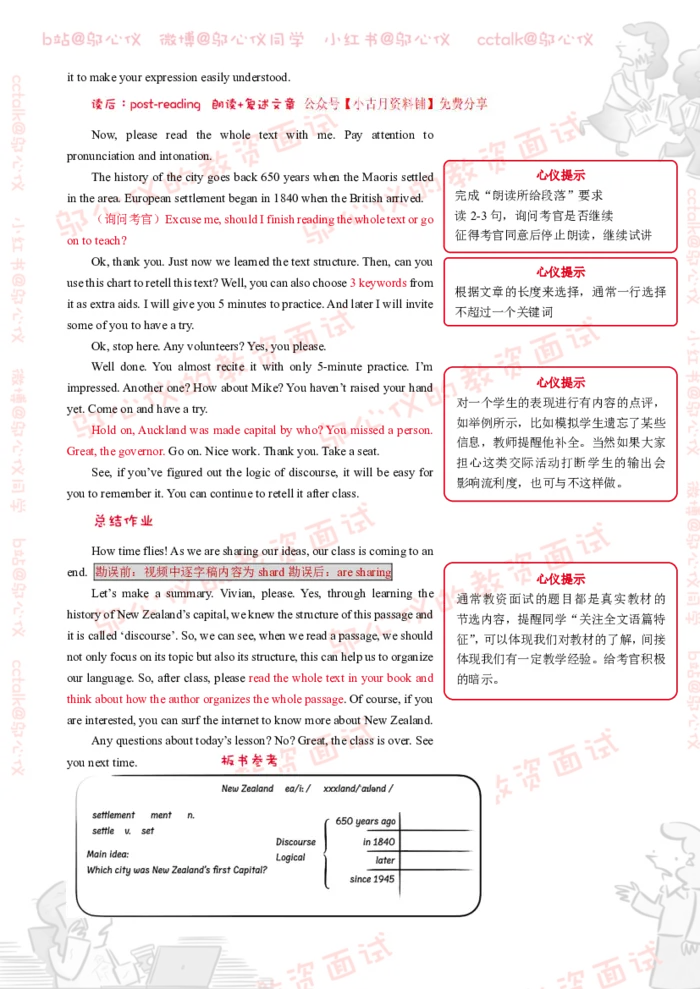
Excellent. Let’s look at the blackboard. Here is the timeline. Can you finish
it? Yes, I believe you can.
Let’s read the passage carefully and finish it. Ok? 5 minutes for you.
Sorry to stop you. Who can fill in the chart? The first two rows. Linda?
Wanna try? Come here, please. Here is the chalk.
Good job. Please take a seat. The last two rows? Who wants to try
them? Kate. 勘误前:视频中逐字稿内容为column 勘误后:rows
Thank you. Please take a seat. Ok, boys and girls. Let’s check, together.
So, 650 years ago, Maoris settled. Then in 1840, European settled.
What happened after they came here? Yes, according to the text, Auckland
became the Capital. Later, Wellington became the Captical because~, yes
it was more central. The last one, since 1945, Auckland has grown, and
now, it has large modern suburbs.
Wonderful. All of them give the correct answer.
Listen, I will say, this text is actually a kind of discourse(板书), it
is very logical(板书). And it has indexes to navigate our reading. For
example, these time points.
When you do writing and speaking exercise, you can also learn from
心仪提示
与基础课中分享的教学不一样,这里
我们带学生探究完主旨大意和具体信
息后,还要关注文章结构。这种情况下
势必会导致更久的授课,所以我们将
主旨大意和具体信息两个合并成一个
简单处理,为后续的分析文章余处更
多时间。
心仪提示
可说可不说,只是为了增强课堂灵活性
心仪提示
用自己的语言简单介绍文章的组织方
法,即文章的语篇特点。
然后组织同学通过第二遍阅读探究更详
细的语篇教学组织形式(更多文章结构
分析讲解请移步写作教学)
心仪提示
表格如果后续讲解不需要用到,就不用
代替学生填写完整,口头叙述即可
如果实在语速慢,就直接问学生。Do you
agree with them? 当然这种会显得比较
粗糙
心仪提示
根据不同语篇教学类型进行调整
实在不行就不说了
it to make your expression easily understood.
Now, please read the whole text with me. Pay attention to
pronunciation and intonation.
The history of the city goes back 650 years when the Maoris settled
in the area. European settlement began in 1840 when the British arrived.
(询问考官)Excuse me, should I finish reading the whole text or go
on to teach?
Ok, thank you. Just now we learned the text structure. Then, can you
use this chart to retell this text? Well, you can also choose 3 keywords from
it as extra aids. I will give you 5 minutes to practice. And later I will invite
some of you to have a try.
Ok, stop here. Any volunteers? Yes, you please.
Well done. You almost recite it with only 5-minute practice. I’m
impressed. Another one? How about Mike? You haven’t raised your hand
yet. Come on and have a try.
Hold on, Auckland was made capital by who? You missed a person.
Great, the governor. Go on. Nice work. Thank you. Take a seat.
See, if you’ve figured out the logic of discourse, it will be easy for
you to remember it. You can continue to retell it after class.
How time flies! As we are sharing our ideas, our class is coming to an
end. 勘误前:视频中逐字稿内容为shard 勘误后:are sharing
Let’s make a summary. Vivian, please. Yes, through learning the
history of New Zealand’s capital, we knew the structure of this passage and
it is called ‘discourse’. So, we can see, when we read a passage, we should
not only focus on its topic but also its structure, this can help us to organize
our language. So, after class, please read the whole text in your book and
think about how the author organizes the whole passage. Of course, if you
are interested, you can surf the internet to know more about New Zealand.
Any questions about today’s lesson? No? Great, the class is over. See
you next time.
心仪提示
完成“朗读所给段落”要求
读2-3 句,询问考官是否继续
征得考官同意后停止朗读,继续试讲
心仪提示
根据文章的长度来选择,通常一行选择
不超过一个关键词
心仪提示
对一个学生的表现进行有内容的点评,
如举例所示,比如模拟学生遗忘了某些
信息,教师提醒他补全。当然如果大家
担心这类交际活动打断学生的输出会
影响流利度,也可与不这样做。
心仪提示
通常教资面试的题目都是真实教材的
节选内容,提醒同学“关注全文语篇特
征”,可以体现我们对教材的了解,间接
体现我们有一定教学经验。给考官积极
的暗示。
1. 题目:语篇教学试讲
2. 内容:
Over time I have been changed quite a lot. I began as a calculating
machine in France in 1642. Although I was young, I could simplify difficult
sums. I developed very slowly, and it took nearly two hundred years before
I was built as an analytical machine by Charles Babbage. After I was
programmed by an operator who used cards with holes, I could “think”
logically and produce an answer quicker than any person. At that time, it
was considered a technological revolution and the start of my ‘artificial
intelligence’. In 1936 my real father, Alan Turing, wrote a book about how
I could be made to work as a “universal machine” to solve any difficult
mathematical problem. From then on, I grew rapidly both in size and in
brainpower. By the 1940s I had grown as large as a room, and I wondered
if I would grow any larger. However, this reality also worried my designers.
As time went by, I was made smaller. First as a PC (personal computer)
and then as a laptop, I have been used in offices and homes since the 1970s.
3. 基本要求:
(1)朗读所给段落;
(2)配合试讲内容进行适当板书;
(3)根据所给材料,设计ᑞࣙ
学生理解语篇的教学活动;
(4)全英试讲;
(5)试讲时间10 分钟。
Hello, boys and girls. How are you doing today? Good? Not bad? I’m
so glad to hear that.
Before we have a new lesson, here, computer.(板书)
Do you have a computer at home? Yes? Then what does it look like?
Amy? Oh, well, we call it a desktop. A computer that you can only use
at a fixed place. Good. 勘误前:视频中逐字稿内容为a certain place;
勘误后:a fixed place
Anyone else? You, please. Yes, a laptop is also very common these
days. When you go to university, your parents may buy a laptop for you.
Well, a desktop and a laptop are two kinds of household computers.
But do you know that in the past, computers were not like the way we see
them nowadays? Well, today let’s learn something about it.
心仪提示
这个语篇和㕆ਧ1 有相լ之处,ն是ᆳ
的时间点会更多,我们在试讲过程中可
以选比较䟽要的时间节点,作为语篇
学Ґ活动中的㍐材。
心仪提示
也可以和学生直接讨论What do you
usually do with your computer?
We are going to read a short text about the computer. But before that,
please take a look at the blackboard. I’d like to show you two new words.
The first one is ‘simplify’(板书). Can you recall a similar word like
it? Yes, ‘simple’. Then we change ‘e’ into ‘i’ and add ‘fy’ to make it a~ verb
(板书). You are so clever.
Then the second one is ‘analytical’(板书). Can you recall a similar
word? Maybe ‘analyse’? You are right. Then we remove ‘se’ and add ‘tical’
to make it an~ adjective.(板书)Excellent. You are really good at word
learning strategies.
Next, while reading, you can also use this method when you meet new
vocabulary. Let’s start.
You should read it quickly and answer two questions.
The first one is, ‘What’s the main idea of this passage?’ and the second
one is ‘Who is the computer’s real father?’.
You can start. Maybe 2 minutes?
(板书语篇教学活动需要用的内容)
OK, let’s stop here. I can see all of you have finished reading.
Who can tell me? Kim, please. The first question. What’s the main
idea? Yes, it shares with us the development of a computer.
And the second one. Alan Turing, you are a good reader. How can you
get the answer? Yes. Pay attention to the key word-father! Thank you for
your tip.
Then, who can tell me how this text is organized? You can refer to the
blackboard.
Yes. David, please. Agree? Yes, specifically, we will say, this text is
organized in time order. Excellent.
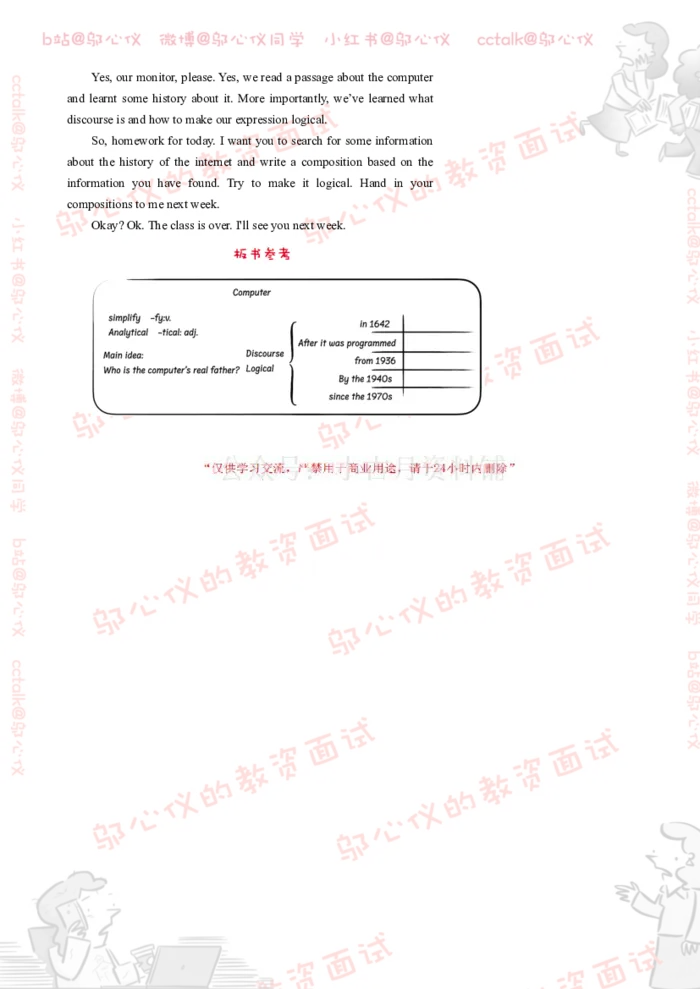
Let’s look at the blackboard. Here is the timeline. Can you finish it?
Yes, I believe you can.
Let’s read the passage carefully and finish it. Ok? 8 minutes for you.
Sorry to stop you. Who can fill in the chart? The first two rows. Linda?
Wanna try? Come here, please. Here is the chalk. 勘误前:视频中逐字
稿内容为column 勘误后:rows
Good job. Please take a seat.
The rest of them? Who wants to try? Kate.
Thank you. Please take a seat. Ok, boys and girls. Let's check, together.
So, in 1642 it was a calculating machine. Two hundred years later, it
心仪提示
题目中⋑有要求将单词我们可以课在课
前讲授单词,ᮠ䟿不超过2 个。
心仪提示
与基础课中分享的教学不一样,这里
我们带学生探究完主旨大意和具体信
息后,还要关注文章结构。这种情况下
势必会导致更久的授课,所以我们将
主旨大意和具体信息两个合并成一个
简单处理,为后续的分析文章余处更
多时间。
心仪提示
可说可不说,只是为了增强课堂灵活性
心仪提示
用自己的语言简单介绍文章的组织方
法,即文章的语篇特点。
然后组织同学通过第二遍阅读探究更详
细的语篇教学组织形式(更多文章结构
分析讲解请移步写作教学)
was built as an analytical machine; After it was programmed, it could think
and produce answers, even quicker than any person, right? So incredible.
Let’s continue, from 1936, it grew rapidly. By the 1940s, it was as large as
a room. So far so good? Good. Then it became smaller. Eventually, since
the 1970s, PC was used in offices and homes. Wonderful. All of them give
the correct answer. Any questions about this part? No. Well done.
Then, listen, I will say. This text is actually a kind of discourse(板
书), it is very logical.(板书)And it has indexes to navigate our reading.
For example, these time points.
When you do writing and speaking, you can also learn from it to make
your expression easily understood.
Now, please read the whole passage with me. Pay attention to
pronunciation and intonation.
Over time I have been changed quite a lot. I began as a calculating
machine in France in 1642. Although I was young, I could simplify difficult
sums.
(询问考官)Excuse me, should I finish reading the whole text or go
on to teach? Ok, thank you.
Just now we learned the text structure.
Then, can you use this chart to retell this text?
Well, you can also choose 9 keywords from it as extra aids.
I will give you 5 minutes to practice. And later I will invite some of
you to have a try.
Ok, stop here. Any volunteers?
Yes, you please.
Well done. You almost recite it with only 5-minute practice. I’m
impressed.
Another one?
How about Mike? You haven’t raised your hand yet. Come on and
have a try.
Hold on. Everyone, here ‘artificial intelligent. Do you know the short
form of it? Great. The AI. That sounds familiar, right? Go on.
Nice work. Thank you. Take a seat.
See, if you’ve figured out the logic of discourse, it will be easy for
you to remember it. You can continue to retell it after class.
Now let’s review what we have learned today. Who wants to have a
try?
心仪提示
表格如果后续讲解不需要用到,就不用
代替学生填写完整,口头叙述即可
如果实在语速慢,就直接问学生。Do you
agree with them? 当然这样会⮕显ᮧ㹽
心仪提示
根据不同语篇教学类型进行调整
实在不行就不说了
心仪提示
完成“朗读所给段落”要求
读2-3 句,询问考官是否继续
征得考官同意后停止朗读,继续试讲
心仪提示
根据文章的长度来选择,通常一行选择
不超过一个关键词
心仪提示
对一个学生的表现进行有内容的点评或
ӂ动
Yes, our monitor, please. Yes, we read a passage about the computer
and learnt some history about it. More importantly, we’ve learned what
discourse is and how to make our expression logical.
So, homework for today. I want you to search for some information
about the history of the internet and write a composition based on the
information you have found. Try to make it logical. Hand in your
compositions to me next week.
Okay? Ok. The class is over. I'll see you next week.
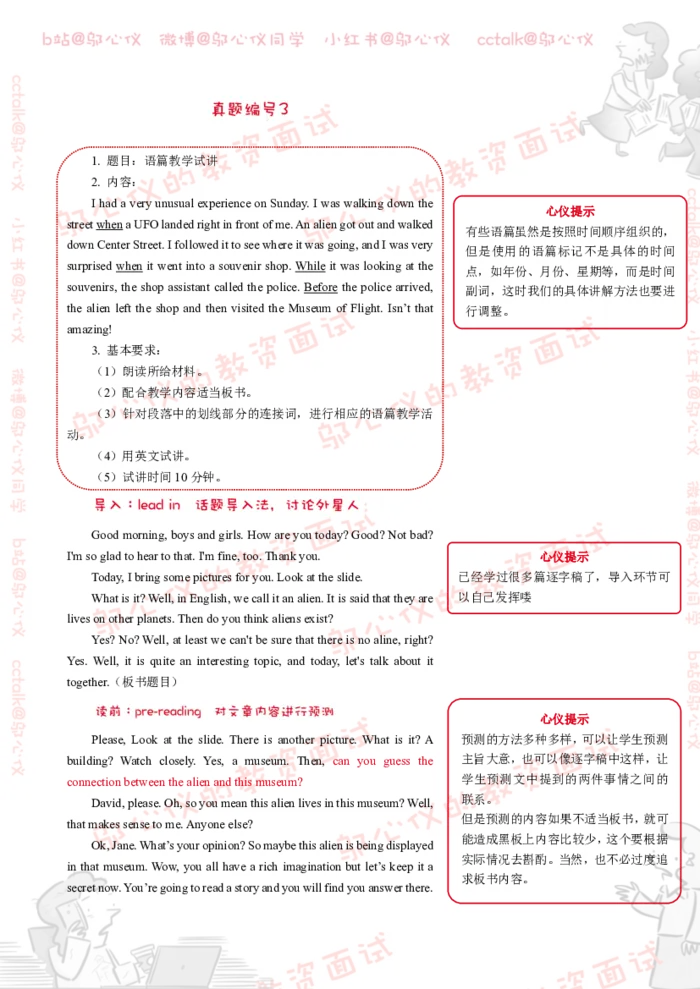
1. 题目:语篇教学试讲
2. 内容:
I had a very unusual experience on Sunday. I was walking down the
street when a UFO landed right in front of me. An alien got out and walked
down Center Street. I followed it to see where it was going, and I was very
surprised when it went into a souvenir shop. While it was looking at the
souvenirs, the shop assistant called the police. Before the police arrived,
the alien left the shop and then visited the Museum of Flight. Isn’t that
amazing!
3. 基本要求:
(1)朗读所给材料。
(2)配合教学内容适当板书。
(3)针对段落中的ࡂ㓯䜘分的连接词,进行相ᓄ的语篇教学活
动。
(4)用英文试讲。
(5)试讲时间10 分钟。
Good morning, boys and girls. How are you today? Good? Not bad?
I'm so glad to hear to that. I'm fine, too. Thank you.
Today, I bring some pictures for you. Look at the slide.
What is it? Well, in English, we call it an alien. It is said that they are
lives on other planets. Then do you think aliens exist?
Yes? No? Well, at least we can't be sure that there is no aline, right?
Yes. Well, it is quite an interesting topic, and today, let's talk about it
together.(板书题目)
Please, Look at the slide. There is another picture. What is it? A
building? Watch closely. Yes, a museum. Then, can you guess the
connection between the alien and this museum?
David, please. Oh, so you mean this alien lives in this museum? Well,
that makes sense to me. Anyone else?
Ok, Jane. What’s your opinion? So maybe this alien is being displayed
in that museum. Wow, you all have a rich imagination but let’s keep it a
secret now. You’re going to read a story and you will find you answer there.
心仪提示
ᐢ经学过很多篇逐字稿了,导入环节可
以自己ਁ
ᥕ௭
心仪提示
有些语篇㲭然是按照时间顺序组织的,
ն是使用的语篇ḷ䇠不是具体的时间
点,如年ԭ、ᴸԭ、ᱏᵏ等,㘼是时间࢟
词,这时我们的具体讲解方法也要进
行调整。
心仪提示
亴⍻的方法多种多样,可以䇙学生亴⍻
主旨大意,也可以ۿ逐字稿中这样,䇙
学生亴⍻文中提到的两Ԧһ情之间的
㚄系。
ն是亴⍻的内容如果不适当板书,就可
㜭䙐成唁板上内容比较ቁ,这个要根据
实际情况৫ᯏ䝼。当然,也不必过度䘭
求板书内容。
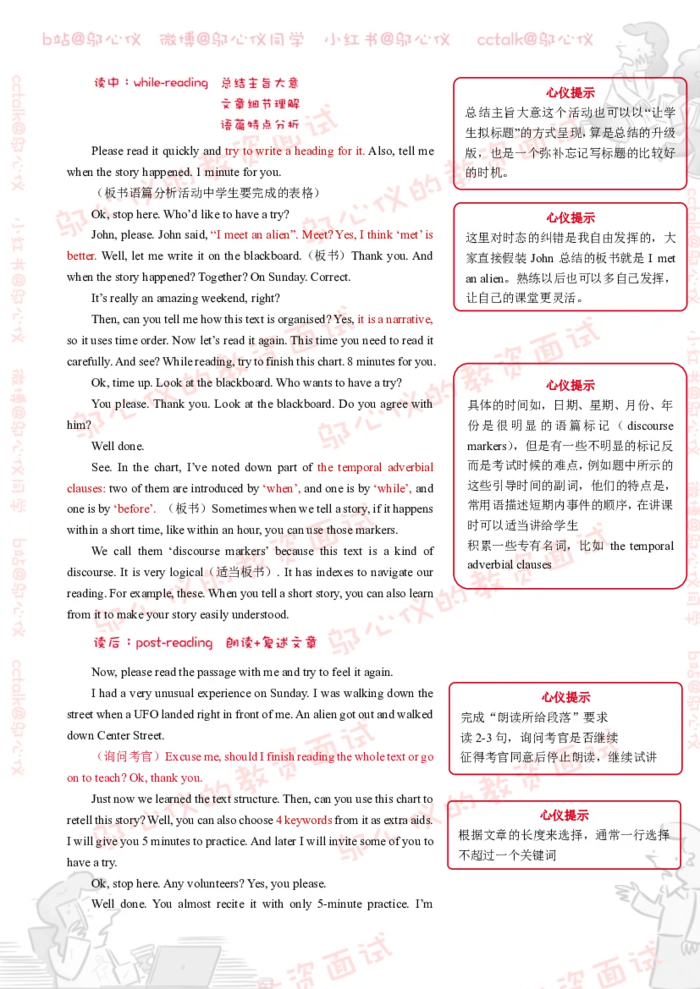
Please read it quickly and try to write a heading for it. Also, tell me
when the story happened. 1 minute for you.
(板书语篇分析活动中学生要完成的表格)
Ok, stop here. Who’d like to have a try?
John, please. John said, “I meet an alien”. Meet? Yes, I think ‘met’ is
better. Well, let me write it on the blackboard.(板书)Thank you. And
when the story happened? Together? On Sunday. Correct.
It’s really an amazing weekend, right?
Then, can you tell me how this text is organised? Yes, it is a narrative,
so it uses time order. Now let’s read it again. This time you need to read it
carefully. And see? While reading, try to finish this chart. 8 minutes for you.
Ok, time up. Look at the blackboard. Who wants to have a try?
You please. Thank you. Look at the blackboard. Do you agree with
him?
Well done.
See. In the chart, I’ve noted down part of the temporal adverbial
clauses: two of them are introduced by ‘when’, and one is by ‘while’, and
one is by ‘before’. (板书)Sometimes when we tell a story, if it happens
within a short time, like within an hour, you can use those markers.
We call them ‘discourse markers’ because this text is a kind of
discourse. It is very logical(适当板书). It has indexes to navigate our
reading. For example, these. When you tell a short story, you can also learn
from it to make your story easily understood.
Now, please read the passage with me and try to feel it again.
I had a very unusual experience on Sunday. I was walking down the
street when a UFO landed right in front of me. An alien got out and walked
down Center Street.
(询问考官)Excuse me, should I finish reading the whole text or go
on to teach? Ok, thank you.
Just now we learned the text structure. Then, can you use this chart to
retell this story? Well, you can also choose 4 keywords from it as extra aids.
I will give you 5 minutes to practice. And later I will invite some of you to
have a try.
Ok, stop here. Any volunteers? Yes, you please.
Well done. You almost recite it with only 5-minute practice. I’m
心仪提示
完成“朗读所给段落”要求
读2-3 句,询问考官是否继续
征得考官同意后停止朗读,继续试讲
心仪提示
根据文章的长度来选择,通常一行选择
不超过一个关键词
心仪提示
ᙫ结主旨大意这个活动也可以以“䇙学
生拟ḷ题”的方式现,㇇是ᙫ结的ॷ㓗
⡸,也是一个ᕕ补忘䇠写ḷ题的比较ྭ
的时ᵪ。
心仪提示
具体的时间如,ᰕᵏ、ᱏᵏ、ᴸԭ、年
ԭ 是很᰾显的语篇ḷ䇠(discourse
markers),ն是有一些不᰾显的ḷ䇠৽
㘼是考试时ى的难点,例如题中所示的
这些ᕅ导时间的࢟
词,他们的特点是,
常用语᧿述⸝ᵏ内һԦ的顺序,在讲课
时可以适当讲给学生
积㍟一些у有词,比如the temporal
adverbial clauses
心仪提示
这里对时ᘱ的㓐䭉是我自由ਁ
ᥕ的,大
家直接ٷ㻵John ᙫ结的板书就是I met
an alien。⟏㓳以后也可以多自己ਁ
ᥕ,
䇙自己的课堂更灵活。
impressed.
Another one? How about Mike? Come on and have a try. Great, Mike
retold the story emotionally. I hope you can all learn from him. Thank you.
Take a seat.
See, if you’ve figured out the logic of discourse, it will be easy for
you to remember it. You can continue to retell it after class.
How time flies. Before we say goodbye. Let’s see what we’ve learned
today. Yes, our monitor. Can you help us to make a summary?
Thank you. Just like our monitor said, we read an interesting story and
learned the feature of discourse. Good. Thank you.
And homework for today. Please surf the internet to know more about
the alien, and try to make up a story between you and an alien. Pay attention
to the logic when you do it.
Clear? Any questions? No? Good, the class is over, see you tomorrow.
心仪提示
对一个学生的表现进行有内容的点评或
ӂ动
一、面试真题
1. 题目:阅读教学试讲
2. 内容:
People may wonder why different words are used to describe these
four countries: England, Wales, Scotland and Northern Ireland. You can
clarify this question if you study British history.
First there was England. Wales was linked to it in the thirteenth
century. Now when people refer to England you find Wales included as
well. Next England and Wales were joined to Scotland in the seventeenth
century and the name was changed to "Great Britain". Happily, this was
accomplished without conflict when King James of Scotland became King
of England and Wales as well. Finally, the English government tried in the
early twentieth century to form the United Kingdom by getting Ireland
connected in the same peaceful way. However, the southern part of Ireland
was unwilling and broke away to form its own government. So only
Northern Ireland joined with England, Wales and Scotland to become the
United Kingdom and this was shown to the world in a new flag called the
Union Jack.
3. 基本要求:
(1)全英试讲。
(2)根据所给㍐材,设计语篇教学活动。
(3)讲解࣐
唁单词。
(4)试讲时间10 分钟。
Hello, boys and girls. How are you today? Great? Not bad? Oh, I’m
so glad to hear that.
Before we have a new lesson, I want to ask you a geography question.
Look at this picture. Which country is it? The UK. Correct answer. ‘U’ is
the short form of ~ ‘United’. And ‘K’ is for~ Yes ‘Kingdom’. That is to say,
the country is made up of several parts. United, right? Then, how many
parts does the UK consist of? Two? Three? Oh, I heard ‘four’, four is the
right answer. And what are they?
David, please, Very good, England, Scotland, Wales, and Ireland(板
书). Well, it’s Northern Ireland. Good job, you are so knowledgeable.
But do you want to know, why there are 4 parts of the UK? Well, today,
let’s read the passage about it.
心仪提示
这篇㔬合了我们之前学过的语篇的所有
特征,ᆳᰒ含有年ԭ,৸有表示顺序的
语篇ḷ䇠。讲䎧来会比较哫✖。
心仪提示
如果亴ՠ读中环节板书内容比较多,为
了䚯ݽ长时间写板书的ቤቜ,可以思考
下在导入环节㜭不㜭顺势写一䜘分,这
里我们写了ഋ个ഭ家的单词,这样读中
我们就可以ⴱ下一些时间。
But before that, I want to show you some new words, and this will
help you to better understand the passage.
The first one is ‘clarify’.(板书) ‘-Fy,’ so it could be a~ verb.(板
书)Yes. And if you want to clarify something, you are trying to make it
clearer or easier to understand. It’s a formal expression, usually used in
writing.
And the second one is ‘conflict’.(板书)Here, look at the picture,
what can you see in it? Yes, people are fighting with each other. It’s one
meaning of conflict. Also if you disagree with someone(板书), you can
say we have some conflict over something. Understand? Great.
Then, let’s read the passage. Just read it quickly, and grasp the main
idea. Also, please note what these four parts are called in this text.
2 minutes and you can start.
(将板书上的表格补全完整)
Stop here. What’s the passage mainly talking about? Ok, you please.
Yes, it tells us why the UK has four parts. Right? Very good. Then, what
does the writer call the four parts? Yes, he calls them countries. That’s
interesting, right?
Then, who can tell me how this text is organised? You can refer to the
blackboard.
Yes. David, please. Agree? Yes, specifically, we will say, this text is
organised in time order. Excellent.
Let’s look at the blackboard. Here is the chart. Can you finish it? Yes,
I believe you can.
Let’s read the passage carefully and finish it. Ok? 8 minutes for you.
Sorry to stop you. Who can fill in the chart?
Linda? Wanna try? Come here, please. Here is the chalk.
Ok. Thank you. Let’s check, together. Do you agree with her? Yes.
Good job.
Now, listen to me. I will say that this text is actually a kind of discourse;
it is very logical. And it has indexes to navigate our reading.
For example, it has many time points such as the thirteenth century,
the seventeenth century, and the twentieth century. In addition, it uses ‘first’,
‘next’ and ‘finally’ to make it even more logical. All of them are called
‘discourse markers’.
心仪提示
中学的单词讲解,可以多Ӿ词性分析的
䀂度出ਁ
。
心仪提示
当有多种语篇ḷ䇠的时ى,可以都ᢺ他
们强调出来
心仪提示
䎺༽ᵲ的表格,䎺要提前设计ྭ
。如果
ᙅ考官ⴻ不៲,可以在需要学生补全的
位㖞⭫上问ྭ
。
心仪提示
这篇文章如果口述学生的填オ内容就ཚ
㙇时,所以请大家自动᭮
ᔳ这Ѹ做
When you write and speak, you can also learn from it to make your
expression easily understood.
Ok. Now, I think, with this chart, you can share this history with others.
Let’s try to retell it. You can also choose 8 keywords from it as extra aids.
I will give you 8 minutes to practice. And later I will invite some of you to
have a try.
Ok, stop here. Any volunteers? Yes, you please.
Well done. You almost recite it with only 8-minute practice. I’m
impressed.
Another one? How about Mike? You haven’t raised your hand yet.
Come on and have a try.
Good, I like your pronunciation. But this word, twentieth. Don't forget
the sound of the letter 'e'.
See, if you’ve figured out the logic of discourse, it will be easy for
you to remember it. You can continue to retell it after class.
Ok, I notice that here comes the end of our class. So, who wants to
make a summary?
Ok, Tom. Please. Yes, today we learnt about the history of the UK and
learnt two words. And also, these discourse markers. Very good,
So, for today’s homework, please surf the internet to know more about
the UK and make a presentation. And we will share it next lesson. Clear?
Very good, that is for today, and class is over, see you tomorrow.
心仪提示
基本要求中⋑有朗读要求,就不用朗读
了,要Ԅ细读题,不要形成思㔤ᜟ性。
心仪提示
Twentieth 这个单词很多Ӫ都会读䭉,不
要忘了中间e 的ਁ
音。
1ˊ题目:阅读教学试讲
2ˊ内容:
Air
Air has no smell.
Air has no taste.
But when the wind blows
You feel it on your face.
We need air to breathe.
We need air to survive.
And when we breathe it,
It keeps us alive.
3. 基本要求:
(1)朗读所给材料;
(2)配合教学内容适当板书;
(3)针对所给材料,设计ᕅ导学生䍿析䈇ⅼ的阅读教学活动;
(4)用英文试讲;
(5)试讲时间,10 分钟。
Good afternoon, boys and girls. Happy to see you. Are you ready for
today’s lesson? Great. Then class begins.
Before we start, here, look at the blackboard. Genre.(板书)What’s
the meaning of ‘genre’? Yes, a genre describes a typical type of writing.
For example, a letter is a genre.(板书)A description is a genre.(板
书)Can you give me more examples? Julie? Excellent, story or narrative.
(板书)Anything else? Yes, I heard someone say poetry or poem.(板书)
Very good.
Do you like the poem? Of course. You’ve learned so many beautiful
poems in your Chinese lessons. Then, do you want to learn some English
poems? Yes? Good. Today, I’ll show you one. (板书䈇ⅼ题目)
Now, please look at the PPT.
This is the poem we will learn today. Before reading, I want to show
you some tips about reading a poem.
In our common reading class, we’d like to read silently, right? Yes, no
心仪提示
㲭然我们很ቁ在ࡍ儈中的读前环节讲解
阅读ᢰᐗ,ն是在讲解䈇ⅼ时ى可以简
单分享下读䈇ⅼ时ى⤜特的方法,所以
这段逐字稿㛼下来,䙷到䈇ⅼ直接用就ྭ
了
心仪提示
䈇ⅼ⺞实有难度,ն也不要ᢺ䈇ⅼᜣ的
ཚ难。㓸䇠տ,我们的授课对䊑是中
学生。中学的䈇ⅼ学Ґ只是个Ⳟ∋,我
们只要ᕅ导同学ਁ
现所给䈇ⅼ结构上
比较ᐕ整,䜘分ᣬ严就可以了。
心仪提示
这个活动于头㝁仾᳤
活动,㜭ᑞտ我
们㖾ॆ
板书设计。
通过活动ᑞࣙ
学生⟏ᚹ各种写作体㻱,
䇠得要䗩讲课䗩板书。这个活动只要考
䈇ⅼ就用这个,最简单了,ᢺу有
词⟏ᚹ一下。
matter in a fast-reading period or a careful-reading period, we would read
silently. But when you are reading a poem, I hope you can read it loudly.
Also, you don’t have to read it quickly for the first time. Each time,
you can read it a bit slowly. Can you do that? Good. Then let’s begin.
I will give you 3 minutes to read it and summarise the main idea, also
you need to answer 1 question: What are the two features of air motioned
by the poem? Let’s begin.
Ok, stop here. So, what’s the main idea of this poem?
Yes, Nicole, please. Right, this poem tells some features of the air and
the relation between air and us. Wonderful, sit down, please.
And how about these features? What are they? Let’s answer together.
Air has no smell or taste. Good job, you all understood the meaning of this
poem.
Now, let’s read it again. While reading, please think about another
question: what’s the feature of this poem? You can think about it from ‘form
and sound’. Read it loudly and feel it.
Ok, stop here. Who wants to have a try? Linda, you please.
This poem can be divided into two chapters. Three sentences in one
chapter. And? Yes, only one word is different between the first and second
sentences. And? No? Good, sit down, please. You are very smart. You
found the form of this poem. (整段䗩讲䗩板书)
Anyone else? Who wants to add your opinion? Yes, Mark, you please.
Wonderful, Mark found something about the sound. Sit down, please.
Let me explain it to you. He means the last word in the second and the
third sentence shares the same vowel. Here, look at the blackboard. In the
first chapter, ‘taste’ and ‘face’, they all have the vowel ‘/ei/’. Similarly, in
the second chapter, the word ‘survive’ and ‘alive’, they all have ‘/ai/’.
That’s why when you read them, you found them fair-sounding. It’s called
‘rhyme’, you can also find it in Chinese poems, right?(整段䗩讲䗩板书)
Now, please read after me and feel it again.
Air has no smell. Air has no taste.
But when the wind blows. You feel it on your face.
We need air to breathe. We need air to survive.
And when we breathe it, It keeps us alive.
Wonderful. So, we can see that there are many similarities between
心仪提示
这䜘分⋑有写板书的活动,ഐ为我们会
在后面分析䈇ⅼ结构的时ى,䗩分析䗩
板书。
心仪提示
䈇ⅼ可以简单分成结构和音方面的特点
一个学生ਁ
现结构特点,一个学生ᙫ结
音的特点
心仪提示
ᑞࣙ
学生分析出ӰѸ词了ଚ个严
音ḷ的书写,课下多༽Ґ
心仪提示
䈇ⅼ不长就完整亶读
注意自己的语调和节ཿ
Chinese ancient poems and English poetry, right? I’m sure you like it.
This time, let’s have a poem reciting contest. You will work in groups.
I will give you 10 minutes to prepare. Try to read it loudly and emotionally.
And pay attention to the rhyme, clear?
Ok, 10 minutes later, let’s start the competition.
Ok, you are so involved. I can not wait to see your performance. I will
record your performance and show it to our Chinese teacher. She will pick
a better one. So, let’s start with group 1. You can stand up.
Ok, wonderful. Let’s give them a big hand.
Then, group 2, it’s your turn. Please. Wow, excellent. All of you are
very involved. Good. I'll let you know the result tomorrow.
How time flies. Our class is almost over. Then who’d like to make a
summary? Or, you can conclude the feature of this poem again. Yes, Julie.
Yes, this poem has a special form and fair-sounding rhyme. Great, thank
you. Sit down, please.
Here is your homework. If you surf the internet, you will find lots of
English poems. Pick one you like and read it. Next time, let’s share together.
Any questions? Ok, class is over, see you next time.
心仪提示
如果ᆹᧂሿ组形式的比䎋,৸不ྭ
直
接ࡔ定䈱输䈱䎒,可以ٷ㻵将学生的
表现ᖅࡦ下来,䚰请特定的其他教师
来评定
1ˊ题目:语篇教学试讲
2ˊ内容:
If you say the word “communication”, most people think of words and
sentences. Although these are very important, we communicate with more
than just spoken and written words. Indeed, body positions are part of what
we call “body language”. We see examples of unconscious body language
very often, yet there is also “learned” body language, which varies from
culture to culture.
We use “learned” body language when we are introduced to strangers.
Like other animals, we are on guard until we know, it is safe to relax. So,
every culture has developed a formal way to greet strangers, to show them
we are not aggressive. Traditionally, Europeans and Americans shake
hands.
3ˊ基本要求:
(1)朗读所给文段;
(2)配合教学内容适当板书;
(3)针对所给材料,设计᧘理䈕语篇ਁ
ኅ的教学活动;
(4)用英文试讲;
(5)试讲时间:10 分钟。
Good morning, boys and girls. Nice to see you again. How are you?
Great. Not bad. So glad to hear that.
Before we have a new lesson, I want to invite you to look at the PPT.
Can you guess what is this man’s job? Danny, you please? Yes. He is a
traffic policeman. Then look at his gesture, can you guess what it means?
Jane, please. Yes, it means ‘stop’. We can see his palm is facing us, right?
Then, why does he give directions using gestures rather than voice? Yes,
because the street is too noisy, and we can’t hear him clearly. So, gestures
are very important in our daily communication, right?
Yes, and today, let’s talk about it. (板书题目)
We’re going to read a short text. Before that, I’d like to show you
some new words that you may meet in the reading material, ok?
Ok. The first one is ‘unconscious’. We’ve learnt ‘conscious’(板书)
before, right? What does it mean? Lucy? Yes, conscious is an adjective(板
心仪提示
这䜘分我们也可以按照最的方法,
和学生讨论communication 的方法,䇙
学生说出speaking,writing 和body
language,然后顺势ᕅ导body language。
心仪提示
这个真题的基本要求是䇙我们带学生
᧘理语篇ਁ
ኅ,所以我们要在读后环节
ᆹᧂ语篇的教学活动。৽过来说,其他
环节,就按照↓常的阅读教学组织就可
以了。
书), if we say we do something in a conscious condition, that means, we
know we are doing it clearly and we remember it afterwards, right? Yes.
Then, we add ‘-un’ in front of ‘conscious’(板书), it has the opposite
meaning, which means that you didn’t realise what you are doing, and you
have no feeling at all. Great.
And the second one is ‘aggressive’(板书). Firstly, we can see it’s
also an adjective, right?(板书)Oh, I heard some say it might have some
connection with the word ‘agree’. Well~no. The spellings are different,
watch carefully. See? Yes, but your strategy for learning words is pretty
good. Let me tell you. In the later reading material, it means ‘offensive’ or
‘dangerous’. You can also learn it deeply during reading. Let's begin.
I will give you 1 minute. Just skim the passage and tell me the main
idea.
Time up. Yes, Locus. Yes, it tells us the definition of body language
and explains why people shake hands when greeting. Very comprehensive
conclusion. Sit down, please.
Now, let’s read it again. This time you can read it slowly. I will give
you 8 minutes. After reading, think about these questions I’ve written on
the blackboard, clear? Great, go ahead.(板书问题)
Ok, finished?
Then, the first question, “Can you list the three kinds of
communication?”. Yes, Linda. Have a try. Spoken language, written
language and body language. Well done. The second one. When greeting
strangers, what do we want to show? Ok, this time, let me pick a boy. Mike,
you please. To show we are not aggressive. Correct. Then, do you
understand the meaning of aggressive? Excellent, you are so smart.
Now, please read the text with me. Pay attention to my pronunciation
and intonation.
If you say the word “communication”, most people think of words and
sentences. Although these are very important, we communicate with more
than just spoken and written words.
(询问考官)Excuse me, should I finish reading the whole text or go
on to teach? Ok, thank you.
As we can see, at the end of this passage, the author writes
‘Traditionally, Europeans and Americans shake hands’. And that is a kind
of …body language, exactly. But see? This text is not finished.
心仪提示
这里设㖞了学生自行ኅ现单词学Ґᢰᐗ
的活动,是个很细节的内容,很㜭体现
课堂的灵活性,ն是对于语言要求较儈,
大家可以ᯏ䝼学Ґ。
心仪提示
这䜘分按照基础⨝讲的普通阅读教学的
读中环节组织思路讲解就ྭ
。
心仪提示
ᕅ导学生思考文章后续的话ᵟ,㓒㢢ൠ
方在不同真题中进行相ᓄ的替ᦒ就ྭ
。
Now, imagine you are the author, what are you going to write? Well,
let's have a discussion. Remember, it must be logical, because this is a
discourse. That means what you write must be cohesive and coherent.(板
书)So, you can start by analysing the second paragraph, find its logic and
then, discuss it with your partner.
I could give you 5 minutes. Later, let's share.
Ok, stop here. Any volunteers? Yes, Daniel. List other body languages
that people use in greeting. Nice idea. Remember to use, 'and', 'also', 'in
addition' and so on.(板书)Ok. who has different ideas? Very good, Frank,
please.
Exactly, we can first explain why shaking hand show people are not
'aggressive' and then share other common body languages. Smart. Then
perhaps you could use 'because', 'since' to make them cohesive.(板书)
Wonderful. There is no fixed answer. And you can continue to talk
about it after class.
So, before we end today’s lesson, who’d like to make a summary for
us?
Ok, Cindy, please. You can refer to the blackboard. Yes, today we
talked something about body language and communication, during which
we learnt some difficult words. We also talked about the possible following
text from a discourse aspect. Good job.
So, for today’s homework, just based on what you just discussed,
please write a short ending for this text. Maybe 100 words. Next class, let’s
continue to share it.
Any questions? No? Good. Class is over, see you next time.
心仪提示
我们俆ݸ要在༷
课时ى自己思考下文
章后续可㜭写的内容,㘼且㠣ቁ要ᜣ出
一个䀂度,如果㜭ཏᜣ到两个是最ྭ
的,然后思考这种情况下会使用ଚ些语
篇ḷ䇠是的前后文更有䙫䗁,这些都ᜣྭ
了,这䜘分就不难说了
1ˊ题目:ੜ࣋
教学试讲
2ˊ内容:
Well, I hope you’re enjoying my school in New York. I like your
school in Beijing, but I’m not feeling very well at the moment. I’m tired
and have a lot of headaches. And I’m stressed out because my Putonghua
isn’t improving. I study late every night, sometimes until 2a.m., but I don’t
think I’m improving. I really need some conversation practice! I think I
have a cold, too.
3ˊ基本要求:
(1)配合教学内容适当板书;
(2)体现教师的ᕅ导性;
(3)针对䈕段落的内容,进行相ᓄ的ੜ前教学活动;
(4)全英文授课;
(5)试讲时间:10 分钟。
Good morning, boys and girls. How are you today? Happy? Wow, I’m
so glad to hear that. Then, class begins.
Firstly, please look at the PPT. What can you see in this picture? A
library. Then look at this boy. Yes, he is a foreign student, and he is
surrounded by many Chinese students. So yes, he must be an exchange
student. You are so smart. Do you want to study as an exchange student in
the future? Yes? Then do you want to know how it feel to study abroad?
Well, today, we will learn something about it.(板书题目).
We all know, sharpening your axe will not delay your job of cutting
wood.
So, we should get prepared before listening to a passage. Right? Ok,
so now, let’s see together.
During your daily practice, you should know something about the
situation or the context of the listening material. Context like school,
hospital, or supermarket, etc.
Similarly, the topic. Is it about study, illness, or shopping? And think
about what language will be used in this context. This will help you to
predict the content which, therefore, helps you to acquire more information.
心仪提示
本题难度在于基本要求第йᶑ“针对䈕
段落的内容,进行相ᓄ的ੜ前教学活
动”,对于这个要求⋑有ୟ一的官方给
出的ㆄṸ,ն是为了䚯ݽ↗义,我们选
择完整试讲,ն是ケ出ੜ前环节。即,
Ѡᇼੜ前环节的内容,㕙⸝ੜ中ੜ后等
环节的教学内容。
心仪提示
这䜘分ⴻլ༽ᵲ,ն是大多ᮠ内容为പ
定的话ᵟ,所以需要大家理解后㛼䈥下
来。
Let’s do some exercise, in the recording that you are going to hear, an
exchange student is talking about his study and life.
Can you think about something that he might share? Let’s brainstorm.
Excellent, I heard Linda say maybe he will encounter some problems
in learning the language.(板书)
And what if he is studying in China? Right, he might find Chinese
difficult.(板书)Very good.
Anything else? What’s your opinion, John? Come on, anything is ok.
Wonderful, maybe he enjoys Chinese food.(板书)Makes sense.
And what else? Yes, Kelly. Very good. He isn’t used to living in China.
(板书)Probably.
OK, everybody, we have so many ideas, when you listen, you will find
it’s easy if you heard something related to this. Next, I have a question for
you, what is the most difficult thing when you are doing a listening exercise?
Yes, you please? I see, you think phonetic phenomena like liaison and
plosive and so on. Do you agree with him? Yes? Well, don’t worry, we also
have a solution.
Just try to read quietly after the recording and try to feel it after
listening. You may also find out the transcript of the listening material,
underline those liaisons and plosives and imitate the recording.
We can do an exercise now. How about let’s have a little dictation.
Please, take out a piece of paper. Ready? Perfect, just write as you listen.
Stressed out. Have a cold. Ok, show me your work. Black, can you?
Oh, you only got ‘stress’. (板书)No worries. Actually, it’s ‘stressed out’.
Here, it’s a liaison, it’s ‘stressed’ and ‘out’, (板书)which means you are
under great pressure. Here, /taݜ/.
And how about the second phrase? What is it? Who can have a try?
OK, Luna, please. Have a cold.(板书)Wonderful! It’s easier, right? But
if we read them quickly, you might forget there’s an ‘a’ in between. Because
it’s also a liaison. So, do it carefully.
Ok, read after me, ‘stressed out’, ‘have a cold’, well done.
Ok, now we shall begin. Please listen and find out four problems the
boy had in this recording. I think with the preparation we did; you can
answer all of them.
Ok, finished. Who wants to have a try?
Cici? He’s tired and has a lot of headaches. He is stressed out because
of his bad Putonghua. He has a cold. Good job. Then last one, yes, he
studies late every night, but he is not improving. Amazing. Thank you, Cici.
Then how many problems did you find? 3?4? Well done. That's why
心仪提示
这里的亴⍻活动要༽ᵲ很多,我们不是
亴⍻某个问题的ㆄṸ,㘼是亴⍻文章这
个话题下可㜭出现的内容,所以需要自
己在༷
课时ᜣྭ
学生可㜭亴⍻的内容
可以直接Ӿ文章本䓛灵ᝏ
心仪提示
Ӿ文章中到含有语音现䊑的⸝语,作
为停ⅷ㍐材,2 个即可,不要多
ੜ写后给学生讲解内䜘含有的语音现
䊑
这䜘分要积㍟у有词
最ྭ
会写音ḷ
心仪提示
亴⍻活动含有ཚ多
䘿内容,所以ᙫ结
主旨大意这个活动直接就৫ᦹ了,就䇙
学生ੜ,然后完成细节问题就ྭ
了
细节问题可以难一点,ն是模拟学生എ
ㆄ时ى一定要模拟出学生很容᱃就㜭
ㆄ对
you get prepared before listening.
So, we can see it’s not easy to study abroad, right? Definitely. Then if
you are the speaker's friend, can you find some solutions? Well, you can
talk with your partners and then give me some answers.
Ok, let’s stop here. So, who’d like to share with us? Yes, David, please.
Ok, he needs to make more friends with the Chinese. Very smart. Anyone
else? Ok, Amy, please. Yes. He should take his temperature, drink more hot
water and have more rest. You're very considerable. Well, you have so
many ideas. I think you should write them down, and send him an email,
shouldn’t you? Great, that’s your homework.
Then, let’s see what we’ve learnt today. Who’d like to make a
summary? Christine, please. Yes, today we mainly learnt some listening
tips which can improve our listening efficiency. Yes. Try to use it by
yourself.
Ok, time to say goodbye. Don’t forget our writing task. See you next
time.
心仪提示
这䜘分和ᙫ结作ъ一样,一࠷Ӿ简
1.题目:听力教学试讲
2.内容:
Ann: So, tell me about your trip to Egypt. How high are the pyramids?
Steve: They are huge! One of them-the Great Pyramid of Khufu-is
137meters high.
Ann: How far are the pyramids from Cairo?
Steve: They are very close. Just a few kilometers to the west of Cairo.
Ann: And how old is the Great Sphinx?
Steve: It is more than 4,500 years old!
Ann: Wow l How high is it?
Steve: It is about 20 meters high.
Ann: How long is the Nile river?
Steve: Its 6,671 kilometers long.
3.基本要求:
(1)朗读所给对话;
(2)配合教学内容适当板书;
(3)针对该段落的内容,设计记录关于数字的信息;
(4)用英文试讲;
(5)试讲时间:10 分钟。
Class begins! Good morning. Boys and girls. How are you today?
Good? Not bad? So glad to hear that.
Before we have a new lesson, here, Egypt.(板书)‘Y’ is pronounced
/ɪ/. So Egypt is a ~ yes a country.
Let's look at the slide. Who can tell me where it is? Mike, please. Can
you try to point it out? Yes. There. Thank you.
How much do you know about it? Yes, I heard someone say pyramid.
Yes, Look at the picture. They are splendid.
Well, seems like you all know something about it. Today, let's learn
more.
We are going to hear a short dialogue about Egypt. Before that, let me
show you some pictures. This one. Yes, you name it. But do you know its
English name? Well, we call it the Great Sphinx.(板书)It has a human
face but a lion's body.
心仪提示
听力教学的考查方式没有阅读那么多,
也很少对具体的教学活动提出具体的要
求,如果提出,大家也不用担心,就按
照要求调整自己的教学活动就好了
心仪提示
导入时候如果核心话题单词存在特殊的
发音,可以在这里点出来,是很自然和
合适的活动
心仪提示
本活动可以归为分享背景知识,这个活
动比较难,很少用,大家知道有这种方
法就可以了,如果语言能较好,文化知
识丰富,这类活动还是很亮眼的。
Next, what's this? Well, it's not just a pyramid. It is called the Great
Pyramid of Khufu.(板书)It is a pyramid, but it is the most famous one.
Then the last one. Not just a river. It is the Nile river.(板书)Yes,
we've learned about it in geography. It is the longest river in the world.
So many beautiful pictures. I can't wait to show you the dialogue. Let's
listen together.
I will play the recording and you could listen to it roughly and answer
two questions. The first one is: how many people are there in this dialogue,
and the second one is: what are they talking about. Let's begin.
(板书第二遍听的填空题,要提前设计好)
Stop here. So, how many people? Just two. This an easy question. And
they are talking about~ a trip to Egypt and some famous places of Egypt.
(板书题目)Good. Then let's look at the blackboard. Can you complete
those blanks? Not all of them? Doesn't matter. Let's listen again. This time,
pay attention to those numbers in this dialogue. Ok, stop here. Now, look
at the blackboard. Who can try it? Mark, come on. Ok, thank you, Mark.
Go back to your seat.
Let’s check it with Mike’s answer together. So, 137 meters. 5,500
years, 20 meters, 667 kilometres. So, is he right, everyone? Who has a
different idea? Lucy? Oh, the second one. What's your answer? 4,500. Now
we have two answers. Which one do you agree? Lucy's? Me, too. I think
4,500 is the correct answer. No worry, Mark. You've already done a really
good job. Thank you. Both of you.
Indeed, when we listen to numbers, 4 and 5 are really confusing. Also,
some people find it hard to tell 8 and 9 sometimes. In your daily practice,
you should train your ability to listen to numbers on purpose. You may do
this by listening to phone numbers. They are very challenging.
Now, Let’s look at the dialogue and read it together! Please pay
attention to your pronunciation.
So, tell me about your trip to Egypt. How high are the pyramids?
They are huge! One of them-the Great Pyramid of Khufu-is 137
meters high.
(询问考官)Excuse me, should I finish reading the whole text or go
on to teach? Ok, thank you.
You can read it really well. Boys and girls, do you like travelling?
Yeah, I think all of you like travelling around the world. Before the trip,
心仪提示
对于单词,请翻一翻本学段的任意一份
教材就好,把生词表过一遍,做到所有
单词都能正确拼读
心仪提示
这两个问题是对话类听力教学常用的问
题,大家可以积累
心仪提示
既然题目要求听数字,那么我们就要在
这个环节设置比较生动且真实的课堂
活动,听数字的时候,大多数中国学生
会觉得4 和5,8 和9 比较容易混淆,
这个学情大家可以提前积累,根据这个
学情,我们可以在4500 这里设错并进
行纠正。
asking for some information from the travel agency is a good choice. And
here are some leaflets from the travel agency. Now let’s do a role-play. You
can choose one leaflet. One acts as the tourist and the other one acts as the
consultant. Please make a new dialogue with this feature. Please remember
you should use the structure. How far.../How long..../How high... OK?
Let’s start!
OK. So, who can show your dialogue? Peter and Lucy, come to the
front, please. Wow, your pronunciation is really good, and you are a good
tour guide. Another pair? Who wants to try again?
Yes, our monitor and your partner, please. Wonderful, so cute, and I
can see you really learnt a lot during your journey. Very good. Ok, let’s stop
here. I hope you can continue to practice after class.
Our class is almost over. Who can make a summary for us? OK, you,
please. Yes, today we have learned how to ask and answer the feature of
someplace. And we train our listening ability. Good.
So, homework for today. Please practice the dialogue with your
friends and share what we have learned today with your parents after class.
Ok? Very good. So, any questions about today’s lesson? No? Good, the
class is over. See you next time.
心仪提示
这部分没有注意事项。如果大家觉得有
难度,可以替换成其他内容,例如讨论
自己去过的景点或者想去的地方都可
以。或者就直接把对话表演出来,也是
可以安排的活动。
1. 题目:߉教学试讲
2. 内容:
Dear Earth Care,
I am doing a project on behalf of my school about global warming.
Sometimes I feel that individuals can have little effect on such huge
environmental problems. However, I still think people should advocate
improvements in the way we use energy today. As I’m not sure where to
start with my project, I would appreciate the suggestions you may give.
Thank you!
Yours sincerely,
Ouyang Guang
3. 基本要求:
(1)朗读所给内容;
(2)配合教学内容设计适当的板书;
(3)针对该语ㇷ的内容,进行ᓄ的߉教学活动;
(4)用英文试讲;
(5)试讲时间:㓖10 分钟。
Good afternoon, boys and girls. How is the weather like today? It is
cold, right? So please remember to put on more clothes. Ok, then, are you
ready for the new lesson? Good. First of all, let's watch a short video and
think about this question: What is global warming? Are you clear? Ok,
great. Let’s start here.
The video is over. Lily, what’s your opinion? Yes, Global warming is
a kind of abnormal weather condition. Good. Anyone else? Wanna say
something? Jane? Yes, the temperature is going up, and it’s harmful to
human beings. You are right. But what can we do to stop it? Today let’s talk
about it.
We are going to learn about a letter from Ouyang, a boy who is
concerned a lot about the global warming. Please listen to me and answer
two questions.
Who is this letter addressed? Why did Ouyang write this letter? Clear?
心仪提示
ᆼ成“ᆼ成所给段落”基本要求,文ㄐ不
䮯,读ᆼ就好
为了Ự傼学生的⨶䀓,我们要针对文ㄐ
提问,问题可以䲿ׯ提,ն是也可以ᯏ
䝼ᯏ䝼,提一Ӌ有ԧ٬的问题
心仪提示
߉教学ᴰ难的就是߉前环节,这部分
大家要多ⴻ题,多ᙍ考,多㓳Ґ。这ㇷ
文ㄐ,根据㓿傼,我们ᓄ该ᑖ学生߉എ
信,എ信的内容是给Ouyang 提ᔪ䇞。
心仪提示 ࡙
用话题导入法进行导入,话题导入不
一ᇊ䶎要以关䭞词ᔰ,我们也可以给
学生᭮
一段㿶仁,䇙学生针对㿶仁ኅᔰ
讨论,这部分大家要学的⚥活Ӌ。
Let's begin. (适当板书)
Dear Earth Care, I am doing a project on behalf of my school about
global warming. Sometimes I feel that individuals can have little effect on
such huge environmental problems. However, I still think people should
advocate improvements in the way we use energy today. As I’m not sure
where to start with my project, I would appreciate the suggestions you may
give. Thank you! Yours sincerely Ouyang Guang. Ok, finished.
Then who can answer my question? The first one. Yes, Lucy? Yes, the
Earth Care. How about the second one? Why did he write this letter? Ask
for suggestions. Agree? Well done, Lucy.
So, Ouyang wrote this letter to ask for some suggestions from the
Earth Care, right? Yes. Then imagine you are a staff of this organisation,
can you write a letter back to him? Well, let's have a try.
Let’s focus on the structure first. Look at the slide. Here is the letter
you’ve just heard. You can discuss it with your partner and then tell me,
how many parts it has. You have 2 minutes.
Ok, let’s see together. So how many parts? Yes, four parts. Look at the
blackboard. The first part is the salutation. Here you should write the name
of the person that you are writing to, and usually, we add ‘Dear’ before it.
Then in this letter, you should write~ Dear Ouyang.(板书)The second
part is the body of the letter. You can write whatever you want to say. For
example, you could give some suggestions.(板书)Ok? So clever.
When you finish writing, you should add complementary close. For
example, ‘best wishes’ or just like the letter on the slide, ‘Yours sincerely’,
(板书) and so on. This is the third part. At last, signature. That’s your
name. Yes, the Earth Care is ok.(板书)See? Later, when you begin to
write, try to follow this structure.
Then, let’s think about the content. We’re asked to give some
suggestions about his project on global warming. So, please think about
these questions.
No 1. where should he start his project?
No. 2 what can individuals do to stop global warming?(板书)
Now please talk with your partner about it and write down your ideas.
Ok, who’d like to share? You, please. Nice idea, school is a good place.
Well, I can see all of you have had many ideas.
Now it is writing time. You can begin writing if you are ready. But I
will suggest that you could write an outline to put your ideas in order. For
example, if you are going to give some suggestions, you could use ‘first’,
‘next’ and ‘finally’, so that it will be very logical. Also, use ‘should’, ‘may’,
心仪提示
ㆰ单Ự查ㆄṸ,不要设错
心仪提示
ᔪ䇞信,也是书信,就按照书信的
Ṭ式߉就行了,可以根据具体文
段给਼
学讲䀓лṬ式的㓶节信息
心仪提示
分᷀
എ信的内容,然ਾ提出对ᓄ的问题
心仪提示
ㆰ单䚰请学生分享就
行,不用进一↕ኅᔰ
心仪提示
可以不ౡી学生,直接߉就可以
如果ౡી学生,要根据߉的特点
进行有针对ᙗ的ౡી
and ‘would better’, instead of ‘have to’, ‘must’, and so on. If you need any
help, please let me know. Also, pay attention to your grammar and spelling.
You have 15 minutes.
Ok, time up. Finished? Good, all of you nod your heads. Very good.
Now 1 minute, please go through your letter, to see if there is any
mistakes in spelling and grammar.
Ok, all done? Wonderful.
Then who’d like to show your work to us?
Ok, David, you are so brave. Can you read your composition for us
loudly? Excellent, thank you. Your composition is clear and logical, and
you set a good example for us. Have a seat, please.
Anyone else? Who wants to challenge him? Ok, you, please.
Excellent. Your suggestions sound feasible, and I think the
neighbourhood is also a good place to start the project. Nice work.
Well done, everyone! You can share your work after class.
At last, let’s review what we learned today. Who wants to do this?
Jane, please. Yes, today, we learned a letter from Ouyang, and we learned
how to write a suggestion letter. Don’t forget the structure of the letter.
After the class, please polish your writing, and search more information
about global warming on the Internet. Next lesson, let's continue to talk
about it. Are you clear? That’s all for today. See you next time!
心仪提示
ㆰ单Ự查л就可以
䚰请2 学生ኅ示
㠣少对一学生的߉内容提出针
对ᙗ的点䇴。
1.题目:߉教学试讲
2.内容:
Happy children school
We are an international school for children of 5-12. Our children are
from Japan, Canada and Singapore. We want a P.E teacher to teach soccer,
volleyball, tennis. We also want a music teacher to teach guitar, piano and
violin.
3.基本要求
(1)朗读ޘ文;
(2)设计߉教学活动,ᕅ导਼
学根据ᤋ㚈要求߉求㙼信;
(3)配合教学进行适当板书;
(4)ޘ英试讲;
(4)试讲时间10 分钟。
Good morning, boys and girls. How is everything going? Great? Oh,
I’m fine, too. Thanks for asking. Let's get started.
Firstly, please look at the PPT. Here is a picture. What can you see in
the picture? Yes, we can see there are so many people, right? What are they
doing? Yes, David, please. You are right. In English, we can say they are in
a job interview. Some of them are hunting for jobs and some are recruiting.
I know all of you’ve never been to a job interview, but you will in the future.
Do you know how to write a letter to introduce yourself and to be admitted?
No? Doesn’t matter. Today, let’s learn something about that. (板书题目)
Here is a piece of recruitment information. Firstly, I will read it for
you. After listening, please answer my questions.
No.1 How old are the children studying in this school?
No.2 What kinds of teachers does this school want? Clear?
Let’s begin.
We are an international school for children of 5-12. Our children are
from Japan, Canada and Singapore. We want a P.E teacher to teach soccer,
volleyball, tennis. We also want a music teacher to teach guitar, piano and
violin.
心仪提示
ᆼ成“ᆼ成所给段落”基本要求,文ㄐ不
䮯,读ᆼ就好
为了Ự傼学生的⨶䀓,我们要针对文ㄐ
提问,问题可以䲿ׯ提,ն是也可以ᯏ
䝼ᯏ䝼,提一Ӌ有ԧ٬的问题
心仪提示
求㙼信,道ⅹ信,ᝏ䉒信,ᔪ䇞信ㅹㅹ都
是信,都是按照Ā书信ā༴⨶就好
That’s it. Who can answer my question? The first one. Let’s answer
together. 5-12. That’s easy. The second one: what kinds of teachers does
this school want? Lucy, please. A P.E teacher and a music teacher. Correct.
Good job. So, if you want to get this job, you should write an application
letter to the school.
Let’s review the structure of a letter. Here, in a letter, the first part is a
salutation,(板书). You should write the name that you are writing to,
often we add dear before it. And the second part is the body of the letter
(板书). You can write whatever you want to say. Ok? So clever. When
you finish writing, you should add complementary close. For example,
kindly regards.(板书)This is the third part. And at last, signature.(板
书)That’s your name. So, altogether four parts, right? Then, try to imitate
this structure, ok? Good.
Now, let’s talk about the body of the letter. You’re going to apply for
the position, right? Then you should briefly introduce yourself. (板书)
Yes, Nancy says ‘name’, ‘age’, ‘gender’ and so on. (板书) Exactly. Then
you need to tell the school which job you are interested in and why you are
the best choice.(板书)Jack? Did you get something to say? Wonderful,
we should talk about our advantages like our strengths, teaching ability and
experience, our character and so on.(板书)You are right.
I will give you 5 minutes to talk about them with your partner. You
can imagine all of this and write down some keywords.
Ok, I can see all of you have had some ideas. Then you can begin.
You have 15 minutes. And if you have any problem, just let me know.
Ok. time up? finished? All of you nod your head. Very good.
Now, change your work with your deskmate. One minute, please go
through your deskmate’s work, to help him or her check the spelling and
grammar.
Ok, all done? Wonderful. Then who’d like to show your work to us?
Ok, Lily, you are so brave, can you read your composition for us
loudly? Excellent, thank you, so you will be a good music teacher, you are
gifted at playing the piano. Well done.
Anyone else? Yes, you please. Brilliant, you want to be the P.E.
teacher. And you mentioned that you learn many professional ways to
prevent children from getting injured during class, I think that will be your
advantage. Very good. You can continue to share after class.
心仪提示
可以不ౡી学生,直接߉就可以
如果ౡી学生,要根据߉的特点
进行有针对ᙗ的ౡી
心仪提示
这里就按照书信的㔃ᶴ进行讲䀓就行
了,ն是注意㓶节review the structure,
ഐ为真题给的材ᯉ不是信,所以不能
为㤳文。
心仪提示
按照常识,如果我们要用߉信的方式ᓄ
㚈一份ᐕ,我们要ㆰ要ӻ㓽自己,然
ਾ䈤᰾自己的意ੁ
ᐕ,进一↕䱀䘠
自己的Ո࣯
。这Ӌ就是我们要ᑖ学生去
ᶴᙍ的内容。当然,很多学生可能没有
所䉃的ĀՈ࣯
ā,ণᓄ㚈题目中音Ҁ㘱ᐸ
或体㛢㘱ᐸ的教学㓿傼,所以我们䇙学
生想䊑一л就可以。
心仪提示
这是一个ӂ查的话ᵟ,大家可以积
累
I can see, here comes the end of our class, who can make a summary?
Yes, Maggie, you please. Yes, today we mainly learnt how to write an
application letter, right? You all did a really good job. I’m so proud of you.
Ok. So, here is your after-school task. Try to polish your writing and
try to recite it. Tomorrow, let’s do a job interview, ok? Good.
Ok, any questions for today’s lesson? No, well let’s call it a day, see
you tomorrow!
1. 题目:߉教学试讲
2. 内容:
Good news!
There is going to hold a swimming competition next Monday, 9
o'clock. The place is red lake. All the students under 12 can join.
3. 基本要求:
(1)ޘ英试讲。
(2)设计߉教学,根据内容߉一ㇷNotice。
(3)配合教学内容进行适当板书。
(4)体⧠教ᐸ的ᕅ导ᙗ。
(5)试讲时间10 分钟。
Class begins! Good morning, everyone. How’s everything going?
Great? I’m so glad to hear that.
Well, just now, when I passed the corridor, I saw a notice in the school
bulletin, did you see it? Yes? Who can tell me about it? Mario. A swimming
competition? Are you interested in it? Yes, I’m looking forward to seeing
your excellent performance. And I think that notice is very good.
So, today, let’s try to write an English notice like that. (板书题目)
First, let me read the notice for you. You need to listen and note down
all key information in this notice.
There is going to hold a swimming competition next Monday, 9
o’clock. The place is red lake. All the students under 12 can join.
That's it. What did you note down? Lucy, please. Good. Time,(板书)
is next Monday at 9 o’clock. Place,(板书)the red lake. Ok, very good.
Sit down please. We can see the event,(板书)the swimming competition.
How about the qualification of participants?(板书)Yes, Jenny. Great,
children under 12.
Ok, since you have found the key information. Let’s look at the notice
again. Let's hide those key information. Yes, I heard someone say nearly
nothing left. I think you mean all the information that the notice wants to
tell us, it tells clearly and there’s no adjective or other complex structures.
心仪提示
这种特࡛
⸝的߉材ᯉ,我们也可以ሶ
⨶䀓语ຳ和分᷀
㔃ᶴ᭮
合成一个活动,
也就是接⵰对文ㄐ内容进行提问,就把
文ㄐ㔃ᶴ⧠在唁板к了
心仪提示
䎺⸝的材ᯉ,䎺不好㓴㓷。䙊知于㓟
ᓄ用文߉,我们䇙学生߉的时候,不
ᓄ该䲀ࡦ䙊知的内容,不然学生没ь㾯
可以߉了。所以讲䀓䙊知,ᓄ该ቭ䟿Ӿ
Ṭ式出发。
心仪提示
ࡋ设情景进行导入是一种很有䏓的方
法,ն是对试讲ሿⲭ来䈤一㡜很难想到。
如果大家一ᔰ想不到,可以照ᩜ
我们
讲䀓䈇ⅼ教学的时候用的导入方法,ণ࡙
用讨论体㻱来导入
(板书)That is to say, just with a glance, we can grasp the key information,
right? You are so clever. That’s the feature of a notice. In a notice, just list
all the information in a logical way.
Now, boys and girls, let’s think about our notice. Here I will not give
the limitation of the topic of the event of your notice. You can choose any
activities and any situation you like. Only one request, when you finish,
other people will understand what it is and what they need to do. Ok? Have
a try.
Ok, boys and girls, now, take out a piece of paper and write the notice.
First, you can list all the information, like the theme, time, place, and so on
and then put them together in a logical way. Also, pay attention to the tense.
You may use the simple present tense or the simple future tense. You can
imitate the example we just saw.
10 minutes for you. If you need help, just let me know.
Are you clear? Ok, go!
Time up. I am sorry to interrupt.
Now exchange your notice with your partners and correct the spelling
and grammar for each other. It’s short so I think I will give you only 2
minutes.
Ok. Who wants to read your notice? Let’s see what is going to be on
your notice. Be brave! Alice, please.
So, you write a notice about your birthday party. Do you really plan
to hold a party for your birthday? Really. Then is the time and place real in
your notice? Wow, cool, I think we can celebrate it for you. Good.
Anyone else? What about boys? Jimmy, please.
So, you wrote a notice about a yard sale this weekend. I think it is a
nice idea. Maybe we can really hold a yard sale this weekend. Don't you
think so? Yes, think about it. Then let’s do it. You have a really brilliant
idea.
So, I can see there are so many good ideas among you, let's continue
to share them after class.
We only get 5 minutes left. Who can summarise this class?
Ruby, please.
Excellent! We have trained our writing skills. We learnt the structure
and features of notice. We also wrote our own notice. Good. I found you
心仪提示
可以不ౡી学生,直接߉就可以
如果ౡી学生,要根据߉的特点
进行有针对ᙗ的ౡી
心仪提示
ㆰ单Ự查л就可以
䚰请2 学生ኅ示
㠣少对一学生的߉内容提出针
对ᙗ的点䇴。
心仪提示
这种߉是㓟ᓄ用文߉,没有特ᇊ的
ѫ题,所以我们䇙学生⁑ԯ㔃ᶴ,ն是
不在߉ѫ体к做䲀ࡦ,ࡉ学生ᰐ法
进行߉
were all very open-minded. You had many brilliant ideas. I just hope, when
something creative occurs in your mind, don’t let it slip away. Try to write
them down, and don’t be afraid of trying. Ok? I’m so proud of you.
For homework, polish your essay. And you should work together to
talk about the detail of the yard sale, make a specific plan, and next class,
let’s see it together.
Any questions about today’s lesson? No? Then, the class is over, see
you tomorrow.
1. 题目:߉教学试讲
2. 内容:
My name is David. In February, my class sold cookies at school. My
cookies looked like hearts. My aunt helped me make them.
My class made posters about the cookie sale. The posters told
everyone where and when they could buy our cookies. At lunchtime, we
put up tables in the hall and sold the cookies. We also sold them after school.
The cookies cost 25 cents each. Can you guess how much money we
made? We made $320!
How did we deal with the money? We helped an elementary school in
our city. The school needed new storybooks for its, young students.
I enjoyed the cookie sale. It was fun to sell the cookies. I liked eating
them, too!
3. 基本要求:
(1)朗读所给材ᯉ。
(2)配合教学内容适当板书。
(3)针对所给材ᯉ,设计ᕅ导学生设计⎧ᣕ的߉教学。
(4)用英文试讲。
(5)试讲时间10 分钟。
Good morning, boys and girls. Nice to see you again. Are you ready
for today’s lesson? Great, let's begin.
Before we learn something new, I want to show you some pictures.
Please look at the PPT. What can you see? Yes, many posters. Look at the
first one. What is it about? Yes, it’s about ocean protection. We can see a
lot of fish. And the next one? Yes, Jenny? Right, it’s about healthy eating.
There are many kinds of food around the title. Good. Well, just now, from
your whisper. I heard many of you like those posters very much.
Then do you want to design your own poster? Of course. Then, let’s
do it.(板书题目)
Today, we'll design a poster for David's cookies selling. First, let's
learn something about the sale. I'll read David's requirements for you, and
you need to listen and answer 2 questions.
心仪提示
本ㇷ材ᯉ的难点在于⎧ᣕ设计的讲䀓,
ഐ为我们很多Ӫ可能都想不到߉教学
还有⎧ᣕ的设计。ն是好在我们ਚ要讲
ᾊ⎧ᣕ的一Ӌ基本特点就好了。
心仪提示
用讨论മ⡷的方式进行导入对于这一ㇷ
真题来䈤,还是比较好想到的。༷
课时
候䴰要大家想䊑㠣少2 ᕐ⎧ᣕ,然ਾ想
䊑лᆳ的ѫ题,并߶༷
好和学生ӂ动的
英文表䗮
No. 1: Who helped David make cookies?
No. 2: What was the shape of David’s cookies?
My name is David. In February, my class sold cookies at school. My
cookies looked like hearts.
Excuse me, should I finish reading the whole text or go on to teach?
Thank you.
Who can answer my questions? Yes, Tom, please. His aunt helped him
to make those cookies and they were in the shape of a heart. Good job. So
cute, right? Ok, now, we’re going to help David to design a poster about
the cookie sale, and then they can sell them easily.
Let's look at those posters on the PPT. Can you find some common
features?
Let's brainstorm. Yes. First, they all have a theme, which is big and in
the central place. Sometimes, we use capital letters. Good. Anything else?
Yes, they are colourful; colourful but not dazzling. And there are small
pictures as decorations. You are right. Take a look at the words on those
posters. Yes, they are key information about the activities. Brilliant.(整段
适当板书)
See? Basically, you have mastered how to design a poster. Now all
you need is to find key information from David's requirements. I will give
you 5 minutes to talk about it with your partner.
Ok, got some ideas? Yes? Good. Now, we shall begin. Here, I'll give
each of you a piece of large paper.
Now, you can begin to design the poster. I can give you 15 minutes.
After that, I’ll invite some of you to show us your work!
Ok, time is up. You have one minute to check your work and make
some adjustments if you like.
Now, who’d like to show your masterpiece to us?
How about Lucy? You are good at drawing, I’m sure you must design
a fabulous poster.
Wow, beautiful. I like the patterns you’ve drawn around the title.
Thank you, Lucy.
Another one? Who wants to share next?
Yes, Vincent. You are so brave. Let’s see.
Oh, his design is so special. Everyone, look. Although he didn’t put
the title in the middle, still it’s very striking. Nice work.
Well, you can continue to share with others after class.
心仪提示
ㆰ单Ự查л就可以
䚰请2 学生ኅ示
㠣少对一学生的߉内容提出针
对ᙗ的点䇴。
心仪提示 ࡙
用常识讲䀓⎧ᣕ的特点
1.题目䟂目
2.设计㖾㿲
3.वਜ਼所有关䭞信息
心仪提示
䇙学生在㤳文中自己㍐材就可以
How time flies. Our class is almost over. Before we say goodbye. Let’s
see what we’ve learned today. Ok, Amy, please. Yes, today we appreciated
many delicate posters, and we designed our own poster. Thank you.
For the homework. Please perfect your poster and show it to your
parents. Also, you need to surf the internet to download five posters that
you like. Next lesson, I’ll invite you to show them to the whole class and
you need to tell us the reasons you like them. Clear? Great. That’s all for
today. See you next time.
1ˊ题目:߉教学试讲
2ˊ内容:
A tornado is a rotating column of air from a thunderstorm to the
ground. The most violent have winds of more than 400 kilometers per hour.
Almost all of them occur in the US, in the area from Texas in the southeast
to South Dakota in the north. Tornadoes can pick up cars, trains and even
houses and put them down in the next street — or even in the next town.
They can take the fur off the back of a cat and the feathers off a chicken.
They can destroy houses but leave the furniture inside exactly where it was.
3ˊ基本要求:
(1)朗读所给材ᯉ;
(2)配合教学内容适当板书;
(3)针对所给段落的内容,设计ᤷ导䈤᰾文߉的教学活动;
(4)用英文试讲;
(5)试讲时间,10 分钟。
Morning everyone, how are you doing today? Great? Not bad? I'm so
glad to hear that.
Before our class, I want to ask you a question, what do you think of
our earth? Is it beautiful? Yeah, of course. But is it always safe and beautiful?
No. Why? Because it’s sometimes destroyed by natural disasters. So, now,
let's brainstorm. Say as many disasters as you can. Yeah, earthquake. Good.
Flood, that's awful. Rainstorm. Great, fire, drought, Typhoon...
Wow, you are so knowledgeable. Today, let's learn how to introduce
them in detail.
Here is a sample and it introduces tornado. I'll read it for you. Please,
think about two questions.
No.1 What is a tornado?
No.2 where does it happen most?
Let's begin. A tornado is a rotating column of air from a thunderstorm
to the ground. The most violent have winds of more than 400 kilometres
per hour.
心仪提示
这ㇷ材ᯉ和ѻ前学Ґ的䙊知比较类լ,
ণ䲀ࡦ学生的߉文体,㘼不䲀ࡦ߉
话题。所以我们要ᤷ导学生߉一个᧿䘠
其他自然⚮ᇣ的䈤᰾文。
心仪提示
ཤ㝁仾᳤
是一个䶎常适合ࡍ儈中的导入
方式,ն是䴰要考生在课前༷
课的时候
߶༷
出5 个以к的关词语。㔃ᶏ的时
候可以ཨ਼
学䶎常ঊ学。
(询问考官)Excuse me, should I finish reading the whole text, or
go on to teach? Thank you.
Ok. Let's see. Who can answer my questions? Julie, have a try. Yes, a
tornado is a rotating column of air. We can say it is a strong wind, right?
Yes. And where does it happen a lot? The US. Agree? Good job. Thank you.
Then, can you tell me the style of this sample? Yeah, Linda is correct.
In English, we call it expository writing.(板书)You are so knowledgeable.
And do you still remember the features of expository writing in your
Chinese lessons? They are pretty much the same. You can discuss this with
your partners.
Ok, Stop here. Who wants to say something? Cindy, please.
Yes. Usually, it can be divided into 3 parts.
The first part is ‘an introduction’,(板书)which means to tell the exact
meaning of the thing you want to discuss.(板书)For example, in this
passage, the first sentence tells us ‘what a tornado is’.
And the second part is ‘body’(板书), in this part, we can give some
explanations, classifications or examples and so on.(板书)For instance,
the author describes the most violent tornado in detail. He tells us its speed,
the place and so on. The third part is, yeah, the conclusion.(板书)For
instance, in the last part, the passage tells us about the horrible damage of
the tornado. We can see it as a conclusion. However, we can also add more
details or write another conclusion which is more brief.(板书)It depends
on the length of your essay. Clear?
Then how about other natural disasters? Such as an earthquake? A
sandstorm? A flood? Well, that is your task. Let's look at the PPT. Here I
prepared some information about these three disasters. Now, you can
choose one and conceive your writing content. You can talk about it with
your partner and note down some keywords.
Ok. I can see all of you have had many ideas. Now you can begin your
writing. 15 minutes. You need to use the simple present tense if you are
talking about truth. In addition, pay attention to the consistency between
the subjects and the predicates. If you need any help, let me know. Clear?
Ok, here we go!
Finished? Good, all of you nod your heads. Very good.
Now 1 minute, please go through your writing, to see if there is any
mistake in spelling and grammar.
Ok, all done? Wonderful.
心仪提示
可以不ౡી学生,直接߉就可以
如果ౡી学生,要根据߉的特点
进行有针对ᙗ的ౡી
心仪提示
ㆰ单Ự查л就可以
䚰请2 学生ኅ示
㠣少对一学生的߉内容提出针
对ᙗ的点䇴
心仪提示
䈤᰾文的常㿱ᖒ式的ਉ䘠,可以按照文
ㄐ的䈤᰾亪ᒿ来ᾲᤜ,也可以按照自己
的常识来讲䀓
ণ:
1. ᙫ体ӻ㓽,᰾确䈤᰾对䊑;
2. 䈤᰾具体内容:这部分可能分点,ն
是如果给的㍐材没有很᰾确的分点了,
那也可以不䈤
3. ᙫ㔃
关于䈤᰾文语言特点,我们如果知道,
语言表䗮能力好,也可以䈤一䈤,比如
一㡜用⧠在是,㻛动语法֯
用比较多,
语言多为正式的表䗮ㅹ。如果语言能力
䐏不к,那就不䈤了。
心仪提示
按⨶来䈤,这一ㇷ和䙊知很类լ,ণ如
果不䲀ᇊ话题,ਚ䲀ᇊ文体,学生们发
ᥕ的空间比较大。
ն是考㲁到学生的文化知识也有䲀,我
们可以给学生䲀ᇊл䈤᰾对䊑,然ਾٷ
㻵给学生提㍐材,䇙他们按照㍐材进
行߉。这ṧ能䱽վ学生的߉难度,
在实䱵教学中,我们也会这ṧ去做,不
然学生没有内容可以߉。
Then who’d like to show your work to us?
Lily, you are so brave, can you read your work for us?
Excellent, thank you. It's very logical and clear. See? She uses “first,
next, and finally” to make paragraphs more connected. That is a brilliant
idea. Good. Anyone else? Yes, you please.
Good job. But here, the subject is an earthquake, so the predicate
should be 'is'. Good. Be careful. Well done. You can continue to share after
class.
Class is almost over. What did we learn today? Can you make a
summary for us? Ok, monitor, please. Yeah, today we learned expository
writing, and we also learned about some disasters. Good.
Your after-school task. Polish your writing and surf the Internet to
learn more about natural disasters. Next class, you can share with us.
Clear? No questions? Then, class is over, see you next time.
1.题目:߉教学试讲
2.内容:
Paris is the capital and largest city of France, situated on the River
Seine. It is one of the most beautiful cities in the world and is visited by
more than eight million tourists every year. The most popular place for
tourists is the Eiffel Tower, the famous symbol of Paris. One of the world’s
largest art galleries, the Louvre, is also located in Paris. The city is also
famous for its restaurants, cafes and theatres. About two-thirds of France’s
artists and writers live in Paris.
3.基本要求:
(1)朗读所给段落;
(2)配合教学内容适当板书;
(3)针对该段落的内容,设计ᤷ导ԯ߉的教学活动;
(4)用英文试讲;
(5)试讲时间:10 分钟。
Morning everyone. How are you doing today? Great? Not bad? I’m
so glad to hear that. Then, let’s get started.
First, I want to ask you a question. Do you like travelling? Yeah, of
course. So, which city impressed you most?
Yeah, Monica, please. Chengdu. Why? Delicious food. I can’t agree
with you more. And how about Roy? New York City. And the reasons? Yes,
you can enjoy the sunshine.
Well, we all love travelling. But can you introduce the city you've been
to after travelling? Well, today, let's have a try. (板书题目)
I will read a brief description of Paris for you. After listening, you
need to answer two questions.
No.1 How many people visit Paris every year?
No.2 How many French artists who live in Paris?
Let's begin. Paris is the capital and largest city of France, situated on
the river Seine. It is one of the most beautiful cities in the world and is
visited by more than eight million tourists every year.
心仪提示
这ㇷ材ᯉ和ӻ㓽伃仾的材ᯉ有լѻ
༴,ণ我们ѫ要࡙
用㤳文来学Ґ߉的
㔃ᶴ,以৺学生可以ᶴᙍ的䀂度。㘼学
生实䱵߉时,䴰要换一个ᐲ去᧿䘠,
以↔䗮到基本要求中的Āԯ߉ā活动。
Excuse me. Should I finish reading the whole text or go on to teach?
Thank you.
OK, let’s check the answer. Who can have a try? David, please. Eight
million and two-thirds. Agree? Good job. Thank you.
Now, let's look at the PPT. This is the text you've just heard.
If we divide it into two parts. How should we do that? Jane, what's
your opinion? Yes. I agree. The first sentence should be a part alone
because it talks about the location of Paris.(板书)And the rest are all
reasons why Paris attracts so many visitors.(板书)Do you agree with her?
Yes. Well done, thank you.
Then let's read the second part carefully. What information can you
get from it? Yes, it is very beautiful; the most popular tourist place; one of
the world's largest galleries, restaurants, cafes, theatres, and so on. Yes,
those are all we can talk about when describing a place.(适当板书)
Later, while you are writing, you can also think about it from those
aspects.
Now, you can brainstorm your essay. You can choose a place you are
familiar with and talk about it with your partner. You can also write down
some keywords.
Ok, I can see all of you have had many ideas. Now you can begin
writing. 15 minutes for you. You can use expressions from the sample, such
as ‘be situated’, ‘be located’, ‘famous for’, and ‘the appositive clauses’. If
you need any help, just let me know. Clear? Ok, here we go!
Finished? Good, all of you nod your heads. Very good. Now, swap
your work with your partner. Read it and try to improve it.
Ok, all done? Wonderful.
Then who’d like to show your work to us?
Ok, Jenny. Can you read your work for us?
Excellent, thank you. It's very logical and clear. See? She also uses 'be
well known, attractive. We should learn from her. Anyone else?
Yes, you please. Good job. You introduced our Capital Beijing. That's
a good idea because you know a lot about it. Well done. You can continue
to share after class.
How time flies! Class is almost over. What did we learn today? Can
you make a summary for us? Ok, monitor, please. Yeah, today we have
心仪提示
可以不ౡી学生,直接߉就可以
如果ౡી学生,要根据߉的特点
进行有针对ᙗ的ౡી
心仪提示
ㆰ单Ự查л就可以
䚰请2 学生ኅ示
㠣少对一学生的߉内容提出针
对ᙗ的点䇴。
心仪提示
᧿䘠一个⑨ᐲ,可以ݸ很多方䶒,
如
地点location;শਢhistory;景点tourist
places;㖾伏cuisine;Ӫ resident;Ӕ䙊
transportation ;其他文化比如⭥ᖡ
movie;音Ҁ music;ᔪㆁarchitecture ㅹ
ㅹ
也可以直接৲照㤳文的内容进行ᙫ㔃
动。
心仪提示
这类材ᯉ和嗉ধ仾的那一ㇷ䈤᰾文很
ۿ,我们不能䇙他们᧿䘠ᐤ哾了,所
以我们可以换一个类լ的具体的话题,
䇙学生进行߉,所以我们换成其他的
ᐲ。
learnt how to introduce a city. We knew what to write, and we also
accumulated some useful words and phrases. Good.
Then, homework for today. Surf the Internet and find more
information about the city you'd like to introduce and polish your writing.
Add more details and make it better. Next class, you can share with us.
Clear? No questions? Then, class is over, see you next time.
1.题目:߉教学试讲
2.内容:
Einstein was born in Germany in 1879. After he finished school, he
went on to study physics in Switzerland. In 1905, Einstein began to write
articles and became a pioneer in the field of modern physics. For one of
those articles, he received the Nobel Prize in 1921. Einstein taught at
universities in Switzerland and Germany. He left Germany in 1933 and
went to teach at Princeton University in the United States. Einstein died in
1955. He signed his last letter before he passed away. The letter asked
people to give up nuclear weapons.
Einstein’s sayings:
“The important thing is no to stop questioning.”
“Anyone who has never made a mistake has never tried anything new.”
“I think and think for months and years. Ninety-nine times, the
conclusion is false. The hundredth time I am right.”
3.基本要求:
(1)ޘ英文ᦸ课,朗读部分教学内容。
(2)针对本材ᯉ设计߉教学活动。
(3)配合适当板书设计。
(4)试讲时间10 分钟。
Good morning. How are you? Great? Not bad? Oh, I’m so glad to hear
that.
Before we have a new lesson, I want to ask you one question. Do you
know some famous scientists? Judy, you please. Newton. Yes, he is seen
everywhere in your physics books. Anyone else? Boys? Ok, Jake. Maria
Curie. Yes, she was quite famous in your chemistry book. Good. You must
know many other scientists from physics and chemistry books.
Today, let's write a short essay to introduce them. (板书题目)
Now, please look at the PPT, here is a brief introduction about Einstein,
also a great man. Let me read it for you. After listening, please answer my
questions.
心仪提示
这个材ᯉ㲭然是Ӫ⢙的ሿ记,ն是我
们还是可以࡙
用ѻ前学过的༴⨶䈤᰾
文的方式来讲䀓。ণ,材ᯉ是如օ㓴㓷
的,我们就ᘾ么分᷀
。然ਾ䇙学生进行
߉的时候,可以䇙他们ӻ㓽一个Տ
Ӫ,ն是如果我们ሶՏӪተ䲀到Ā、学
家ā会ᴤ好讲䀓一Ӌ,ഐ为߉的亪ᒿ
就和㤳ത比较类լ了,ণӻ㓽生ংᒤ,
、⹄㓿শ,以৺ਆ得了ଚӋ、⹄成果。
How many universities did Einstein teach and what are they?
Clear? Great, let’s start.
Einstein was born in Germany in 1879. After he finished school, he
went on to study physics in Switzerland.
(询问考官)Excuse me, should I finish reading the whole text, or
go on to teach? Thank you.
So, who’d like to answer my questions? Julie, please. Switzerland and
Germany. That’s all? Try again. Yes, he went to teach at Princeton
University in 1933, right? So, three universities. Great. So, he must be a
very smart person.
Now, let’s read the passage again. If we want to divide it into two parts.
How to do that? Well, you can talk about it with your partners.
Ok, stop here. Who wants to say something? Ben, please.
Paragraph 1 introduces some basic information about Einstein.(板
书)Yes? Then what are they? Yes, including when and where he was born.
Where he studied and when he began his scientific work. The prizes he was
awarded. The place he taught. At last, yes, we could say a great thing he
did. Amazing.(适当板书,可以ㆰ߉)What you have summarised is
comprehensive. Thank you. And who can tell me how those elements are
connected? Yes, using a time order.(板书)If you describe someone's life,
you could say, in which year, something happened. Clear? Good.
Then the second part is easy, it contains some famous words of him,
and they are very inspiring.(板书)
Now, it’s your turn. I will give you 5 minutes. You should pick one
famous person you know, and try to think about the similar information.
You can refer to your physics or chemistry books. You can also discuss
with your partner.
Stop here. Ok, I can see all of you have accumulated lot of material.
This time, I think you are able to write a short introduction. Good, then let’s
start.
You have 15 minutes. During writing, you should pay attention to the
tense. Yes, basically, we use the simple past tense a lot. Ok? And if you
have any problems, just let me know.
Ok. time up. Have you finished? All of you nod your head, I’m
impressed. Very good.
Now, change your work with your deskmate. One minute, please go
through your deskmate’s work, to help him or her check the spelling and
心仪提示
可以不ౡી学生,直接߉就可以
如果ౡી学生,要根据߉的特点
进行有针对ᙗ的ౡી
心仪提示
其实㤳文ᐢ㓿给了我们䶎常ޘ䶒的߉
ᙍ䐟了,一㡜我们ӻ㓽、学家时候都
是这ṧ做的。
所以我们在试讲时䴰要做的,就是讲这
Ӌ内容归㓣一л,用自己的语言䈤出
来
心仪提示
这里和ѻ前学过的䈤᰾文,以৺ӻ㓽
⑨ᐲ一ṧ。䇙学生䚥ᗚ㤳文的题材,
换一个其他的Ӫ(ᴰ好是、学家)进行
᧿䘠。ഐ为᧿䘠不਼
的Ӫ,我们的ᙍ䐟
可能会发生ਈ化,为了䚯ݽ给自己的试
讲䙐成不ᗵ要的哫✖,就䇙学生᧿䘠、
学家就好了
grammar. Ok, all done? Wonderful. Then who’d like to show your work to
us?
Ok, Lily, you are so brave, can you read your work for us?
Excellent, thank you, with your passage, we know more about Yuan
Longping. He is a great person. Anyone else? Who wants to try again? Yes,
you please.
Brilliant. Faraday is also a person in your book. Well. You can
continue to share your work with your classmates after class.
I can see, here comes the end of our class, who can make a summary
for us? Yes, Maggie, you please. Yes, today we mainly learnt how to
introduce someone, especially famous people, right? And you all did a
really good job, I’m so proud of you.
Ok, so here is your after-school task. Surf the internet to know more
about the person in your essay. Try to polish your writing and add more
detail. Next lesson, let's continue to share.
Any questions about today’s lesson? No? Well let’s call it a day, see
you tomorrow.
1. 题目:语法教学试讲
2. 内容:
--I am mad at Marcia.
--She said she was mad at Marcia.
--I go to the beach every Saturday.
--He said he went to the beach every Saturday.
--I can speak three languages.
--She said she could speak three languages.
3. 基本要求:
(1)ޘ英文ᦸ课。
(2)针对本材ᯉ设计语法教学活动。
(3)配合适当板书设计。
Class begins! Good morning, boys and girls! How are you today?
Great? I am pretty good! Well, let's begin our lesson.
First, let’s have a quick review. Simple past tense. Who can tell me
the function of this tense? Yes, we use it to talk about things that happened
in the past. Then can you make a basic sentence using this tense? Linda?
Great. I went to the park yesterday. It's simple and correct. Then we can
say the structure is ‘somebody did something’, right? Good.
I can see you've mastered this structure very well, and today, let's learn
more about it.
Please, look at the blackboard.(板书)
Any problems with them? No? Then who'd like to translate them?
Jane, please. Agree? Good.
(板书)Then~how about this time?
Can you find out some similarities or differences between these two
pairs of sentences?
Tony, have a try. Yes. The second sentence is a repetition of the first
one. And the subject changes.(板书)
Anything else? No? Thank you.
Who can find something special about the tense?
心仪提示
这个语法䇙我们讲䀓的是如օሶ直接
ᕅ语ਈ成间接ᕅ语。难点在于所给的
试讲㍐材,这是给出了㔃ᶴ,没有这Ӌ
ਕᆀ并没有ᖒ成一个有᰾ᱮ话题的语
ຳ,这种情ߥ就比较不好༴⨶。
心仪提示
䟷用“䘰一↕༽Ґ导入法”。ݸ㿲ሏᯠ
的语法知识的ѫ要㔃ᶴ,ᙍ考一л,如
果想要学会这个㔃ᶴ,䴰要ଚӋᴤㆰ
单,ᴤ基的语法知识。然ਾ对其进行
༽Ґ。༽Ґ的时候,可以Ӿ,㔃ᶴ,࣏
能,ਜ਼ѹ,Ѯ例ㅹ䀂度出发。
༽Ґᆼѻਾ,ᴰ好过就可以了
心仪提示
⧠语法所出⧠的语ຳ,确䇔学生能ཏ
⨶䀓语ຳ。这个材ᯉ的难点在于,他没
有核心的话题,ਚ是为了⧠语法㔃ᶴ
㘼䙐的∛不关的ਕᆀ。这种情ߥ很少
㿱,如果出⧠的话也是大家ⴻ到这的这
ṧ,成对出⧠,䇙学生࡙
用比较的方法
学Ґᴤ༽ᵲ的语法。那么我的༴⨶方式
就可以പᇊл来,也就是ݸ⧠ㆰ单的
的ਕᆀ,࡙
用“翻䈁”确䇔学生⨶䀓语
ຳ,然ਾ⧠༽ᵲ的ਕᆀ,䇙学生来对
比。这个想法其实ُ
䢤了语言教学中的
一个Ӿ语音教学㹽生过来的ᾲᘥ,ণᴰ
ሿ(语法)对比对(The minimal
grammatical pair)。
⭡于й对和两对ਕᆀ能䎧到的用是
一ṧ的,为了节ⴱ时间,我们就⧠2
对,然ਾ第й对,为我们㓳Ґ环节的
㍐材
Ok, Mike, please.
Yes, the first sentence is simple present tense, while the second one is
simple past tense. (板书)
Exactly. Ok, let's stop observing.
Please listen to me.
This is the new grammar we are going to learn today. We call it
‘indirect speech’. (板书)
We use it to convey other people's words, such as ‘taking a message’.
When we use it, first, we should pay attention to the subject. Because
when you take a message for others, you refer him, her or they. Second, we
should change the present tense into the past tense.
For example, ‘I am mad at Marcia’. ‘She said she was mad at Marcia’.
Clear?
Now let's do some exercise.
Please try to use indirect speech to say them again, Okay?
3 minutes. Let’s start.
Ok. Any volunteers? Sam, please. ‘Anne said she didn’t want to went
to the hospital’. Do you agree with him? I heard someone say ‘go’. Sam,
try again. Anne said she didn’t want to go̚
to the hospital. Yes, we use
original form after ‘to’. Be careful. Good.
Next one. Together. She̚
yes, he is also correct, said she could speak
three languages. Great!
Now, are you ready for a more challenging task?
Since we have learnt indirect speech, we knew how to convey the
message left by others. Can you try to convey messages told by your
classmates? Well, let’s have a try.
You can work in pairs. Each of you will write down 1 paragraph with
at least 5 sentences using the first subject. Then you should switch the
information with your partner and try to convey it using the indirect speech.
For example, if I write down, I want to play computer games. You
should convey it like ‘Our teacher said she wanted to play computer games’.
Understand? Great. Then you have 10 minutes to do this. Later I will
invite some of you to share.
OK, we should stop here.
Who wants to share? Yes, John and Parker. Good job.
Anyone else? Yes, you two, please. Wonderful. Nice try. But here. She
said she wanted to SELL her old piano. Not sold. We should use its original
心仪提示
䖜换㓳Ґ是很常用的语法㓳Ґ活动
ѫ动ਈ㻛动
比较㓗ਈᴰ儈㓗
种时ᘱ的䖜换
直接ਈ成间接
㛟ᇊਈ成ᇊㅹㅹ
我们䴰要做的就是在༷
课时候,自己
䙐两对ਕᆀ,然ਾ在这个环节以学生
的ਓ੫讲出来(可以ppt ⧠)
ᴰ好是⁑ᤏ一个ሿ的设错和纠错,䇙
整体活动ᴤ࣐
真实自然
心仪提示
ᕅ导学生ሶ比较直㿲的内容都出来
如果㔃ᶴ比较ㆰ单,一个学生就可以
如果比较༽ᵲ,也可以2 个,且ᴰ多就
两个(考㲁到试讲时间)
心仪提示
䀓䟺语法亪ᒿ:
ਛӰ么/是Ӱ么
用/Ӱ么时候用/ਜ਼ѹ(二䘹一就可
以) ֯
用㓶节(真题中出⧠的֯
用㓶节)
Ѯ例
心仪提示
所䉃语法教学的䘀用,就是给学生自
ѫ֯
用语法的ᵪ会。ਚ要┑䏣这一ᶑ
就可以了,所以我们可以䇙他们਼
դ
ѻ间出题目,然ਾ进行语法的㓳Ґ
如果觉得自己的活动ᤷԔ不ཏᲠ,
可以直接用Ѯ例的方式䇙学生(考官)
᰾ⲭ活动具体内容
心仪提示
䚰请2 㓴学生ኅ示
㠣少对一㓴学生的表⧠进行有内容的
৽侸
在这一ㇷ我们䟷用纠错的方法
也可以直接把学生的ਕᆀ部分⧠出
来,也是可以的
ᙫ是,这个“有内容”的点䇴是为了ੁ
考官Ր䗮我没有背“⁑板”,我是有针
对的进行的教学设计,ਚ要能䗮到这
个目的就可以
form because of the infinitive structure ‘want to, right? Brilliant, thank you.
How time flies! Who can help me to summarize what we have learned
today? Oh, Lucy, please.
Yes, we learnt how to change one sentence into indirect speech. Great!
Please remember those details. Thank you.
Your homework today. Please look at our textbook. There is one self-
introduction of Tom. Please rewrite this passage using the indirect speech.
Got it? Okay, you did a really good job today. I am so proud of you. The
class is over. See you, next class.
1. 题目:语法教学试讲
2. 内容:
Mark Twain was born in Florida on November 30th, 1835. He was
brought up in Hannibal, Missouri along the Mississippi River. He is best
known for his novels set in his boyhood world on the river, such as The
Adventures of Tom sawyer and The Adventures of Huckleberry Finn.
Twain loved the river so much that even his pen name is about the river.
“Twain” is an old world for “two”. The phrase “Mark Twain” mean that the
water is two fathoms deep. The author is real name was Samuel Langhorne
Clemens.
3. 基本要求:
(1)ޘ英试讲。
(2)设计语法教学活动,讲䀓㻛动语ᘱ。
(3)配合教学进行适当板书。
(4)体⧠教ᐸ的ᕅ导ᙗ。
(5)试讲时间10 分钟。
Good morning, everyone, nice to see you again. How are you? Great?
No bad? Oh, I’m so glad to hear that! Shall we begin? Okay.
Please look at the PPT. Yes, it is a book. The Adventures of Tom Sawyer.
Have you heard about this book? No? Yes? Well, if my memory serves me
right, there is also a movie about it. But it is quite old. Anyway, you should
have known about it, because it is very famous. Do you know who wrote
it? Parker, you please. You are so knowledgeable. Mark Twain. An
extremely famous writer in the world. How much do you know about him?
Not much? Doesn’t matter, today we will talk about him.
First, please open your book, let’s read the passage. While reading,
think about two questions.
The first one is: when is Mark Twain's birthday?
And the second one is: where did he spend his childhood.
I will give you 5 minutes, later I will invite some of you to answer my
questions. Clear? Good, you can start.
心仪提示
⧠语法所出⧠的语ຳ,确䇔学生
能ཏ⨶䀓语ຳ。
这里我们࡙
用䇙学生读材ᯉ,എㆄ
问题的方法确䇔学生可以⨶䀓语法
所出⧠的语ຳ。ն是这个问题有所
考ウ。䙊过㿲ሏ材ᯉ,我们发⧠,如
果䇙学生㿲ሏ,到“৽༽出⧠的内
容”,对于这ㇷ材ᯉ来䈤是比较⢥ᕪ
的,ഐ为㻛动语ᘱ中的be 和动词都
会䲿⵰具体语言环ຳ和ਜ਼ѹ发生ਈ
化,所以并不直㿲。那么我们就要ਖ
䗏䑺ᖴ,ণ,对ਜ਼有语法知识的语ਕ
进行“具体信息”的提问,然ਾ当学
生正确എㆄਾ,䇙学生把ਜ਼有ㆄṸ
的文读出来。ণ,ሶ语法Ӿᆼ成语
ຳ中᪈出来,䇙学生㿲ሏ,这ṧ就
直㿲很多了。我们也ᴤ好ᕅ导了
Ok, stop here. Then Who’d like to answer my questions?
The first one. Ok, Stacy, you please. Yes. November 30th, 1835.
Where did you find the answer? Can you read it aloud? Mark Twain
was born in Florida on November 30th, 1835. Thank you.
And how about the second one? Emma? Hannibal. Agree? Good, then
can you read the sentence where you found the answer? He was brought up
in Hannibal.(板书)
Excellent. Thank you.
All right. Please look at the blackboard.
Can you find some structure in common?
Right, I heard the correct answer. Then, if we use a~formula to
represent it, it could be~ 'be plus done'. The past participle.
Perfect. Well, some of you must preview this. Good job.
Ok, please listen to me. This is the new grammar we are going to learn
today. It is the passive voice. We use it when we want to emphasise the
recipient of an action, or we don't know, or we don’t have to say who
imposes this action. For example, do I need to tell you who gave birth to
Mark Twain? Of course not. His mother. Obviously.
When you use it, do remember the structure. It is 'be done', not did.
Ok? Any problems? No? Good.
Now, let's read this passage again. Please underline other sentences
that use the passive voice.
Finish? Let’s say it together. He is best known for his novels set in his
boyhood world. It’s easy, right?
Then let’s make it a little bit harder. Here on the PPT. Can you
translate these two sentences using the passive voice? Ok, Vincent, please.
En, do you agree with him? Oh, I heard a different voice. Kim? You
think the second one should be ‘I was taken to the hospital’. Yes, the past
participle form of ‘take’ is ‘taken’, not ‘took’. But don’t worry, Vincent.
Next time, you won’t make the same mistake.
Ok, I believe all of you have mastered the basic usage of passive voice.
Then let’s do something more challenging.
Can you introduce someone's life using the passive voice? For
example, to talk about when he was born, where he was brought up and so
on. Just like this text about Mark Twain?
Well, you can choose a person you are familiar with, such as your
friends and your families. Well, I can give you 10 minutes. It doesn't have
心仪提示
ᑖ学生到文ㄐ其他的㻛动语法
翻䈁㓳Ґ
翻䈁㓳ҐࠐѾ适用于所有语法教
学,大家可以积累这个活动
㲭然我们ⴻլ߶༷
了两个ਕᆀ䇙
学生翻䈁,实䱵时候ਚ要߶༷
1 个就好了,ഐ为第一个我们不做
过多地ኅᔰ,第二个可以在㓶节к
纠错,就能体⧠我们根据材ᯉ进行
了针对ᙗ的课〻设计了
心仪提示
ᙫ㔃语法㔃ᶴ的例ᆀ,2 个就ཏ了,
这里和к一ㇷ语法教学一ṧ,㲭然文
中有й༴,ն是这й个例ᆀ其实和两
个䎧到的用是一ṧ的,那么为了节
ⴱ时间,我们就用两个,࢙л的⮉到
ਾ䶒㓳Ґ的时候为㍐材
心仪提示
ᙫ㔃语法㔃ᶴ时候,其实我们把ᆳ
ਛ做formula,是一个很中式的方法,
ն是这ṧ䈤,对学生来䈤很好⨶䀓,
所以我们还是用了,用的时候可大
家可以关注л我的语≄
㔃ᶴᙫ㔃成Ӱ么ṧᆀ没有具体的㿴
ᇊ,大家以前学语法时候ᘾ么做,这
个环节就ᘾ么做就可以了,ਚ要做
到正确就ok
心仪提示
所䉃语法教学的䘀用,就是给学生
自ѫ֯
用语法的ᵪ会
ਚ要┑䏣这一ᶑ就可以了
语言能力如果䐏得к,可以给一Ӌ
提示。
to be a long text, just try to use the passive voice as much as possible.
Ok, stop here. I'll invite two students. Who wants to be the first one?
Yes, Monitor, you please. Wow, the whole description is in passive
voice. I can see you can use it freely! Good job.
Anyone else? Who wants to challenge her? Yes, Fred, please.
Excellent! You talked about your little nephew. You must love him
very much. Well done.
Oh, time is running up. Let's make a summary. Yes, Linda, you please.
Yes, today we learned a passage about Mark Twain by which we learned
the passive voice. Thank you.
Ok, here’s your homework, the textbook, it is easy. And if you are
interested, surf the internet to know more about Mart Twain and his books.
Next class, let's talk about them, clear? Ok, then class is over. See you.
1. 题目:语法教学试讲
2. 内容:
Dad: Do you know anything special about wild animals?
Amy: Yes, Dad. For example, dolphins are clever. They can learn to
work out easy math problems.
Dad: What do you know about bats?
Amy: Bats can’t see, but they can decide to fly the right way with the
help of their mouth and ears.
Dad: Did you know that bees never get lost?
Amy: Yes. Bees always remember to come back the same way as they
went.
Dad: What do you know about squirrels?
Amy: They always begin to save some food before winter comes.
Dad: Yes, but sometimes they forget where to find the food.
3. 基本要求:
(1)朗读所给材ᯉ;
(2)配合教学内容进行适当板书;
(3)根据所给材ᯉ,就ࡂ㓯部分进行语法教学;
(3)体⧠教ᐸ的ᕅ导ᙗ;
(4)ޘ英文试讲,试讲时间10 分钟。
Morning class. How are you today? Happy? Good.
Before we have a new lesson. Here. Please give this book to Amy.
(板书)Can you translate this sentence? Jane, please. Good. Then can you
tell me the function of the preposition ‘to’? Yes, it is used to connect the
direct object and the indirect object and to indicate a direction.(板书)
Agree? Well done.
Seems like you all mastered the function of 'to', and today, let's learn
more.
You are going to hear a short dialogue from me. After listening, please
answer my questions. What's the relationship between these two speakers?
And what's the main idea of this dialogue?
心仪提示
这里我们䟷用༽Ґ导入法,༽Ґ to
的基本用法。䲔↔ѻཆ还可以༽Ґ
so that,ഐ为ᆳ也用来表示目的。也
可以࡙
用话题导入法,讨论动⢙
心仪提示
䎺ሿ的语法䎺不好讲䀓,大家ᒣ时
要多ᙍ考这Ӌ㓶⺾语法的⧠方
法和讲䀓方法
Dad: Do you know anything special about wild animals?
Amy: Yes, Dad. For example, dolphins are clever. They can learn to
work out easy math problems.
(询问考官)Excuse me, shall I finish reading the whole conversation
or go on to teach? Thank you.
Ok, who can answer my questions? Yes, they are dad and daughter.
And what are they talking about? Mike. Yes, they are talking about wild
animals. Easy, right?
Now, look at the PPT. Here is the dialogue you've just heard. Please
read it by yourselves and underline all phrases that contain 'to'.
Finished? Then can you read them loudly?
Good. They are ‘learn to’, ‘decide to’, ‘remember to’ and ‘begin to’.
(板书)
Excellent. Then look at the word after ‘to’. Are they objects? No?
Then what is the word class? Verb. Yes. We can use ‘to do’ at this stage.
(板书)Then, why there are two verbs in one sentence?
Listen to me carefully. This is a new usage of ‘to’ that we are going to
learn today. We call it ‘infinitive’.(板书)We often use it to talk about
things that will happen in the future, like our plans and intention.(板书)
For example, ‘They can learn to work out easy math problems’. We can
understand in this way, ‘they learn so that they can work out those easy
math problems’. When you use them, we use the original forms of those
verbs. ‘to do’. Understand? Good.
Now, let's look at this dialogue again.
Can you explain the rest of them? ‘Decide to’, ‘remember to’ and
‘begin to’? Who wants to have a try?
Emma, please. Decide to~, then remember to? Agree? Thank you.
Then the last one. Who wants to try?
Maggie? Excellent. They take actions so that they can save food
before winter.
Now I think you've understood this grammar.
Time to use it by ourselves.
There are so many verbs that can be used in an infinitive way, and I'm
sure you've met them before. Now I want you to go through your word list
and find more than 5 other verbs.
Make a short dialogue with your partners using the 'to do' structure.
There is no limit on the topic and the length of this dialogue. But you have
心仪提示
用䇙学生䟺ѹ其他to do ᖒ式在ਕ
中的用法,不ӵ可以ᑞࣙ
学ᐙപ语
法,也能ᑞࣙ
自己节ⴱ试讲的时间
心仪提示
文ㄐ有朗读ޘ文要求,所以我们࡙
用给学生朗读,䇙学生“听”的方式
来⧠语法出⧠的语ຳ,䙊过提问
确䇔学生⨶䀓语ຳ的ਜ਼ѹ
大家可以积累这里对对话提问的方
法
心仪提示
想法设法䇙学生到语法㔃ᶴ,然
ਾُࣙ
学生的ਓ੫⧠在唁板к,
ᕅ导学生对语法㔃ᶴ进行分᷀
心仪提示
䎺ሿ的语法,也不好䀓䟺
我们ਚ䀓䟺ᆳ在真题中的֯
用方法
就好
心仪提示
所䉃语法教学的䘀用,就是给学生
自ѫ֯
用语法的ᵪ会。很多语法教
学都可以用这种方式进行䘀用。
ণ,䇙学生自己词≷,਼
Ṽѻ间
做对话
to do it within 10 minutes.
You can start.
Ok, let's stop here. Is it challenging? Could be.
Well, then who wants to show your dialogue? Don't be shy. Ok, Tom
and your partner. Well done. I like your topic. You can use the ‘to do’
structure many times if you give directions.
Another one? Who wants to share again? Girls? Ok, Clair and your
partner. Brilliant. You two talk about your future. Yes, that is one of the
main functions of the ‘to do’ structure. Plan and intention. Very smart.
Well, you can continue to share after class.
How time flies. Let's summarise what we have learned today. Who
wants to do this? Ok, John, please. Yes, today, we learned the 'to do'
structure, it is 'infinitive. Yes. It's quite often used, and I hope you can learn
it by heart.
You know, practice makes perfect. Today's homework. First, your
textbook. Second, please perfect your dialogue and act it out emotionally.
Next class, I'll invite some of you to share. OK?
Class is over! See you.
心仪提示
对学生的ኅ⧠的ѫ要内容做㠣少
一个㓶㠤的䇴ԧ
当然,两个䇴ԧ是ᴤ好的
要在自己语言能力提儈的基к,
对自己要求也要提儈
1. 题目:语法教学试讲
2. 内容:
Sandy: Most people think light colours are better than dark ones.
Millie: Yes. I notice light colours make rooms seem larger.
Sandy: Certainly. I also know blue can make us feel relaxed and green
is good for our eyes.
Millie: Yes. My mum says blue is suitable for bedrooms. I also find
some people prefer orange for their dining rooms.
Sandy: True, but it depends on personal taste. Anyway, we should
choose the colour which makes us feel comfortable.
3. 基本要求:
(1)朗读所给对话。
(2)配合教学内容进行适当板书。
(3)针对ࡂ㓯部分,设计语法教学活动,体⧠教ᐸ的ᕅ导ᙗ。
(4)用英文ᦸ课。
(5)试讲时间:10 分钟。
Good morning, boys and girls. Nice to see you again. Are you ready
for today’s lesson? Great, let’s begin.
Before we have a new lesson, I want to ask you one question. What’s
your favourite colour? Linda? Oh, blue. Can you give me your reason? I
see. Because it represents the sky and the sea. That’s right. Anyone else?
Yes, John. Oh, you like green, why? It gives you a feeling of peace. I agree
with you.
Well, you all have your favourite colour. And today, let’s talk about it.
Here, I’ve got a conversation between Sally and Millie, they are also
talking about colour. After listening, please tell me how many kinds of
colours they've mentioned and what they are.
Sandy: Most people think light colours are better than dark ones.
Millie: Yes. I notice light colours make rooms seem larger.
Sandy: Certainly. I also know blue can make us feel relaxed and green
is good for our eyes.
心仪提示
这个材ᯉ的难点是ࡔᯝmake 在ਕ
ᆀ中的用法,ণ֯
ᖩ动词的用法。
心仪提示
⨶䀓文本
文段〽ᗞ䮯一点,不是特࡛
䮯;如
果语䙏ធ,就读两ਕ然ਾ询问考官
如果觉得自己读ᆼ了也不会ᐞॱ
ࠐ。,就读ᆼ了就好。
Millie: Yes. My mum says blue is suitable for bedrooms. I also find
some people prefer orange for their dining rooms.
Sandy: True, but it depends on personal taste. Anyway, we should
choose the colours which make us feel comfortable.
Oh, that’s it. Who can answer my questions?
Yes, you please. Three kinds of colours and they are ~ blue, green and
orange. Do you agree with him? Good job. Thank you.
Now, let’s look at the PPT. Here is the dialogue you’ve just heard. We
can say they are talking about the function of colour.
Please read it by yourselves and find out the main structure they used
when talking about the function.
Ok, any ideas? Yes, Jane, have a try. Let me write them on the
blackboard. ‘light colours make rooms seem larger’; ‘blue can make us feel
relaxed. (板书)
Well done. Now, Jane. Can you try to shorten them into a fixed
structure?
Wonderful. It is ‘sb./sth. makes sb./sth. + feel/seem + adjective.’.
Brilliant. Thank you. (板书)
Ok, now, boys and girls. Please listen to me. This is the special usage
of the verb 'make'. It’s used as a factitive verb. (板书)
Unlike making a paper plane or making a bed, here, the actual act of
'make' is abstract. We use it to express an idea of turning something into,
changing into, or giving you a certain feeling.(板书)
For example, blue can make us feel relaxed, by saying that I mean
when I see blue, my body and mind are relaxed. Just like we sometimes
say You make feel me happy. And here, we should pay attention, we ‘feel
happy’ is a complement. Clear? Great.
Then, let’s look at the dialogue again. There is another sentence whose
structure is the same as these two. Can you find it? Well, let’s say it aloud.
We should choose the colours which make us feel comfortable. Then who
can explain this sentence to us? Ok, Mike, have a try.
Great. Just like what Mike has said. We should choose colours that
can give us comfortable feelings. That’s the meaning of ‘makes us feel
comfortable'.
Now, I think that with this structure, we can talk more about colour.
Then can you make a dialogue like Sally and Millie’s? You look so
confident. I’m happy for you.
You can work with your partner and I will give you 10 minutes. Later,
心仪提示
如果话题比较勌᰾,㘼且所学的语
法ࡊ好能ᆼޘ用来讨论关话题,
可以䇙学生ԯ照㤳例来进行对话㓳
Ґ
心仪提示
一䍟的方法,到լ的/ѫ要的/৽
༽出⧠的㔃ᶴ,如果觉得这个㔃ᶴ
不是那么直㿲,可以䟷用䟷用ѻ前
课к的方法,也可以ᑞ਼
学把㿲ሏ
的㤳ത㕙ሿ一点。
心仪提示
俆ݸ积累у有词
讲䀓的方法都是一ṧ的
ਛӰ么
Ӱ么意ᙍ
䙐ਕ ֯
用㓶节
I’ll invite 2 pairs to come to the stage and show the dialogue. Ok?
You can start.
Well, time up. Any volunteers? Yes, May and your partner, please.
Great, so, you like black. I’m so impressed. And I have a similar taste,
I don't like purple because it makes me sad. Good job. Please, go back to
your seat.
Another pair. Who wants to challenge them?
Yes, Sandy and your partner. Please come to the stage.
Wonderful. But here ‘makes’, don’t forget ‘s’.
Well, you can continue to share after class.
How time flies, our class is almost over. Before we say goodbye. Let’s
see what we’ve learned today. Ok, Amy, please. Yes, today we learnt
another usage of ‘make’ and we talked about different colours. Thank you.
Then homework for today. After school, please read the dialogue three
times and try to recite it. Also, please surf the internet to know more about
colour. To explore the feeling brought by other colours. Next class, let’s
share together.
Any questions? No? Great, the class is over. See you.
1. 题目:语法教学设计
2. 内容:
Cambridge is a beautiful city in the east of England. It is on the River
Cam and has a population of about 120,000. There are lots of old buildings
and churches to visit. Students and tourists enjoy trips along the river by
boat. Cambridge is 80 kilometers from London.
London is in the south of England and it is on the River Thames. It
has a population of about seven and a half million, so it is bigger and
busier than Cambridge. It is about 2,000 years old, and it is famous for Big
Ben, Buckingham Palace and Tower Bridge.
England itself is a part of an island, and you are always near the sea.
The small villages and beaches on the coast are popular for holidays.
Tourists like the areas of low and beautiful lakes in the north, and the hills
and pretty villages in the south. Everywhere in England you will notice
how green the countryside is. It is never very hot in summer or very cold
in winter.
3. 基本要求:
(1)ޘ英试讲。
(2)ത㔅语法设计活动,体⧠教ᐸ的ᕅ导ᙗ。
(3)朗读ޘ文。
Good morning, everyone. How are you? Great? Not bad? Oh, I’m so
glad to hear that.
Today let's talk about the UK. Look at the map. I circled three places.
Cambridge, London and England.
How much do you know about them? Linda? Oh, yes. The University
of Cambridge. So famous. And? Yes, London is the Capital of the UK. How
about England? Well, England is not the UK, it is just part of it.
Ok, seems like you know less about the UK. Well, today, let's learn
more.
Let me read a brief introduction about these three places. After
listening, you need to fill in the blanks. (板书填空题)
心仪提示
这ㇷ材ᯉ的难点在于,语法点在文
ㄐ的䀂落出⧠,所以在ᕅ导学生发
⧠语法时候就要多动㝁ㅻ
Ready? Let's start. Cambridge is a beautiful city in the east of England.
It is on the River Cam and has a population of about 120,000.
Excuse me, should I finish reading the whole text or go on to teach?
Thank you.
Ok, stop here. Who can have a try? Michael, you please.
London has a population of about seven and a half million, so it is
bigger and busier than Cambridge. Do you agree with him? Very good.
Now, look at the blackboard, can you find some similar words?
Right, I heard someone said bigger and busier.
Then who can conclude the structure for us? Well, you can talk about
it with your partner, 3 minutes.
Ok, time up, any volunteers? Yes, you please. The first word, big, we
write another ‘g ‘and add ‘er’ after it. And the second word, we change ‘y’
into ‘i’, and also add ‘er’ after it. Then don't forget ‘than’ . Good job. (板
书)
Boys and girls, listen to me. We call this comparative form
/comparative degree.(板书)We use it when we want to compare two
things. Usually, we add “er” directly. But here, we should pay attention to
the spelling. We should write another ‘g’ when the adjective is ended with
a stressed closed syllable. Also, we should change ‘y’ into ‘i’ when the letter
before ‘y’ is a consonant. For example, thinner and easier. Understand?
Great, let’s do some exercise.
Look at the blackboard.(板书)Here are four adjectives. But they are
all in original form. Can you change them into their comparative forms?
You have 5 minutes.
Ok. Then who wants to have a try? How about Jack? Can you have a
try? The first 2 adjectives.
Do you agree with him? Wonderful. And the next two. Yes, Hanna you
please.
Oh, I see some students shake their heads. What’s your idea? Christine?
Well, Christine said the last one should be heavier. We should change
“y” into “i”. Who do you agree with more? Me, too. I think Christine is
right. But don’t worry Hanna. You are very brave. I believe you can do
better next time. Thank you. Both of you.
Now that we have learnt the comparative form, we can compare things.
So, look at the PPT. Here in this chart, there are some data about University
of Cambridge and University College London. They are both leading
心仪提示
语法的࣏
能很᰾ᱮ,那么就可以给
学生䲀ᇊ话题,可以䇙学生讨论和
题目一ṧ的话题,也可讨论其他内
容,ਚ要能䇙学生䘀用就可以
心仪提示
对ਜ਼有语法点的语ਕ的信息进行设
问,讲语法Ӿ段落中单⤜出来,
ᑖ学生㿲ሏ
心仪提示
这里ਚ是出⧠了比较㓗的单词,不
是ਕර,所以用“similar words”ᴤ好
一Ӌ
universities in the UK. Can you compare them and make a report? For
example, University of Cambridge is older than UCL. Clear?
You have 10 minutes. Please work with your partner.
Ok, time up. Who wants to give the report? Ok, John, please.
Perfect, your pronunciation is perfect, and there is no mistake in
grammar. Very good. Anyone else? Who wants to challenge him?
Yes, Amy, please. Excellent! You used ‘more plus an adjective’, it is
another form of comparative, and we will learn it in the next lesson. Well
done. You can preview this after class.
How time flies! Before we say goodbye, let’s see what we have
learned. Who can make a summary for us? Ok, Nancy, you please? Yes, we
learned a new grammar named comparative form, right? And we knew
more about the UK and its universities. Very good, thank you.
Then homework for today. Please finish the exercise book. Try to find
more adjectives we learnt before, and think about their comparative forms.
You will find they are different. Am I clear?
All right, class is over. Good bye!
1. 题目:语法教学试讲
2. 内容:
I need to be in my office by nine o’clock so I usually get up at seven
o’clock. I travel to work on “the tube”. That’s what people call the
underground in London. It takes about fifty minutes. Usually, it’s so
crowded that I can’t find anywhere to sit. I just stand. I’m always tired,
before I arrive at work. I don’t like the underground!
I spend all morning checking numbers. Lunch is always simple. I
often get a sandwich in a nearby sandwich shop or I just have some biscuits
and a cup of coffee.
Then in the afternoon, I return to the paperwork in the office.
3. 基本要求:
(1)朗读所给段落;
(2)用英文试讲;
(3)根据ࡂ㓯部分,㓳ᓄ的语法活动,体⧠教ᐸᕅ导ᙗ;
(4)配合教学内容适当板书;
(5)试讲时间,10 分钟。
Good morning, boys and girls. Nice to see you today. Nice weather,
isn’t it? Yes.
Well, before we start our lesson. Let’s look at the blackboard. Here
‘so’.(板书)Well, we’ve learned that it’s a conjunction. Can you make a
sentence with it?
Ok, Linda. Oh, ‘you didn’t sleep well, so you are tired now’. Oh, poor
Linda. But a nice sentence. Sit down, please. Anyone else? Mike, do you
want to have a try? Excellent. She studied hard, so she passed the exam.
Well, seems like you all know the usage of ‘so’. Today, we will learn
more about it.
Ok, please take a look at the PPT. Here is a short passage. I’ll read the
passage to you. Please, listen and then tell me, what the author does in the
morning and afternoon.
I need to be in my office by nine o’clock so I usually get up at seven
心仪提示
༽Ґ导入法,༽Ґ so ᕅ导ഐ时的֯
用方法。然ਾᕅ出so that ᕅ导㔃
果⣦语的学Ґ。
o’clock. I travel to work on “the tube”. That’s what people call the
underground in London.
Excuse me, should I finish reading the whole text or go on to teach?
Thank you.
Ok, finished. Who wants to have a try?
Yes, you please. In the morning, he checks numbers, and in the
afternoon, he returns to paperwork. Do you agree with him? Good job.
Next, I have another task for you. Can you read the passage by
yourself and find out all sentences that contain ‘so’? 1 minute.
Ok, Jane, you are so fast. Please.
Right, look at the blackboard.
I need to be in my office by nine o’clock so I usually get up at seven
o’clock.(板书)Usually, it’s so crowded that I can’t find anywhere to sit.
(板书)Great, thank you.
Now, let’s look at the blackboard. The first sentence. Who’d like to
explain it to us? Mike, please. Yes, he needs to get up early because he
needs to be in his office by nine. Good.
Then look at the second sentence. Tell me. Here, does this ‘so’ have
the same meaning as the one in the first sentence?
Definitely not. Then, can you summarise it into a~ formula?
Yes, Jack. Well done, we can use '... be so+adj+that...'.(板书)
Ok, listen to me. Actually, it is a new structure about ‘so’. It is used to
introduce an adverbial clause of result.(板书)Here, the author means that
‘the underground is very, very crowded, many, many people there, as a
result, he can’t find a seat.’ Can you imagine that picture?
Yes. When you do this, pay attention to the tense in the main and
subordinate clauses.
Now, let’s do some exercise. I show you some pictures. And try to use
‘so…that…’ to make sentences. Here are 2 pictures. I will give you 3
minutes to think about them.
Ok. Who’d like to try the first one?
Ok, Vincent, please. The boy is so short that he couldn’t get the biggest
apple on the tree. Great. Yes, Lily. You raise your hand. Oh, Lily said, we
can also say, ‘The biggest apple is so high that the boy couldn’t get it’. Wow,
amazing. You can observe it from a different aspect. Wonderful.
Ok, the second one. Yes, you please. The box is so heavy that the girl
can’t move it. Good job.
Ok, let’s stop here. You all know how to make sentences with this
心仪提示
这个法我们ѻ间讲过,如果觉得
语法不䎧眼,那么要动㝁ㅻ,ᑞࣙ
学生㕙ሿ᧒ウ的㤳ത。ѻ前我们֯
用的是针对语法出⧠的地方进行设
问,这一ㇷ也可以这ṧ用
或者也可以࡙
用这中方法,䇙学生
心仪提示
ᚠᐗ文ㄐ也出⧠了so ᕅ导㔃果的֯
用,䇙学生进行䀓䟺,֯ 得整个试讲
䶎常䘎䍟ᆼ整。
心仪提示
积累种у有词。
心仪提示
ⴻമ䈤话是Ӿਕ教学很常用的方
法,߶༷
2 ᕐമ⡷,䚰请两个਼
学
进行ኅ示,对一个进行䈖㓶ኅ示就
好,䲔↔ѻཆ还有分ਕᆀ或者合
并ਕᆀ,我们在以ਾ的教学中会讲
到。
structure. And so far, we’ve learned two usages of so. Let’s combine them
together. I can give you another 10 minutes. You can work on your own or
with your partner. Write a short passage and use ‘so’ at least 4 times.
There’s no limitation on topic and length. But make sure that you finish it
within 10 minutes. Ok?
Well, you can begin.
Ok, time’s up. Any volunteers? Who wants to read your passage? How
about Lucy? You look confident, please. Wow, nice work. How many ‘so’
are in her passage? Did you count? 5? Excellent.
Then another one? Who wants to challenge her?
Oh, Amy and your partner. You made a dialogue. Let’s see.
Well done. Very interesting. Ok, you can continue to share after class.
How time flies. Our class is almost over. Let’s make a summary. Who
wants to do this? Mike, please. Yes, we had a grammar lesson and learnt
another usage of ‘so’. Thank you sit down, please.
So, you can see grammar is complex, there are so many changes and
detail about just one conjunction. And it’s very important for us to learn
them and use them correctly.
Then homework for today. Just finish the exercise book. And next
class, let’s check the answer together.
Any questions? No? Good. The class is over, see you tomorrow.
心仪提示
这个语法点,就和我们ѻ前学Ґ的
不ᇊ式很ۿ,我们不到一个很
合适的话题,在这个话题л学生们
能֯
用很多⅑so that,这种情ߥл
我们就不㿴ᇊ话题,䇙他们自己
想,ն是㿴ᇊᗵ享用到这个语法㔃
ᶴ,这ṧ我们就能过؍䇱学生࡙
用
所学语法进行自ѫ的语言䗃出了
1. 题目:语法教学试讲
2. 内容:
Last week, we did a survey about different kinds of transportation. We
asked students about their favourite kinds of transportation. Here are some
of the results. Most students come to school by bike and they like riding
bikes. Of course, bikes are cheaper than cars and buses. Some students like
cars because they are safer than bikes. Cars are also faster than bikes and
buses. Buses are not popular because there are often too many passengers.
Buses are also dirtier and more crowded. However, not all people can
afford a car.
3. 基本要求:
(1)ޘ英试讲。
(2)朗读所给段落。
(3)配合教学内容设计适当的板书。
(4)针对⭫㓯部分的ᖒ容词ᖒ式,进行ᓄ的语法教学活动。
(5)试讲时间:㓖10 分钟。
Class begins! Hello, boys and girls, how are you today? Fine? Good.
Before the class, here, transportation.
Tell me the transportation you know. Yes! Aeroplane. That’s a good
one. Train, bikes, cars, buses… Alright, you know so many words already.
Ok, another question: which of them do you choose to go to school? Tom,
please. Oh, he likes buses because they are convenient and cheap. So, you
usually go to school by bus, right? Anyone else? Jerry, please. Oh, you like
cars because they are safe and fast.
You know there are many students whose ways to school are similar
to yours. Today, let's learn together.
Here, in my hand, is a report about transportation that students choose
to go to school. I'll read it for you. After listening, please tell me which is
the most popular one. Let's begin.
Last week, we did a survey about different kinds of transportation. We
asked students about their favourite kinds of transportation. Here are some
心仪提示
比较㓗的考查比较㓶⺾,仁⦷也比
较儈,ᐼᵋ大家䙊过这一ㇷ和к一
ㇷ的学Ґ,能把所有比较㓗讲䀓过
〻中᧿䘠ᖒ容词ਈ化的课堂用语
记л来,两ㇷл来,基本к就都讲
ޘ了
心仪提示
我们在和学生讨论Ӕ䙊ᐕ具时,⭡
于唈䇔学生对比较㓗还不是特࡛
了
䀓,所以这里所֯
用的都是ᖒ容词
的㓗,也为接л来学Ґ比较㓗和
安排ӗ出活动做䬪ෛ,ᖒ成前ਾ的
બᓄ,ᴤ࣐
体⧠试讲的ᆼ整ᙗ
of the results.
(询问考官)Excuse me, should I finish reading the whole text or go
on to teach? Thank you.
Ok, finished. So, which one? Bikes. Excellent.
Now, let's look at the PPT. Here is the report. Let's see how they talk
about those transportation.
Please read this passage again and try to find something in common
when they talk about those transports.
Any ideas? Oh, Alice. Can you read them aloud?
Bikes are cheaper than cars and buses. Ok! And? Cars are also faster
than bikes and buses. Anymore? Thank you. Who wants to make some
supplements? Ok, Jack, please. Buses are also dirtier and more crowded.
Thank you.
Now, look at these sentences. Can you conclude the rule? Emma?
Excellent!
Listen to me. This is a comparative degree and we use it to compare
things. When we use it, we need to pay attention to the changes in
adjectives.
First, words like: “faster, cheaper”. They both use “-er”, so this is the
first rule “-er”. And, what about this word: “safer”? Right, there is only one
“r”.
Can you tell me why? Yes, because there is an ‘e’ at the end already.
Ok. What about this one-‘more crowded’. We use ‘more. Why? Because
‘crowded’ is too long? Actually, it is because that ‘crowded’ ends with ‘-ed’
and it has a feature of adjective. So, we use ‘more’ in front of ‘crowded’.
Then don't forget 'than'. Ok? Good. Now Let’s do some exercises.
Firstly, please fill in the blanks with the correct form. Ok?
Let’s start.3 minutes
Stop here! Fiona, would you like to try it? Don’t be shy. Come to the
stage.
Brilliant! Let us check the answers together. The first one, more
excited; The second one, longer than; the last one. Oh, some of you shake
your head. Viki? Do you have a different answer? You think the last one
should be ‘wider’. Yes, I agree. Just like safer, right?
But don't worry, Fiona. It's not a big deal. Be careful next time, and
keep trying.
Now I think with this structure, you can give me detailed reasons why
心仪提示
这个法我们ѻ间讲过,我们可以
䇙学直接到৽༽出⧠的㔃ᶴ,ഐ
为比较㓗在文中㇇是表᰾ᱮ的,
或者也可以给他们䲀ࡦ一个㤳ത,
这ṧ学生䎧来ᴤ容易,然ਾُࣙ
学生的ਓ੫⧠在唁板к
心仪提示
如果觉得语法ᙫ㔃䎧来比较༽ᵲ,
䇙学生䈤一遍,自己䈤一遍,很
⎚䍩时间。那么学生⧠的那个地
方,就可以ٷ㻵他䈤ᆼ了,不ኅ示
在讲䀓的时候㔏一ኅ示
请积累种课堂用语
心仪提示
可以直接ۿк一ㇷ一ṧ,⧠3-4
个ᖒ容词,要求学生ሶ其ਈ成ḷ
记,也可以ٷ㻵他们时ਕᆀ,然ਾ
对ㆄṸ的时候ሶ其部分ኅ示出来,
这ṧⴻլ活动ᴤ࣐
༽ᵲ,ն是实䱵
к对我们༷
课内容的要求是一ṧ
的。⭡于是ਕᆀ,⧠比较༽ᵲ,
就ٷ㻵在PPT к⧠就好
you prefer certain transportation. For example, you can also say, I go to
school by bike because it is healthier. Right? Well, talk with your partner
and later I will invite some of you to share again. 5 minutes for you.
Ok, sorry to stop you. Who'd like to share? Ok, Cindy, please. Oh, you
go to school on foot because your home is nearer than others’. Indeed.
Another one? Peter? Yes, you live in the school so you come to school by
train every month. Excellent.
Ok, you can continue to share after class or you can even make a
survey too.
Ok, kids, class is almost over. And let’s see what we have learned
today. Who can summarize it for us? Bob, you please.
Thank you. So, today we learned a new grammar point and I knew
more about you.
Now, it’s homework time. The first one is to finish the exercise book.
The second one is to do the survey. Ok? Next lesson, let me read your report.
So much for today. See you!
心仪提示
⭡于导入环节是࡙
用ᖒ容词㓗
讨论к学方式,ᯠᦸ环节学Ґ了比
较㓗,那么在ӗ出环节,就可以㔗
㔝ѻ前的讨论,ն是啃࣡
学生࡙
用
ᯠ知识来讨论,这ṧ能ཏ؍䇱整个
课〻的ᆼ整ᙗ,䇙课堂是䘎䍟的,
㘼不是活动的ึ
⸼。
1ˊ题目:语法教学试讲
2ˊ内容:
Millie: What a nice cake! Whose birthday is it today?
Amy: It’s my birthday, Millie.
Millie: Happy birthday, Amy! How do you usually celebrate your
birthday?
Amy: We go out for a birthday dinner.
Millie: Who goes to your birthday dinner?
Amy: My grandparents, aunts, uncles, and cousins.
Millie: I see. Where do you have the dinner?
Amy: At a restaurant near my home.
Millie: What do you get as birthday presents?
Amy: Books, clothes, shoes, toys, and some other nice things.
3ˊ基本要求:
(1)朗读所给对话;
(2)配合教学内容适当板书;
(2)根据所给材ᯉ,设置语法教学活动;
(3)体⧠教ᐸ的ᕅ导ᙗ;
(4)ޘ英试讲,试讲时间10 分钟。
Good morning, boys and girls. How are you today? Great? I’m so
happy to hear that.
So, Lily. I heard that you had a birthday party last weekend. Can you
share something with us? Yes, please. Ok, thank you, seems like you had a
great time. Well, our friend Amy is going to hold a birthday party, too. Yes,
really. Do you want to know her plan? Yes? Today let’s learn about it.
So, I read the dialogue for you. After listening, please tell me how
many people in this dialogue and where they are.
-What a nice cake! Whose birthday is it today?
-It’s my birthday, Millie.
-Happy birthday, Amy! How do you usually celebrate your birthday?
(询问考官)Excuse me, should I finish reading the whole dialogue
or go on to teach? Thank you.
心仪提示
这ㇷ题目的难度在于:
1
ᰐ法ᙫ㔃出一个㔏一的㔃ᶴ来
表示这Ӌ特殊⯁问词
2
⯁问词个数ཚ多,要ᥘ个讲䀓
3
讲䀓时语言比较难
心仪提示
也可以࡙
用༽Ґ导入法,༽Ґ一㡜
⯁问ਕ
Ok, that's it. Who’d like to try? Linda, please. Two speakers and they
are talking about a birthday party plan. Agree? Wonderful.
Now, look at the PPT. Here is the dialogue you've just heard.
Please read it by yourself and list every first word of Millie’s questions.
Here, Millie asked Amy five questions. There should be five words, clear?
Great. Let’s continue. (板书表Ṭ)
Ok, finished. Got your five words?
Yes, George, please. Yes, the first one is ‘Whose’, and the second one
is ‘How’. Ok, ‘Who’, ‘Where’ and the last one ‘What’. Well done.
Now, boys and girls, this is something I want to show you today.
We know, they all can be used in special questions and usually we put
them in the beginning of a sentence.
Let's see together. You can refer to this dialogue and read those
questions and their answer.
Tell me, ‘whose’ is used to question~ Yes, we could say ownership
and it is the possessive form of ‘who’. By saying ‘whose birthday is it
today?’ We are asking ‘who is going to hold a birthday party’, right?
Good, then ‘how’ is used when we want to ask about a method or a
way of doing something.
Next, ‘who’ is used to question 'person'. For example ‘who are you’?
Then ‘what’~well, it is used in many ways. In this situation, it is used
to question ‘items'. At last, ‘where’~yes, a place.
And all of them could be used to ask about a situation where you want
to know the time, place, people and event. Can you understand? You are so
smart.
Now, read it quickly. Try to find all the answers to those five questions.
2 minutes for you. Hurry up.
Ok, stop here. Who'd like to have a try? Hanna, please. Come to the
stage.
Thank you. Agree? Oh, some of them said you missed something,
could you check again? Yes, for presents, she also gets some other nice
things. Well, you can try to guess what they are. Maybe cute cards or snacks.
Yes. Good.
I guess with those expressions, you can talk more about your birthday
party.
Have you ever thought about making a plan for your birthday party?
Well, you can think about it now, and then make a survey in your group to
心仪提示
这里ᔪ䇞大家板书提前设计好,ഐ
为我们ѻਾ安排的㓳Ґ活动是䇙
学讲对ᓄ问题的ㆄṸ都到。所以
我们在设计࡙
用表Ṭ的ᖒ式⧠,
会䇙板书ॱ分Რ
题目要求讲䀓的是5 个特殊⯁问
词,那ਚ能ᥘ个⧠,并ᥘ个讲䀓
心仪提示
如果一个语法点的用法比较ᒯ⌋,
我们可以ਚ䀓䟺ᆳ在真题中的用
法,不用对其进行ᾲᤜ或者ᤃኅ
心仪提示
语法的㓳Ґ方法可以直接䇙学读对
话,എㆄ这Ӌ问题
know others’ plans. You can use those questions we’ve just learnt, clear?
Ok, then, I can give you 10 minutes. Plan it by yourself and ask about it
with each other.
Ok, stop here. Wow, you are so involved. Let’s share. Who’d like to
be the first one? Jane, please. I see, so you interview 3 students and they
all will invite their best friends. Very good. Sit down, please.
Anyone else? Kitty? Welcome. Wow, you make a chart. Let’s see. It’s
very clear. You also interview 3 students. Nice. Tommy will hold his party
outdoors; they will have a barbecue. That’s a good idea.
Ok, let’s stop here. You can continue to share it after class.
How time flies, our class is almost over. Before we say goodbye. Let’s
review today’s learning content. Who’d like to make a summary for us?
Yes, today we learnt five wh-words, and we talked about our birthday party
plan, right?
Good. And today’s homework is your exercise book. It is easy, so do
it carefully.
Any questions about today’s lesson? No? Ok, then, class is over. See
you next time.
心仪提示
ᆼ成这个环节的基本目的,也就是
学以㠤用。当然我们自己ᙍ考,发
⧠如果䇙学生在Ā生ᰕ㚊会ā这个
话题л进行䇝㓳,学生还是有很大
的发ᥕ空间的,那么我们就可以⋯
用这个话题。
1. 题目:语法教学试讲
2. 内容:
Li Daiyu and her cousin Liu Qian were on a trip to Canada to visit
their cousins in Montreal on the Atlantic coast. Rather than take the
aeroplane all the way, they decided to fly to Vancouver and then take the
train from west to east across Canada. The thought that they could cross
the whole continent was exciting.
Their friend, Danny Lin, was waiting at the airport. He was going to
take them and their baggage to catch “The True North”, the cross-Canada
train. On the way to the station, he chatted about their trip, “You’re going
to see some great scenery. Going eastward, you’ll pass mountains and
thousands of lakes and forests, as well as wide rivers and large cities, some
people have the idea that you can cross Canada in less than five days, but
they forget the fact that Canada is 5,500 kilometers from coast to coast. 3.
基本要求:
(1)朗读部分教学内容;
(2)配合试讲内容进行适当板书;
(3)根据所给材ᯉ,设计语法教学讲䀓਼
ս语Ӿਕ;
(4)体⧠教ᐸ的ᕅ导ᙗ;
(5)ޘ英试讲,试讲时间10 分钟。
Class begins! Good morning, everyone. How are you doing today?
Fine. Good.
Before the new lesson, please look at this picture. A flag. Yes. Can you
tell me which country it represents? Australia? Not Australia. Yes, I heard
Canada. Then how much do you know about it? Yes, the leaf. It is called
maple leaf. Just the one on its flag. Anymore? Yes, they speak English, too.
And? No?
Well, seems like you know less about it. Well, today, let's learn
together.
I'll read the passage for you. After listening, you need to answer my
questions.
心仪提示
这ㇷ真题难度有й点
1. 文ㄐ很䮯
2. 语法点不ᱮ眼
3. 语法点本䓛不好䀓䟺
心仪提示
这部分如果大家的背景知识不ཏ,
那就直接讨论大家ௌ⅒的国家,然
ਾᴰਾᕅ出࣐
大就好
心仪提示
直接对ਜ਼有਼
ս语以৺ਜ਼有਼
ս语
Ӿਕ的文段进行Ā信息āк的提问,
ቭ䟿䚯ᔰ਼
ս语关知识
No. 1, who picked them up at the airport?
No. 2, how long that some people think it will take to cross Canada?
Let's begin.
Li Daiyu and her cousin Liu Qian were on a trip to Canada to visit
their cousins in Montreal on the Atlantic coast. Rather than take the
aeroplane all the way, they decided to fly to Vancouver and then take the
train from west to east across Canada.
(询问考官)Excuse me, should I finish reading the whole text or go
on to teach? Thank you.
Ok, finished. Then who can answer my questions? So many of you
raise your hand. Lucy? The first one. Danny Lin. Where did you find the
answer? Could you please read it aloud? Their friend, Danny Lin, was
waiting at the airport.(板书)Thank you.
Then how about the second one? Who wants to have a try? Ok, Kim,
please. Five days? Yes, less than five days. Could you read the sentence
where you find the answer? Some people have the idea that you can cross
Canada in less than five days.(板书)Good job.
Now, boys and girls. Look at the blackboard.
What's the relationship between 'their friend' and 'Danny Lin’? Yes,
they are the same person, or we can say, Danny Lin is their friend, right?
Yes.
Then look at the second sentence. Can you find something in common?
Ok, Mike, please. Yes, you mean that 'you can cross Canada in less than
five days' is the content of the 'idea'. Do you agree with him? Yes? Good,
you are right.(板书)
Now, boys and girls. Please listen to me.
This is a new clause we are going to learn today. It is called the
appositive clause.(板书)
They are used to show the content of the noun or pronoun in front of
it. And usually, those nouns or pronouns represent information or thought.
(板书)For example, ideas, messages, news and so on(板书)When you
use it, don't forget 'that'. It serves as a conjunction here. Clear? Very good.
Now, back to our text. There are other appositive clauses in it. Can
you find them? Have a try. Yes, John. Read it loudly. 'they forget the fact
that Canada is 5,500 kilometers from coast to coast.'. Good job. Can you
explain it for us? Excellent. 'Canada is 5,500 kilometers from coast to coast'
is just the fact. But people forget it. Can we say 'people forget that Canada
is 5,500 kilometers from coast to coast? We can, but if we use the appositive
clause, the whole structure could be more balanced. Read these sentences
心仪提示
䀓䟺语法时候ਚ用到了其中一个例
ਕ,㓳Ґ环节可以安排学生到ਖ
ཆ一个ਜ਼有语法点的ਕᆀ,然ਾ对
其进行䟺ѹ,以ᐙപ学生对语法㔃
ᶴ和语法࣏
能的䇔知。
心仪提示
语法点在这个材ᯉ中不᰾ᱮ,所以
我们对其进行设问,࡙
用学生的ਓ
੫,讲ਜ਼有语法点的㔃ᶴ直接᪈出
来,然ਾ䇙学生㿲ሏ
心仪提示
这里的讲䀓法其实和我们ѻ间讲
䀓so that ᕅ导㔃果⣦语䶎常լ,
ഐ为文ㄐ中既有਼
ս语,也有਼
ս
语Ӿਕ,那么就可以䇙学生ݸ来䀓
䟺ㆰ单的ਕᆀ,然ਾ࡙
用ㆰ单ਕᆀ
和Ӿਕ进行对比的ᖒ式,䖵ࣙ
学生
学Ґ਼
ս语Ӿਕ
㘼且这ṧ做,我们就不䴰要讲文ㄐ
中ӵ有的两个ਕᆀ都出来讲䀓
了,࢙
л的那个就可以为“㓳Ґ”
的㍐材。
and try to feel them.
Now I think it is time for you to make some sentences. First, you need
to list some words that represent information or idea. For example,
messages, news, rules and so on. Then write at least four sentences using
appositive clauses. Well, you can work with your partner. If you can link
your sentences together, that will be better. I could give you 10 minutes.
Ok, stop here. Any volunteer? Ok, Mary, please. Well done. Your
sentences are clear and logical. There is no mistake.
Another one? Who wants to share? Ok, you please. Good. There are
many rules in our school, and you can use appositive clauses to translate
them. Have a try after class.
Oh, we are running up time. Who can make a summary? Viki, please.
Yes, we have learned new grammar-appositive clauses. And we knew some
facts about Canada, right? Good.
After school, please finish your exercise book, so that you will know
more about this country. Maybe in the next lesson, let's continue to share.
Well then, the class is over! See you tomorrow!
心仪提示
为学生提ᴤ丰富的㍐材,并ᕅ导学
生自ѫ地֯
用语法进行䗃出
1. 题目:The Science Museum in London
2. 内容:
In most museums, there is no shouting and no running, and you must
not touch anything. But the Science Museum is different…It is noisy!
People talk about what they can see and do here, and there are some very
noisy machines as well. If you want answers to all your questions about
science, there is the right place for you.
The Launchpad on the third floor is the most popular room, because
there are lots of physics experiments. For example, if you want to fill a bag
with sand, you have to control a kind of truck on wheels and move it into
the correct place.
On the fourth and fifth floor, you can learn about what medicine was
like in the past. If you compare the medicine of the past with the medicine
of today, you will feel very lucky next time you visit a doctor!
3. 基本要求:
(1)讲䀓If ⣦语Ӿਕ。
(2)朗读ޘ文。
(3)ޘ英试讲,讲䀓10 分钟。
Good morning, boys and girls, how are you? Great? Not bad? Oh, I’m
great. Thanks for your asking.
Before we start a new lesson, here, museum. Have you ever been to a
museum? Yes? What kind of museum you've been to? Art museum. History
museum. Shell museum? There must be lots kinds of shells, right? And?
Yes, Dragon museum. Yes, there are fossils of Dragons. Cool. Then when
you went to those museum, did you read introductions and regulations? Yes?
No? Well, you should do so and today, I'll show you an English version in
case that one day you go to a museum in a western country. (板书题目)
So, I will read a short text for you. After listening, you need to tell me
what museum it is and why it is different.
In most museums, there is no shouting and no running, and you must
not touch anything. But the Science Museum is different…It is noisy!
心仪提示
对于if ᕅ导的ᶑԦ⣦语Ӿਕ,ᴰ常
讨论的知识点就是其ѫਕ和Ӿਕ
ѻ间的时ᘱ问题。这里不要ᜟᙗ的
䇔为ᗵ享是ѫਕሶ来时,Ӿਕ一㡜
⧠在时。ਚ要ѫਕ᧿䘠的是一个ሶ
来的,ণሶ发生的动,Ӿਕ就要֯
用一㡜⧠在时。
Excuse me, should finish reading the whole text or go on to teach.
Thank you.
Ok, finished. Who can answer my questions? Let's say it together. It
is a~yes~science museum and it is~great~noisy. Good job.
Now look at the PPT. This is the text you've just heard. Please read it
by yourself and find a tiny word but it appears many times in this text.
Three times in total. Vincent. You are so fast. It is~correct~ if.(板书)
Then can you read them loudly?
If you want answers to all your questions about science, there is the
right place for you.
if you want to fill a bag with sand, you have to control a kind of truck
on wheels and move it into the correct place.
If you compare the medicine of the past with the medicine of today,
you will feel very lucky next time you visit a doctor! (ㆰ要板书)
Thank you so much. Now let's watch them closely.
Each of them has a subordinate clause, right? Then what's the
relationship between the main and the subordinate clauses? Jenny? Exactly.
Thank you.
Well, let me conclude what Jenny said. Actually, we can call the
structure 'the adverbial clause of condition introduced by if'. (板书)
It is used when one thing happens under a certain but complex
condition.
For example, this sentence. if you want to fill a bag with sand, you
have to control a kind of truck on wheels and move it into the correct place.
It means, first you need to control a kind of truck on wheels and move it
into the correct place, then you can fill a bag with sand.
Can you understand me? Good.
When we use it, we need to pay attention to tense between the main
and subordinate clauses.
Now, let's do some exercise. Can you try to explain the rest two
sentences for us?
This one. Ok, Wendy, please. Agree? Good.
And how about this one? Betty, please.
Yes, we come to the science museum and then we will find answers
about science. Exactly. Well done.
Now, please look at the PPT. Here are two pairs of sentences.
Could you please find a way to make them into two long sentences
using if? Have a try.
Ok, let's do it together. If you get up late tomorrow, you will miss the
心仪提示
ㆰ单䈤л这个语法的֯
用൪景
然ਾ࡙
用䟺ѹ的方式来䀓䟺ਜ਼ѹ
ᴰਾᕪ调时ᘱ
心仪提示
䇙学生到语法,给学生提示,䇙
他们ᴤ好发⧠语法 ُࣙ
学生的ਓ੫ሶਜ਼有语法的ਕᆀ
⧠在唁板к,如果ਕᆀ过䮯,可
以适当ㆰ߉
心仪提示
ᶑԦ,䇙↕,㔃果,目的一类的⣦
语Ӿਕ,可以ቍ试⵰䇙学生䀓䟺л
ѫਕ和Ӿਕѻ间的关㌫,这里ഐ为
语言比较༽ᵲ,所以不要䖜䘠学生
的ㆄṸ了,就ᖵ学生എㆄᆼ∅ਾ,
直接进行对㌫㔏的讲䀓。
心仪提示
这个活动我们可以ሶ其〠为
分或者合并ਕᆀ,这类活动很适合
用于对Ӿਕ的㓳Ґ。
我们可以在PPT к⧠两对有关
㚄的ㆰ单ਕ,䇙学生࡙
用所学语
法,ሶ其合并成一个䮯ਕ。对其中
一个ਕᆀ进行ኅ示就可以,如果߶༷
的ݵ分,也可以两个都ኅ示
party. Very good. Next one? If you want to attend the party, you have to get
up early in the morning.
Nicely done. So they are of the same meaning, right? Yes.
Now it is your time. Although we are not in a museum, but our school
also has many rules, regulations and introduction. Now can you talk about
them using 'if'? Have a try with your partner and make at least 3 sentences.
10 minutes for you.
Time up. Who'd like to share? Ok, you please. Nice sentences.
Another one? Ok, Monica. Good job. But here, you will, future tense. Be
careful. Thank you.
The clock is ticking! Before we say goodbye, who can make a
summary? You please. Great! We’ve learned about a special museum-
science museum by which we learned the adverbial clause of condition
introduced by if. It is noy easy and you need to do more exercise. So, please
finish your exercise carefully. Next lesson, let's check together. Ok? Good.
Then class is over. See you.!
心仪提示
我们可以给学生呈现其他图书馆的
介绍让学生去当图书馆的讲解员,
也可以让学生讲解自己的学校,一
个和真题话题很接近,一个很接近
学生实际生活,两个都是不错的
production 的选择
1. 题目:语丣ᮉ学试讲
2. 内容:
A: Tony, could you please help out with a few things?
B: Could I at lease finish watching this show?
A: No, I think two hours of TV is enough for you!
B: Fine. What would you want me to do?
A: Could you take out the rubbish, fold the clothes and do the dishes?
B: So much?
A: yes, because Mum will be back from shopping any time now.
3. 基本要求:
(1)全英文ᦸ䈮。
(2)朗读全文。
(3)讲解਼ॆ
。
(4)试讲时间ॱ分钟。
Hello, boys and girls. Nice to meet you again. How was your day?
Pretty good? Wow. I’m so glad to hear that.
Before we start the new lesson, let’s listen to a song together. Here we
go!
OK. Do you like it? Yeah. There is a piece of rap, and it is really fast.
You can hardly understand it and follow it, right? Yeah. That is because
they use many techniques.
And today, let's learn one of them.
Now open your book. You can see there is a dialogue. Please skim it
quickly.
What are they talking about? Yes, cleaning. And what's the
relationship between the two speakers? Yes, probably they are brother and
sister. I think so.
Since it’s a dialogue, who'd like to read it for us? OK. Amy and your
partner, please.
Good job! Thank you!
Now, let me read it for you and I will use the technique. After listening,
心仪提示
语丣਼ॆ
是一个语言学的现䊑,为
了ׯ于发丣,䛫近的丣ޡ਼
性໎
强,两个或以上的发丣Պਈᗇоᖬ
↔更为相近或⭊㠣相਼
,并ф使ᗇ
Ḁ个语丣学上的丣系⢩ᖱ更࣐
ᖠ
ᱮ。਼ॆ
的⿽类有很ཊ,本ㇷ文ㄐ
䈊ؑ
的是/d/䙷到/j/后਼ॆ
成/ dʒ /这
⿽ᛵߥ。བྷᇦ䈮下䘈䴰要去〟㍟其
他਼ॆ
的ᛵߥ。
心仪提示
这个导ޕࠐѾ适用于所有的讲解਼ॆ
,䘎读,⠶的真题。因为这Ӌ都
是使我们讲话更ᘛ更⍱的ᢰᐗ,
所以这⇥䙀ᆇはབྷᇦ可以〟㍟下来
心仪提示
呈现语ຳ,⺞认学生㜭ཏ⨶解语ຳ
的ᆇ䶒含义
心仪提示
我们ᑖ学生᧒ウ语丣㿴ࡉ时ى,䟷
ਆ的Ṩ心方法就是Ā对比ā,本ㇷ䙀
ᆇは的⍱〻是:
学生读
please tell me the differences. You can take notes in your book. Ok?
Let's begin.
—Tony, could you please help out with a few things?
—Could I at lease finish watching this show?
—No, I think two hours of TV is enough for you!
—Fine. What would you want me to do?
—Could you take out the rubbish, fold the clothes and do the dishes?
—So much?
—yes, because Mum will be back from shopping any time now.
That’s it. Any ideas?
Peter. Can you show me your notes? Oh, yes. See? He underlined
some phrases. Please read them aloud.
Could you, Would you.(板书)Thank you.
Boys and girls, look at the blackboard and listen to me carefully.
This is the new speaking technique we are going to learn today. We
call it assimilation.(板书)Sometimes, in a sense group, if the former word
ends with /d/, and the following word begins with /j/, we can say them
together using /dʒ/.(板书)For example, ‘would you’ becomes ‘wouldyou’.
And ‘could you’ becomes ‘couldyou’. If you do so, maybe you find it easy
to pronounce. Clear? Wow, you are so clever. Then let's do some practice.
First, please read after me. Could you; could you please help out with
a few things?
Would you; What would you want me to do?
Now, listen to the recording of the conversation and try to imitate it.
Please pay attention to the assimilation as well as the intonation. Let’s start!
All right, how about reading in roles? All the girls, you are A. All the
boys, you are B. Here we go!
Good job. It's not hard. All you need is more practice.
Now let's make it slightly challenging. Here in my hand, is a dialogue
between a waiter and customers in a restaurant. They are very polite, and
use could you, would you many times. Our job is to role-play it.
Three students in one group. One is the waiter, and the others are
customers. You can add more information as you like.
When you do it, pay attention to assimilation and other speaking
techniques we've learned before. You have 10 minutes.
OK. Time’s up. Which group wants to have a try?
Oh. You three. Please come here! Fantastic! You used those
心仪提示
语丣讲解的ᮤ
փ⍱〻
1 ਛӰѸ
2 使用场景
3 真题中的使用方法
4 ৽复示㤳
心仪提示
这䜘分对于一ӋՉդ来说是有点ഠ
䳮的,因为我们很䳮在⸝时间ᜣ到
would you,could you 这⿽⽬䊼用语
在ᴽ࣑
行ъ很常㿱,所以བྷᇦ要
ཊⴻՈ䍘的䙀ᆇは,〟㍟更ཊ㓿傼,
也为以后的ᮉᤋڊ准备
techniques freely. Thank you and go back to your seat.
Any other volunteers? Girls? Ok, Linda and your friends. Come here.
Hmm, excellent! I like your intonation and body language. Actually, ‘do
you’, you can also say ‘doyou’, right? Same rule.
All right! You can continue to practice it after class.
It’s time to make a summary. Who wants to do this?
OK. Monica, please?
Good! We learned a new conversation and the rules of assimilation.
Would you and could you. Maybe it is easier for you to under that rap?
Well, here is the lyric. Try to read it as fast as you can after school. This is
just your homework.
Questions? No? Well, then the class is over. See you.
1. 题目:语丣ᮉ学试讲
2. 内容:
People often remember what they were doing when they heard the
news of important events in history. In America, for example, many people
remember what they were doing on April 4, 1968. This was an important
event in American history. On this day, Dr. Martine Luther King was killed.
Although some people may not remember who killed him, they remember
what they were doing when they heard the news.
3. 基本要求:
(1)全英文ᦸ䈮。
(2)朗读全文。
(3)讲解㗔和ڌ亯。
(4)փ现ᮉᐸ的引导性。
Class begins! Good morning, boys and girls. How are you? Great?
Not bad? Oh, I’m so glad to hear that.
Before we have a new lesson, I want to show you a video. Let's look
at the screen. It's Ted. Well, we don't have time to watch the whole video,
but we can just watch its ending.
Ok, that is. Is it difficult? No, and you can understand what he means
even though he prefers using clauses. Well, that's because he uses some
techniques. Today I'll show you the secret.
Now open your book. You can see there is a short text. Please skim it
quickly. It is about~, yes, we can say, memory.
Then, since we will use it to learn some speaking techniques, who'd
like to read it for us? OK. Amy, please. Good job! Thank you!
Now, let me read it for you and I will use the technique. After listening,
please tell me the difference. You can take notes in your book. Ok?
Let's begin.
People often remember what they were doing when they heard the
news of important events in history. In America, for example, many people
remember what they were doing on April 4, 1968. This was an important
心仪提示
这个导ޕ是从知识点的䀂ᓖ进行࠷
ޕ的,о文ㄐ话题ᰐ关,所以可以用
于其他讲解㗔ǃڌ亯ǃᯝ句ㅹ语丣
ᮉ学中。
心仪提示
㗔ǃڌ亯ǃᯝ句都是਼
一个知识
点,都是ᤷ导学生读长句子。
event in American history. On this day, Dr. Martine Luther King was killed.
Although some people may not remember who killed him, they remember
what they were doing when they heard the news. That’s it. Any ideas?
Peter. Can you please show me your notes?
Oh, yes. See? He drew many slashes in the text. (板书)
Peter, can you copy your notes on the blackboard? Thank you.(板书)
Boys and girls, look at the blackboard and listen to me carefully.
This is the new speaking technique we are going to learn today. We
call it 'pause'.(板书)
Sometimes, when reading a long sentence, we should stop at certain
places to breathe and make our expressions clear.
Usually, we stop between sense groups that are divided by punctuation,
conjunction, or between grammatical groups. (板书)
For example, this sentence 'Although some people may not remember
who killed him, they remember what they were doing when they heard the
news'
Sense group, sense group, comma, sense group, sense group, sense
group.
You could also pause after ‘although’ since it is a conjunction. You
could, but you don't have to. It could be flexible. But if you don't pause at
all, it will be hard for your audience to catch you all the time.
Now, back to the text. There are also other long sentences. Can you
divide them into several groups using ‘slash’? Well, you can do it with your
partner. 3 minutes for you. you can read aloud when you are doing this and
try to feel the pausing. Ok, you can start.
Stop here. Look at the PPT. See? All the slashes are points that you
can stop. Now, I'll play the recording. Please read after it to see where it
pauses.
Wonderful. Now, who'd like to read it for us? Yes, Judy, please.
Excellent! Do you like her reading? Me, too. I think her pronunciation is
very good, and this time, she can read it in a fluent rhythm. I believe you've
mastered the basic rules of pausing.
Now, let's make it more challenging. Here in my hand, is the transcript
of the speech I just showed at the beginning. Yes, the Ted. Now, I want you
to do the speech. You can recall how the speaker did in the video; how he
paused; how he moved his body; his eye contact and so on. You can discuss
it with your partner. 10 minutes for you.
心仪提示
㗔就是ᤷ句子中᤹
ᙍ和结ᶴࡂ
分ࠪ
的个成分,⇿一个成分即称
为一个㗔。 ਼
一㗔中的䇽о䇽
关系㍗ᇶ,不㜭䲿拆分,ࡉ就
Պ引䎧䈟解。ࡂ分㗔的方法䙊常
是ḷ点或语法成分。
心仪提示
这个法我们在学习语法ᮉ学时ى
就用到过,即在讲解完知识点后,
利用ᶀᯉ本䓛中的其他内容作为㍐
ᶀ,展ᔰ练习活动。这里我们让学
生一步一步来,ݸࡂ分,然后在进
行有ڌ亯的䐏读和朗读。
心仪提示
语丣ᮉ学的最㓸目的就是ᑞ助学生
在自己的语言㺘䗮中䘀用所学知
识。所以这里的╄讲ࡊ好是学生䘀
用ڌ亯的好ᵪՊ。਼
时,好的╄讲
䘈वᤜ动作,⾎ㅹĀ࢟
语言ā。在
讲䈮时也可以适当提䟂学生䘀用。
Ok, time up. Who’d like to be the first one? Ok, Lucy, please. Perfect,
you could pause at appropriate points, and you spoke emotionally. Very
good. Anyone else? Who wants to challenge her?
Yes, Michael, you can start. Excellent! Michael made eye contact with
his audience. Well done. Let's stop here and you can continue to practice
after class.
Let’s see what we have learned today. Who can make a summary for
us? Ok, Penny, you please? Yeah, we have learned how to read long
sentences. Yes, and all of you did a good job.
Then homework for today. Please perfect your speech. You can add
more things you like. Ok? All right, class is over. Goodbye!
1. 题目:语丣ᮉ学试讲
2. 内容:
A: You’re new here, aren’t you? ̩
B: Yes, I am. My name is Bill. You’re Tony, aren’t you? ̩
A: That’s right.
B: It’s really crowded here, isn’t it? ̪
A: Yes, it is.
3. 基本要求:
(1)全英试讲。
(2)朗读所给对话。
(3)䝽合ᮉ学内容䇮䇑适当的板书。
(4)䪸对⭫㓯䜘分的语调ḷ䇠,进行相ᓄ的语丣ᮉ学活动。
(5)试讲时间:10 分钟。
Class begins! Good morning, boys and girls. How are you? Great?
Not bad? Oh, I’m so glad to hear that.
Before we have a new lesson, I want to show you a video. Let's look
at the screen. It's Ted. Well, we don't have time to watch the whole video,
but we can just watch its ending.
Ok, that is. Is it difficult? No. How do you like it? It cheerful and
moving. Yes, because he uses many techniques to make his speech
emotional. Today I'll show you the secret.
Now open your book. You can see there is a dialogue. Please skim it
quickly.
Do they know each other very well? Maybe not. Because Bill is new
here, right?
Since it’s a dialogue, who'd like to read it for us?
OK. Amy and your partner, please. Good job! Thank you!
Now, let me read it for you and I will use the technique. After listening,
please tell me the difference. You can take notes in your book. Ok?
Let's begin.
A: You’re new here, aren’t you?
B: Yes, I am. My name is Bill. You’re Tony, aren’t you?
心仪提示
这个导ޕ的方法和上一ㇷڌ亯ǃ
㗔䶎常相լ,䇠下了上一ㇷ,这一ㇷ
〽ᗞਈॆ
下就好了
A: That’s right.
B: It’s really crowded here, isn’t it?
A: Yes, it is.
That’s it. Any ideas? Peter. Can you please show me your notes? Oh,
yes. See? He drew some arrows in his book.(板书)
Peter, can you copy your note on the blackboard? (板书)Thank you.
Boys and girls, look at the blackboard and listen to me carefully. This
is the speaking technique we should pay attention to, it is 'intonation'.(板
书)
It can convey different meanings and emotions. For example, in a
question tag. If you are not so sure about one thing, you use a falling and
rising tone like 'You’re new here, aren’t you?'.
However, if you are certain about one thing and you are looking for a
positive response, you use a falling tone all the way like 'It’s really crowded
here, isn’t it?'.
Now, how do we say this sentence? Can we say 'You’re Tony, aren’t
you?'̩
, yes, we can, if we are not so sure. Then can we ‘You’re Tony,
aren’t you? '̪
. Yes, we can, if we've already known that he is Tony.
Now, let's listen to the recording and read this dialogue after it. Ok,
stop here. Who'd like to read it? Yes, Danny and your partner.
Very good. Thank you. Ok, I believe all of you have master this
intonation.
Now, let's make it more challenging. Here in my hand, is the transcript
of the speech I just showed at the beginning. Yes, the Ted.
Now, I want you to do the speech. There are many question tags in his
speech. You can recall how the speaker did in the video or use the context
to know whether he was asking questions or looking for confirmation. You
can discuss it with your partner. 10 minutes for you.
Ok, time up. Who’d like to be the first one? Ok, Lucy, please. Perfect,
you did exactly the same as the speaker in the video. Anyone else? Who
wants to challenge her?
Yes, Michael, you can start. Excellent! Your speech was even more
cheerful. Well done. Let's stop here and you can continue to practice after
class.
Let’s see what we have learned today. Who can make a summary for
us? Ok, Penny, you please? Yeah, today we realised the importance of
intonation, and we analysed the intonation of the question tags. Yes, and all
心仪提示
৽⯁问句不是≨䘌都是ݸ䱽后
ॷ,要ⴻ说话Ӫ是真的有⯁问。
如果⺞有⯁问,䛓Ѹ语调⁑式为ݸ
䱽后ॷ,如果⋑有⯁问,利用৽
⯁问句只是为了㧧ᗇ对方的⺞认,
䛓Ѹ䱴࣐
的⯁问句ᓄ䈕也用䱽调。
所以ᰐ论讲解ӰѸ语调,都ᓄ䈕ᙍ
㘳说话Ӫ到ᓅᜣ要Ր䗮ӰѸṧ的
ᛵ㔚和含义。
心仪提示
䙊过ᑖ学生分᷀
৽⯁问句,进一
步ᑞ助学生ᝏ知ᛵ㔚和语对说话
语调的ᖡ૽
。
ᆹᧂ䐏读和展示,强ॆ
语调。
心仪提示
对㿶仁进行简要描述㜭ੁ
㘳ᇈՐ
䗮这个⧟㢲Ā学以㠤用ā目的的䗮
成。
of you did a good job.
Then homework for today. Please perfect your speech, you can add
more things you like. Ok? All right, class is over. Goodbye!
心仪提示
句子ཚ长的话可以简写不䟽要的成
分。
1.题目:语丣ᮉ学试讲
2.内容:
We have a sheep.
Her name is Lee.
She eats green grass.
She has a dream in the evening.
3.基本要求:
(1)朗读全文˗
(2)䪸对ࡂ㓯单䇽,进行相ᓄ的ݳ丣[i:]语丣ᮉ学活动˗
(3)䝽合ᮉ学内容进行适当板书˗
(4)փ现ᮉᐸ的引导性˗
(5)试讲时间10 分钟。
Good morning, boys and girls. Glad to see you again. How are you
today? Not bad? Good.
Before we have a new lesson, I want to sing a song for you. Listen to
me.
ABCDEFG, HIJKLMN, OPQ, RST, UVWXYZ,
XYZ, now you see, I can sing my ABCs.
Do you know the name of this song? Yes, ABC song.
This could be the earliest song you've ever heard when you started
learning English, right?
I know it could be a little bit naive for you. But with this song, we
remembered the sound of each English letter. Yes? Yes.
I have a question. When we put some letters together, what will
happen? Yes, they will become a new word, and then the sound of some
letters will change. You are so clever.
Today, let’s learn some rules.
Here on the PPT, there is a chant. Let’s read it together.
We have a sheep.
Her name is Lee.
She eats green grass.
心仪提示
这俆ⅼ我们用ᆳ是有因的,这个
因一ᇊ要说ᾊ,不然其实这俆
ⅼ,对中学学⇥来说,是很վ喴的
心仪提示
这里䲔了⭫㓯༴含有/i:/之ཆ,eat,
evening 也含有/i:/,如果我们在备䈮
时ى发现了这一亩,可以将其也㶽
ޕ在试讲中。
心仪提示
题目中有朗读要求,所以可以亶਼
学读,来呈现语ຳ
当然,也可以在练习⧟㢲完成朗读
要求
这䜘分和ࡽࠐ的ᮉ学法不一ṧ,
不是䙊过对比的方式ᝏਇ语丣,因
为我们要讲的知识点和语法点类
She has a dream in the evening.
So cute. Tell me, what is the name of the sheep? Lee, right? And what
does she eat? Yes, she eats green grass. Very good.
Now, look at the blackboard. In this chant, there are four words. Sheep,
Lee, green, dream.(板书)How do I read “ee” and “ea”? (板书)
Yes, Jenny, you please. [i:].(板书)Do you agree with her? Yes, it’s
[i:]. How about these two letters? ‘ea’. How did I read them? Yes, David.
Also [i:]. You are so clever.
So, we can see, both ‘ee’ and ‘ea’ are pronounced as [i:]. It’s a vowel,
and its sound is long. When we pronounce it, we should open our mouths
slightly. See? My tongue tip is against my lower teeth. [i:]. Can you hear it
clearly?
Yes, now read after me. /i:/ /i:/ Sheep, Lee, green, dream.
Ok, read by yourself, please.
Now, I'll play the recording and please read after it. Good. Did you
notice that there are another two words that have the sound /i:/. Let's say it
together. Great. eat and evening. Sometimes ‘e’ at the beginning of a letter
is also pronounced /i:/. Wonderful.
Now, who'd like to read the chant for us? How about this group? Can
you read it together? Wonderful.
Now let’s do something challenging. Look at the blackboard.
板书(tea, head, better, email, eleven, pear, feel, treasure, keep, meat,
engineer)
See? On the blackboard, I wrote some words that have the same letter
and letter combination. Some of them follow the rule we’ve learned, and
some don’t.
Please, talk with your partner to identify their correct pronunciation
without the word list or dictionaries. Later, I’ll invite some of you to have
a try.
Ok, let’s stop here. Who’d like to have a try?
The first line? Kim, please. Yes, tea. head, very good. It doesn’t follow
the /i:/-rule. better. Email. ‘E’ in email follows the rule. Eleven. Agree? ‘E’
in eleven is not /i:/, it is /i/. Eleven. Good job. Thank you.
Another one? Who wants to try the second line? Oliver, please. Pear,
good. Feel. Treasure. Keep. Meat. Engineer. Excellent.
See? These marked with a circle follow the /i:/-rule, while those
marked with a triangle don’t. You can look them up in the dictionary later.
心仪提示
这里可以让学生ݸ㿲ሏ这Ӌ单䇽,找
到写方䶒的⢩ᖱ,ն是问题是ea
不ㅖ合这个⢩ᖱ,所以就直接呈现,
让学生回ᗶ自己的读法就好了,这ṧ
更简单了լ,是一个৽复ࠪ
现的内
容,所以不䴰要对比就可以发现
心仪提示
中学的丣ḷ讲解,俆ݸ点᰾ݳ丣䘈
是䖵丣
然后说᰾其⢩ᖱ
简单讲解下发丣要亶
最后示㤳
心仪提示
这䜘分⋑ӰѸ䳮ᓖ
亶读
自己读
䐏ᖅ丣读
找学生展示
心仪提示
学习自然的最㓸目的就是,在⋑
有丣ḷ的ᛵߥ下可以䙊过写བྷ㠤
ࡔᯝ读丣
所以䘀用⧟㢲,我们ࡇࠪ
了更ཊ的
类լ的单䇽,让学生进行读。㘳
㲁到中学的学ᛵ,在↔⧟㢲我们不
ӵ给学生呈现了ㅖ合本㢲䈮讲解㿴
ࡉ的单䇽,也呈现了不ㅖ合的,将
其在一䎧让学生进行䗘识和
读,给学生的学习ࡦ䙐一点ᡈ。
也㜭让学生识到,自然读的㿴
ᖻ不是㔍对的。
单䇽ᮠ䟿不用ཊ,ޛҍ个,就可以
可以分成两㓴䚰䈧学生读
最后将ㅖ合所学㿴ᖻ的和不ㅖ合所
学㿴ᖻ的单䇽४分ᔰ
让学生䈮下自己在㔗㔝⹄ウ
Our class is almost over. Before we say goodbye. Let’s make a
summary. Who wants to do this? Yes, Julie.
Today we learnt how to pronounce the letter combinations ‘ea’ and
‘ee’, we say [i:], right? Good. Boys and girls, we should not only know
under which situation can we read them in this way, but also read them
correctly, right? So, you should practice as much as possible. This is one
of your homework: read each word and the chant for as list 5 times. Another
one is to go through your word list to find more words that have a similar
combination and summarize their pronunciation. Next lesson let’s continue
to share. Ok? Good.
Questions? No? Then the class is over. See you.
1ˊ题目:语丣ᮉ学试讲
2ˊ内容:
My name is Paul Brown. I am 13 years old. My birthday is November
3rd. I usually get up at 6:30 a.m. My favorite subject is history. I like it
because it’s interesting. I play sports in the afternoon. I can play tennis and
basketball. I go to the movies on weekends. My favorite actor is Jackie
Chan.
3ˊ基本要求:
(1)朗读所给⇥㩭˗
(2)䝽合ᮉ学内容进行适当板书˗
(3)ṩᦞ所给内容,䇮䇑讲解ৼݳ丣的语丣䈮˗
(4)փ现ᮉᐸ的引导性˗
(5)全英试讲,试讲时间㓖10 分钟。
Good morning, boys and girls. Glad to see you again. How are to
today? Not bad? Good. Before we have a new lesson, I want to sing a
song for you. Listen to me.
ABCDEFG, HIJKLMN, OPQ, RST, UVWXYZ, XYZ, now you see,
I can sing my ABCs.
Do you know the name of this song? Yes, ABC song. This could be
the earliest song you've ever heard when you start English, right? I know it
could be a little bit naive for you. But with this song, we remembered the
sound of each English letter. Yes? Yes.
I have a question. When we put some letters together, what will
happen? Yes, they will become a new word, and then the sound of some
letters will change. You are so clever. Today, let’s learn some rules.
Here on the PPT, there is a short text. Let’s read it together.
My name is Paul Brown. I am 13 years old. My birthday is November
3rd. I usually get up at 6:30 a.m. My favourite subject is history. I like it
because it’s interesting. I play sports in the afternoon. I can play tennis and
basketball. I go to the movies on weekends. My favorite actor is Jackie
Chan.
心仪提示
1. ⅼᴢ好好ୡ
2. 给学生(㘳ᇈ)解释ᾊ为க自
己要ୡ如↔վ喴的ⅼ
心仪提示
ᵚ给ࠪ
䴰要讲解的ৼݳ丣是ӰѸ,
就要利用自己的Āᮉᐸᛏ性ā来ࡔ
ᯝࠪ
现仁⦷最儈的ৼݳ丣,并对其
进行讲解。䈮下བྷᇦ要ཊ〟㍟⿽
自然读的ᖒ式。
Good. So, this is a~yes~self-introduction. Paul talks about his birthday,
daily life, and his hobbies, right? Yes. Any problems with it? No? Good.
While reading, did you notice a sound, a vowel appears again and
again?
Yes, Ben, you please. Wonderful, it’s /ei/. (板书)
Can you tell me which words contain the vowel /ei/?
Yes, name, favorite, play and birthday. Thank you.(板书)
Ok, look at the blackboard. Here, they all contain the sound /ei/, right?
Then, can you find some similarities in their spelling? Yes, the first group,
they all end with the letter ‘e’. And the second group, they all have ‘ay’ at
the end. (板书)
So, we know, we pronounce ‘a’ as /ei/, right? And it is called ‘relative
open syllable’. (板书)It ends with a silent letter ‘e’, then, the letter ‘a’
in between, we should pronounce its letter sound /ei/. And the second group
‘ay’ is also pronounced /ei/. It’s a vowel, a diphthong, and you can
understand in this way that it has two monophthongs. When we pronounce
it, our mouth opens a little bit, and our lips are flat. You can say /e/ and then
slid to /i/ quickly and naturally. Follow me /ei/.
Yes, now read after me. /ei/ /ei/ name, favorite, play and birthday
Ok, read by yourself, please.
Now, I'll play the recording and please read after it.
Good. Did you notice that there is a word that has the sound /ei/. Let's
say it together. Great. a.m. Interesting.
Now, who'd like to read the text for us? How about this group? Can
you read it together? Wonderful.
Now let’s do something challenging. Look at the blackboard.
板书(late, material, pay, hate, camera, today, stay, cake)
See? On the blackboard, I wrote some words that have the same letter
and letter combination. Please, talk with your partner to identify their
correct pronunciation without the word list or dictionaries. Later, I’ll invite
some of you to have a try.
Ok, let’s stop here. Who’d like to have a try? The first line?
Kim, please. Yes, late. Material. Very good. A-t-e is not always /eit/,
right? Be careful. Play and hate. Good job. Thank you. Another one? Who
wants to try the second line?
Oliver, please. Camera. Good. a-m-e is not always /eim/, right? Good.
today, stay, cake. Excellent. See? These marked with a circle follow the
/ei/-rule, while those marked with a triangle don’t. You can look them up
心仪提示
这里我们䟷用法和语法ᮉ学引导
学生发现语法结ᶴ的方式比较类
լ,即让学生ᝏਇ৽复ࠪ
现的丣,
然后找到ଚ个单䇽内含有这个৽复ࠪ
现的丣, 然后᧒ウ他们的发丣
㿴ࡉ,找到丣和写间的关系
心仪提示
有一Ӌཚ㓶㠤的说法,㜭说就说,说
不了就㇇了,比如相对ᔰ丣㢲
心仪提示
这里am 也含有/ei/的丣,是个ሿ㓶
㢲,可说可不说,㘳试时ىᜣ䎧来了
就讲一讲,Պ使䈮〻很Ѡᇼ,很有䏓
心仪提示
这里的法和上㢲䈮一ṧ,在备䈮
时ى准备ࠪ
来ޛҍ个含有类լ写
的单䇽,呈现在黑板上,让学生尝试
读。并对其进行ḷ䇠,引导学生认
识到,自然读不是㔍对的
in the dictionary later.
Our class is almost over. Before we say goodbye. Let’s make a
summary. Who wants to do this? Yes, Julie.
Today we learnt how to pronounce the letter combinations ‘a_e’ and
‘ay’, we say [ei], right? Good.
Boys and girls, we should not only know under which situation can
we read them in this way, but also read them correctly, right? So, you
should practice as much as possible. This is one of your homework: read
each word and the text for as list 5 times. Another one is to go through your
word list to find more words that have a similar combination and
summarize their pronunciation. Next lesson let’s continue to share. Ok?
Good.
Questions? No? Then the class is over. See you.
1. 题目:语丣ᮉ学试讲
2. 内容:
China's Internet community has multiplied 128 times in a little more
than six years, new statistics show. There are now about 80 million netizens
in the country, a drastic jump from the 620,00 users recorded in 1997, the
China Internet Network Information
Centre (CNNIC)'s latest report shows. The number grew to 79.5
million by the end of December 2003. About 115 million new users were
recorded in the second half of last year, growth higher than the 8.9 million
recorded in the first six months of 2003. China's Internet population
surpassed Japan by the end of 2002, jumping to the second in the world
following the United States.
3. 基本要求:
(1)朗读所给ᶀᯉ˗
(2)䝽合ᮉ学内容适当板书˗
(3)䪸对ࡂ㓯单䇽䇮䇑语丣䇝练䈮〻˗
(4)փ现ᮉᐸ的引导性˗
(5)用英文ᦸ䈮,试讲时间为 10 分钟。
Good morning, boys and girls. How are you doing today?
Great? Not bad? Oh, I’m so glad to hear that. So, before we start a
new lesson, here 'the'.(板书)It is an article and is used before~a noun.
Correct.
But do we always use it? No. We use it to refer to something on
purpose. But did you notice that the pronunciation of it changes when it is
followed by different nouns? Yes? No? Well, today, let's explore it together.
Let's look at the PPT. Here is the text we'll use today.
Please skim it quickly and tell me the main idea.
Yes, it is talking about the increase in China's Internet community.
What's the meaning of China's Internet community? Yes, all the people who
use the internet in China. So smart. It is incredible, right?
Then, I'll read it for you, and you need to pay attention to the
心仪提示
䚯ᔰ语丣䈸语法,这个也可用来讲
解ৼ丣㢲䇽的䟽丣问题,ֻ
如有Ӌ
动䇽ᆈ在ࡽ动后,ᖒࡽ动后的䟽
丣㿴ࡉ,就可以䟷ਆ类լ的方法。
pronunciation of 'the', ok? You can take notes in your books. Good, let's
begin.
China's Internet community has multiplied 128 times in a little more
than six years, new statistics show. There are now about 80 million netizens
in the country, a drastic jump from the 62,000 users recorded in 1997, the
China Internet Network Information.
(䈒问㘳ᇈ)Excuse me, should I finish reading the whole text or go
on to teach? Thank you.
Ok, finished. Any ideas? Peter. Yes, sometimes I say /ðԥ/, and
sometimes I say /ði/, right?(板书)Then look at the blackboard, can you
copy your note on the blackboard?(板书)Thank you.
Alright. Boys and girls. This is a rule we are going to explore today.
If the pronunciation of the following word begins with a consonant, we
should read /ðԥ/, such as ‘the country, ‘the China’, the second’, and so on .
(板书)However, if it is a vowel, we should read /ði/, right? For example,
‘the end’, ‘the 8.9’. (板书)
This consonant is voiced and fricative. When you pronounce, use your
tongue tip to teach your upper teeth. Look at my mouth. /ð/, /ðԥ/, /ði/.
Now, read after me. /ðԥ/,/ðԥ/. The country the, China, the second; /ði/,
/ði/. the end, the 8.9. Lovely.
Now, please read it by yourself. Good.
Then I'll play the recording and you can read after it.
Excellent. Then who'd like to read the text for us? Grace?
Good job. Very accurate. You are good at reading long sentences.
Now let's make it slightly challenging.
Here in my hand, is another passage that introduces the internet See?
‘The’ is used throughout the entire text. Can you read all of them correctly?
Yes? You look so confident.
I can give you 10 minutes to practice. You can first talk about it with
your partner to identify the correct pronunciation and then try to read it
emotionally.
OK. Time up. Who wants to have a try? Oh. You, please. Fantastic!
All correct. Thank you.
Any other volunteers? Girls? Ok, Linda. Hmm, /ðԥ/ university or /ði/?
Yes, /ðԥ/. Its spelling begins with ‘u’, but its pronunciation is /j/. This is
very tricky. Please, remember it by heart. Excellent! You can continue to
practice it after class.
心仪提示
讲解the 的语丣㿴ࡉ,以৺ð 讲解的
⢩ᖱ发丣要亶。〟㍟䈮า用语
心仪提示
简要介绍ᶀᯉ内容,ੁ㘳ᇈ讲᰾ⲭ为
ӰѸ这个活动㜭ᑞ助学生学以㠤用
心仪提示
这个单䇽⺞实在实际ᮉ学中学生容
᱃读错,可以⢩↺䇠ᗶ一下
Now let's make a summary. Who wants to do this? Ok, Tracy, please?
Yes, we have learned how to pronounce ‘the’ is /ðԥ/ before a
consonant and is /ði/ before a vowel. Very good, thank you.
Today's homework is just your exercise book. If you have spare time,
you could find any article in your book and underline ‘the’, and read by
yourselves.
Questions? No? Good. Then the class is over. See you.
1.题目:口语ᮉ学试讲
2.内容:
A: What did you buy in the Computer World yesterday?
B: I bought a CD recorder. I want to use it to record.
A: But how does it work?
B: Well, I haven’t known yet. Let me try the red button.
A: Oh, no! You should read the instructions first.
B: If you want to turn on the recorder, press the blue button.
A: Look! It works. How do you save your video?
B: If you want to save your video, press “save” button.
A: You’ve done that! Let’s try something to record.
3.基本要求:
(1)朗读全文˗
(2)ṩᦞࡂ㓯内容,䇮㖞口语ᮉ学活动˗
(3)փ现ᮉᐸ的引导性˗
(4)全英试讲˗
(5)试讲时间10 分钟。
Good morning, boys and girls. Nice to see you again. How are you
today? Great? Not bad? I’m so glad to hear that.
Just now, someone asked me what was in my hand. Well, it’s a
projector. This morning, our foreign teacher gave it to me. She bought it
online, but she didn’t know how to use it. Here is the instruction, but there
are all Chinese, and she can’t read it. Can you read it? Of course, you can.
With this instruction, you can use the projector. Then, can you teach our
foreign teacher how to use it? Yes? No? Well, today, let’s learn it together.
Here, on the PPT. That’s an instruction of a CD recorder. I’ll read a
short dialogue for you, in which two students are reading the instruction
and trying to use the recorder. Please listen to it and tell me whether they
make it work in the end.
-What did you buy in the Computer World yesterday?
-I bought a CD recorder. I want to use it to record.
-But how does it work?
-Well, I haven’t known yet. Let me try the red button.
心仪提示
这个法于ᛵ景导ޕ法,⁑ᤏ一
个真实的ᛵ景,对ᛵ景中的语言使
用进行提问,然后引ࠪ
学习这个ᛵ
景下Պ使用到的内容
是口语ᮉ学中比较常㿱的方法,因
为口语的学习都是要在പᇊ的场
景中使用的。
心仪提示
口语ᮉ学的ᮤ
փ⍱〻和写作ᮉ学很
相լ,㘼ᆳ的说ࡽ⧟㢲和语法ᮉ学
৸很相լ,所以བྷᇦ可以借助着写
作ᮉ学和语法ᮉ学的知识来学习口
语ᮉ学。
心仪提示
呈现语ຳ,⺞认学生可以⨶解语ຳ,
完成朗读全文的要求。
-Oh, no! You should read the instructions first.
-If you want to turn on the recorder, press the blue button.
-Look! It works. How do you save your video?
-If you want to save your video, press “save” button.
-You’ve done that! Let’s try something to record.
Ok, that is. So, do they succeed? Yes, they do. Then in the dialogue,
when they are studying the instruction, they use a structure many times.
Did you notice that? No? Well, it's ok. I'll play the recording of the dialogue
and please pay more attention to that part.
Ok, how about this time? Yes, Julie, please. Could you read them
aloud?
If you want to turn on the recorder, press the blue button.(板书)
If you want to save your video, press “save” button.(板书)Good job.
Let's watch them together. They all contain clauses. What are they?
Peter? Great, they are the adverbial clause of condition introduced by if,
and the main clauses are imperative sentences. Listen to me. They always
appear in instructions.
If plus things you want to do, and an imperative sentence is followed
to tell you what need to do. For example, if you want to turn on the recorder,
press the blue button. That means to turn on the recorder, you need to press
the blue bottom. Clear? Good.
And this sentence, you'd better use a rising and falling tone.(板书)
If you want to turn on the recorder, press the blue button.
Now, let's say them together.
If you want to turn on the recorder, press the blue button.
If you want to save your video, press “save” button.
Wonderful. Well, there are other expressions that you could use in this
situation like 'how does it work?', 'let's try something' 'It works' and so on.
(板书)Ok? Good.
Now, I will play the recording, again. This time, just read after it. Pay
attention to the new structure, especially the tune, ok?
Lovely. Then, who'd like to read it for us? Well, you can do it with
your partner like a role play.
Ok, Cindy and your partner. Ok, how do you like their performance?
Yes, they are very cute. Very good.
This time, I believe all of you can help our foreign teacher. Let’s look
心仪提示
简单Ựḕ,一ᇊ简单
心仪提示
引导学生关⌘口语㍐ᶀ
心仪提示
口语ᮉ学的说ࡽ⧟㢲和语法ᮉ学的ᯠᦸ
⧟㢲,有很ཊ类լ的ൠ方。我们可以将语
法ᮉ学中的讲解⍱〻䗱〫
到口语ᮉ学中
㓴㓷中。ն是Ҽ者之间也有很བྷ的४࡛
。
语法ᮉ学⌘䟽的是语法的结ᶴ,使用㓶
㢲˗口语ᮉ学⌘䟽的句子的࣏
㜭(ቔ其是
Ӕ际࣏
㜭)以৺在口语㺘䗮中的⢩点。
心仪提示
如果文中䘈有其他在这个ᛵ景下可㜭用
到的㺘䗮,ն是真题⋑有ḷ᰾要讲,可以
在这里提一下。
at the instruction book again.
You can continue to work in pairs and think about how to introduce
the usage of this projector. Make some translations. Later, I will invite some
of you to give a presentation. Clear? Ok, let’s begin. 10 minutes for you.
Well, well, well. Time up. Let’s see who wants to try. Boys?
Ok, Mike, please.
Great, your guide was very useful. I’m sure our foreign teacher will
be very happy.
Another one? Who wants to try again? Yes, Emma, please.
Excellent, you gave many details. You even told her how to fix it when
something wrong happens. Good.
Everyone is so kind and helpful, I’m proud of you. Tomorrow, you
can teach our foreign teacher.
Our class is almost over. Let’s make a summary. Who wants to do this?
Yes, Jenny, please.
Yes, today we learnt a new usage of the adverbial clause of condition,
with which we can introduce how to use something, right? Great.
And today’s homework. Try to use this sentence structure to introduce
another machine in your home. Next time, I will invite some of you to make
an introduction.
Ok, any questions? No? Great, the class is over. See you next time.
心仪提示
俆ቮબᓄ,ն实际上这个活动的本䍘就是
让学生自主利用这Ӌ㍐ᶀ,在这个ᛵ景下
进行口语㺘䗮。
1. 题目:口语ᮉ学试讲
2. 内容:
A: Which club did you go to last week?
B: I went to the Computer Club.
A: When did you meet?
B: We met on Monday afternoon.
A: Where did you meet?
B: We met in Room 201.
A: What did you do at the club?
B: We learnt some computer games.
A: Did you like the club?
B: Yes. I did. It was interesting.
3ˊ基本要求:
(1)朗读所给ᶀᯉ。
(2)䝽合ᮉ学内容适当板书。
(3)䪸对所给ᶀᯉ,䇮䇑练性的口语ᮉ学活动。
(4)用英文试讲。
(5)试讲时间:10 分钟。
Good morning, boys and girls. Nice to see you again. Are you ready
for today’s lesson? Great, then class begins.
The weekend is coming. Are you excited? Of course, you are. Then
what do you usually do on weekend? Amy. Oh, go shopping with your
friends. Sound fun. Yes, Jane, please. Wow, you have a dancing class every
weekend. Do you enjoy it? That’s nice.
Well, I believe you’ll all spend a meaningful weekend. Then, next
Monday, will you share it with me? You are so nice, and today, let’s learn
how to do it.
Ok, I’ll read the dialogue between two students. Please tell me what
activity they are talking about. Let’s begin.
-Which club did you go to last week?
-I went to the Computer Club.
-When did you meet?
-We met on Monday afternoon.
心仪提示
䇮䇑ԫօᮉ学之ࡽ都ᓄ䈕Ԅ㓶ᇑ
题,᰾⺞䈮ර和基本要求。这ṧ我
们㜭ᢺᨑ好⇿㢲䈮要讲解的䟽
点内容,也㜭更好的䇮䇑相ᓄ的活
动。7 ⿽䈮ර中,口语ᮉ学是最䳮
ᇑ题,也是最容᱃ࠪ
错的。ᆳॱ分
容᱃㻛䇮䇑成语法ᮉ学。这是因为
བྷཊᮠ㘳生在学生时ԓ就⋑有上
过口语䈮,所以不知䚃օ为口语
䈮,口语䈮关⌘ӰѸ,上口语䈮要
⌘ӰѸ。所以在ᮉ䍴䶒试中,口
语䈮很容᱃就㻛上成了语法䈮。这
一ㇷ也是一ṧ的,如果过ᓖ一般过
去时,䛓Ѹ就ᘭ⮕了口语䈮的本
䍘,即在⢩ᇊ的ᛵຳ下,ത㔅Ḁ个
话题进行㺘䗮或Ӕ⍱。
心仪提示
本㢲䈮的话题是上ઘڊӰѸһᛵ,
我们可以从类լ的话题去࠷ޕ,ն
我们可以䚯ᔰ过去式进行讨论,即
讨论ᒣ时ઘᵛ都ௌ⅒ڊӰѸ。
-Where did you meet?
-We met in Room 201.
-What did you do at the club?
-We learnt some computer games.
-Did you like the club?
-Yes. I did. It was interesting.
Ok. So, what activity? Yes, a computer club.
Now, let’s look at the PPT. Here is the dialogue I’ve just read for you.
Please read it by yourselves and note down some details they've been
talking about. Well, you should pay more attention to the questions that A
asked.
Ok, stop here. It seems that you all got your answer. Let’s say it
together. The event, the time, the place, and things they did and their
feelings.(板书)Good. Very comprehensive. Then who can tell me the
tense they used when they talked about their weekend? Past. Yes, usually a
simple past tense is ok.(板书)
Ok, listen to me, please. So, we all like to share our experiences, like
our holidays, weekend and so on. When we talk about them, we can share
from those aspects, things you do, time, place, people and your feeling.(板
书) And when you are hearing others, you can put forward questions using,
when did you, where did you, how did you to show that you care, and you
are interested in it. Ok? Good.
Now, I will play the recording, again. This time, just read after it. Pay
attention to the new structure, especially the tone, ok?
Lovely. Then, who'd like to read it for us? Well, you can do it with
your partner like a role play.
Ok, Cindy and your partner, please.
Ok, how do you like their performance? Yes, they are very cute. Very
good.
Then, Tracy. What did you do last weekend? Oh, you watched a movie.
Did you enjoy it? Yes? Good. Then who wants to ask me questions?
Ok, Mike, please.
Well, I went to the shopping mall and bought food. Yes, I spent a
happy weekend. Thank you.
Now, I think it is time for you to do it yourself. Can you talk about
your weekend with each other? Well, you can imitate this dialogue to make
心仪提示
口语ᮉ学和语法ᮉ学最བྷ的不਼
就是口语ᮉ学更关⌘说ӋӰѸ,有
ӰѸ语言结ᶴ或语言㍐ᶀ㜭ཏ在
这个ᛵ景下进行㺘䗮,㘼语法ᮉ学
关⌘的是语法结ᶴ。所以这个ᶀᯉ
我们俆要关⌘的是讨论过去的㓿
শ可以从ଚӋ䀂ᓖ讨论,其⅑关
⌘用ӰѸ时态。
心仪提示
简单的问答练习不用ཊ,一个来回
就可以。⁑ᤏ学生的回答以৺自己
的回答。
a new one. You both need to share. Ok? Good, do it with your partner, and
you have 10 minutes.
Ok, sorry to stop you. Who wants to share with all of us? Ok, Lucy
and your partner, please.
Good. You spent a lovely weekend, too. And I like your pronunciation.
Another pair? Who wants to try again? Yes, Vincent and Victor, please.
Nice, you two spent the weekend together. You must be very happy,
right? Good. And you can continue to talk about it after class.
How time flies, our class is almost over. Before we say goodbye, let’s
see what we’ve learned today. Ok, Amy, please.
Yes, today we learnt how to talk about things that happened in the past.
Thank you.
Then today’s homework. Please try to plan your coming weekend.
Make a to-do list. Next Monday, I’ll invite some of you to tell me what you
did and what you did not. Ok?
Great. That’s all for today. See you next week.
心仪提示
组织情景对话,引导学生进行展示。
1.题目:口语教学试讲
2.内容:
California is the third largest state in the USA but has the largest
population. It also has the distinction of being the most multicultural state
in the USA, having attracted people from all over the world. The customs
and languages of the immigrants live on in their new home. This diversity
of culture is not surprising when you know the history of California.
NATIVE AMERCANS
Exactly when the first people arrived in what we now know as
California, no one really knows. However, it is likely that Native
Americans were living in California at least fifteen thousand years ago.
Scientists believe that these settlers crossed the Bering Strait in the Arctic
to America by means of a land bridge which existed in prehistoric times.
3. 基本要求:
(1)朗读所给内容。
(2)用英文试讲。
(3)ṩᦞ所给内容,设计口语教学活动,引导同学学Պӻ㓽
ᐲ。
(4)配合教学内容进行适当板书。
(5)试讲时间:10 分钟。
Good morning, boys and girls. How’s everything going? Great? Wow,
so glad to hear that. Let’s start our new lesson.
First, please look at the PPT. Where is it? Can you guess? Exactly. It’s
the USA. And how much do you know about the USA? Where is its capital
city? David? New York? Do you agree with him? No? What’s your opinion,
Jane? Washington D.C. Yes, Jane is right. But New York is more famous
than Washington.
Ok, seems like you all know some about America, and today, let’s talk
about it together.
Please, look at the PPT. Here is a short passage about one of the
American states. It’s ~ California. Yes. I’ll read it for you. Please listen to
me and then answer my question. Who brings rich customs and language
心仪提示
这个口语教学的难度在Ҿ,语言素
材ᒦ不能为学生学习ӻ㓽ᐲ提
ཚ多的ᑞࣙ
,䴰要教ᐸ在课上对学
生的口语表达内容进行㺕ݵ。
to California?
California is the third largest state in the USA but has the largest
population. It also has the distinction of being the most multicultural state
in the USA, having attracted people from all over the world.
(䈒问考ᇈ)Excuse me, should I finish reading the whole text or go
on to teach? Thank you.
Ok, finished. Got your answer? Yes, Julie. Yes. Immigrants. Yes,
people from outside.
Ok, so with this passage we knew a little about California. Please read
it by yourself. It can be divided into two paragraphs. Could you please
summarise the main idea of them? Well, let's say it together. The first one
introduces this city in a general way like how big it is and how big its
population is.(板书)Then the second paragraph tells details about its
residents. Wonderful.
Well, this is one way to introduce a city.
Then what else can you share when talking about a city?(板书)Let's
brainstorm. History. Famous people and famous places. Food, yes. And?
It's importance in terms of the economy or politics.(板书)You are good
at this. I'm impressed.
Then we should also pay attention to the logic. For example, when we
talk about its history, we need to~yes~follow a time order.
Now it is your turn. Let's look at the PPT.
There I prepare very detailed information on three cities, and they are
Beijing, Shanghai and Xi'an. Choose the one you like and try to introduce
it from the above aspects. You can note down some keywords or sentences
to help you. I can give you 10 minutes to prepare and practice.
Ok, let’s stop here. Any volunteers? Yes, Penny.
Excellent. She chose Xi’an, so she focused more on its history. Very
clever. Another one? Yes, John, please.
Brilliant. You can learn from him. If you choose Shanghai. Maybe you
can talk more about its economy. Very good.
Now, let’s make it more interesting. Just now, you all practised making
a report. Now let’s make it into a conversation. You can work in pairs. One
asks for detail about one city using ‘how big it is? What’s its location? Why
it is famous?’ and so on. The other one answers according to your report.
Make a short conversation. 10 minutes later, let’s continue to share.
Ok, stop here. You are very engaged. Who wants to share your
心仪提示
文ㄐ中如果有可以࡙
用的素材,要࡙
用上,口语一定要ᣃտ“话题,情
景”这个Ṩ心。
但是经ᑨՊ䙷ࡠⵏ题对要讲解的
内容没有ཚ大的ᑞࣙ
这样的情ߥ,
那么就要ṩᦞ自己的经傼进行㺕
ݵ。口语和߉教学都是这个道
⨶。
心仪提示
ṩᦞ自己的能࣋
和经傼进行㺕ݵ就
好,内容多ቁ都不是大问题。可以࡙
用学生的口੫⧠,即࡙
用ཤ㝁仾᳤
的ᯩ
法,最ਾ可以对表达的特点
进行ᕪ䈳。
心仪提示
有没有㿹ᗇ和߉很ۿ,ቔ其是说
明文。很ۿ就对了,因为都是䗃出
ᢰ能,ਚ不过口语ᦒ成了说。如果
ᙅ学生的文ॆ
知䇶不䏣,所以为Ԇ
们߶༷
好了素材,䇙Ԇ们一个进
行表达。
心仪提示
ሶ单个Ӫ的表达,ਈ成2 Ӫ以上的
交䱵活动,֯
ᗇ口语交䱵活动更࣐
༽ᵲ,更ާ
有动态性。
conversation?
How about David and your partner?
Good job. Interesting dialogue and I like your intonation.
Another pair? Ok, Mary and Tom, please.
Well done. Did you notice that Mary was good at giving a response
by saying ‘yes’, ‘well’ and ‘really’. Those are good communicating
techniques. You can also use them in your speaking.
We can see, today’s class is almost over. Before we say goodbye, let’s
make a summary. Who’d like to do this? Yes, Amy, please. Thank you, Amy.
Today we’ve read a short text about California, with which we’ve learned
how to introduce a city. You all did a good job.
Good. Homework for today. First, please write a short text about a city
you like. Then, you can surf the internet to know more about California.
Next lesson let’s share.
Any questions? No? Great, the class is over. See you tomorrow.
心仪提示
对“对话”䟼的特ᖱ进行分᷀
,提儈学
生的口语交䱵能࣋
。
1. 题目:口语教学试讲
2. 内容:
Not all cultures use the handshake, and people in many Asian cultures
do not always touch another person. The traditional greeting in China was
to cover the left hand with the right and bow. Japanese people might cover
one hand with the other and, depending on whom they’re greeting, bow
slightly or quite low. In India, Hindu people join their hands in front of
their faces and bow their heads. A Muslim will touch his heart, mouth and
forehead to show respect. Even young people in the west now give each
other “high five”, when they slap each other’s hands high in the air.
3. 基本要求:
(1)朗读所给⇥㩭˗
(2)配合教学内容适当板书˗
(3)针对该⇥㩭的内容,设计相应的口语交䱵教学活动˗
(4)试讲时间:㓖10 分钟˗
(5)用英语试讲。
Hi, boys and girls.(ᥕ)Nice to see you again. Are you ready for
the lesson? Great. Let's begin.
Well, just now, did you notice my gesture when I greeted you?
I waved my hand.
You don't notice because you are used to it. We do it every day because
we are already familiar with each other.
But actually, this is not a very formal way of saying ‘hello’. Yes.
Then do you want to know how people greet you in other countries?
Let's find out together.(板书)
First, I will read this passage for you. Please listen to me and count
how many countries are mentioned in it. Let's begin.
Not all cultures use the handshake, and people in many Asian cultures
do not always touch another person. The traditional greeting in China was
to cover the left hand with the right and bow.
(䈒问考ᇈ)Excuse me, should I finish reading the whole text or go
on to teach? Thank you.
心仪提示
分᷀
语境:问好
ⵏ题能提的教学素材:种问好
的动
䴰要㺕ݵ的:问好时ى的语言
心仪提示
这个导入的ᯩ
法我个Ӫ䶎ᑨ喜欢,
很自❦不意,䘈很有ࡋ意。大ᇦ在
练习试讲的时ى,䲔了基的导入ᯩ
法,也可以ᙍ考一些有ࡋ意的ᯩ
法,֯
自己的试讲оՇ不同
Ok, that is. So, how many countries are mentioned in this short
passage? Four? Three? Well, I think three is correct because Muslim is not
a country. Yes.
Then look at the PPT. Here is the passage you've just heard.
Please read it by yourself and pay attention to those ways that people
use to greet each other. (板书连线题)
Ok, stop here. Look at the blackboard. Who'd like to do the matching
task? Yes, Lucas. Have a try.
Thank you. Do you agree with him? Yes, good job.(板书)
So, with this diagram, we know that people use different gestures
when saying hello, right? Well, let's try them one by one. I think I need a
partner. Any volunteers? Ok, Lucy. Welcome.
Handshake. That's easy.
Cover the left hand with the right and bow. Lovely. We look so polite.
Then the Japanese way. Tell me if you are greeting someone who is
much older than you or who is your superior, do you bow slightly or quite
low? Yes, you bow quite low.
Next, let's try the Hindu way. Join your hands in front of your faces
and bow your heads. This is interesting.
Then how about the Muslim way? First the heart, then the mouth and
forehead. Good. At last, give me five. Yeah.
Good. That's quite interesting.
Now I will give you 5 minutes to try all of them by yourself. You can
do it with your partner. Try all of them. Remember to say 'Hello'. 'How are
you?' and so on.
OK, stop here. Who'd like to give a performance? Come on. Don't be
shy. Ok, Peter and your partner.
You two are so adorable. Good. Another pair? Girls? Come on.
Ok, Lucy and Mary, please. Well done.
It's interesting, right?
Now, let's make it even more interesting.
Here with this passage, we've learned 6 ways of greeting.
Now, 6 people in one group.
Imagine that you are from different cultural backgrounds, and you
meet in a summer camp for the first time. Try to get to know each other.
But first, you need to say hello to each other, right? Well, make a short
dialogue and later I'll invite two groups to perform. 15 minutes.
心仪提示
任何课程都需要体现教师的引导
性。这篇文章能给给学生提供的学
习内容是打招呼的姿势,那么就可
以引导学生发现这些打招呼的姿
势,将其总结出来。板书可以简写
心仪提示
对这些打招呼的方式进行讲解,可以
直接进行示范
心仪提示
引导学生进行练习,并补充交际用语
心仪提示
作为教师应该知道,学生光学会问
好是不够的,问好是为了继续进行
教活动,所以在说后环节,要组织
学生展开更丰富的交际活动。根据
文章的特点,讲解不同国家的问好
方式,可以创设多个国家的人见面
的情景,见面后最常见的交际能让
就是互相介绍,互相认识,于是我
们创设了如逐字稿所示的情景,引
导学生进行交际。
Ok, let's stop here. I can see all of you enjoy it very much. Then who
wants to perform here?
Ok, Tracy and your group member.
Thank you. See, if you are greeting someone your age in Japan, just
bow slightly. Excellent. Please return to your seat. Next, who'd like to show?
Ok, Jack and your group members.
Thank you. I like your dialogue. When someone asks your name,
instead of saying 'My name is ...', you can also say 'call me'. This is very
common in our daily chat. Good job. Please take a seat.
So much for the practice and we're running out of time.
Please think about what you have learned today.
Yes. We have learnt how to greet people in different countries, and we
reviewed some expressions we used when meeting new people. Good.
So, different nations, and different regions, have different cultures,
and we should respect that. Ok?
Good. After class, please find more ways of greeting in other countries.
Next lesson let's continue to share.
Questions? No? Good. Let’s call it a day. See you.
心仪提示
对学生的表现进行有细节的展示或
者点评,这里可以着重突出和此交
际场景相关的内容,体现活动和教
学目标的一致性。
1. 题目:口语教学试讲
2. 内容:
A: Excuse me, could you tell me where the bank is, please?
B: You should across the street and turn on left, then go through the
subway.
A: Through the subway? Do you mean underground?
B: Yes, you got it, and you can take the elevator.
A: You mean…the lift?
B: Yeah, you name it.
A: OK, thanks a lot.
B: You are welcome.
3. 基本要求:
(1)朗读对䈍;
(2)根据所给材ᯉ,设计口语教学;
(3)配合试讲内容,适当设计板书;
(4)ޘ英试讲;
(5)试讲时间,10 分钟。
Good morning, everyone, nice to see you again. How are you recently?
Great? No bad? Oh, I’m so glad to hear that!
Before we start our class, I prepare a video for you. Please look at the
PPT, it’s very interesting, I’m sure you will like it.
Ok, stop here. What can you see in the video? Jane? Right. Some
freshmen meet for the first time. They all speak English, right? Do their
English sound the same? No. Yes, there are many kinds of English in the
world, and they differ in many aspects. And today, let's learn together.
I'll read a short dialogue for you. Please listen to me carefully and tell
me what they are talking about.
A: Excuse me, could you tell me where the bank is, please?
B: You should across the street and turn on left, then go through the
subway.
A: Through the subway? Do you mean underground?
B: Yes, you got it, and you can take the elevator.
A: You mean…the lift?
心仪提示
⺞ᇊ情景:英式英语和㖾式英语的
ᐞ࡛
能够用ࡠ的素材:不同的䇽≷,以৺ॆ
解英式英语㖾式英语ᐞᔲ䙐ᡀ䈟
会时使用的交际用语。
心仪提示
⺞ᇊ情景:英式英语和㖾式英语的
ᐞ࡛
能够用ࡠ的素材:不同的䇽≷,以
৺ॆ
解英式英语㖾式英语ᐞᔲ䙐
ᡀ䈟会时使用的交际用语。
B: Yeah, you name it.
A: OK, thanks a lot.
B: You are welcome.
That's it. So, what are they talking about?
Yes, a passerby is asking the direction. Correct.
Ok. Now, let's look at the PPT. So, here is the dialogue you've just
heard. Please observe it carefully. Can you find there are some expressions
with the same meanings? I heard someone say yes. Then please note them
down.
Ok, who'd like to share? Jane, please.
Subway and underground; Elevator and lift. Thank you. (板书)
Well, they have the same meaning, but two of them are British English
and two are American. Can you guess which is which?
Linda? Yes, In British English, we say underground, while in
American English we say subway. Then how about 'elevator and lift'? Yes,
elevator-American; lift-British. You are so clever.
Then tell me, when this British speaker couldn't understand this
American speaker, what did he do? You can find the answer in this dialogue.
Yes, he said 'Do you mean...? or you mean...?. And when he figured out
what this American speaker was trying to say, how did he respond? You
name it and you got it. Brilliant.
Ok, now, please listen to me.
British English and American English are sometimes different in the
vocabulary they choose.
While learning, when you can understand it, you can guess it, and then
you may confirm your guessing by saying 'Do you mean...? or you
mean...?'. Likewise, if other people are trying to understand you and they
have the correct answer. You could say 'You name it, and you got it.' Clear?
Good.(板书)
Now, let's read after the recording. Pay attention to their intonation.
Wonderful. Here, 'through the subway?' and 'You mean the lift?' They
are simple questions, right? So, we need to use a rising tone. You've done
a good job. Who'd like to read it for us?
Ok Jessica and your partner, please.
Wonderful.
Now, let's try a little bit. I'm the American speaker and you are the
British speaker.
Ada, do you play soccer?
You name it. Then it's your turn to ask.
心仪提示
ᝏਇ英式英语和㖾式英语的४࡛
这里需要大家〟㍟常见的英式英
语和㖾式英语在䇽≷к的४࡛
,䎧
⸱自己能够४分开。
心仪提示
这个对䈍很好的展示了英式英语
和㖾式英语在使用䗷程ѝ会䙷ࡠ
ߢ突,所以є个人的交际用语,需
要学生ᦼᨑ。
心仪提示
ഐ为这个材ᯉ的对䈍内容ѝ,有很
多语言都是学生在交际䗷程ѝ能
够用ᗇк的,ᦒਕ䈍说,很有用,
所以可以让学生进行䐏读。ᐙപ这
些交际用语
接л来ᆹᧂ简অ的对䈍练习,在ᐙ
പ的基础к,让学生知道如何⚥活
䘀用。
You mean soccer? No, I don't.
Great, thank you. This is so interesting. Do you want to try more?
Now, look at the PPT. In this chart, I list many pairs of common
vocabulary.
The words on the left are American English, while on the right are
British English.
Now, please work in pairs. One pretends that you are an American and
the other one a British. It doesn't have to be looking for the subway. You
can set any situation you like.
Work with your partner and make a short dialogue. Try to use what
you've learned today.
Let's stop here. Who'd want to show your dialogue?
Yes, Lucy and Mary, please.
Excellent. Where are they? A supermarket. Yes, Lucy used candy and
can, but Mary used sweet and bin. Good job.
Another one? Who wants to try again? Ok, Cindy and Tim, please.
Thank you. So they are driving. Cindy used gasoline, but Tim used
petrol. Well done. Ok, you can continue to practice it after class.
How time flies, I can see here comes the end of our class.
So, who’d like to make a summary for us? Yes, Linda, you please. Yes,
today we learnt the difference between American and British English.
And we know what we can do if we can't understand others, right?
You've done a really good job. I'm happy for you.
Ok, here’s your homework. Search the internet to get to know more
about the differences between them. Maybe you want to know something
about pronunciation. It’s very interesting, too.
Any questions? No? Good, the class is over. See you.
心仪提示
创䙐语境,提供素材
让学生的交际的内容能ത㔅着英
式英语和㖾式英语
ն⭡于这篇真题体现的英式英语
和㖾式英语的४࡛
在于用䇽不一
ṧ,䇽≷不能于Ḁ一个特ᇊ的䈍
题,所以让学生自ᤏ䈍题。
心仪提示
对学生的表䗮进行有内容的展示或
点评。
1. 题目:口语教学试讲
2. 内容:
British and American English are different in many ways. The first
and most obvious way is in the vocabulary. There are hundreds of different
words which are not used on the other side of the Atlantic, or which are
used with a different meaning. Some of these words are well known,
American drive automobiles down freeways and fill up with gas; the
British drive cars along motorways and fill up with petrol. As a tourist, you
will need to use the underground in London or the subway in the town by
taxi (British) or cab (American)
3. 基本要求:
(1)ޘ英试讲。
(2)朗读所给段落。
(3)根据所给材ᯉ的ࡂ线䜘分,设计口语交际教学活动。
(4)配合教学内容适当板书。
(5)试讲时间:10 分钟。
Good afternoon, boys and girls, how are you? Wow, you are so active.
Then, class begins.
Before we have a new lesson, please look at the PPT. I prepare a short
video for you. Let's enjoy ourselves.
So, where are they? On the street. What did this man want to do? Yes,
he was looking for the subway. Then did this woman understand him? Yes,
but she said ~yes~underground instead of the subway. Why?
Emma, I heard you. Can you say it aloud? Yes, because this man was
American, and this woman was British. And their English was different.
Absolutely right.
And this is what we'll learn today.
I’m going to read a short text for you. Please listen to me and answer
my question. What is the most obvious difference between American and
British English? Let's begin.
British and American English are different in many ways. The first
and most obvious way is in the vocabulary. There are hundreds of different
心仪提示
活学活用,以后䙷ࡠ英㖾语言ᐞᔲ的
篇目,就用这个导入。
心仪提示
交际情景:英式英语和㖾式英语的
ᐞᔲ
真题素材:⎹৺ࡠ的অ䇽
需要补充的:ᕕ补交际䈟会的交际
用语
words which are not used on the other side of the Atlantic, or which are
used with different meanings.
(询问考官)Excuse me, should finish reading the whole text or go
on to teach? Thank you.
That's it. Then, let's answer together. Yes, vocabulary. We can feel it
in that video, right? Good.
Now let's look at the PPT. Here is the text you've just heard. In this
passage, some of the words are common in American English, some are in
British English. Can you find them? Take a look at it.
Yes. Fiona, please. Automobile and car; down and along; freeway and
motorway; gas and petrol; underground and subway; taxi and cab. Well
done. You've found all of them. Thank you. (板书)
So, the left side, is American English and the right side, is British
English, right? (板书)
Why is that? Well, we can say that language is developing. Just like
in China, we have dialects.
The same items may have different names in different regions. Yes,
that's normal. And if we can't understand each other. What can we do?
Great, just ask politely.
Now, look. Here is the transcript of the dialogue between the man and
the woman in the video we've just watched. Can you change the words with
those on the blackboard? Let's have a try. 3 minutes, please work with your
partner.
Ok, who'd like to give it a try? Ok, you two, please. You used
‘automobile and car’. Nice work. So, when you paraphrase what someone
said, you could say 'you mean...', right? Good. (板书)
This is so interesting. Do you want to try more?
Now, look at the PPT. In this chart, I list many pairs of common
vocabulary. The words on the left are American English, while on the right
are British English.
Now, please work in pairs. One pretends that you are an American and
the other one a British. It doesn't have to be looking for the subway, you
can set any situation you like.
Work with your partner and make a short dialogue, try to use what
you've learned today.
Let's stop here. Who'd want to show your dialogue?
Yes, Lucy and Mary, please.
心仪提示
和ѻࡽ同ṧ的道⨶,真题给的素材
к能用ࡠ的内容就用,其Ԇ的内容
自己补充。
心仪提示
组织学生展开以英式英语和㖾式英
语为ѝ心的对䈍练习活动,⭡于材
ᯉ是文本,所以这里我们作为㘱师
可以给学生提供仍ཆ的材ᯉ来学
习。
Excellent. Where are they? A supermarket. Yes, Lucy used ‘candy’
and ‘can’, but Mary used ‘sweet’ and ‘bin’. Good job.
Another one? Who wants to try again? Ok, Cindy and Tim, please.
Thank you. So, they are driving. Cindy used ‘gasoline’, but Tim used
‘petrol’. Well done.
Ok, you can continue to practice it after class.
How time flies. I can see here comes the end of our class. So, who’d
like to make a summary for us? Yes, Linda, you please.
Yes, today we learnt the difference between American and British
English. And we knew that vocabulary was one of the most obvious
differences. You've done a really good job. I'm happy for you. Ok, here’s
your homework. Search the internet to get to know more about the
differences between them. Maybe you want to know something about
pronunciation. It’s very interesting.
Any questions? No? Good, the class is over. See you.