学科网(北京)股份有限公司
第1 页共60 页
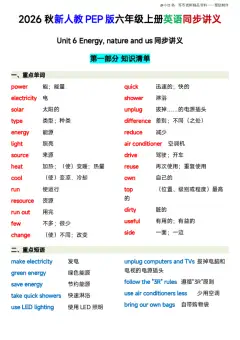
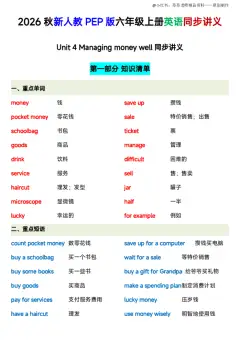
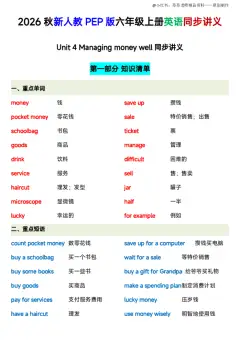
人教PEP 版新六年级英语暑期预习课
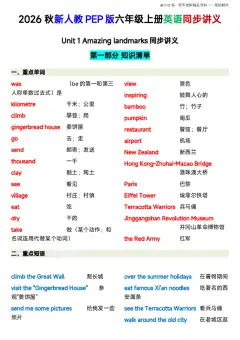
Unit 1 Amazing places 课文知识预习+巩固练习
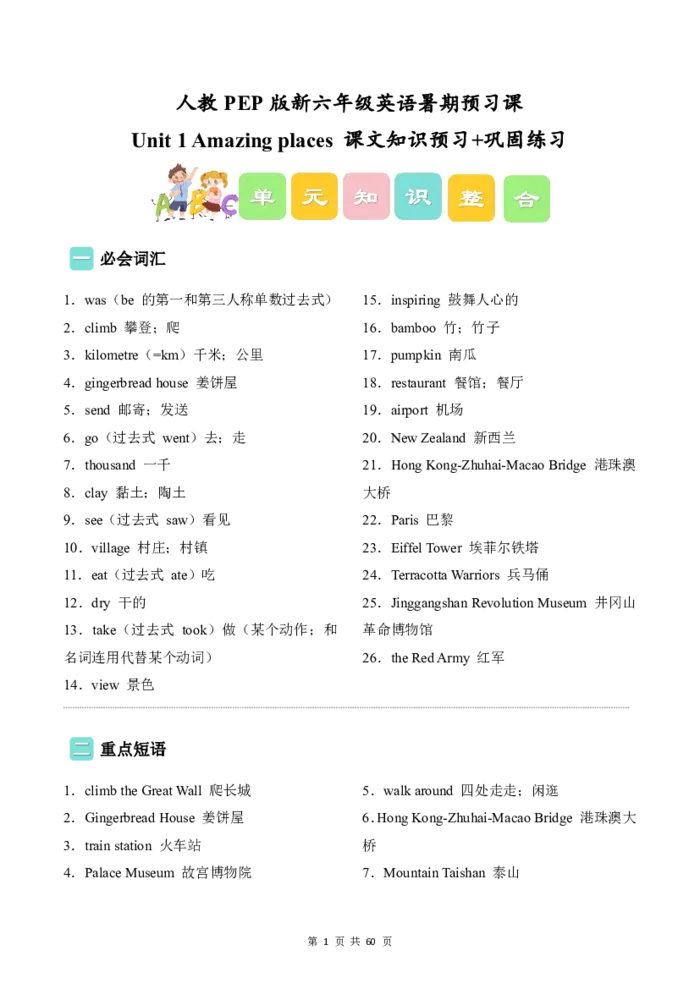
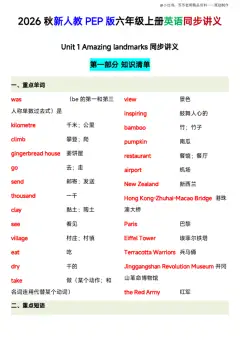
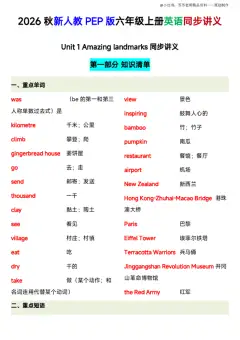
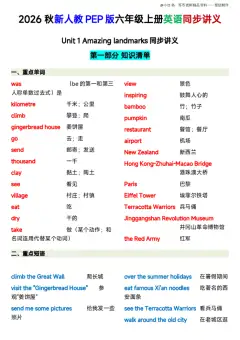
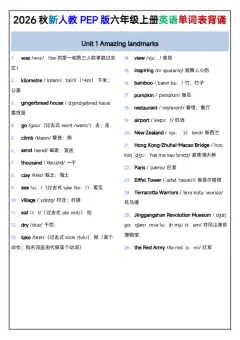
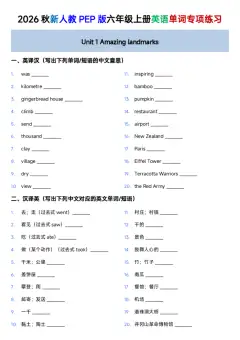
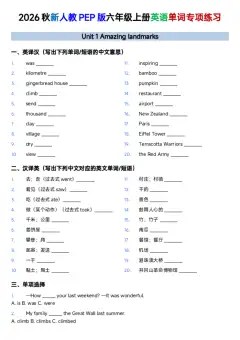
必会词汇
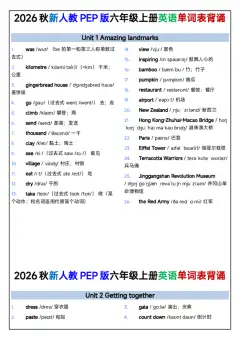
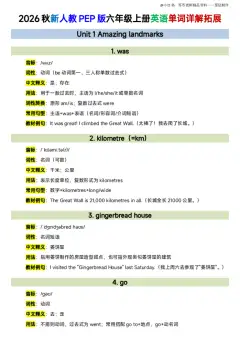
1.was(be 的第一和第三人称单数过去式)
2.climb 攀登;爬
3.kilometre(=km)千米;公里
4.gingerbread house 姜饼屋
5.send 邮寄;发送
6.go(过去式went)去;走
7.thousand 一千
8.clay 黏土;陶土
9.see(过去式saw)看见
10.village 村庄;村镇
11.eat(过去式ate)吃
12.dry 干的
13.take(过去式took)做(某个动作;和
名词连用代替某个动词)
14.view 景色
15.inspiring 鼓舞人心的
16.bamboo 竹;竹子
17.pumpkin 南瓜
18.restaurant 餐馆;餐厅
19.airport 机场
20.New Zealand 新西兰
21.Hong Kong-Zhuhai-Macao Bridge 港珠澳
大桥
22.Paris 巴黎
23.Eiffel Tower 埃菲尔铁塔
24.Terracotta Warriors 兵马俑
25.Jinggangshan Revolution Museum 井冈山
革命博物馆
26.the Red Army 红军
重点短语
1.climb the Great Wall 爬长城
2.Gingerbread House 姜饼屋
3.train station 火车站
4.Palace Museum 故宫博物院
5.walk around 四处走走;闲逛
6.Hong Kong-Zhuhai-Macao Bridge 港珠澳大
桥
7.Mountain Taishan 泰山
学科网(北京)股份有限公司
第2 页共60 页
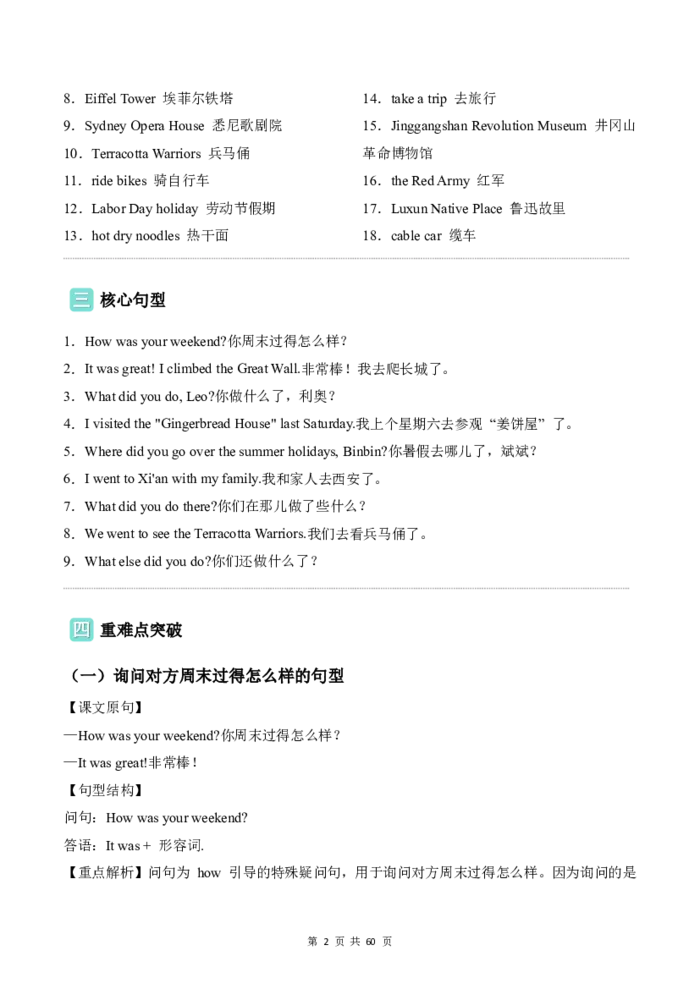
8.Eiffel Tower 埃菲尔铁塔
9.Sydney Opera House 悉尼歌剧院
10.Terracotta Warriors 兵马俑
11.ride bikes 骑自行车
12.Labor Day holiday 劳动节假期
13.hot dry noodles 热干面
14.take a trip 去旅行
15.Jinggangshan Revolution Museum 井冈山
革命博物馆
16.the Red Army 红军
17.Luxun Native Place 鲁迅故里
18.cable car 缆车
核心句型
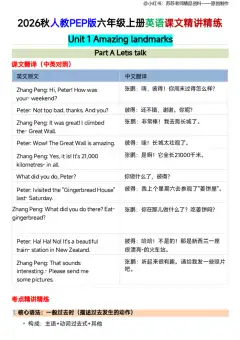
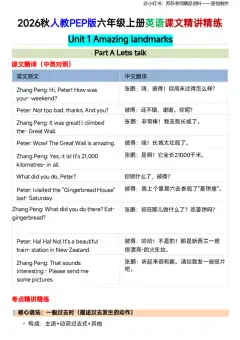
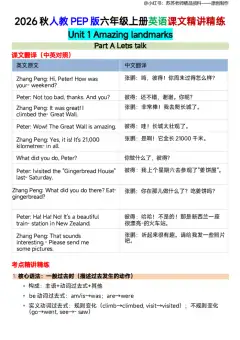
1.How was your weekend?你周末过得怎么样?
2.It was great! I climbed the Great Wall.非常棒!我去爬长城了。
3.What did you do, Leo?你做什么了,利奥?
4.I visited the "Gingerbread House" last Saturday.我上个星期六去参观“姜饼屋” 了。
5.Where did you go over the summer holidays, Binbin?你暑假去哪儿了,斌斌?
6.I went to Xi'an with my family.我和家人去西安了。
7.What did you do there?你们在那儿做了些什么?
8.We went to see the Terracotta Warriors.我们去看兵马俑了。
9.What else did you do?你们还做什么了?
重难点突破
(一)询问对方周末过得怎么样的句型
【课文原句】
—How was your weekend?你周末过得怎么样?
—It was great!非常棒!
【句型结构】
问句:How was your weekend?
答语:It was + 形容词.
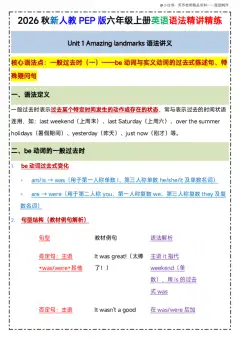
【重点解析】问句为how 引导的特殊疑问句,用于询问对方周末过得怎么样。因为询问的是
学科网(北京)股份有限公司
第3 页共60 页
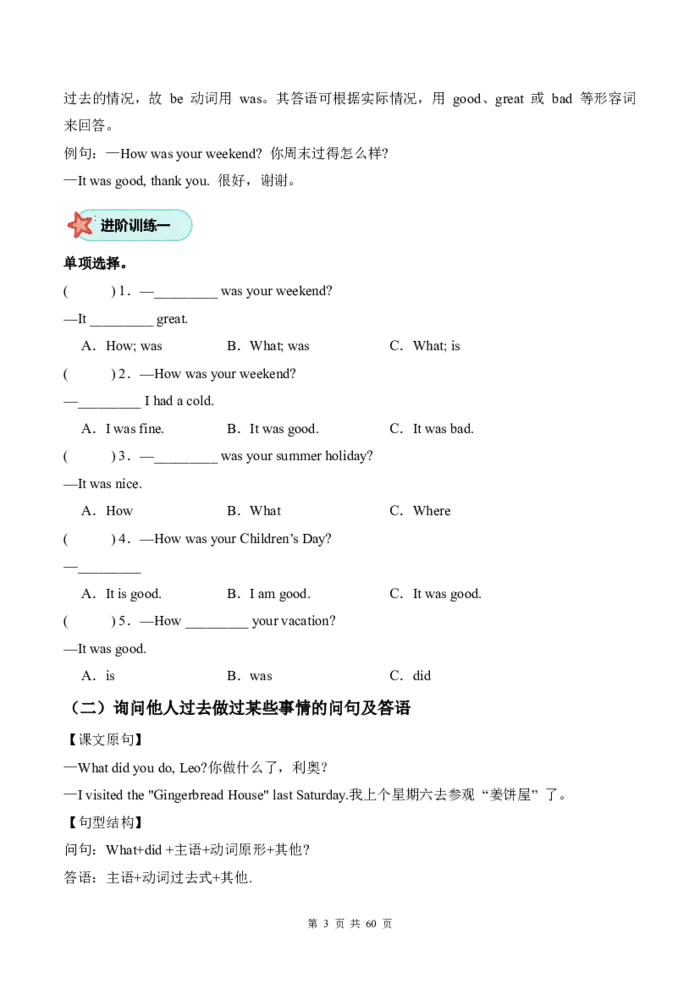
过去的情况,故be 动词用was。其答语可根据实际情况,用good、great 或bad 等形容词
来回答。
例句:—How was your weekend? 你周末过得怎么样?
—It was good, thank you. 很好,谢谢。
进阶训练一
单项选择。
(
) 1.—_________ was your weekend?
—It _________ great.
A.How; was
B.What; was
C.What; is
(
) 2.—How was your weekend?
—_________ I had a cold.
A.I was fine.
B.It was good.
C.It was bad.
(
) 3.—_________ was your summer holiday?
—It was nice.
A.How
B.What
C.Where
(
) 4.—How was your Children’s Day?
—_________
A.It is good.
B.I am good.
C.It was good.
(
) 5.—How _________ your vacation?
—It was good.
A.is
B.was
C.did
(二)询问他人过去做过某些事情的问句及答语
【课文原句】
—What did you do, Leo?你做什么了,利奥?
—I visited the "Gingerbread House" last Saturday.我上个星期六去参观“姜饼屋” 了。
【句型结构】
问句:What+did +主语+动词原形+其他?
答语:主语+动词过去式+其他.
学科网(北京)股份有限公司
第4 页共60 页
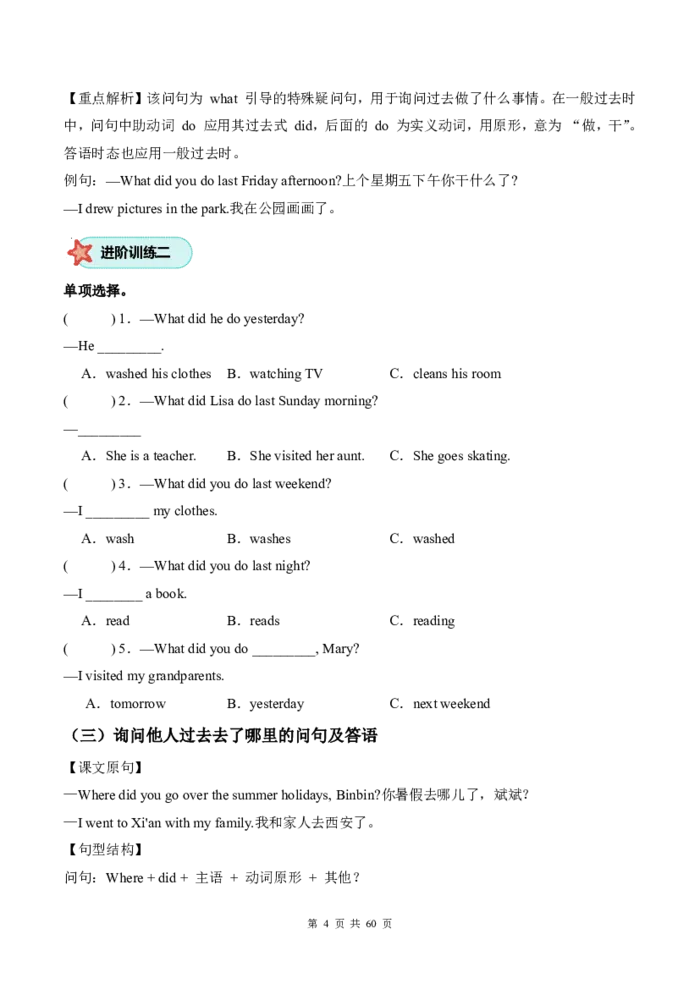
【重点解析】该问句为what 引导的特殊疑问句,用于询问过去做了什么事情。在一般过去时
中,问句中助动词do 应用其过去式did,后面的do 为实义动词,用原形,意为“做,干”。
答语时态也应用一般过去时。
例句:—What did you do last Friday afternoon?上个星期五下午你干什么了?
—I drew pictures in the park.我在公园画画了。
进阶训练二
单项选择。
(
) 1.—What did he do yesterday?
—He _________.
A.washed his clothes
B.watching TV
C.cleans his room
(
) 2.—What did Lisa do last Sunday morning?
—_________
A.She is a teacher.
B.She visited her aunt.
C.She goes skating.
(
) 3.—What did you do last weekend?
—I _________ my clothes.
A.wash
B.washes
C.washed
(
) 4.—What did you do last night?
—I ________ a book.
A.read
B.reads
C.reading
(
) 5.—What did you do _________, Mary?
—I visited my grandparents.
A.tomorrow
B.yesterday
C.next weekend
(三)询问他人过去去了哪里的问句及答语
【课文原句】
—Where did you go over the summer holidays, Binbin?你暑假去哪儿了,斌斌?
—I went to Xi'an with my family.我和家人去西安了。
【句型结构】
问句:Where + did + 主语+ 动词原形+ 其他?
学科网(北京)股份有限公司
第5 页共60 页
答语:主语+ 动词过去式+ 地点/ 其他.
【重点解析】该问句为where 引导的特殊疑问句,用于询问对方过去去了什么地方。在一般
过去时中,问句中助动词do 应用其过去式did,后面的实义动词go 要用原形,意为“去”。
答语时态也应用一般过去时,回答时要说明去的地点和相关信息。
例句:—Where did you go last weekend? 上个周末你去哪儿了?
—I went to the countryside with my grandparents. 我和爷爷奶奶去乡下了。
进阶训练三
单项选择。
(
) 1.—_________ did you go last weekend?
—I went to the zoo.
A.What
B.Where
C.How
(
) 2.—Where did you _________ over the winter holiday?
—I _________ to Turpan.
A.go; go
B.go; went
C.went; went
(
) 3.—Where did you go?
—_________.
A.Last Sunday
B.By car
C.Beijing
(
) 4.—Where did Mary _________ yesterday?
—Cinema.
A.went
B.go
C.goes
(
) 5.—Where did you go _________ over the holidays?
—I _________ to the moon.
A.to; go
B.for; went
C.for; goes
(四)else 的用法
【课文原句】What else did you do?你们还做什么了?
【重点解析】else 意为“别的、其他的”,用法核心有:
修饰疑问词,表“其他/ 还”它常放在what/who/where/when 等疑问词后面,表示“别
的……、还……”,用来补充提问范围。
学科网(北京)股份有限公司
第6 页共60 页
例:What else did you eat? 你还吃了别的什么?
例:Who else went to the party? 还有谁去了派对?
修饰不定代词,表“其他的”放在something/anything/nothing/someone/anyone 等不定代词
后面,表示“其他的、别的”。
例:Is there anything else you need? 你还需要别的东西吗?
例:Nothing else, thank you. 没别的了,谢谢。
进阶训练四
单项选择。
(
) 1.—What else did you do?
—_________
A.I learned the piano. B.Great!
C.Thank you.
(
) 2.—What did Linda do last night?
—Linda watched TV all night and didn’t do _________.
A.else something
B.something else
C.anything else
(
) 3.—Did you do _________ else last night?
—Yes. I _________ some children’s shows on TV.
A.something; read
B.anything; watched
C.everything; watch
(
) 4.—Is there _________ else important this week?
—Yes. Friday is mum’s birthday.
A.anything
B.something
C.nothing
(
) 5.Did you do _________ else?
A.any
B.something
C.anything
一、写出下列动词的过去式。
1.cook
2.play
3.love
4.see
5.study
6.think
学科网(北京)股份有限公司
第7 页共60 页
7.stay
8.wash
9.watch
10.drink
二、单项选择。
(
) 1.—______ did you go last Saturday?
—I went to Beijing.
A.What
B.Where
C.Who
(
) 2.— Li, where did you go over the Labour Day holiday?
—______.
A.I went home. East or west, home is best
B.I went by ship
C.I went with my parents
(
) 3.—______ did you go last holiday?
—I went to the science museum.
A.What
B.How
C.Where
(
) 4.I ______ tea with my grandma last night.
A.have
B.drink
C.drank
(
) 5.______ you ______ to school by bike yesterday?
A.Do; go
B.Did; go
C.Are; going
(
) 6.—______ did you do in the morning?
—I took a dancing class.
A.How
B.Where
C.What
(
) 7.John didn’t ______ a film last night.
A.see
B.saw
C.sees
(
) 8.Jack and I ______ TV together last night. We ______ happy.
A.watched; are
B.watch; were
C.watched; were
(
) 9.Amy likes ______ TV at home. But she ______ her room last night.
A.watching; cleaning B.watching; cleaned
C.watched; cleaning
(
) 10.They played football ______.
A.every weekend
B.next weekend
C.last weekend
学科网(北京)股份有限公司
第8 页共60 页
三、为句子选择合适的答语。
A.She went to the Terracotta Warriors.
B.No, I played badminton.
C.It was sunny and fun!
D.I climbed the Great Wall.
E.My dad did.
(
) 1.How was your weekend?
(
) 2.Where did Amy go over the summer holiday?
(
) 3.Did you play basketball?
(
) 4.What did you do?
(
) 5.Who cooked dinner?
四、阅读并选择合适的选项,完成句子对话,有一个选项是多余的。
A.What about you?
B.What else did you do with your grandma?
C.It was a sunny day.
D.Did you have a good time?
E.What did you see at the zoo?
F.It was great.
A: How was your last weekend?
B: 1.
I went to the zoo with my parents.
A: 2.
B: I saw many animals, like lions, tigers and monkeys. 3.
A: I had a busy weekend. I helped my grandma with the housework.
B: That’s very nice of you. 4.
A: Yes, I did. I made my grandma happy.
B: 5.
A: I also walked in the park with her and chatted with her.
B: Sounds good. I am going to visit my grandparents.
学科网(北京)股份有限公司
第9 页共60 页
A: Good. Have a nice weekend with them.
五、阅读短文。根据短文内容,判断正(T)误(F)。
Last winter, Harbin became a popular city in China. It’s famous for its beautiful Ice and Snow
World as well as interesting winter activities. During the New Year Holiday, about 3 million (百万)
people visited Harbin.
Jack went to Harbin with his parents last winter vacation. They visited many interesting places.
The first day, they walked to Central Street (中央大街). In the evening, they saw many amazing ice
sculptures (冰雕) in ice and Snow World.
The second day, they went to the Sun Island Park (太阳岛) and made a snowman. It was very
beautiful. In the afternoon, Jack went skiing (滑雪) on the Songhua River. That was interesting.
The third day, Jack ate delicious food such as the Harbin sausages (红肠) and the frozen pears
(冻梨). The last day, they visited Saint Sophia Cathedral (圣索菲亚大教堂) and took lots of pictures.
Jack also bought some gifts for his grandparents. They had a good time.
(
) 1.Harbin is famous (著名) for the Ice and Snow world and winter activities.
(
) 2.Jack made a snowman on the Songhua River in the afternoon.
(
) 3.On the third day, Jack ate the Harbin sausages and the frozen pears.
(
) 4.Jack took lots of pictures and bought some gifts for his friends.
(
) 5.Jack and his family had a lot of fun in Harbin.
六、请仔细阅读短文, 根据短文内容选择正确的选项。
The Great Wall of China is one of the
greatest wonders (奇迹) of the world. It’s in
Beijing. It’s over two thousand years old and
more than twenty thousand kilometres long.
The Museum of the Terracotta Warriors
and Horses ( 兵马俑) is in Xi’an. There are
thousands of warriors and horses buried (埋葬)
in the grave of Qin Shihuang.
学科网(北京)股份有限公司
第10 页共60 页
The Huangshan Mountain is also called
the Yellow Mountain. It is in the south of
Anhui. It is famous for its beautiful mountains
and pine trees.
There are many famous lakes in China.
This is the West Lake. It’s in Hangzhou. The
lake looks different in each season. There are
beautiful lotus flowers (莲花) and fish in the
water.
(
) 1.—How long is the Great Wall?
—It’s more than ________ kilometres long.
A.2,000
B.20,000
C.200
(
) 2.—Where is the Museum of the Terracotta Warriors and Horses?
—It’s in ________.
A.Xi’an
B.Beijing
C.Hangzhou
(
) 3.文中画线部分“pine trees” 意为“________”。
A.桃树
B.柳树
C.松树
(
) 4.There are beautiful ________ in the water.
A.lotus flowers and fish
B.lotus root and fish
C.warriors and horses
(
) 5.The best title (题目) of this passage should be “_________”.
A.Famous Countries
B.Famous Places in China C.Famous Food in China
学科网(北京)股份有限公司
第11 页共60 页
参考答案
进阶训练一:
1.A
2.C
3.A
4.C
5.B
进阶训练二:
1.A
2.B
3.C
4.A
5.B
进阶训练三:
1.B
2.B
3.C
4.B
5.B
进阶训练四:
1.A
2.C
3.B
4.A
5.C
知识演练场:
一、写出下列动词的过去式。
1.cooked
2.played
3.loved
4.saw
5.studied
6.thought
7.stayed
8.washed
9.watched
10.drank
二、单项选择。
1.B
2.A
3.C
4.C
5.B
6.C
7.A
8.C
9.B
10.C
三、为句子选择合适的答语。
1.C
2.A
3.B
4.D
5.E
四、阅读并选择合适的选项,完成句子对话,有一个选项是多余的。
1.F
2.E
3.A
4.D
5.B
五、阅读短文。根据短文内容,判断正(T)误(F)。
1.T
2.F
3.T
4.F
5.T
六、请仔细阅读短文, 根据短文内容选择正确的选项。
1.B
2.A
3.C
4.A
5.B
学科网(北京)股份有限公司
第12 页共60 页
人教PEP 版新六年级英语暑期预习课
Unit 1 Amazing places 语法易错+巩固练习
语法易错01
语法点拨:动词过去式的变化规则
①一般情况下,直接加ed
work→worked
look→looked
walk→walked
②以e 结尾的单词,直接加d
live →lived
hope→hoped
use→used
③以辅音字母+y 结尾的,变y 为i 加ed
study→studied
carry→carried
④以元音字母+y 结尾的,直接加ed
enjoy →enjoyed
play→played
⑤以重读、一个辅音字母结尾的闭音节结尾的动词,双写最后的辅音字母+ed
stop→stopped
plan→planned
口诀技巧
一般动词加ed,e 结尾只加d。
辅音加y 要小心,y 变i 再加ed。
重读闭音节要注意,末尾辅音要双写!
不规则变化特殊记,多读多练别忘记。
本单元出现的动词过去式:
am,is-was
are-were
climb-climbed
visit-visited
do-did
walk-walked
travel-travelled
watch-watched
go-went
eat-ate
see-saw
ride-rode
take-took
write-wrote
think-thought
drink-drank
call-called
love-loved
cook-cooked
have-had
学科网(北京)股份有限公司
第13 页共60 页
知识演练一
一、单项选择。
(
) 1.He ______ a book at home yesterday.
A.read
B.reading
C.reads
D.rode
(
) 2.We ______ to the museum last Sunday.
A.go
B.went
C.will go
(
) 3.She ______ a film with her sister last night.
A.watch
B.watches
C.watched
(
) 4.Linda ______ to the zoo last Saturday.
A.walk
B.walks
C.walked
(
) 5.—Where did you ______ last winter holiday?
—I ______ to Mountain Huangshan.
A.go; go
B.go; went
C.went; went
(
) 6.—Did you ______ fresh food in Hainan?
—Yes, I did. I ______ fish.
A.eat; eat
B.ate; eat
C.eat; ate
(
) 7.I ______ a lot of fun yesterday.
A.had
B.have
C.has
(
) 8.He drank some tea and ______ TV at home.
A.watch
B.watches
C.watched
(
) 9.I often ______ TV on the weekend, but I ______ a horse last weekend.
A.watch; ride
B.watched; rode
C.watch; rode
(
) 10.Tom ______ a film magazine last night. He ______ it was interesting.
A.saw; thought
B.read; thought
C.see; thinks
二、用所给单词的适当形式填空。
11.We
(walk) around the ancient city yesterday morning.
12.They
(take) many photos in the park yesterday.
13.They
(visit) the museum last week.
14.We
(eat) seafood last holiday.
学科网(北京)股份有限公司
第14 页共60 页
15.I
(go) to India last holiday.
16.We
(have) a good time last trip.
17.Yesterday Bill
(watch) a basketball game on TV.
18.I
(go) to Beijing last year.
19.My grandma
(write) letters to her friends when she was a young girl.
20.We had bananas in Hainan last week. They
(are) delicious.
语法易错02
语法点拨:一般过去时
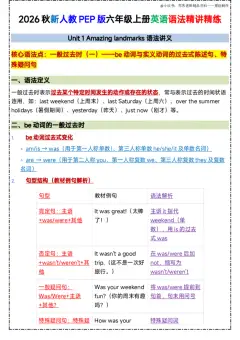
(一)概念及结构
一般过去时表示过去某个时间发生的动作或存在的状态。句型结构为:主语+ 动词过去式+
其他。
(二)用法
表示过去某一时间发生的动作。
例:My father got home at 8 o'clock last night.我爸爸昨晚八点到的家。
表示过去某一时间存在的状态。
例:He was very busy last week. 上周他很忙。
表示过去经常或反复发生的动作,常与always(总是)、usually(通常)、never(从不)、
often(经常)等连用。
例:I often played football last year. 去年我经常踢足球。
表示主语过去的特征和性格。
例:He was short and thin when he was six years old. 六岁时,他又矮又瘦。
表示已故的人所做的事情或情况。
例:Lu Xun wrote a lot of novels. 鲁迅写了很多部小说。
(二)结构:
句式
结构
例句
肯定句
主语+be(was/were)+其它
主语+动词过去式+其它
I went to Wuhan last month.
我上个月去了武汉。
学科网(北京)股份有限公司
第15 页共60 页
否定句
主语+be(was/were)+not+其它
主语+did not(didn’t)+动词过去式+其它
I didn’t go to Wuhan last month.
我上个月没去过武汉。
一般疑问句
Be(Was/Were)+主语+其它
Did+主语+动词原形+其它
Did you go to Wuhan last month?
上个月你去过武汉吗?
特殊疑问句
特殊疑问词+be 动词(was/were)+主语(+
其他)?
特殊疑问词+did+主语+系动词的动词
原形(+其他)?
Where were they an hour ago?他们一小
时前在哪里?
How did she feel?她感觉怎么样?
(三)常与一般过去时连用的时间状语:
yesterday 昨天
last night 昨晚
last weekend 上周末
last Monday 上周一
the day before yesterday 前天
last week 上周
last month 上个月
last year 去年
two days ago 两天前
once upon a time 从前
long long ago 很久很久以前
知识演练二
一、单项选择。
(
) 1.I ________ see a film last Sunday.
A.am not
B.don’t
C.didn’t
(
) 2.He washed his clothes and ________ his room.
A.cleans
B.cleaned
C.cleaning
(
) 3.—How _________ the sea?
—It was beautiful.
A.was
B.were
C.is
(
) 4.I played football ________ Thursday.
A.at
B.in
C.last
(
) 5.She ________ to Beijing yesterday.
A.go
B.goes
C.went
(
) 6.Joe often ________ basketball on the weekend. But he ________ badminton last
weekend.
A.plays; played
B.play; played
C.plays; plays
学科网(北京)股份有限公司
第16 页共60 页
(
) 7.Oliver went shopping ________.
A.last Saturday
B.every Saturday
C.next Saturday
(
) 8.—What ________ you ________ last weekend?
—I visited my grandparents.
A.do; do
B.did; do
C.did; did
二、连词成句。
9.was, how, your, last, weekend (?)
_________________________________________________________
10.my, with, went, mom, I, shopping (.)
_________________________________________________________
11.you, last, did, weekend, What, do (?)
_________________________________________________________
12.did, where, you, go, summer, last (?)
_________________________________________________________
13.the holiday, rode a horse, over, he (.)
_________________________________________________________
三、句型转换。
14.She cleaned the room the day before yesterday. (改为否定句)
_________________________________________________________
15.I eat fresh food and buy gifts for my friends. (改为一般过去时的句子)
_________________________________________________________
16.The beach was beautiful. (对画线部分提问)
_________________________________________________________
17.Tom goes to the park every weekend. (用last weekend 改写句子)
_________________________________________________________
18.My parents cleaned the house last Sunday. (对画线部分提问)
_________________________________________________________
19.They visited Qinghai Lake last summer holiday. (对画线部分提问)
_________________________________________________________
学科网(北京)股份有限公司
第17 页共60 页
20.Kate often rides a bike on Saturdays. (用yesterday afternoon 改写句子)
_________________________________________________________
一、单项选择。
(
) 1.—________ did they go last weekend?
—Nanchang.
A.What
B.Where
C.When
(
) 2.—What did you do last weekend, Li Tao?
—I ________.
A.camping
B.go camping
C.went camping
(
) 3.—________ did you go there?
—We went there by ________.
A.How; car
B.When; bus
C.Where; subway.
(
) 4.—________ you take pictures there?
—Yes, we did. They were about apricot flowers(杏花).
A.Do
B.Did
C.Are
(
) 5.Chen Jie ________ in the park yesterday.
A.to take pictures
B.see a film
C.took pictures
(
) 6.—How was your weekend?
—________ I hurt my foot.
A.It was good.
B.It was fine.
C.It was bad.
(
) 7.He cleaned his room ________.
A.last Sunday
B.next week
C.tomorrow
(
) 8.—Did you do anything ________?
—Yes, I played table tennis.
A.also
B.too
C.else
学科网(北京)股份有限公司
第18 页共60 页
(
) 9.Grandpa watered the flowers and ________ tea in the afternoon.
A.drinks
B.drank
C.drinking
(
) 10.What ________ Oliver ________ last Sunday?
A.did; do
B.do; do
C.does; do
二、用所给单词的适当形式填空。
1.Sarah wanted to
(visit) her brother last weekend.
2.I
(see) a funny movie yesterday evening.
3.She
(do not) watch TV last Friday.
4.They
(play) football yesterday afternoon.
5.—How
(be) the beach?
—It was beautiful.
6.My mother
(eat) an egg last night.
7.We had bananas in Hainan last week. They
(are) delicious.
8.Last winter holiday, I went to Harbin. It
(be) cold and snowy.
9.I went swimming and
(ride) a horse last weekend.
10.They
(visit) their grandparents last Friday.
三、句型转换。
1.She went to Shanghai by plane. (改为否定句)
__________________________________________
2.What did you do over the Labour Day holiday? (根据实际情况回答问题)
__________________________________________
3.My father went to Guangzhou last year. (对划线部分提问)
__________________________________________
4.I cooked the food last night. (对划线部分提问)
__________________________________________
5.I watch some shows on TV. (改为一般过去时)
__________________________________________
四、连词成句。
1.you, the, where, go, did, holiday, over, summer (?)
__________________________________________
学科网(北京)股份有限公司
第19 页共60 页
2.did, you, what, do, weekend, last (?)
__________________________________________
3.was, how, last, your, weekend (?)
__________________________________________
4.what, see, did, you, the, on, Great, Wall (?)
__________________________________________
5.the, climbed, mountains, I (.)
__________________________________________
五、港珠澳大桥是中国境内一座连接香港、广东珠海和澳门的桥隧工程。选择合适的单词,
补全短文。(注意词的形式)
south visit
kilometre world
take
My name is Su Ming. I
1
Zhuhai with my family last weekend. It’s a city in the
2
of China. I had a big surprise here. I saw a wonderful bridge. It's Hong Kong-Zhuhai-Macao Bridge.
It’s 55
3
long. And it's the longest cross-sea bridge in the
4
. About 35 kilometres of
the bridge is overthe water. And a part of it is under the water. It's easy to travel among the three
places now. In the past, it
5
about four hours to go from Hong Kong to Zhuhai. But now, it
takes about 45 minutes.
1.
2.
3.
4.
5.
六、阅读对话,从A、B、C、D、E 五个选项中,选出一个最佳答案完成对话,将选项填在
横线上。
A.We took a lot of pictures there.
B.Did you do anything else?
C.Welcome to my home to see the photos.
D.Where did you go over your winter holiday last year?
E.I will go there next time.
John: Hi, Amy. 1.
Amy: I went to Harbin with my family.
John: Really? Was it interesting?
学科网(北京)股份有限公司
第20 页共60 页
Amy: Of course. 2.
John: Can I see your pictures sometime?
Amy: Sure. 3.
John: Thank you. 4.
Amy: Yes, we had snowball fights(打雪仗) and made a big snowman.
John: Sounds great. 5.
七、阅读短文,选择正确答案。
港珠澳大桥是连接香港、珠海和澳门的超大型跨海通道,全长约55 公里,是世界最长的
跨海大桥。它集桥、岛、隧于一体,极大缩短了三地间的时空距离,被誉为现代工程奇迹。
The Hong Kong-Zhuhai-Macao Bridge is the longest sea-crossing bridge in the world. It is
about 55 kilometers long. This amazing bridge connects (连接) three important places: Hong Kong,
Zhuhai, and Macao.
Before the bridge was built, traveling by car between Hong Kong and Zhuhai took about three
hours. Now, with the bridge, the same trip takes only 30 minutes. This helps people travel faster and
easier.
The bridge also has a special underwater tunnel (隧道). It is about 6.7 kilometers long. The
tunnel allows big ships to sail safely above it. Building this bridge was a huge project and it helps the
economy of the area.
根据笔记内容,选择合适的选项。
(
) 1.How long is the Hong Kong-Zhuhai-Macao Bridge?
A.About 55 kilometers.
B.About 30 kilometers.
C.About 6.7 kilometers.
(
) 2.Which three places does the bridge connect?
A.Beijing, Shanghai, Guangzhou.
学科网(北京)股份有限公司
第21 页共60 页
B.Hong Kong, Zhuhai, Macao.
C.Shenzhen, Zhuhai, Macao.
(
) 3.How long does it take to travel from Hong Kong to Zhuhai by car now?
A.About three hours. B.About 30 minutes.
C.About one hour.
(
) 4.Why is there an underwater tunnel in the bridge?
A.To make the bridge longer.
B.To allow big ships to sail safely.
C.To help cars go faster.
(
) 5.Which one is Right?
A.It is the oldest bridge in the world.
B.It only connects two cities.
C.It helps people travel faster than before.
八、阅读短文,判断正(T)误(F)。
My name is Jenny. Last vacation, I went to Beijing with my family. We went there by train.
The train was comfortable. We spent five days visiting Beijing. On the first day, we went to
Tian’anmen Square. It is so big. There were so many people taking photos there. Then we went to
the Palace Museum. We saw thousands of houses. Kings lived there before. I felt excited. The second
day was cloudy, so we went to the museum. We saw many old things. On the third day we climbed
the Great Wall. It is so great! We were tired. So the next day we stayed at the hotel. The last day we
went shopping and bought lots of things. I had a happy vacation.
(
) 1.Jenny went to Beijing last vacation.
(
) 2.Jenny spent six days in Beijing.
(
) 3.Jenny went to Tian’anmen Square on the first day.
(
) 4.Jenny went to the Great Wall on the fourth day.
(
) 5.Jenny had a good time in Beijing during the vacation.
学科网(北京)股份有限公司
第22 页共60 页
参考答案
知识演练一:
1.A
2.B
3.C
4.C
5.B
6.C
7.A
8.C
9.C
10.B
11.walked
12.took
13.visited
14.ate
15.went
16.had
17.watched
18.went
19.wrote
20.were
知识演练二:
1.C
2.B
3.A
4.C
5.C
6.A
7.A
8.B
9.How was your weekend?
10.I went shopping with my mom.
11.What did you do last weekend?
12.Where did you go last summer?
13.He rode a horse over the holiday.
14.She didn’t/did not clean the room the day before yesterday.
15.I ate fresh food and bought gifts for my friends.
16.How was the beach?
17.Tom went to the park last weekend.
18.What did your parents do last Sunday?
19.Where did they visit last summer holiday?
20.Kate rode a bike yesterday afternoon.
重难点特训:
一、单项选择。
1.B
2.C
3.A
4.B
5.C
6.C
7.A
8.C
9.B
10.A
二、用所给单词的适当形式填空。
1.visit
2.saw
3.didn’t
4.played
5.was
6.ate
7.were
8.was
9.rode
10.visited
三、句型转换。
1.She didn’t go to Shanghai by plane.
2.I went camping.(答案不唯一)
学科网(北京)股份有限公司
第23 页共60 页
3.Where did your father go last year?
4.What did you do last night?
5.I watched some shows on TV.
四、连词成句。
1.Where did you go over the summer holiday?
2.What did you do last weekend?
3.How was your last weekend?
4.What did you see on the Great Wall?
5.I climbed the mountains.
五、港珠澳大桥是中国境内一座连接香港、广东珠海和澳门的桥隧工程。选择合适的单词,
补全短文。(注意词的形式)
1.visited
2.south
3.kilometres
4.world
5.took
六、阅读对话,从A、B、C、D、E 五个选项中,选出一个最佳答案完成对话,将选项填在
横线上。
1.D
2.A
3.C
4.B
5.E
七、阅读短文,选择正确答案。
1.A
2.B
3.B
4.B
5.C
八、阅读短文,判断正(T)误(F)。
1.T
2.F
3.T
4.F
5.T
学科网(北京)股份有限公司
第24 页共60 页
人教PEP 版新六年级英语暑期预习课
Unit 2 Getting together 课文知识预习+巩固练习
必会词汇
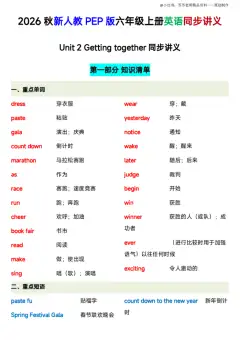
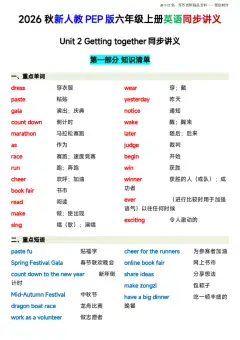
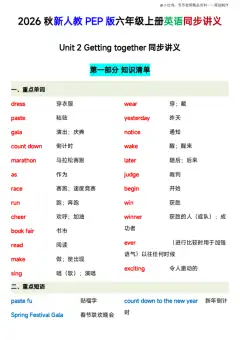
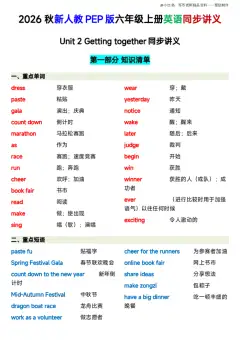
1.paste 粘贴
2.dress 穿衣服
3.gala 演出;庆典
4.count down 倒计时
5.marathon 马拉松赛跑
6.as 作为
7.race 赛跑;速度竞赛
8.run 跑;奔跑(过去式ran)
9.cheer 欢呼;加油
10.book fair 书市
11.writer 作家;作者
12.read 阅读(过去式read)
13.make 做;使出现(过去式made)
14.sing 唱(歌);演唱(过去式sang)
15.wear 穿;戴(过去式wore)
16.yesterday 昨天
17.notice 通知
18.wake 醒;醒来(过去式woke)
19.later 随后;后来
20.judge 裁判
21.begin 开始(过去式began)
22.win 获胜(过去式won)
23.winner 获胜的人(或队);成功者
24.ever (进行比较时用于加强语气)以往
任何时候
25.exciting 令人激动的
重点短语
1.Mid-Autumn Festival holiday 中秋节假期
2.Spring Festival 春节
3.paste fu and eat jiaozi 贴福字、吃饺子
4.clean the house 打扫房子
5.dress in red 穿红色衣服
6.Spring Festival Gala 春节联欢晚会
7.count down 倒计时
8.an online book fair 线上书市
9.run a marathon 参加马拉松赛跑
10.an art festival 艺术节
11.National Day 国庆节
12.Earth Day 世界地球日
学科网(北京)股份有限公司
第25 页共60 页
13.put up a tent 搭帐篷
14.dragon boat race 龙舟比赛
15.Dragon Boat Festival 端午节
核心句型
1.How was your Mid-Autumn Festival holiday, Binbin? 你中秋假期过得怎么样,斌斌?
2.It was great! 非常棒!
3.Did you take a trip? 你们去旅行了吗?
4.No, we didn't. 不,我们没有。
5.Did you eat mooncakes? 你们吃月饼了吗?
6.Yes, we did. 是的,我们吃了。
7.My mother and I went to a marathon on Sunday. 我和妈妈上周日去看了一场马拉松活动。
8.What did you like about it? 你喜欢这个活动的哪个方面?
9.I liked watching the runners. 我喜欢看参赛者(跑步)。
10.What did you do last weekend? 你上周末做什么了?
重难点突破
(一)询问过去某段时间(假期)过得怎么样的句型
【课文原句】
—How was your Mid-Autumn Festival holiday, Binbin? 你中秋假期过得怎么样,斌斌?
—It was great! 非常棒!
【句型结构】
问句:How + was/were + 主语+ (过去的时间)?·
答句:主语+ was/were + 形容词.
【重点解析】
1.时态:一般过去时
was 是is/am 的过去式,说明对话讨论的是已经结束的中秋假期,所以要用过去时。
易错点:主语是单数(holiday),所以用was,不用were。
学科网(北京)股份有限公司
第26 页共60 页
2.核心词汇
Mid-Autumn Festival holiday:中秋节假期
great:这里不是“伟大的”,而是口语中表示“很棒、很不错” 的常用评价词。
3.称呼语
Binbin 是人名,放在句末用逗号隔开,相当于中文里“斌斌,你中秋假期过得怎么样?”,
是口语对话的常见用法。
【例句】
—How was your Spring Festival holiday? 你的春节假期过得怎么样?—It was wonderful! 超棒
的!
进阶训练一
单项选择。
(
) 1.—How was your summer holiday?
—______
A.It was great fun.
B.Thank you.
C.I don’t think so.
(
) 2.—How was your Labour Day holiday?
—______
A.It was good.
B.It was warm.
C.I hurt my foot.
(
) 3.—How was your winter holiday?
—______
A.I like it.
B.It is wonderful.
C.It was nice.
(
) 4.—How was your National Day holiday?
—______.
A.That’s too bad
B.It was great fun
C.I think so
(
) 5.—How ______ your trip?
—It ______ great. But I ______tired now.
A.was; was; am
B.is; was; was
C.is; is; am
(二)询问对方过去是否做过某事的句型
学科网(北京)股份有限公司
第27 页共60 页
【课文原句】
①—Did you take a trip? 你们去旅行了吗?
—No, we didn't. 不,我们没有。
②—Did you eat mooncakes? 你们吃月饼了吗?
—Yes, we did. 是的,我们吃了。
【句型结构】
问句:Did + 主语+ 动词原形+ 其他?
肯定回答:Yes, 主语+ did.
否定回答:No, 主语+ didn't.
【重点解析】一般过去时问句用did,说明动作发生在过去(这里指中秋假期)。易错点:问
句里的动词take 和eat 必须用原形,过去式已经体现在did 上了。
【例句】—Did you watch TV last night? 你昨晚看电视了吗?
—Yes, I did. 是的,我看了。/ No, I didn't. 不,我没有。
进阶训练二
单项选择。
(
) 1.—Did you enjoy reading The Secret Garden?
—______. It’s a wonderful book.
A.Yes, I do
B.Yes, I did
C.No, I didn’t
(
) 2.—______ you ______ a good time?
—Yes, I did.
A.Did; has
B.Did; have
C.Do; have
(
) 3.—______ you go to the British Museum?
—No, we ______.
A.Did; did
B.Did; didn’t
C.Do; didn’t
(
) 4.—Did you ______ a new cap, Lily?
—No, I didn’t.
A.bought
B.buy
C.buys
(
) 5.Did you ______ your clothes last night?
学科网(北京)股份有限公司
第28 页共60 页
A.wash
B.washed
C.washing
(三)询问对方过去对某件事的看法和喜欢的部分的句型
【课文原句】
—What did you like about it? 你喜欢这个活动的哪个方面?
—I liked watching the runners. 我喜欢看参赛者(跑步)。
【句型结构】
问句:What did + 主语+ like about + 事物/活动?
答句:主语+ liked + 动词-ing 形式/名词.
【重点解析】like doing sth. 表示“喜欢做某事”,过去时中like 变liked,后面的动词依然
用-ing 形式:liked watching(喜欢看)。
【例句】—What did you like about the book fair? 你喜欢书市的什么?
—I liked reading storybooks there. 我喜欢在那儿读故事书。
进阶训练三
选择合适的单词,并用其合适的形式填空。
sing
put up
watch
read
cheer
1.—What did you like about the Dragon Boat Festival?
—I liked ______ the dragon boat races.
2.—What did your sister like about the Spring Festival Gala?
—She liked ______ the songs.
3.—What did they like about the school trip?
—They liked ______ the tent.
4.—What did your father like about the marathon?
—He liked ______ for the runners.
5.—What did you like about the book fair?
—I liked ______ the new storybooks.
学科网(北京)股份有限公司
第29 页共60 页
一、写出动词的过去式。
1.watch→________
2.like→________
3.visit→________
4.play→________
5.paste→________
6.go→________
7.have→________
8.see→________
9.do→________
10.am→________
二、单项选择。
(
) 1.—Did you clean your room?
—______.
A.Yes, I do
B.Yes, I am
C.Yes, I did
(
) 2.She ______ angry with me because I broke her cup.
A.is
B.was
C.will be
(
) 3.We ______ to the park with our friends last Saturday.
A.go
B.went
C.will go
(
) 4.My brother usually ______ to school by bike, but he ______ to school on foot yesterday.
A.go; went
B.goes; went
C.goes; go
(
) 5.—What did you do last weekend?
—I ______ my room.
A.clean
B.cleaned
C.am cleaning
(
) 6.—What did you ______ today?
—I ______ some chicken.
A.eat; eat
B.eat; ate
C.ate; ate
(
) 7.—Did your sister ______ English yesterday?
—No, she didn’t. She ______ TV at home.
A.study; watched
B.studied; watched
C.study; watch
(
) 8.—______ your weekend, Jack?
—It was good.
A.How
B.How is
C.How was
学科网(北京)股份有限公司
第30 页共60 页
(
) 9.Kate ______ her room the day before yesterday.
A.doesn’t clean
B.didn’t clean
C.didn’t cleaned
(
) 10.Long long ago, there ______ a bird in the forest. She ______ good at singing.
A.was; were
B.was; was
C.were; were
三、根据图片提示,补全句子。
1.She
the pipa for the old people last Sunday.
2.Tony
a book yesterday.
3.—What did you do last weekend?
—I
a film.
4.Diandian
fu on the door with his parents last night.
5.Last night, Sam
the house with his mum.
四、用所给单词的适当形式填空。
1.Lu Ban was a great craftsman, and he
(make) the first saw in the world.
2.He
(be) born in 2014.
3.She
(have) a cold yesterday.
4.She
(clean) her room yesterday.
5.Bill
(play) football after school yesterday.
6.I
(see) a funny movie yesterday evening.
学科网(北京)股份有限公司
第31 页共60 页
五、为句子选择合适的答语。
A.Yes, she did.
B.I went fishing.
C.No, I didn’t.
D.He read a book yesterday.
E.It was great.
(
) 1.What did he do yesterday?
(
) 2.Did you wash the clothes yesterday?
(
) 3.What did you do last weekend?
(
) 4.Did she went to the park?
(
) 5.How was your Mid-Autumn Festival holiday?
六、读短文,选词填空。
I 1.
(go / went) to Sichuan last winter vacation. It was a great trip. I 2.
(buy /
bought) some gifts for my parents. I 3.
(eat / ate) Sichuan food, climbed Mountain Emei,
and 4.
(see / saw) monkey there. They were naughty. They 5.
(take / took) bananas
from my bag.
七、根据所给情境,选择合适的选项补全对话。
A.How about you?
B.That’s too bad!
C.What happened?
D.How was your weekend?
E.Can I see your pictures sometime?
A: Hello, Lili, 1.
B: Hi, Xixi. It was not very good.
A: 2.
B: I rode a bike in the park with my friend. But I fell off the bike, because I didn’t see a stone (石头)
in front of me.
A: 3.
Are you all right?
学科网(北京)股份有限公司
第32 页共60 页
B: I hurt my leg, so I went to the hospital. But now I feel better. 4.
What did you do last
weekend?
A: I climbed the mountains and went fishing.
B: Sounds interesting! Did you do anything else?
A: Yes, I also took lots of pictures.
B: Really? 5.
A: Sure!
八、【新语篇·传统故事】阅读绘本,选择正确的答案。
Long long ago, there was a scary beast
named Nian. Its name means year. Nian went to
a village at night. People was scared of it. It ate
many animals.
One day, an old man came to the village.
“Don’t be afraid. I have three ways. We need
the color red, fire and noise,” he said.
People followed his ideas. When Nian
came again, it saw the red clothes, fire and
heard the firecrackers(鞭炮). It was afraid and
ran away.
Everyone was happy again. From then on,
people put up couplets( 对联), hang the
lanterns(灯笼), set off firecrackers on that day
every year. The day was named Nian.
(
) 1.What is Nian long long ago?
A.A day.
B.A man.
C.A beast.
(
) 2.Who ate many animals at night?
A.People.
B.Nian.
C.An old man.
学科网(北京)股份有限公司
第33 页共60 页
(
) 3.The word “scared” can be replaced(代替) by _______.
A.afraid
B.proud
C.tired
(
) 4.The underline word noise means _______.
A.喊叫
B.烟花
C.响声
(
) 5.Why do people put up couplets and hang the lanterns in the story?
A.Because Nian is afraid of the color red.
B.Because Chinese people like the color red.
C.Because Nian likes the color red.
(
) 6.The origin(由来) of _______ is the story of Nian.
A.Lantern Festival
B.Children’s Day
C.the Spring festival
学科网(北京)股份有限公司
第34 页共60 页
参考答案
进阶训练一:
1.A
2.A
3.C
4.B
5.A
进阶训练二:
1.B
2.B
3.B
4.B
5.A
进阶训练三:
1.watching
2.singing
3.putting up
4.cheering
5.reading
知识演练场:
一、写出动词的过去式。
1.watched
2.liked
3.visited
4.played
5.pasted
6.went
7.had
8.saw
9.did
10.was
二、单项选择。
1.C
2.B
3.B
4.B
5.B
6.B
7.A
8.C
9.B
10.B
三、根据图片提示,补全句子。
1.played
2.read
3.watched
4.pasted
5.cleaned
四、用所给单词的适当形式填空。
1.made
2.was
3.had
4.cleaned
5.played
6.saw
五、为句子选择合适的答语。
1.D
2.C
3.B
4.A
5.E
六、读短文,选词填空。
1.went
2.bought
3.ate
4.saw
5.took
七、根据所给情境,选择合适的选项补全对话。
1.D
2.C
3.B
4.A
5.E
八、【新语篇·传统故事】阅读绘本,选择正确的答案。
1.C
2.B
3.A
4.C
5.A
6.C
学科网(北京)股份有限公司
第35 页共60 页
人教PEP 版新六年级英语暑期预习课
Unit 2 Getting together 语法易错+巩固练习
语法易错01
语法点拨:动词过去式的变化规则
1. Be 动词的过去式:
❶第一人称单数I 和第三人称单数he/she/it 以及单数名词作主语时,be 动词用was;
❷第二人称单数you、第一人称复数we、第三人称复数they 以及复数名词作主语时,be 动
词用were。
2. 实义动词的过去式:
规则变化:
❶大多数动词在词尾直接加-ed。
look→looked
play→played
start→started。
❷以不发音的e 结尾的动词,只需在词尾加-d。
live→lived
hope→hoped
use→used。
❸以辅音字母加y 结尾的动词,变y 为i 再加-ed。
study→studied
carry→carried
worry→worried。
❹重读闭音节结尾且末尾只有一个辅音字母的动词,先双写这个辅音字母,再加-ed。
stop→stopped
plan→planned
不规则变化:
❶有些动词的过去分词形式与原形或过去式相同。
hit→hit
set→set
put→put
cut→cut
let→let
get→got
sit→sat
find→found
hold→held
win→won
hang→hung
lose→lost
❷有些动词的过去分词形式与原形不同。
feed→fed
lead→led
meet→met
learn→learnt
本单元出现的动词过去式:
am,is-was
have-had
do-did
visit-visited
enjoy-enjoyed
学科网(北京)股份有限公司
第36 页共60 页
tell-told
clean-cleaned
paste-pasted
dress-dressed
wait-waited
count-counted
go-went
work-worked
watch-watched
run-ran
join-joined
like-liked
share-shared
talk-talked
read-read
make-made
sing-sang
dance-danced
wear-wore
are-were
come-came
wake-woke
begin-began
cheer-cheered
win-won
make-made
play-played
see-saw
eat-ate
stay-stayed
知识演练一
一、用所给单词的适当形式填空。
1.Jim
(tell) us a funny joke last night.
2.Bob
(do) well in the sports meeting last week.
3.How
(be) your summer holiday?
4.She
(go) shopping yesterday.
5.I
(see) a film with my friends last night.
6.Jenny
(put) up the Christmas tree last night.
7.We
(watch) a basketball game on TV last night.
8.Amy
(play) the piano at home last night.
9.John
(read) a book last night.
10.—Did Sam wear paper clothes too?
—No. He
(wear) a lot of bottles.
二、用方框中所给单词的适当形式补全短文。
fine
egg
eat
play
festival
It was a 11.
day yesterday. It was the Dragon Boat 12.
. I had a good time
yesterday. I watched the dragon boat race. I 13.
a lot of delicious food. I gave some rice
dumplings to my good friend, Tom. And he gave me some chocolate 14.
and some bread.
We 15.
with balloons and flew kites. We were both very excited yesterday.
语法易错02
语法点拨:一般过去时
学科网(北京)股份有限公司
第37 页共60 页
1. 含be 动词的句型结构
句型
结构
例句
肯定句
主语+ was/were + 其它.
She was a doctor.
否定句
主语+ was/were + not + 其它.
She wasn’t a doctor.
一般疑问句
Was/Were + 主语+ 其它?
Was she a doctor?
肯定回答
Yes, 主语+ was/were.
Yes, she was.
否定回答
No, 主语+ was/were + not.
No, she wasn’t.
2. 含实义动词的句型结构
句型
结构
例句
肯定句
主语+ 动词过去式+ 其它.
He played football yesterday.
否定句
主语+ didn’t + 动词原形+ 其它.
He
didn’t
play
football
yesterday.
一般疑问句
Did + 主语+ 动词原形+ 其它?
Did he play football yesterday?
肯定回答
Yes, 主语+ did.
Yes, he did.
否定回答
No, 主语+ didn’t.
No, he didn’t.
知识演练二
一、单项选择。
(
) 1.—Did you go to the park last Sunday?
—_______ I went to the zoo.
A.Yes, I do.
B.Yes, I did.
C.No, I didn’t.
(
) 2.—Did you visit your grandpa last weekend?
—_______
A.Yes, I do.
B.No, I didn’t.
C.No, I don’t.
(
) 3.Our school _______ small five years ago, but now it’s big and beautiful.
A.is
B.was
C.were
(
) 4.She _______ a book yesterday, and she often _______ books after school.
A.read; reads
B.reads; read
C.readed; reads
(
) 5.—Did you go swimming last night?
—_______ I had a cold and slept all night.
学科网(北京)股份有限公司
第38 页共60 页
A.Yes, I did.
B.No, I didn’t.
C.No, I don’t.
(
) 6.She _______ a very interesting day on Sunday.
A.have
B.had
C.having
(
) 7.—What _______ your mother do last weekend?
—She cooked dinner.
A.do
B.does
C.did
(
) 8.—Look at my new comic book.
—Oh, I _______ it last weekend.
A.watched
B.read
C.reads
二、句型转换。
9.He finished his homework yesterday. (变成一般疑问句)
____________________________________________
10.He was in the park yesterday. (对画线部分提问)
____________________________________________
11.She cleaned the room the day before yesterday. (改为否定句)
____________________________________________
12.He was an English writer. (改为一般疑问句)
____________________________________________
13.How was your last winter holiday? (根据实际情况回答问题)
____________________________________________
14.Did Sarah go cycling last Sunday? (作否定回答)
____________________________________________
15.Did John hurt his foot last Wednesday? (作肯定回答)
___________________________________________
一、写出下列动词的过去式。
学科网(北京)股份有限公司
第39 页共60 页
1.tell ____________
2.have ____________
3.read ____________
4.play ____________
5.dress ____________
6.wait ____________
7.like ____________
8.go ____________
9.have ____________
10.wear ____________
二、单项选择。
(
) 1.I ______ last week.
A.went swim
B.went swimming
C.go swimming
(
) 2.— What ______ you do last night?
— I ______ my homework.
A.do; do
B.did; did
C.did; do
(
) 3.We ______ a lot of fun at the party last night.
A.have
B.had
C.will have
(
) 4.Before, they ______ staying at home, but now they often ______ outdoors.
A.liked; played
B.liked; play
C.like; playing
(
) 5.It ______ us two hours ______ get there by train.
A.took; to
B.take; for
C.taking; to
(
) 6.—Did you ______ to the West Lake?
—Yes, we ______.
A.go; did
B.went; did
C.go; didn’t
(
) 7.—How ______ your summer holiday?
—It ______ fine.
A.was; is
B.were; was
C.was; was
(
) 8.—______ you ______ fishing?
—No, I didn’t.
A.Did; went
B.Do; go
C.Did; go
(
) 9.Amy went to Beijing with her family ______.
A.now
B.next week
C.last Sunday
(
) 10.There ______ any milk in the fridge just now.
A.is
B.isn’t
C.wasn’t
学科网(北京)股份有限公司
第40 页共60 页
三、句型转换。
1.I went to the volunteer activity last week. (改为否定句)
I ________ ________ to the volunteer activity last week.
2.I visit my hometown. (用last year 改写句子)
I ________ my hometown last year.
3.Zhang Peng washed his clothes last Sunday. (改为一般疑问句)
________ Zhang Peng ________ his clothes last Sunday?
4.Did you go to your grandparents’ house? (作否定回答)
No, I ________.
5.They saved the boy yesterday. (对画线部分提问)
________ ________ they do yesterday?
四、连词成句。
1.did, last, what, you, weekend, do (?)
__________________________________________
2.the holiday, rode a horse, over, he (.)
__________________________________________
3.did, trip, have, you, a, good ( ? )
__________________________________________
4.see, film, Did, a, yesterday, Amy (?)
__________________________________________
五、Nick 与堂哥Mingming 视频通话,分享春节家乡介休烟花秀中的精彩瞬间。请根据上下
文,补全对话。
A.What is Liuli art?
B.Yes, it was great!
C.Jiexiu is famous for it.
D.Come to my place and have a look, will you?
E.I’m watching a fireworks show in my hometown, Jiexiu.
Nick: Hi, Mingming!
Mingming: Hi, Nick! Did you have a good time at Spring Festival?
学科网(北京)股份有限公司
第41 页共60 页
Nick: 1.
What are you doing?
Mingming: 2.
Nick: Wow! How was the show?
Mingming: It was amazing! There was a drone (无人机) show! 1,000 drones flew in the sky and
made nice words like “I Love Jiexiu” and “loyalty and filial piety, honesty and integrity” (忠孝诚信).
They also made beautiful pictures of “Mianshan Mountain”, “Jie Zitui”, and “Liuli art” from Houtu
Temple (后土庙).
Nick: That sounds so cool! 3.
Mingming: It’s a kind of coloured glass art. 4.
Nick: I like learning Chinese culture!
Mingming: Me too! I took lots of photos. 5.
Nick: OK. I have to go now. Talk to you later!
Mingming: Bye!
六、用所给单词的适当形式填空,补全短文。
Long long ago, there
1
(be) a boy. One day he
2
(want) to make fun of the farmers.
So he
3
(climb) up a big stone ( 石头) and shouted, “Wolves! Help! Wolves are
4
(come)!”
The farmers
5
(run) to help the boy. But there
6
(be) no wolf. The farmers
7
(be) very angry and
8
(go) away. The boy
9
(laugh) happily.
The next day, the boy
10
(play) the trick (骗局;把戏) again. The kind farmers heard him
and ran to help him. The boy was happy and shouted, “Ha! Ha! It's so funny.” The farmers
11
(become) really angry.
One day a wolf really came. The boy was afraid and
12
(cry) out, “Wolf! Wolf! ” And he
shouted, “Help! Help! Please help me! A wolf!” But no one
13
(come). At last, the wolf
14
(eat) the boy's sheep.
1.
2.
3.
4.
5.
6.
7.
8.
9.
10.
11.
12.
13.
14.
学科网(北京)股份有限公司
第42 页共60 页
七、【新语篇·时事热点】阅读短文,判断正(T)误(F)。
Did you watch the 2025 CCTV Spring Festival Gala (盛会)?
There was a wonderful robot show called Yang BOT《秧BOT》. 16 robots danced with people.
They can run fast, jump high and even use sticks (棍子). They moved and waved (挥动) colorful
ribbons (彩绸). The robots were strong and smart. People were excited and surprised.
It was a great show. I was so proud (自豪的) of these smart robots. I love our country.
(
) 1.There was a robot show called Yang BOT at the 2025 CCTV Spring Festival Gala.
(
) 2.Sixty robots danced with people in the show.
(
) 3.The robots only could run fast and jump high.
(
) 4.The underlined word “smart” means “聪明的”.
(
) 5.We should be proud of China and love our country.
学科网(北京)股份有限公司
第43 页共60 页
参考答案
知识演练一:
1.told
2.did
3.was
4.went
5.saw
6.put
7.watched
8.played
9.read
10.wore
11.fine
12.Festival
13.ate
14.eggs
15.played
知识演练二:
1.C
2.B
3.B
4.A
5.B
6.B
7.C
8.B
9.Did he finish his homework yesterday?
10.Where was he yesterday?
11.She didn’t/did not clean the room the day before yesterday.
12.Was he an English writer?
13.It was great fun.(答案不唯一)
14.No, she didn’t.
15.Yes, he did.
重难点特训:
一、写出下列动词的过去式。
1.told
2.had
3.read
4.played
5.dressed
6.waited
7.liked
8.went
9.had
10.wore
二、单项选择。
1.B
2.B
3.B
4.B
5.A
6.A
7.C
8.C
9.C
10.C
三、句型转换。
1.didn’t;go
2.visited
3.Did;wash
4.didn’t
5.What;did
四、连词成句。
1.What did you do last weekend?
2.He rode a horse over the holiday.
3.Did you have a good trip?
4.Did Amy see a film yesterday?
五、Nick 与堂哥Mingming 视频通话,分享春节家乡介休烟花秀中的精彩瞬间。请根据上下
学科网(北京)股份有限公司
第44 页共60 页
文,补全对话。
1.B
2.E
3.A
4.C
5.D
六、用所给单词的适当形式填空,补全短文。
1.was
2.wanted
3.climbed
4.coming
5.ran
6.was
7.were
8.went
9.laughed
10.played
11.became
12.cried
13.came
14.ate
七、【新语篇·时事热点】阅读短文,判断正(T)误(F)。
1.T
2.F
3.F
4.T
5.T
学科网(北京)股份有限公司
第45 页共60 页
人教PEP 版新六年级英语暑期预习课
Unit 3 Healthy life 课文知识预习+巩固练习
必会词汇
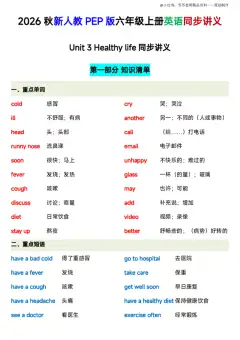
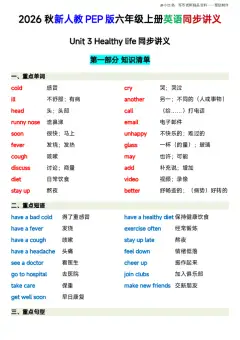
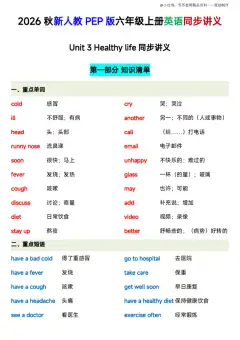
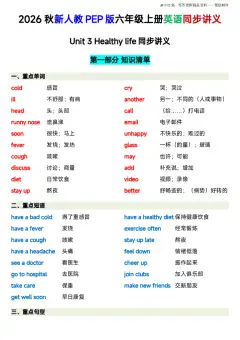
1.cold 感冒
2.ill 不舒服;有病
3.head 头;头部
4.runny nose 流鼻涕
5.soon 很快;马上
6.fever 发烧;发热
7.cough 咳嗽
8.discuss 讨论;商量
9.diet 日常饮食
10.stay up 熬夜
11.cry 哭;哭泣
12.another 另一;不同的(人或事物)
13.call (给……)打电话
14.email 电子邮件
15.unhappy 不快乐的;难过的
16.glass 一杯(的量);玻璃
17.may 也许;可能
18.add 补充说;增加
19.video 视频;录像
20.better 舒畅些的;(病势)好转的
重点短语
1.science museum 科学博物馆
2.have a bad cold 重感冒
3.have a runny nose 流鼻涕
4.see a doctor 看医生
5.take care 保重;小心
6.have a fever 发烧
7.have a cough 咳嗽
8.live a healthy life 过健康的生活
9.make video calls 打视频电话
核心句型
1.How do you feel?你感觉怎么样?
学科网(北京)股份有限公司
学科网(北京)股份有限公司
第46 页共60 页
2.I feel ill. My head hurts and I have a runny nose.我感觉不舒服。我头痛还流鼻涕。
3.I’m sorry to hear that. Maybe you should see a doctor.对此我感到难过。也许你应该看看医生。
4.How can we live a healthy life?我们怎样能过健康的生活?
5.We need to eat healthy food. We should exercise too.我们需要吃健康的食物。我们还需要运动。
6.Have a healthy diet.(保持)健康的饮食。
7.Don't stay up late.不要熬夜。
8.Think about happy things.想开心的事情。
9.Join clubs and teams.加入俱乐部和团队。
重难点突破
(一)询问身体状况的句型
【课文原句】
—How do you feel?你感觉怎么样?
—I feel ill. My head hurts and I have a runny nose.我感觉不舒服。我头痛还流鼻涕。
【句型结构】
问句:How do/does + 主语+ feel?
主语是第三人称单数(he/she/it/Tom 等)时,用does;其他人称用do。
答句:主语+ feel/feels + 形容词. 或主语+ have/has + 疾病名词.
也可以两种结合,比如原句的I feel ill. My head hurts and I have a runny nose.
【重点解析】
1. 核心单词与短语
feel:动词,意思是“感觉、觉得”,后面常接形容词,比如feel happy(感觉开心)、
feel tired(感觉累)。
ill:形容词,意思是“不舒服的、生病的”,口语里也可以用sick 表达同样的意思。
hurt:动词,意思是“(身体部位)疼痛”,常用结构是My + 身体部位+ hurts.,表示
“我…… 疼”。要注意,主语是单数(比如my head)时,动词要变成第三人称单数形
式hurts。
have a runny nose:固定短语,意思是“流鼻涕”。类似的表达还有have a cold(感冒)、
学科网(北京)股份有限公司
学科网(北京)股份有限公司
第47 页共60 页
have a fever(发烧)、have a cough(咳嗽)。
2. 语法要点
整个对话用的是一般现在时,用来描述当前的状态。
注意主谓一致:
How do you feel? 里主语是you,助动词用do。
My head hurts. 里主语my head 是单数,动词hurt 要变成hurts。
I have a runny nose. 里主语是I,动词用have;如果主语换成he/she,就要用has。
【例句】
①—How does she feel? 她感觉怎么样?
—She feels tired. 她感觉很累。
②—How do you feel today? 你今天感觉怎么样?
—I feel great! I don't have a headache anymore. 我感觉棒极了!我头不疼了。
进阶训练一
一、单项选择。
(
) 1.—How do you feel today?
—I feel ______.
A.sun
B.sad
C.rain
(
) 2.—How do you ______ now?
—I still feel ill.
A.do
B.feel
C.look
(
) 3.—How does he feel?
—______
A.He felt sad.
B.He doesn’t feel hungry.
C.He feels angry.
(
) 4.—How does the boy feel?
—He ______ thirsty and hungry.
A.feel
B.feeling
C.feels
学科网(北京)股份有限公司
学科网(北京)股份有限公司
第48 页共60 页
(
) 5.How does ______ feel?
A.your parents
B.Jenny
C.your friends
二、用所给单词的适当形式填空。
6.How
(do) Sarah feel?
7.How
(do) they feel?
8.—How
(do) your sister
(feel)?
—She
(feel) hungry.
9.How do you
(feel) today?
10.How
(do) your mum feel now?
(二)建议保持健康生活的祈使句
【课文原句】
1.Have a healthy diet.(保持)健康的饮食。
2.Don't stay up late.不要熬夜。
3.Think about happy things.想开心的事情。
4.Join clubs and teams.加入俱乐部和团队。
【句型结构】
肯定祈使句:动词原形+ 其他
否定祈使句:Don't + 动词原形+ 其他
【重点解析】
1. 短语与词汇解析:
have a healthy diet:固定搭配,意为“保持健康饮食”,diet 指日常饮食。
stay up late:固定短语,意为“熬夜”,stay up 表示“不睡觉、熬夜”。
think about:固定短语,意为“思考、考虑”,后面可接名词或代词。
join clubs and teams:意为“加入俱乐部和团队”,join 指加入某个组织或团体并成为其
中一员。
2. 语法要点
祈使句没有时态变化,无论对谁说话,都用动词原形。
否定形式中,Don't 后面必须接动词原形,不能加s 或其他变化。
多个动作并列时,都用动词原形,比如Come and see.
学科网(北京)股份有限公司
学科网(北京)股份有限公司
第49 页共60 页
【例句】
Drink more water every day. 每天多喝水。
Don't eat too much junk food. 不要吃太多垃圾食品。
进阶训练二
英汉互译。
1.Have a healthy diet. ____________________
2.Don't stay up late. ____________________
3.Exercise often. ____________________
4.Think about happy things. ____________________
5.Join clubs and teams. ____________________
6.Have fun with your friends and family. ____________________
7.每天多喝水。____________________
8.不要吃太多甜食。____________________
一、单项选择。
(
) 1.—How do you ________ now?
—I still feel ill.
A.do
B.feel
C.look
(
) 2.—Mum, I’m ill.
—________
A.You should go to school.
B.You should see a doctor.
C.You should take a deep breath.
(
) 3.—You are stronger than me. I want to be as strong as you!
—You should ________.
学科网(北京)股份有限公司
学科网(北京)股份有限公司
第50 页共60 页
A.study harder
B.wear warmer clothes
C.do more exercise
(
) 4.—Does Timmy have a ________ diet?
—Yes, he eats ________ food.
A.healthy; health
B.healthy; healthily
C.healthy; healthy
(
) 5.In a healthy diet, we should have __________ vegetables.
A.a lot of
B.a few
C.a little
二、连线题。
1.have a headache
a. 感冒
2.have a runny nose
b. 头痛
3.have a cold
c. 流鼻涕
4.have a fever
d. 咳嗽
5.have a cough
e. 发烧
三、用所给单词的适当形式填空。
1.My uncle
(have) a healthy life.
2.You should
(go) to the hospital. You have a fever.
3.She
(have) a fever.
4.How
he feel now? (do)
5.I don’t feel
(good). I am unhappy.
四、完形填空。
Everyone needs a healthy life. We
1
get up early and do sports. We
2
eat too
much junk food. It is bad
3
our body.
Last Sunday, I
4
to the park with my family. We ran and played games. We
5
a great day together.
(
) 1.A.should
B.can’t
C.won’t
(
) 2.A.always
B.never
C.often
(
) 3.A.to
B.for
C.with
(
) 4.A.go
B.goes
C.went
(
) 5.A.had
B.have
C.has
学科网(北京)股份有限公司
学科网(北京)股份有限公司
第51 页共60 页
五、阅读短文,选出最佳答案。
Health is more important than money and wisdom (智慧). Good health helps us enjoy our life
and get what we need. How can we stay healthy? Here is some helpful advice (建议).
(1) Eat more vegetables and fruit. They are full of vitamins (维生素). And they can help us
keep healthy and young.
(2) Keep a balanced diet and good eating habits. Eat less food with lots of sugar and fat. Eat
lots of food high in protein (蛋白质).
(3) Exercise every day. Doing sport can make our bodies strong.
(4) Learn to relax ourselves. Being too tired all the time may make us get sick easily.
(5) Give up bad habits, such as drinking and smoking.
In a word, if we do in this way, we’ll live a healthy life and get fit.
(
) 1.How much advice on how to stay healthy does the writer give us?
A.Three.
B.Four.
C.Five.
(
) 2.If your body needs vitamins, what should you eat?
A.More vegetables and fruit.
B.More milk and less meat.
C.More food and fish.
(
) 3.What does the underlined word “balanced” probably mean in Chinese?
A.美味的
B.均衡的
C.健康的
(
) 4.Why do we need to do sport?
A.Because it can make us tall.
B.Because it can make us slim.
C.Because it can make us strong.
(
) 5.Which of the following is the best title (标题)for the passage?
A.Healthy Diet.
B.How to Get Fit.
C.Doing More Exercise.
六、校广播站号召大家关注心理健康,保持乐观心态。阅读短文,选择正确的答案。
“I feel a bit ‘emo’.” Do you often hear people say this these days? “Emo” is short for
“emotional (有情绪的)”. It means someone has bad feelings such as anger, worry and sadness.
Everyone can feel emo sometimes. You may be sad when you fail your exam. You may feel
angry after quarrelling (争吵) with someone. When you are emo, you may want to cry. You may not
want to eat, speak or move. So, what can you do to feel better?
学科网(北京)股份有限公司
学科网(北京)股份有限公司
第52 页共60 页
·Paint your feelings with colours. Red is anger. Blue is sadness...
·Do exercise like jogging. It helps you relax.
·Hug (拥抱) your parents or your pets. They can make you feel safe and warm.
·Talk to others about how you feel.
·Eat sweet food and think of happy things.
(
) 1.If Jack is emo, he feels ______.
A.happy
B.worried
C.excited
(
) 2.We may feel emo when we ______.
A.win games
B.do well in exams
C.quarrel with our parents
(
) 3.Mary is emo. She should ______.
A.keep everything to herself (把一切都藏在心里)
B.paint her feelings on paper
C.think of bad things
(
) 4.______ makes us feel safe and warm.
A.Exercising
B.Eating candies
C.Hugging our pets
(
) 5.Why does the writer write this passage (文章)?
A.To help us know well about “emo”.
B.To teach us how to be emo.
C.To tell us what “emo” is.
学科网(北京)股份有限公司
学科网(北京)股份有限公司
第53 页共60 页
参考答案
进阶训练一:
1.B
2.B
3.C
4.C
5.B
6.does
7.do
8.does;feel;feels
9.feel
10.does
进阶训练二:
1.保持健康的饮食。
2.不要熬夜。
3.经常锻炼。
4.想开心的事情。
5.加入俱乐部和团队。
6.和你的朋友、家人一起开心玩耍。
7.Drink more water every day.
8.Don't eat too much sweet food.
知识演练场:
一、单项选择。
1.B
2.B
3.C
4.C
5.A
二、连线题。
1—b
2—c
3—a
4—e
5—d
三、用所给单词的适当形式填空。
1.has
2.go
3.has
4.does
5.well
四、完形填空。
1.A
2.B
3.B
4.C
5.A
五、阅读短文,选出最佳答案。
1.B
2.A
3.B
4.C
5.B
六、校广播站号召大家关注心理健康,保持乐观心态。阅读短文,选择正确的答案。
1.B
2.C
3.B
4.C
5.A
学科网(北京)股份有限公司
学科网(北京)股份有限公司
第54 页共60 页
人教PEP 版新六年级英语暑期预习课
Unit 3 Healthy life 语法易错+巩固练习
语法易错01
语法点拨:祈使句
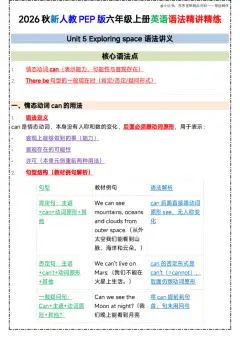
祈使句主要用来表达请求、命令、建议、叮嘱或祝愿等。祈使句通常省略主语(you)。
祈使句类型:祈使句三类型,Let,Do 型,还有be
类型
句型结构
例句
Do 型祈使句
动词原形+其他.
Hurry up! 快点。
Put your hand up to speak. 发言要举手。
Be 型祈使句
Be+形容词.
Be quiet.保持安静
Be a good boy.做个好孩子。
Let 型祈使句
Let's/Let me+动词原形+其他.
Let me help you.让我帮你。
Let’s play football.让我们一起踢足球吧。
否定祈使句:否定前面加don't, 想要客气please
类型
句型结构
例句
Do 型祈使句
Don't+动词原形+其他.
Don’t run in the class.不要在班里乱跑。
Be 型祈使句
Don't+be+形容词.
Don't be late for class. 不要上课迟到。
示例:
Open the door!→Don't open the door!
Close the window!→Don't close the window!
Be quiet!→Don't be quiet!
拓展:No 型祈使句
(1)No+动词-ing 形式+其他.
(2)No+名词+其他.
例句:No fishing. 禁止钓鱼
No photos. 禁止拍照;请勿拍照
学科网(北京)股份有限公司
学科网(北京)股份有限公司
第55 页共60 页
知识演练一
一、单项选择。
(
) 1.Don’t ________ TV too much.
A.watching
B.watches
C.watch
(
) 2.Have a good ________!
A.time
B.times
C.timed
(
) 3.Let’s ________ a travel plan.
A.make
B.makes
C.making
(
) 4.Please ________ your hands before meals. It’s a good habit and a family rule.
A.wash
B.washes
C.washing
D.to wash
(
) 5.________ cross the road when the light is red. It’s dangerous.
A.Don’t
B.Do
C.Must
二、句型转换。
6.Turn right. (改为否定祈使句)
__________ __________ right.
7.Don’t smoke here. (改为同义句)
No __________ here.
8.Cross the road at the zebra crossing. (改为否定句)
__________ __________ the road at the zebra crossing.
9.Please wait in line. (改为否定句)
__________ __________ in line.
10.Clean the classroom. (改为否定句)
__________ __________ the classroom.
语法易错02
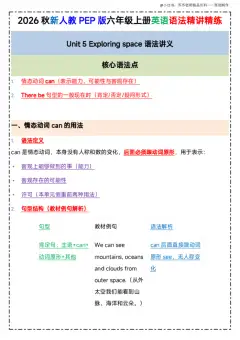
语法点拨:情态动词should 的用法
should 后面接动词原形,不受人称和数的变化影响,有should 的句子,改为否定句时,
学科网(北京)股份有限公司
学科网(北京)股份有限公司
第56 页共60 页
在should 后加not 即可;改为一般疑问句时,则将should 提前,首字母大写。
1.should 表示义务,意为“应该”。
例:We should help the old people. 我们应该帮助老人。
2.should 表示建议或劝告,意为“应该”。
例:(1) You should go and ask your teacher. 你应该去问问你的老师。
(2) You should give up smoking. 你应该戒烟。
3.should 表示推断,意为“应该;可能”。
例:They should have been there by now, I think. 我想现在他们应该已经到那儿了。
4.should 表示命令、要求或责备,强调主观看法。
例:You should clean your bedroom after you get up. 起床后你应该打扫你的卧室。
5.should 用于一般疑问句中,用于征求对方的意见,主语为“我”。
例:Should I open my eyes? 我可以睁眼了吗?
知识演练二
单项选择。
(
) 1.We ______ eat more vegetables to keep healthy.
A.should
B.shouldn’t
C.can’t
(
) 2.We ______ eat too much sweet food. It’s bad for our teeth.
A.should
B.shouldn’t
C.can
(
) 3.We ______ wait for the bus at the bus stop.
A.should
B.is
C.are
(
) 4.You ______ eat too much or go to bed too late. It’s bad for your health.
A.shouldn’t
B.should
C.would
(
) 5.We ______ think of others.
A.do
B.should
C.can
(
) 6.You’re tired. You ______ have a rest.
A.should
B.shouldn’t
C.can’t
(
) 7.If your family member is ill, you ______ try to make him happy.
A.should
B.will
C.did
(
) 8.Mary should ______ to the hospital.
学科网(北京)股份有限公司
学科网(北京)股份有限公司
第57 页共60 页
A.go
B.goes
C.going
(
) 9.We ______ eat too much junk food. It’s not good for our health.
A.should
B.shouldn’t
(
) 10.You have a cough. You______ eat ice creams.
A.should
B.should not
C.have to
一、单项选择。
(
) 1.—______ do you feel today?
—I am very well.
A.How
B.How many
C.How old
(
) 2.Sam is ill. He should ________ a doctor.
A.see
B.sees
C.to see
(
) 3.—How do you feel?
—______
A.It’s ten yuan.
B.I feel angry.
C.I’m eleven years old.
(
) 4.—How does Amy feel now?
—______
A.She is a nurse.
B.She likes dancing.
C.She is angry.
(
) 5.—You are sad. ______ the matter?
—My cat is ill.
A.How’s
B.Who’s
C.What’s
二、用所给单词的适当形式填空。
1.We should
(eat) healthy food.
2.Lily is ill. She should
(see) a doctor.
3.How
he feel now? (do)
4.How
Sam
(feel)?
学科网(北京)股份有限公司
学科网(北京)股份有限公司
第58 页共60 页
5.She
(have) a bad cold.
三、连词成句。
1.cold, bad, I, a, have (.)
2.do, how, you, feel (?)
3.should, you, do, exercises, more, (.)
4.I, tired, because, I, stayed, late, up, am, night, last (.)
5.I’m, to, hear, sorry, that (.)
四、根据情境,选择合适的选项补全对话。
A.I’m sorry to hear that.
B.Are you feeling tired now?
C.Why are you feeling sad now?
D.I feel sad.
E.Did you lose your new schoolbag?
A: Hello, Sam. How do you feel?
B: Hello, Amy. 1.
A: What’s the matter? 2.
B: No, I didn’t.
A: You helped your grandma yesterday. 3.
B: Yes, I am, but I was happy yesterday. I helped her clean the room.
A: 4.
B: Because there was a football game. My class won the game, but the goalkeeper bumped his legs.
He couldn’t walk.
A: 5.
Is he better now?
B: Yes, he is.
学科网(北京)股份有限公司
学科网(北京)股份有限公司
第59 页共60 页
五、阅读短文,完成下列任务。
Everyone wants to have a healthy body. But do you know how to keep in good health?
First, we must always have breakfast. It gives us energy(能量) for the morning. And it helps us
to have a good state(状态) to study and work.
Second, we should eat more fresh fruit and vegetables. And an apple a day keeps the doctor
away. Don’t eat too much meat, sugar or junk food. Junk food, like hamburgers and hot dogs, is
delicious, but it has a lot of fat. Then, it will lead to(导致) many diseases(疾病).
Third, the body also needs exercise. What is exercise? Running, walking, jumping and playing
ball games are exercise. You should exercise three times a week.
Last but not least, have good habits(习惯). We should go to bed early and get up early, because
the body needs enough sleep. Don’t forget to wash hands before eating something. Brush your teeth
before breakfast and after dinner.
These are the secrets(秘密) of keeping healthy. If you can follow these suggestions (建议), I
believe you can have a healthy body and a better life.
1.阅读短文,判断下列句子正(T)误(F)。
(
) (1) Going to bed late at night will help you keep healthy.
(
) (2) We should exercise three times a week.
(
) (3) Junk food is good for our health.
(
) (4) The writer gives us four suggestions.
2.给这篇短文,选择正确的标题:______
A.Everyone wants to have a healthy body.
B.Suggestions for keeping healthy.
学科网(北京)股份有限公司
学科网(北京)股份有限公司
第60 页共60 页
参考答案
知识演练一:
1.C
2.A
3.A
4.A
5.A
6.Don’t;turn
7.smoking
8.Don’t;cross
9.Don’t;wait
10.Don’t;clean
知识演练二:
1.A
2.B
3.A
4.A
5.B
6.A
7.A
8.A
9.B
10.B
重难点特训:一、单项选择。
1.A
2.A
3.B
4.C
5.C
二、用所给单词的适当形式填空。
1.eat
2.see
3.does
4.does;feel
5.has
三、连词成句。
1.I have a bad cold.
2.How do you feel?
3.You should do more exercise.
4.I am tired because I stayed up late last night.
5.I’m sorry to hear that.
四、根据情境,选择合适的选项补全对话。
1.D
2.E
3.B
4.C
5.A
五、阅读短文,完成下列任务。
1.F
T
F
T
2.B