新六年级英语暑假衔接讲义
(PEP 版三年级起点)
━━━━━━━━━━━━━━━━━━━━━━━━━
第1 讲
一般现在时·三单复习
适用年级:新六年级(五升六)
教材版本:PEP 版(三年级起点)
内容说明:本讲复习一般现在时的基本用法和第三人称单数变化规
则
第1 讲
一般现在时·三单复习
Part 1
知识讲解
一、什么是一般现在时?
一般现在时(Simple Present Tense)表示经常发生的动作、习惯或客观
事实。
常见的标志词:
• always(总是)• usually(通常)• often(经常)• sometimes
(有时)• every day / every week
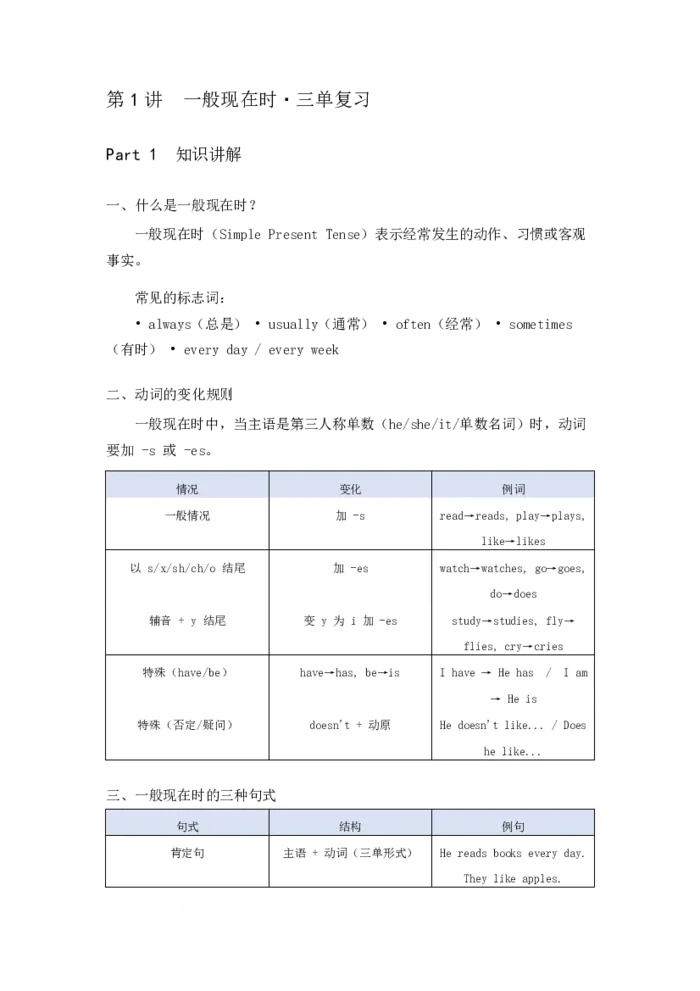
二、动词的变化规则
一般现在时中,当主语是第三人称单数(he/she/it/单数名词)时,动词
要加-s 或-es。
情况
变化
例词
一般情况
加-s
read→reads, play→plays,
like→likes
以s/x/sh/ch/o 结尾
加-es
watch→watches, go→goes,
do→does
辅音+ y 结尾
变y 为i 加-es
study→studies, fly→
flies, cry→cries
特殊(have/be)
have→has, be→is
I have →He has
/
I am
→He is
特殊(否定/疑问)
doesn't + 动原
He doesn't like... / Does
he like...
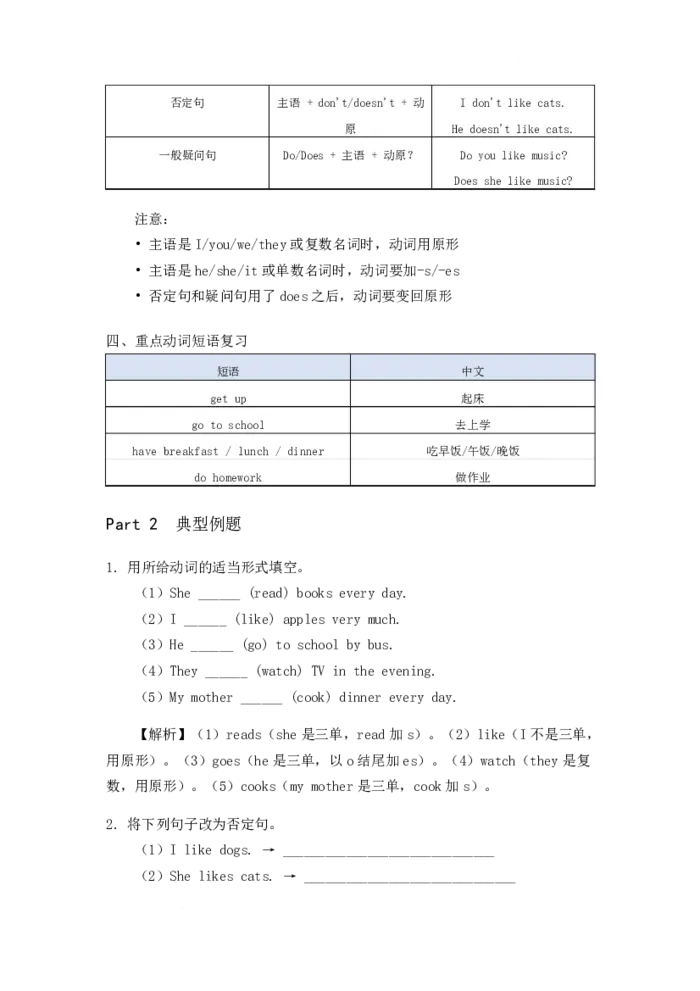
三、一般现在时的三种句式
句式
结构
例句
肯定句
主语+ 动词(三单形式)
He reads books every day.
They like apples.
否定句
主语+ don't/doesn't + 动
I don't like cats.
原
He doesn't like cats.
一般疑问句
Do/Does + 主语+ 动原?
Do you like music?
Does she like music?
注意:
• 主语是I/you/we/they 或复数名词时,动词用原形
• 主语是he/she/it 或单数名词时,动词要加-s/-es
• 否定句和疑问句用了does 之后,动词要变回原形
四、重点动词短语复习
短语
中文
get up
起床
go to school
去上学
have breakfast / lunch / dinner
吃早饭/午饭/晚饭
do homework
做作业
Part 2
典型例题
1. 用所给动词的适当形式填空。
(1)She ______ (read) books every day.
(2)I ______ (like) apples very much.
(3)He ______ (go) to school by bus.
(4)They ______ (watch) TV in the evening.
(5)My mother ______ (cook) dinner every day.
【解析】(1)reads(she 是三单,read 加s)。(2)like(I 不是三单,
用原形)。(3)goes(he 是三单,以o 结尾加es)。(4)watch(they 是复
数,用原形)。(5)cooks(my mother 是三单,cook 加s)。
2. 将下列句子改为否定句。
(1)I like dogs. →______________________________
(2)She likes cats. →______________________________
【解析】(1)I don't like dogs.(主语非三单,用don't)(2)She
doesn't like cats.(主语三单,用doesn't,likes 恢复原形like)
3. 将下列句子改为一般疑问句。
(1)You like English. →______________________________
(2)He plays football. →______________________________
【解析】(1)Do you like English?(主语非三单,用Do)(2)Does
he play football?(主语三单,用Does,plays 恢复play)
Part 3
基础练习
1. 写出下列动词的第三人称单数形式。
(1)read →______
(2)play →______
(3)go →______
(4)watch →______
(5)study →______
(6)fly →______
(7)have →______
(8)do →______
(9)like →______
(10)cook →______
2. 用所给动词的正确形式填空。
(1)I ______ (get) up at 7:00 every morning.
(2)She ______ (go) to school by bike.
(3)My father ______ (work) in a hospital.
(4)They ______ (play) football on Sundays.
(5)He ______ (study) English every evening.
(6)We ______ (have) lunch at school.
(7)Tom ______ (like) swimming.
(8)The cat ______ (sleep) on the sofa.
3. 用do 或does 填空。
(1)______ you like apples?
(2)______ he go to school by bus?
(3)______ they play football?
(4)______ she read books every day?
(5)______ your mother cook dinner?
Part 4
提高练习
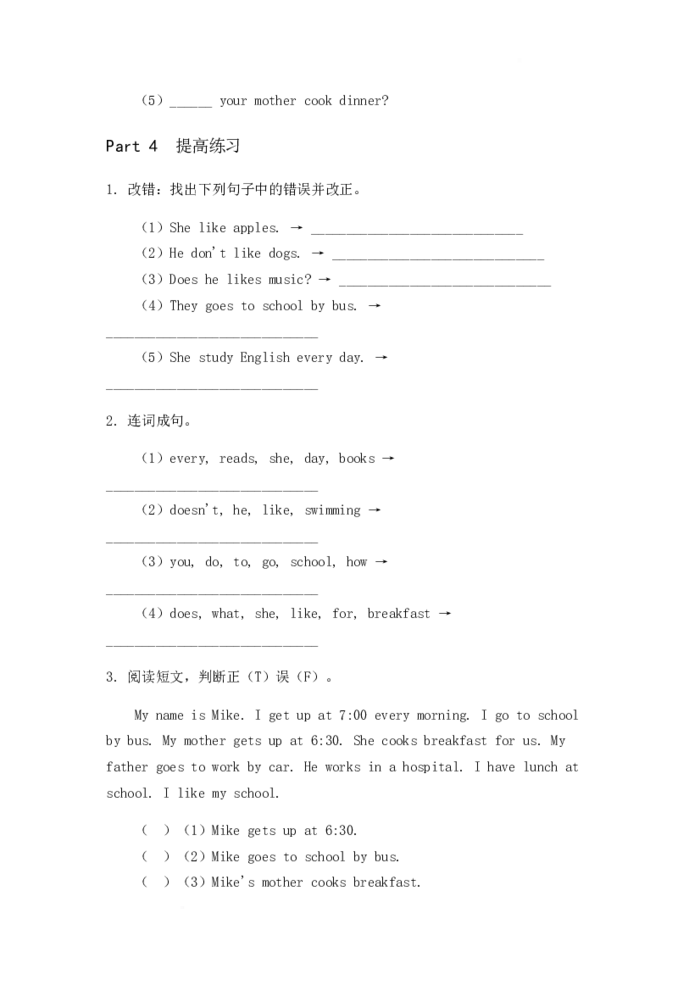
1. 改错:找出下列句子中的错误并改正。
(1)She like apples. →______________________________
(2)He don't like dogs. →______________________________
(3)Does he likes music? →______________________________
(4)They goes to school by bus. →
______________________________
(5)She study English every day. →
______________________________
2. 连词成句。
(1)every, reads, she, day, books →
______________________________
(2)doesn't, he, like, swimming →
______________________________
(3)you, do, to, go, school, how →
______________________________
(4)does, what, she, like, for, breakfast →
______________________________
3. 阅读短文,判断正(T)误(F)。
My name is Mike. I get up at 7:00 every morning. I go to school
by bus. My mother gets up at 6:30. She cooks breakfast for us. My
father goes to work by car. He works in a hospital. I have lunch at
school. I like my school.
(
)(1)Mike gets up at 6:30.
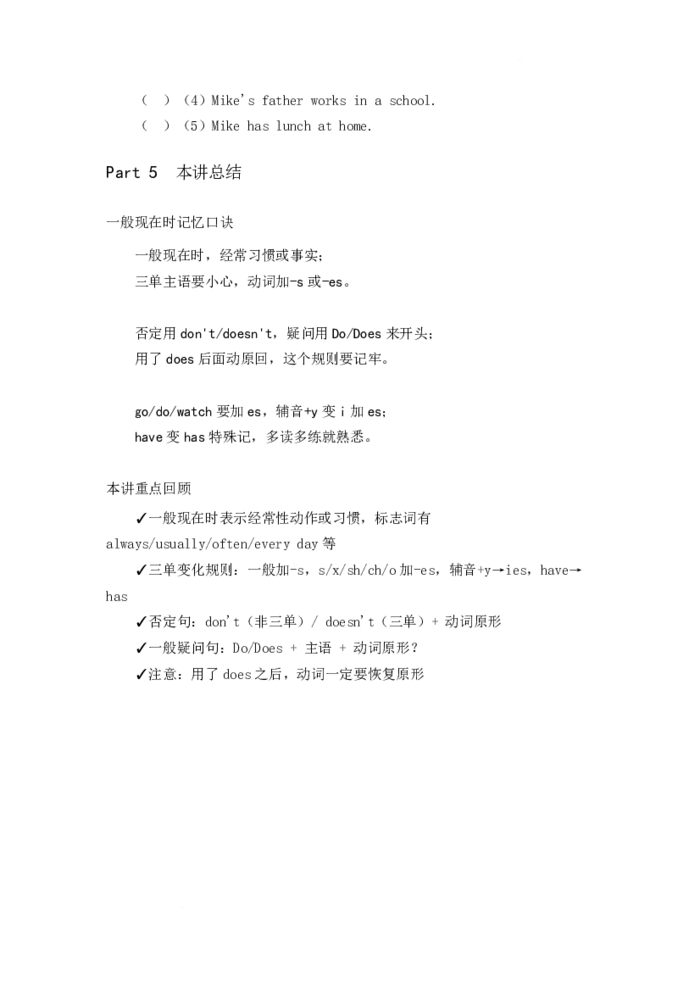
(
)(2)Mike goes to school by bus.
(
)(3)Mike's mother cooks breakfast.
(
)(4)Mike's father works in a school.
(
)(5)Mike has lunch at home.
Part 5
本讲总结
一般现在时记忆口诀
一般现在时,经常习惯或事实;
三单主语要小心,动词加-s 或-es。
否定用don't/doesn't,疑问用Do/Does 来开头;
用了does 后面动原回,这个规则要记牢。
go/do/watch 要加es,辅音+y 变i 加es;
have 变has 特殊记,多读多练就熟悉。
本讲重点回顾
✓一般现在时表示经常性动作或习惯,标志词有
always/usually/often/every day 等
✓三单变化规则:一般加-s,s/x/sh/ch/o 加-es,辅音+y→ies,have→
has
✓否定句:don't(非三单)/ doesn't(三单)+ 动词原形
✓一般疑问句:Do/Does + 主语+ 动词原形?
✓注意:用了does 之后,动词一定要恢复原形
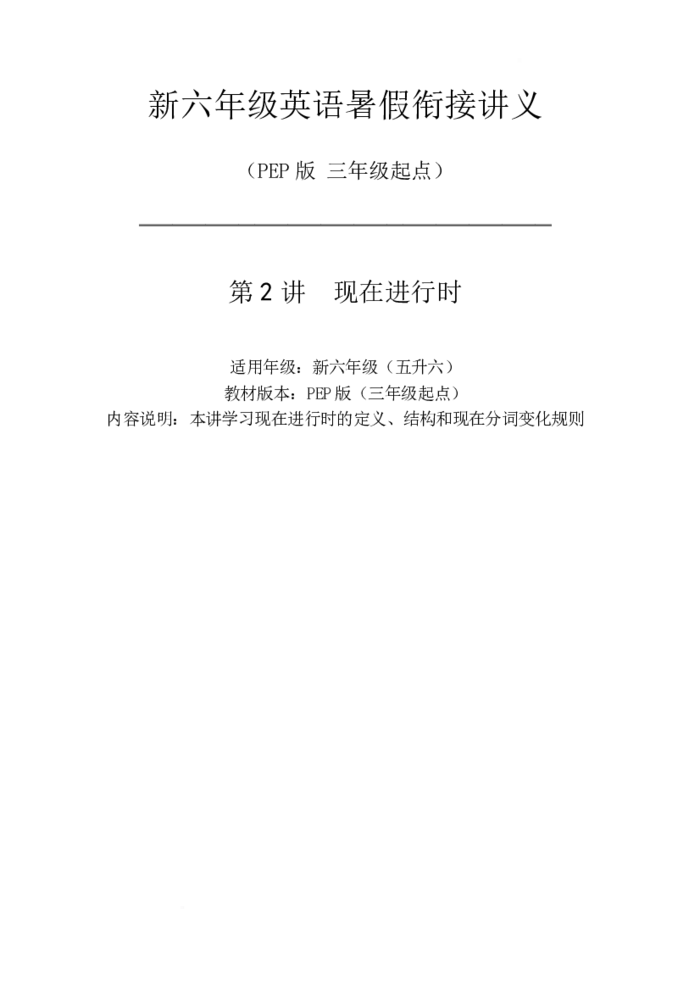
新六年级英语暑假衔接讲义
(PEP 版三年级起点)
━━━━━━━━━━━━━━━━━━━━━━━━━
第2 讲
现在进行时
适用年级:新六年级(五升六)
教材版本:PEP 版(三年级起点)
内容说明:本讲学习现在进行时的定义、结构和现在分词变化规则
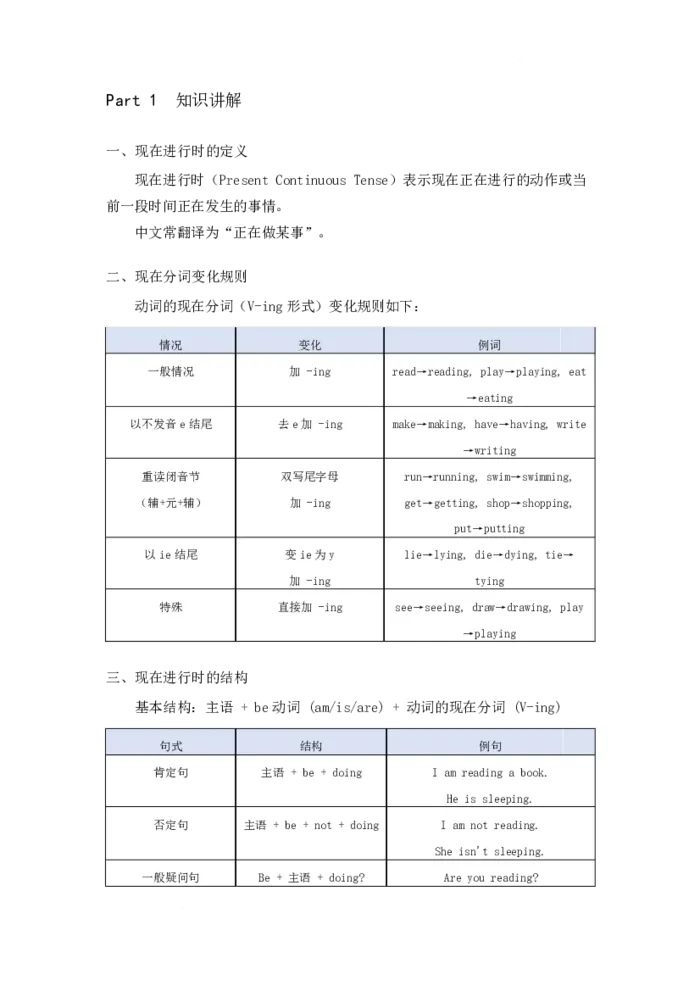
Part 1
知识讲解
一、现在进行时的定义
现在进行时(Present Continuous Tense)表示现在正在进行的动作或当
前一段时间正在发生的事情。
中文常翻译为“正在做某事”。
二、现在分词变化规则
动词的现在分词(V-ing 形式)变化规则如下:
情况
变化
例词
一般情况
加-ing
read→reading, play→playing, eat
→eating
以不发音e 结尾
去e 加-ing
make→making, have→having, write
→writing
重读闭音节
双写尾字母
run→running, swim→swimming,
(辅+元+辅)
加-ing
get→getting, shop→shopping,
put→putting
以ie 结尾
变ie 为y
lie→lying, die→dying, tie→
加-ing
tying
特殊
直接加-ing
see→seeing, draw→drawing, play
→playing
三、现在进行时的结构
基本结构:主语+ be 动词(am/is/are) + 动词的现在分词(V-ing)
句式
结构
例句
肯定句
主语+ be + doing
I am reading a book.
He is sleeping.
否定句
主语+ be + not + doing
I am not reading.
She isn't sleeping.
一般疑问句
Be + 主语+ doing?
Are you reading?
Is he sleeping?
四、be 动词的选择
be 动词随主语变化:
I →am
he / she / it →is
we / you / they →are
五、常见标志词
现在进行时的常见标志词有:
now(现在)
look(看——提醒注意正在发生的事情)
listen(听——提醒注意正在发生的声音)
at the moment(此刻)
It's ... o'clock(现在是几点了)
Part 2
典型例题
一、用所给词的适当形式填空
1. Listen! The girl ______ (sing) in the room.
2. Look! They ______ (play) football.
3. It's 6 o'clock now. I ______ (have) breakfast.
4. My mother ______ (cook) in the kitchen.
5. The boys ______ (swim) in the pool.
解析:以上题目中都有标志词(Listen, Look, It's ... o'clock, now),
提示我们使用现在进行时。注意be 动词要根据主语变化。
二、句型转换
1. I read books every day. (改为现在进行时,把every day 改为now)
_______________________________________________
2. He is watching TV. (改为否定句)
_______________________________________________
3. They are playing basketball. (改为一般疑问句,并作肯定回答)
_______________________________________________
解析:第1 题要先变主语+be+doing 结构;第2 题在be 后加not;第3 题
将be 提到主语前,肯定回答用Yes, 主语+be。
三、改错
1. He is read a book now.
改正:_________________________________________
2. She are singing.
改正:_________________________________________
3. Look! The cat are sleeping.
改正:_________________________________________
解析:现在进行时中动词必须用ing 形式(第1 题);be 动词要和主语保
持一致(第2、3 题)。
Part 3
基础练习
一、写出下列动词的现在分词形式
例:read →reading
1. cook →__________
2. make →__________
3. write →__________
4. run →__________
5. swim →__________
6. get →__________
7. see →__________
8. have →__________
9. shop →__________
10. eat →__________
二、用am / is / are 填空
1. I ______ reading a book.
2. She ______ cooking dinner.
3. We ______ playing games.
4. They ______ sleeping.
5. He ______ writing a letter.
三、用所给词的正确形式填空
1. Look! The birds ______ (fly) in the sky.
2. Listen! Tom ______ (sing) in the next room.
3. It's 7 o'clock now. We ______ (have) breakfast.
4. My sister ______ (draw) a picture now.
Part 4
提高练习
一、连词成句
1. is / she / now / what / doing / ?
_______________________________________________
2. are / playing / they / football / in / the / park
_______________________________________________
3. not / he / watching / is / TV
_______________________________________________
二、阅读短文,判断正(T)误(F)
It's Sunday morning. The Smith family are at home. Mr. Smith is
reading a newspaper. Mrs. Smith is cooking in the kitchen. Tom is
doing his homework. His sister Lily is drawing a picture. The cat is
sleeping on the sofa. They are all busy.
1. The Smith family are in the park. ______
2. Mr. Smith is reading a book. ______
3. Mrs. Smith is cooking. ______
4. Tom is watching TV. ______
5. Lily is drawing a picture. ______
三、看图写话(根据提示写出句子)
提示:在公园里,大家都在做什么?
1. a boy / fly a kite
_______________________________________________
2. two girls / read books
_______________________________________________
3. an old man / walk a dog
_______________________________________________
Part 5
本讲总结
记忆口诀
现在进行时,动作正进行;
now look listen 是标志,be 加doing 要记清。
动词ing 有变化,直接加ing 最常见;
去e 双写不算难,特殊变化记心间。
肯定句主语加be 加doing,
否定句be 后加not,
疑问句be 放句首,
be 随主语变形式。
本讲重点回顾
✓现在进行时表示正在进行的动作,标志词有now / look / listen 等
✓结构:主语+ be (am/is/are) + doing
✓现在分词变化规则:一般加ing,去e 加ing,双写尾字母加ing
✓否定句在be 后加not,一般疑问句将be 提到主语前
✓注意be 动词与主语保持一致(I 用am,he/she/it 用is,we/you/they
用are)
新六年级英语暑假衔接讲义
(PEP 版三年级起点)
━━━━━━━━━━━━━━━━━━━━━━━━━
第3 讲
There be 句型
适用年级:新六年级(五升六)
教材版本:PEP 版(三年级起点)
内容说明:本讲学习There be 句型的基本结构、就近原则及与
have 的区别
Part 1
知识讲解
一、There be 句型的定义
There be 句型表示“某地有某物”或“存在某物”,表示“存在”的概念。
基本结构:There + be + 名词+ 地点状语
二、be 动词的选择
There be 句型中be 动词用is 还是are,取决于后面的名词。
情况
be 动词
示例
可数名词单数/
is
There is a book on the
不可数名词
desk.
There is some water in
the cup.
可数名词复数
are
There are two pens in the
pencil box.
多个名词并列
就近原则
There is a pen and two
(看最近的名词)
books...
There are two books and a
pen...
三、句式结构
句式
结构
例句
肯定句
There is/are...
There is a cat under the
table.
否定句
There isn't/aren't...
There isn't a cat under
the table.
一般疑问句
Is/Are there...?
Is there a cat under the
table?
四、There be 与have/has 的区别
There be 表示“某地存在某物”,强调存在。
have/has 表示“某人拥有某物”,强调所属关系。
比较:
There is a book on the desk.(桌上有一本书。——强调存在)
I have a book.(我有一本书。——强调拥有)
Part 2
典型例题
一、用is/are 填空
1. There ______ a book on the desk.
2. There ______ two apples on the table.
3. There ______ some milk in the glass.
4. There ______ a pen and three pencils in the box.
5. ______ there any water in the cup?
解析:第1 题book 是单数用is;第2 题two apples 是复数用are;第3
题milk 是不可数名词用is;第4 题就近原则,a pen 是单数用is;第5 题
water 不可数用Is。
二、句型转换
1. There is a cat under the chair. (改为否定句)
_______________________________________________
2. There are some books on the shelf. (改为一般疑问句)
_______________________________________________
3. There is a park near the school. (改为一般疑问句)
_______________________________________________
解析:否定句在be 后加not;一般疑问句将be 提到there 前,注意some
要变成any。
三、用there be 或have/has 填空
1. I ______ a new bike.
2. ______ a big playground in our school.
3. She ______ two brothers.
4. ______ some flowers in the garden.
解析:have/has 表示“拥有”,主语是人;there be 表示“存在”,主语
是地点。
Part 3
基础练习
一、用There be 的适当形式填空
1. ______ a pencil in the pencil box.
2. ______ many books on the shelf.
3. ______ some water in the bottle.
4. ______ a map on the wall.
5. ______ two cats under the bed.
二、按要求改写句子
1. There is a library in my school. (改为否定句)
_______________________________________________
2. There are some apples on the tree. (改为一般疑问句)
_______________________________________________
3. There is a bird in the tree. (对划线部分提问)
_______________________________________________
三、根据提示完成句子
看图片,用There be 句型完成句子。
1. There ______ a ______ in the picture. (床)
2. There ______ two ______ on the desk. (书)
3. There ______ a ______ near the window. (桌子)
Part 4
提高练习
一、改错
1. There have a pen on the desk.
改正:_________________________________________
2. There is two cats under the table.
改正:_________________________________________
3. There aren't some water in the cup.
改正:_________________________________________
4. Is there a book on the desk? — Yes, there's.
改正:_________________________________________
二、阅读短文,判断正(T)误(F)
This is my room. There is a bed near the window. There is a desk
next to the bed. There are some books on the desk. There is a chair
under the desk. There is a picture on the wall. I like my room.
1. There is a bed near the window. ______
2. There is a desk behind the bed. ______
3. There are some books on the desk. ______
4. There is a chair near the desk. ______
5. There is a map on the wall. ______
三、用There be 和所给词描述教室场景
1. 25 desks / in the classroom
_______________________________________________
2. a blackboard / on the wall
_______________________________________________
3. some flowers / on the teacher's desk
_______________________________________________
Part 5
本讲总结
记忆口诀
There be 句型有特点,主语跟在be 后面;
单数is 复数are,不可数名词用is 记心间。
多个主语并列时,就近原则要牢记;
否定be 后加not,疑问be 到句前去。
和have 用法不一样,have 表拥有there 表存在;
I have a book 我有书,There is a book 有本书。
本讲重点回顾
✓There be 表示"某地有某物",have/has 表示"某人拥有某物"
✓be 动词的选择:单数名词/不可数名词用is,复数名词用are
✓多个名词并列时遵循就近原则(看离be 最近的名词)
✓否定句在be 后加not,一般疑问句将be 提到there 前
✓some 在否定句和疑问句中变成any
✓There be 与have 的区别:there be 表存在,have 表拥有
新六年级英语暑假衔接讲义
(PEP 版三年级起点)
━━━━━━━━━━━━━━━━━━━━━━━━━
第4 讲
名词
适用年级:新六年级(五升六)
教材版本:PEP 版(三年级起点)
内容说明:本讲学习可数名词复数变化规则、不可数名词用法和名
词所有格
Part 1
知识讲解
一、名词的分类
名词分为可数名词和不可数名词。
可数名词:可以用数字计数的名词,有单数和复数形式。
不可数名词:不能用数字计数的名词,没有复数形式。
二、可数名词复数变化规则
情况
变化
例词
一般情况
加-s
book→books, pen→pens, cat→cats,
apple→apples
以s/x/sh/ch 结
加-es
bus→buses, box→boxes, watch→
尾
watches, brush→brushes
以辅音+y 结尾
变y 为i 加-es
baby→babies, party→parties, family
→families
以f/fe 结尾
变f/fe 为v 加-es
knife→knives, leaf→leaves, wolf→
wolves
以o 结尾
加-es(部分)
potato→potatoes, tomato→tomatoes,
hero→heroes
(注:photo→photos, piano→pianos)
不规则变化
特殊记忆
child→children, man→men, woman→
women,
foot→feet, tooth→teeth, mouse→
mice,
sheep→sheep, fish→fish, deer→deer
三、不可数名词
不可数名词没有复数形式,不能用a/an 修饰。表示数量时用some, much,
a little 等。
类别
例词
食物/饮料
water, milk, juice, tea, coffee, rice, bread, meat, fish,
chicken, beef, soup
其他
paper, music, homework, news, weather, information, money,
time, fun
不可数名词的量如何表达?
用some:some water(一些水)
用a piece of:a piece of paper(一张纸)
用a cup/glass of:a cup of tea(一杯茶)
四、名词所有格
名词所有格表示“......的”,有三种常见形式。
情况
变化
例句
有生命名词单数
加's
Tom's book, my mother's bag, the cat's
tail
有生命名词复数
加'
the students' classroom, my parents'
car
(不规则复数仍加's: the children's
room)
无生命名词
of 结构
the door of the room, the name of the
school
共同/分别所有
A and B's 或
Tom and Jerry's room(共同的)
A's and B's
Tom's and Jerry's rooms(各自的)
Part 2
典型例题
一、写出下列名词的复数形式
1. book →__________
2. box →__________
3. baby →__________
4. knife →__________
5. potato →__________
6. child →__________
7. foot →__________
8. sheep →__________
解析:注意特殊规则——box 加es,baby 变y 为i 加es,knife 变f 为v
加es,potato 加es,child/foot/sheep 不规则。
二、用所给词的正确形式填空
1. There are two ______ (box) on the desk.
2. Look at those ______ (child). They are playing.
3. I have two ______ (tooth).
4. How many ______ (sheep) are there on the farm?
5. I'd like some ______ (bread) and two ______ (egg).
解析:第4 题sheep 单复数同形;第5 题bread 不可数不变,egg 可数变
复数。
三、名词所有格填空
1. This is ______ (Tom) book.
2. ______ (my mother) bag is red.
3. The ______ (students) classroom is big.
4. ______ (Tom and Jerry) mother is a teacher. (共同所有)
解析:单数名词加's;复数名词以s 结尾加';共同所有在最后一个名词后
加's。
Part 3
基础练习
一、写出下列名词的复数形式
1. cat →__________
2. bus →__________
3. family →__________
4. knife →__________
5. tomato →__________
6. man →__________
7. child →__________
8. tooth →__________
9. sheep →__________
10. fish →__________
二、用所给词的正确形式填空
1. There are three ______ (box) in the room.
2. I like ______ (apple) very much.
3. Look! The ______ (child) are playing.
4. How many ______ (sheep) are there?
三、选择填空
1. This is ______ room.
A. Tom
B. Tom's
C. Toms'
2. ______ are on the desk.
A. Two book
B. Two books
C. Two bookes
3. I want some ______.
A. waters
B. water
C. waters'
Part 4
提高练习
一、改错
1. There are two boxs on the floor.
改正:_________________________________________
2. I have three childs.
改正:_________________________________________
3. This is Tom and Jerrys room.
改正:_________________________________________
4. There are many sheeps on the hill.
改正:_________________________________________
二、阅读短文,判断正(T)误(F)
Hello, I'm Amy. This is my bedroom. There are two beds in the
room. One is for me, and one is for my sister. There are some books
on the desk. Look at those photos on the wall. They are my family
photos. There are some apples and bananas on the table. I like fruit
very much.
1. There are two beds in the room. ______
2. There are some books under the desk. ______
3. There are family photos on the wall. ______
4. There are some oranges on the table. ______
5. Amy doesn't like fruit. ______
三、用所给词的正确形式填空(小短文)
I have a good friend. ______ (He) name is Mike. He has two ______
(sister). They are ______ (child). ______ (They) room is very nice.
There are many ______ (toy) in the room. I like ______ (play) with
them.
Part 5
本讲总结
记忆口诀
名词复数有规律,一般词尾加s;
s/x/sh/ch 加es,辅音+y 变ies。
f/fe 变v 加es,o 结尾多数加es;
不规则变化要牢记,child→children man→men。
不可数名词没有复数,不能用a/an 来修饰;
water/bread/rice 等,表示数量用some。
名词所有格,有生命加's;
无生命用of,共同所有最后一个加's。
本讲重点回顾
✓可数名词复数变化:一般+s,s/x/sh/ch+es,辅音+y→ies,f/fe→ves,
o 一般+es
✓不规则变化:child/children, man/men, woman/women, foot/feet,
tooth/teeth, sheep/sheep
✓不可数名词没有复数,不用a/an,用some/much 修饰
✓不可数名词的量:a piece of, a cup of, a glass of 等
✓名词所有格:有生命用's,无生命用of,共同所有在最后一个加's
新六年级英语暑假衔接讲义
(PEP 版三年级起点)
━━━━━━━━━━━━━━━━━━━━━━━━━
第5 讲
代词
适用年级:新六年级(五升六)
教材版本:PEP 版(三年级起点)
内容说明:本讲学习人称代词的主格与宾格、形容词性与名词性物
主代词
Part 1
知识讲解
一、人称代词(主格和宾格)
人称代词分为主格和宾格。主格作主语(动作的发出者),宾格作宾语
(动作的承受者)。
数
人称
主格
宾格
(作主语)
(作宾语)
单数
第一人称
I
me
第二人称
you
you
第三人称
he / she / it
him / her / it
复数
第一人称
we
us
第二人称
you
you
第三人称
they
them
例:
I like English. (I 作主语)
Please help me. (me 作宾语)
She is my friend. (She 作主语)
Give it to her. (her 作宾语)
二、物主代词(形容词性和名词性)
物主代词表示“......的”,分为形容词性物主代词(后加名词)和名词
性物主代词(单独使用)。
数
人称
形容词性
名词性
例句
(+名词)
(单独用)
单数
第一人称
my
mine
This is my
pen. = This is
mine.
第二人称
your
yours
Is this your
book? = Is
this yours?
第三人称
his / her /
his / hers /
It's his bag.
its
its
= It's his.
复数
第一人称
our
ours
This is our
classroom.
第二人称
your
yours
Your school is
big.
第三人称
their
theirs
That is their
dog.
记忆小窍门:形容词性物主代词+ 名词= 名词性物主代词
my book = mine
your pen = yours
her bag = hers
三、指示代词
指示代词用来“指”人或事物。
近指(这儿)
远指(那儿)
单数
this(这个)
that(那个)
复数
these(这些)
those(那些)
例:
This is my book. (近处的书)
That is your bag. (远处的包)
These are my friends. (近处的朋友们)
Those are his toys. (远处的玩具们)
Part 2
典型例题
一、用所给代词的正确形式填空
1. ______ (I) am a student. ______ (I) teacher is Ms. Wang.
2. This is ______ (he) book. Give it to ______ (he).
3. ______ (they) are my friends. ______ (they) names are Tom and Mike.
4. This is not my pen. ______ (I) is on the desk.
解析:注意区分主格(作主语)、宾格(作宾语)和物主代词(表
“......的”)。
二、选择题
1. ______ is my sister. (This / These)
2. ______ are my books. (That / Those)
3. Look at ______ boys over there. (that / those)
4. ______ apples are red. (This / These)
解析:单数用this/that,复数用these/those;近处用this/these,远
处用that/those。
三、改错
1. This is I book.
改正:_________________________________________
2. That pen is my.
改正:_________________________________________
3. She likes I.
改正:_________________________________________
解析:第1 题“我的书”用形容词性物主代词my;第2 题单独用应用名词
性物主代词mine;第3 题“喜欢我”中“我”作宾语用me。
Part 3
基础练习
一、写出对应形式
1. I(宾格)→__________
2. he(宾格)→__________
3. she(宾格)→__________
4. they(宾格)→__________
5. we(宾格)→__________
6. you(宾格)→__________
二、用适当的代词填空
1. ______ am a teacher. (I / Me / My)
2. This is ______ book. (I / me / my)
3. Please help ______. (he / him / his)
4. ______ is a good student. (Her / She / Hers)
5. This pen is not mine. ______ is on the desk. (My / Mine / I)
6. ______ are my friends. (Their / Them / They)
7. Look at ______. (they / them / their)
三、用this / that / these / those 填空
1. ______ is my pen near here.
2. ______ are my books. (近处)
3. ______ is a car over there.
4. ______ are his friends over there.
Part 4
提高练习
一、用括号内代词的正确形式填空
1. ______ (I) have a cat. ______ (It) name is Mimi.
2. ______ (They) are in the classroom. ______ (They) teacher is Mr.
Li.
3. This is ______ (you) book.
4. That is not ______ (she) bag. ______ (She) is on the desk.
5. ______ (We) like ______ (they) very much.
二、翻译句子
1. 这是我的书。那是他的。
_______________________________________________
2. 这些是我们的教室。那些是他们的。
_______________________________________________
3. 她喜欢他,但他不喜欢她。
_______________________________________________
三、选择填空
1. ______ pen is red, and ______ is blue.
A. My; her
B. Mine; hers
C. My; hers
2. Please give ______ the book.
A. I
B. my
C. me
3. ______ are my friends. I like ______ very much.
A. They; they
B. Them; them
C. They; them
Part 5
本讲总结
记忆口诀
人称代词分主宾,主格做主宾格跟;
I/you/he/she/it 作主语,me/you/him/her/it 作宾语。
物主代词分两种,形容词性后加名词;
名词性单独用,my 变mine your 变yours。
this/these 是近指,that/those 是远指;
单数this/that,复数these/those。
本讲重点回顾
✓人称代词主格(作主语):I, you, he, she, it, we, they
✓人称代词宾格(作宾语):me, you, him, her, it, us, them
✓形容词性物主代词(+名词):my, your, his, her, its, our, their
✓名词性物主代词(单独用):mine, yours, his, hers, its, ours,
theirs
✓指示代词:this(近单)/ these(近复)/ that(远单)/ those(远
复)
✓形容词性物主代词+ 名词= 名词性物主代词(my book = mine)
新六年级英语暑假衔接讲义
(PEP 版三年级起点)
━━━━━━━━━━━━━━━━━━━━━━━━━
第六讲
情态动词
适用年级:新六年级(五升六)
教材版本:PEP 版(三年级起点)
内容说明:本讲学习情态动词can 的用法,表示能力和许可
Part 1
知识讲解
一、can 表示能力(能、会)
can 是英语中最常用的情态动词之一,表示能力,意思是"能、会"。例如:
I can swim. (我会游泳。)
She can dance. (她会跳舞。)
使用can 时有两个重要规则:
1. can 没有人称和数的变化。不管主语是I、you、he 还是she,can 的写
法不变。要说"He can...",不能说"He cans..."。
2. can 后面必须跟动词原形。can 和动词之间不能加to,也不能加-ing。
二、句式结构
句式
结构
例句
肯定句
主语+ can + 动词原形
I can swim.
She can dance.
否定句
主语+ can't + 动词原形
I can't swim.
He can't sing.
一般疑问句
Can + 主语+ 动词原形?
Can you swim?
Can she dance?
三、can 的其他用法
1. 表示请求许可:Can I...? (我可以……吗?)
Can I go to the bathroom? (我可以去洗手间吗?)
2. 表示请求帮助:Can you...? (你能……吗?)
Can you help me? (你能帮我吗?)
Part 2
典型例题
1. 用can 或can't 填空。
(1) Birds ______ fly.
(2) Fish ______ fly.
(3) I ______ speak English.
(4) She ______ swim. She is afraid of water.
(5) ______ you play the piano?
2. 句型转换。
(1) I can cook. (改为否定句)
___________________________
(2) He can play football. (改为一般疑问句并肯定回答)
___________________________
(3) They can sing English songs. (对划线部分提问)
___________________________
3. 选择题。
(1) She ______ speak Chinese well.
A. can
B. cans
C. can to
(2) ______ you help me?
A. Can
B. Are
C. Do
(3) He ______ swim.
A. can't
B. can not
C. A and B
Part 3
基础练习
1. 在横线上填入can 或can't。
(1) A bird ______ fly. But a rabbit ______ fly.
(2) I ______ play basketball. I like it.
(3) She is only 2. She ______ read.
(4) ______ I open the window? It's hot.
2. 用所给词完成句子。
(1) I ______ (swim) very well.
(2) She ______ (dance) beautifully.
(3) They ______ (speak) English.
(4) He ______ (ride) a bike.
3. 根据实际情况回答。
(1) Can you swim?
___________________________
(2) Can your mother cook?
___________________________
(3) Can you speak English?
___________________________
Part 4
提高练习
1. 改错(找出错误并改正)。
(1) He cans play the guitar.
___________________________
(2) She can to swim.
___________________________
(3) I not can play football.
___________________________
(4) Can he sings?
___________________________
2. 连词成句。
(1) can, I, help, you?
___________________________
(2) can't, he, play, piano, the
___________________________
(3) what, do, you, can?
___________________________
3. 阅读短文,判断正(T)误(F)。
Hello, I'm Tom. I'm 10 years old. I can swim and play basketball.
But I can't play football. My sister Lily can dance and sing. She can
play the piano too. My father can cook very well. My mother can speak
English and Chinese. We are a happy family.
(1) Tom can swim.
(2) Tom can play football.
(3) Lily can dance and sing.
(4) Tom's father can cook.
(5) Tom's mother can speak three languages.
Part 5
本讲总结
情态动词can,能力许可它来管;
不管人称怎么变,can 后面动原站。
肯定句can 动词间,否定can 后not 添;
疑问句can 到句前,肯定回答Yes 主体can。
can't 要记牢,can not 缩写成can't;
Can I 表示请求,Can you 表示拜托。
本讲重点回顾
✓can 表示能力(能/会)和许可(可以)
✓can + 动词原形,没有人称和数的变化
✓否定句:主语+ can't + 动词原形
✓一般疑问句:Can + 主语+ 动词原形?
✓肯定回答:Yes, 主语+ can.
否定回答:No, 主语+ can't.
新六年级英语暑假衔接讲义
(PEP 版三年级起点)
━━━━━━━━━━━━━━━━━━━━━━━━━
第七讲
一般将来时(be going to)
适用年级:新六年级(五升六)
教材版本:PEP 版(三年级起点)
内容说明:本讲学习一般将来时be going to 结构,表示计划和预
测
Part 1
知识讲解
一、定义
一般将来时表示将来某个时间要发生的动作或存在的状态。be going to
结构用来表达事先计划好的打算或根据已有迹象预测将要发生的事情。
二、标志词
一般将来时常见的标志词(时间状语)有:
tomorrow(明天), next week(下周), next month(下个月), next
year(明年), this weekend(这个周末), tonight(今晚), soon(很快),
in the future(在未来)
三、句式结构
句式
结构
例句
肯定句
主语+ be + going to + 动
I am going to visit my
词原形
grandma.
She is going to buy a
book.
否定句
主语+ be + not + going
I am not going to
to + 动词原形
visit...
She isn't going to buy...
一般疑问句
Be + 主语+ going to + 动
Are you going to
词原形?
visit...?
Is she going to buy...?
四、be going to 与will 的区别(简单了解)
be going to 多表示事先计划好的事情。例如:I am going to visit my
grandma this weekend.(这周末我打算去看奶奶。)
will 多表示临时决定的事情或纯粹预测。例如:I will help you.(我来
帮你。——临时决定)
Part 2
典型例题
1. 用be going to 的适当形式填空。
(1) I ______ (visit) my grandparents this weekend.
(2) She ______ (buy) a new dress tomorrow.
(3) We ______ (have) a party next week.
(4) They ______ (not play) football tomorrow.
(5) ______ you ______ (do) your homework tonight?
2. 句型转换。
(1) I am going to watch TV. (改为否定句)
___________________________
(2) She is going to sing a song. (改为一般疑问句)
___________________________
(3) They are going to play basketball. (对划线部分提问)
___________________________
3. 选择题。
(1) I ______ going to read a book.
A. am
B. is
C. are
(2) She ______ going to visit the museum.
A. am
B. is
C. are
(3) They ______ going to swim.
A. am
B. is
C. are
Part 3
基础练习
1. 用am/is/are going to 填空。
(1) I ______ play football this afternoon.
(2) She ______ visit her aunt next Sunday.
(3) We ______ have a test tomorrow.
(4) They ______ watch a movie tonight.
(5) He ______ not do his homework.
2. 用所给词完成句子。
(1) I ______ (go) to Beijing next week.
(2) She ______ (buy) some books tomorrow.
(3) We ______ (have) a picnic this weekend.
(4) They ______ (not play) games tonight.
3. 连词成句。
(1) going, I, am, to, read, a, book
___________________________
(2) she, is, going, buy, to, what?
___________________________
(3) not, are, we, going, to, play
___________________________
Part 4
提高练习
1. 改错(找出错误并改正)。
(1) She is going to swims.
___________________________
(2) I am go to visit my grandma.
___________________________
(3) Are you going to the park?(提示:意思是"要去公园做某事"而不是"去
公园")
___________________________
(4) He not is going to play football.
___________________________
2. 阅读短文,判断正(T)误(F)。
Tomorrow is Saturday. I am going to get up late. In the morning,
I am going to do my homework. In the afternoon, I am going to play
basketball with my friends. My mother is going to go shopping. My
father is going to wash his car. We are going to have a big dinner in
the evening.
(1) Tomorrow is Sunday.
(2) I am going to get up early.
(3) I am going to play basketball in the afternoon.
(4) My mother is going to wash the car.
(5) We are going to have a big dinner.
3. 用be going to 描述你的周末计划(写3-5 句话)。
(1) ___________________________
(2) ___________________________
(3) ___________________________
(4) ___________________________
(5) ___________________________
Part 5
本讲总结
一般将来时,计划预测都可以;
标志词要记清,tomorrow next week 看仔细。
be going to 加动原,be 随主语变形式;
am/is/are 别用错,计划动作在后面。
否定be 后加not,疑问be 到主语前;
特殊疑问词在前,be 后主语紧相连。
本讲重点回顾
✓一般将来时表示计划或预测,标志词有tomorrow / next week / this
weekend 等
✓结构:主语+ be (am/is/are) + going to + 动词原形
✓否定句在be 后加not
✓一般疑问句将be 提到主语前
✓be going to 多表示计划好的事情,will 多表示临时决定
新六年级英语暑假衔接讲义
(PEP 版三年级起点)
━━━━━━━━━━━━━━━━━━━━━━━━━
第八讲
介词(时间、方位)
适用年级:新六年级(五升六)
教材版本:PEP 版(三年级起点)
内容说明:本讲学习常用时间介词和方位介词的用法
Part 1
知识讲解
一、方位介词
方位介词用来描述事物之间的位置关系。以下是常见的方位介词:
介词
含义
例句
in
在……里面
The pen is in the pencil
box.
on
在……上面(接触)
The book is on the desk.
under
在……下面
The cat is under the
table.
behind
在……后面
The boy is behind the
door.
in front of
在……前面
There is a tree in front
of the house.
next to
在……旁边
The library is next to
the school.
between
在……之间(两者)
The school is between the
park and the hospital.
near
在……附近
There is a park near my
home.
beside
在……旁边
Sit beside me.
二、时间介词
时间介词用来表示动作发生的时间。最常用的三个时间介词是at、in 和
on:
介词
用法
例句
at
具体时刻/ 夜晚/ 周末
at 7:00, at night, at the
weekend
in
年/ 月/ 季节/ 上午/
in 2024, in May, in
下午/ 晚上
summer, in the morning
on
具体某天/ 星期/ 日期
on Monday, on June 1st,
on my birthday
三、其他常用介词
除了方位介词和时间介词,还有一些常用的介词需要掌握:
with:和……一起
例:play with friends(和朋友一起玩)
for:为了……
例:go for a walk(去散步)
from...to...:从……到……
例:from Monday to Friday(从周一到周
五)
about:关于
例:talk about(谈论)
Part 2
典型例题
1. 用in / on / at 填空。
(1) I get up ______ 7:00.
(2) We have English class ______ Monday.
(3) My birthday is ______ May.
(4) I often read books ______ the evening.
(5) The party is ______ 6:30 ______ Friday.
2. 用方位介词(in / on / under / behind / next to)填空。
(1) The cat is ______ the box. (在里面)
(2) The book is ______ the desk. (在上面)
(3) The ball is ______ the chair. (在下面)
(4) The boy is ______ the door. (在后面)
3. 选择题。
(1) My mother goes to work ______ bus.
A. by
B. on
C. in
(2) I often play football ______ my friends.
A. and
B. with
C. for
(3) The shop is open ______ 9:00 ______ 6:00.
A. from; to
B. from; at
C. at; to
Part 3
基础练习
1. 看图填空(用方位介词in / on / under / behind)。
(1) The cat is ______ the box.
(2) The ball is ______ the desk.
(3) The dog is ______ the door.
2. 用in / on / at 填空。
(1) ______ Sunday
(2) ______ 8:30
(3) ______ July
(4) ______ the morning
(5) ______ night
3. 选择正确的介词。
(1) I go to school ______ (by / on) foot.
(2) She is good ______ (at / in) English.
(3) Thank you ______ (for / to) your help.
(4) The girl ______ (in / with) red is my sister.
Part 4
提高练习
1. 改错(找出错误并改正)。
(1) I go to school in bus.
___________________________
(2) We have PE class in Monday.
___________________________
(3) The cat is on the chair. (提示:猫在椅子下面)
___________________________
2. 阅读短文,判断正(T)误(F)。
This is my room. There is a desk near the bed. On the desk, there
is a computer and some books. My schoolbag is on the chair. There is
a cat under the desk. There is a picture on the wall. I like my room
very much.
(1) The desk is near the bed.
(2) There is a computer under the desk.
(3) The schoolbag is on the bed.
(4) There is a cat under the desk.
(5) There is a clock on the wall.
3. 根据中文提示完成句子。
(1) 我在早上6:30 起床。
I get up ______ 6:30 ______ the morning.
(2) 她和我一起去上学。
She goes to school ______ me.
(3) 图书馆在学校和公园之间。
The library is ______ the school ______ the park.
Part 5
本讲总结
时间介词in/on/at,at 时刻in 年月;
on 加星期和日期,固定搭配要记忆。
方位介词很重要,in 在里面on 上面;
under 下面behind 后,next to 旁边near 附近。
between...and 在中间,in front of 在……前;
by 乘车with 和人,for 为了of……的。
本讲重点回顾
✓时间介词:at + 时刻,in + 年/月/季节/上下午,on + 星期/日期
✓方位介词:in / on / under / behind / in front of / next to /
between / near
✓其他常用介词:by + 交通工具,with + 一起,for + 目的,
from...to...
✓注意固定搭配:on foot, be good at, thank you for, in + 颜色衣
服
新六年级英语暑假衔接讲义
(PEP 版三年级起点)
━━━━━━━━━━━━━━━━━━━━━━━━━
第九讲
特殊疑问句
适用年级:新六年级(五升六)
教材版本:PEP 版(三年级起点)
内容说明:本讲学习Wh-疑问词及特殊疑问句的构成和回答
Part 1
知识讲解
一、常见的特殊疑问词
特殊疑问句以疑问词开头,用来询问具体信息。常用的特殊疑问词有:
疑问词
含义
用法
what
什么
询问事物/事情
who
谁
询问人
where
哪里
询问地点
when
什么时候
询问时间
why
为什么
询问原因
which
哪一个
询问选择
whose
谁的
询问所属
how
怎样
询问方式/状态
二、how 的常用搭配
短语
含义/用法
how old
询问年龄
how many
询问可数名词数量
how much
询问不可数名词数量/价格
how long
询问时间长度
三、特殊疑问句的结构
特殊疑问句的结构是:特殊疑问词+ 一般疑问句(be/助动词/情态动词+
主语+ 其他)?
例如:
What do you like? (你喜欢什么?)
Where is she? (她在哪里?)
How old are you? (你多大了?)
四、What 的不同用法
what 后面可以跟名词,构成不同的疑问短语:
What colour:询问颜色
例:What colour is your bag?
What time:询问具体时间
例:What time do you get up?
What class / grade:询问班级/年级
例:What class are you in?
Part 2
典型例题
1. 对划线部分提问。
(1) My name is Tom. →______ is your name?
(2) She is 10 years old. →______ ______ is she?
(3) The book is on the desk. →______ is the book?
(4) I like apples. →______ do you like?
(5) He gets up at 7:00. →______ ______ does he get up?
2. 用合适的疑问词填空。
(1) ______ is that girl? (问人)
(2) ______ are you late? (问原因)
(3) ______ books do you have? (问数量)
(4) ______ is your birthday? (问时间)
3. 选择题。
(1) ______ is your English teacher?
A. Who
B. What
C. Where
(2) ______ do you go to school?
A. How
B. Where
C. When
(3) ______ apples do you want?
A. How many
B. How much
C. How
Part 3
基础练习
1. 写出下列疑问词的中文意思。
(1) what ______
(2) who ______
(3) where ______
(4) when
______
(5) why ______
(6) how ______
(7) whose ______
(8) which
______
2. 选词填空(what / who / where / when / why / how)。
(1) ______ is your best friend?
(2) ______ do you live?
(3) ______ do you like dogs? — Because they are cute.
(4) ______ is your favourite colour?
(5) ______ do you go to school? — By bus.
(6) ______ is Children's Day? — June 1st.
3. 对划线部分提问。
(1) I am 11 years old. →______ ______ are you?
(2) The pen is blue. →______ ______ is the pen?
(3) There are three books. →______ ______ books are there?
(4) My mother is a teacher. →______ is your mother?
Part 4
提高练习
1. 连词成句(特殊疑问句)。
(1) is, your, how, father?
___________________________
(2) do, what, like, you, breakfast, for?
___________________________
(3) she, where, does, live?
___________________________
2. 根据答句写出问句。
(1) Q: ___________________________
A: My name is Mike.
(2) Q: ___________________________
A: I am 12.
(3) Q: ___________________________
A: I like apples.
(4) Q: ___________________________
A: I go to school by bus.
3. 阅读回答问题。
Hello, I'm Sarah. I'm 11 years old. My favourite day is Saturday.
I get up at 8:00 on Saturday morning. I go to the park with my
parents. We fly kites there. I like the park because it's beautiful.
(1) How old is Sarah?
___________________________
(2) What is Sarah's favourite day?
___________________________
(3) What time does Sarah get up on Saturday?
___________________________
(4) Where does Sarah go on Saturday?
___________________________
(5) Why does Sarah like the park?
___________________________
Part 5
本讲总结
特殊疑问句,wh 词来开头;
what 问什么,who 问是谁人。
where 问地点,when 问时间;
why 问原因,how 问怎样。
how many 问数量,how much 问价钱;
how old 问年龄,how long 问多长。
结构要记牢:疑问词加一般疑问句;
回答不用yes/no,直接回答就最好。
本讲重点回顾
✓常见疑问词:what, who, where, when, why, which, whose, how
✓How 词组:how old / how many / how much / how long
✓特殊疑问句结构:疑问词+ 一般疑问句语序
✓回答时直接回答内容,不需要用yes/no
✓对不同成分提问要用对应的疑问词
新六年级英语暑假衔接讲义
(PEP 版三年级起点)
━━━━━━━━━━━━━━━━━━━━━━━━━
第10 讲
形容词与比较级
适用年级:新六年级(五升六)
教材版本:PEP 版(三年级起点)
内容说明:本讲学习形容词的用法及比较级的变化规则
Part 1
知识讲解
一、形容词的用法
形容词用来描述人或事物的特征,例如:big(大的)、small(小的)、
tall(高的)、short(矮的/短的)、beautiful(美丽的)等。
用法1:放在名词前作定语。例如:a big apple(一个大苹果)、a tall
boy(一个高个子男孩)。
用法2:放在be 动词后作表语。例如:The apple is big.(这个苹果很
大。)He is tall.(他很高。)
二、形容词比较级
比较级用于比较两个人或事物,标志词是than(比……)。
结构:A + be 动词+ 比较级+ than + B。
例如:Tom is taller than Jerry.(Tom 比Jerry 高。)My bag is
heavier than yours.(我的书包比你的重。)
三、比较级变化规则
情况
变化
例词
一般情况
加-er
tall→taller, small→
smaller, short→shorter
以e 结尾
加-r
nice→nicer, cute→cuter,
fine→finer
辅音+y 结尾
变y 为i 加-er
happy→happier, funny→
funnier, heavy→heavier
重读闭音节
双写尾字母
big→bigger, hot→hotter,
(辅元辅)
加-er
thin→thinner
多音节词
前面加more
beautiful→more beautiful
expensive→more expensive
不规则变化
特殊记
good/well→better
bad→worse
many/much→more
little→less
四、用比较级时的常用句型
1. A + be + 比较级+ than + B:A is taller than B.
2. My bag is heavier than yours.
3. Who is taller, Tom or Jerry?
Part 2
典型例题
1. 写出下列形容词的比较级。
(1)tall→______
(2)nice→______
(3)happy→______
(4)big→______
(5)good→______
2. 用所给词的正确形式填空。
(1)Tom is ______ (tall) than Jerry.
(2)My book is ______ (big) than yours.
(3)She is ______ (happy) than me.
(4)This cat is ______ (cute) than that one.
(5)This flower is ______ (beautiful) than that one.
3. 选择最佳答案。
(
)(1)I am ______ than my sister.
A. tall
B. taller
C. more tall
(
)(2)Who is ______, Tom or Mike?
A. tall
B. taller
C. tallest
(
)(3)This book is ______ than that one.
A. good
B. better
C. best
Part 3
基础练习
1. 写出下列形容词的比较级。
(1)tall→______
(2)short→______
(3)small→______
(4)big→
______
(5)hot→______
(6)nice→______
(7)happy→______
(8)heavy→______
(9)good
→______
(10)bad→______
2. 用所给词比较级填空。
(1)My sister is ______ (young) than me.
(2)Summer is ______ (hot) than spring.
(3)This pencil is ______ (long) than that one.
(4)The red apple is ______ (sweet) than the green one.
(5)I am ______ (tall) than my friend.
3. 根据提示完成句子。
(1)Tom / tall / Mike →Tom is taller than Mike.
(2)My bag / heavy / your bag →______
(3)This book / interesting / that book →______
(4)She / happy / he →______
Part 4
提高练习
1. 找出下列句子中的错误并改正。
(1)She is tall than me. →______
(2)This apple is bigger that that one. →______
(3)He is more tall than his brother. →______
(4)This book is gooder than that one. →______
2. 阅读短文,判断正(T)误(F)。
I have two friends, Tom and Jerry. Tom is 11 years old. Jerry is
10 years old. Tom is taller than Jerry. But Jerry is heavier than Tom.
Tom's bag is bigger than Jerry's. Jerry's shoes are newer than Tom's.
We often play together.
(
)(1)Tom is 11 and Jerry is 11 too.
(
)(2)Tom is taller than Jerry.
(
)(3)Tom is heavier than Jerry.
(
)(4)Tom's bag is bigger than Jerry's.
(
)(5)Jerry's shoes are newer than Tom's.
3. 用比较级描述你和你的好朋友,写3-5 个句子。
(1)I am ______ than ______.
(2)______
(3)______
(4)______
(5)______
Part 5
本讲总结
形容词比较级,两者比较要用它;
结构简单要记清,A 加be 加比较级加than 加B。
变化规则看词尾,一般词尾加er;
e 结尾加r,辅音y 改i 加er。
重读闭音双写加,多音节词more 在前;
不规则变化要牢记,good 变better bad 变worse。
本讲重点回顾
✓形容词比较级用于比较两个人或事物,结构:A + be + 比较级+ than
+ B
✓变化规则:一般+er,e 结尾+r,辅音+y 变i+er,重读闭音双写+er,
多音节前+more
✓不规则变化:good/well→better, bad→worse, many/much→more,
little→less
✓比较级的标志词是than,注意than 前后是比较的对象
新六年级英语暑假衔接讲义
(PEP 版三年级起点)
━━━━━━━━━━━━━━━━━━━━━━━━━
第11 讲
阅读理解专项
适用年级:新六年级(五升六)
教材版本:PEP 版(三年级起点)
内容说明:本讲通过主题阅读训练,提高阅读理解能力
Part 1
知识讲解
一、阅读理解技巧
技巧1:先读问题,带着问题读文章。这样可以帮助我们有目的地寻找答
案,提高阅读效率。
技巧2:找关键词定位答案。在题目中找到关键词(如人名、地名、数字
等),然后在文章中快速定位。
技巧3:注意细节,不要凭空想象。答案一定要在原文中找到依据,不能
根据自己的主观想法来选择。
技巧4:判断正误题要注意绝对词(always, never, all 等)。含有绝对
词的选项通常需要仔细辨别。
二、常见题型
1. 判断正误(T/F):根据文章内容判断句子是正确(True)还是错误
(False)。
2. 选择正确答案:阅读文章后从A、B、C 选项中选择最佳答案。
3. 回答问题:根据文章内容用完整的句子回答问题。
4. 根据短文填空:从文章中找出合适的词填入空白处。
Part 2
典型例题
Passage 1
人物介绍型
Hi, I'm Amy. I'm 11 years old. I study in Sunshine Primary School.
I have a good friend. Her name is Sarah. She is tall and thin. She
has long hair and big eyes. She likes reading books. We often go to
the library together.
(
)(1)How old is Amy?
A. 10
B. 11
C. 12
(
)(2)Who is Amy's good friend?
A. Sarah
B. Tom
C. Mike
(
)(3)What does Sarah like?
A. Drawing
B. Singing
C. Reading books
(
)(4)Where do they often go?
A. The park
B. The library
C. The zoo
Passage 2
日常生活型
Tom gets up at 7:00 every morning. Then he brushes his teeth and
washes his face. He has breakfast at 7:30. He goes to school at 8:00.
He has four classes in the morning and two in the afternoon. He goes
home at 4:30. In the evening, he does his homework and watches TV.
(
)(1)What time does Tom get up?
A. 6:30
B. 7:00
C. 7:30
(
)(2)What does Tom do after getting up?
A. Has breakfast
B. Goes to school
C. Brushes his teeth
(
)(3)How many classes does Tom have in the morning?
A. Two
B. Four
C. Six
(
)(4)What does Tom do in the evening?
A. Watches TV
B. Plays games
C. Goes to the park
Passage 3
动物型
There is a zoo near my home. There are many animals in it. Look
at the monkeys. They are very cute. They are eating bananas. The
elephants are big and strong. They like eating grass. The pandas are
black and white. They are from China. I like the pandas best.
判断正误(T/F):
(
)(1)The zoo is far from my home.
(
)(2)The monkeys are eating bananas.
(
)(3)Elephants like eating meat.
(
)(4)Pandas are black and white.
(
)(5)I like monkeys best.
Part 3
基础练习
Passage 1
学校生活
Hello, I'm Mike. I'm a student. My school is big and beautiful.
There is a big playground in my school. We have PE class on the
playground. There is a library next to the teaching building. I like
reading books there. My favourite teacher is Mr. Li. He is our
English teacher. He is funny and kind.
(1)Mike's school is ______ and ______.
(2)Where is the library? It's ______ the teaching building.
(3)Who is Mike's favourite teacher? ______
(4)What is Mr. Li like? He is ______ and ______.
Passage 2
家庭介绍
This is a photo of my family. There are four people in my family.
They are my father, my mother, my sister and me. My father is a
doctor. He works in a hospital. My mother is a teacher. She teaches
English. My sister is eight. She is a student. I love my family.
(
)(1)How many people are in the family?
A. Three
B. Four
C. Five
(
)(2)What does father do?
A. A teacher
B. A doctor
C. A driver
(
)(3)What does mother do?
A. A nurse
B. A doctor
C. A teacher
(
)(4)How old is the sister?
A. Seven
B. Eight
C. Nine
Part 4
提高练习
Passage 1
季节与天气
There are four seasons in a year: spring, summer, autumn and
winter. Spring is warm and green. I can fly kites in spring. Summer
is hot. I can swim in summer. Autumn is cool. The leaves turn yellow.
Winter is cold. It snows in winter. I can make a snowman. My
favourite season is winter.
(1)How many seasons are there in a year? ______
(2)What can you do in spring? I can ______.
(3)What colour are the leaves in autumn? They are ______.
(4)Why does the writer like winter best? Because ______.
判断正误(T/F):
(
) a. Spring is hot.
(
) b. I can swim in summer.
(
) c. Winter is cold and it snows.
Passage 2
日常作息对比
Jack and Lily are good friends. Jack gets up at 6:30. He goes to
school by bus. Lily gets up at 7:00. She goes to school on foot. Jack
likes maths. He thinks it's fun. Lily likes English. She reads
English every morning. Both of them like sports. Jack can play
basketball. Lily can play ping-pong.
(1)What time does Jack get up? ______
(2)How does Lily go to school? She goes to school ______.
(3)What subject does Jack like? ______
(4)What sport can Lily play? She can play ______.
(5)根据短文判断:Jack 和Lily 都喜欢运动。______
Passage 3
公园场景
It's a sunny day. The park is beautiful. There are many people in
the park. Some children are flying kites. Some old men are playing
chess under the tree. A young woman is reading a book on the bench.
Two boys are playing football. A little girl is eating ice cream.
Everyone is happy.
(
)(1)What's the weather like?
A. Rainy
B. Sunny
C. Cloudy
(
)(2)What are the old men doing?
A. Flying kites
B. Playing chess
C. Reading books
(
)(3)Where is the woman reading?
A. Under the tree
B. On the bench
C. On the grass
(
)(4)What is the little girl doing?
A. Eating ice cream
B. Flying kites
C. Playing football
(5)Fill in the blank: Two boys are ______ football.
Part 5
本讲总结
做阅读,有方法,先看题目再读文章;
关键词,要画圈,定位原文找答案。
细节题,仔细看,选项都在文章里;
判断题,找依据,不能凭空来想象。
人物介绍看特点,日常生活看时间;
动物故事看特征,季节天气看变化。
本讲重点回顾
✓先读题目再读文章,带着问题找答案
✓注意关键词定位法,快速在原文中找到相关信息
✓判断正误题要在原文找到依据,不能凭空想象
✓回答问题时注意人称和时态的变化
✓多读多练是提高阅读能力的关键
新六年级英语暑假衔接讲义
(PEP 版三年级起点)
━━━━━━━━━━━━━━━━━━━━━━━━━
第12 讲
综合测试卷
适用年级:新六年级(五升六)
教材版本:PEP 版(三年级起点)
内容说明:本讲为综合测试卷,检测本册知识掌握情况
新六年级英语暑假衔接讲义
综合测试卷
总分:100 分
时间:60 分钟
一、单项选择(共15 小题,每题2 分,共30 分)
从A、B、C 三个选项中选出最佳答案。
(
)(1)She ______ books every day.
A. read
B. reads
C. reading
(
)(2)Listen! The girl ______ in the room.
A. sing
B. sings
C. is singing
(
)(3)There ______ a pencil and two books on the desk.
A. is
B. are
C. be
(
)(4)I have two ______.
A. box
B. boxs
C. boxes
(
)(5)This is ______ book. ______ is on the desk.
A. my; Mine
B. mine; My
C. I; Mine
(
)(6)She ______ speak English very well.
A. can
B. cans
C. can to
(
)(7)We ______ going to visit the museum tomorrow.
A. am
B. is
C. are
(
)(8)I get up ______ 7:00 ______ the morning.
A. at; in
B. in; at
C. at; on
(
)(9)______ is your favourite teacher?
A. What
B. Who
C. Where
(
)(10)Tom is ______ than Jerry.
A. tall
B. taller
C. tallest
(
)(11)______ you like apples?
A. Do
B. Does
C. Are
(
)(12)Look at ______ monkeys over there.
A. this
B. that
C. those
(
)(13)There ______ some water in the cup.
A. is
B. are
C. be
(
)(14)She is ______ dinner now.
A. cook
B. cooks
C. cooking
(
)(15)This book is ______ than that one.
A. good
B. better
C. best
二、用所给词的正确形式填空(共10 小题,每题2 分,共20 分)
(1)She ______ (read) books every day.
(2)Look! The boys ______ (play) basketball.
(3)There ______ (be) a book and two pens on the desk.
(4)I have two ______ (watch).
(5)This is ______ (I) book. ______ (you) is on the desk.
(6)She ______ (can) swim very well.
(7)We ______ (go) to visit the zoo tomorrow. (用be going to)
(8)Tom is ______ (tall) than his brother.
(9)______ (who) bag is this? — It's ______ (Mike).
(10)I ______ (not like) cats.
三、句型转换(共5 小题,每题2 分,共10 分)
(1)I like apples. (改为否定句)
__________________________________
(2)She reads books every day. (改为一般疑问句)
__________________________________
(3)There is a book on the desk. (改为复数句)
__________________________________
(4)He can swim. (改为一般疑问句并做否定回答)
__________________________________
(5)I am going to visit my grandma. (对划线部分提问)
__________________________________
四、连词成句(共5 小题,每题2 分,共10 分)
(1)reads, she, every, day, books
_________________________________
(2)is, what, doing, she?
__________________________________
(3)there, is, a, park, near, home, my
__________________________________
(4)you, can, play, the, piano?
__________________________________
(5)is, going, she, to, buy, a, new, dress
__________________________________
五、阅读理解(共10 分)
阅读短文,根据短文内容判断正(T)误(F)。(每题2 分,共10 分)
Today is Sunday. The Brown family are at home. Mr. Brown is
reading a newspaper. Mrs. Brown is cooking in the kitchen. Their son
Tom is doing his homework. He can do it very well. Their daughter
Lucy is drawing a picture. There is a cat under the table. It is
sleeping. Everyone is busy but happy.
(
)(1)Today is Saturday.
(
)(2)Mr. Brown is reading a book.
(
)(3)Mrs. Brown is cooking in the kitchen.
(
)(4)Tom can do his homework very well.
(
)(5)The cat is sleeping under the table.
六、书面表达(共10 分)
题目:My Friend
要求:用一般现在时介绍你的一个好朋友,内容包括姓名、年龄、外貌、
爱好等。字数40-50 词。
_____________________________________________________________________
_____________________________________________________________________
_____________________________________________________________________
_____________________________________________________________________
_____________________________________________________________________