文档文本内容
页 1
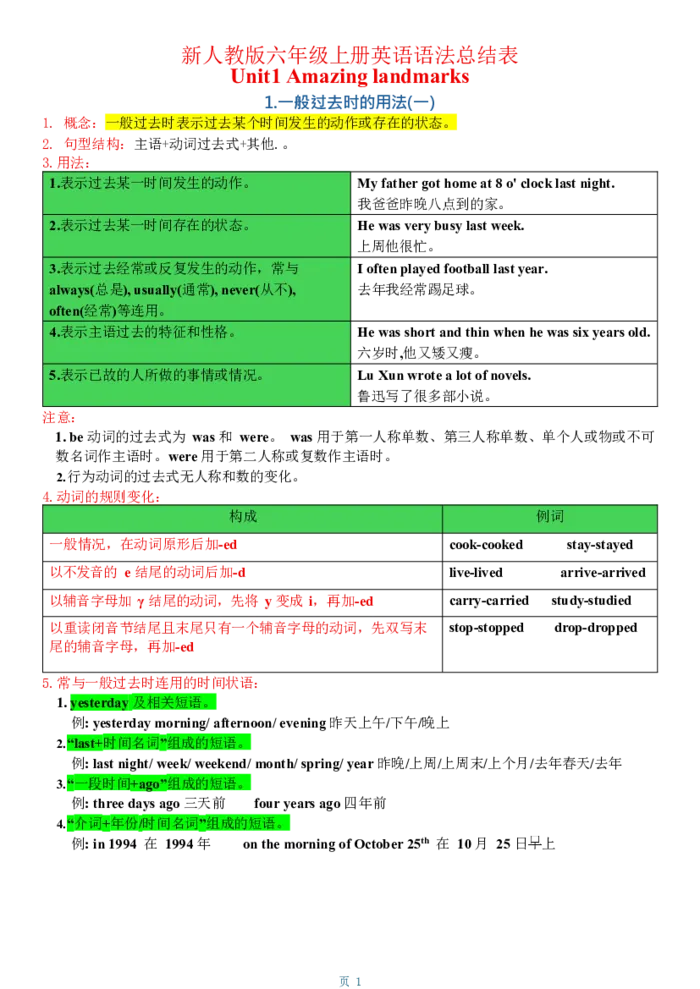
新人教版六年级上册英语语法总结表
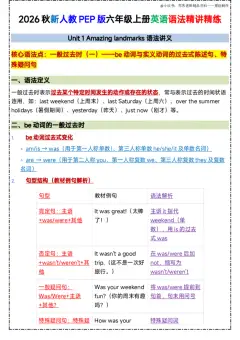
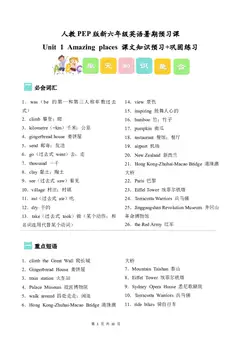
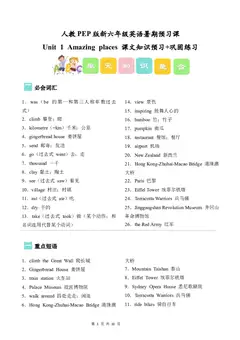
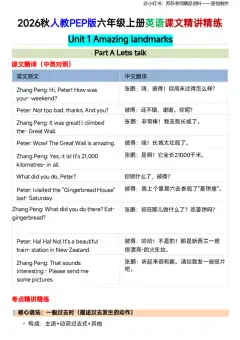
Unit1 Amazing landmarks
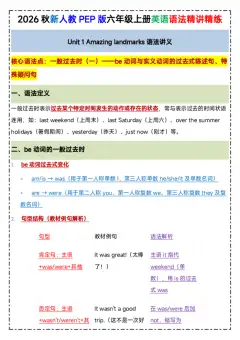
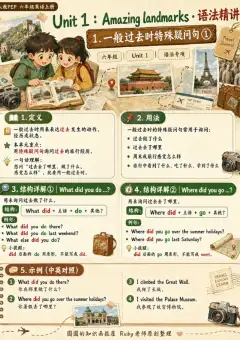
1.一般过去时的用法(一)
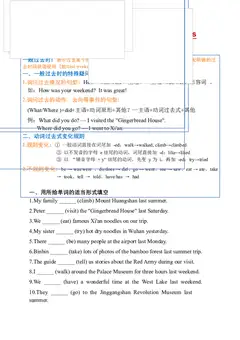
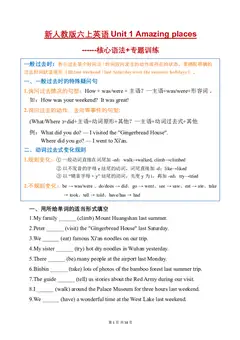
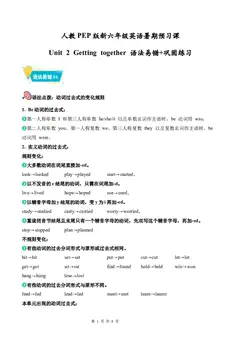
1. 概念:一般过去时表示过去某个时间发生的动作或存在的状态。
2. 句型结构:主语+动词过去式+其他.。
3.用法:
1.表示过去某一时间发生的动作。
My father got home at 8 o' clock last night.
我爸爸昨晚八点到的家。
2.表示过去某一时间存在的状态。
He was very busy last week.
上周他很忙。
3.表示过去经常或反复发生的动作,常与
always(总是), usually(通常), never(从不),
often(经常)等连用。
I often played football last year.
去年我经常踢足球。
4.表示主语过去的特征和性格。
He was short and thin when he was six years old.
六岁时,他又矮又瘦。
5.表示已故的人所做的事情或情况。
Lu Xun wrote a lot of novels.
鲁迅写了很多部小说。
注意:
1. be 动词的过去式为 was 和 were。 was 用于第一人称单数、第三人称单数、单个人或物或不可
数名词作主语时。were 用于第二人称或复数作主语时。
2.行为动词的过去式无人称和数的变化。
4.动词的规则变化:
构成
例词
一般情况,在动词原形后加-ed
cook-cooked
stay-stayed
以不发音的 e 结尾的动词后加-d
live-lived
arrive-arrived
以辅音字母加 γ 结尾的动词,先将 y 变成 i,再加-ed
carry-carried
study-studied
以重读闭音节结尾且末尾只有一个辅音字母的动词,先双写末
尾的辅音字母,再加-ed
stop-stopped
drop-dropped
5.常与一般过去时连用的时间状语:
1. yesterday 及相关短语。
例: yesterday morning/ afternoon/ evening 昨天上午/下午/晚上
2.“last+时间名词”组成的短语。
例: last night/ week/ weekend/ month/ spring/ year 昨晚/上周/上周末/上个月/去年春天/去年
3.“一段时间+ago”组成的短语。
例: three days ago 三天前
four years ago 四年前
4.“介词+年份/时间名词”组成的短语。
例: in 1994 在 1994 年
on the morning of October 25th 在 10 月 25 日
上
页 2
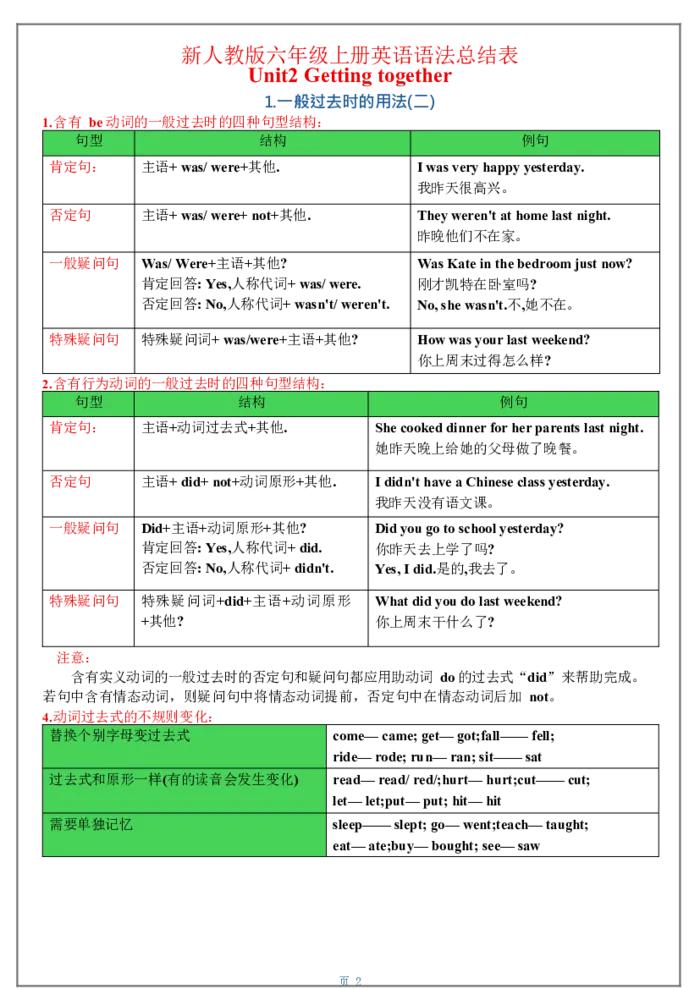
新人教版六年级上册英语语法总结表
Unit2 Getting together
1.一般过去时的用法(二)
1.含有 be 动词的一般过去时的四种句型结构:
句型
结构
例句
肯定句:
主语+ was/ were+其他.
I was very happy yesterday.
我昨天很高兴。
否定句
主语+ was/ were+ not+其他.
They weren't at home last night.
昨晚他们不在家。
一般疑问句
Was/ Were+主语+其他?
肯定回答: Yes,人称代词+ was/ were.
否定回答: No,人称代词+ wasn't/ weren't.
Was Kate in the bedroom just now?
刚才凯特在卧室吗?
No, she wasn't.不,她不在。
特殊疑问句
特殊疑问词+ was/were+主语+其他?
How was your last weekend?
你上周末过得怎么样?
2.含有行为动词的一般过去时的四种句型结构:
句型
结构
例句
肯定句:
主语+动词过去式+其他.
She cooked dinner for her parents last night.
她昨天晚上给她的父母做了晚餐。
否定句
主语+ did+ not+动词原形+其他.
I didn't have a Chinese class yesterday.
我昨天没有语文课。
一般疑问句
Did+主语+动词原形+其他?
肯定回答: Yes,人称代词+ did.
否定回答: No,人称代词+ didn't.
Did you go to school yesterday?
你昨天去上学了吗?
Yes, I did.是的,我去了。
特殊疑问句
特殊疑问词+did+主语+动词原形
+其他?
What did you do last weekend?
你上周末干什么了?
注意:
含有实义动词的一般过去时的否定句和疑问句都应用助动词 do 的过去式“did”来帮助完成。
若句中含有情态动词,则疑问句中将情态动词提前,否定句中在情态动词后加 not。
4.动词过去式的不规则变化:
替换个别字母变过去式
come— came; get— got;fall—— fell;
ride— rode; run— ran; sit—— sat
过去式和原形一样(有的读音会发生变化)
read— read/ red/;hurt— hurt;cut—— cut;
let— let;put— put; hit— hit
需要单独记忆
sleep—— slept; go— went;teach— taught;
eat— ate;buy— bought; see— saw
页 3
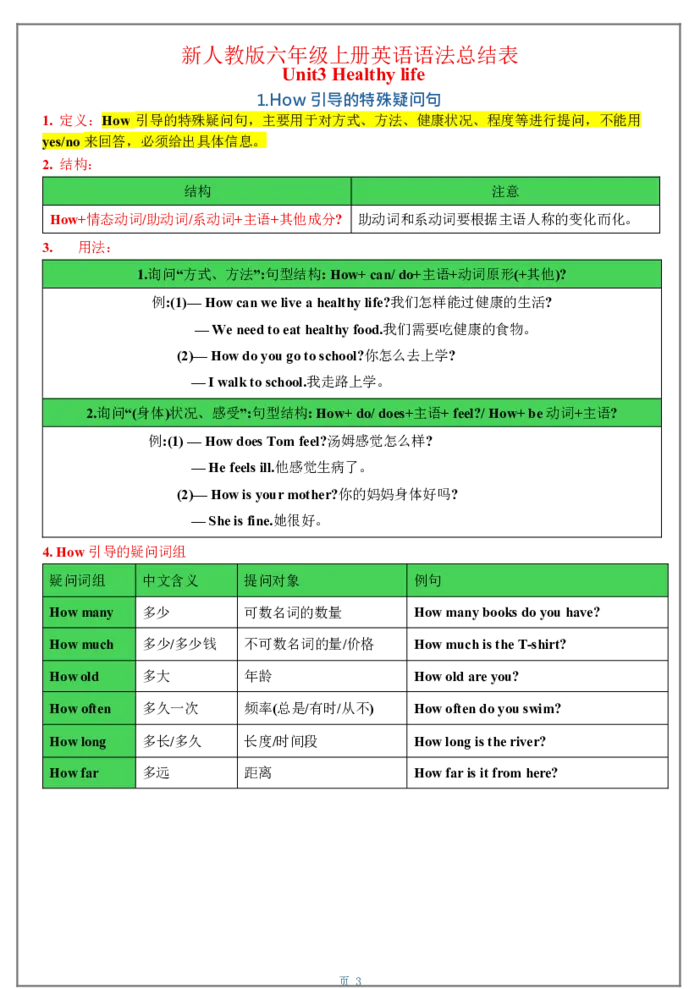
新人教版六年级上册英语语法总结表
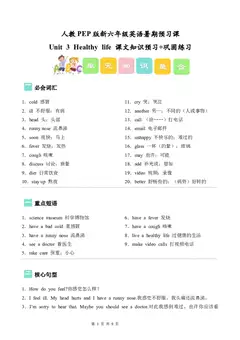
Unit3 Healthy life
1.How 引导的特殊疑问句
1. 定义:How 引导的特殊疑问句,主要用于对方式、方法、健康状况、程度等进行提问,不能用
yes/no 来回答,必须给出具体信息。
2. 结构:
结构
注意
How+情态动词/助动词/系动词+主语+其他成分?
助动词和系动词要根据主语人称的变化而化。
3.
用法:
1.询问“方式、方法”:句型结构: How+ can/ do+主语+动词原形(+其他)?
例:(1)— How can we live a healthy life?我们怎样能过健康的生活?
— We need to eat healthy food.我们需要吃健康的食物。
(2)— How do you go to school?你怎么去上学?
— I walk to school.我走路上学。
2.询问“(身体)状况、感受”:句型结构: How+ do/ does+主语+ feel?/ How+ be 动词+主语?
例:(1) — How does Tom feel?汤姆感觉怎么样?
— He feels ill.他感觉生病了。
(2)— How is your mother?你的妈妈身体好吗?
— She is fine.她很好。
4. How 引导的疑问词组
疑问词组
中文含义
提问对象
例句
How many
多少
可数名词的数量
How many books do you have?
How much
多少/多少钱
不可数名词的量/价格
How much is the T-shirt?
How old
多大
年龄
How old are you?
How often
多久一次
频率(总是/有时/从不)
How often do you swim?
How long
多长/多久
长度/时间段
How long is the river?
How far
多远
距离
How far is it from here?
页 4
新人教版六年级上册英语语法总结表
Unit4 Managing money well
1.be going to 句型
1.定义:“be going to”主要用于表示将来打算、计划去做某事,或者已经有了做某事的意图和计划。
2.时间标志词: tomorrow(明天), next week/month(下一周/下个月), tonight(今晚)等。
3.句型结构:
句型
结构
例句
肯定句:
主语+ be going to + 动词原形(+其他).
Amy is going to buy some animal books.
埃米打算买一些动物类书籍。
否定句
主语 + be not going to + 动词原形
(+其他).
She isn't going to spend all her pocket money.
她不打算花光所有零花钱。
一般疑问句
— Be 动词+主语+ going to + 动词原
形(+其他)?
— Yes,主语+ be 动词./
—No,主语+ be 动词+ not.
— Are they going to spend their pocket
money on toys?
他们打算把零花钱花在玩具上吗?
— Yes, they are.是的,他们打算。
/ No, they aren't.不,他们不打算。
特殊疑问句
特殊疑问词+ be 动词+主语 + going
to+动词原形(+其他)?
What are you going to buy with your pocket
money?
你打算用你的零花钱买什么?
4.拓展:
“主语+will+动词原形+其他.”也可以用来表示一般将来时,表示将要发生的动作、意愿或对未来
的预测,可用于描述临时决定、客观推测或承诺。
例: We will have a school trip next week.我们下周将有一次学校旅行。
2.want to do 和 need to do 的用法
want to do
need to do
用法
表达主观愿望,意为“想要做某事”,是内心
的想法、愿望。
表达“客观上需要做某件事”,是必须做的、有
必要做的,意为“需要做某事”。
肯定句
主语+ want(s)+ to +动词原形(+其他).
1. I want to buy a microscope too.
我还想要买一台显微镜。
2. She wants to visit the museum.
她想要去参观博物馆。
主语+ need(s)+ to +动词原形(+其他).
1. I need to do my homework.
我需要写作业。
2. He needs to wash his hands first.
他需要先洗手。
否定句
主语+ don't / doesn't+ want to+动词原
形(+其他).
I don't want to watch TV tonight.
我今晚不想看电视。
主语+ don't/ doesn't+ need to+动词原形(+
其他).
Tom doesn't need to take a taxi.
汤姆不需要坐出租车。
一般疑
问句
Do/ Does+主语+ want to +动词原形(+其
他)?
Do you want to play with me?
你想要和我一起玩吗?
Do/ Does+主语+ need to +动词原形(+其
他)?
Does your sister need to wear a uniform?
你妹妹需要穿校服吗?
注意: need 也可作情态动词,一般用于否定句和疑问句.
例: You needn't worry.你不必担心。
本单元讨论实义动词的用法。第三人称单数变化:当主语是 he/she/it 或单数人名时, want
要变 wants, need 要变 needs。
页 5
新人教版六年级上册英语语法总结表
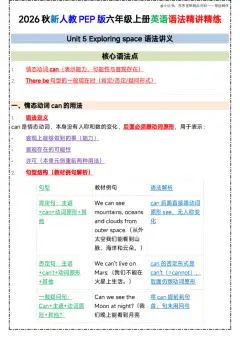
Unit5 Exploring space
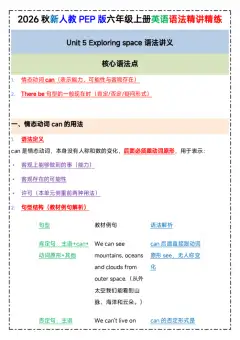
1.there be 句型
1. 概念:There be 句型表示“(某地)有某物/某人”,用来描述事物的存在,be 动词(is/ are)的单复数
形式需根据其后最近的名词单复数来确定,即遵循“就近原则”。
2. there be 句型的句式结构:
肯定陈述句: There be+名词+地点/时间状语.
(1) There is a dog under the tree.树底下有一只狗。 (可数名词单数)
(2) There is some water in the water bottle.水壶里有一些水。
(不可数名词)
(3) There are many kids in the park.公园里有很多孩子。(可数名词的复数形式)
there be 句型的就近原则:
如果 there be 后面是几个并列名词作主语时,be 动词的形式应与跟它最近的那个名词保持单
复数的一致。
例: There is a book and some pens on the desk.
例: There are some pens and a book on the desk.
否定陈述句:There be+ not/ no+名词+地点/时间状语.
(1) There wasn't any food in the kitchen.厨房里没有食物。
(2) There were no books on the desk.书桌上没有书。
注意:陈述句中如果出现 some,变否定句时, some 要变成 any。
一般疑问句: Be 动词+ there+名词+地点/时间状语?
(1) Is there a dictionary on the desk?书桌上有一本词典吗?
(2) Are there any elephants in the zoo?动物园里有大象吗?
特殊疑问句:特殊疑问词(+名词)+be 动词+there+地点/时间状语?
How many students are there in the classroom?教室里有多少名学生?
3.拓展(一)
“There be”句型也有不同的时态; 一般过去时用“There was / were”, 一般将来时用“There will
be”或“There is / are going to be”。
例:(1) There was a small house here ten years ago.十年前这里有一座小房子。
(2) There will be a new park in our city next year.明年我们城市将会有一座新公园。
4.拓展(二)
there be 句型与 have/has 的异同:
there be
have/ has
there be 句型意为“某地有……”, 表示客观存
在,there be 句型的主语放在 be 动词之后。
have/ has 表示的是“所属”的“有”, have/
has 前需要有主语。
例:
(1)I have some good friends.我有一些好朋友。
主语
(2) Lisa has an elder sister.
主语莉萨有一个姐姐。
主语
(3) There are many kids in the park.公园里有很多孩子。
主语
页 6
新人教版六年级上册英语语法总结表
Unit6 Energy nature and us
1.情态动词 can 和 should 的用法
can
should
核心含义
表“能、会、可以”,强调能力或允许。
表“应该、应当”,强调建议、责任或义务。
常用场景
(1)描述“会做某事”(能力):
例 :I can speak English.
我会说英语。
(2)表达”可以做某事“(允许):
例: Can I use your pen?
我可以用你的钢笔吗?
(1)给出建议:
例: You should drink more water.
你应该多喝些水。
(2)表达责任:
例: We should help our parents.
我们应该帮助父母。
重要规则: can / should 没有人称和数的变化。无论主语是 I/ you / he,都直接用 can / should.
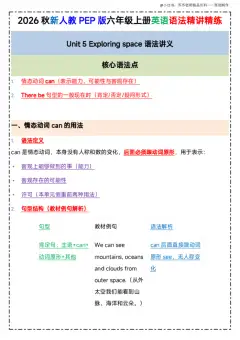
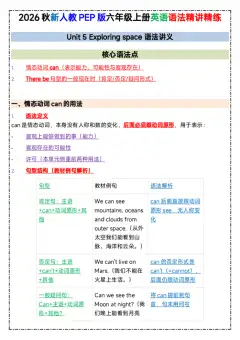
1.can 句型结构:
句型
结构
例句
肯定句:
主语+can+动词原形(+其他).
She can swim fast.她能游得很快。
否定句
主语 + can't +动词原形(+其他).
He can't ride a bike.他不会骑自行车
一般疑问句
— Can+主语+动词原形(+其他)?
— Yes,主语+ can./ No,主语+ can't.
— Can you sing?你会唱歌吗?
— Yes, I can.是的,我会。
特殊疑问句
特殊疑问词+can+主语+动词原形(+其他)?
— What can you do?你会做什么?
2.should 结构:
句型
结构
例句
肯定句:
主语+ should +动词原形(+其他).
They should study hard.
否定句
主语+shouldn't+动词原形(+其他).
You shouldn't watch TV too late.
一般疑问句
— Should+主语+动词原形(+其他)?
—Yes,主语+should./No,主语+ shouldn't.
— Should I clean my room?
— No, you shouldn't.
特殊疑问句
特殊疑问词+should+主语+动词原形(+其他)?
— What should I wear today?
2. 一般现在时
1.概念:表示经常性、习惯性的动作或状态,客观事实、真理,以及现阶段的特征。
2.基本结构:
句型
结构
例句
肯定句:
①主语(I/ We/ You/复数名词)+动词原形+
其他
②主语(He/ She/ It/单数名词)+动词第三人
称单数形式+其他.
I play football every weekend.
我每周末踢足球。
He plays football every weekend.
他每周末踢足球。
否定句
主语+ don't/ doesn't+动词原形+其他.
He doesn't like football.
他不喜欢足球运动。
一般疑问句
Do/ Does+主语+动词原形+其他?
Do you like football?
你喜欢足球运动吗?
特殊疑问句
特殊疑问词(组)+一般疑问句?
What do you eat for breakfast?
你
饭吃什么?
3. 动词变第三人称单数形式的规则:
一般情况加-s
例:look→looks
以 s/x/ ch/ sh/o 结尾加-es,
例:wash→washes
以辅音字母+y 结尾,变 y 为 i 加-es,
例:study→studies
不规则变化,
例:have→has