文档文本内容
新六年级英语暑假衔接讲义
(PEP 版 三年级起点)
━━━━━━━━━━━━━━━━━━━━━━━━━
第七讲 一般将来时(be going to)
适用年级:新六年级(五升六)
教材版本:PEP 版(三年级起点)
内容说明:本讲学习一般将来时 be going to 结构,表示计划和预
测
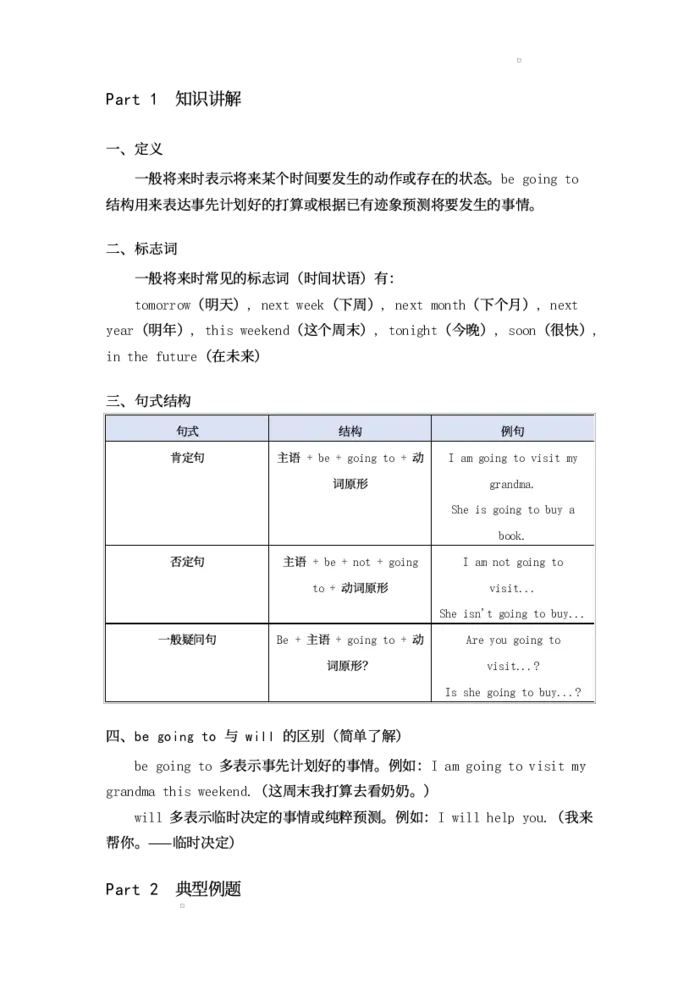
Part 1 知识讲解
一、定义
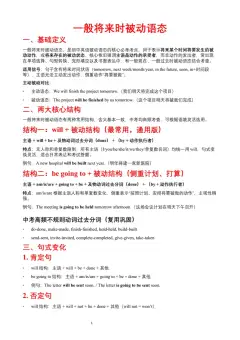
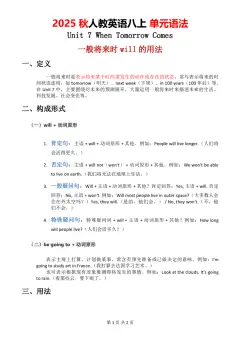
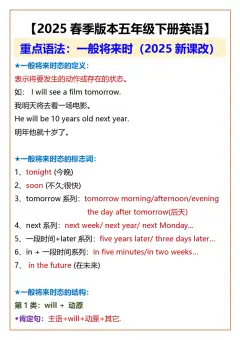
一般将来时表示将来某个时间要发生的动作或存在的状态。be going to
结构用来表达事先计划好的打算或根据已有迹象预测将要发生的事情。
二、标志词
一般将来时常见的标志词(时间状语)有:
tomorrow(明天), next week(下周), next month(下个月), next
year(明年), this weekend(这个周末), tonight(今晚), soon(很快),
in the future(在未来)
三、句式结构
句式
结构
例句
肯定句
主语 + be + going to + 动
I am going to visit my
词原形
grandma.
She is going to buy a
book.
否定句
主语 + be + not + going
I am not going to
to + 动词原形
visit...
She isn't going to buy...
一般疑问句
Be + 主语 + going to + 动
Are you going to
词原形?
visit...?
Is she going to buy...?
四、be going to 与 will 的区别(简单了解)
be going to 多表示事先计划好的事情。例如:I am going to visit my
grandma this weekend.(这周末我打算去看奶奶。)
will 多表示临时决定的事情或纯粹预测。例如:I will help you.(我来
帮你。——临时决定)
Part 2 典型例题
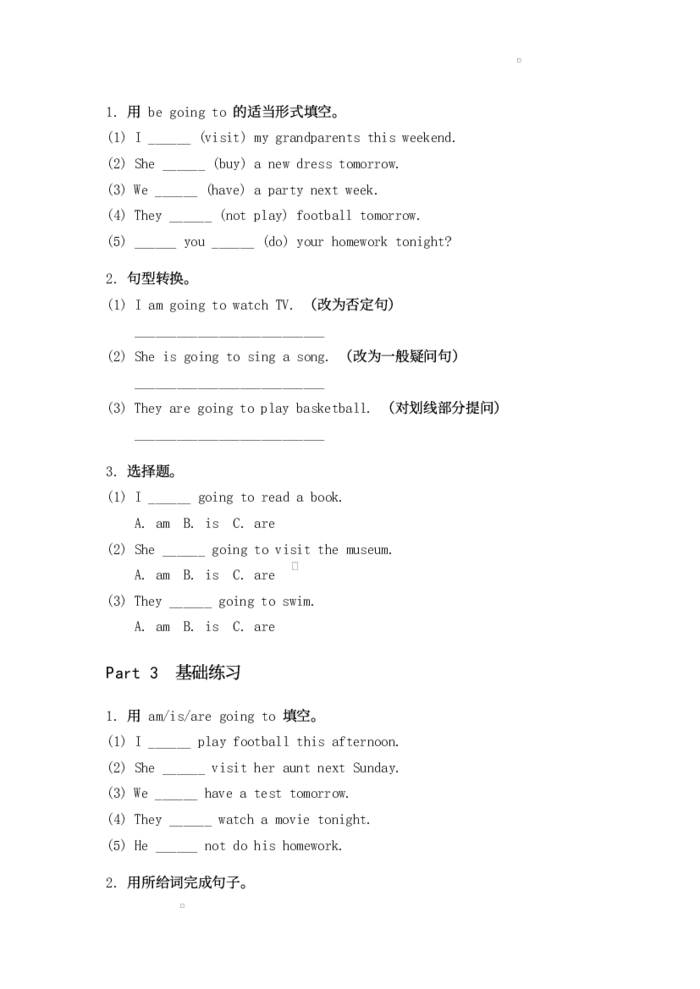
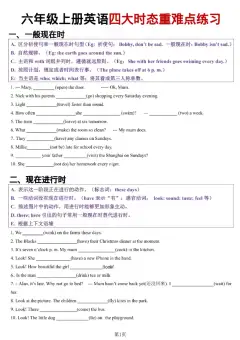
1. 用 be going to 的适当形式填空。
(1) I ______ (visit) my grandparents this weekend.
(2) She ______ (buy) a new dress tomorrow.
(3) We ______ (have) a party next week.
(4) They ______ (not play) football tomorrow.
(5) ______ you ______ (do) your homework tonight?
2. 句型转换。
(1) I am going to watch TV. (改为否定句)
___________________________
(2) She is going to sing a song. (改为一般疑问句)
___________________________
(3) They are going to play basketball. (对划线部分提问)
___________________________
3. 选择题。
(1) I ______ going to read a book.
A. am B. is C. are
(2) She ______ going to visit the museum.
A. am B. is C. are
(3) They ______ going to swim.
A. am B. is C. are
Part 3 基础练习
1. 用 am/is/are going to 填空。
(1) I ______ play football this afternoon.
(2) She ______ visit her aunt next Sunday.
(3) We ______ have a test tomorrow.
(4) They ______ watch a movie tonight.
(5) He ______ not do his homework.
2. 用所给词完成句子。
(1) I ______ (go) to Beijing next week.
(2) She ______ (buy) some books tomorrow.
(3) We ______ (have) a picnic this weekend.
(4) They ______ (not play) games tonight.
3. 连词成句。
(1) going, I, am, to, read, a, book
___________________________
(2) she, is, going, buy, to, what?
___________________________
(3) not, are, we, going, to, play
___________________________
Part 4 提高练习
1. 改错(找出错误并改正)。
(1) She is going to swims.
___________________________
(2) I am go to visit my grandma.
___________________________
(3) Are you going to the park?(提示:意思是"要去公园做某事"而不是"去
公园")
___________________________
(4) He not is going to play football.
___________________________
2. 阅读短文,判断正(T)误(F)。
Tomorrow is Saturday. I am going to get up late. In the morning,
I am going to do my homework. In the afternoon, I am going to play
basketball with my friends. My mother is going to go shopping. My
father is going to wash his car. We are going to have a big dinner in
the evening.
(1) Tomorrow is Sunday.
(2) I am going to get up early.
(3) I am going to play basketball in the afternoon.
(4) My mother is going to wash the car.
(5) We are going to have a big dinner.
3. 用 be going to 描述你的周末计划(写 3-5 句话)。
(1) ___________________________
(2) ___________________________
(3) ___________________________
(4) ___________________________
(5) ___________________________
Part 5 本讲总结
一般将来时,计划预测都可以;
标志词要记清,tomorrow next week 看仔细。
be going to 加动原,be 随主语变形式;
am/is/are 别用错,计划动作在后面。
否定 be 后加 not,疑问 be 到主语前;
特殊疑问词在前,be 后主语紧相连。
本讲重点回顾
✓一般将来时表示计划或预测,标志词有 tomorrow / next week / this
weekend 等
✓结构:主语 + be (am/is/are) + going to + 动词原形
✓否定句在 be 后加 not
✓一般疑问句将 be 提到主语前
✓be going to 多表示计划好的事情,will 多表示临时决定
参考答案
Part 2 典型例题
1. (1) am going to visit (2) is going to buy (3) are going to have
(4) are not going to play (5) Are, going to do
2. (1) I am not going to watch TV. (2) Is she going to sing a song?
(3) What are they going to do?
3. (1) A (2) B (3) C
Part 3 基础练习
1. (1) am going to (2) is going to (3) are going to (4) are going to
(5) is going to
2. (1) am going to go (2) is going to buy (3) are going to have (4)
are not going to play
3. (1) I am going to read a book. (2) What is she going to buy? (3)
We are not going to play.
Part 4 提高练习
1. (1) swims -> swim (2) go -> going to go (3) Are you going to go to
the park? (4) He is not going to play football.
2. (1) F (2) F (3) T (4) F (5) T
3. (答案略,学生自由发挥)