考点11 动词的将来时态(核心考点精讲精练)
温馨提示:
本资料注重培优,集中强化重点,突破难度,规避易混易错点,练习全部
是26 年新模拟题
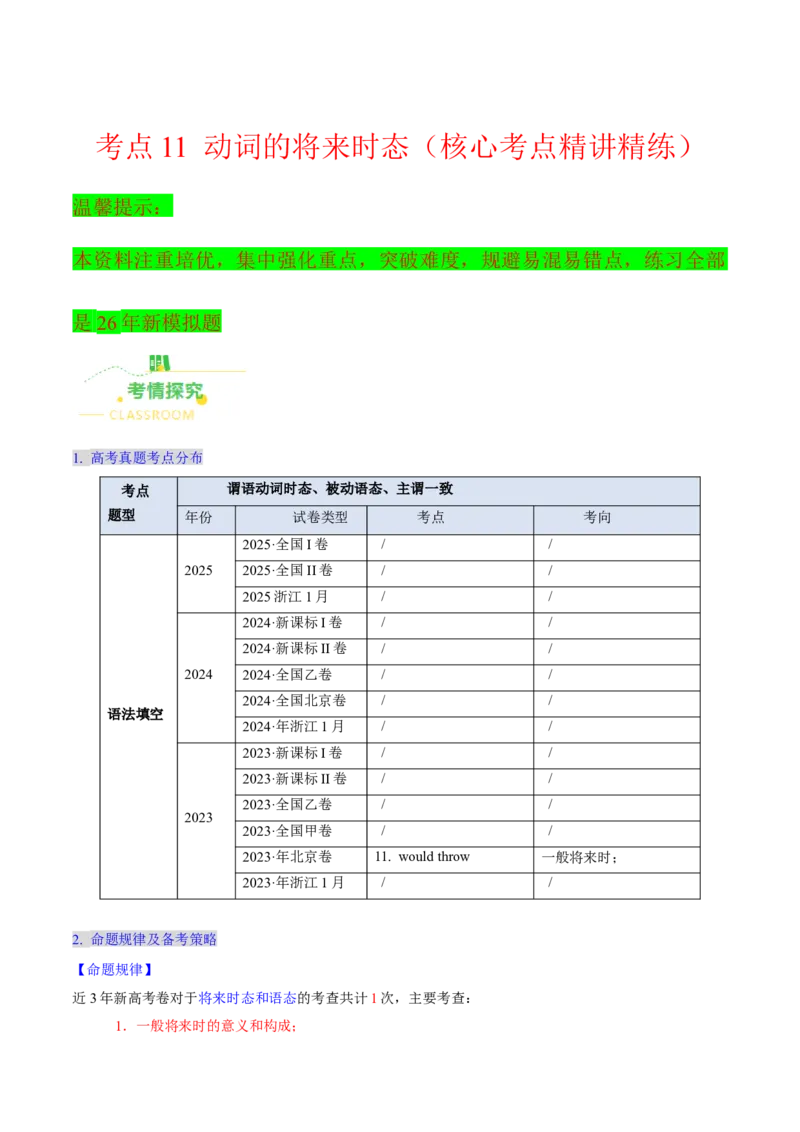
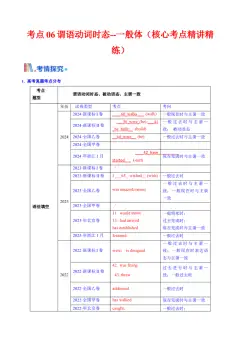
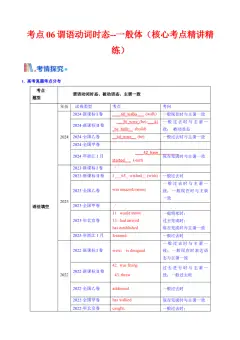
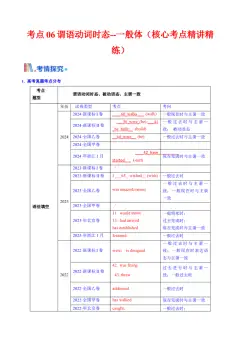
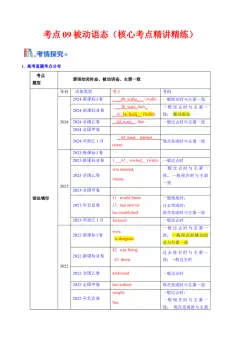
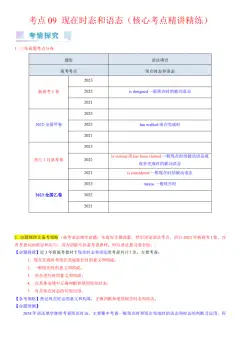
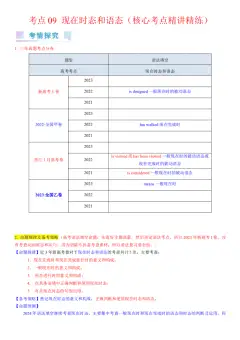
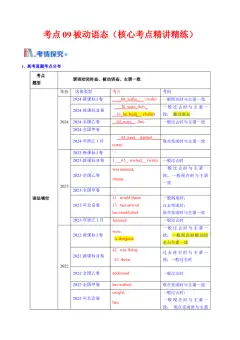
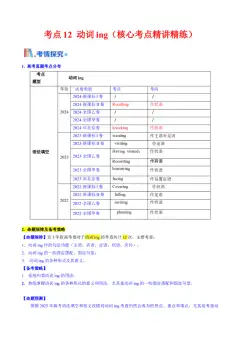
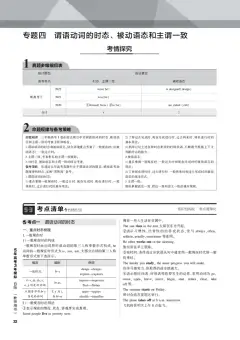
1. 高考真题考点分布
考点
题型
谓语动词时态、被动语态、主谓一致
年份
 试卷类型
考点
考向
语法填空
2025
2025·全国I 卷
 /
 /
2025·全国II 卷
 /
 /
2025 浙江1 月
 /
 /
2024
2024·新课标I 卷
 /
 /
2024·新课标II 卷
 /
 /
2024·全国乙卷
 /
 /
2024·全国北京卷
 /
 /
2024·年浙江1 月
 /
 /
2023
2023·新课标I 卷
 /
 /
2023·新课标II 卷
 /
 /
2023·全国乙卷
 /
 /
2023·全国甲卷
 /
 /
2023·年北京卷
11. would throw
一般将来时;
2023·年浙江1 月
 /
 /
2. 命题规律及备考策略
【命题规律】
近3 年新高考卷对于将来时态和语态的考查共计1 次,主要考查:
1.一般将来时的意义和构成;
2.将来进行时的意义和构成;
3.  将来完成时的意义和构成;
4.  在具体语境中正确判断和使用将来时态;
【备考策略】熟记将来时态的意义和构成,正确判断和使用将来时态和语态。
3.【命题预测】
2026 年语法填空有可能考查将来时态,主要集中考查一般将来时的语态和时态的判断及运用,同时兼
顾其他将来时态。
1.考查一般将来时的基本用法;
2 考查将来进行时的基本用法;
3.考查将来完成时的基本用法;

考点一 考查一般将来时的用法
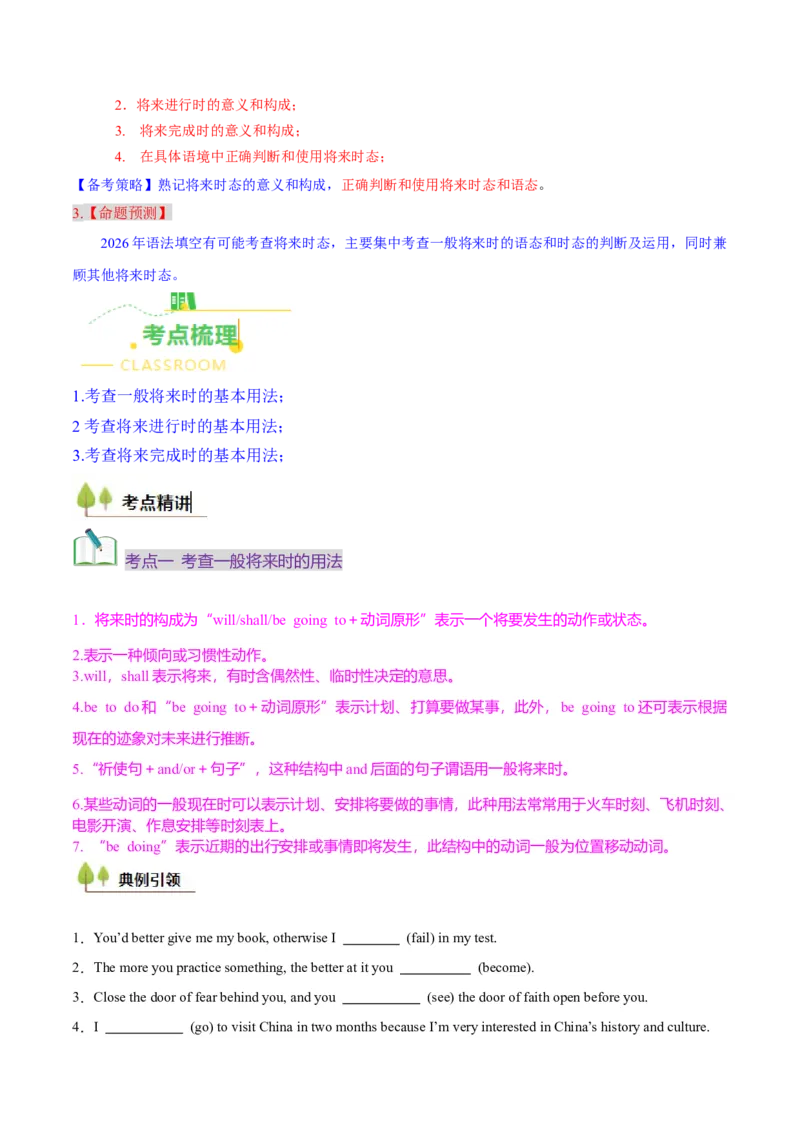
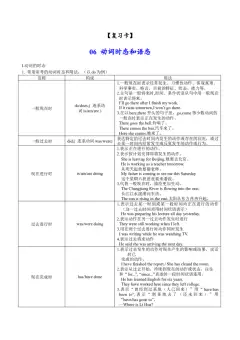
1.将来时的构成为“will/shall/be going to+动词原形”表示一个将要发生的动作或状态。
2.表示一种倾向或习惯性动作。
3.will,shall 表示将来,有时含偶然性、临时性决定的意思。
4.be to do 和“be going to+动词原形”表示计划、打算要做某事,此外,be going to 还可表示根据
现在的迹象对未来进行推断。
5.“祈使句+and/or+句子”,这种结构中and 后面的句子谓语用一般将来时。
6.某些动词的一般现在时可以表示计划、安排将要做的事情,此种用法常常用于火车时刻、飞机时刻、
电影开演、作息安排等时刻表上。
7. “be doing”表示近期的出行安排或事情即将发生,此结构中的动词一般为位置移动动词。
1.You’d better give me my book, otherwise I          (fail) in my test.
2.The more you practice something, the better at it you            (become).
3.Close the door of fear behind you, and you             (see) the door of faith open before you.
4.I             (go) to visit China in two months because I’m very interested in China’s history and culture.
1.The spacecraft          (enable) scientists to study some dark corners of the solar system in the near future.
2.There’s no doubt that the Internet           (make) our life more convenient in lots of ways in the future.
3.Dr. Smith, together with his wife and daughters,              (go) to visit Beijing, and will not be back until
next week.
4.Never          you be admitted to your ideal university if you are addicted to online games.
5.I guess most parents            (support) the new plan at the meeting tomorrow.
6.The plan they paid much attention to       (discuss) at tomorrow’s meeting.
7.Keep your eyes open, or you      (miss) the most exciting moment of the magic.

考点二 考查将来进行时的用法
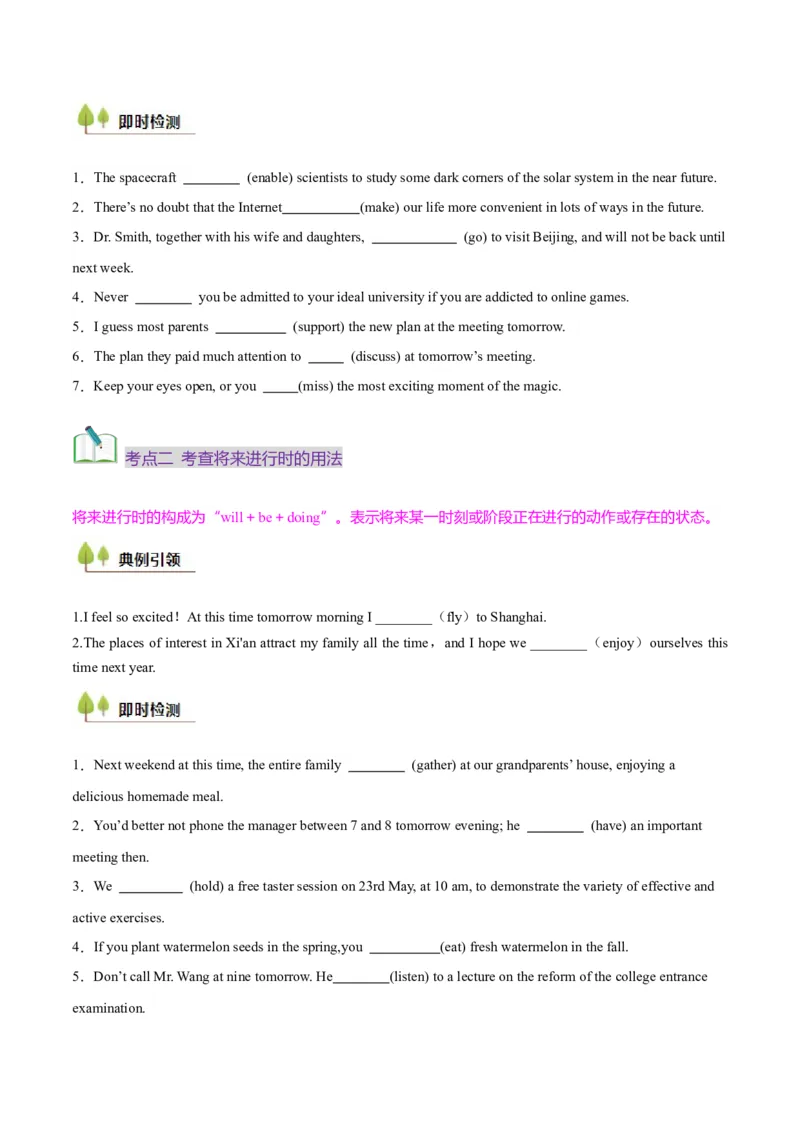
将来进行时的构成为“will+be+doing”。表示将来某一时刻或阶段正在进行的动作或存在的状态。
1.I feel so excited!At this time tomorrow morning I ________(fly)to Shanghai.
2.The places of interest in Xi'an attract my family all the time,and I hope we ________(enjoy)ourselves this
time next year.
1.Next weekend at this time, the entire family          (gather) at our grandparents’ house, enjoying a
delicious homemade meal.
2.You’d better not phone the manager between 7 and 8 tomorrow evening; he          (have) an important
meeting then.
3.We           (hold) a free taster session on 23rd May, at 10 am, to demonstrate the variety of effective and
active exercises.
4.If you plant watermelon seeds in the spring,you           (eat) fresh watermelon in the fall.
5.Don’t call Mr. Wang at nine tomorrow. He        (listen) to a lecture on the reform of the college entrance
examination.
6.While AI enthusiasts promise us a bright future where intelligent robots          (work) to our advantage,
these undoubted benefits also bring concerns and fears.

考点三 考查将来完成时的用法
1.将来完成时的构成为“will+have+done”。主要表示某一动作到将来某个时间为止已完成,上下文
情景中常含有by 短语,如by six o'clock,by the weekend,by the end of next month 等。
2.过去将来完成时(would have done)表示将来某一时间之前已经完成的动作,多与宾语从句和虚
拟语气连用。
By the time Mr Smith arrives at the supermarket,we ________(stay)there for one hour.
1.By the time I come back, I think you          (finish) all the work here.
2.He          (learn) English for eight years by the time he graduates from the university next year.
3.You have to hurry up, or the train              (leave) by the time you reach the station.
4.Martin has been working really hard on the presentation since Monday and he believes that he        (finish)
it by Friday.
5.Is it likely that the scientists            (discover) a cure for cancer by the year 2040?
1.(2026·四川省成都外国语学校期中)China         (reduce) the carbon dioxide emissions a lot by 2030,
the vice premier told the media.
2.(2026·黑龙江省双鸭山市第一中学高三上学期开学考试)By the time this letter reaches you, I

(leave)the country.
3.(2026·上海市南洋模范中学期中)It is reported that by the end of this month, the output of plastic in the
factory            (rise) by about 10%.
4.On the next birthday, Ann            (marry) for twenty years.
5.In the future, we         (use) advanced technology every day for automatic control of just about everything
in our home.
6.Jane can't attend the meeting at 3 o'clock this afternoon because she        (teach) a class at that time.
7.Don’t call me at nine tomorrow because I            (study) at the library then.
8.You should work on your people skills, as you           (talk) to people all day.
9.Engineers are now working on a new concept: the rail drones of the future. They           (move) on the
track ahead of the train, and programmed to run autonomously.
10.Tony suggested that Claire invite her friends to the house the night before she             (be) to leave and
Larry was to return.
11.Linda was about           (start) telling her story when the phone rang.
12.As he proudly signed his name at the bottom of the page, Beethoven tried to imagine how people
(respond) when they heard it for the first time.
13.This morning, I was worried that no one         (will) talk to me. But I was wrong. I didn’t feel awkward or
frightened at all.
14.But surely, people believe, his dream      (come) true in the near future.
15.Technology          (assist) conventional educational ways in the future, and students can use computers to
learn with a personalized education system.
16.We are          (attend) a lecture this afternoon.
17.Either you or I        going to the teacher’s office after class. (用适当的词填空)
18.The number is an indicator of how quickly technology         (change) in many years.
19.It’s true that if one doesn’t take the first step, a journey          (remain) a dream forever.
20.If you destroy our home, we          (have) nowhere to live. Please think twice.
语法填空
阅读下面短文, 在空白处填入1 个适当的单词或括号内单词的正确形式。(宁夏银川一中月考)
The British have many traditions but there is nothing more quintessential (典型的) than taking afternoon tea.
We know the British have a love affair with drinking tea,    1    more than 160 million cups drunk every day,
but it was the invention of afternoon tea that turned tea-drinking into    2    popular pastime.
This sociable feast involves drinking good quality tea     3     (comfort) while nibbling (小口吃) on nice
sandwiches, scones with jam and cream and a selection of small cakes. And, of course, it can only happen in the
afternoon!   Afternoon tea,     4     (design) as a light snack to bridge the gap between lunch and dinner, dates
back to the 1840s.  It went on to become a     5     (fashion) social occasion for the upper classes.
Now there is a resurgence (复苏) in its     6     (popular) in the UK and it is available to anyone who can
afford it.    7    it can be enjoyed at home, the best way to experience it is at a smart hotel of café. But if you’re
thinking of visiting such a place    8    (enjoy) a plate of sweet and tasty treats with a steaming hot brew,
remember the rules you must follow to avoid     9     (ask) to leave.
Writer Henry James once noted that “there are few hours in life more agreeable than the hour devoted to the
ceremony known as afternoon tea”. I’m sure once you try it, you     10    (agree).