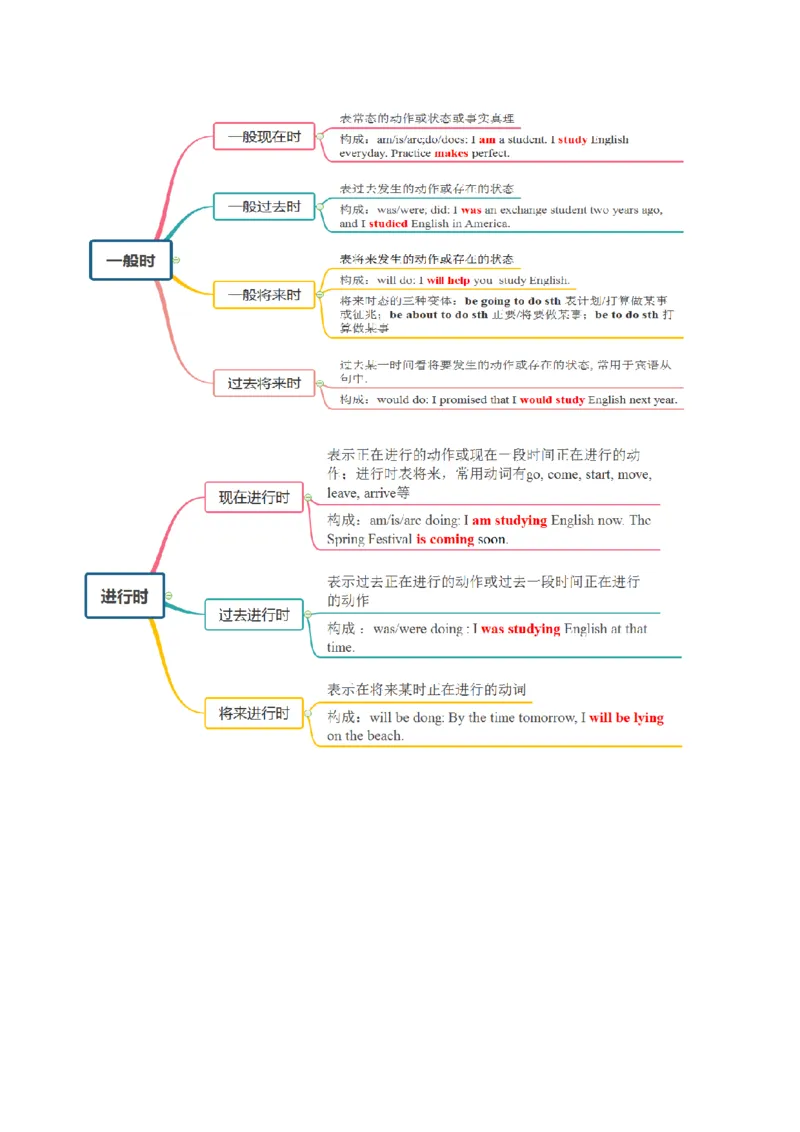
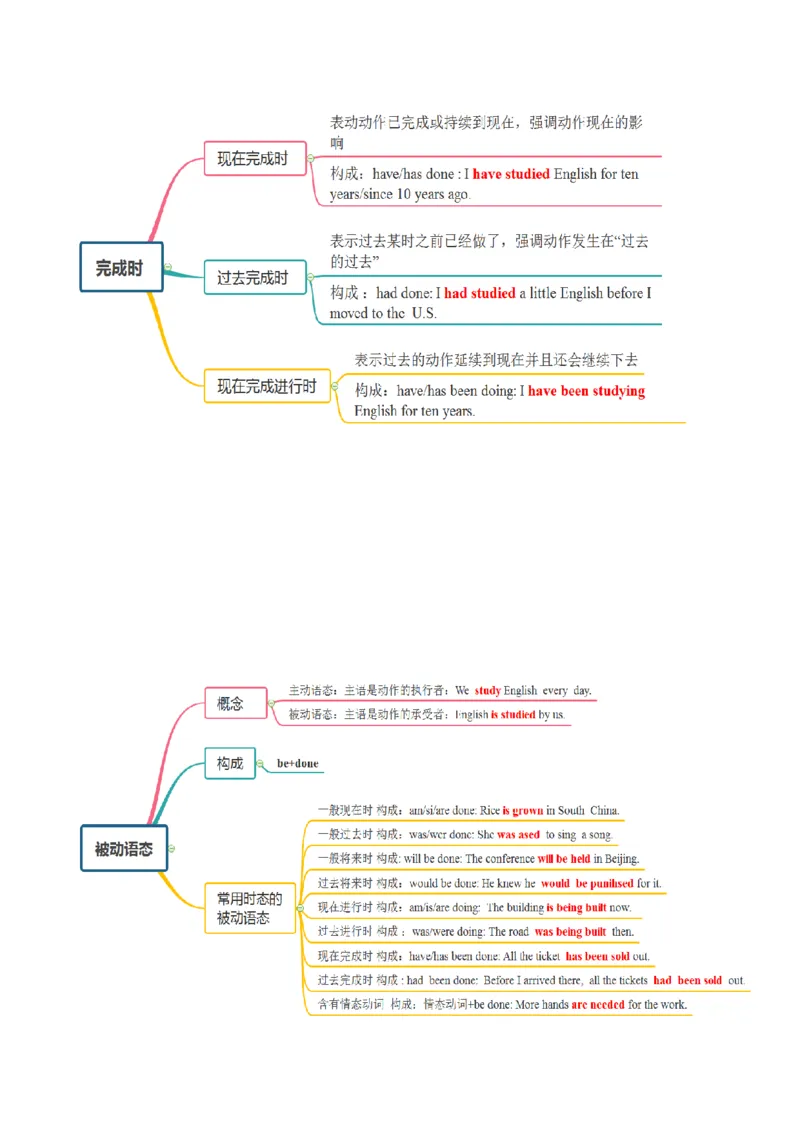
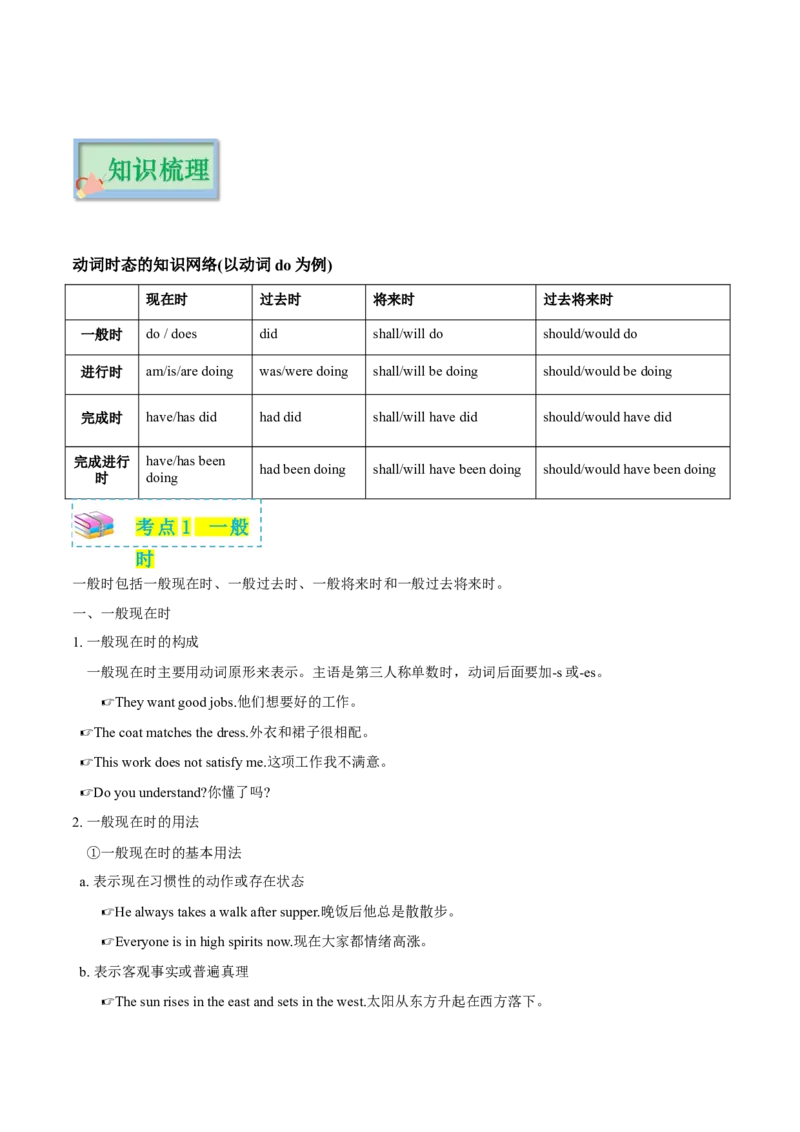
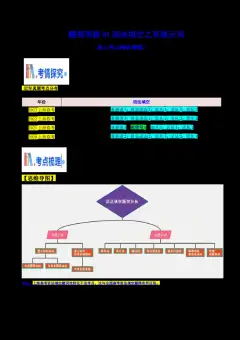
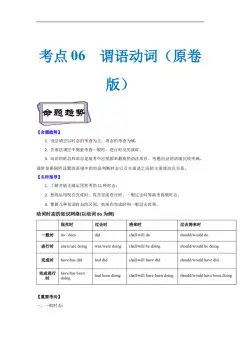
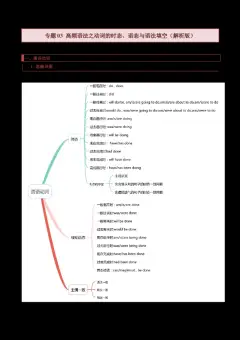
专题 04 动词的时态和语态动词时态的知识网络(以动词do为例)
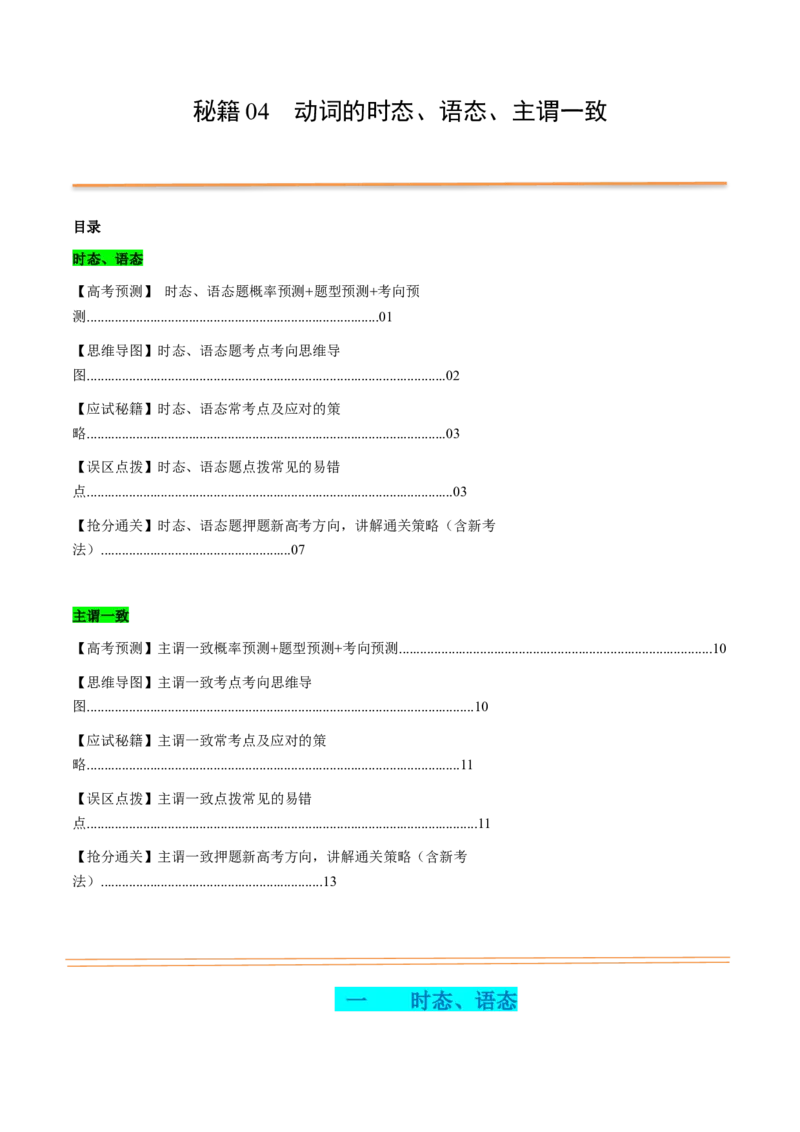
现在时 过去时 将来时 过去将来时
一般时 do / does did shall/will do should/would do
进行时 am/is/are doing was/were doing shall/will be doing should/would be doing
完成时 have/has did had did shall/will have did should/would have did
完成进行 have/has been
had been doing shall/will have been doing should/would have been doing
时 doing
考点 1 一般
时
一般时包括一般现在时、一般过去时、一般将来时和一般过去将来时。
一、一般现在时
1. 一般现在时的构成
一般现在时主要用动词原形来表示。主语是第三人称单数时,动词后面要加-s或-es。
☞They want good jobs.他们想要好的工作。
☞The coat matches the dress.外衣和裙子很相配。
☞This work does not satisfy me.这项工作我不满意。
☞Do you understand?你懂了吗?
2. 一般现在时的用法
①一般现在时的基本用法
a. 表示现在习惯性的动作或存在状态
☞He always takes a walk after supper.晚饭后他总是散散步。
☞Everyone is in high spirits now.现在大家都情绪高涨。
b. 表示客观事实或普遍真理
☞The sun rises in the east and sets in the west.太阳从东方升起在西方落下。☞Sound travels faster through water than it does through air.
声音在水中的传播速度要比在空气中快。
☞Time and tide wait for no man.时间不等人。
c. 表示主语的特征、能力和状态
☞This cloth feels soft.这布摸上去很软。
☞I love classical music.我喜欢古典音乐。
☞The President still seems able to find time to go fishing.
看来总统仍能有时间去钓鱼。
d. 表示按计划或安排将要发生的动作
☞The meeting begins at 7:00.会议七点钟开始。
☞We leave here at 8:00 sharp.我们八点整离开这里。
e. 在时间、条件、让步状语从句中表示将来动作
☞When you come next time, bring me some magazines.
你下次来时,给我带几本杂志。
☞If time allows, we shall go there tomorrow.
如果时间允许的话,我们明天去那里。
☞Whether he agrees or not, I will stay at home.
不管他同意与否,我都会待在家里。
②一般现在时的特殊用法
a. 用于新闻标题或图片说明中
☞China Declares Manned Spaceflight Successful中国宣布载人航天飞行圆满成功
☞Laura Bush Arrives in Moscow劳拉·布什抵达莫斯科
b. 用于体育运动、表演等实况报道中
☞Francis slips past, passes the ball to Yao Ming, who jumps, catches and shoots it into the basket.
弗朗西斯穿过去,把球传给姚明,姚明跳起来,接住球投进篮里。
☞Now, look, I press the button and turn on the machine.
现在,看,我按下按扭,打开了这台机器。
c. 表示告诫或劝说
☞You mind your own business.你不要管闲事!
☞If he does that again, he goes to prison.如果他再那样的话,他就会进监狱的。
d. 表示现在瞬间的动作☞Here comes the bus.汽车来了。
☞There goes the bell.铃响了。
2. 一般过去时
①一般过去时的基本用法
a. 表示过去某个特定时间发生的动作或存在的状态
☞He suddenly fell ill yesterday.昨天他突然生病了。
☞The engine stopped because the fuel was used up.
发动机因燃料用光而停机了。
注意:
在一般过去时的句子中,通常都要有表示过去的时间状语。
【误】I visited the Palace Museum.(在没有上下文的情况下,应避免这样说)
【正】I visited the Palace Museum last year.
去年我参观过故宫博物院。
【正】I have visited the Palace Museum.
我参观过故宫博物院。
b. 表示过去经常发生的动作或存在的状态
☞I wrote home once a week at college.我上大学时每周给家里写一封信。
☞He was already in the habit of reading widely in his boyhood.
他童年时就养成了广泛阅读的习惯。
表示过去的习惯性动作,除了用过去式外,还可以用used to或would来表示。
☞She used to study late into the night when she was in Senior Three.
她上高三时经常学习到深夜。
☞He would sit for hours doing nothing.
过去他常常一坐几个钟头什么事也不做。
c. 表示过去连续发生的一系列动作
☞She entered the room, picked up a magazine and looked through it carefully.
她走进房间,拿起一本杂志,认真地翻阅了起来。
☞The students got up early in the morning, did morning exercises and then read English aloud in the open air.
学生们很早起床,做早操,然后在室外朗读英语。
②一般过去时的特殊用法
a. 在虚拟语气中表示现在或将来时间的动作或状态☞It's time we went.是我们该走的时候了。
☞I wish I were twenty years younger.但愿我年轻20岁。
☞I would rather you didn't do anything for the time being.我宁愿你暂时先不要采取什么措施。
b. 在口语中,一般过去时往往显示委婉客气。
☞I wondered if you could give me a hand.我想请你帮个忙。
☞Might I come and see you tonight?我想今晚来看你,好吗?
3.一般现在时和一般过去时的比较
一般现在时要和现在时间相联系,而一般过去时和说话的“现在”不相联系。
☞His father is a film director.他父亲是电影导演。(他现在还是)
☞His father was a film director.他父亲曾是电影导演。(他现在不是)
☞How do you like the novel?你觉得这部小说怎么样?(还在看小说)
☞How did you like the novel?你觉得这部小说怎么样?(已看完小说)
三、一般将来时
1. 一般将来时的用法
①表示将要发生的动作或存在的状态
☞I shall be free this afternoon.我今天下午有空。
☞There'll be no chemistry classes tomorrow.明天没有化学课。
☞They will probably go to Shanghai for their holiday.他们可能去上海度假。
注意:
在口语中,常用will / shall + be doing结构来代替will / shall + 动词原形,以表示生动。
☞I'll be seeing a friend off at the airport.我要去机场给一个朋友送行。
☞He'll be going with us tomorrow.他明天和我们一起去。
②表示将要反复发生的动作
☞My uncle will come to see me every Saturday.我叔叔每个星期六都会来看我。
☞The students will have five English classes per week this term.本学期学生们每周要上五节英语课。
③表示同意或答应做某事
☞That bag looks heavy. I'll help you with it.这个包看起来很重,我来帮你提。
☞I won't tell anyone what happened, I promise.我保证不告诉别人所发生的事。
2. 一般将来时的常用结构
①用于“I expect, I'm sure, I think, I wonder + 宾语从句”中
☞Don't worry about the exam. I'm sure you'll pass. 不要担心这次考试,我确信你会通过的。☞I wonder what will happen.我不知道将会发生什么事。
②用于“祈使句 + and + 陈述句”中
☞Work hard and you will succeed.如果你努力,就会成功的。
☞Go at once and you will see her.马上去,你就会见到她了。
③与表示时间或条件的状语从句连用
☞I'll let you know as soon as he arrives.他一到我就通知你。
☞If you ask him, he will help you.如果你请他,他会帮助你的。
☞We shall go unless it rains.除非下雨,否则我们是要去的。
3. 将来时间的其他表达法
①be going to + 动词原形
☞I'm going to buy a new coat this winter.今年冬天我打算买一件新大衣。
☞Look at those black clouds. It is going to rain.
瞧那乌云,天要下雨了。
☞The car is going to turn over.汽车要翻了!
比较:
“be going to + 动词原形”与“will / shall + 动词原形”的区别
a. be going to通常表示很快就要发生的事,而will/shall既可表示不久的将来,也可表示长远的将来或不确
定的将来。
☞She is going to get better.
她的病要好了。(有恢复健康的迹象)
☞She will get better.
她的病会好的。(认为最终会恢复健康的)
b. will表示将来,通常是指事先无计划的意图,是临时决定的; be going to则表示事先有计划的意图,
是经过考虑的。
☞— George phoned while you were out.你外出的时候乔治打电话来的。
— Ok. I'll phone him back.好的,我给他回电话。(临时决定)
☞— Matthew phoned while you were out.你外出的时候马修打电话来了。
—Yes, I know. I'm going to phone him back.是的,我知道了。我准备给他回电话。(早有安排)
c. 表示有迹象显示将要发生某一动作时,要用be going to,不用will或shall。
☞I feel terrible. I think I'm going to be sick.
我觉得不舒服,我想我要生病了。d. be going to 可用于条件句,表示将来时间,will则不能。
☞If you are going to attend the meeting, you'd better leave now.
如果你要出席会议,你最好现在就动身。
②be + 动词的-ing形式
“be + 动词的-ing形式”表示根据现在的计划或安排,预期将会发生某事,这种安排不容随意改变。在这
一结构中,动词-ing形式通常是表示位置转移的动词,如arrive, come, go, leave, move, start, stay, get 以及
eat, meet, see off, die等,并与表示将来的时间状语连用。如果没有时间状语,则所表示的动作有即将发
生之意。
☞He is leaving for Xinjiang in a few days.
他几天后要动身去x疆。
☞I am dining out tonight.今晚我将出去吃饭。
☞The plane is taking off soon. 飞机马上就要起飞了。
☞The old man is dying. 那位老人快要死了。
比较:
“be + 动词的-ing形式”和“be going to + 动词原形”的异同
a. 表示按计划发生的动作时,两者可互换。
☞We are moving to a new flat tomorrow.
我们明天就要搬到新房子里去了。
☞We are going to move to a new flat tomorrow.
我们明天就要搬到新房子里去了。
b. 表示由于客观因素而产生的将来动作或状态时,用be going to结构,不用be + 动词的-ing形式。
☞You are going to fall if you climb that tree.
如果你爬树的话,你会摔下来的。(不可说 You are falling if ...)
☞Be careful. You are going to break that chair.
当心!你会把那张椅子弄坏的。(不可说 You are breaking that chair)
③ be + 动词不定式
这一结构中的be,只有现在式 (am, is, are) 和过去式 (was, were) 两种形式。
a. 表示按计划或安排将要发生的动作
☞The highway is to be open to traffic in May.这条公路将在五月份通车。
☞Am I to take over his work?我是不是要接管他的工作?
b. 用于条件句中强调按计划或安排将要发生的动作☞If we are to take the 5:00 train, we must leave now.
如果我们乘坐5点的火车的话,那我们现在就得出发。
c. 表示命令或吩咐等。否定形式常表示“禁止”或“不许”。
☞You are to be back before 10 p.m..你必须在10点前回来。
☞You are not to go out alone at night.晚上你不能单独出去。
比较:
“be + 动词不定式”与“be going to+ 动词原形”的区别
a. “be going to+ 动词原形”侧重说话人个人的意图和打算,“be + 动词不定式”侧重受别人的指示或安排
要做的事。
☞I'm going to try my best to write this article well.
我将尽力把这篇文章写好。
☞Am I to wait here till their arrival?我要在这儿一直等到他们抵达吗?
b. 表示由于客观因素或不受人控制的将要发生的动作时,只用“be going to+ 动词原形”,不用“be + 动词
不定式”。
☞It's going to rain.天要下雨了。(不说It's to rain.)
☞Rachel is going to faint.雷切尔要晕倒了。
四、一般过去将来时
一般过去将来时的用法
一般过去将来时间的出发点是过去,即从过去某一时刻看以后要发生的动作和状态。
a. 一般过去将来时常用于间接引语中
☞He said they would arrange a party.他说他们将安排一个晚会。
☞I asked if he would come and fix my TV set.
我问他是否来帮我修电视机。
b. 一般过去将来时可用来表示非真实的动作或状态
☞If I had a chance to study abroad, I would study at Cambridge University.
如果我有机会出国学习的话,我就会去剑桥大学。
☞I wish he would go with me to the cinema tonight.
今晚他能和我一起去看电影就好了。
【巧学妙记】
一般过去时用法口诀
动词一般过去时,表示过去发生事。
句中动词用过去式,过去时间作标记。否定句,很简单,谓语动词前didn’t添。
疑问构成也有法,主语前面Did加。
还有一点不能忘,后面动词要还原。
【巧学妙记】
一般现在时用法口诀
用好一般现在时,时间状语需牢记。
基本用法要记清,动作习惯经常性。
客观真理和能力,有时还表将来时。
谓语若为行为动,形式还要主语定。
主语人称是三单,动词要把-s/-es添。
句中若把助动用,谓语动词用原形。
考点 2 进行
时
进行时表示动作正在进行,这个动作是暂时的,也是未完成的。进行时包括现在进行时、过去进行时和
将来进行时。
一、现在进行时
1. 现在进行时的用法
①现在进行时的基本用法
a. 表示说话的此刻正在进行的动作
通常由表示“此刻”的时间状语(now, at this moment),或通过Look/Listen!这两个提示语来表明此
时此刻动作正在进行。
☞She is making a fire now.她正在生火。
☞Listen! Mary is singing an English song in the classroom.听!玛丽正在教室里唱英文歌。
b.表示现在时间段中正在进行的动作
☞They are planting trees on the hill these days.这几天他们正在山上种树。
☞I don't really work here; I am just helping out until the new secretary arrives.
我并不在这儿工作,我只是在新秘书来之前帮帮忙罢了。
c. 表示按计划或安排将要发生的动作
能这样用的动词并不多,通常是arrive, begin, come, do, drive, fly, go, leave, stay 等表示位置转移的动词。这种用法比较生动,给人以一种期待感。
☞Jane and Betty are going on holiday in a few days.几天后简和贝蒂将出去度假。
☞Where are you staying in Guangzhou?你到广州后准备住在哪里?
②现在进行时的特殊用法
a.表示一种重复的动作,带有“厌恶”、“赞叹”等感情色彩
现在进行时往往与constantly, always, forever等状语连用,给现在的动作披上一层感情色彩。
☞She's constantly complaining.她不停地抱怨。
☞My brother is always leaving things about.我弟弟总是乱丢东西。
☞He is forever thinking of doing more for the students.他总是想着为学生多做些事情。
b. 表示某一具体动作或心理状态的发展过程
☞The house is falling down.房子正在倒下。
☞The weather is changing for the better.天气慢慢转好了
c. 强调动作的重复
☞The train is arriving late almost every day this summer.
这个夏季火车几乎天天晚点。
☞Someone is knocking at the door.有人不断地在敲门。
☞The boy is jumping with joy.那男孩高兴地跳个不停。
2.不用进行时态的动词
①表示状态的动词
这类动词有seem, look, appear, have, belong to, own, hold等。
☞This backpack belongs to me.这背包是我的。
☞He seems rather angry with you.看起来他很生你的气。
②表示知道、信念、理解、推测、怀疑、希望等含义的动词
这类动词有know, remember, understand, see, think, believe, suppose, hope, doubt等。
☞I don't think he will come tomorrow.我想他明天不会来。
☞I still remember the days when we studied together. 我还记得我们一起学习的那些日子。
提示:
有时这些动词的进行时态可表示心理状态的缓慢发展过程。
☞She's understanding you better now.她越来越了解你了。
③表示要求、心愿等意义的动词
这类动词有want, wish, need, desire等。☞Your clothes need washing.你的衣服需要洗了。
☞How I wish I were a bird!我多希望我是一只鸟啊!
④表示继续或持续含义的动词
这类动词有continue, keep, last, go on等。
☞She still continues in poor health.她仍然身体很差。
☞Every day after finishing his homework, he goes on to do some reading.
他每天做完作业后,都会继续看会儿书。
⑤表示感觉的动词
这类动词有see, hear, smell, taste, feel等。
☞The apples taste good.这些苹果尝起来不错。
☞This flower smells nice.这花闻上去很香。
☞Your suggestion sounds reasonable.你的建议听上去有道理。
注意:
如果这些动词表示一种有意识的行为,则可用进行时态。
☞She is tasting the apple.她正在尝苹果。
☞The dog is smelling the footprints.狗正在嗅脚印。
☞The bell is sounding for dinner.晚饭铃响了。
【易混辨析】
现在进行时和一般现在时的比较
a. 暂时性动作和经常性动作
☞The computer is working perfectly.计算机运转得很好。(暂时)
☞The computer works perfectly.计算机运转很好。(一直如此)
b. 持续性动作和短暂性动作
☞The bus is stopping.车停了下来。(渐渐地)
☞The bus stops. 车停了。(迅速)
c. 暂时性动作和永久性动作
☞She is living in the country.她现在住在农村。(暂时)
☞She lives in the country.她住在农村。(永久)
d. 有感情色彩和没有感情色彩
☞He is doing well at school.他在学校表现很好。(赞扬)
☞He does well at school.他在学校表现很好。(一般事实)二、过去进行时
过去进行时的基本用法
a.表示在过去某一时刻正在发生的动作或该动作与过去的另一动作同时发生
☞I was having supper at 7:00 yesterday evening.
昨天晚上7点我正在吃晚饭。
☞She was playing the piano while I was reading the newspaper.
她弹钢琴时我在看报。
提示:
当句子意思很清楚时,我们也可以把两个动词都换成一般过去时。
☞We listened closely while the teacher read the text.
老师读课文时,我们都仔细地听着。
b.表示过去一段时间内正在进行的动作
☞We were talking about you the whole morning.
我们整个上午都在说你。
☞He was watching TV at home from 3:00 to 5:00 yesterday afternoon.
昨天下午从3点到5点他一直在看电视。
c. 表示按计划、安排过去将要发生的事
☞He told me that he was going soon.
他告诉我他很快就要走了。
☞She said she was leaving for New York the next month.
她说她下个月动身去纽约。
【易混辨析】
过去进行时与一般过去时的区别
①一般过去时往往表示某一动作已经完成,而过去进行时却表示动作在持续或未完成。
☞She wrote a letter to her friend last night.
她昨晚给朋友写了封信。(信写完了)
☞She was writing a letter to her friend last night.
她昨晚一直在给朋友写信。(信不一定写完)
②一般过去时表示只做一次动作,而过去进行时却表示动作反复地进行。
☞She waved to me.她朝我挥了挥手。
☞She was waving to me.她不断地朝我挥手。
☞The boy jumped up and down.这男孩跳了一下。☞The boy was jumping up and down.这男孩不停地跳着。
三、将来进行时
1. 将来进行时的基本用法
a. 表示在将来某一时间正在进行的动作
☞I'll be taking my holiday soon.我不久就去度假了。
☞They will be meeting us at the station.他们会在车站接我们的。
b. 在口语中代替will/shall do
☞I hope you will be coming on time. 我希望你按时来。
☞I'll be seeing Mr. Smith tomorrow.我明天将见到史密斯先生。
☞The minister will be giving a speech on international affairs.
部长将就国际事务发表演讲。
2. 将来进行时的特殊用法
a. 表示原因、结果或猜测
☞Please come tomorrow afternoon. Tomorrow morning I'll be having a meeting.
请你明天下午来吧。我明天上午有个会。(表原因)
☞Stop the child or he will be falling over.
抓住那个孩子,要不他会掉下去的。(表结果)
☞You will be making a mistake.你会出错的。(表推测)
b. 用在问句中,表示委婉礼貌
☞Will you be reading anything else?
你还要看点儿什么吗?
☞When shall we be meeting again?
我们什么时候再见面?
c. 表示稍后一点儿的安排
☞The students aer studying Unit 3 this week, and next week we'll be studying Unit 4.
这星期我们学第三单元,下周我们将学第四单元。
☞My duties will end in July and I will be returning to Shanghai.
我的任务在7月结束,之后我会回上海。
考点 3 完成
时完成时是用来表示动作的完成与未完成的情况。完成时包括现在完成时、过去完成时和将来完成时。
一、现在完成时
1. 现在完成时的用法
①表示结果的现在完成时
现在完成时着眼于过去的动作对现在产生的结果或影响。这是现在完成时的“已完成”用法,表示动
作或过程发生在说话之前就已完成,并与现在有联系。这种联系实际上就是“过去的动作”对现在的影响
或产生的结果。
☞I have bought a pen.
我买了一支笔。(结果:I have a pen now.)
☞The temperature has increased by 10℃.
温度上升了10摄氏度。(结果:It is quite hot now.)
☞Air pollution has taken the lives of many people.
空气污染已经夺去了很多人的生命。(结果:Air pollution is very serious now.)
注意:
现在完成时的上下文所指的时态必须呼应。
【误】I have bought a pen but I have lost it now.(have bought表示你现在已经有笔了,这和后面的 have
lost有矛盾)
【正】I bought a pen but I have lost it now.
我(过去)买了一支笔,但我已经把它丢了。
【误】I have lost my pen but I have found it now.(have lost强调你现在已经没有笔了,与后面have found
的意思有冲突)
【正】I lost my pen but I have found it now.
我丢了一支笔,但现在已经找到了。
②表示经历的现在完成时:强调过去某一时刻到说话时这段时间中的经历。
☞Have you ever been to the Great Wall?你去过长城吗?
☞I have visited Beijing at least ten times.北京我至少访问过十次了。
☞She has never spent a holiday at the seaside.她从未到海滨度过假。
③表示延续的现在完成时
这是现在完成时的“未完成”用法,表示一个动作或状态从过去某时开始,持续到现在,可能要继续下
去。☞He's loved fishing for a long time.他爱好钓鱼为时已久。(他现在仍爱好钓鱼)
☞I have lived here for more than thirty years.
我已在这儿住了三十多年了。(也许还会继续住下去)
注意:
现在完成时的“未完成”用法既可用于动态动词(主要是持续动词),也可用于状态动词,但它一般不
适用于表示短暂动作或位置转移的动词,如:open, break, go, come, arrive, leave 等。如用这类动词表示
“未完成”,通常只限于否定结构。
☞I haven't seen a film for weeks.我已经好几个星期没看电影了。
☞She hasn't written to me since September.自从9月份以来她还没给我写过信呢。
2. 现在完成时的时间状语
①与现在完成时“已完成”用法连用的时间状语
现在完成时表示的动作或状态发生在现在时间以前的某个未明确指出的过去时间内,和它连用的时间状
语要与现在时间有关,不能是明确地表示过去的时间状语。
a. 不确定的过去时间状语:already, yet, before, recently, lately等
☞I've seen the film before.我以前看过这部电影。
☞Have you been there lately?近来你去过那里吗?
b. 频度时间状语:often, sometimes, ever, never, once, rarely 等
☞We have never heard of that.我们从未听说过这事。
☞He has sometimes played tennis.他有时打网球。
☞Big Ben has rarely gone wrong.大本钟很少出差错。
c. 包含现在时间在内的时间状语:now, just, today, this morning, this week, this year等
☞I have just finished the letter now.我现在刚写完信。
☞You have just missed the bus.你刚好错过公共汽车。
☞Has he done much work today?他今天做了很多工作吗?
比较:already和yet用法上的区别
already常用于肯定句,置于句中。yet常用于否定句和疑问句,置于句末。但already有时也可用在疑问句
中暗示惊讶的心情。
☞She has already gone.她早就走了。
☞Have you eaten your dinner already?你已经吃过饭了?
☞He has not come yet.他还没有来。②与现在完成时“未完成”用法连用的时间状语
与“已完成”用法一样,表示具体的过去的时间状语不能与“未完成”用法连用。与其连用的往往是指
一段时间的状语以具体表示某一动作或状态持续了多久。
a. since + 具体时间,表示动作或状态从何时开始
☞Since then, he has developed another bad habit.
自那以后他养成了另一个坏习惯。
☞He hasn't been home since he graduated.
他毕业后就没回过家。
b. for + 一段时间,表示动作或状态持续了多久
☞We have worked here for ages.我们在这里工作很久了。
☞There has been no rain here for nearly two months.
这里已经近两个月没有下雨了。
c. until now, up till now, so far, up to the moment到目前为止
☞I have not seen him so far.到目前为止我没见过他。
☞Up to the present, everything has been OK.到目前为止一切正常。
d. in/during the past/last five years在刚刚过去的5年里
☞He has been away from school during the last few weeks.
过去的几个星期里他没在学校。
☞In the past few years they have dealt with quite a few international corporations successfully.
在过去的几年中他们已经和好几家跨国公司做成了生意。
e. all the while, all day 一直,一整天
☞She has been busy all day.
她忙了一整天。
【易混辨析】
现在完成时和一般过去时的区别
①两者都可表示过去发生过的动作,但前者表示的是过去的动作对现在的影响,而后者则只是表示过去有
这一动作的事实。
☞He locked the door.他锁过门。(但现在门是开是锁不清楚。)
☞He has locked the door.他把门锁上了。(现在门是锁着的。)
☞Who turned on the light?谁开的灯?(着眼开灯的动作,不管现在灯是开是关。)
☞Who has turned on the light?谁把灯打开了?(着眼开灯的结果,即现在灯还亮着。)②两者都可表示过去开始并延续了一段时间的动作,现在完成时表示该动作仍在继续,而一般过去时则说
明该动作现已终止。
☞He has lived in Beijing for four years.
他在北京住了四年了。(现在仍住那儿)
☞He lived in Beijing for four years.
他曾在北京住了四年。(现在不住那儿了)
二、 过去完成时
过去完成时的动作须在过去某一时间之前发生,即发生在“过去的过去”。
1. 过去完成时的用法
①“已完成”用法
表示某一动作或状态在过去某一时间之前或过去某一动作之前已经完成。句中常用by引导的时间状语
或以 before, until, when, than等词引导的内含一般过去时的时间状语从句。
☞By 5:00 yesterday morning we had done that work.到昨天早上5点钟时,我们已经做完了那件工作。
☞He had just finished sweeping the classroom when the teacher returned from the office.
老师从办公室回来时,他刚把教室打扫完。
☞They came earlier than we had expected.
他们到得比我们预料的要早。
☞I had learnt 5000 words before I entered the university.
我在进大学之前就已学了5000个单词。
☞It rained yesterday after it had been dry for many months.
旱了好几个月之后,昨天下雨了。
注意:
在包含before和after的复合句中,因为从句动作和主句动作发生的先后顺序已经非常明确,可以用一般
过去时代替过去完成时。
☞The train (had) started before I reached the station.
在我到达车站之前,列车已经开了。
☞After he (had) arrived in England, Marx worked hard to improve his English.
马克思到达英格兰之后,努力提高他的英语水平。
②“未完成”用法
表示一个动作或状态在过去某一时刻之前就已开始,一直持续到这一过去时间,还可能再持续下去。
☞Up to that time all had gone well.直到那时一切都很顺利。☞John and Jane had known each other for a long time before their marriage.
约翰和简在结婚前就认识很长时间了。
☞She said she had made much progress since she came here.
她说自从她到这儿后已取得了很大的进步。
③“想象性”用法
过去完成时有时表示一种未实现的愿望或想法,主要用在if引导的和过去事实相反的条件句以及wish, as
if引导的从句中。
☞If she had worked hard, she would have succeeded.
要是她努力的话,她就会成功了。(事实上她没努力,也没成功。)
☞I wish I had gone with you to the concert.
我要是和你一起去音乐会就好了。
☞The two strangers talked as if they had been good friends for many years.
那两个陌生人交谈起来就像是多年的老朋友。
④表示“刚刚……就……”
过去完成时常用在 hardly/scarcely/barely ... when..., no sooner ... than ... 等结构中,表示“刚刚……
就……”。
☞Hardly had he begun to speak when the audience interrupted him.
他刚开始演讲,听众就打断了他。
☞No sooner had he arrived than he went away again.
他刚到就又走了。
注意:
intend, mean, hope, want, plan, suppose, expect, think等动词的过去完成时可以用来表示一个本来打算做而未
做的事。
☞I had meant to come, but something happened.我原本打算来的,但有事发生了。
☞I had intended to call on you, but was prevented from doing so.我本打算去看你的,但没能去成。
2. 过去完成时与一般过去时的比较
一般过去时表示过去时间的动作或状态。过去完成时表示的动作或状态发生在一般过去时表示的动作或
状态之前,因此它表示的是“比过去更过去”。
☞I returned the book that I had borrowed.我已归还了我借的书。
☞He didn't know a thing about the verb, for he had not studied his lessons.
他对动词一无所知,因为他没有好好学习功课。☞I had been at the bus stop for 20 minutes when a bus finally came.
我在车站等了20分钟车才来。
三、将来完成时
将来完成时的用法
①表示在将来某一时间之前已完成的动作,并往往对将来某一时间产生影响。
☞We shall have learned 12 units by the end of this term.
到这个学期末,我们将学完12个单元。
☞By the time you get home I will have cleaned the house from top to bottom.
你到家之前我将把房子彻底打扫一遍。
☞Will you soon have finished laying the table?
你会很快摆放好餐桌吗?
注意:
在时间状语从句中,不用将来完成时,要用现在完成时来代替。
☞When I have finished that, I shall have done all I am supposed to do.
等我做完这件事时,我就做完我该做的所有的事了。
☞Please don't get off the bus until it has stopped. 请待车停稳了再下车。
②表示推测
☞You will have heard of this, I guess.
我想你已经听说过这件事了。
☞I am sure he will have got the information.
我相信他一定得到了这个信息。
四、完成进行时
完成进行时是完成时和进行时的结合,包括现在完成进行时和过去完成进行时。
1. 现在完成进行时的用法
①表示动作从过去某时开始,一直延续到现在
现在完成进行时常和all this time, this week, this month, all night, all the morning, recently等状语以及since
和for引导的状语连用。
☞I have been reading Hemingway's Farewell to Arms recently.
我最近一直在读海明威的《永别了,武器》。
☞She has been reciting the words all the morning.
她整个上午都在背单词。☞This is what I have been expecting since my childhood.
这是我从小以来就一直期待着的事情。
②表示动作刚刚结束
☞My clothes are all wet. I've been working in the rain.
我的衣服全湿了,我刚才一直在雨中干活。
☞He is dead drunk. He's been drinking with his friends.
他烂醉如泥,他刚才一直在和朋友们喝酒。
③表示一个近期内时断时续、重复发生的动作
☞You've been saying that for five years.
这话你已经说了五年了。
☞He has been writing articles to the newspapers and magazines since he became a teacher.
自从任教以来,他一直在为报刊杂志撰稿。
④表达较重的感情色彩
☞What have you been doing to my dictionary?
看你把我的字典弄成什么样子了!
☞Time has been flying so quickly!
时间过得可真快啊!
☞Too much has been happening today.
今天可真是个多事的日子。
【易混辨析】
现在完成进行时和现在完成时的比较
①现在完成进行时可以表示动作的重复,而现在完成时一般不表示重复性。
☞Have you been meeting him recently?
你最近常和他见面吗?
☞Have you met him recently?你最近见到过他吗?
②现在完成进行时有时含有感情色彩,而现在完成时一般是平铺直叙。
☞I have been waiting for you for two hours.
我一直等了你两个小时。(可能表示不满)
☞I have waited for you for two hours.
我等了你两个小时。(说明一个事实)
③现在完成进行时强调动作,而现在完成时强调结果。
☞Who has been eating the oranges?谁一直在吃这些桔子呀?(还剩余一些)
☞Who has eaten the oranges?
谁把桔子吃光了?(强调吃得一个不剩)
2. 过去完成进行时
①表示过去某一时间之前一直进行的动作
过去完成进行时表示动作在过去某一时间之前开始,一直延续到这一过去时间。和过去完成时一样,
过去完成进行时也必须以一过去时间为前提。
☞I had been looking for it for days before I found it.这东西我找了好多天才找着的。
☞They had only been waiting for the bus a few moments when it came.他们只等了一会儿车就来了。
②表示反复的动作
☞He had been mentioning your name to me.他过去多次向我提到过你的名字。
☞You had been giving me everything.你对我真是有求必应。
③过去完成进行时还常用于间接引语中(详见第12章)
☞The doctor asked what he had been eating. 医生问他吃了什么。
☞I asked where they had been staying all those days. 我问他们那些天是待在哪儿的。
④过去完成进行时之后也可接具有“突然”之意的when 分句
☞I had only been reading a few minutes when he came in. 我刚看了几分钟他就进来了。
☞She'd only been reviewing her lessons for a short while when her little sister interrupted her.
她温习功课才一会儿,她妹妹就打断她了。
考点 4 主动形式表示被动意
义
1. 有些动词如read, write, clean, wash, iron, burn, draw, cook, keep, cut, open, blow, peel, sell, act等用作不及物
动词且表示主语的某种属性时,常和副词well, easily, smoothly等连用,且通常用主动结构表示被动含义。
这些动词的主语一般是表物的词,且这些物往往具有某种内在的特点,这些句子的时态多用一般现在时
或一般将来时。如:
☞This pen writes smoothly.这笔写起来很流畅。
☞The cloth washes well.这种布料耐洗。
2.动词need, require, want, be worth后加v.ing的主动结构表被动意义。
☞My watch can’t work; it needs repairing.
我的手表不能用了,需要修了。☞This film is really worth seeing. 这部电影的确值得看。
☞The book is worth reading again.
=The book is worthy of being read again.
=The book is worthy to be read again.
这本书值得再读一遍。
3. 在"主语+be+形容词+不定式"句型中,形容词后跟不定式作状语,而句子的主语又是动词不定式的
逻辑宾语时,常用不定式的主动形式表达被动含义。这样的形容词很多,常用的有:amusing, cheap,
comfortable, dangerous, difficult, easy, fit, hard, important, impossible, interesting, nice, pleasant, funny, heavy,
light等。
☞That question is difficult to answer.那个问题不容易回答。
4. 动词不定式放于名词或代词之后作定语,不定式和名词之间构成逻辑上的动宾关系,同时又和句中另一
名词或代词构成逻辑上的主谓关系时,不定式的主动形式表示被动含义。
☞I have a lot of things to do this afternoon.
今天下午我有许多事情要做。(to do与things是动宾关系,与I是主谓关系。)
☞I'll go to the post office. Do you have a letter to post?
我要去邮局。你有信要寄吗?(post与主语you之间不存在主谓关系,只和前面letter构成动宾关系。)
【巧学妙记】
主动语态变被动语态记忆口诀
一般现、过用be done,be有人称、时、数变。
完成时态have done,被动将been加中间。
一般将来shall (will) do,被动变do为be done。
将来进行无被动,shall (will) be doing。
现在完成进行同,have (has) been doing。
现、过进行be doing,被动be加being done。
情、助、有、是妥安排,一律随新主语变。
否定助后加not,疑问一助置主前。
主语恰是疑问词,直陈语序主在前。
一般情助加be done,双宾多将间宾变。
复合宾语宾变主,宾补、主补相应变。
注释:①"be有人称、时、数变"即be有人称、时态和单、复数的变化。
②"情助"是指情态动词和助动词must,may,can,shall,will等一律随新主语(多是
主动句中的宾语)来变化。
③"疑问一助置主前"是说有两个助动词的话,应把主语放在第一助动词之后或把第一助动词置于主语之前。