专题 05 非谓语动词、考点 1 非谓语动词作主语、宾语和表
语
一、动名词和不定式作主语
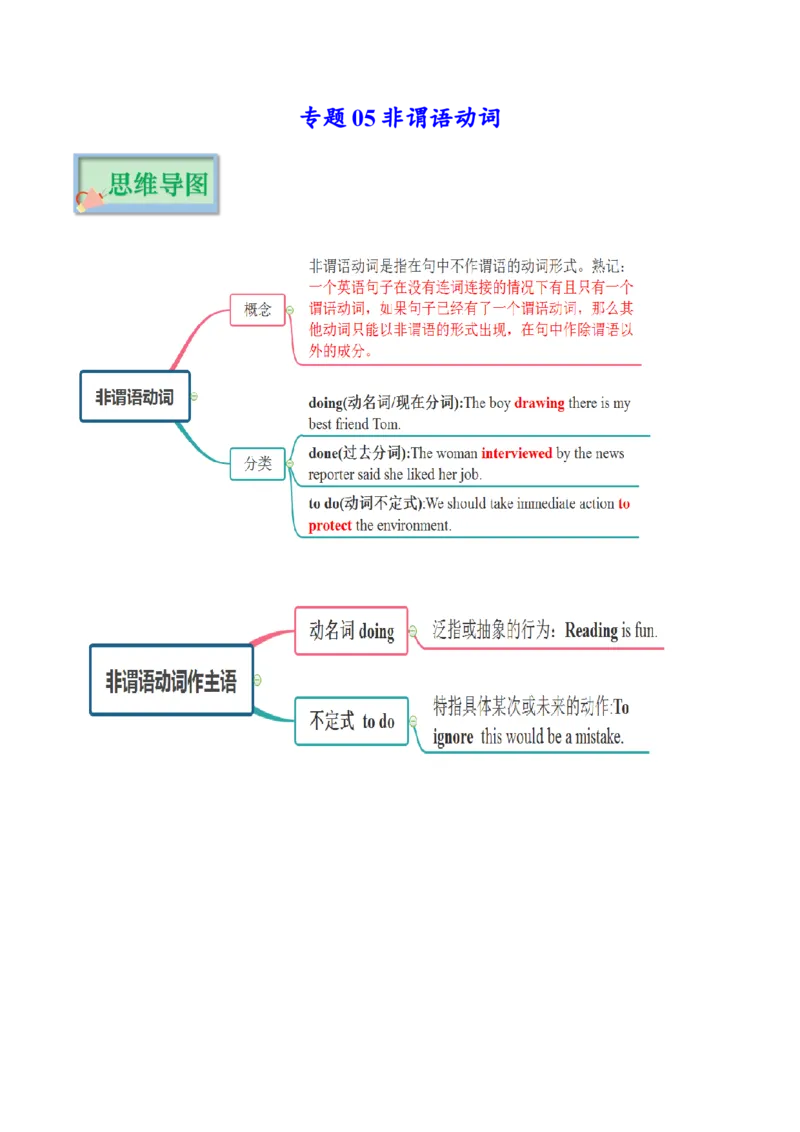
能作主语的非谓语动词有不定式和动名词。二者的区别是:表示某一具体的动作时,多用不定式;
表示比较抽象的一般行为倾向的,多用动名词。
动名词作主语时通常位于句首;不定式作主语时常置于句末,用it 作形式主语放在句首。
▶Smoking is prohibited(禁止)here. ( 抽象 )
▶It is not very good for you to smoke so much. ( 具体 )
注意:
①如果表语是不定式,主语也是不定式;表语是动名词,主语也是动名词。如:
▶To see is to believe.=Seeing is believing.
②常用动名词作主语的句型:
▶It’s no use complaining without taking action.不采取行动只是抱怨是没有用的。
二、动名词和不定式作宾语
1. 下列动词只能用不定式作宾语,请牢记下面的口诀
决心学会想希望,拒绝设法愿假装。
主动答应选计划,同意请求帮一帮。
decide/determine,learn,want,expect/hope/wish; refuse,manage,care,pretend; offer,promise,
choose,plan; agree,ask/beg,help。
此外,afford,strive,happen,wait,threaten等也要用不定式作宾语。
☞She pretended not to see me when I passed by.当我经过时,她假装没看见我。
2. 有些动词只能用动名词作宾语,巧记动词后跟动名词的口诀:
避免错过少延期, 建议完成多练习,
喜欢想象禁不住,承认否定与妒忌,
逃脱冒险莫原谅,忍受保持不在意。
avoid, miss, delay, suggest, finish, practice, enjoy, imagine, resist, admit, deny , envy, escape, risk,
pardon, stand, keep, mind
☞I would appreciate your calling back this afternoon.
今天下午如果你能给我回电话,我将非常感激。3. 注意区别下列动词后接不定式和动名词
①forget to do sth. 忘记要去做某事(此事未做)
forget doing sth. 忘记做过某事(此事已做过或已发生)
remember to do sth. 记得去做某事(未做)
remember doing sth. 记得做过某事(已做)
②stop to do 停止(某件事),目的是去做另一件事
stop doing 停止正在或经常做的事
go on to do 继续(去做另外一件事情)
go on doing 继续(原先没有做完的事情)
③regret to do sth. 对要做的事感到遗憾(遗憾地要去做某事)
regret doing sth. 对过去做过的事或未做过的事感到后悔(后悔做过或未做过某事)
④try to do 努力、企图做
try doing 试验、试一试某种办法
⑤mean to do (人)打算,有意要……
mean doing (物)意味着
⑥can't help (to) do sth. 不能帮助做某事
can't help doing sth. 情不自禁做某事
三、不定式、动名词和分词作表语
作表语用的非谓语动词有:不定式(to do),动名词(doing),和分词(done,doing)
■ 不定式作表语
①Her wish was to become an artist.
她的愿望是成为一位艺术家。
②The most important thing is to put theory into practice.
最重要的是要把理论应用到实践。
③Our aim is to help them,not to teach them a lesson.
我们的目的是帮助他们,而不是教训他们。
总结: 不定式作表语表示主语的具体内容,如①;表示将来的动作,如②;表示
目的,如③。因此,在表示“目的,愿望,梦想,需求”等名词作主语时其表语应
该用不定式。■ 动名词作表语
①My job is teaching.(Teaching is my job.)
②Seeing is believing. 百闻不如一见。
总结:动名词作表语,表示抽象概念。动名词作表语一般用来表示“身份,职
业”等。大部分时候主语与表语可以互换,如①。此外,还要注意主语与表语的一
致性,如②。例②还可以说成:
To see is to believe.
试比较:一般来说,表示比较抽象的一般行为时多用动名词作表语;
表示具体某次动作,特别是将来的动作时,多用不定式.
☞Their job is building houses.他们的工作是盖房子.
☞Our task now is to develop our economy.我们的任务是发展经济。
■ 分词作表语
首先做一些练习
①The situation is____(encourage).
②The door remained____(lock) when he came again.
【答案】①encouraging ②locked
总结: surprise,interest,excite,puzzle,disappoint,astonish,encourage,
inspire,shock,move等及物动词用作表语时,要看其与主语的关系。
如果与主语为主动关系,则用-ing形式,表示主语的特征。如果是被
动关系,用-done这种形式,表示主语的状态。
☞The news astonished us.
这句话就表明了the news与astonish为主动关系。astonish与us为被动
关系。那么就可以直接得出以下两个句子:
☞The news was astonishing.
☞We were astonished(by the news)
考点2 非谓语动词作定语
高考对非谓语动词作定语的考查主要包括以下几个方面的内容:
不定式作定语;
-ing分词作定语;-ed分词作定语。
1.不定式作定语
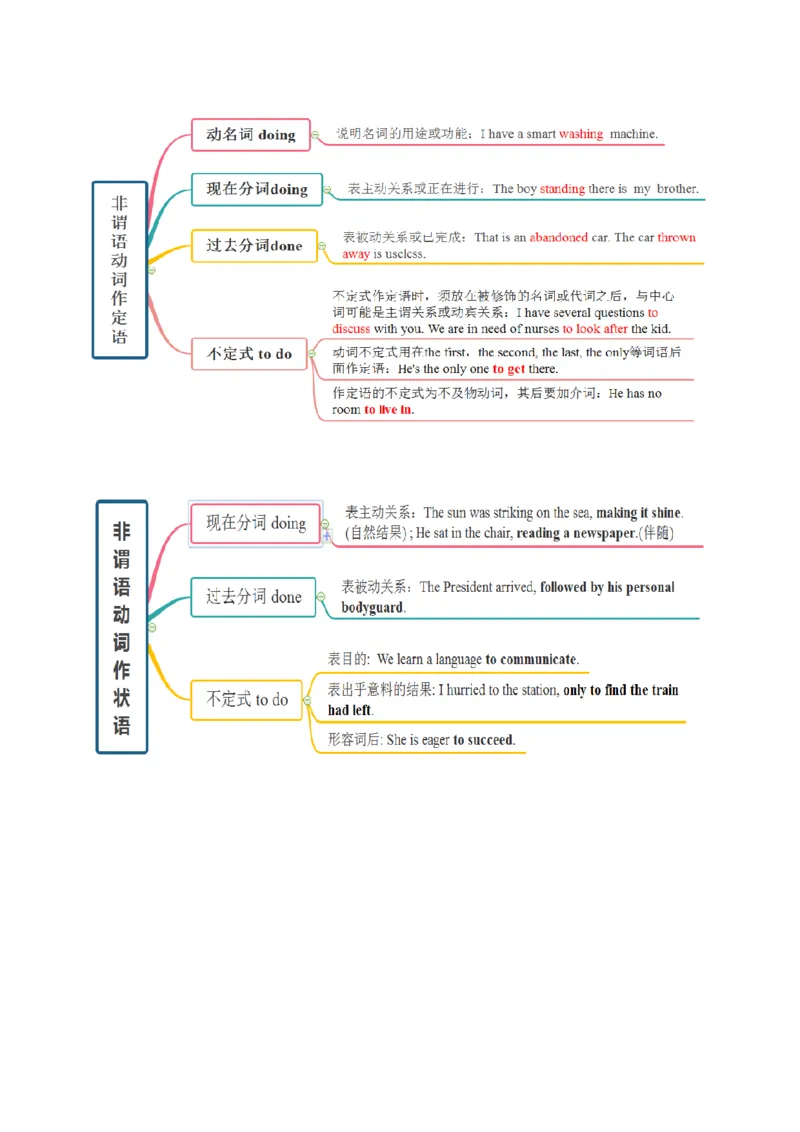
① 不定式作定语常用于不定代词或被the first/next/only/last等修饰的名词和其他一些名词、代词之后。其
中, 不定式的一般式通常表示一个将来或经常性的动作,完成式则表示该动作发生在谓语动词所表
示的动作
之前。
☞She is always the first (one) to come and the last to leave.
② 如果作定语的不定式与被修饰的名词有动宾关系,在不及物动词后通常要加上适当的介词.
☞Let's first find a room to live in / to put the things in.
☞We have nothing to worry about.(=There is nothing for us to worry about.)
③ 不定式作定语修饰一个在逻辑上是其宾语名词时,若在句子中能找到该不定式的逻辑主语, 则该不定式
多用主动表被动,否则,用被动式。
☞I have a lot of things to do today. ( I ... do ... things)
☞Have you got anything to say at the meeting? ( you... say ... anything)
☞Here is a letter to be taken to Mr. Li.
在there be句型中,有时用主动式或被动式意思不同。比较:
There is nothing to do at present.(=We have nothing to do at present.)
There is nothing to be done at present.(= We can do nothing at present.)
2.-ing分词作定语
① 单个的-ing分词作定语一般前置,说明名词的性质、特征或用途等,-ing短语作定语一般后置;强调动作
的
单个-ing分词也常后置。
a sleeping car ( = a car for sleeping ) a sleeping child ( = a child who is sleeping )
the boy standing there ( = the boy who is standing there )
The girl singing is my classmate.
② -ing分词作定语一般要求其动作与谓语动词所表示的动作同时发生或是在说话时该动作正在进行,否则,
要用从句作定语。
☞Do you know the boy talking ( = who is talking ) to the teacher?
☞Did you notice the boy sitting ( = who was sitting ) at this desk yesterday?
☞The man shaking ( = who is now shaking ) hands with Mr. Li visited our class yesterday.比较:
【误】He is the man visiting our class yesterday.
【正】He is the man who visited our class yesterday.
3.-ed分词作定语
-ed分词作定语一般表示一个被动或已完成动作,-ing分词表示一个主动或正在进行的动作。
a developed/developing country
He is a student loved by all the teachers.
The building being built will be the third Teaching Building of our school.
考点3 非谓语动词作补语
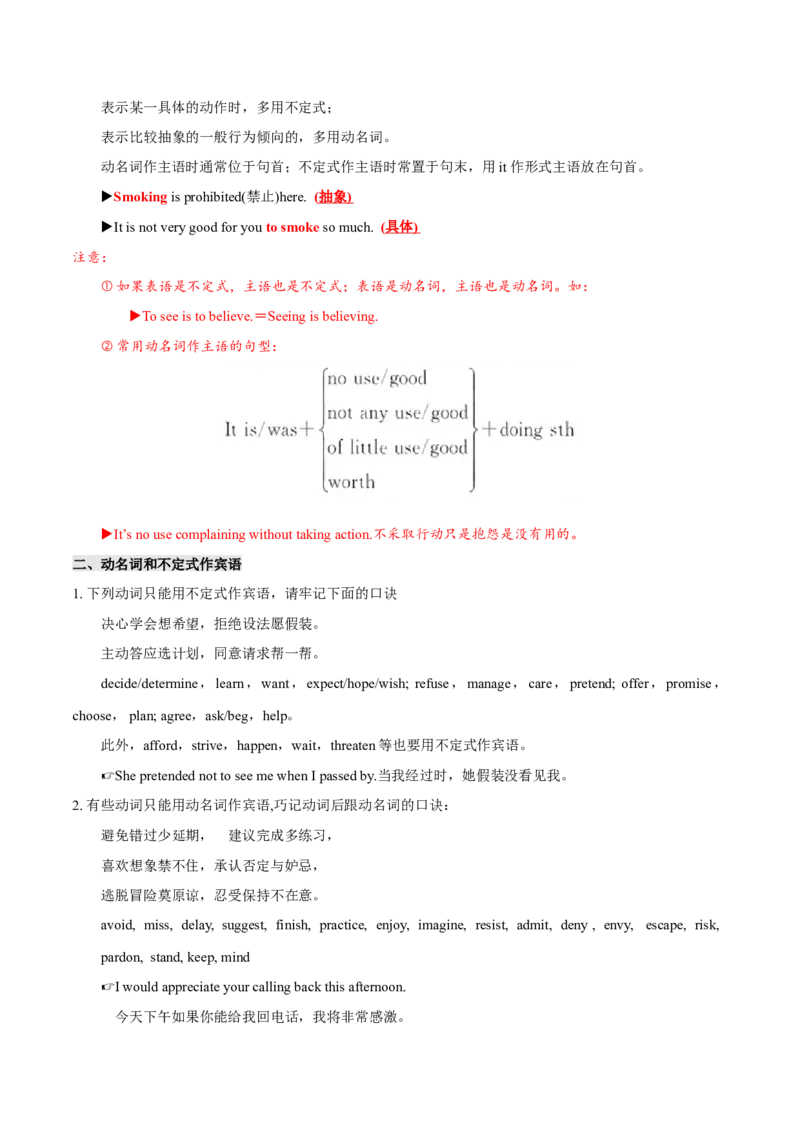
1. 带to的不定式( to do )作宾补的动词,常见的有:
ask, invite, tell, want, encourage, wish, expect, beg, request, require, advise, order, force, cause, allow, permit,
forbid, warn, remind, teach, send, call on, wait for, would like / love / prefer 等表示劝请、要求类动词后,用带
to的不定式作宾补。
☞ The teacher asked us to finish our homework.老师叫我们完成家庭作业。
☞ She wanted him to sing for her friends.她想让他为她的朋友唱歌。
☞ The policeman told the boys not to play in the street.警察告诉孩子们别在街上玩耍。
2. 常见的接不带to的不定式作宾补的动词:
一感:feel 二听:hear, listen to 三让:let, make, have
四看:see, watch, notice, observe
半帮助:help sb. to do/do sth.
表示某人做某事的全过程或某事发生的全过程,强调事物的发生和结束。
☞I saw him leave a few minutes ago.
我看见他几分钟前离开了。
☞To learn English well,we should find opportunities to hear English spoken as much as possible.
为了学好英语,我们应该尽可能多地找机会听英语。
☞The teacher raised his voice in order to make himself heard.
那个老师提高了嗓门以便别人能听到他。3. V-ing形式作宾补
V-ing形式作宾补,表示动作的过程,即动作正在进行,尚未结束。宾语与宾补之间是主动的逻辑主谓
关系。
☞I hear someone knocking at the door.
☞I’m sorry to keep you waiting for a long time.
4. V-ed形式作宾补
着重动作完成,表明动作的结果,它与宾语之间是被动的逻辑主谓关系。
☞He saw the thief caught by the police.
☞I’m going to have my hair cut.
考点4 非谓语动词作状语
1.不定式作状语
(1)作目的状语。注意其他非谓语动词形式不能用作目的状语。
☞To keep themselves awake they sat on the floor and told each other stories.
为了不至于睡着,他们坐在地板上轮流着讲故事。
(2)作结果状语,表示出乎意料的结果,经常与only连用。
☞We hurried to the station,only to be told that the train had left.
我们急匆匆赶到车站,结果被告知火车已开走了。
(3)作原因状语
①形容词或过去分词作表语时,后面可接不定式作原因状语。常见词有:happy,lucky,sorry,proud,
disappointed,surprised,ready,delighted,clever,foolish,pleased等。
☞We’re proud to be young people of China.
作为中国青年我们感到自豪。
②在“主语+系动词+表语(形容词)+to do”结构中,不定式的主动形式表示被动意义。该结构中常用的形
容
词有:easy,difficult,important,interesting,pleasant,comfortable,dangerous等。
☞The chair is very comfortable to sit on.
这把椅子坐上去很舒服。
【解题技巧】 动词的不定式用法口诀:不定式有标记,to与动词连一起。
没有人称数变化,动词特点它具备。
主宾定状表补语,唯独作谓不可以。
not 加上不定式,否定结构要牢记。
疑问词与不定式,构成短语有意义。
仔细推敲多思考,准确判断有依据。
2.分词作状语(表时间、原因、条件、结果、方式或伴随、让步等)
(1)作状语的分词要求其逻辑主语与句子的主语保持一致。
☞Satisfied with what he did,the teacher praised him in class.
由于老师对他所做的事情很满意,于是在班上表扬了他。
(2)若现在分词的动作发生在谓语动词所表示的动作之前,则用现在分词的完成形式(having done)。
☞Having cleaned the desks,we began reading.
擦完桌子后,我们便开始看书。
(3)若与句中主语为逻辑上的动宾关系,且先于谓语动词动作发生,用现在分词完成式的被动形式(having
been done)。
☞Having been shown the classrooms,we were taken to see the library.
我们被领着看了教室后,又被带去看图书馆。
(4)如句子的主语是分词动作的承受者,则要用过去分词(done)。
☞Seen from the top of the mountain,the city is very beautiful.
从山顶上看,这座城市很漂亮。
(5)如句子的主语是分词动作的发出者,就用现在分词形式(doing)。
☞Seeing from the top of the hill,we find the park even more beautiful.
从山顶上看,我们发现这个公园显得更加美丽。
难点剖析
独立主格结构
(一)独立主格结构的形式独立结构可分为两部分,一部分事名词或代词(主格),起着逻辑主语的作用;另一部分由形容词、
副词、名词、分词、不定式、介词短语等构成,表示前面名词或代词的状态或动作。
1. 名词/代词+形容词
☞I heard that she got injured in the accident , my heart full of worry.
我听说她在这次事故中受了伤,内心充满担忧。
☞He stood silent in the moon-light, his door open .月光下,门开着,他默默地站在那。
2. 名词/代词+现在分词
☞Winter coming ,it gets colder and colder. 冬天来了,天气越来越冷了。
☞The rain having stopped ,he went out for a walk. 雨停了,他出去散散步。
3. 名词/代词+过去分词
☞More time given ,we should have done it much better.
如果给我们更多时间,我们会做的更好。
☞The boy stood there , his right hand raised.
那个男生站在那里,右手高举。
4. 名词/代词(主格)+不定式
☞Here are the first two volumes , the third one to come out next month.
这是前俩卷,第三卷将于下雨问世。
☞The two boy said good-bye to each other ,one to go home ,the other to go to his friend\s
两个男孩彼此道了别,一个回了家,另一个去了他朋友家。
5. 名词/代词+介词短语
☞The huntsman entered the forest ,gun in hand.
那个猎人手里提着枪走进了树林。
注意:这里 gun in hand 还可以说成 with a gun in hand。 但不可以说 a gun in hand 或 gun in his hand。
6. 名词/代词+副词
☞Nobody in ,the thief took a lot of things away.
由于没有人,小偷拿走了许多东西。
☞Lunch over ,he left the house .But he was thinking.
午饭结束,他离开了路。但他还在考虑。
7. 名词/代词+名词
☞He fought the wolf ,a stick his only weapon.
他和狼搏斗着,唯一的为武器是一根棍棒。8. with 复合结构
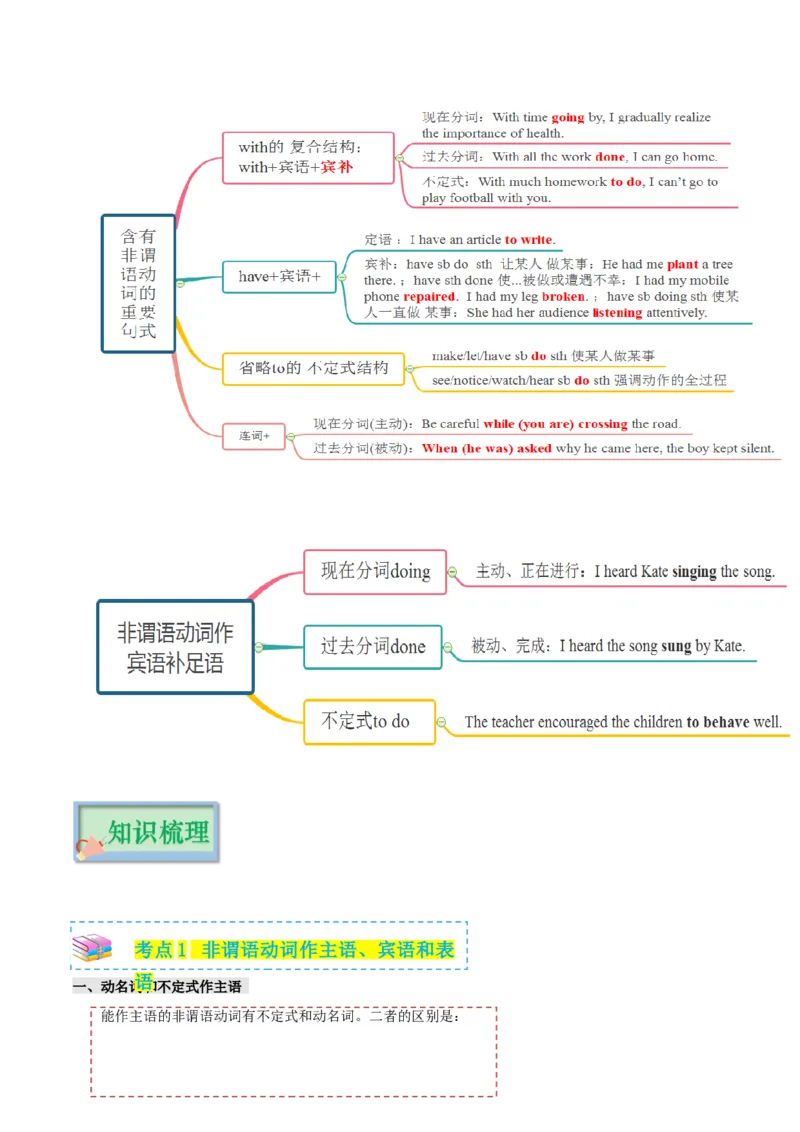
它的构成是:“with+宾语+宾语补足语”。宾语由代词、名词、名词词组充当,宾语由分词、不定式、
形容词、副词、介词短语、名词等充当。
☞Holms and Watson sat with the light on for half an hour.
福尔摩斯和沃森坐着,让灯亮了半个小时。(介词短语)
☞He used to sleep with the door open . 他过去常开着门睡觉 (形容词)
☞With a boy leading the way ,they started towards the village.
由一个小男孩领着路,他们朝那个村子去了。(现在分词)
☞With the work done ,he went home. 工作做完后,他回了家。(过去分词)
☞With you to help us, we will finish the task in time
有你来帮忙,我们将会及时完成任务。(不定式)
☞Hong Kong looks more beautiful with thou-sands of lights on night .
夜里,香港万盏灯火,分外美丽。(副词)
从以上例句可以看出:在with 复合结构中,宾语和宾补之间形成逻辑上的主谓关系。当这种主谓关系
表现为主动语态是,用现代分词:当这种主谓关系表现为被动语态是,用过去分词:当这种主谓关系表示
将来意义是,用不定时:当这种主谓关系辨识伴随意义时,用现在分词或副词。
(二)独立主格结构的用法
它表示谓语动词发生的时间、原因、条件或伴随情况等,相当于一个状语从句或并列句。
1. 作时间状语
☞The work done(=After the work had been done) , we went home. 工作完成后,我们才回家。
2. 作条件状语
☞Weather permitting(=If weather permits) , they will go on an outing to the beach tomorrow.
如果天气允许的话,他们将在明天组织一次海滨小游。
3. 作原因状语
☞An important lecture to be given tomorrow(=As an important lecture will be given tomorrow) , the
professor has to stay up late into the night.
因为明天要发表一个重要的演讲,教授不得不熬夜到很晚。
4. 作伴随状语
☞He was lying on the grass, his hands crossed under his head(=and his hands were crossed under his head) .
他躺在草地上,两手交叉枕在脑后。5. 表补充说明
☞A hunter came in, his face red with cold(=and his face was red with cold) .
一个猎人走了进来,他的脸冻得通红。
注:独立主格结构表示时间、条件或原因时,相当于一个状语从句,一般放在句首,表示原因时还可
放在句末;表伴随状况或补充说明时,相当于一个并列句,通常放于句末。