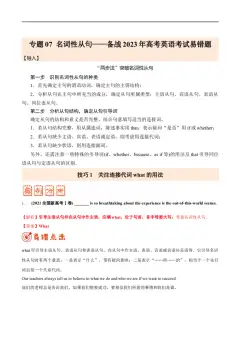
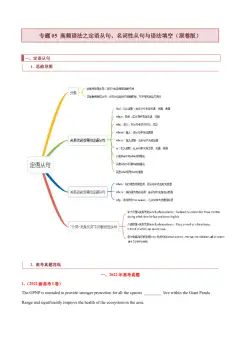
专题 06 从句
(定语从句、名词性从句、状语从句)
Part01 定语从句1:考点梳理
1. 引导定语从句的关系词;2. 限制性与非限制性定语从句的区别;
3. “介词+关系代词”的结构;
4. 关系词之间的异同及选用。
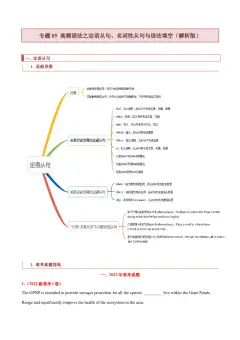
考点1 定语从句的种类
(1)限制性定语从句
从句在句中是不可缺少的部分,去掉后主句意思往往不明确,与主句之间不用逗号隔开。
This is the house which we bought last month.
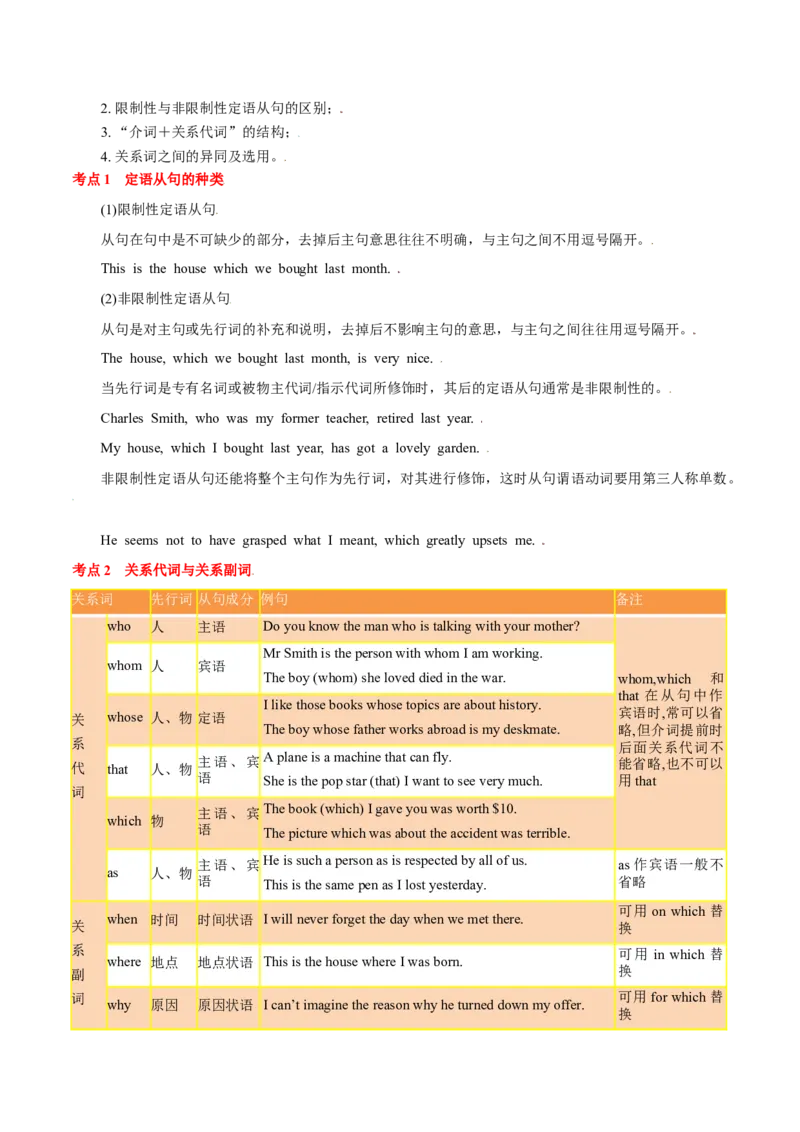
(2)非限制性定语从句
从句是对主句或先行词的补充和说明,去掉后不影响主句的意思,与主句之间往往用逗号隔开。
The house, which we bought last month, is very nice.
当先行词是专有名词或被物主代词/指示代词所修饰时,其后的定语从句通常是非限制性的。
Charles Smith, who was my former teacher, retired last year.
My house, which I bought last year, has got a lovely garden.
非限制性定语从句还能将整个主句作为先行词,对其进行修饰,这时从句谓语动词要用第三人称单数。
He seems not to have grasped what I meant, which greatly upsets me.
考点2 关系代词与关系副词
关系词 先行词 从句成分 例句 备注
who 人 主语 Do you know the man who is talking with your mother?
Mr Smith is the person with whom I am working.
whom 人 宾语
The boy (whom) she loved died in the war. whom,which 和
that 在从句中作
I like those books whose topics are about history.
关 whose 人、物 定语
宾语时,常可以省
The boy whose father works abroad is my deskmate. 略,但介词提前时
系 后面关系代词不
A plane is a machine that can fly.
代 that 人、物
主语、宾 能省略,也不可以
语 She is the pop star (that) I want to see very much. 用that
词
The book (which) I gave you was worth $10.
主语、宾
which 物
语
The picture which was about the accident was terrible.
主语、宾 He is such a person as is respected by all of us. as作宾语一般不
as 人、物
语 This is the same pen as I lost yesterday. 省略
可用 on which 替
when 时间 时间状语 I will never forget the day when we met there.
关 换
系 可用 in which 替
where 地点 地点状语 This is the house where I was born.
副 换
词 可用for which替
why 原因 原因状语 I can’t imagine the reason why he turned down my offer.
换考点3 关系代词that和which的特殊用法
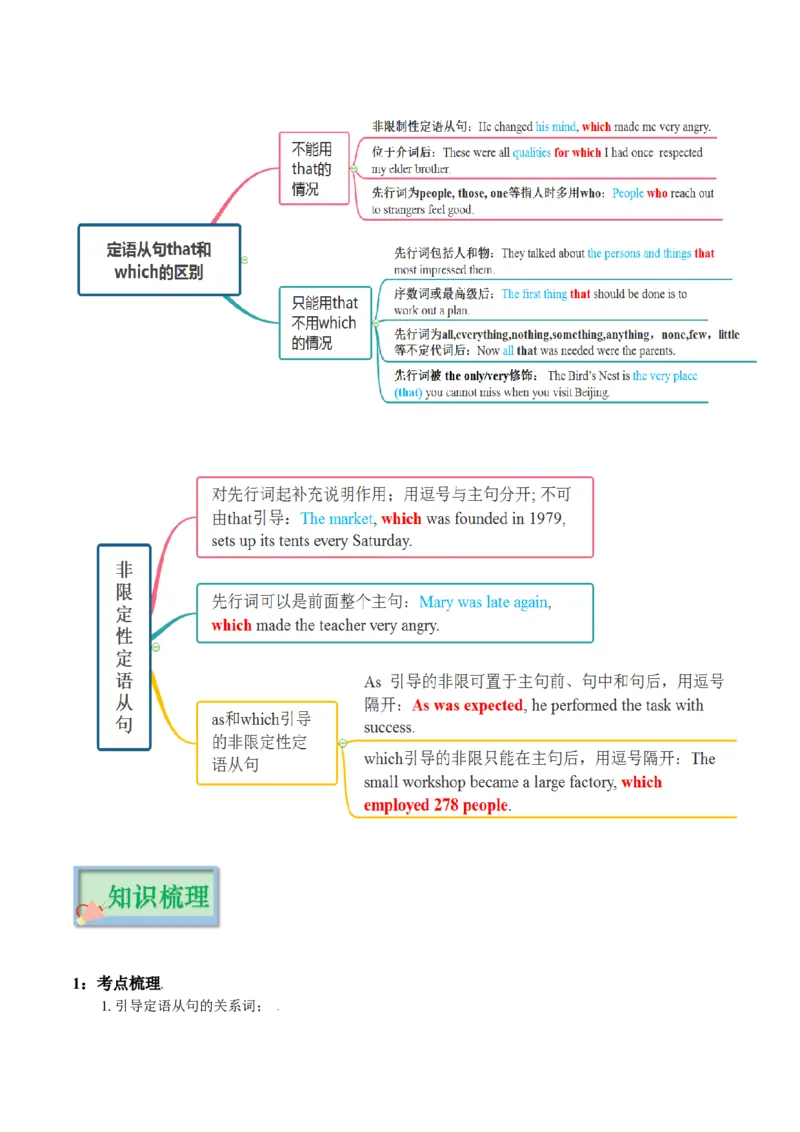
1. 限制性定语从句中,只用关系代词that的情况:
(1)先行词是all, everything, anything, nothing, little, much, few等不定代词。
I will tell you everything that I know.
(2)先行词被序数词或形容词最高级修饰。
What is the first foreign city that you have ever been to?
(3)先行词被the only, the very (正好), the last, all, any, every, no, little, much, some等限定词修饰。
Chatting is the only thing that interests her.
(4)先行词中既有人也有物。
The things and persons that they mentioned are strange to me.
(5)在which或who的特殊疑问句中含有定语从句。
Who is the boy that is lying under the tree?
2. 先行词指物时,只用关系代词which的情况:
(1)“介词+关系代词”结构中。
The house in which we live is very large.
(2)非限制性定语从句中。
He changed his mind, which made me angry.
(3)先行词本身是that。
What is that which you have put into your schoolbag just now?
考点4 限制性定语从句与非限制性定语从句的区别
类别 语法意义及特征 例句
对先行词起修饰限制作用,如果去掉,主句意思就不完
限制性定语从 The accident happened at the time
整明确,这种从句与主句的关系十分密切,写时不用逗号分
句 when I left.
开
对先行词作附加的说明,与主句的关系不是十分密切,
非限制性定语 His mother,whom he loved
较松散。从句和主句之间用逗号分开,相当于一个插入语,
从句 deeply,died ten years ago.
不能用that引导,关系代词作宾语时也不能省略
考点5 关系代词as和which的区别
1. 位置不同。
as引导的定语从句可位于句首、句中、句末;which引导的定语从句不能位于句首。
As we all know, life is not a bed of roses.
Life is not a bed of roses, which we all know.
2. 意义不同。as意为“正如,就像”,引导的从句表达人的观点、事物的习惯性等意义,主要起承上启下的作用;
which意为“这一点”,引导的从句在意义上相当于一个并列句,补充说明主句的状态或结果。
As often happened, they won the football game again.
It rained heavily, which prevented us from going out.
3. 当先行词被such, so, as等词修饰时,一般用as引导定语从句。
Such books as you want are sold out.
Part02 名词性从句1:考点梳理
5. 主语从句、宾语从句、表语从句的基本用法;6. 易混引导词的辨析;
7. 名词性从句、定语从句和状语从句的区分。
考点1 基本用法
引导词
常见引导词 作用
类别
what, which, who, whose, whom, 有词义,在从句中担任主语、表语、
连接代词
whatever, whichever, whoever, whomever 宾语、或定语等成分
how, when, where, why, however,
连接副词 有词义,在从句中担任状语成分
whenever, wherever
除that外均有词义,在从句中不担任
从属连词 that, whether, if
成分,只起连接作用
考点2 主语从句
1. 引导词
在复合句中充当主句主语的从句叫作主语从句。主语从句的常见引导词有:
(1)从属连词: that, whether, if
(2)连接代词:what, which, who, whose, whom, whatever, whichever, whoever, whomever
(3)连接副词:how, when, where, why, however, whenever, wherever
2. it作形式主语
在通常情况下,that引导主语从句时,常用it作形式主语,而将that从句置于句尾。用it作形式主语
通常有以下四种句型:
(1)It+be+形容词+从句:
It is necessary that... 有必要……
It is important that... 重要的是……
It is obvious that... 很明显……
(2)It+be+过去分词+从句:
It is believed that... 人们相信……
It is known to all that... 众所周知……
It has been decided that... 已决定……
(3)It+be+名词(短语)+从句:
It is common knowledge that... ……是常识
It is a surprise that... 令人惊奇的是……
It is a fact that... 事实是……
(4)It+不及物动词/动词短语+从句:
It appears that... 似乎……It happens that... 碰巧……
It occurs to sb. that... 某人突然想起……
It doesn’t matter whether... ……没有关系
考点3 宾语从句
动词+宾语从句 I want to know what he has told you.
介词+wh-类连接词引导的宾语
His father is worried about whether he would lose his work.
从句
Have you heard anything beyond that he is ill?
besides/beyond/but/except/that (除了) Criticism and self-criticism is necessary but that it helps us
correct our mistakes.
find,feel,think,consider,make,beli
eve等+it+宾语补足语+that引导的宾 I think it necessary that we take plenty of boiled water every day.
语从句
hate,enjoy,like,love,dislike,see to
I hate it when they talk with their mouths full of food.
等+it+宾语从句
形容词+宾语从句 I’m sure that they can make it.
考点4 表语从句
1. 引导词
在复合句中充当表语的从句叫作表语从句,可接表语从句的连系动词有be, seem, look, sound, taste,
feel, remain, appear等。表语从句的常见引导词有:
(1)从属连词: that, whether
(2)连接代词: what, which, who, whose, whom, whatever, whichever, whoever, whomever
(3)连接副词: how, when, where, why
2. 几种特殊的表语从句
(1) as if/though 引导的表语从句
此类表语从句常出现在seem, look, sound, taste, feel, appear等连系动词后,从句可用陈述语气,也可
用虚拟语气。
It sounds as if you are from Canada.
It seemed as if she had heard the news.
(2) because和why引导的表语从句
此类表语从句常用于以下句型:
this/that is why... 这/那是……的原因
this/that is because... 这/那是因为……
注意:主句主语是reason时,表语从句一般由that引导,而不用because或why。The accident that happened yesterday was because the driver had been drunk.
The reason for yesterday’s accident is that the driver was drunk.
考点5 同位语从句
常见的能接同位语从句 belief,fact,hope,idea,doubt,news,conclusion,suggestion,problem,order,answer,
的名词 decision,explanation,information,thought,word
同位语从句一般用that引导,但根据语境的不同,也可以用其他的连接代词
引导词
和连接副词。引导同位语从句的that不能省略
The news that our women volleyball team had won the championship
encouraged us all greatly.
例句
The question where we shall have a meeting hasn’t been decided.
考点6 连词whether和if在名词性从句中的使用
1. 用whether或if均可的情况
(1) whether可引导各种名词性从句。引导大部分动词后的宾语从句时,两者均可。
(2) it作形式主语,且主语从句在句末时,两者均可引导主语从句。
It hasn’t been decided whether/if we shall study abroad.
2. 用whether而不用if的情况
(1)主语从句和宾语从句置于句首
Whether we will go camping depends on the weather.
Whether he will succeed, I can’t say.
(2)引导表语从句和同位语从句
The question is whether we can get in touch with him.
He must answer the question whether he will attend the meeting.
(3)引导介词的宾语从句
Everything depends on whether we have free time.
(4)引导词与or not连用
He doesn’t know whether or not he is going to stay.
(5)引导词后接to do
They needed more time to consider whether to hold a meeting.
(6)有些动词如discuss, decide等后的宾语从句
We discussed whether we should hold a meeting.
(7)避免用if引导产生歧义
Let me know whether you are coming to our party.Part03 状语从句1:考点梳理
8. and和but的用法区别;
9. while表对比的用法。
10. 时间、地点、原因、结果、目的、让步、条件、方式和比较状语从句等;
11. 常用的引导状语从句的连词。
考点1 基本用法
1. 并列句的用法及常见连词
用法 连词
表并列、递进或顺 and,both... and...,neither... nor...,not only... but also... ,as well as承关系
表转折关系 but(不可与although/though连用), yet
表选择关系 either... or... ,not... but...,or,or else,rather than
表因果关系 for(表“由于”,一般不放在句首),so
and与or用 祈使句+and+陈述句,and表顺承
于并列句 祈使句+or+陈述句,or表转折
while表对比 强调对比关系,意为“然而;而”
2. 状语从句的类型及常见连接词
状语从句类型 常见连接词
when, while, as, before, after, since, till, until, immediately, as soon as,
时间状语从句
every time
地点状语从句 where, wherever
though/although, even if/even though, while, “疑问词-ever”, “no
让步状语从句
matter+疑问词”
条件状语从句 if, once, unless, in case, as/so long as, on condition that
because, as, since, now that, seeing that, in that, considering that, for the
原因状语从句
reason that
结果状语从句 so that, so/such... that
目的状语从句 so that, in order that, for fear (that), in case
比较状语从句 than, as... as, not so... as
方式状语从句 as, as if/as though
考点2 时间状语从句
关联词或短语 意义 例句
He jumped up when the phone rang.
We listened while the teacher read.
当…
when,while,as The phone rang just as I was leaving.
…的时候
(as强调主、从句动作同时或几乎同时发生;while从句的谓语动
词必须是延续性动词,不能是非延续性动词)
Jane completed her last novel Persuasion in 1816,but it was not
till,until 直到 published until after her death.(until要与延续性动词连用;not...until 要
与非延续性动词连用)
It is two years since he joined the army.他参军两年了。
It is two years since he smoked.他戒烟两年了。
since 自从
(其后所用动词不同,该动词所表示动作持续时间的计算方法也
不同)
the moment,the minute,the 一…… Tell him the news as soon as you see him.instant,the second;no I recognized her the moment (that) I saw her.
sooner...than...;hardly...wh
就…… I want to see him the minute (that) he arrives.
en...;as soon as;directly,
I went home directly I had finished work.
immediately,once
Once he arrives,we can start.
考点3 结果状语从句
关联短语或结构 意义 例句
He didn’t plan his time well,so that he didn’t
so that 结果
finish his work in time.
Xiao Ming is so clever that all his teachers like
so+形容词/副词+that从句
him.
so+形容词+a/an+单数可数名词+that It is so beautiful a scenery that many people
从句 如 look lost in it.
此……
so+ many/much/little/few+名词+that从 There was so little water in the jar that it was
句 以至于 not enough for all of us.
such+a/an+形容词+单数可数名词+that …… We left in such a hurry that we forgot to lock
从句 the door.
such+形容词+可数名词复数/不可数名 They are such interesting books that I want to
词+that从句 read them once more.
考点4 让步状语从句
关联词或短语 意义 例句
Although/Though small,the company has about 1,000 buyers in
though,although 虽然 over 30 countries.(although和though用正常语序,可和yet连用,但
不可和but连用)
Hard as/though he works,he makes little progress.=Though he
works hard,he makes little progress.
as 虽然
(在让步状语从句中常用倒装形式,可被though替换)
even if,even though 即使 Even though/if you say so,I do not believe it.
no matter
Whoever breaks laws will be punished.=No matter who breaks
what,whatever,no matter
laws,he/she will be punished.
who,whoever,no matter 无
which,whichever,no matter 论…… (“疑问词+ever”=“no matter +疑问词”,“疑问词+ever”也可以
how,however,no matter 引导名词性从句)
when,whenever
While he loves his students,he is very strict with them.
尽管,
while
虽然 (一般位于句首,用于句中时,译为“然而”,表对照对比关系)
无论
whether...or not Whether you believe it or not,it is true.
(是否)
考点5 条件状语从句
引导条件状语从句的常用连接词有if, once, unless, in case, as/so long as, on condition that,
supposing (that), given (that), providing/provided (that) 等。1. if
(1)若主句为将来时,if从句多用一般现在时表将来。
If it snows tomorrow, we will go skiing.
(2) if possible/necessary意为“如有可能,如有必要”。
If (it is) necessary, please bring your computer here.
(3) only if和 if only
only if意为“只有”, 置于句首时主句的主谓要用部分倒装。if only 意为“但愿,要是……就好
了”,引导的从句要用虚拟语气。
Only if you work harder can you catch up with others.
If only it could be sunny tomorrow.
2. unless
unless引导条件状语从句,表示“除非,否则”,可替换成if... not...。
Please don’t speak, unless you are invited.
=Please don’t speak, if you are not invited.
考点6 比较状语从句
比较状语从句一般位于句尾,常用than, as... as..., not as/so... as...等引导。
1. than前的形容词和副词用比较级形式。
It’s easier than I thought.
I sing better than he does. = He doesn’t sing as well as I do.
2. as... as...表示“前者与后者一样……”,not as/so... as...表示“前者不如后者……”,形容词和副
词均用原级。常用于以下句型:
as+adj. /adv. +as
as+adj. +a/an+可数名词单数+as
as+many/few+可数名词复数+as
as+much/little+不可数名词+as
I have as good a sister as you have.
I’m not as considerate as so many people seem to think.
They are having almost as much unemployment as we are.
考点7 状语从句中的省略
1. 在时间、地点、条件、方式、让步或比较状语从句中,当从句和主句主语一致,且从句中又有be
动词时,可将从句主语及be动词省略。He opened the desk drawer, as if (he was) in search of something important.
2. 当从句主语为代词it,从句中又有be动词时,从句主语及be动词可省略。
Come along with your teacher if (it is) possible.
3. 当从句是there be结构时,there be可省略。
You can ask me questions if (there are) any.
4. 在as, than引导的状语从句中,可省略与主句中重复的任何成分及be动词。
She speaks English better than he (speaks English).
You should do it as (you were) told to (do it).
考点8 状语从句中的倒装
1. no sooner... than...和hardly/scarcely... when...引导时间状语从句,no sooner和hardly/scarcely位于
句首时,需将no sooner和hardly/scarcely所在的句子部分倒装,且常用过去完成时,其后的than和when
连接的句子不倒装,常用一般过去时。
Hardly had he begun to speak when his wife stopped him.
2. not until...位于句首时,主句要部分倒装,not until从句不倒装。
Not until he came back yesterday evening did we finish the work.
3. if虚拟条件状语从句谓语含were, should, had时可将if省略,把were, should, had移至主语前。
Should he be here (= If he should be here) next week, he would help us.
4. so... that...和such... that...引导的结果状语从句中,若将“so +adj./adv.”或“such +n.”置于句首,
主句要部分倒装。
So moved was she that she could not say a word.
5. as/though引导让步状语从句的倒装结构为:名词/形容词/副词/分词+as/though+主语+谓语,动词
+as/though+主语+助动词。若是可数名词单数,前置时要省略冠词a/an。
Child as/though he is, he can take care of himself.
Try as/though he might, he could not find a job.
Much as/though I like it, I won’t buy it.
6. however, whatever引导的让步状语从句。
However/No matter how hard he worked, he couldn’t solve the problem.
Whatever/No matter what reasons you have, you should carry out your promise.