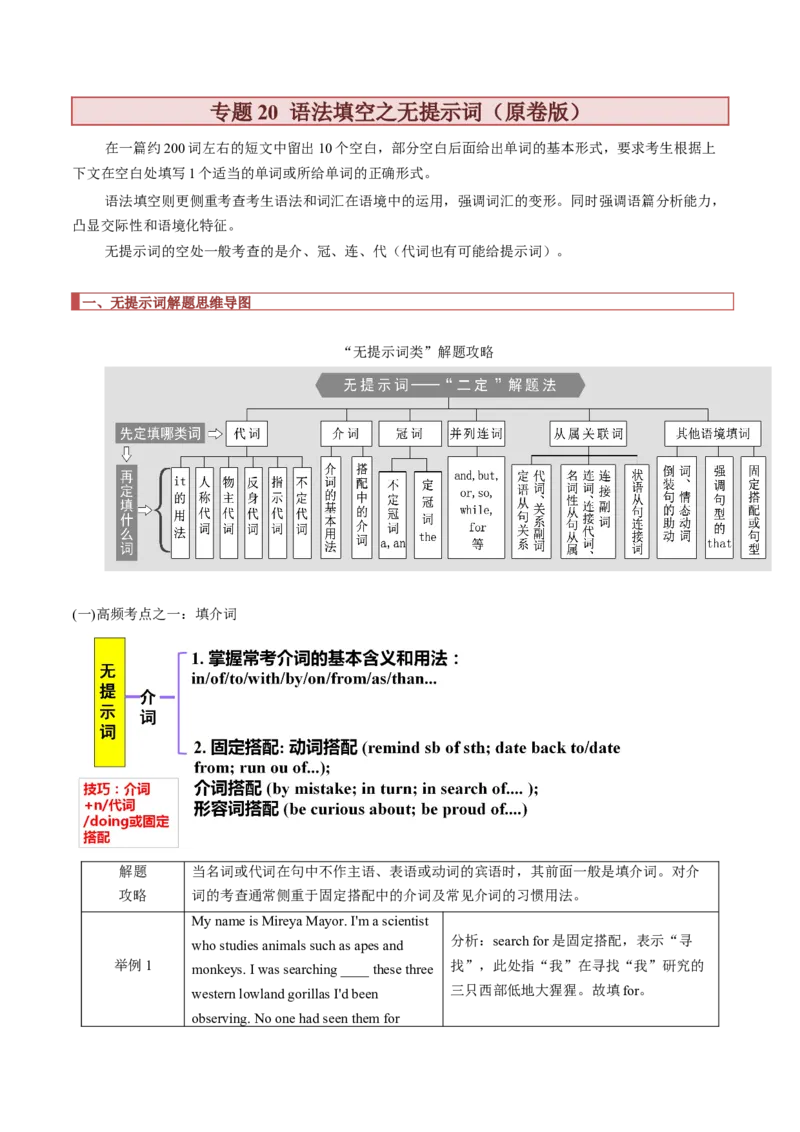
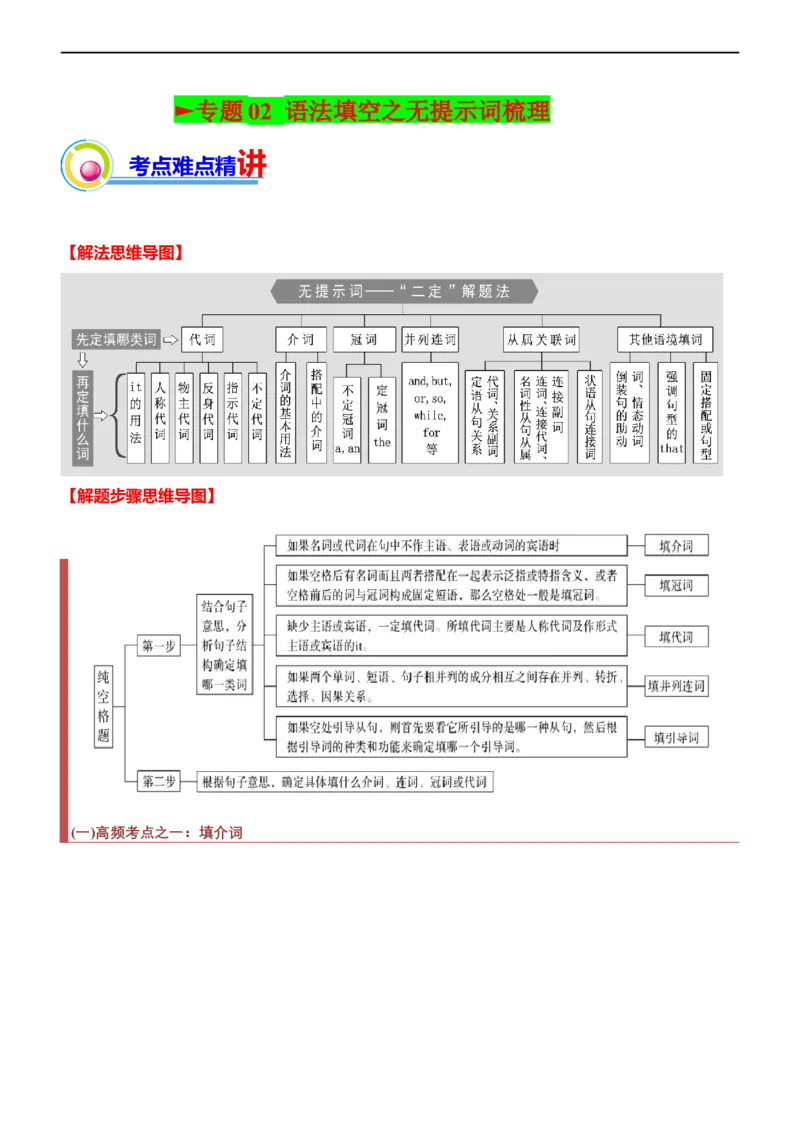
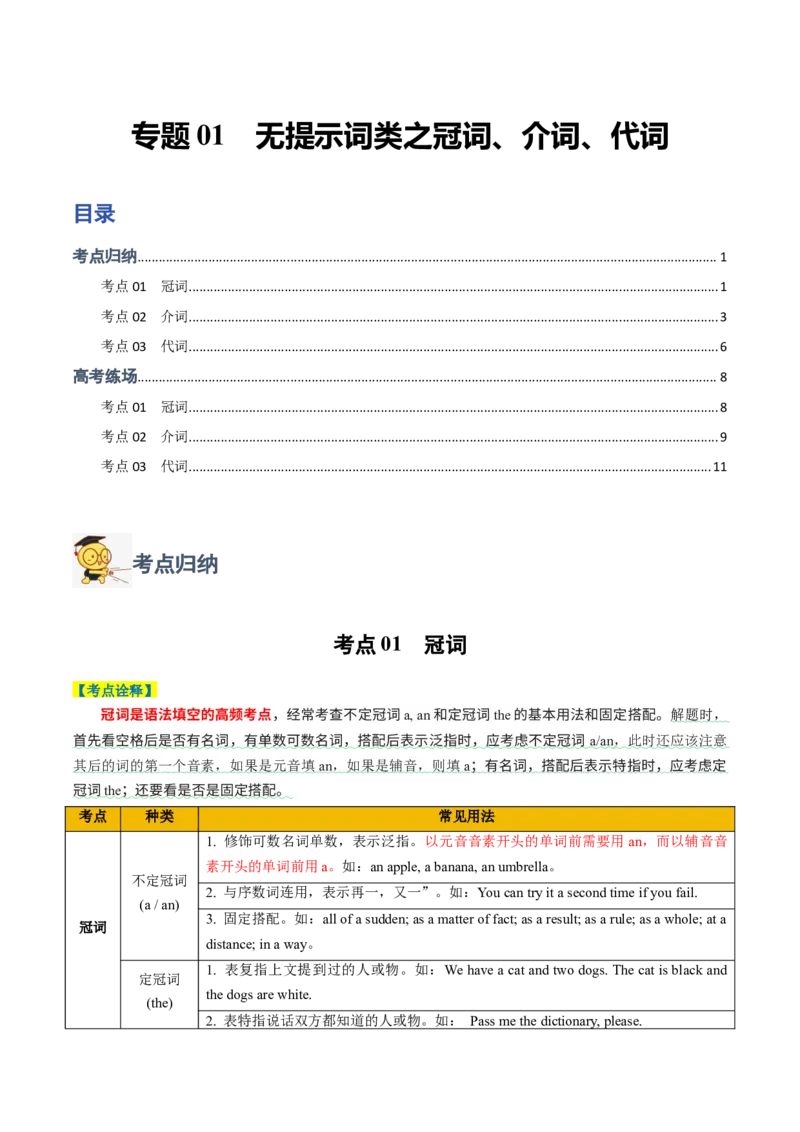
专题 01 冠词 代词 介词
Part 01 冠词考点1 不定冠词
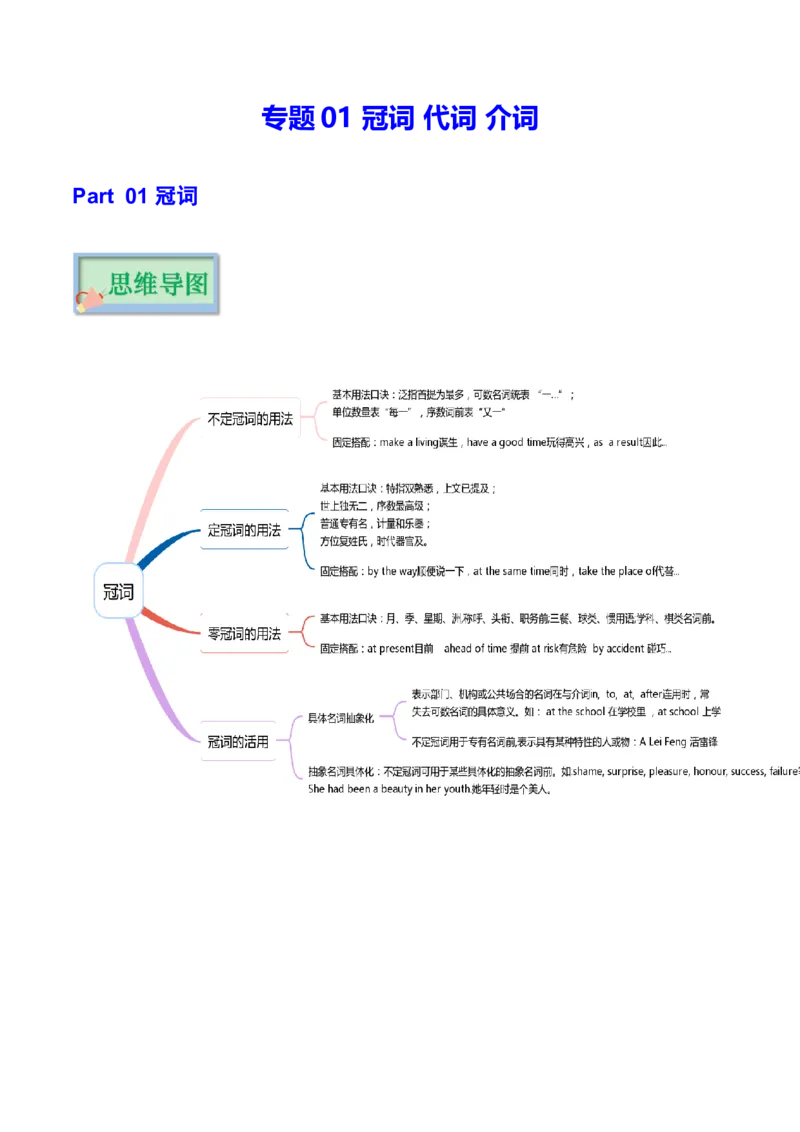
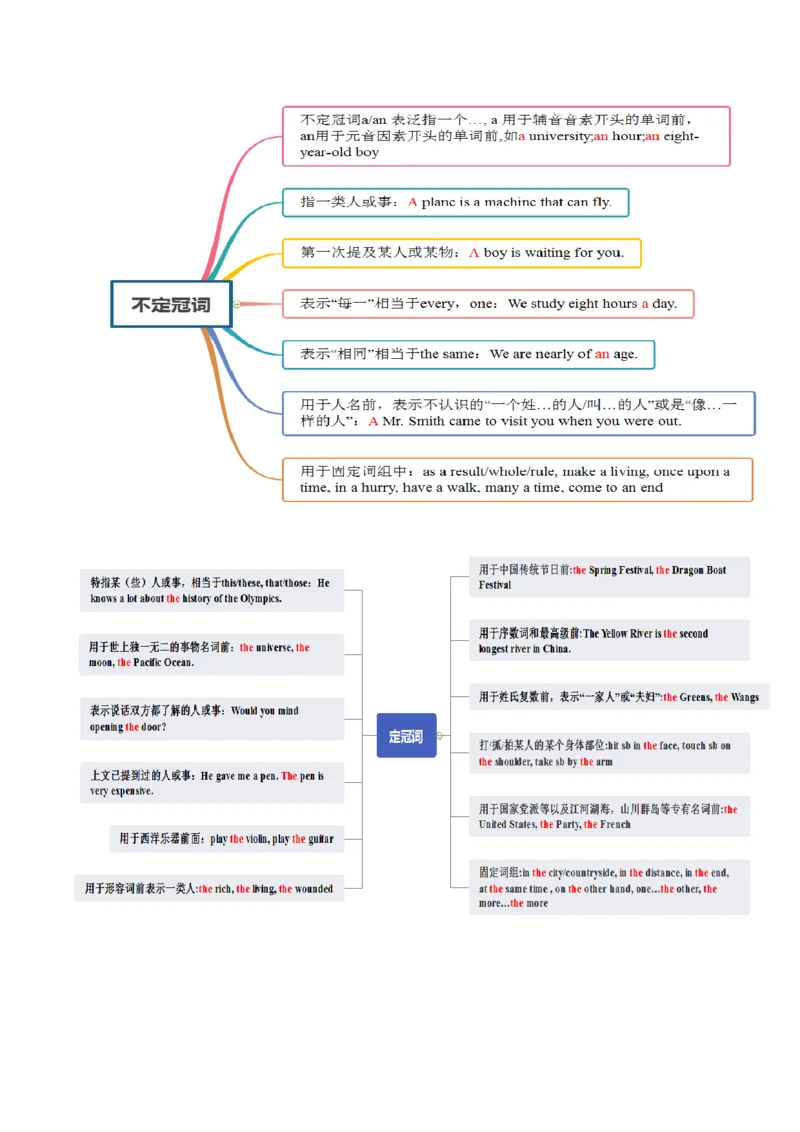
1. 与可数名词单数连用, 表示类别,泛指一类人或事物。
☞ —I knocked over my coffee cup. It went right over the keyboard.
—You shouldn’t put drinks near a computer.
2. 用来表示不确定的某一个, 相当于 a certain。
☞—Hello, could I speak to Mr. Smith?
—Sorry, wrong number. There isn’t a Mr. Smith here.
3.用于数量、时间等名词前, 表示"每一(单位)的……"。
☞I earn 10 dollars an hour as a supermarket cashier on Saturdays.
4. 在抽象名词、物质名词前(特别是这两种名词有定语修饰时)用不定冠词, 使之意义具体化, 表示"一种"、
"一件"、"一份"等。☞It is an honour for me to be invited to the party.我被邀请参加聚会是一种荣誉。(honour是抽象名词,an
honour指一件荣誉的事)
5. 不定冠词用在序数词前不表示排序,而表示"再一,又一"。
☞She didn’t like the color of the two bags and asked for a third one.
她不喜欢这两个包的颜色,又要了一个。
【巧学妙记】
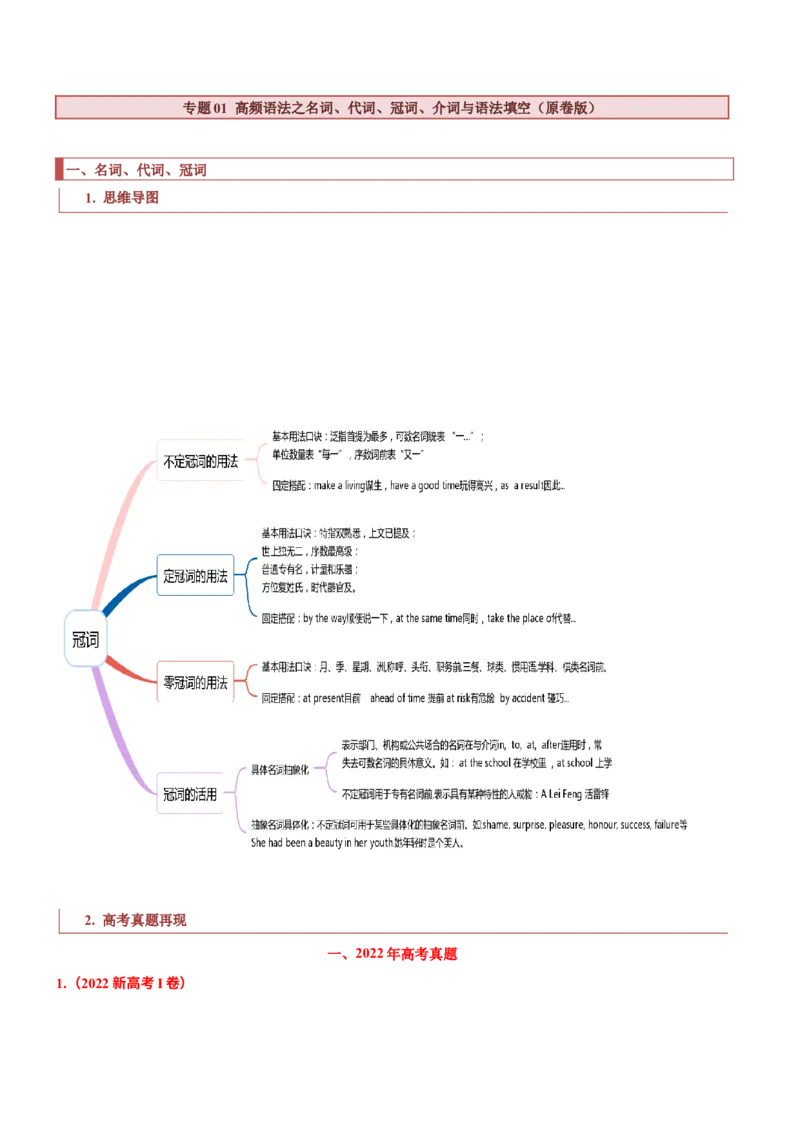
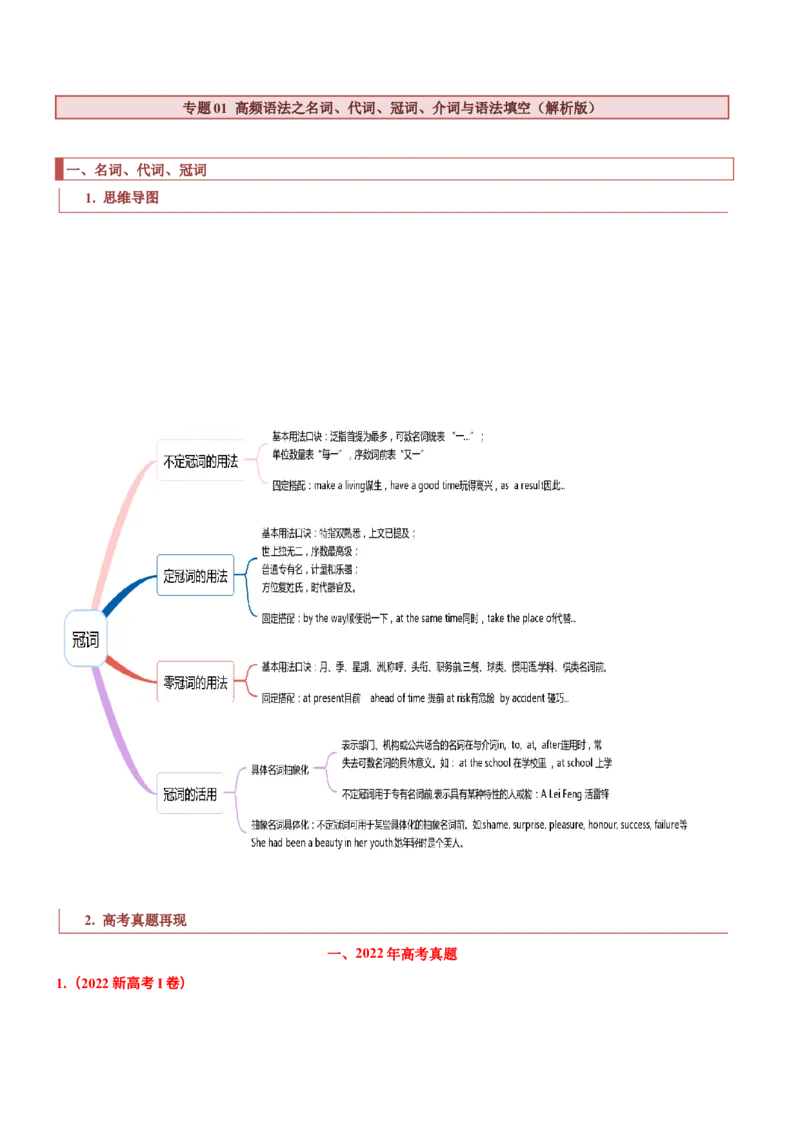
不定冠词的用法口诀
泛指单数和首提,某个/每个/又一个;
物质名词具体化,相同还是抽象词;
三餐四季有修饰,感叹句中有名单。
注释:
①泛指的单数可数名词前和首次提到的单数可数名词前;
②表示又一个,某一个(a second;a certain...);
③具体化的物质名词和抽象名词前(a success,a surprise...);
④有修饰词的三餐和四季前(a wonderful supper…);
⑤感叹句中有单数可数名词(What a lovely girl!...) 。
有些单词以元音字母开头,但读音却以辅音开头,这些单词前要用不定冠词a;
相反,有些以辅音字母开头、读音却以元音开头的单词前要用不定冠词an。如:
a useful book,an hour,an honest child等。
考点 2 定冠
词
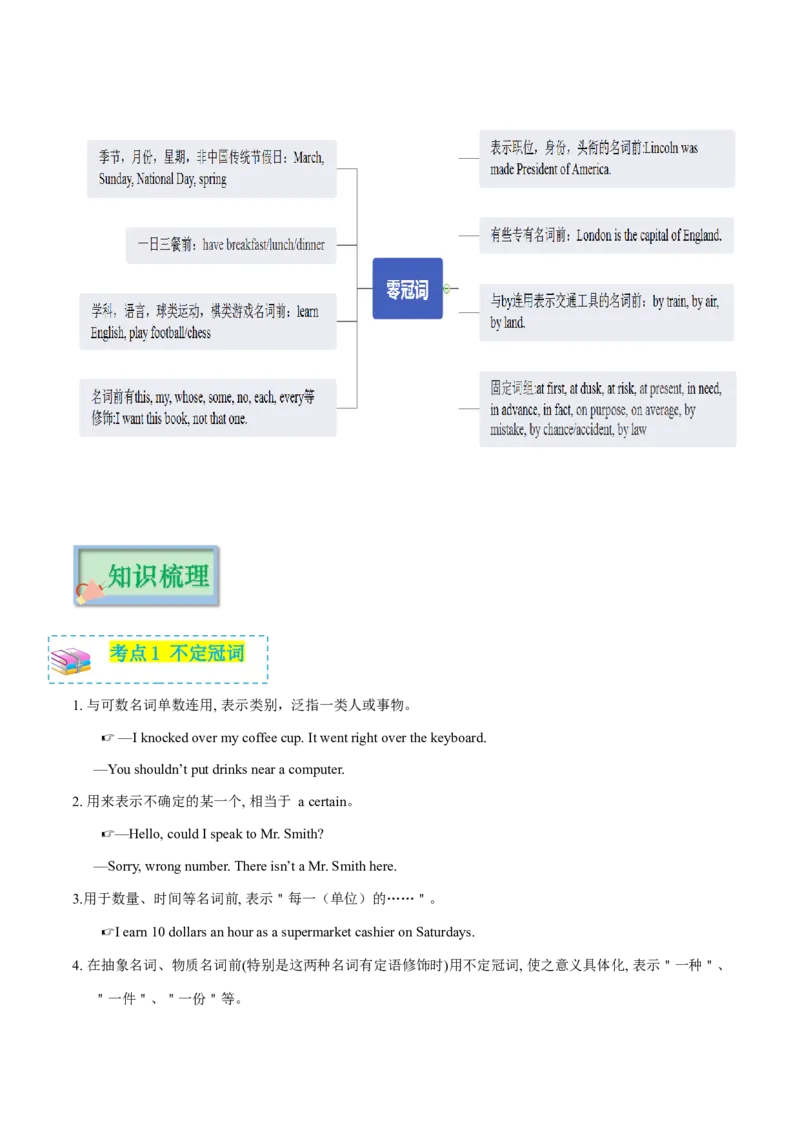
1. 用来特指某(些)人或某(些)事物。所特指的名词常被短语或定语从句所修饰。
☞Of all the reasons for my decision to become a university professor, my father’s advice was the most
important one.
2. 指说话的双方都知道的人或事物。
☞Don’t worry if you can’t come to the party. I’ll save some cake for you.
3. 复述上文中提到的事物。☞There is a shelf in my father’s room. The shelf is new.
4. 用于单数可数名词之前, 表示该类事物, 相当于 a。
☞When you come here for your holiday next time, don’t go to the hotel; I can find you a bed in my flat.
5. 序数词和形容词最高级前。比较级前若表示特指时也要用定冠词 the。
☞The cakes are delicious. He’d like to have a third one because the second one is rather too small.
6. 用于复数姓氏之前, 表示"夫妇"或"全家"。
☞The Whites settled down in Canada last year.
去年怀特一家在加拿大定居。
7. 表示世界上独一无二事物的名词前。
☞the sun, the moon, the earth, the world
8. 用于由普通名词构成的专有名词、江河、山脉、湖泊、海洋、群岛、海峡、海湾运河及些建筑物等名
称前。
☞According to the World Health Organization, health care plans are needed in all big cities to prevent the
spread of AIDS.
9. 定冠词the和形容词、过去分词连用,表示一类人或事物。
☞Many of the injured are still in danger.
许多受伤者仍处于危险中。
☞the rich the poor, the old
the wounded the living the dead
10. 用在方位名词和西洋乐器名词前。
☞the east 东部 play the piano 弹钢琴
【巧学妙记】
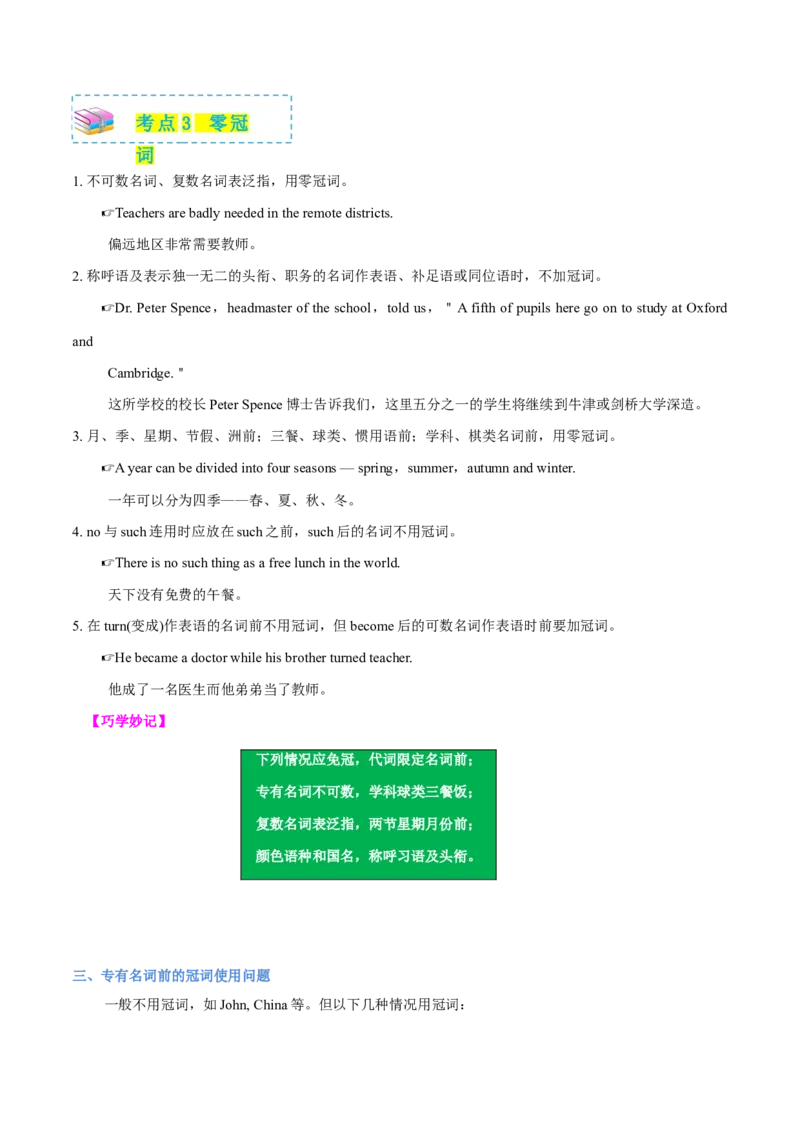
定冠词的用法口诀:
特指双知上文提,独一无二普遍专;
方位顺序最高级;赛项乐器影剧院;
姓氏复数一家人,形容词前可数单;
群岛河山江湖海,沙漠海峡和海湾。
阶级党派国全名,组织团体与机关。
连续应用比较级,朝代年代按天算。考点 3 零冠
词
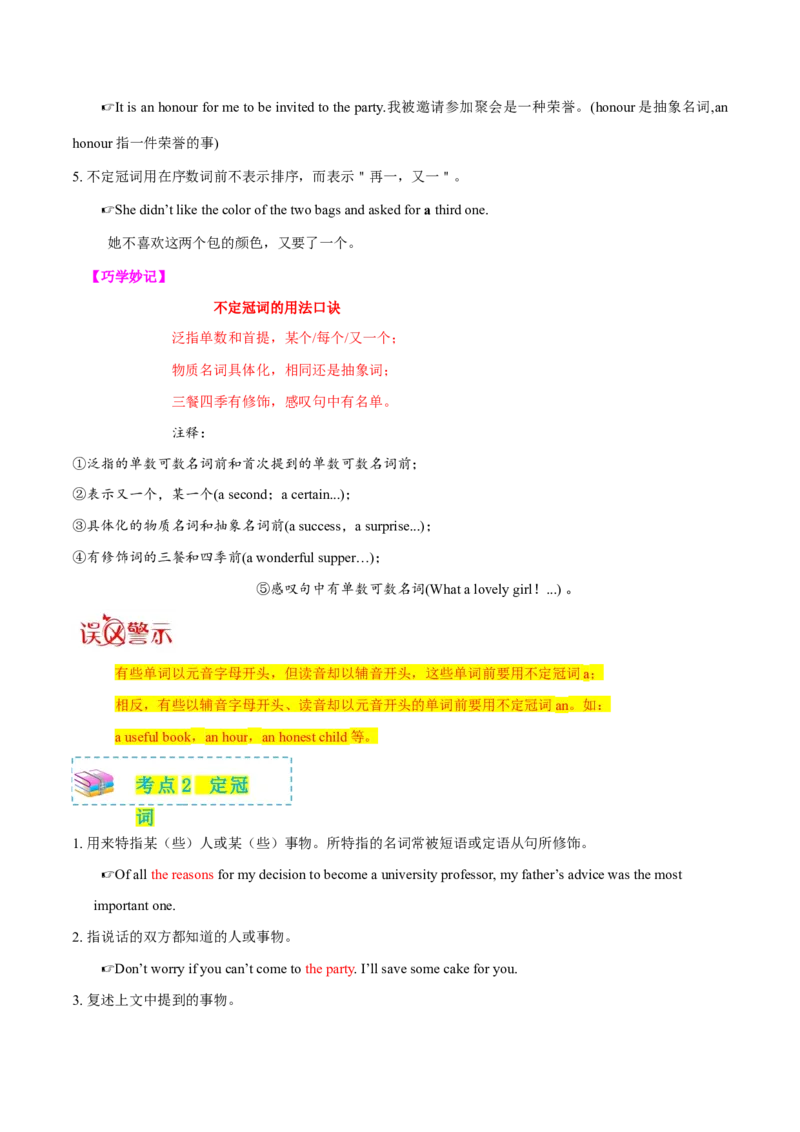
1. 不可数名词、复数名词表泛指,用零冠词。
☞Teachers are badly needed in the remote districts.
偏远地区非常需要教师。
2. 称呼语及表示独一无二的头衔、职务的名词作表语、补足语或同位语时,不加冠词。
☞Dr. Peter Spence,headmaster of the school,told us,"A fifth of pupils here go on to study at Oxford
and
Cambridge."
这所学校的校长Peter Spence博士告诉我们,这里五分之一的学生将继续到牛津或剑桥大学深造。
3. 月、季、星期、节假、洲前;三餐、球类、惯用语前;学科、棋类名词前,用零冠词。
☞A year can be divided into four seasons — spring,summer,autumn and winter.
一年可以分为四季——春、夏、秋、冬。
4. no与such连用时应放在such之前,such后的名词不用冠词。
☞There is no such thing as a free lunch in the world.
天下没有免费的午餐。
5. 在turn(变成)作表语的名词前不用冠词,但become后的可数名词作表语时前要加冠词。
☞He became a doctor while his brother turned teacher.
他成了一名医生而他弟弟当了教师。
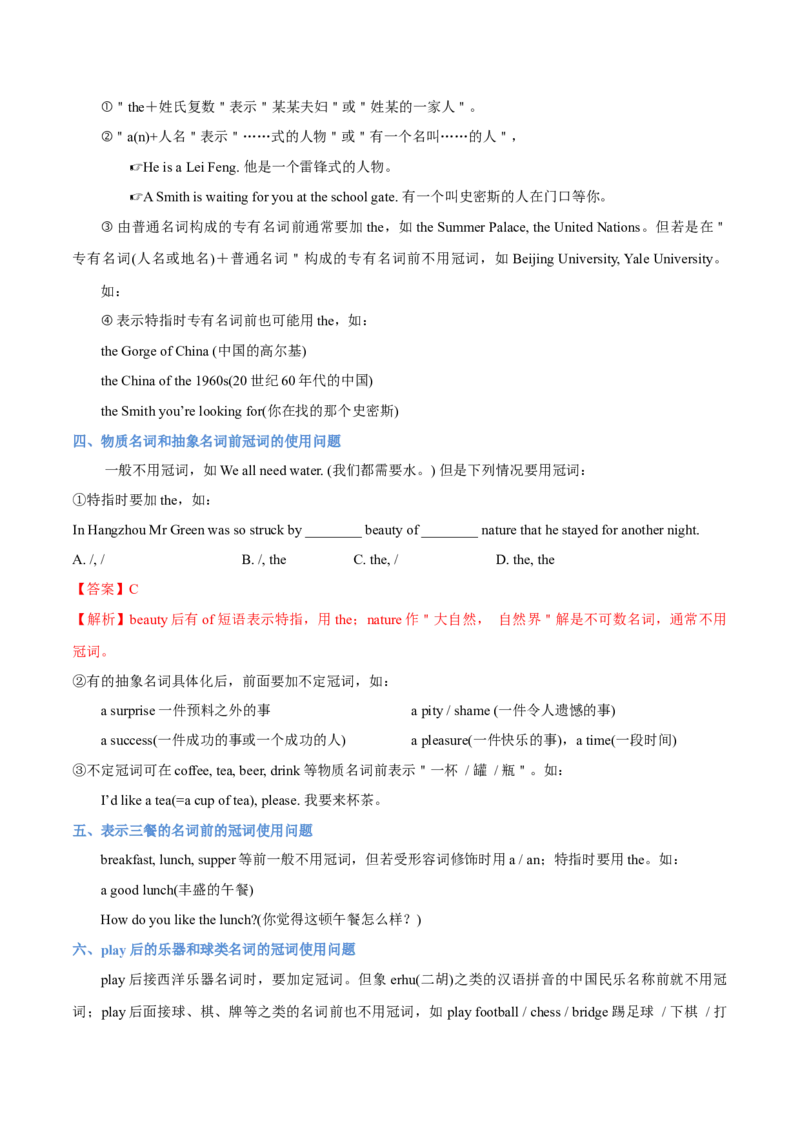
【巧学妙记】
下列情况应免冠,代词限定名词前;
专有名词不可数,学科球类三餐饭;
复数名词表泛指,两节星期月份前;
颜色语种和国名,称呼习语及头衔。
三、专有名词前的冠词使用问题
一般不用冠词,如John, China等。但以下几种情况用冠词:①"the+姓氏复数"表示"某某夫妇"或"姓某的一家人"。
②"a(n)+人名"表示"……式的人物"或"有一个名叫……的人",
☞He is a Lei Feng. 他是一个雷锋式的人物。
☞A Smith is waiting for you at the school gate. 有一个叫史密斯的人在门口等你。
③由普通名词构成的专有名词前通常要加the,如the Summer Palace, the United Nations。但若是在"
专有名词(人名或地名)+普通名词"构成的专有名词前不用冠词,如Beijing University, Yale University。
如:
④表示特指时专有名词前也可能用the,如:
the Gorge of China (中国的高尔基)
the China of the 1960s(20世纪60年代的中国)
the Smith you’re looking for(你在找的那个史密斯)
四、物质名词和抽象名词前冠词的使用问题
一般不用冠词,如We all need water. (我们都需要水。) 但是下列情况要用冠词:
①特指时要加the,如:
In Hangzhou Mr Green was so struck by ________ beauty of ________ nature that he stayed for another night.
A. /, / B. /, the C. the, / D. the, the
【答案】C
【解析】beauty后有of 短语表示特指,用the;nature作"大自然, 自然界"解是不可数名词,通常不用
冠词。
②有的抽象名词具体化后,前面要加不定冠词,如:
a surprise一件预料之外的事 a pity / shame (一件令人遗憾的事)
a success(一件成功的事或一个成功的人) a pleasure(一件快乐的事),a time(一段时间)
③不定冠词可在coffee, tea, beer, drink等物质名词前表示"一杯 / 罐 / 瓶"。如:
I’d like a tea(=a cup of tea), please. 我要来杯茶。
五、表示三餐的名词前的冠词使用问题
breakfast, lunch, supper等前一般不用冠词,但若受形容词修饰时用a / an;特指时要用the。如:
a good lunch(丰盛的午餐)
How do you like the lunch?(你觉得这顿午餐怎么样?)
六、play后的乐器和球类名词的冠词使用问题
play后接西洋乐器名词时,要加定冠词。但象erhu(二胡)之类的汉语拼音的中国民乐名称前就不用冠
词;play后面接球、棋、牌等之类的名词前也不用冠词,如 play football / chess / bridge踢足球 / 下棋 / 打桥牌。
七、表示季节、月份、星期的名词前的冠词使用问题
一般不用冠词,但特指时用the;受形容词修饰表示具有某种特点时可用a / an。如:
the spring of 1998 1998年的春天 a hard winter 一个严寒的冬天
八、表示节日的名词前的冠词使用问题
含有day的节日前一般不用冠词,如May Day, New Year’s day, Christmas Day, April Fool’s Day,
Mother’s Day等;但仅中国才有的传习统节日名称前常用 the,如the Spring Festival(春节), the Mid-autumn
Festival(中秋节)。
九、有后置定语的名词前的冠词使作问题
特指某人或某物时用the;但若指一类事物时用a / an。如:
I’d like to buy a present that is useful but not expensive.
我想买一件价格不贵但又有用的那样一类礼物。(from www.nmet168.com)
十、两个并列名词前冠词的使用问题
指同一人、同一物或同一概念时,第二个名词前不用冠词,如a teacher and writer(一位教师兼作家),a
horse and cart(一辆马车),a knife and fork(一付刀叉);但若是指两个人时,第二个名词前一般也要加冠词,
如a man and a woman(一个男人和一个女人)。
十一、冠词的非前位用法
1. 不定冠词用在quite,rather,many,half,what,much等词之后。如:
☞He is rather a fool.
☞—What did you think of the concert?
—Oh,it was quite a success.
2. 不定冠词用在so(as,too,how)+形容词之后。如:
☞She is as clever a girl as you can wish to meet.
☞It’s too difficult a book for us to read.
注意:以元音音素开头的名词前加不定冠词时用"an"。例如:an apple。
即使单词拼写以辅音字母开头,但该词的读音是元音音素开头,加不定冠词时也要用"an",例如:
an hour,an honest boy;反之,拼写以元音字母开头,但读音是辅音,加不定冠词时要用"a",例如:a
university。
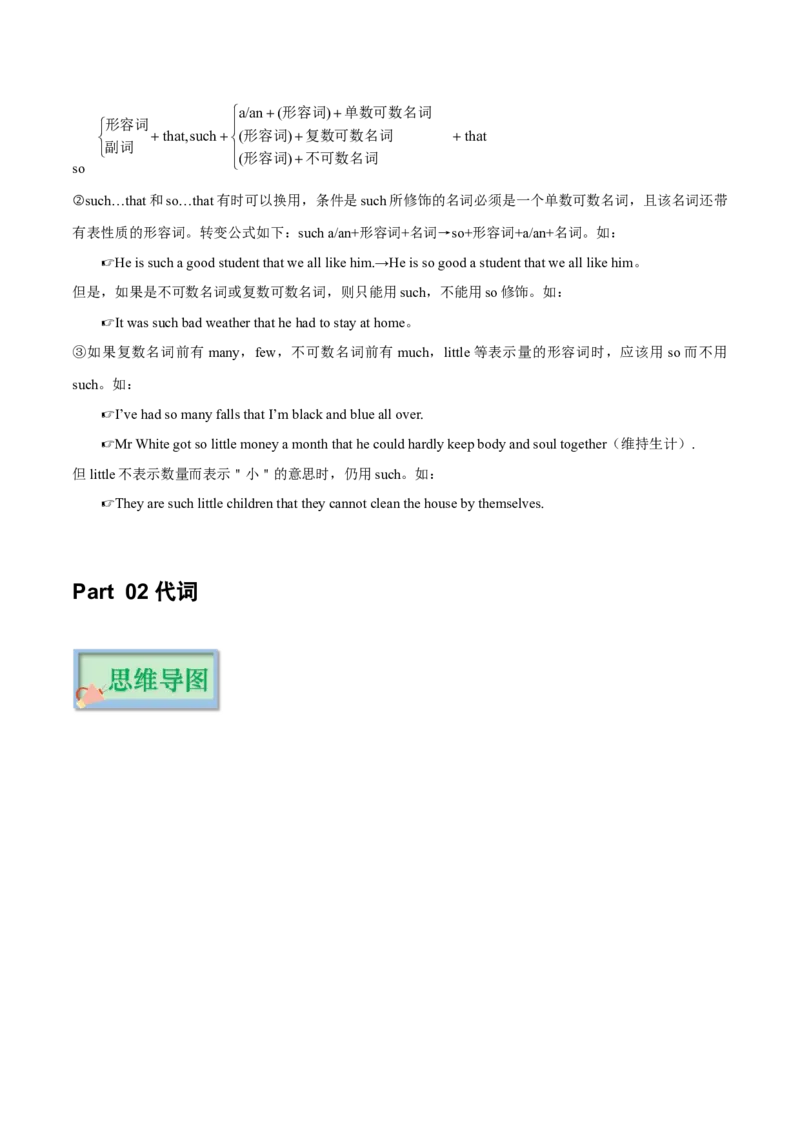
3. so…that与such…that:
①so…that和such…that都作"如此……以至于"解,that引导结果状语从句。常见句型如下:a/an(形容词)单数可数名词
形容词
that,such(形容词)复数可数名词 that
副词
(形容词)不可数名词
so
②such…that和so…that有时可以换用,条件是such所修饰的名词必须是一个单数可数名词,且该名词还带
有表性质的形容词。转变公式如下:such a/an+形容词+名词→so+形容词+a/an+名词。如:
☞He is such a good student that we all like him.→He is so good a student that we all like him。
但是,如果是不可数名词或复数可数名词,则只能用such,不能用so修饰。如:
☞It was such bad weather that he had to stay at home。
③如果复数名词前有many,few,不可数名词前有much,little等表示量的形容词时,应该用 so而不用
such。如:
☞I’ve had so many falls that I’m black and blue all over.
☞Mr White got so little money a month that he could hardly keep body and soul together(维持生计).
但little不表示数量而表示"小"的意思时,仍用such。如:
☞They are such little children that they cannot clean the house by themselves.
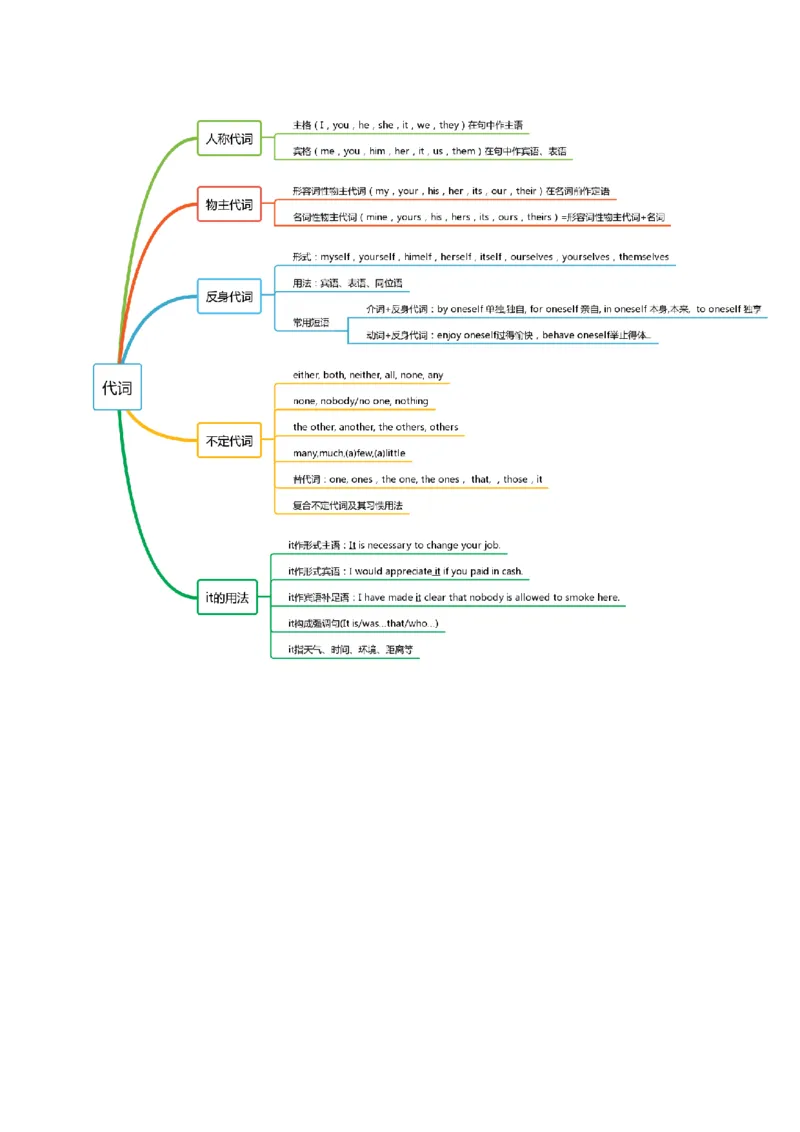
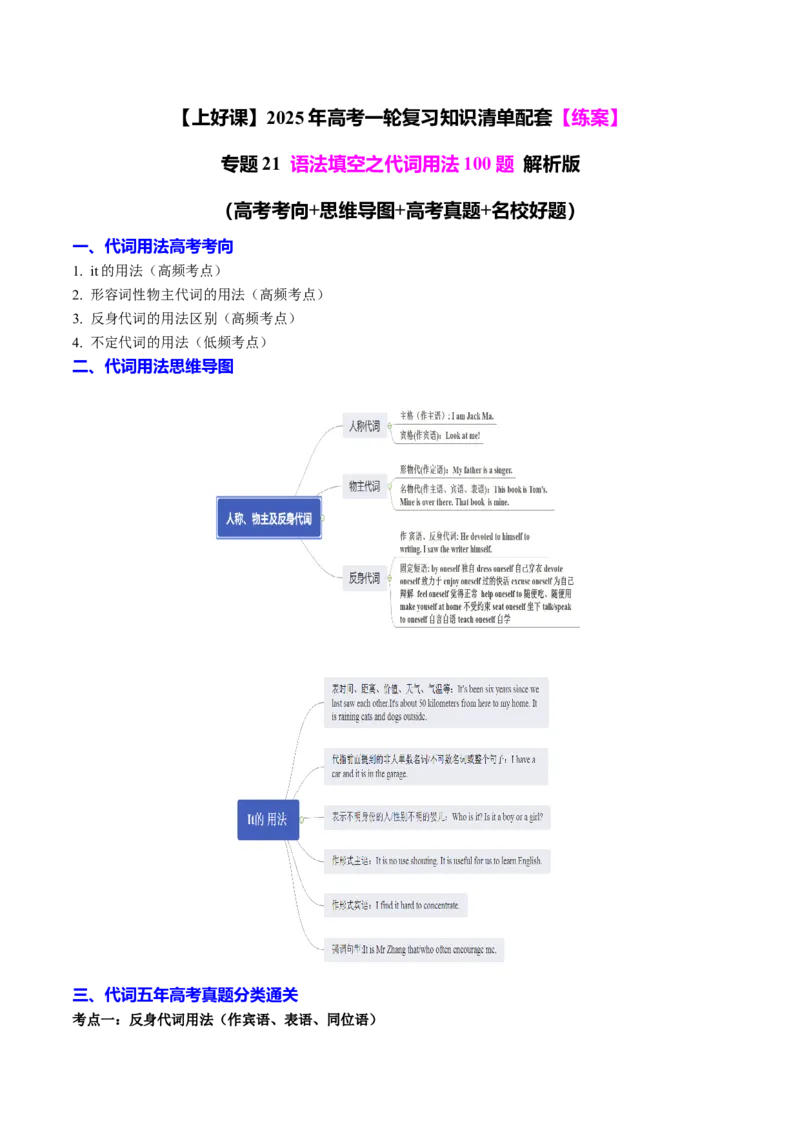
Part 02 代词考点1 人称代词、物主代词和反身代词
一、 人称代词
1. 人称代词的分类和数:
2. 人称代词作主语时要用主格,作宾语时用宾格,作表语时常用宾格。
☞She’s my classmate.
☞I bought a present for him.
【名师点睛】
在强调句中人称代词的使用应该根据人称代词具体作什么成分而定。
☞I met her in the hospital.→It was her who I met in the hospital.
☞It was I that first arrived at the airport.
3. 几个人称代词单数并列主语时,一般的排列顺序为:
单数二 三 一(人称),即you, he ,I。复数一二三,即we, you, they。
☞ You , she and I will be in charge of the case.
二、 物主代词
1.物主代词的分类和数:
人称 第一人称 第二人称 第三人称
人称代词 单数 复数 单数 复数 单数 复数
形容词性物主代词 my our your your his/her/its their
名词性物主代词 mine ours yours yours his/hers/its theirs
2. 物主代词的用法:(1)形容词性物主代词相当于形容词,在句中只能作名词或动名词的前置定语,不能单独使用。
(2)名词性物主代词相当于“形容词性物主代词+名词”,可单独作主语、表语和宾语,也可与of连用作
后置定语,但不能单独作定语
☞This isn’t my shirt; mine is over there.
【巧学妙记】
物主代词用法口诀
物主代词分两种 形容词性名词性
形容词性能力差 自己不能来当家
句子当中作定语 身后定把名词加
物主代词名词性 相当名词可单用
句中充当主宾表 身后没有名词影
两种代词形不同 添个“s”形变名
his,its不用变 my变mine要记清
三、 反身代词
1. 反身代词的形式
第一人称 第二人称 第三人称
单数 myself yourself himself / herself /itself
复数 ourselves yourselves themselves
2. 反身代词常在enjoy, teach, hurt, buy, introduce等动词后和by, for, to ,of 等介词后作宾语
☞All of them enjoyed themselves. 所有的人都玩得很好。
☞Help yourself to some fish. 请自己动手吃点鱼吧。
3. 反身代词有时用于 be, feel, seem, look 等后作表语,表示身体或精神处于正常状态。
☞You don’t seem yourself today. 你今天好像不太好。
4. 强调用法:
反身代词在强调用法中表示强调,即用来加强某个名词或者代词的语气,可译成“亲自”、“本人”。
此时,它在句中作同位语。即使去掉,也不影响句子的完整性。如:
☞You must do it yourself. 你必须自己做。
☞I myself did the homework last night。
昨晚是我自己做了家庭作业。5. 含有反身代词的短语
for oneself 给(为)自己,独自 to oneself 对自己
say to oneself 心 里 想
talk / speak to oneself 自言自语
come to oneself 苏醒过来 absent
oneself 缺席
beside oneself 失常,若狂 by oneself 独自
地,单独地
of oneself 独自,自发地
【巧学妙记】
反身代词的用法歌诀:
反身代词莫乱用,能作句中宾、表、同,主语、定语
不能用,固定搭配要记清。
单数反身代词:myself, yourself, himself, herself, itself
复数反身代词:ourselves, yourselves, themselves
考点2 指示代词和替代词
1. this, that, these, those的区别
(1)this(these)一般指时间或空间上较近的人或物;that(those)常指时间或空间上较远的人或物。
☞This is my desk and that is yours.
☞In those days they could not go to school.
(2)this常指后面要讲到的事物,有启下的作用;that则指前面讲到过的事物,有承上的作用。
☞I want to tell you this:the English party will be held on Saturday afternoon.
☞He hurt his leg yesterday. That’s why he didn’t come.
(3)为了避免重复,常用that或those代替前面已提过的名词。
☞The weather of Beijing is colder than that of Nanjing.
☞The ears of a rabbit are longer than those of a fox.
(4)this在电话用语中用于作自我介绍,that用于询问对方;this和that可以当副词用,意思相当于副词so。
☞Can hard work change a person that much?
2. so
(1)指示代词so在句中常作宾语,还常用在动词think, believe, suppose, guess等后面,代替上文
提到的事情。
☞——It’s likely to snow. 好像要下雪了。
——I believe so.我想是的。
(2)用在hope, I’m afraid后,代替上文提到的观点,只用于肯定句。
☞——Is she coming to the party? 她回来聚会吗?
——I hope so. 我希望会。
(3)有时前后两个句子中有相同的“动词+宾语”, 为了避免重复,后一个句子中常用do so来代替。
☞——Have you handed in your homework?你的家庭作业交了吗?
——I did so yesterday.我昨天就交了。
3. such
(1)指如前面所述的这样的人或事物。
☞Such is our plan for the coming holiday.
这就是我们为即将到来的假期制订的计划。
(2)such作定语修饰名词时,与all/any/no/some/many/several等词连用,常置于这些词的后面。
☞All such things can be found on the Internet.
所有这些东西都可以在网上找到。
(3)such与不定冠词连用修饰可数名词单数时,such需置于不定冠词前;当such前有no时,则不用不定
冠词。
☞He is such a lovely boy that we all like him.
他是如此可爱的一个男孩,我们都很喜欢他。
☞There is no such man here. 这里没有一个这样的人。
4. one, the one, that, it的区别
易混词 含义
this 指代上文说过的事物或下文要提到的事物。代替可数名词复数用these。
that 用来指代上文提到的某一个名词,可以是可数名词,也可以是不可数名
词,表示特指。代替可数名词复数用those(相当于the ones),后面必须有定
语。
one (复数形式是ones)只能用来指代上文提到的某一个可数名词单数,表示同名
异物。其前可以有定语,其后也可以有定语。it 指上文提到的同一个事物,也可指代前面(或后面)整句话的意思。通常还可
用作形式主语或形式宾语。
☞This is the book I borrowed from Lucy.
这就是我从露西那儿借的书。
☞The population of Shandong is larger than that of Qinghai.
山东的人口比青海的人口多。
☞I don’t like the blue shirt. I like the yellow one.
我不喜欢这件蓝色的衬衫。我喜欢那件黄色的。
☞I can’t find my hat. I don’ t know where I put it.
我找不到我的帽子。我不知道我把它放在哪儿了。
考点3 不定代词
1. both, either, neither, , all, none, no one, nobody
● both表示“两个人或物都”,具有肯定含义;
either表示“两者中的 任何一个”,与否定词连用,表示对两者的全部否定;
neither表示“两者都不”,其后可接of短语
● all表示“全部”,指三者或三者以上的人或物,;all也可笼统地表示“一切,所有”;
none表示“三者或三者以上的人或物的全部否定”,在与of连用或回答how many/much的提问时只
能用none;
no one=nobody表示“没有一个人”,其后均不可接of短语, 常用来回答who引导的问句。
☞Both of my parents are doctors. 我的父母都是医生。
☞All of the students are interested in it. 所有的学生对此都很感兴趣。
☞He has two sons, neither of whom is rich. 他有两个儿子,都不富有。
☞He has three sons, none of whom is rich. 他有三个儿子,都不富有。
2. 不定代词some与any的用法
在通常情况下,some要用于肯定句,在否定句或疑问句中,一般用any代替。但是,这只是一般情况。
在某些特殊情况下,some也可用于疑问句和否定句。
(1)some用于疑问句:一是用于可预料答语为“是”的问句中,二是用于表示请求或建议的疑问句。如:
☞Did some of you sleep on the floor? 你们有人睡在了地板上吗?
☞Would you like some more fruit? 你要不要再吃点水果?
(2)some用于否定句:Some用于否定句主要见于以下情形:
①用于部分否定的句子中。比较:I do not like any of the films. 这些电影中我一部也不喜欢。
I don’t like some of the films. 这些电影中的某一些我不喜欢。
I don’t like some one of the films. 这些电影中某一部我不喜欢。
②用于否定句,但在否定范围之外。如:
☞I haven’t seen Tom for some years. 我有好几年没见到汤姆了。
☞Some of the students didn’t see the film. 其中有些学生没有看这部电影。
③用于否定句表示特别的强调。如:
☞It should be for all our children, not just some. 这应该适用于我们所有的儿童,而不仅仅是某些孩子。
④用于否定句介词without之后。如:
☞It’s risky to buy a car without some good advice. 不作些咨询就去买车是有风险的。
若在without后用any,则所表示的语气很强,含有“没有任何”“没有一点儿”之意。如:
☞We did the work without any difficulty. 我们干这工作没有任何困难。
3. few, a few 与 little, a little的用法
(1) few和a few的用法:其后要接可数名词的复数形式。few表示数量很少或几乎没有,强调“少”,含有
否定意义;a few 表示数量虽然少但毕竟还有,强调“有”,含有肯定意义。比较:
☞It is very difficult, and few people understand it. 它很难,没几个人能懂。
☞It is very difficult, but a few people understand it. 他虽难,但是有些人懂。
(2) little 和 a little的用法:其后接不可数名词,其用法区别跟few和a few之间的区别相似。如:
☞Unfortunately, I had little money on me. 很不巧,我身上没带什么钱。
☞Fortunately, I had a little money on me. 幸好我身上带着一点钱。
4. other, the other, another与others的用法
这些不定代词不仅在含义上有单复数之分,而且在用法上有泛指(无the)和特指(有the)之别。其用法区
别可归纳如下:
(1) 指单数时的区别:若泛指用another,若特指用 the other。如:
☞Give me another (one). 另外给我一个。
☞Shut the other eye, please. 请把另一只眼睛也闭上。
(2) 指复数时的区别:若泛指用 other(后接复数名词),若特指用the other(后接复数名词)。如:
☞There are other ways of doing it. 做这事还有其他的办法。
☞Where have the other students gone? 其他学生都到哪里去了?
(3) others的用法:它永远表示复数意义(且其后不能再接名词)。其用法大致相当于“other+复数名词”,同
样地 the others 大致相当于“the other+复数名词”。如:
☞Other people [Others] may not think that way. 别的人可能不这样想。
☞He is cleverer than the others [the other students] in her class. 他比班上其他学生聪明。
(4) another的用法:一般只能表单数,且其后接名词也只能接单数名词。但是若其后有数词或 few 修饰时,
则也可接复数名词。如:
☞We need another few chairs. 我们还需要几把椅子。
☞In another two weeks it’ll be finished. 再过两个星期就可做完了。
5. each和every
●each 指代或修饰单数可数名词,强调个体,多用于两者或两者以上的场合,可与 of连用。作主语时,
谓语动词用单数
●every修饰单数可数名词,强调整体,用于三者或三者以上的场合,不与of连用。
☞For boys, you can buy socks for only $5 each. 男士袜子每双只需5美元。
☞Every mother loves her children dearly. 每个母亲都非常爱自己的孩子。
6. 复合不定代词的用法
复合不定代词包括 something, somebody, someone, anything, anybody, anyone, nothing, nobody, no one,
everything, everybody, everyone 等。它们在句中可用作主语、宾语或表语,但不能用作定语。something,
someone 等和 anything, anyone等的区别与 some 和 any 的区别一样,前者一般用于肯定句,后者一般用于
否定句、疑问句或条件句。具体使用时应注意以下几点:
(1)其定语修饰语的位置:复合不定代词受定语修饰时,定语应放在它们后面。如:
☞There is nothing wrong with the radio. 这收音机没有毛病。
☞Have you seen anyone [anybody] famous? 你见过名人吗?
(2)复合不定代词与指示代词:指人的复合不定代词若用作主语,其谓语动词一般用单数,相应的人称代词
和物主代词也用单数 he, him, his (不一定指男性)。但在非正式文体中常用复数代词 they, them, their。如:
☞If anybody comes, ask him [them] to wait. 要是有人来,让他等着。
指事物的复合不定代词若用作主语,谓语动词只能用单数,相应的人称代词也只能用 it,而不用
they。如:
☞Everything is ready, isn’t it? 一切都准备好了,是吗?
(3)其后是否接of短语:anyone, everyone 等只能指人,不能指物,且其后一般不接of 短语。若是指物或后
接 of 短语,可用 any one, every one (分开写)。如:
any one of the boys (books) 孩子们(书)当中的任何一个(本)
every one of the students (schools) 每一个学生(一所学校)考点4 it的用法
it作为代词用法非常灵活,可用于代替上文中提到的事物,代替上文中说到的一件事,代替不知情的
人(尤其是不知身份、性别和姓名的人)。也可用于表示时间、天气、距离、计算结果等。还可用来代替
不定式、动名词、从句等,充当形式主语或形式宾语。
一、用于指人以外的一切生物、无生命的东西和事情
一般指说话者心目中已经了解或所指的生物、无生命的东西或事情,没有性别的区分;可以是可数名
词,也可以是不可数名词,在句子中既可以作主语,也可以作宾语。
1. 指动物和植物。
☞ Look at that bird. It always comes to my window. 看看那只鸟。它总是飞到我的窗前来。
2. 指代无生命的东西。
☞ This is my watch. It’s made in Switzerland. 这是我的手表。它是瑞士产的。
3. 代替上文提到过的整个事情。
☞ Well, you mustn’t play on the road. It’s dangerous! 哦,你不能在马路上玩。这是危险的!
二、用于指代人
1. 指代说话者心目中不太清楚的那个人,常在打电话或敲门时用。
☞ —Who is knocking at the door? ——谁在敲门?
—It’s me. ——是我。
2. 指说话者心目中的那个人。
☞ —Look, someone is coming. Who can it be? ——看,有人过来了。他可能是谁呢?
—It may be the headmaster. ——可能是校长。
3. 在回答用指示代词表示人的特殊问句时,常用it指人。
☞ —Who’s that? ——那人是谁?
—Is it Helen? ——是海伦吗?
—Yes, I think you’re right. It’s Helen. ——是的,我想你说对了,是海伦。
三、用于指时间、距离和自然现象等
1. 表示时间。
☞ —What’s the date? ——今天是几月几日?
—It’s the third of March. ——今天是3月3日。
2. 表示距离。
☞ It’s only five minutes’ walk from here. 离这儿仅有五分钟步行的路程。3. 表示自然现象。
☞ It is going to rain. 天要下雨了。
4. 表示环境、形势等。
☞ If it’s convenient, I can see you tomorrow. 如果方便的话,我明天能见到你。
四、用作形式主语,替代动词不定式,动名词或从句
1. It is clear (obvious,true,possible,certain...) that...该句型中it是形式主语,真正的主语是that引导的主
语
从句,常译为"清楚(显然,真的,可能,肯定……)"。
☞ It is very clear that he doesn’t like it.=That he doesn’t like it is very clear. 很明显他不喜欢它。
2. It is said (reported/learned/believed/thought/known/told/hoped...) that...该句型中的it仍是形式主语,真正主
语
是that引导的主语从句;该结构常译为"据说(据报道,据悉……)"。
☞ It is reported that another satellite has been put into orbit. 据报道又一颗卫星被送入轨道。
3. It is time (about time,high time) that...该句型中that后的从句应该用虚拟语气,值得注意的是从句的谓语
动词常用过去时态表示虚拟,有时也用should+动词原形,should不能省略,常译为"是(正是)……
的
时候了"。
☞ It is time that children should go to bed.=It is time that children went to bed. 孩子们该睡了。
4. It is the first (second...) time that...该句型中的that从句不用虚拟语气,而用完成时态。至于用什么完成时
态,
由主句的谓语动词的时态决定。如果是一般现在时,后面从句用现在完成时态;如果是一般过去时,后
面从句则用过去完成时态,该结构中that可以省去;it有时用this/that替换,常译为"是第一(二)……
次做……"。
☞ It is the first time I have been here. 这是我第一次到这里来。
5. It is a pity (a shame/an honour/a good thing/a fact/a surprise/...) that...该句型中,that后的从句一般用虚拟语气
(should+动词原形),should可省略,表示出乎意料,常译为"竟然"。没有这种意义时,则不用虚拟语
气。
☞ It is a pity that such a thing (should) happen in your class. 这种事竟然发生在你们班上,真是遗憾!
☞ It is a pity that he is ill. 他生病了,真遗憾!
6. It happens (seems,looks,appears) that...该句型中it是形式主语,that引导的是主语从句,主句中的
happen,seem等词是不及物动词。
☞ It seems that he will be back in a few days. 看来他再过几天才能回来。
7. It be+adj.(kind, nice, brave, clever, stupid...) of sb+to do sth该句型中的不定式短语是真正主语,如果不定
式的逻辑主语由of引起,句中的形容词必须是表示逻辑主语特征的形容词(即句中的形容词是修饰逻辑
主语的)。常见的形容词有 bad,brave,careless,clever,cruel,foolish,good(好心的),honest,
horrible,
kind,lazy,modest,naughty,nice,polite,rude,silly,stupid,wise,wrong等。这个句型可以转换为:
sb is+adj.+to do sth
☞ It is kind of you to say so.=You are kind to say so. 你这么说真是太善良了。
8. It be+adj.(difficult,easy,hard,important) for sb to do sth该句型与上一个同属一个句型。不定式的逻辑
主语由for引起,形容词常表示重要性、紧迫性、频繁程度、难易、安全等情况(即句中的形容词是修
饰
动词不定式的)。常见的形容词有important,necessary,natural,easy,safe,common,normal,hard,
difficult,
dangerous,unusual,impossible,pleasant等。
☞ It is important for her to come to the party.=It is important that she (should) come to the party.
对她来说,参加这次聚会很重要。
9. It takes sb some time to do sth 做某事花费某人……时间
☞ It took me five days to solve the problem. 解决这个问题花了我五天时间。
10. It costs sb some money to do sth 做某事花费某人……钱
☞ It will cost my father five thousand yuan to buy such a computer. 买这台电脑花了我父亲5, 000元。
11. It’s up to sb to do sth 应由某人(负责)做……
☞ It is up to you to decide whether to take the job or not. 做不做这份工作由你决定。
12. It’s useless/(of) no use/(of) no good doing sth
该句型常译为"做……是徒然的/没有益处的",句中的动名词短语是真正的主语,表语可以是 no
use(=not any use),no good(=not any good)等。
☞ It’s no use arguing with her. 跟她争论没有用。
五、作形式宾语
1. 用于 "主语+及物动词+宾语+宾语补足语" 句型中:当复合宾语中的宾语是不定式、动名词或宾语
从句时,常用it作形式宾语,而往往把真正的宾语——不定式、动名词或宾语从句置于补足语之后。
☞ I think it important that we should keep calm. 我认为我们应该保持安静,这很重要。☞ I feel it my duty that I should devote myself to teaching. 我感到致力于教学是我的责任。
☞ I make it a rule that I read English every morning. 每天早晨读英语是我的习惯。
2. 用于"主语+及物动词+宾语"句型中:有些动词或短语动词不能直接跟 that引导的宾语从句,需
要在从句前先加上形式宾语it。
①appreciate,dislike,hate,like,love,make(按时到达,成功),have(表明,坚持说),take(认为,猜
想),hide(隐瞒),publish(公布),put(表达,写出来)等。
☞ I take it that you will be leaving Shanghai soon. 我认为你会很快离开上海。
☞ The report has it that no one was to blame for the accident. 报告表明没有人要对这次事故负责。
☞ We published it that we had finished the project ahead of time. 我们宣布我们已提前竣工了。
②answer for(承担……的后果),count on(期待),depend on(依靠),insist on(坚持主张,坚决要求),see
to(确保)等。
☞ I am counting on it that you will come. 我期待你会来。
六、it构成强调句
1. 强调句型的基本结构为:It is/was+被强调部分+that/who+其他成分。
2. 强调句型强调的成分
强调句型强调的成分:主语、宾语、状语。被强调部分指人时,用who或that皆可;指物时,只能用
that;被强调部分是时间、地点,原因或方式状语时,不用when,where,why或how而用that。
☞ It was the beautiful lady that/who I met in the hotel yesterday.
我昨天在旅馆里遇到的正是这位漂亮女士。(强调宾语)
☞ It was in Beijing that we visited the Bird’s Nest and Water Cube.
正是在北京我们参观了鸟巢和水立方。(强调地点状语)
☞ It is my mother who/that reminds me to get up on time every day.
每天都是我妈妈提醒我按时起床。(强调主语)
3. 对not...until结构的强调
not...until结构的强调句型为"It is/was not until...that..."在这一固定句型中,由于not已经前移,that后
只能用肯定形式。
☞ He didn’t go to bed until ten o’clock.→It was not until ten o’clock that he went to bed. 直到10点他才睡觉。
☞ I didn’t realize it until I got off the bus.→It was not until I got off the bus that I realized it.
4. 如何识别强调句型
强调句型中的it is/was和that无实际意义,去掉后,句子结构仍然完整、正确,句意仍然明确;而其他句型去掉it is/was和that后,句意不完整。
☞ It is for three hours that they have worked. 他们已经工作三个小时了。(强调句型)
☞ It is a wonder that he is still alive. 他还活着真是个奇迹。(it作形式主语)
难点剖析
一、部分否定与全部否定
1. no one, none, nobody, nothing以及“no与名词连用”等都表示全部否定。
☞None of us was going to the party. 我们之中没人去参加那个聚会。
2. 当not出现在含有表示全部肯定的不定代词all, both, everyone, everybody, everthing等以及“every+名词”
的句子中时,不管not在它们之前还是之后都表示部分否定。
☞Not all of them smoke. = All of them don’t smoke. 他们当中不是所有的人都抽烟。
☞All of the boys are clever, but none of them can work out this problem.
这些男孩都很聪明,但他们当中没有一个人能解出这道题。
二、 it构成的几个易混淆的句型
1. It+be+时间+since引导的状语从句
这个句型表示从since 从句谓语动作发生以后到现在或过去所经过的一段时间,意为“自从……以来
已多久了”。表示现在的情况时,主句多用一般现在时,从句多用一般过去时;表示过去的情况时,主句
用一般过去时,从句用过去完成时。如:
☞It is three years since his father passed away. 自从他父亲去世已经三年了。
☞It was 10 years since they had married. 自从他们结婚已经十年了。
2. It+be+时间+before引导的状语从句
这个句型中的时间一般为表示一段时间的词语,如 some time, long, years, months, weeks, days, hours,
minutes等。主句中的谓语动词用肯定式时,意为“过多长时间才……”;用否定式时,意为“没过多长时
间就……”。主句的时态可用过去时was或将来时will be/be going to be:用was 时,before从句的动词用
一般过去时;用will be 时,before从句常用一般现在时。 如:
☞It was some time before I realized the truth.
过了一段时间我才了解到真相。
☞It wasn’t long before he told us about this affair.
没过多久他就告诉了我们这件事情。☞It will be many years before the situation improves.
这种状况要过许多年才能得到改善。
3. It+be+时间+when引导的状语从句
这个句型中,it 指时间,而且表示时间的词语前没有介词(时间一般为具体时间)。主句中的谓语动词
和从句中的谓语动词在时态上一般是一致的,但是当主句是 will be时,when从句一般用一般现在时代替
将来时。如:
☞It was already 8 o’clock when we got home. 我们到家时已经8点了。
☞It will be the next morning when we finish our work. 我们结束工作时将是第二天早晨。
Part 03 介词考点1 介词
一、 表示“时间”的介词
1. at, on, in
(1) at表示“在某一时刻,某一时点”。如:
☞I get up at 6:00 every day. 我每天6点起床。
注:at daybreak在黎明 at noon在中午
at night在夜间 at Christmas在圣诞节期间
at the age of five在五岁时
(2) on表示“在具体某一天或某天的上、下午”。如:☞I heard a shot on (the morning of ) March 18. 三月十八日(早晨) 我听到一声枪响。
☞We don’t have classes on Sunday. 星期天我们不上课。
(3) in表示“在某世纪、年、季度、月、周”以及泛指的上、下午、晚上。如:
in the 20th century在20世纪 in 1999在1999年
in winter在冬季 in September在九月
in the morning/afternoon/evening 在上午/下午/晚上
【巧学妙记】
at用在时刻前,亦与正午、午夜连,黎明、终止和开端,at与之紧接着相伴。
周月季年长时间,in须放在其前面, 泛指一晌和傍晚,也要放在in后边。
on指特定某一天,日期、星期和节日前 某天上下和夜晚,依然要在on后站。
今明昨天前后天,上下这那每之前,at、in、on都不用,此乃习惯记心间。
注:“上下这那每之前”是指“last/next/this/that/every”之前。
2. for, during, through
(1) for后接“一段时间”,表示某事持续多久,多与完成时连用。如:
☞She has been ill for several days. 她已经病了几天了。
(2) during表示“在……期间”。如:
☞I went to France for two weeks during the summer. 夏天我去了法国两个星期。
(3) through表示“一直……,自始至终”。如:
☞They worked hard through the winter. 整个冬天他们都在努力工作。
3. from, since
(1) from表示“时间的起点”,可译作“从……”,多用于“from…to/till…”中。如:
☞You can come anytime from Monday to Friday. 周一至周五你什么时间来都行。
(2) since表示“自从……以来(直到现在)”。如:
☞We have known each other since ten years ago. 我们十年前就认识了。
注意:
for和since都常与完成时连用,但for接时间段,since接时间点。如:
for two hours(持续)两小时 since last week从上周直到现在
4. before, by, till, until
(1) before指“在……之前”,与after相对。如:
☞Please come before ten o’clock. 请10点以前来。
(2) by指“不迟于,到……时为止,在……以前”。如:☞We had learned over 1000 words by the end of last term.
到上学期末为止,我们已经学了1000多个单词了。
☞We will have learned 2000 English words by the end of this term.
到本学期结束前,我们将学了两千英语单词了。
注:by后接过去时间,常与过去完成时连用;by后接将来时间,常与将来完成时连用。
(3) till (until) “直到……为止”。 在肯定句中,till/until必须与延续动词连用;在否定句中,till/until常与
非
延续性动词连用。如
☞I didn’t go to bed until 12 o’clock. 直到12点我才睡。
☞You must wait for him till tomorrow. 你必须一直等到他明天。
5. after, in, within
(1) in和after都可表示“在……之后”,但用法不同:
a. 用in时要具备两个条件:用于将来时;后接时间段
☞I’ll arrive in an hour. 我一小时后到达。
b. after既可用于将来时,也可用于过去时
☞He got a cancer and died after a year. 他患了癌症,一年后去世了。
☞The meeting will end after 3:00pm. 会议将在下午三点后结束。
(2) within“在……时间之内”。强调事情发生的全过程不超出某一时间,没有时态的限制。如:
☞I can finish it within an hour. 我不需一小时就可把它做完。
二、 表示“地点、方位”的介词
1. at, on, to, in
at表示在小地方; 在……附近,旁边
in 表示 在大地方; 在……围之内
on 表示毗邻,接壤
to 表示在„„范围外,不强调是否接壤
☞He arrived at the station at ten.
☞He is sitting at the desk.
☞He arrived in Shanghai yesterday.
☞Jiangsu lies in the east of China.
☞Russia live on the north of China.
☞Fujian is to the south of Jiangsu Province.2. above, over, on
above 指在……上方,不强调是否垂直,与 below相对;
over指垂直的上方,与under相对,但over与物体有一定的空间,不直接接触;
on表示某物体上面并与之接触。
☞The bird is flying above my head.
☞There is a bridge over the river.
☞He put his watch on the desk.
3. along, through, across
(1) across 和 through 都可表示“横过”或“穿过”,前者主要表示从某物的表面“横过”,涉及“面”
的概念;而后者则表示从某个空间“穿过”,涉及“体”的概念。如:
☞He walked across the road carefully. 他小心地走过马路。
☞He walked through the forest alone. 他独自一人走过森林。
有时 across 表示“横过”也可在“体”内进行,但此时它仍与through 有差别:前者表示从某个“体”的
一端到另一端,而后者表示穿过两端。如:
☞He walked across the hall. 他从大厅的一端走到另一端。
☞He walked through the hall. 他穿过大厅。
(2)along 表示“沿着”,通常用于狭长的东西。如:
☞I saw him running along the road. 我看见他沿着这条路跑。
4. between, among
between一般指“两者之间”
among用于三个或三个以上的人或物之中,或笼统的一群人或一些物之中,表示“在……中间”。如:
☞Between the door and the windows there is a map. 门和窗户的中间有一张地图。
☞They hid themselves among the trees. 他们躲在树林中。
三、其他介词
1. 表示“工具或手段”的介词 by, with, on
(1)by用某种方式,多用于交通。
by bus乘公共汽车,
by e-mail. 通过电子邮件。
注意:表示搭乘交通工具时,用by时不用冠词,用in时要用冠词。请比较:
☞I went there by bus/in a bus. 我是坐公共汽车去的那儿。(2)with表示“用某种工具”。如:
☞He broke the window with a stone. 他用石头把玻璃砸坏了。
注意:with表示用某种工具时,必须用冠词或物主代词。
(3)on表示“以……方式”,多用于固定词组。
☞They talked on the telephone. 他们通过电话进行交谈。
☞She learns English on the radio/on tv. 她通过收音机/电视学英语。
2. 表示关于的介词 of, about, on
(1) of仅是提到或谈到过某人或某事。如:
☞He spoke of the film the other day. 他前几天提到了这部影片。
(2) about指“关于”某人或某事物的较详细的情况。如:
☞Can you tell me something about yourself? 你能告诉我一些关于你自己的事情吗?
(3)on指“关于”学术性的或严肃的事。如:
☞It’s a textbook on the history of china. 它是一本有关中国历史的教科书。
3. 表原因或理由的介词for, at, from, of, with, by, because of
(1)for表示原因,常与sorry, famous, punish, praise, thank, blame等词连用。如:
☞I am sorry for what i said to you. 我后悔不该对你讲那些话。
(2)at指情感变化的原因,意为“因听到或看到而……”。如:
☞He was surprised at the news. 听到这消息他大吃一惊。
(3)from指“外在的原因”,如受伤、车祸等。如:
☞He died from the wound. 他因受伤而致死。
(4) of指“内在的原因”,如病、饿等。如:
☞The old man died of hunger. 老人死于饥饿。
(5) with指生理上或情感上的由外界到内心的原因。如:
☞Hearing the news, he jumped with joy. 他们听到这个消息,欣喜若狂。
(6)by表示外部的,尤其是暴力的或无意中造成某种结果的原因。
☞Her body was bent by age. 他因年老背弯了。
☞She took your umbrella by mistake. 我因弄错拿了你的雨伞。
(7)because of 表示引起结果的直接原因。如:
☞He retired last month because of illness/because he ill.
考点2 介词短语常见的介词搭配:
1. “介词+ 名词”型
(1) in 构成的短语
in advance 在前头,事先,预先 in case 如果,万一
in charge主管,掌管,看管 in common共有,共同,公有
in demand有需要的 in doubt 感到疑惑的,难以确定的
in effect实际上,生效 in fact事实上
in order按序,井然有序,情况良好; 恰当 in progress进行中
in return作为回报 in vain徒劳
in turn依次,替换地;相应地,转而
(2) on构成的短语
on guard 在值勤 on leave在休假
on holiday在度假 on strike罢工
on sale出售 on loan借贷
on the move在移动,搬迁;离开 on the march在行军
on the go正在活动,正在奔走 on the air正在广播
(3) beyond构成的短语
beyond one's power是某人力所不及的 beyond praise夸不胜夸
beyond one's reach够不着 beyond description难以形容
beyond words无法用语言形容 beyond doubt无疑
beyond one's understanding 无法理解
(4) under构成的短语
under development 在发展中 under observation在观察中
under test在测试中 under construction在建设中
under examination在检查(调查)中 under consideration在考虑中
under repair在修理中
(5) at 构成的短语
at length 详细地,长时间 at sea茫然
at will任意地 at work在上班
at lunch在吃午饭 at rest在休息
at table在吃饭 at school上学at church做礼拜 at peace处于和平状态
(6) out of 构成的短语
out of breath 上气不接下气 out of balance失去平衡
out of date过时 out of patience不耐烦
out of control失去控制 out of business破产
out of style过时,不时髦 out of the ordinary不寻常的
out of touch失去联系
2. 复杂介词型
(1) 表示原因(通常在句中作状语), 意为“由于,因为”。
because of:表示实际原因(表达一种较强的因果关系);
on account of:常用来引述逻辑、理性和事实因素。
(2) 表示“除……之外”。
with the exception of= except, except for“除……之外”;
apart from (=美式英语中的aside from)是个复合介词,既可表示“除……之外”,相当于except (for),
又可以表示“除……之外,(还,也)”,相当于besides;
in addition to“除……之外(还,也)”,相当于besides。
(3) 表示“有关,关于”。
concerning=regarding“关于,就……而论,在……方面”;
with respect to“关于,就……而言”;
as for和as to用于句首时表示“至于”。
(4) 表示“在……之前”。
ahead of=in advance of,可表示“(在空间或时间上比某人或某事物)更前,更早”, 还可表示“领先,
优于”;
in front of 多指空间的前后关系,“在……前方”。
(5) 表示“支持,赞成”。
in support of 维护,支持,支援;
in favor of 可指某人“支持,赞成”,也可指事物“有利于……”
(6) 表示“鉴于,由于;根据,按照”。
in the light of 按照,考虑到 in terms of 就……而言,谈到
according to 根据;按照 in view of 鉴于,因为
(7) 表示“尽管”。in spite of 尽管,不管
考点3 动词短语
一、动词搭配是语法填空的重点,考生平时要注意积累常见的动词短语。
1.动词+ away构成的短语动词有:
throw away扔掉 put away把……收拾好 give away捐赠,分发
carry away运走 run away 潜逃,跑开 go away 走开
2.动词+ for构成的短语动词有:
answer for负责 provide for供给 all for要求
plan for打算,为……计划hope for希望,期待 ask for索取,寻找
send for派人去请 go for努力获取 pay for偿还,赔偿
3.动词+on构成的短语动词有:
try on试穿,试验 put on穿上,上演 have on穿着,戴着
pull on穿,戴 hold on不挂断,坚持,继续 carry on继续开展,坚持
keep on继续 go on继续 get on上(车)
4.动词+over构成的短语动词有:
come over过来 hand over移交 go over仔细检查,复习
get over克服,恢复 look over检查 think over仔细考虑
take over接受,接管 hand over 移交 turn over翻转
5.动词+ up构成的短语动词有:
bring up抚育,培养 call up召唤,打电话给 come up走上前来,长出
cut up切碎 fix up修理 give up放弃;go up 上升,增长
grow up 长大 look up尊敬,向上看,查寻 make up虚构,弥补,组成
put up举起,搭建 set up建立,创(纪录) pick up 捡起,(开车)接某人,偶然得到
send up发射 show up 揭露,露面 turn up出现,把……调高一点
6.动词+out构成的短语动词有:
come out出来 go out出去,熄灭 look out留神,当心
walk out走出 set out出发,开始 put out扑灭,生产
give out发出,发表 hand out分发 pick out挑选
find out找出,发现 speak out大声地说 turn out生产,结果是
get out出去,离开 carry out实行,执行 work out计算出,解决,实行,行得通bring out出版 start out 出发,动身。
二、常见同根动词短语辨析
1.bring
bring in引进,挣得 bring about引起,导致
bring up养育,培养,呕吐,提出 bring out使展现,推出(书等)
bring down降低,使倒下 bring back把……带回来,使忆起
bring forth结果,生产,产生 bring forward提出,提前
bring off圆满完成(困难之事)
2.break
break down崩溃,瓦解,垮掉,失败,分解 break up打碎,分解,分开,结束,制止
break through逾越,突破,冲破 break away(from)挣脱,脱离
break out爆发 break in破门而入
break into进入建筑物以便行窃,突然发出,打扰 break off折断,中断
3.come
come about发生 come out结果出来,出版,开花
come across偶遇,被理解 come true变为现实
come up走上前,被提出,走近 come along一起来
come up with产生,发现(解决办法等)
4.give
give up放弃 give in屈服,呈交
give out 用尽,耗尽,分发,公布,发表
give off发出 give away颁发,赠送,送掉,捐赠
5.go
go against违背,与……不符,对……不利 go without勉强维持,凑合
go in for爱好,参加,从事 go by过去,依据,按照
go on继续,发生 go over复习,仔细审查,走近
go ahead 进行 go through 从头到尾地阅读,经历
go away走开,外出度假,消失 go for去取来或接来,争取得到
6.keep
keep away(from)使远离 keep back 扣除,保留,隐瞒不讲
keep off 避开 keep on继续keep out 挡在外边,请勿靠近 keep up保持,不低落,持续,继续
keep up with跟上 keep down抑制(以防其增长)
7.look
look ahead向前看 look about环顾
look back回忆,回顾 look out当心,找出
look up向上看,查阅,看望 look down upon看不起
look through翻阅 look into调查,向内看
look after照看,负责处理 look on旁观
look forward to盼望 look round寻找,边走边看,观光
8.put
put back放回原处,拨回,阻碍,推迟 put down平定,镇压,记下
put away将事物放置于惯常保存之处,储蓄 put forward提出(计划、建议),拨快,提前
put off延期 put on穿戴,上映
put out扑灭,生产 put up举起,张贴
9.take
take in吸收 take for 误认为
take out 拿出 take down 放下
take up从事,拿起,占据 take off 飞机起飞,脱下,休假,成功
take by攻占 take after像
take along 随身携带 take away带走,拿走,使离去
take back 收回,退回(所购商品) take charge 负责,掌管
take on呈现,雇佣 take out拿出,带……出去
take over 接管,接任
10.turn
turn back折回,掉转头 turn away转身,走开,打发走 turn out结果是,赶出,生产,制造
turn down 拒绝,调小 turn off 关掉 turn over翻过来,移交
turn in上交(作业等),拐入 turn into变成,翻译 turn on打开,取决于
turn to求助于,翻到 turn up调大,出现难点剖析
1.常见同一形容词与不同介词搭配时意义上的差别
常见形 搭配 意义
容词
(be) absent from 缺席
absent
(be) absent in 不在这里而在……
(be) afraid of 担心……
afraid
(be) afraid for 为……而担心
(be) angry with sb. 对某人生气
angry
(be) angry at/about sth. 因某事而生气
(be)anxious for sth 急于想得到
anxious
(be)anxious about sth./sb. 对某事/某人担心
(be) different from 与……不同
different
(be) different to 不关心
(be) familiar with 精通,熟悉
familiar
(be) familiar to 为……熟知(悉)
(be) good at 擅长于
good (be) good for 对……有益
(be) good to 对……友好/态度好
(be) popular with sb. 受……欢迎
popular
(be) popular for 因……而流行
(be) strict with sb. 对某人要求严格
strict
(be) strict in sth. 对某事要求严格
2. 容易混淆的含有介词固定搭配的词组
举 例
类 型
in front of(在……前面)——in the front of(在……前部)
in charge of(负责)——in the charge of(由……负责)
差一冠词,大相径庭
out of question(毫无疑问)——out of the question(不可能)
at table(在吃饭;在吃饭时)——at the table(在桌子旁边)
know sb.认识某人——know about sb.了解某人
shoot sb.击中某人——shoot at sb.向某人射击
有无介词,意义不同
search sb.搜身——search for sb.搜寻某人
believe sb.相信某人的话——believe in sb.信任某人的人格benefit sb.使某人受益——benefit from sb.从某人那里得到益处
serve the people为人民服务(容易在serve后加for)
enter the room进入房间(容易在enter后加into)
follow me跟在我后面(容易在follow后加behind)
画蛇添足,误加介词
marry sb.与某人结婚(容易在marry后加with)
go abroad出国(容易在go后面加to)
live upstairs住在楼上(容易在live后面加 in)
be caught in the rain被雨淋着(不用by)
leave for some place动身去某地(不用to)
set an example to sb.为某人树立榜样(不用for)
in the direction朝着……方向(不用to)
母语思维,误用介词 do a favor for sb.帮某人一个忙(不用to)
different from和……不同(不用with)
with the help of在……的帮助下(不用under)
steal sth. from sb.偷某人的东西(不用of)
read sth. to sb.给(为)……读(念)……(不用for)