动词的时态和语态(讲义)
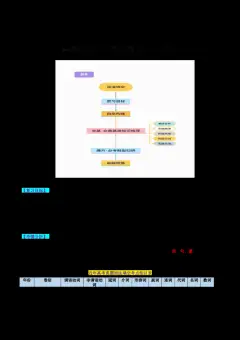
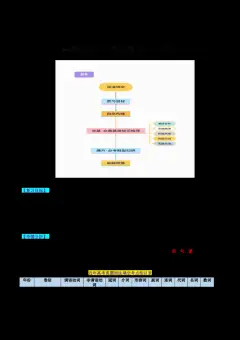
目录
一 动词的时态
二 动词的被动语态
三 动词的时态与语态易错点
四 高考模拟试题
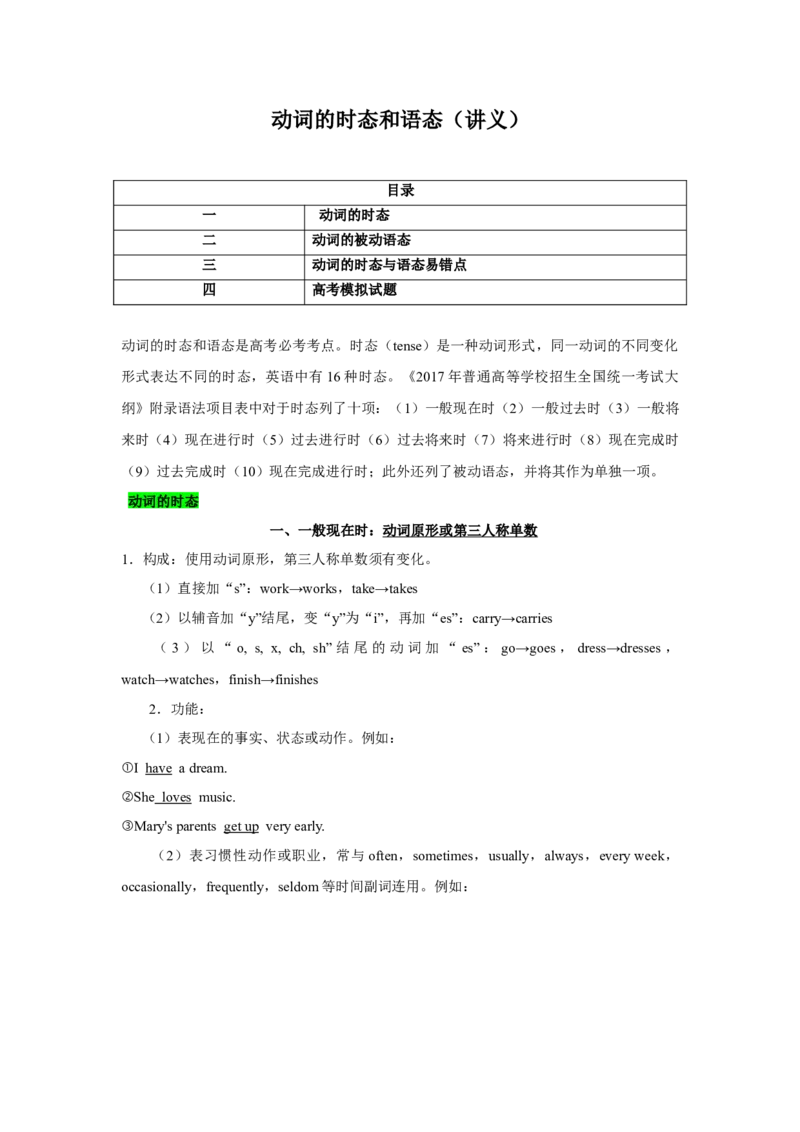
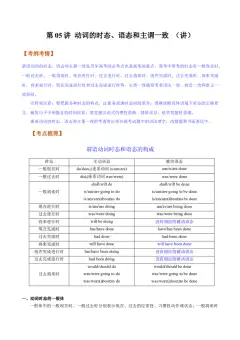
动词的时态和语态是高考必考考点。时态(tense)是一种动词形式,同一动词的不同变化
形式表达不同的时态,英语中有16种时态。《2017年普通高等学校招生全国统一考试大
纲》附录语法项目表中对于时态列了十项:(1)一般现在时(2)一般过去时(3)一般将
来时(4)现在进行时(5)过去进行时(6)过去将来时(7)将来进行时(8)现在完成时
(9)过去完成时(10)现在完成进行时;此外还列了被动语态,并将其作为单独一项。
动词的时态
一、一般现在时:动词原形或第三人称单数
1.构成:使用动词原形,第三人称单数须有变化。
(1)直接加“s”:work→works,take→takes
(2)以辅音加“y”结尾,变“y”为“i”,再加“es”:carry→carries
(3)以“o, s, x, ch, sh” 结尾的动词加“ es”:go→goes,dress→dresses,
watch→watches,finish→finishes
2.功能:
(1)表现在的事实、状态或动作。例如:
①I have a dream.
②She loves music.
③Mary's parents get up very early.
(2)表习惯性动作或职业,常与often,sometimes,usually,always,every week,
occasionally,frequently,seldom等时间副词连用。例如:①I always take a walk after supper.
②She writes to me very often.
③She is an English teacher.
(3)表客观真理,格言警句或事实。例如:
①The earth moves around the sun.
②The sun rises in the east and sets in the west.
③Two and two makes four.
④ No man but errs.
(4)表示将来发生的动作:
A.在由 when,after, before,as,as soon as,although,because,if,even if,in
case,till,until,unless,as long as,where,whatever,wherever 等引导的状语从句中用一
般现在时表将来发生的动作。例如:
① I'll tell her when she comes tomorrow.
② Even if it rains this afternoon, I'll meet you.
③Whatever happens, you should keep cool-headed.
④ I'll be right here waiting for you wherever you go.
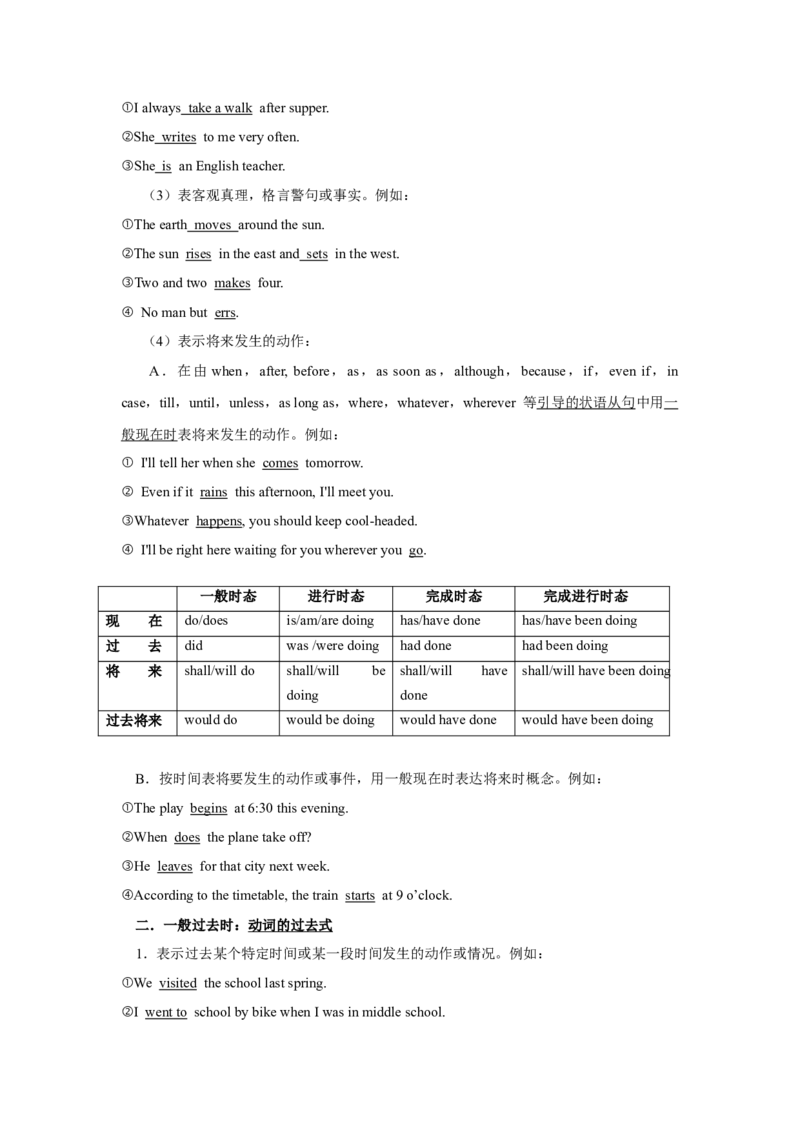
一般时态 进行时态 完成时态 完成进行时态
现 在 do/does is/am/are doing has/have done has/have been doing
过 去 did was /were doing had done had been doing
将 来 shall/will do shall/will be shall/will have shall/will have been doing
doing done
过去将来 would do would be doing would have done would have been doing
B.按时间表将要发生的动作或事件,用一般现在时表达将来时概念。例如:
①The play begins at 6:30 this evening.
②When does the plane take off?
③He leaves for that city next week.
④According to the timetable, the train starts at 9 o’clock.
二.一般过去时:动词的过去式
1.表示过去某个特定时间或某一段时间发生的动作或情况。例如:
①We visited the school last spring.
②I went to school by bike when I was in middle school.③China was founded in 1949.
2.在表示时间或条件等的状语从句中代替过去将来时。例如:
①She told me she would’t go with us if it rained the next day.
②They would not leave until she came back.
③His girlfriend promised to marry him once he bought her a big house.
三.一般将来时: shall / will + 动词原形
1.表示将要发生的动作或存在的状态。例如:
①He will graduate from the college next year.
②We shall finish our work as quickly as possible.
2.将来时的其它结构。 例如:
I .is/am/are going to do sth.(美国口语中常读作be gonna)
①I'm going to buy a new car this fall.
②He is going to sell his house.
注意:be going to与will的对比:下列情况须用will
①I will be sixteen years old next year.
②It will be the 20th of August tomorrow.
③When he comes, I will give him your message.
II. is/am/are + to do sth.表示计划安排做某事或征求意见。例如:
①Am I to take over his work?
②We are to meet at the gate.
III. is/am/are about to do sth. 即将做某事。例如:
①The talk is about to begin.
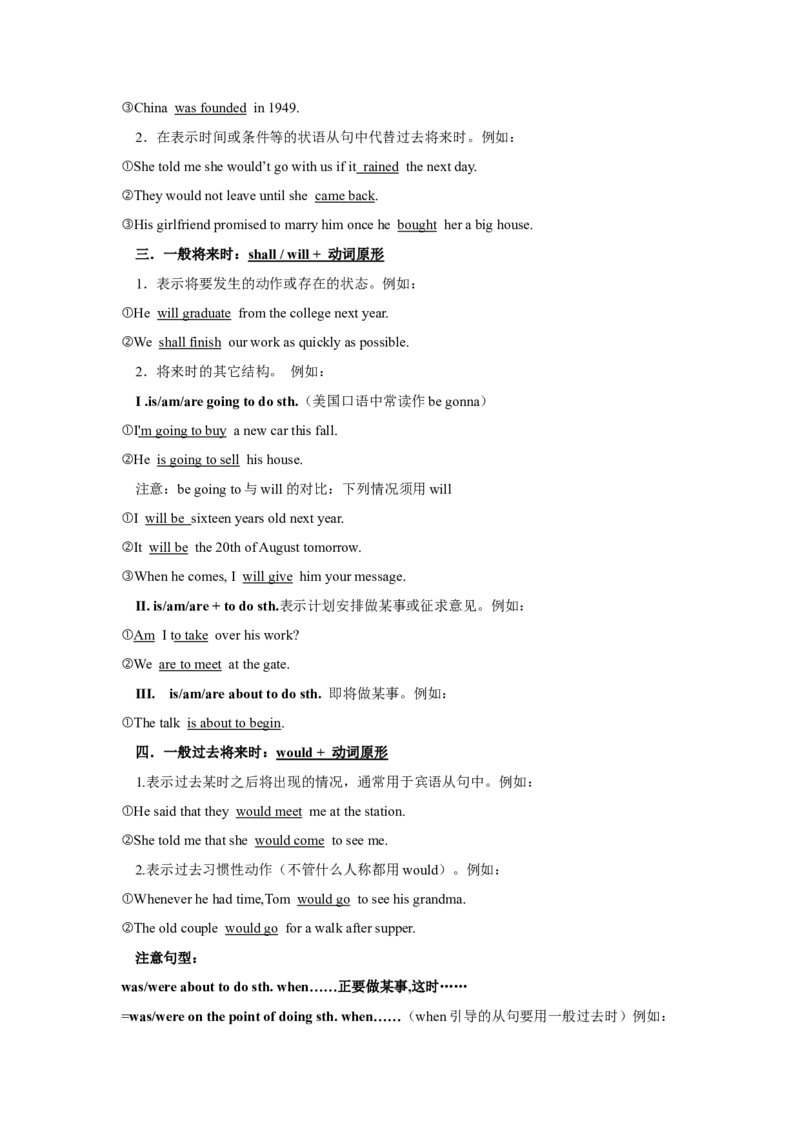
四.一般过去将来时: would + 动词原形
1.表示过去某时之后将出现的情况,通常用于宾语从句中。例如:
①He said that they would meet me at the station.
②She told me that she would come to see me.
2.表示过去习惯性动作(不管什么人称都用would)。例如:
①Whenever he had time,Tom would go to see his grandma.
②The old couple would go for a walk after supper.
注意句型:
was/were about to do sth. when……正要做某事,这时……
=was/were on the point of doing sth. when……(when引导的从句要用一般过去时)例如:①He was about to go out when the telephone rang.
②I was about to go shopping when it rained.
③She was on the point of having supper when the light went off.
五.现在进行时: is / am / are + 现在分词
1.表示现在正在进行的动作。例如:
①The water is boiling. Shall I make tea?
②The workers are building a new bridge across the river.
2.表现阶段正进行的动作。例如:
①He is taking physics this semester.
②We are preparing for our final examination this week.
③Don't you think you eat too much? You're putting on weight.
3.go, come, leave, arrive, land, meet, die, start, return, join, etc.用于进行时态时表示即将
开始的动作。例如:
① Look! The bus is coming.
②The old man is seriously ill, and he is dying.
③Alice is leaving for Shanghai with her mother.
4.与 always, forever, continually, constantly 等副词连用,表示说话人带有感情色彩:
赞赏或厌恶。例如:
①He is always thinking of others.
②The boy is continually making noises.
③The teacher is constantly criticizing her for being late.
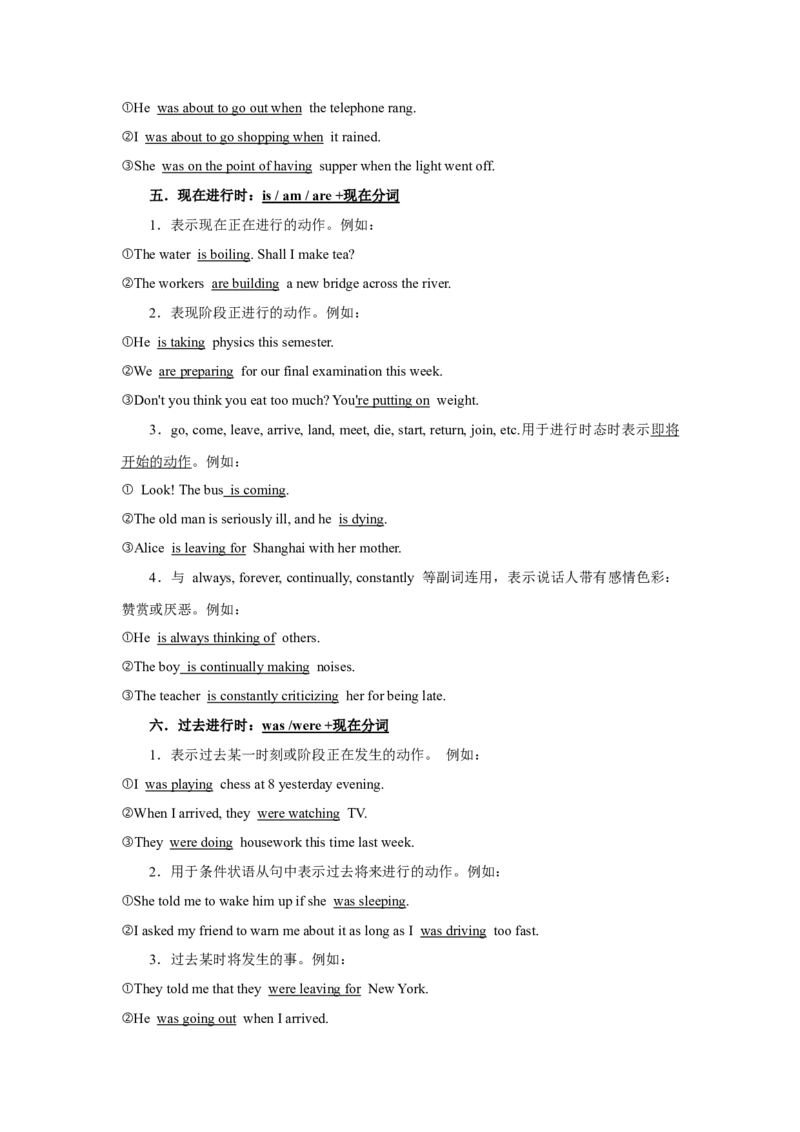
六.过去进行时: was /were + 现在分词
1.表示过去某一时刻或阶段正在发生的动作。 例如:
①I was playing chess at 8 yesterday evening.
②When I arrived, they were watching TV.
③They were doing housework this time last week.
2.用于条件状语从句中表示过去将来进行的动作。例如:
①She told me to wake him up if she was sleeping.
②I asked my friend to warn me about it as long as I was driving too fast.
3.过去某时将发生的事。例如:
①They told me that they were leaving for New York.
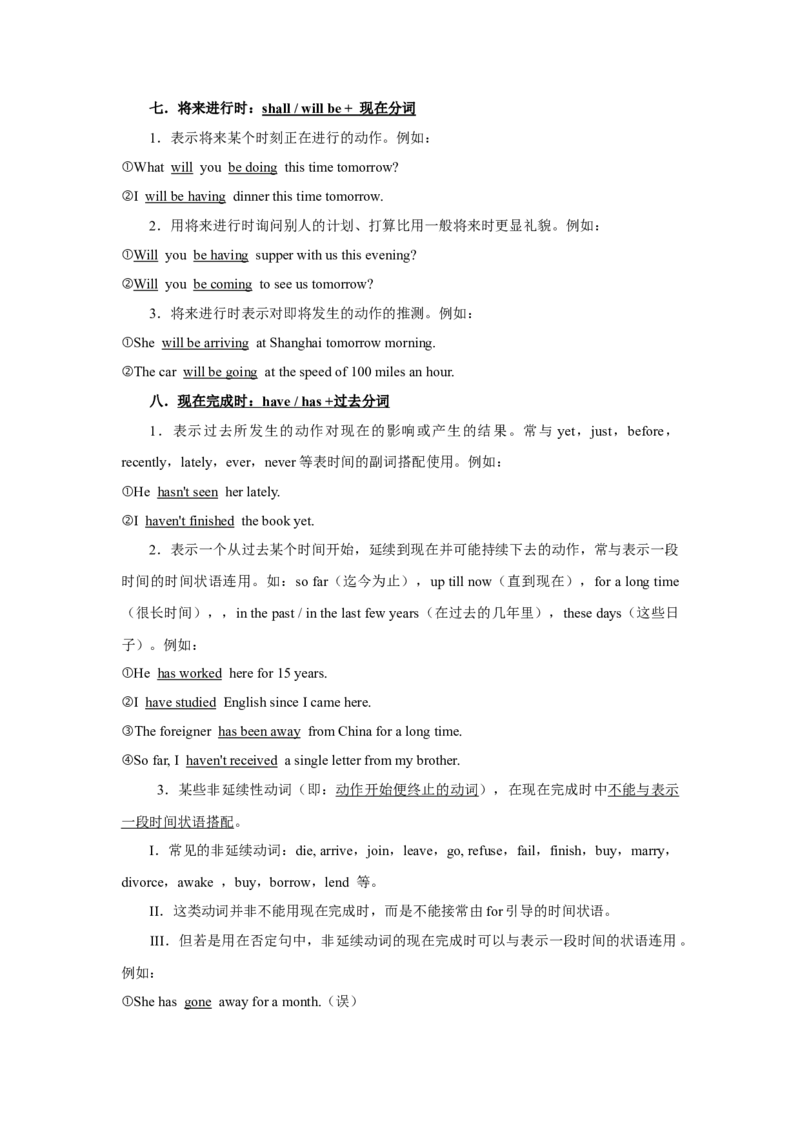
②He was going out when I arrived.七.将来进行时: shall / will be + 现在分词
1.表示将来某个时刻正在进行的动作。例如:
①What will you be doing this time tomorrow?
②I will be having dinner this time tomorrow.
2.用将来进行时询问别人的计划、打算比用一般将来时更显礼貌。例如:
①Will you be having supper with us this evening?
②Will you be coming to see us tomorrow?
3.将来进行时表示对即将发生的动作的推测。例如:
①She will be arriving at Shanghai tomorrow morning.
②The car will be going at the speed of 100 miles an hour.
八. 现在完成时: have / has + 过去分词
1.表示过去所发生的动作对现在的影响或产生的结果。常与 yet,just,before,
recently,lately,ever,never等表时间的副词搭配使用。例如:
①He hasn't seen her lately.
②I haven't finished the book yet.
2.表示一个从过去某个时间开始,延续到现在并可能持续下去的动作,常与表示一段
时间的时间状语连用。如:so far(迄今为止),up till now(直到现在),for a long time
(很长时间),,in the past / in the last few years(在过去的几年里),these days(这些日
子)。例如:
①He has worked here for 15 years.
②I have studied English since I came here.
③The foreigner has been away from China for a long time.
④So far, I haven't received a single letter from my brother.
3.某些非延续性动词(即:动作开始便终止的动词),在现在完成时中不能与表示
一段时间状语搭配。
I.常见的非延续动词:die, arrive,join,leave,go, refuse,fail,finish,buy,marry,
divorce,awake ,buy,borrow,lend 等。
II.这类动词并非不能用现在完成时,而是不能接常由for引导的时间状语。
III.但若是用在否定句中,非延续动词的现在完成时可以与表示一段时间的状语连用。
例如:
①She has gone away for a month.(误)②She has been away for a month (正)
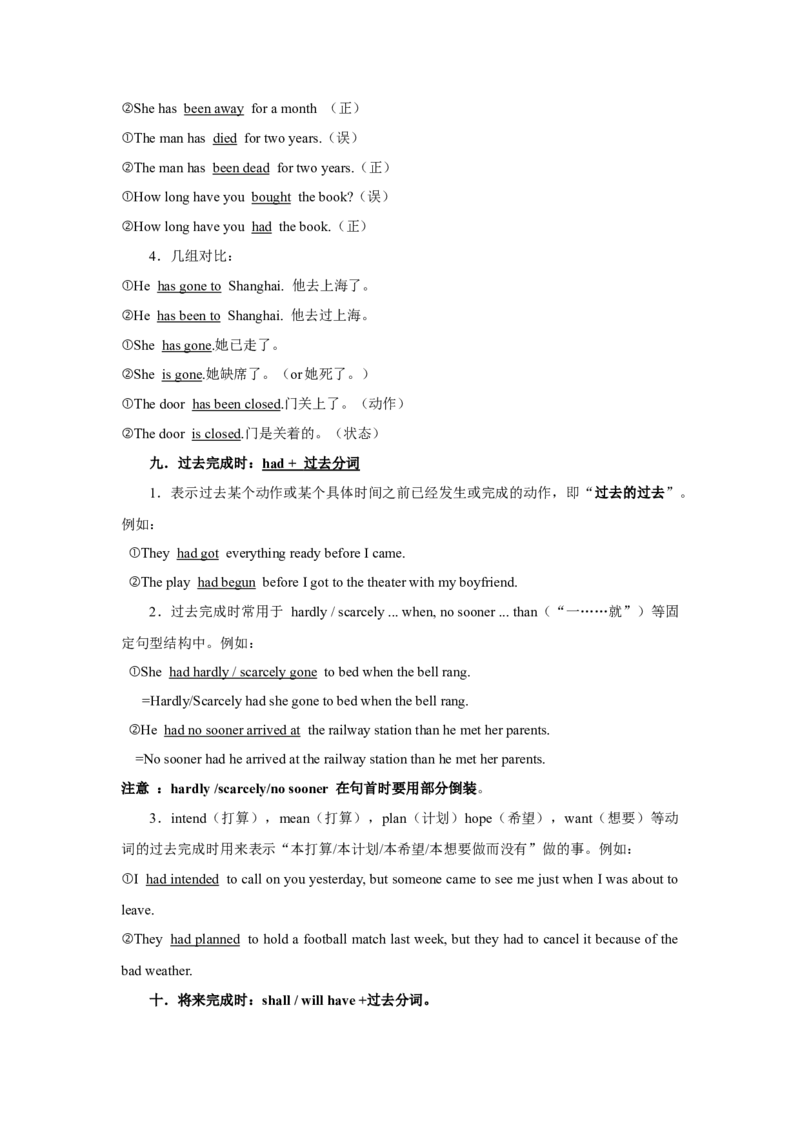
①The man has died for two years.(误)
②The man has been dead for two years.(正)
①How long have you bought the book?(误)
②How long have you had the book.(正)
4.几组对比:
①He has gone to Shanghai. 他去上海了。
②He has been to Shanghai. 他去过上海。
①She has gone.她已走了。
②She is gone.她缺席了。(or她死了。)
①The door has been closed.门关上了。(动作)
②The door is closed.门是关着的。(状态)
九.过去完成时: had + 过去分词
1.表示过去某个动作或某个具体时间之前已经发生或完成的动作,即“过去的过去”。
例如:
①They had got everything ready before I came.
②The play had begun before I got to the theater with my boyfriend.
2.过去完成时常用于 hardly / scarcely ... when, no sooner ... than(“一……就”)等固
定句型结构中。例如:
①She had hardly / scarcely gone to bed when the bell rang.
=Hardly/Scarcely had she gone to bed when the bell rang.
②He had no sooner arrived at the railway station than he met her parents.
=No sooner had he arrived at the railway station than he met her parents.
注意 :hardly /scarcely/no sooner 在句首时要用部分倒装。
3.intend(打算),mean(打算),plan(计划)hope(希望),want(想要)等动
词的过去完成时用来表示“本打算/本计划/本希望/本想要做而没有”做的事。例如:
①I had intended to call on you yesterday, but someone came to see me just when I was about to
leave.
②They had planned to hold a football match last week, but they had to cancel it because of the
bad weather.
十.将来完成时:shall / will have +过去分词。表示将来某时之前已经完成的动作。例如:
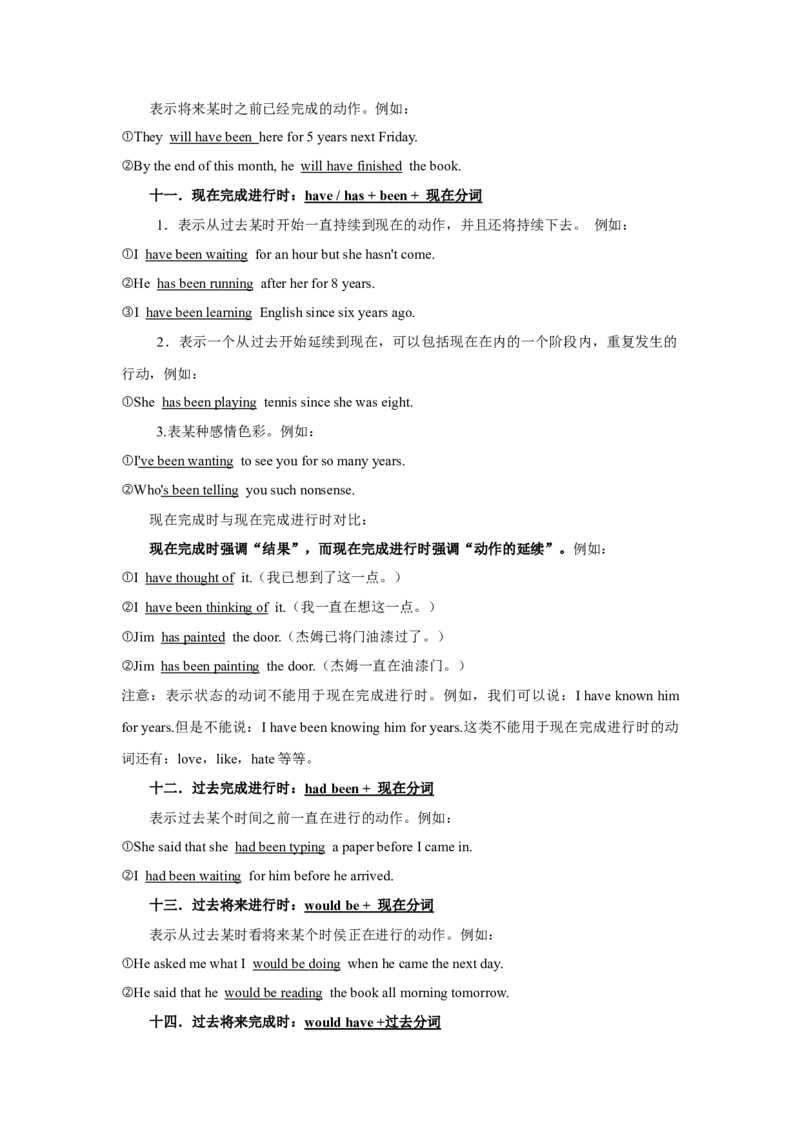
①They will have been here for 5 years next Friday.
②By the end of this month, he will have finished the book.
十一.现在完成进行时: have / has + been + 现在分词
1.表示从过去某时开始一直持续到现在的动作,并且还将持续下去。 例如:
①I have been waiting for an hour but she hasn't come.
②He has been running after her for 8 years.
③I have been learning English since six years ago.
2.表示一个从过去开始延续到现在,可以包括现在在内的一个阶段内,重复发生的
行动,例如:
①She has been playing tennis since she was eight.
3.表某种感情色彩。例如:
①I've been wanting to see you for so many years.
②Who's been telling you such nonsense.
现在完成时与现在完成进行时对比:
现在完成时强调“结果”,而现在完成进行时强调“动作的延续”。例如:
①I have thought of it.(我已想到了这一点。)
②I have been thinking of it.(我一直在想这一点。)
①Jim has painted the door.(杰姆已将门油漆过了。)
②Jim has been painting the door.(杰姆一直在油漆门。)
注意:表示状态的动词不能用于现在完成进行时。例如,我们可以说:I have known him
for years.但是不能说:I have been knowing him for years.这类不能用于现在完成进行时的动
词还有:love,like,hate等等。
十二.过去完成进行时: had been + 现在分词
表示过去某个时间之前一直在进行的动作。例如:
①She said that she had been typing a paper before I came in.
②I had been waiting for him before he arrived.
十三.过去将来进行时: would be + 现在分词
表示从过去某时看将来某个时侯正在进行的动作。例如:
①He asked me what I would be doing when he came the next day.
②He said that he would be reading the book all morning tomorrow.
十四.过去将来完成时: would have + 过去分词表示从过去某个时间看将来某时之前动作已经完成。例如:
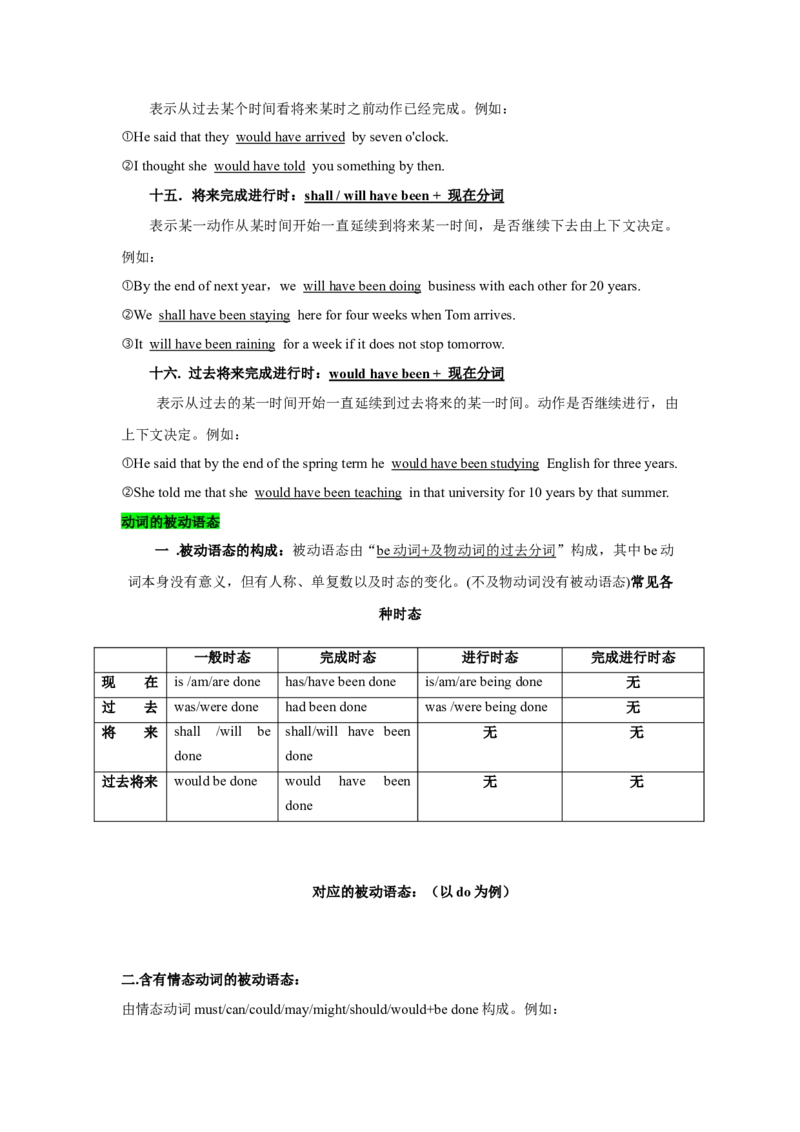
①He said that they would have arrived by seven o'clock.
②I thought she would have told you something by then.
十五.将来完成进行时: shall / will have been + 现在分词
表示某一动作从某时间开始一直延续到将来某一时间,是否继续下去由上下文决定。
例如:
①By the end of next year,we will have been doing business with each other for 20 years.
②We shall have been staying here for four weeks when Tom arrives.
③It will have been raining for a week if it does not stop tomorrow.
十六. 过去将来完成进行时: would have been + 现在分词
表示从过去的某一时间开始一直延续到过去将来的某一时间。动作是否继续进行,由
上下文决定。例如:
①He said that by the end of the spring term he would have been studying English for three years.
②She told me that she would have been teaching in that university for 10 years by that summer.
动词的被动语态
一 .被动语态的构成:被动语态由“ be 动词 + 及物动词的过去分词 ”构成,其中be动
词本身没有意义,但有人称、单复数以及时态的变化。(不及物动词没有被动语态)常见各
种时态
一般时态 完成时态 进行时态 完成进行时态
现 在 is /am/are done has/have been done is/am/are being done 无
过 去 was/were done had been done was /were being done 无
将 来 shall /will be shall/will have been 无 无
done done
过去将来 would be done would have been 无 无
done
对应的被动语态:(以do为例)
二.含有情态动词的被动语态:
由情态动词must/can/could/may/might/should/would+be done构成。例如:①The task must be finished before this weekend.
②He should be punished because he told lies.
③The book may be taken away by someone.
三. 被动语态的用法:
1.不知道谁是动作的执行者,或没有必要指明谁是动作的执行者,被动语态中的介词短语by
sb.通常省略。例如:
①The streets are swept every day.
②His car has been stolen.
③Rice is grown in many countries.
④This kind of advertisement can be seen everywhere.
2.带双宾语的及物动词变成被动语态有两种变法,指人的间接宾语用作被动语态的主语更
常见。例如:
①He gave her a beautiful gift yesterday.
→A beautiful gift was given to her (by him).或者
→ She was given a beautiful gift (by him).
3.get + 过 去 分 词 表 被 动 , 表 示 一 种 结 果 或 状 态 。 常 见 结 构 有 : get
killed/cheated/burnt/wounded/paid/hurt/lost/married/caught.例如:
①He got killed in the traffic accident last week.
②Don’t get cheated by her beauty.
③He got caught by the police because he exceeded the speed limit.
4.have sth done以及get sth done(主要用于口语中)常常表示安排别人把事情做好或谈论意
外的、不好的事情。例如:
①I need to have my hair cut.
②Your watch is broken,you’d better get it repaired.
③If you don’t get out of my house, I will have you arrested .
④We had our money stolen when we were on holiday.
⑤Joe had his leg broken in a fight.
5.have sth to be done表示主动提出请求帮助别人做某事。例如:
①I am going shopping ,do you have anything to be bought?
②I intend to spend my holiday in our hometown,do you have anything to be taken to your
parents?
③Do you have anything to be typed,sir?四.主动形式表被动意义:
1.look,feel,taste,sound,smell,appear,seem,prove,turn,stay,become,fall,get,
keep,grow等系动词+形容词或名词构成系表结构。例如:
①The ice feels cold.
②His plan proved practical.
2.表示开始、结果、运动的动词,如begin,finish,start,open,close,stop,end,shut,
run,move等。例如:
①Work began at 7'clock this morning.
②The shop closes at 6 p.m every day.
3.形容词easy,hard,fit,nice,dangerous,difficult等后面接动词不定式,且不定式和句
中主语构成逻辑上的动宾关系时,常用不定式的主动形式表示被动意义。例如:
①This kind of water is fit to drink.
②The text is easy to understand.
4.某些动词如read,write,sell,wash,clean,lock,open,dry等在表示主语的某种性质时,常用主动
表被动。例如:
①The clothes washes well.
②Your pen writes smoothly.
5.其他的主动表被动的情况。例如:
①The book is worth reading.
②My bike needs/wants/requires repairing.
=My bike needs/wants/requires to be repaired.
③Who is to blame?
动词的时态与语态易错点
易错陷阱1:一般现在时、一般过去时和现在完成时易混易错点
【分析】
一般现在时 常与always,often,sometimes,usually等连用或通过上下文表示。
常与时间状语连用,或者通过上下文逻辑意思及动词时态来体现。
一般过去时
连用时间状语:last week, in 2021, 3 days ago, the other day, in the past
强调对现在造成的结果和影响,通常与时间段连用。
现在完成时
连用时间状语:so far, since, in the past/last 3 days, up to now
The large siheyuan of these high-ranking officials and wealthy businessmen often________
(feature)beautifully carved and painted roof beams and pillars(柱子).易错分析:对一般规则死记硬背,不具体分析句子结构和句意。在时态题中,上下文的时
态暗示是重要线索。应当在句中瞻前顾后寻找并列连词 and, but, or, rather than, or, not
only...but also...等前后的谓语动词形式确定所填谓语动词的时态。
易错陷阱2:一般过去时和过去完成时易混易错点
【分析】
一般过去时 过去的动作或情况。
过去的动作或时间之前发生的事。
过去完成时
连用时间状语:by the end of+过去时间,before+过去时间。
1.下列动词hope、 wish、 expect、 think、 intend、 mean、 suppose
等,用过去完成时表示“原本……(事实上未能……)”。
2.This/It/That was the first/second/third ... time that ...表示“这/那是(某人)第
特殊用法
几次做某事”,that从句中要用过去完成时。
3.hardly ... when ...和no sooner ... than ...两个句型中,主句均用过去完成
时。
易错陷阱3:现在完成时和过去完成时易混易错点
【分析】
现在完成时 连用时间状语so far, since, in the past/last 3 days, up to now
过去的动作或时间之前发生的事。即“过去的过去”,句中必须出现表
过去完成时
示过去的动作、状态或时间状语。
He has been ill for two weeks。他已经病了两个星期了。
对比 He had been ill for two weeks before she came back。
在她回来之前,他已经病了两个星期了。
易错陷阱4:主动语态和被动语态易混易错点
【分析】
受母语干扰,翻译上下文时混淆被动语态与主动语态。
混淆谓语动词被动语态构词be+done与非谓语动词重点过去分词done。
不及物动词及表示主语品质和状态的动词不用被动语态,如:sell, read, write, lock, wash,
drive等。
系动词不用被动语态,如:look看起来, smell闻起来, taste尝起来, sound听起来, feel摸起
来, prove证明时, turn out结果,证明等。
【易错点提醒一】 一般现在时、一般过去时和现在完成时易混易错点
As a little girl, I ___ __ ___ (wish) to be a zookeeper when I grew up.
易错分析:不关注句中的时间状语As a little girl和逻辑意思理解错误是失分原因。The plan will extend protection to a significant number of areas that ________ (be)previously
unprotected, bringing many of the existing protected areas for giant pandas under one authority to
increase effectiveness and reduce inconsistencies in management.
易错分析:句子较长,容易引起句子结构分析失误和翻译的重心转移,从而忽略关键词
previously。
The bridge (call) the Bach Long suspension bridge. It means “White Dragon” in Vietnamese.
易错分析:未能瞻前顾后,正确理解上下文的含义。下文means给出限速,强调客观事实。
Panda conservation, on its own, _____ (be) a success up to now.
【易错点提醒二】 一般过去时和过去完成时易混易错点
He raised a glass of water and asked the audience, “How heavy do you think this glass of water
is?” The students’ answers (range) from 20g to 500g.
易错分析:本题重在分析句子结构,容易误填ranging,应知此处作谓语。谓语与非谓语的
考查是高考的重点。
Noting China’s achievements of green development in urban and rural areas, Zhang Xiaohong,
vice minister of housing and urban-rural development, ___(stress) the difficult task of saving
energy and reducing carbon emissions in urban and rural construction at a press conference on
Monday.
易错分析:此句属于长难句,句子结构容易分析错误从而不会正确翻译,同时上下文时态
的兼顾也是解题重点。
Since the Chinese highly qualified silk_________(make) its fame to the western countries, the
merchants sought the opportunity of trading Chinese silk along this route and gained a great
fortune.
易错分析:此题容易因为since而受到干扰,应当正确分析句子结构,理解since此处表
“因为”。不能单纯看词形识别时间状语,英语单词由很多是一词多义,需具体分析上下
文逻辑意思。
In fact, there is a Lanzhou Beef Noodles restaurant right downstairs, which is about 100 yards
from our Beijing apartment, My niece Kim came to visit us in Beijing this summer, and after
visiting many fancy restaurants, she declared this bowl of noodles to be the best thing she
(eat) in China ever.
【易错点提醒三】现在完成时和过去完成时易混易错点
I love coming here and seeing my family and all the friends I_____ (make)over the years.易错分析:本题出错主要因为固定短语记忆不牢及汉语翻译已经错误联想had done运用过
去完成时则句中要出现表示过去的动作或时间。要牢记现在完成时经常搭配的时间状语:
since, so far, up to now, in/over/during the past days等。
On a website called No Fly Climate Sci, for example,roughly 200 academics - many of them
climate scientists (promise) to fly as little as possible since the effort started two
years ago.
易错分析:受到母语翻译影响,很多学生只要翻译为“已经”,就联想到have的过去时
had,继而had done, 属于现在完成时和过去完成时构成形式记忆不牢。
By Aug 19, Haihua Island________ (receive) over 1 million tourists during the summer vacation.
易错分析:未能牢记过去完成时经常搭配的时间状语如by +过去时间,by the end of+过去
时间。
He mentioned that the Chinese market is significant for jade products, and his business
(operate) in China for 10 years.
【易错点提醒四】 主动语态和被动语态易混易错点
Wudang martial arts based on the Taoist ideology (create) by one of the most famous Taoists,
named Zhang Sanfeng in the early years of the Ming Dynasty.
易错分析:句子结构分析错误,谓语动词分析不当,混淆谓语的被动语态和过去分词都是
错误原因。
Today, the modernist complex (stock) with so many art works that the exhibit arenas can show
just a part of them at a time, making the artistic special exhibitions a highlight of any visit to the
Getty.
易错分析:句子结构分析错误,未能正确理解句子的意思和句子成分,本句属于正确拆分
长难句,并分析逻辑关系。
The choice of “Turret of Palace Museum” as the theme for the mini building block project
(base) on several factors.
The reinforced glass (use) for the bridge can hold up to 450 people at a time.
易错分析:不关注设空后的句子成分,未能发现can hold才是真正的谓语动词,容易误填
be done。
高考模拟试题
一、单项选择
1.(2024·天津和平·二模)—He has got A for his term paper. He must have prepared for it fora long time.
—Exactly. He _______ the whole summer doing research through Europe.
A.has spent B.had spent C.spent D.would spend
2.(2024·天津和平·二模)According to the doctor, this time next week, I_______ around as
normal and the cut on my foot _______ completely.
A.am walking, healed B.will be walking, will have healed
C.walks, is going to heal D.have been walking, heals
3.(2024·天津·一模)The number of firms selling smartphones in this region ______ since last
year.
A.dropped B.was being dropped
C.have been dropping D.has dropped
4.(2024·山东济南·二模)-- ______?
--Yes, a bit cold, though.
A.Freezing, isn't it B.Nice day, isn't it
C.Bad weather, don't you think D.Cold weather, isn't it
5.(2024·天津·二模)Since its establishment, the Flying Tiger Historical Association ______
to friendly interactions between the Chinese and American people.
A.has contributed B.has been contributing C.contributedD.
contributes
6.(2024·天津·模拟预测)—I really shouldn’t have been so rude and lost my temper.
—Well. I ______ you to hold back your anger, but...
A.have reminded B.had reminded C.would remind D.reminded
7.(2024·天津武清·模拟预测)— Could you attend the lecture about city development
tomorrow afternoon?
— Sorry, I ______ to Paris for a Chinese silk exhibition then.
A.will be flying B.will fly
C.fly D.am flying
8.(2024·天津·二模)I miss my parents very much; I_______ from my home for 5 months by
next Sunday.
A.am away B.will have been awayC.have been away D.will be away
9.(2024·天津·二模)There is a river near my home, into which large quantities of waste water_______ poured every day in the past.
A.were B.have been C.was D.has been
10.(2024·天津南开·一模)She ________that the glass would break while opening the
window.
A.has frightened B.was frightened C.frightened D.had frightened
11.(2024·天津红桥·一模)The cars produced in our factory sell well, but several years ago no
one could have imagined the role in the market that they ________.
A.were to play B.were playing C.had played D.played
12.(2024·天津和平·一模)Shadow puppets ______ in China and ______ as far as Turkey and
Greece today.
A.will originate; have been spreading B.originate; will be spreading
C.was originated; is spreading D.originated; have spread
13.(2024·天津河东·一模)I’m afraid I can’t go shopping with you this Sunday afternoon
because I ______a meeting at that time.
A.will have B.will be having C.has had D.would have
14.(2024·天津河北·一模)Nearly seventeen centuries ________ before the city of Pompeii
was dug from its silent resting place.
A.has rolled awayB.had rolled away C.rolled away D.was rolling away
15.(2024·天津和平·一模)I haven’t finished my homework yet. I ______ my mother in the
kitchen all day yesterday.
A.have been helping B.was helping C.had helped D.
have helped
16.(2024·陕西西安·三模)The students spent as much time getting trained as they ______
studying.
A.disliked B.were C.had D.did
17.(2024广东深圳·一模)Recent years ______ a significant increase in the use of AI across
different aspects of human life.
A.saw B.see C.are seeing D.have seen
18.(2024·天津南开·模拟预测)For many years, more than one generation of schoolchildren
________ by his bravery and his scientific approach to looking for the truth.A.have been amazed B.has been amazed
C.was amazed D.were amazed
19.(2024山东济南二模)The lady insisted that the young man ________ her wallet and that
he should be sent to the police station at once.
A.had stolen B.steal C.has stolen D.stole
20.(2024·天津·一模)Better than half a billion dollars ______ that fund to purchase more
than 5 million acres of habitat over the past eighty years.
A.have gone into B.had gone into
C.have been gone into D.has gone into
21.(2024·天津武清·二模)Hundreds of people spent good money on an experience that they
knew ______ crowds, discomfort and danger.
A.include B.will include
C.included D.would include
22.(2024江苏南通三模)The local government announced that only when the fire was under
control ________ to return to their homes.
A.the residents would be allowed B.had the residents been allowed
C.would the residents be allowed D.the residents had been allowed
23.(2024·广东湛江·一模)________that it was already the fourth time that he
_________abroad.
A.So lucky was he; traveled B.So lucky he was; traveled
C.So lucky was he; had traveled D.So lucky he was; had traveled
24.(2024·山东临沂·二模)— I want to know when Lucy ______ to my birthday party this
Sunday.
— I don’t know. But I think she will tell me when she ______.
A.comes; comes B.comes; will come
C.will come; comes D.will come; will come
25.(2024·江苏连云港·三模)I __________ to give you just a surprise quiz but on second
thought I chose to let you reflect on your exercises.
A.had intended B.has intended C.intended D.has been intended
二、单词拼写26.(2024·陕西西安·一模)As soon as the fire alarm went off, everyone in the building
(逃离) to the nearest exit. (根据汉语提示单词拼写)
27.(2024·山东潍坊·模拟预测)You have f (原谅) me, haven’t you? (根据中英文
提示单词拼写)
三、翻译
28.(2024·上海·模拟预测)这所百年老校近年来开展了一系列“古典乐进课堂”活动,
让更多学生感受到经典的独特魅力。(launch)
29.(2024·上海·模拟预测)尽管市场上饮料品种丰富,但我还是深深着迷于中国传统的
茶文化。(although)
30.(2024·上海浦东新·三模)他运动之前习惯热身和拉伸以避免受伤。(ritual)
31.(2024·上海浦东新·三模)为缓解人口老龄化的压力,中国政府正在建立更多的社区
机构来为老年人的生活提供支持。(ease)
32.(2024·上海宝山·二模)坦率地说,考试分数只能作为一个参考,不能作为评价的唯
一标准。(guideline)
33.(2024·上海松江·二模)这位摄影师觉得去热门景点拍照没意思,他已计划好要去沙
漠找灵感。(instead)
34.(2024·上海松江·二模)她原以为没多少人会来体育馆看比赛,结果看台上座无虚席。
(it)
35.(2024·上海松江·二模)这家软件公司会从技术上保护设计师的创意。(perspective)
36.(2024·上海松江·二模)大多数中国人喜欢在生日的时候吃碗面。(tend)
37.(2024·上海崇明·二模)你只要脚踏实地,努力做好每一件事,你的梦想就会离你越
来越近。(effort)38.(2024·上海崇明·二模)毫无疑问,这个历史小镇已成为了很多游客追捧的旅游胜地。
(doubt)
39.(2024·上海崇明·二模)难以置信的是,她看似柔弱,却是一个渴望探险的女孩子。
(long)
40.(2024·上海虹口·二模)随着人们的生活回归正轨,工作节奏加快,一些宠物被遗弃
街头无家可归。(As)