【暑假辅导班】
新高二英语暑假精品课程(人教版)
第10讲 选择性必修一 Unit 2 Learning About Language
将来进行时态
(The future progressive tense)
一、将来进行时
1. 基本结构: 主语+will/shall be +doing
2. 基本用法:
(1)表示将来某一时间正在进行的动作, 一般带状语。
(2)表示现在正在进行的动作, 但这个动作会延续到将来。
(3)表示预先安排好的将来的动作或对将来的打算。
(4)表示委婉的请求、原因或结果。
3. 定义: 将来进行时是指将来某个时间正在进行的动作, 或表示要在将来某一时间开始, 并继续下去的动作,
常用来表示礼貌的询问、请求等。
*I think that she will be working on this experiment until next morning.
我想她会一直做这个实验到第二天早上。
*When shall we be meeting again?
我们什么时候能再见面?
*Hurry up! The guests will be arriving at any minute!
快! 客人随时就要来了。
*Stop the child or he will be falling over.
阻止那个孩子, 要不然他会摔跤的。
二、将来进行时与一般将来时的区别
1. 一般将来时是指将来某个时间将要发生的动作和状态, 基本结构是: 主语+will/shall do; 将来进行时是指将
来某个时间正在进行的动作, 基本结构是: 主语+will/shall be +doing。
*I’ll read a book tomorrow.
明天我要看书。
*I’ll be reading a book at 10: 00 tomorrow.
明天十点我将正在看书。
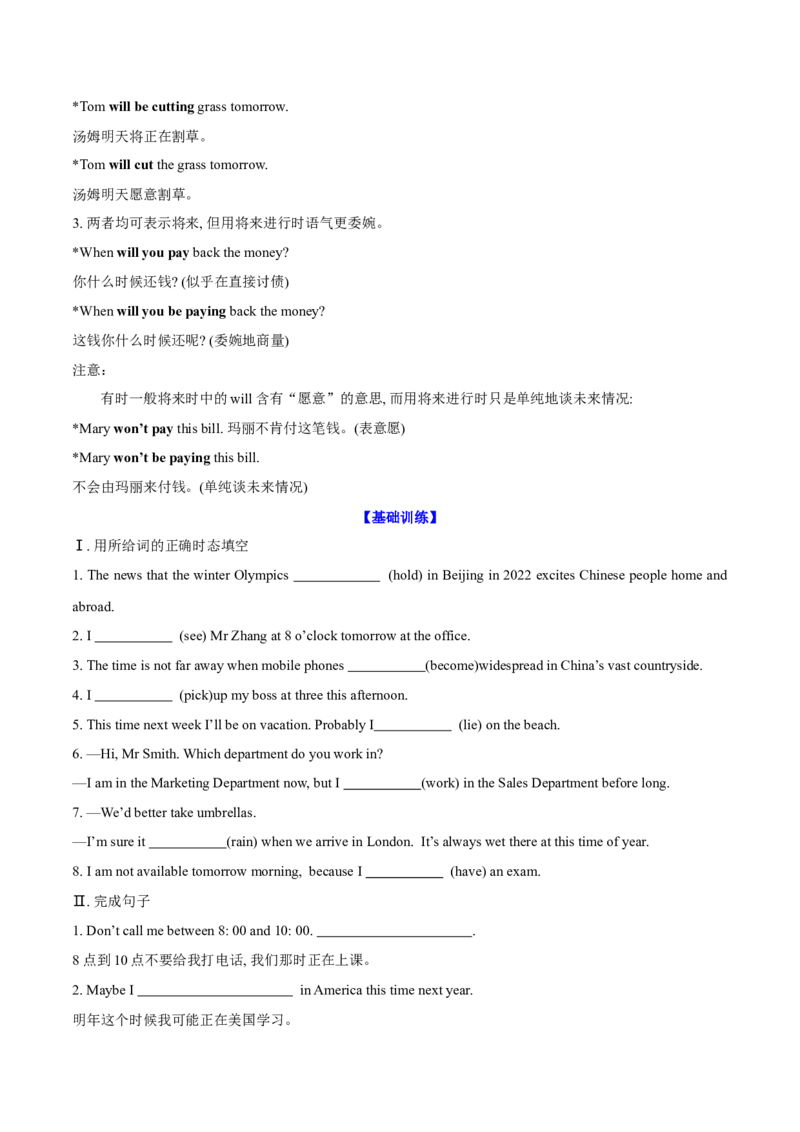
2. 将来进行时通常表示的是对将来事实的简单陈述, 而一般将来时除表示时间概念外, 还带有感情色彩。*Tom will be cutting grass tomorrow.
汤姆明天将正在割草。
*Tom will cut the grass tomorrow.
汤姆明天愿意割草。
3. 两者均可表示将来, 但用将来进行时语气更委婉。
*When will you pay back the money?
你什么时候还钱? (似乎在直接讨债)
*When will you be paying back the money?
这钱你什么时候还呢? (委婉地商量)
注意:
有时一般将来时中的will含有“愿意”的意思, 而用将来进行时只是单纯地谈未来情况:
*Mary won’t pay this bill. 玛丽不肯付这笔钱。(表意愿)
*Mary won’t be paying this bill.
不会由玛丽来付钱。(单纯谈未来情况)
【基础训练】
Ⅰ. 用所给词的正确时态填空
1. The news that the winter Olympics (hold) in Beijing in 2022 excites Chinese people home and
abroad.
2. I (see) Mr Zhang at 8 o’clock tomorrow at the office.
3. The time is not far away when mobile phones (become)widespread in China’s vast countryside.
4. I (pick)up my boss at three this afternoon.
5. This time next week I’ll be on vacation. Probably I (lie) on the beach.
6. —Hi, Mr Smith. Which department do you work in?
—I am in the Marketing Department now, but I (work) in the Sales Department before long.
7. —We’d better take umbrellas.
—I’m sure it (rain) when we arrive in London. It’s always wet there at this time of year.
8. I am not available tomorrow morning, because I (have) an exam.
Ⅱ. 完成句子
1. Don’t call me between 8: 00 and 10: 00. .
8点到10点不要给我打电话, 我们那时正在上课。
2. Maybe I in America this time next year.
明年这个时候我可能正在美国学习。3. They at the station.
他们会在车站接我们的。
4. Lily this time next Friday.
下周五这个时候Lily将正在进行演讲。
5. just as we do today.
我们会像今天一样生活在房子和楼里面。
III. 阅读理解
A
Welcome to Your Future Life!
You get up in the morning and look into the mirror. Your face is firm and young-looking. In 2035, medical
technology is better than ever. Many people at your age could live to 150, so at 40, you’re not old at all. And your
parents just had an anti-aging (抗衰老的) treatment. Now, all three of you look the same age!
You say to your shirt, “Turn red. ” It changes from blue to red. In 2035, “smart clothes” contain particles (粒
子) much smaller than the cells in your body. The particles can be programmed to change your clothes’ color or
pattern.
You walk into the kitchen. You pick up the milk, but a voice says, “You shouldn’t drink that! ” Your fridge
has read the chip (芯片) that contains information about the milk, and it knows the milk is old. In 2035, every
article of food in the grocery store has such a chip.
It’s time to go to work. In 2035, cars drive themselves. Just tell your “smart car” where to go. On the way,
you can call a friend using your jacket sleeve. Such “smart technology” is all around you.
So will all these things come true? “For new technology to succeed, ” says scientist Andrew Zolli, “It has to
be so much better that it replaces what we have already. ” The Internet is one example—what will be the next?
1. We can learn from the text that in the future______.
A. people will never get old
B. everyone will look the same
C. red will be the most popular color
D. clothes will be able to change their pattern
2. What can be inferred from Paragraph 3?
A. Milk will be harmful to health.
B. More drinks will be available for sale.
C. Food in the grocery store will carry electronic information.D. Milk in the grocery store will stay fresh much longer.
3. What is the text mainly about?
A. Food and clothing in 2035.
B. Future technology in everyday life.
C. Medical treatments of the future.
D. The reason for the success of new technology.
B
For many of us, summertime means road trips to the beach or mountains, or at the very least some additional
dust on the outside of our vehicle. The extra dirt leads us to do one of two things: wash our car in the driveway or
head to the car wash. But which choice is better for the environment?
The main concerns with either choice are the amount of fresh water used and the types of chemicals used to
get rid of the din. Both of these concerns can be closely monitored when washing the car at home, says Katy Gresh.
Spokeswoman for the Southwest Region of the Pennsylvania Department of Environmental Protection. She advises
car owners to keep a set amount of water in a container for the entire wash. “You don’t want to leave the water
running or use more than you need for the job, ”she says. But even following this piece of advice comes with an
environmental risk: Washing your car in the driveway gets the dirty water into drains(下水道).
“Drains are not made for treating waste, ”says John Schombert, executive director of 3 Rivers Wet Weather.
Even when car owners use natural soaps to wash their car, Schombert says they are probably ineffective in breaking
down grease(油脂)anyway.
The commercial car wash knows full well the rules regarding wastewater in drains. According to the
International Carwash Association(ICA), professional car washes must use special water treatment systems. These
processes not only keep the dirty water out of drains and regular water treatment systems, but also work to reduce
water usage at commercial facilities.
As experts point out, cleaning our car at home can use 100 gallons of water. Compare that to self-service car
washes, which allow you to use only about 17 or 18 gallons of water. And most full-service Car washes average
about 30 to 45 gallons of water per vehicle.
4. What does Katy suggest people do about washing cars?
A. Use soft toothbrushes.
B. Save treated water.
C. Put aside some water.
D. Avoid using chemicals.5. What is Schombert’s attitude to washing cars at home?
A. Disapproving. B. Favorable.
C. Suspicious. D. Objective.
6. What is the fourth paragraph mainly about?
A. Rules of handling wastewater.
B. Advantages of professional car washes.
C. Processes of getting rid of dirty water.
D. Drawbacks of water treatment systems.
7. Which method of car washing consumes the least water?
A. The full-service car washes.
B. Car washing in the driveway.
C. The self-service car washes.
D. Car washing using natural soaps.
参考答案
Ⅰ. 1. The news that the winter Olympics will be held (hold) in Beijing in 2022 excites Chinese people home and
abroad.
2. I will be seeing (see) Mr Zhang at 8 o’clock tomorrow at the office.
3. The time is not far away when mobile phones will become (become)widespread in China’s vast countryside.
4. I shall be picking (pick)up my boss at three this afternoon.
5. This time next week I’ll be on vacation. Probably I will be lying (lie) on the beach.
6. —Hi, Mr Smith. Which department do you work in?
—I am in the Marketing Department now, but I will work(work) in the Sales Department before long.
7. —We’d better take umbrellas.
—I’m sure it will be raining(rain) when we arrive in London. It’s always wet there at this time of year.
8. I am not available tomorrow morning, because I will be having (have) an exam.
Ⅱ. 1. Don’t call me between 8: 00 and 10: 00. We will be having classes then.
2. Maybe I will be studying in America this time next year.
3. They will be meeting us at the station.
4. Lily will be giving a speech this time next Friday.
5. We will be living in houses and flats just as we do today.
III.A
【文章大意】本文是一篇说明文。文章是一篇科技小短文, 主要畅想了运用科学技术后未来人们日常生活
所发生的一系列变化。
1. 【解析】选D。细节理解题。由第二段“The particles can be programmed to change your clothes’ color or
pattern. ”可知, 衣服上已编程的粒子可以改变衣服的颜色和款式。故选D。
2. 【解析】选C。推理判断题。由第三段可知, 杂货店的食物会含有商品信息的电子芯片。故选C。
3. 【解析】选B。主旨大意题。由第一段“In 2035, medical technology is better than ever. Many people at
your age could live to 150”, 第二段“The particles can be programmed to change your clothes’ color or pattern. ”,
第三段“In 2035, every article of food in the grocery store has such a chip. ”和第四段“In 2035, cars drive
themselves. ”可知, 文章讲述的是运用科技后人们未来日常生活中的变化。故选B。
B
【文章大意】本文为一篇说明文。本文对比了几种洗车方法, 其中自助洗车用水量少, 且不会对环境造成伤
害。
4. 【解析】选C。细节理解题。 根据第二段中的“She advises car owners to keep a set amount of water in a
container for the entire wash”和“You don’t want to leave the water running or use more than you need for the job”
可知, 她建议车主为洗车预留出一定量的水, 这样就不用让水一直流或者用过多的水了。故答案为C。
5. 【解析】选A 。观点态度题。根据第二段中的“Washing your car in the driveway gets the dirty water into
drains”和第三段中的“Drains are not made for treating waste”可知, 下水道并非是用来处理废水的; 再根据第
三段中的“Even when car owners use natural soaps to wash their car, Schombert says they are probably
ineffective in breaking down grease anyway”可知, Schombert认为, 即使车主使用天然肥皂来洗车, 这种肥皂在
分解油脂方面可能也没什么效果。由此可推断, Schombert对在家洗车持反对态度。
6.【解析】选B。段落大意题。第四段主要介绍专业洗车场洗车时用水量少且能够处理脏水, 不会对环境造
成伤害, 故答案为B。
7.【解析】选C。细节理解题。根据文章最后一段所罗列的数字可知, 自助洗车用水量最少, 故答案为C。