【暑假辅导班】
新高二英语暑假精品课程(人教版)
第20讲 选择性必修一 Unit 5 Using Language
【核心知识点讲解】
1. widespread adj. 分布广的, 普遍的, 广泛的
*Chemical pesticides and artificial fertilisers have been in widespread use in farming since the middle of the 20th
century.
自20世纪中叶以来, 化学杀虫剂和人工肥料在农业中被广泛使用。
*(2019·浙江高考)Mclntyre and his colleagues documented a widespread death of big trees that was evident even
in wildlands protected from woodcutting or development.
Mclntyre和他的同事发现大树的广泛死亡, 即使在禁止砍伐和开发的野生土地上也很明显。
*Smart phones are widely used in the world.
智能手机在世界上被广泛使用。
【词块记忆】
(1)a widespread disease 流行病
in widespread use 广泛应用
(2)widely adv. 广泛地, 大大地
2. essential adj. 完全必要的; 极其重要的
*They may look beautiful on the outside, but inside there is usually more water than essential minerals, and they
often have less flavor as well. 它们外表看起来可能很漂亮, 但里面通常含水比必需矿物质多, 而且它们的味道
也往往较淡。
*Before giving my opinion, I think it is essential to look at the argument of both sides.
在给出我的观点之前, 我想有必要看看双方的论据。
*(2019·江苏高考)The example in Paragraph 4 suggests that donators should take people’s essential needs into
account.
第4段中的例子表明捐赠者应该考虑到人们的基本需求。
*(2019·天津高考)History is much more than the study of dusty old objects and events long past. It is an essential
part of who we are today and who we will become.
历史不只是研究满是灰尘的古董和很久以前的事件。它还是搞清楚我们今天是谁和我们将成为谁的重要部
分。*Food is essential to life.
食物对生命是必不可少的。
【词块记忆】
be essential to/for 对……很重要
It is essential that . . . (should) do. . . “做……是完全必要的”
It is essential for sb. to do. . . “对某人来说做……是完全必要的”
3. alternative n. 可供选择的事物 adj. 可供替代的, 非传统的
*As an alternative, some farmers have switched to organic farming, and many customers have turned to organic
food when they shop at the local grocery.
作为一个选择, 一些农民已经转向有机农业, 而且许多顾客在当地杂货店购物时也转向了有机食品。
*In race for a sustainable alternative to plastic, Indonesia bets on seaweed. 在寻找一种可持续的塑料替代品的
竞赛中, 印度尼西亚把赌注押在了海藻上。
*(2019·江苏高考)Many donators have rushed into fancy programmes without carefully assessing the relative long-
term costs and benefits of alternative uses of their money.
许多捐赠者在没有仔细评估其资金的替代用途的相对长期成本和收益的情况下, 就仓促进行了一些花哨的
项目。
【词块记忆】
(1)have no alternative but (to do) 除(做)……外别无选择
(2)choice(同义词) n. 选择, 选择权
make a choice 做选择
have no choice but to do 别无选择只好做
4. instance n. 例子, 实例, 事例
*For instance, they may grow corn or wheat in a field one year, and then grow beans there the next. 例如, 他们可
以一年在田里种植玉米或小麦, 然后下一年在那里种植豆类。
*In one instance, indeed, things have gone full circle.
在一个例子中, 事实上, 事情已经绕了一圈。
*It denies rights not only to animals but also to some people— for instance to infants, the mentally incapable and
future generations. 它不仅剥夺了动物的权利, 也剥夺了一些人的权利, 例如婴儿、智力低下者和后代。
* (2019·天津高考)Most food webs, for instance, consist of many weak links rather than a few strong ones. 例如,
大多数食物网由许多薄弱链接组成, 而不是几个强有力的链接。
【词块记忆】for instance 例如
in the first instance 第一, 首先
【要点拾遗】
1. prohibit vt. 禁止; 阻止(prohibited, prohibited)
*In fact, some pesticides like DDT have been prohibited in most countries because of the damage they cause to
people and the environment. 事实上, 一些杀虫剂, 如DDT, 因为它们对人和环境造成的损害, 在大多数国家已
经被禁止。
*Over 1, 800 foreigners have been arrested for doing legally prohibited jobs in Thailand,
超过1 800名外国人因涉嫌在泰国从事被禁止的工作而被捕。
*(2019·浙江高考)Cutting of Big Trees to Be Prohibited in California soon.
加利福尼亚州即将禁止砍伐大树。
*The professor was deaf and any talking was prohibited.
那个教授是个失聪的人, 并且任何交谈都受限制。
【词块记忆】
prohibit sb. from doing sth. 阻止某人做某事
2. depth n. 向下(或向里)的距离, 深(度)
*Organic farmers also plant diverse crops that use different depths of soil to help keep it rich. 种植有机作物的农
民还种植不同的作物, 使用不同的土壤深度来帮助保持其肥沃。
*We will discuss these three areas in depth.
我们将深入探讨这3个领域。
*(2019·全国卷Ⅱ)You also need to judge the quality and depth of your motivation. 你还需要判断动机的质量和
深度。
【词块记忆】
(1)in depth 完全地, 深入地
(2)deep adj. 深的 adv. 深深地
(3)deeply adv. 深深地, 强烈地
(4)deepen v. (使)变深, (使)加深
3. in turn 相应地, 转而, 依次, 轮流
*This affects the crops grown on the land and, in turn, the animals and humans who digest them.
这会影响在土地上种植的作物, 进而影响消化它们的动物和人类。
*People try to avoid public transportation delays by using their own cars, and in turn this creates further problems.人们通过使用自己的小汽车努力去避免公共交通的延迟, 而这又反过来产生进一步的问题。
【词块记忆】
by turns 轮流, 交替
take turns 轮流, 依次
4. focus on/upon集中(……)于, 聚焦(……)于
*Organic farmers focus on keeping their soil rich and free of disease through natural means.
有机农民注重通过自然手段保持土壤肥沃和免于疾病。
*(2020·新高考全国Ⅰ卷)Too often, when you stand up to give a speech, you focus on the“public”at the expense
of the “speaking”. 很多时候, 当你站起来发表演讲时, 你把注意力集中在“公众”上, 而忽视了“演讲”。
*We are all so focused on our wounds that we forget to hold someone else’s outstretched hand.
我们都太专注于自己的伤口, 以至于忘了握住别人伸出的手。
*Stay focused on your goals once you’ve set them.
一旦你设定了目标, 就要专注于你的目标。
5. in addition 另外, 此外
*In addition, these chemicals can stay in the soil and underground water sources for a long time.
此外, 这些化学药品可长期停留在土壤和地下水源中。
*In addition to giving me some advice, he gave me some money. 他不仅给我提了些忠告, 而且还给了我一些钱。
*(2019·全国卷Ⅲ)In addition, most newspapers had little in them that would appeal to a mass audience.
此外, 大多数报纸几乎没有吸引大众的内容。
【词块记忆】
in addition to 除……之外(还)
additional adj. 另外的
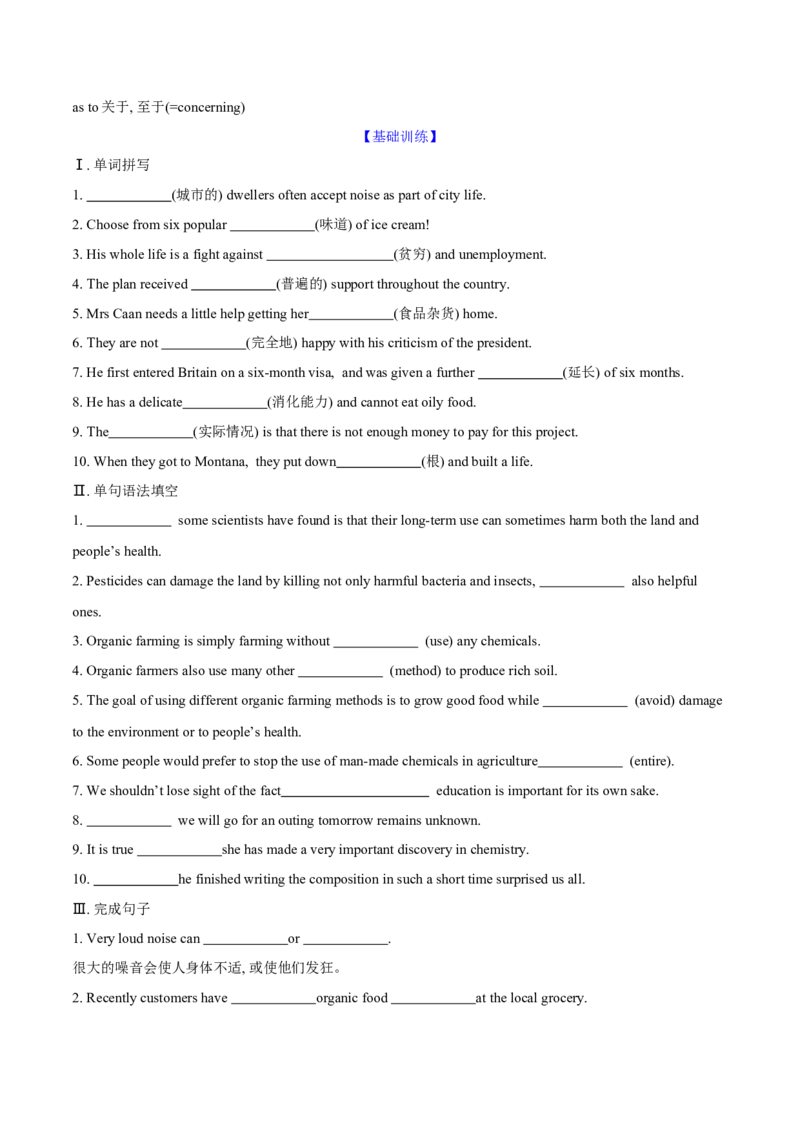
6. as for 关于, 至于
*Definitely, as for the activities, we will be honored to be given high-level training by a professional coach every
Friday around 3-5 pm.
当然, 至于活动, 我们将很荣幸在每周五下午3至5点左右接受专业教练的高水平培训。
*(2018·全国卷Ⅱ)As for cherries (樱桃), they are so delicious who cares? However, they are rich in Vitamin C.
至于樱桃, 它们是如此美味, 谁在乎呢? 然而, 它们富含维生素C。
【词块记忆】
as for (用于介绍谈论的话题)至于, 关于as to关于, 至于(=concerning)
【基础训练】
Ⅰ. 单词拼写
1. (城市的) dwellers often accept noise as part of city life.
2. Choose from six popular (味道) of ice cream!
3. His whole life is a fight against (贫穷) and unemployment.
4. The plan received (普遍的) support throughout the country.
5. Mrs Caan needs a little help getting her (食品杂货) home.
6. They are not (完全地) happy with his criticism of the president.
7. He first entered Britain on a six-month visa, and was given a further (延长) of six months.
8. He has a delicate (消化能力) and cannot eat oily food.
9. The (实际情况) is that there is not enough money to pay for this project.
10. When they got to Montana, they put down (根) and built a life.
Ⅱ. 单句语法填空
1. some scientists have found is that their long-term use can sometimes harm both the land and
people’s health.
2. Pesticides can damage the land by killing not only harmful bacteria and insects, also helpful
ones.
3. Organic farming is simply farming without (use) any chemicals.
4. Organic farmers also use many other (method) to produce rich soil.
5. The goal of using different organic farming methods is to grow good food while (avoid) damage
to the environment or to people’s health.
6. Some people would prefer to stop the use of man-made chemicals in agriculture (entire).
7. We shouldn’t lose sight of the fact education is important for its own sake.
8. we will go for an outing tomorrow remains unknown.
9. It is true she has made a very important discovery in chemistry.
10. he finished writing the composition in such a short time surprised us all.
Ⅲ. 完成句子
1. Very loud noise can or .
很大的噪音会使人身体不适, 或使他们发狂。
2. Recently customers have organic food at the local grocery.最近, 顾客在当地杂货店购物时, 已经转向购买有机食品。
3. For example, many organic farmers natural waste from animals fertiliser.
例如, 许多种植有机农作物的农民使用来自动物的天然废弃物作为肥料。
4. Organic farming is able to meet the need.
有机农业完全不能满足那样的需求。
5. Therefore, there is still a long way to find a suitable solution that puts sufficient food on the dinner table
因此, 要找到一个合适的解决方案, 在保持人和环境尽可能健康的同时, 把足够的食物放在餐桌上, 还有很长
的路要走。
IV. 阅读理解
A
The organic foods have gained a lot of popularity as they are being considered as healthier and tastier. A fair
number of people advocate a large-scale shift to organic farming from conventional agriculture. But this might not
seem well-founded.
Since the mid-19th century, conventional industrial agriculture has become incredibly efficient on a simple
land to food basis. Conventional farming gets more and more crop per square foot of land, which can mean less
wilderness needs to be transformed to farmland.
To make farming more efficient, conventional agriculture uses a significant amount of synthetic fertiliser(合成
肥料)each year, and all that nitrogen(氮)enables much faster plant growth. However, the cost is paid in vast
polluted dead zones at the months of many of the world’s rivers, because much of the nitrogen ends up running off
the soil and into the oceans. This also makes conventional farming one of the major threats to the environment.
To weaken the environmental impact of agriculture, improve soil quality as well as produce healthier foods,
some farmers have turned to organic farming. Environmentalists have also welcomed organic food as better for the
planet than the food produced by agricultural corporations. Organic practices—refusing artificial fertilizers and
chemical pesticides—are considered far more sustainable. Sales of organic food rose 7. 7% in 2010, up to $26. 7
billion—and people are making those purchases for their moral senses as much as their tongues.
Yet a new meta-analysis in Nature does the math and comes to a hard conclusion: organic farming produces
25% fewer crops on average than conventional agriculture.
In the Nature analysis, scientists performed an analysis of 66 studies comparing conventional and organic
methods across 34 different crop species, from fruits to grains. They found that organic farming delivered a lower
output for every crop type, though the difference varied widely. For crops like fruit trees, organic trailed(落后于)conventional agriculture by just 5%. Yet for major grain crops and vegetables—all of which provide the world’s
main calories—conventional agriculture outperformed organics by more than 25%.
What that means is that while organic farming may be more sustainable than conventional agriculture, there
are trade-offs(此消彼长)with each. So an ideal global agriculture system may borrow the best from both systems
rather than upholding merely organic or conventional practices.
1. What do we know about conventional farming?
A. It produces more crops with fewer fertilisers.
B. It achieves efficiency at a huge cost to the environment.
C. If offers a long-term solution to global demand for food.
D. It performs far better for each crop type than organic farming.
2. What does the author most probably agree with?
A. Employing organic farming to plant rice.
B. Adopting organic practices to grow potato.
C. Using conventional methods to plant cabbage.
D. Applying conventional farming to grow apple.
3. Which of the following shows the development of ideas in this passage?
CP: Central Point P: Point
Sp: Sub-point(次要点) C: Conclusion
4. What’s the author’s purpose of writing the passage?
A. To compare two types of farming.
B. To criticize conventional agriculture.
C. To discuss the development of farming.
D. To argue for a realistic agriculture system.B
Imagine you’re at the supermarket checkout. You pay the cashier, load your food into the cart, then take one
third of your newly purchased items outside and throw them into the trash. This may sound unbelievable, but
millions of us worldwide do this regularly, although in a more non-direct way.
In the West, most of this food is thrown away by businesses that are unable to sell it, or by consumers who
buy too much. And the majority of this food, despite being past its shelf life, is still perfectly fit for human
consumption. So where do these excess products end up?
“We receive food from various sources, including food banks, restaurants, cafes, food photographers, and
events” says Adam Smith, founder of The Real Junk Food Project. The British company recently made headlines
in the UK after it became the country’s first “food waste supermarket”, offering products that would otherwise
have ended up in waste. Most of its customers are low-income families, or even college students who find it
difficult to afford food. “We ask our customers to pay what they feel in time, money or skills. We do have people
coming with the intention of paying and if it carries on like it does, it will pay for the cost of the warehouse, ”
Smith explains.
Some shops across Europe are also taking action. France recently passed a law that says all supermarkets must
now donate all of their unsold produce to charities, while the Italian government has also put similar measures in
place. Hundreds of cafes that serve meals made from surplus food have been set up across the continent too, selling
dishes at bottom prices or even giving them away for free.
So what can we do to prevent our dinner ending up in the bin? “Buy less. Or at least shop smarter, ” said
Smith. After all, the best place for food is in our stomachs, not the trash.
5. What’s the meaning of the underlined words “being past its shelf life” in Paragraph 2?
A. Being past its “sell-by” date.
B. Being far from enough.
C. Being past the length of being eatable.
D. Being out of date.
6. What do we know about The Real Junk Food Project?
A. It gets food from the waste.
B. It wants to make a fat profit.
C. It drew massive attention lately.
D. Its main aim is to do charities.
7. What can we learn from Paragraph 4?A. Some countries in Europe are actively helping poor people.
B. Some countries in Europe are trying to address food waste.
C. Related shops in Europe are willing to give away their food.
D. All the countries in Europe have made laws to handle food waste.
8. What is the best title of the passage?
A. Turning Trash into Treats
B. Buying Less and Smarter
C. Food Trash Industry
D. Warn against Food Waste