【暑假辅导班】
新高二英语暑假精品课程(人教版)
第15讲 选择性必修一 Unit 4 Reading and Thinking
【核心知识点讲解】
1. vary vi. (根据情况)变化; 改变
*(2020·天津高考) Galileo was not merely ambitious when he dropped objects of varying weights from the
Leaning Tower at Pisa and timed their fall to the ground. 当伽利略从比萨斜塔上让不同重量的物体下落并计算
它们落地的时间时, 他不仅仅是雄心勃勃。
*(2019·全国卷Ⅰ)Typing patterns vary from person to person. 打字模式因人而异。
*The students’ work varies considerably in quality.
学生作业的质量甚是参差不齐。
*The menu varies with the season. 菜单随季节而变动。
*One had better see life in its various aspects when young.
一个人最好在年轻时就能看到生活的各个方面。
2. approve vi. 赞成; 同意 vt. 批准; 通过
*I’m afraid your parents won’t approve of your going there.
我担心你父母不会赞成你到那儿去。
*She desperately wanted to win her father’s approval.
她急不可待地想赢得父亲的赞同。
*She wants to be an actress, but her parents disapprove.
她想当演员, 可是她父母不同意。
【词块记忆】
(1)approve of sb. /sb. ’s (doing) sth.
赞成/同意某人(做)某事
(2)approval n. 赞成; 同意; 批准; 通过
(3)disapprove v. 不同意
3. employ vt. 使用; 应用; 雇用
*The boss employed a secretary to help him with his work.
老板雇来一位秘书来帮助他的工作。
*The manager employed himself in making a future plan for his company.经理忙于为公司制订将来的计划。
*More local employment will be created, particularly in service industries.
当地会创造出更多的就业机会, 尤其是服务行业。
【词块记忆】
(1)employ sb. to do sth. 雇用某人做某事
(2)be employed in=employ oneself in 忙于
(3)employment n. 雇用
employer n. 雇用者; 雇主
employee n. 雇员; 雇工
4. interpret vt. 把……理解(解释)为 vi. &vt. 口译
*We have to interpret his words in a modern term.
我们不得不用现代术语来解释他的话。
*I didn’t know whether to interpret her silence as acceptance or refusal.
我不知该把她的沉默看作是接受还是拒绝。
*Would you like me to interpret for you?
要不要我来帮你翻译?
*Theatre creates a new interpretation of Shakespeare’s comedy and aims to build a bridge between deaf and
hearing worlds.
剧院创造了一种对莎士比亚喜剧的新诠释, 旨在为聋人和听觉世界架起一座桥梁。
【词块记忆】
(1)interpret sth. in 用(言语或表演)解释某事
(2)interpret as 解释为; 把……理解为
(3)interpret for sb. 为某人做翻译(interpret 主要指“口译”; translate 主要指“笔译”)
(4)interpretation n. 解释; 翻译
5. differ vi. 相异; 不同于
*Ideas on childcare may differ considerably between parents.
在抚育儿童方面父母的观点可能迥然不同。
*Things in the world differ from each other in a thousand ways. 世界上的事物是千差万别的。
*Men differ in habits and appearance.
人的相貌和习惯均不相同。
*The two sides in the dispute still differ with each other over the question of pay.
争执的双方在报酬问题上仍各持己见。*Social customs are greatly different from country to country.
各个国家的社会风俗很不相同。
6. reliable adj. 可靠的; 可信赖的
* It’s not reliable to judge a man only by his looks.
单凭容貌来判断一个人是不可靠的。
*You can rely on us to give your order immediate attention.
您的订单我们将立即处理, 请放心。
*Many people now rely on the Internet for news.
很多人现在靠互联网来了解新闻。
【词块记忆】
(1)unreliable adj. 不可靠的
(2)rely v. 信任, 信赖; 依赖, 依靠
rely on/upon 依靠, 依仗
rely on/upon sb. to do sth. 依靠某人去做某事
7. break down 消除; 分解; 打破
*His health broke down as a result of smoking.
因为吸烟他的健康垮掉了。
*On my way to the station my car broke down.
我的汽车在去车站的路上出故障了。
【知识延伸】
break through 突破; 突围; 有新的重大发现
break up (使)打碎, (使)破碎; 结束; 解散
break out 爆发; 突发
break in 打断; 闯入; 训练; 使逐渐习惯
break away(from) 脱离; 背叛; 逃脱
break into 闯入; 破门而入
8. And if we are feeling down or lonely, there is nothing better than seeing the smiling face of a good friend. 如果
我们感到沮丧或孤独, 没有什么比看到好朋友的笑脸更好的了。
【句式解构】
本句是“否定词+比较级”句式, 是用比较级表达最高级的句式之一, 意为“没有比……更……的”。
*This could give her no greater pleasure. 这使她再高兴不过了。*There’s nothing cheaper. 这东西再便宜不过了。
注意:
(1)在“否定词+比较级”句式中, 常用的否定词有no, not, never, nothing, nobody, hardly等。
(2)比较级表达最高级常用句式如下:
①比较级+than+any other+单数名词
②比较级+than+all the other+复数名词
③比较级+than+the rest of+复数名词或不可数名词
【知识延伸】
can’t. . . enough与can’t too. . . “再怎么也不过分; 越……越……”, 也是用否定形式表示肯定意义。
例如:
*You can’t scold me enough.
你再怎么责备我也不过分。
*You can’t be too careful.
你越小心越好。
【要点拾遗】
1. demonstrate vt. 表现; 表达; 说明; 证明
*We want to demonstrate our commitment to human rights.
我们想表明我们对人权的信念。
*In the cities, vast crowds have been demonstrating for change.
在各城市, 大量的群众已经举行示威游行要求变革。
【词块记忆】
(1)demonstrate sth. to sb. 向(某人)说明/展现某事(物)
(2)demonstrate against 示威反对(某事)
demonstrate for 为……而示威
(3)demonstrator n. 示威者
demonstrationn. 示范
2. bow vi. 鞠躬; 点头 vt. 低(头)
*He bowed low to the assembled crowd.
他向集结的人群深深地鞠了一躬。
*The people all bowed down before the Emperor.
所有人都给皇帝鞠躬。
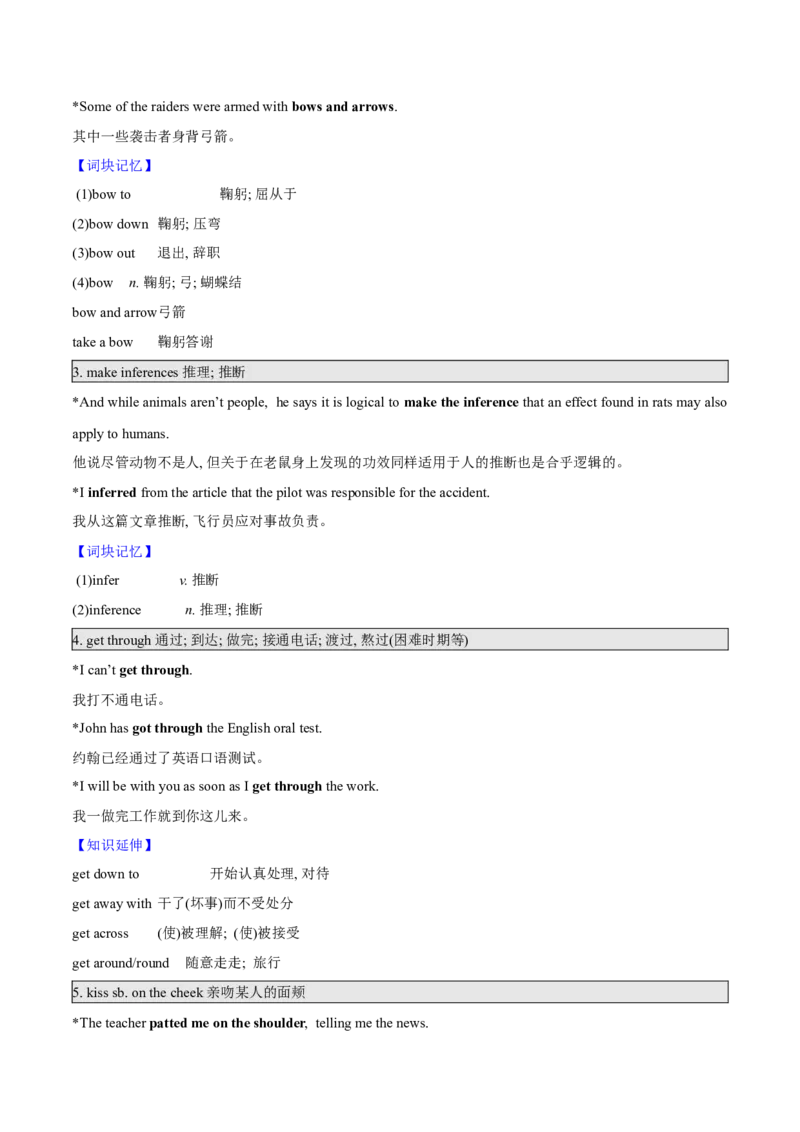
*She has finally decided it’s time to bow out of international tennis. 她最终决定是退出世界网坛的时候了。*Some of the raiders were armed with bows and arrows.
其中一些袭击者身背弓箭。
【词块记忆】
(1)bow to 鞠躬; 屈从于
(2)bow down 鞠躬; 压弯
(3)bow out 退出, 辞职
(4)bow n. 鞠躬; 弓; 蝴蝶结
bow and arrow弓箭
take a bow 鞠躬答谢
3. make inferences 推理; 推断
*And while animals aren’t people, he says it is logical to make the inference that an effect found in rats may also
apply to humans.
他说尽管动物不是人, 但关于在老鼠身上发现的功效同样适用于人的推断也是合乎逻辑的。
*I inferred from the article that the pilot was responsible for the accident.
我从这篇文章推断, 飞行员应对事故负责。
【词块记忆】
(1)infer v. 推断
(2)inference n. 推理; 推断
4. get through 通过; 到达; 做完; 接通电话; 渡过, 熬过(困难时期等)
*I can’t get through.
我打不通电话。
*John has got through the English oral test.
约翰已经通过了英语口语测试。
*I will be with you as soon as I get through the work.
我一做完工作就到你这儿来。
【知识延伸】
get down to 开始认真处理, 对待
get away with 干了(坏事)而不受处分
get across (使)被理解; (使)被接受
get around/round 随意走走; 旅行
5. kiss sb. on the cheek 亲吻某人的面颊
*The teacher patted me on the shoulder, telling me the news.老师拍着我的肩膀, 告诉我这个消息。
* The old man took the stranger by the hand, thanking him again and again.
老人拉着陌生人的手, 连声感谢。
*The referee warned the player not to kick the rival in the stomach.
裁判警告这名选手不能踢竞争对手的肚子。
注意:
英语中, 习惯把接受动作的人作为宾语, 而用介词短语说明接触到的人体部位。
在“动词+宾语+介词+the+身体部位名词”结构中, 常用的动词有hit, pat, touch, take, catch, strike, kick等,
介词有in, on, by等。一般地, 身体柔软的地方用in, 硬的地方用on。by常与take, seize, catch, lead等动词
连用, 表示“拉、扯、抓住身体某部位”。
【基础训练】
Ⅰ. 根据语境及汉语提示写出正确的单词
1. As they’re handmade, each one (不同)slightly.
2. The course is (批准)by the Department for Education.
3. The police had to (采取) force to enter the building.
4. The courier knows Greek, so he will (口译) for us.
5. Medical opinion (相异) as to how to treat the disease.
6. Because the town sits in a (山谷), air pollution is not easily missing.
7. He sang and Alice (为……伴奏) him on the piano.
8. But remember that return the (帮助, 恩惠)when he or she needs your help.
9. The demonstrators broke through heavy police (关卡).
10. The companies with 可靠的)quality, perfect service, reasonable price win the trust of new and
old customers.
Ⅱ. 选词填空
make inferences, break down, by comparison, by contrast, differ in, do a favour, kiss sb. on the cheek, get
through, shake one’s head, look down
1. They size but not in kind.
2. She had been waiting for Simon to the barrier between them.
3. I am not good at expressing myself. , I am better at thinking indeed.
4. My father before he went to work.
5. He is always ready to for his classmates.6. This might allow you to about a character’s educational background and upbringing.
7. , this house has the advantage of low price and that house has the advantage of convenient
transportation.
8. He so that she should not see his eyes.
9. If you a task or an amount of work, especially when it is difficult, you complete it.
10. In a typical fashion, he would close his eyes, make a long sigh slowly and .
Ⅲ. 完成句子
1. I can think of a nice cold beer on a hot summer afternoon.
在夏季炎热的下午, 我想不出什么东西比一杯冰凉可口的啤酒更好。
2. this drug is effective.
这药已被证实是有效的。
3. Her dress .
她的连衣裙和我的几乎一模一样。
IV. 阅读理解
A
Communicating effectively means more than knowing what to say and when to say it. Communication
involves the subtle signals your body language sends to those who are watching. Here are some common body
actions and the impressions they create:
· Fiddling (好动) — Playing with your watch or a pen looks like you’re bored or impatient.
· Clock watching — It looks like you’re to move on to something else.
· Tapping — Tapping your feet or fingers suggests you are impatient or nervous.
· Staring — An unblinking (不眨眼的) stare conveys threatening or violent behaviour.
· Legs crossed or body hunched (弓背, 耸肩) — Closing up your body profile — becoming smaller — looks
like you lack confidence.
· Arms crossed — If you keep your arms folded during communication, you appear to be defending yourself
against the others.
· Touching your face — When you have your hand in front of your mouth, you appear very shy.
· Rubbing your nose, looking away — People who are lying often rub their nose or look away when speaking.
· No eye contact — If you won’t look the other speaker in the eye, you seem to have low interest or a lack of
confidence. (Don’t forget staring above. )
How you communicate with your body language is just as important as what you say. Watch your bodylanguage and control the unconscious messages you might be sending.
1. Which of the following is not included in effective communication?
A. Knowing what to say.
B. Sending unconscious messages to other people.
C. Saying the right thing at the right time.
D. Getting information from the other speaker’s body language.
2. Which of the following people looks shy according to the passage?
3. If you want to show confidence when communicating, you should ______.
A. cross your legs or hunch your body
B. avoid direct eye contact
C. look the other speaker in the eye
D. keep touching your face
4. Which of the following would be the best title for this passage?
A. How to make a good impression on others
B. Can you read body language?
C. Control your body language for effective communication
D. How to send effective information through body language
B
Sign language, the primary form of communication of the deaf community, has been in use for hundreds of
years. You’re probably most familiar with American Sign Language, but sign language is used all over the world
and has nearly 150 variations. Sign language interpreters can be seen everywhere from classrooms and graduation
ceremonies to major sporting events.
When you think of sign language, you most likely imagine signers using their hands to form words and
letters. However, hands are only one of the many different body language techniques that signers use to get their
meaning across. In fact, much of the grammatical structure of sign language is not indicated by the signer’s hands.
While the hands are responsible for forming the words themselves, markers called “non-manual elements”
control much of the languages’ grammatical structure. Non-manual elements (or markers) are body languagetechniques that don’t use the hands. These include head movements, body positioning and facial expressions. Used
together with the signs, these elements give sign language a subtle and extremely complicated grammatical
structure. Linguist Andrea Lackner from Alpcn-Adria University in Austria did a study that shows just how
important these non-manual elements are to sign language users.
The study assessed just how many different things non-manual elements can do. For this study, all participants
were deaf users of Austrian Sign Language. They watched a video of someone using sign language, and they had
to describe the purpose of each non-manual element. The results were very complicated. For instance, things as
subtle as the direction of the signer’s gaze can indicate whether or not a statement is hypothetical(假设的). A single
head movement can indicate the emotion of a statement, or a signer’s feelings toward a hypothetical question.
Body language is always important, but in sign language, it can change the entire meaning of a sentence!
5. What do signers use their hands to do mostly?
A. To know people’s words and letters.
B. To understand people’s meanings.
C. To form the grammatical structure.
D. To form words and letters.
6. What do non-manual elements include?
A. Words, sign language and body language.
B. Head movements, body language and signs.
C. Head movements, body positioning and facial expressions.
D. Body positioning, facial expressions and signs.
7. What does the study show about sign language?
A. The main function of the non-manual elements.
B. The importance of the non-manual elements.
C. The influence of body language on sign language.
D. The influence of sign language on body language.
8. What may be the best title for the text?
A. Non-manual Elements Counts in Sign Language
B. Ways to Avoid Being Misunderstood
C. Grammatical Elements in Sign Language
D. The Importance of Sign Language