【暑假辅导班】
新高二英语暑假精品课程(人教版)
第7讲 选择性必修一 Unit 1 Learning About Language
非限制性定语从句
一、非限制性定语从句
非限制性定语从句是指在复合句中对某些名词、代词或主句等被修饰部分作进一步说明的定语从句。
在一般情况下, 非限制性定语从句都由一个逗号把它和句子的其他部分分开, 在译成汉语时多译成一个并列
句。
*The farmer, who is very pessimistic, says that there will be no fruits this year. 这个农民非常悲观, 他说今年将没
有收成。
*Have you seen the film Titanic, whose leading actor is world-famous?
你看过《泰坦尼克号》这部电影吗? 它的男主演可是世界闻名的。
*In the presence of so many people he was a little tense, which was understandable.
在那么多人面前他有点紧张, 这是可以理解的。
*There are 30 chairs in the small hall, most of which are new.
小厅里有三十把椅子, 绝大部分是新的。
注意:
(1)that不能引导非限制性定语从句。
(2)引导非限制性定语从句时, 常用for which代替why。
(3)引导非限制性定语从句的关系词作宾语时, 也不可省略。
1. who, whom, whose引导的非限制性定语从句。
(1)关系代词who, whom引导的非限制性定语从句修饰人。
(2)关系代词who在定语从句中作主语、宾语或表语; whom作宾语; 介词后用whom, 不用who。
(3)whose作定语, 先行词是人时, whose + n. 相当于the +n. +of whom。先行词是物时, whose + n. 相当于the
+n. +of which。
*Our guide, who was a French Canadian, was an excellent cook.
我们的向导, 一个法裔加拿大人, 擅长烹调。
*Mr Smith, from whom I have learned a lot, is a famous scientist.
史密斯先生是一位著名的科学家, 我从他那里学了很多东西。
*The books on the desk, whose covers are shiny, are prizes for us. 桌子上的书是我们的奖品, 书的封皮很亮。【知识延伸】
关系词 用法说明
非 who,
whom, 指人时可用 who(主语), whom(宾语), whose(定语); 指物时可用 which(主语或宾语),
限
whose, whose(定语)
制 which
性 when,
when指时间; where指地点, 它们都在句中作状语
where,
定
语 as as引导非限制性定语从句时, 常指代整个主句, 有“正如”之意
从 (代词+)
介 词 有时, 根据句意, 关系代词which或whom前可以有代词和介词, 如most of which, none of
句
+which/ whom等
whom
2. which, as的用法。
(1)两者在定语从句中作主语或宾语。
*Water, which is a clear liquid, has many uses.
水是一种清澈的液体, 有许多用途。
*Our country has sent up another man-made earth satellite, as is reported in the papers.
报纸上报道, 我国又发射了一颗人造地球卫星。
(2)as, which引导非限制性定语从句的区别。
项 目 as which
引导的从句只能指代整个主 引导的从句既可指代整个主句的内容, 又
指代
句的内容 可指代主句的一部分
可位于主句之前、之中或之
位置 引导的从句不能位于主句之前
后
意义 正如 这, 那
*I borrowed the book Sherlock Holmes from the library last week, which my classmates recommended to me. 我上
周从图书馆借了《夏洛克·福尔摩斯》, 这本书是我的同学推荐给我的。
*The number of smokers, as is reported, has dropped by 17 percent in just one year. 正如所报道的那样, 仅仅一年
的时间, 吸烟者的数量下降了17%。
3. when, where的用法。
(1)关系副词when在非限制性定语从句中作时间状语, 指代主句中表示时间的词语。
(2)关系副词where在非限制性定语从句中作地点状语, 指代主句中表示地点的词语。
(3)when/where有时可以换成“介词+which”。
*We’ll put off the picnic in the park until next week, when the weather may be better. 我们打算把在公园里的这次
野餐推迟到下周, 那时天气可能会更好。*Opposite is St. Paul’s Church, where you can hear some lovely music. 对面是圣保罗教堂, 在那里你能听到好听
的音乐。
*I left on Sunday, when/on which everyone was at home.
我星期日离开的, 当时人人都在家。
4. “介词+关系代词”引导的定语从句。
在“介词+关系代词”中, 关系代词用whom指人, 用which指物。
*He worked in a car factory for four years, after which he founded his own company in his hometown. 他在一家汽
车厂工作了四年, 之后在他的家乡建立了自己的公司。
*We are short of two people, without whom we will need three more days to finish the work. 我们缺少两个人, 没
有他们, 我们还需要三天的时间来完成这项工作。
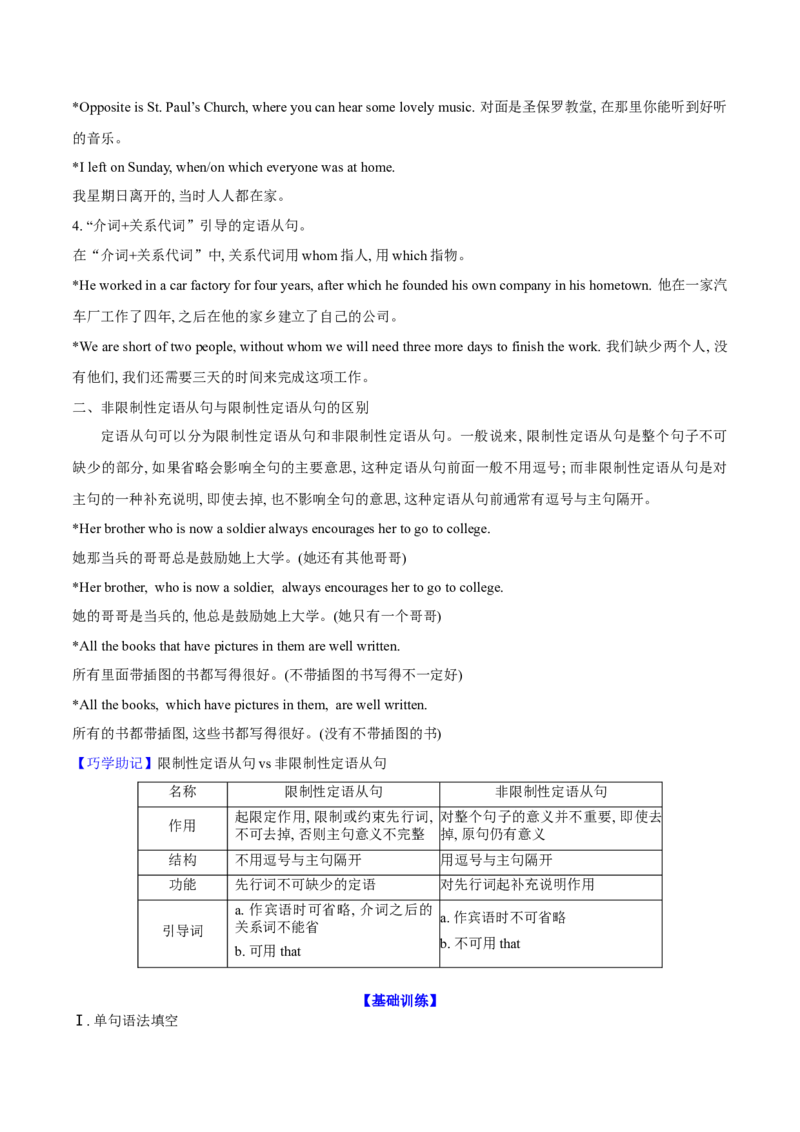
二、非限制性定语从句与限制性定语从句的区别
定语从句可以分为限制性定语从句和非限制性定语从句。一般说来, 限制性定语从句是整个句子不可
缺少的部分, 如果省略会影响全句的主要意思, 这种定语从句前面一般不用逗号; 而非限制性定语从句是对
主句的一种补充说明, 即使去掉, 也不影响全句的意思, 这种定语从句前通常有逗号与主句隔开。
*Her brother who is now a soldier always encourages her to go to college.
她那当兵的哥哥总是鼓励她上大学。(她还有其他哥哥)
*Her brother, who is now a soldier, always encourages her to go to college.
她的哥哥是当兵的, 他总是鼓励她上大学。(她只有一个哥哥)
*All the books that have pictures in them are well written.
所有里面带插图的书都写得很好。(不带插图的书写得不一定好)
*All the books, which have pictures in them, are well written.
所有的书都带插图, 这些书都写得很好。(没有不带插图的书)
【巧学助记】限制性定语从句vs非限制性定语从句
名称 限制性定语从句 非限制性定语从句
起限定作用, 限制或约束先行词, 对整个句子的意义并不重要, 即使去
作用
不可去掉, 否则主句意义不完整 掉, 原句仍有意义
结构 不用逗号与主句隔开 用逗号与主句隔开
功能 先行词不可缺少的定语 对先行词起补充说明作用
a. 作宾语时可省略, 介词之后的
a. 作宾语时不可省略
引导词 关系词不能省
b. 不可用that
b. 可用that
【基础训练】
Ⅰ. 单句语法填空1. The film brought the hours back to me I was taken good care of in that far away village.
2. Tom was late for school again and again, made his teacher very angry.
3. This is the same dictionary I lost last week.
4. A young man had a new girl friend, he wanted to make impressions on.
5. Last Sunday they reached Nanjing, a conference was to be held.
6. Mr Zhang, came to see me yesterday, is an old friend of mine.
7. China, was founded in 1949, is becoming more and more powerful.
8. The newly-built cafe, walls are painted light green, is really a peaceful place for us, especially after
hard work.
9. The place I visited last summer is just the place I spent my childhood.
10. I am going to the airport to meet my uncle tomorrow morning, he will be back from abroad.
Ⅱ. 翻译句子
1. 我最尊敬的人是我的物理老师。
2. 但这是有意义的一天, 我们学到很多东西。
3. 她工作一直很努力, 这是大家有目共睹的。
4. 正如期望的那样, 他试验做得非常成功。
5. 门开了, 英语老师王老师走了进来, 她个子不高, 但很漂亮。
III. 阅读理解
Frankenstein, written by Mary Shelley, turned 200 years old in 2018! It has been called the first true work of
science fiction and the first English horror novel. The story has been told over and over again—not just in books,
but in movies and television shows. To celebrate, New York City’s Morgan Library & Museum has a special
exhibit on the writer and the book.
The reason for the success is that Doctor Frankenstein and his creature—the monster, live on in numerous
remakes, shows, and even comic books.
Mary Shelley’s classic is one of the most famous horror stories of all time. But Frankenstein is so much more
than that. It presents ideas or themes that are still important today. Knowing something about her sufferings canhelp readers have a good knowledge of her work. Shelley wrote the book when she was only 18 years old. And it
relates to her own sad life. Her mother died 10 days after she gave birth to her. She knew what it meant to be a child
without a mother. It is no surprise that Shelley wrote a story about a motherless creature one that is very much alone
in the world.
Losing her mother shortly after her birth in 1797 was only part of her life stories. Mary Shelley gave birth to
four children, but only one child survived to adulthood.
Around the age of 17, she fell in love with the poet Percy Shelley. The two writers got married in 1816.
However, the marriage of Percy and Mary Shelley was short-lived. Her husband died in a sailing accident in 1822.
She was still in her twenties when she became a widow. In some ways, it’s not entirely surprising that she ended up
with a story about a monster without a mother.
After the publication of Frankenstein, Mary Shelley continued to write. She died from brain cancer on
February 1, 1851. Her most important legacy is a monster that is still very much alive today.
1. What do we know about Frankenstein?
A. It exists in different forms of art.
B. It is a romantic fiction.
C. It is not popular with modern readers.
D. It has been made into the most interesting science fiction movie.
2. What did Shelley and the monster have in common?
A. They were quite creative.
B. They felt lonely.
C. They had the same character.
D. They behaved badly at home.
3. Why did the author mention Shelley’s sufferings?
A. To show pity to her.
B. To introduce her to readers.
C. To make readers understand her novel better.
D. To show her difficulty in writing the novel.
4. What is the main idea of the text?
A. Success comes from struggle.
B. Hardship creates a great person.
C. Shelley’s experiences contribute to the success of Frankenstein.D. Frankenstein comes into the market.