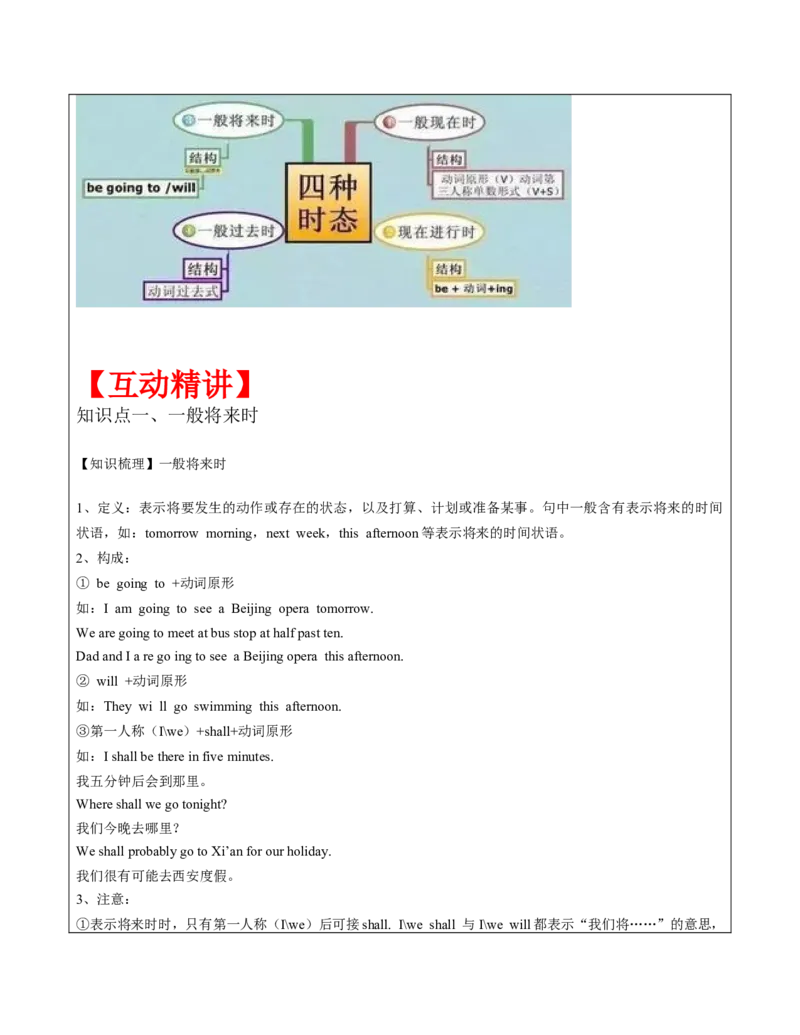
文档文本内容
课程主题: 时态(二) 授课时间:
掌握六年级涉及到的一般将来时和现在进行时两个时态;
学习目标
灵活运用一般将来时和现在进行时。
教学内容
【进门测试】
一、补全对话
A: ______ you go to school by bike yesterday?
B: ______, I______. My father drove me to school.
A: ______ ______ is it today?
B: It’s Wednesday.
A: ______ ______lessons do we have in the afternoon?
B: Two.
A: Hi, Jill. ______ ______ you go last month?
B: I went to Hainan for a trip.
A: ______ ______your trip?
B: It was great fun.
A: Can I help you?
B: I’d like a T-shirt.
A: ______ ______do you like?
B: Blue.
A: OK. Here you are.
B: ______ ______is it?
A: Seventy yuan.
B: OK. I’ll take it.
【多元导学】【互动精讲】
知识点一、一般将来时
【知识梳理】一般将来时
1、定义:表示将要发生的动作或存在的状态,以及打算、计划或准备某事。句中一般含有表示将来的时间
状语,如:tomorrow morning,next week,this afternoon等表示将来的时间状语。
2、构成:
① be going to +动词原形
如:I am going to see a Beijing opera tomorrow.
We are going to meet at bus stop at half past ten.
Dad and I a re go ing to see a Beijing opera this afternoon.
② will +动词原形
如:They wi ll go swimming this afternoon.
③第一人称(I\we)+shall+动词原形
如:I shall be there in five minutes.
我五分钟后会到那里。
Where shall we go tonight?
我们今晚去哪里?
We shall probably go to Xi’an for our holiday.
我们很有可能去西安度假。
3、注意:
①表示将来时时,只有第一人称(I\we)后可接shall. I\we shall 与I\we will都表示“我们将……”的意思,可以通用。如:
We shall have a game of chess after tea.
We will have a game of chess after tea.
喝完茶我们要去下棋。
will 、shall 可以缩写成’ll.
如:I shall\I will = I’ll you will = you’ll she will = she’llit will = it’ll
②be going to 和will 区别:
be going to表示经过事先安排、打算或决定要做的事情,基本 上一定会发生;will则表示有可能去
做,但不一定发生,也常表示说话人的临时决定。
如:I am going to take part in a party this evening.
They are c leaning the library now. I’ll go and join them.
be going to表示近期或眼下就要发生的事情;w ill表示的将来时间则较远一些。如:He is going to
write a letter tomorrow. I will meet her one day.
be going to还可以用来表示有迹象表明某件事将要发生,常用于天气等自然现象。如: Look! It’s
going to rain.
4、一般将来时句型转换:
肯定句: She is going to have a picnic tomorrow.
[来源:学+科+网Z+X+X+K]
否定句: She isn’t going to have a picnic tomorrow.
一般疑问句及回答Is she going to have a picnic tomorrow?
—Yes, she is. / No, she isn’t.
【例题精讲】
完成短文,注意使用正确的动词将来时形式。
My parents are going on holiday, so I can make my own plans for the coming week. It just said on the radio that it
____(be) fine on Monday, so I (go) picnicking with Sarah and Jack. On Tuesday I ____(play) tennis with Eric. On
Wednesday I (visit) Uncle Joe, who (leave) for Paris soon. On Thursday I (stay) at home and ____ (watch)
TV, for there (be) a football match then. On Friday I (have) a party and (invite) all my friends. On Saturday I
_____(sleep) all day. But how about Sunday? My parents (come) back and (find) my room in a mess……..
【巩固练习】单项选择
( ) 1 We won't go to the Great Wall if it ___ tomorrow.
A. snows B. snowed C. snow D. will snow
( ) 2 We won't come back until we ___ the work.A. shall finish B. have finished
C. will finish D. finish
( ) 3 Could you ring me up as soon as he ___?
A. arrived B. would arrive C. arrives D. will arrive
( ) 4 I will not help you with your English if I ___ time tomorrow.
A. don't have B. will not have C. am not D. won’t
( ) 5 The next time you ___ his parents, tell them I want to see them as soon as possible.
A. meet B. will meet C. are going to meet D. met
( ) 6 The key will be left on the table when I ___.
A. left B. leave C. will leave D. am leaving
( ) 7 When you ___ used to the weather here, you will ___ this place.
A. will get; like B. have got; like C. get; liked D. get; will like
( ) 8 Look at the clouds. ___.
A. It's going to rain B. It'll be raining C. It will be rained D. If 11 rain I
( ) 9 My family ____to stay in London for some time.
A. is going B. are going C. go D. are go
( )10 There___ two English films next week.
A. is going to be B. are going to have C. will have D. are going to be
( )11 There is going to___ a volleyball match on our school playground. The match is going to___ at six this
evening.
A. have; be B. be; have C. be; be D. have; have
[来源:学.科.网Z.X.X.K]
( )12 -Are you busy this afternoon?
-No. I ___to watch a football match.
A. am going B. will C. shall D. can
( ) 13 Who ___ help him to move the box away?
A. are B. are going, C. are going to D. is
( )14Where ____ buy a computer for your son?
A. you are B. are going C. you go D. are you going to
( ) 15 Next year my little sister ____ ten years old.
A. is to be B. is going to be C. shall be D. will be
( ) 16 They have just decided that they ___ the job.
A. have taken B. will take C. would take D. are taking
( ) 17 She says that she ___to Beijing next week.
A. has gone B. will go C. goes D. go
( ) 18 If he ___at eight, we___, too.A. leave; do B. leaves; will C. will leave; will D. is leaving; are
( ) 19 -Is this the last exam for this term?
-Yes, but there___ another test three months from now.
A. is B. was C. will be D. has been
( )20 You___ late for school again if you___ early.
A. shall be; won't get up B. are; won't get up
C. will be; don't get up D. have been; not get
知识点二、现在进行时
【知识梳理】现在进行时
用 法 例 句
[来源:Zxxk.Com]
1. 表示现在(说话瞬间)正在发生的动作, 常 ①They are watching TV now.
见的时间状语有now, at the moment等。 他们现在正在看电视。
如果句首有提示性动词look, listen等, 主句 ②Listen! The bird is singing in the
也用现在进行时。 tree.
听! 鸟儿正在树上唱歌。
2. 表示当前一段时间内的活动或现阶段一 She is working in a factory.
直进行的动作。 她正在一家工厂工作。
3. 表示位置移动的动词, 如come, go, ①I’ m coming .
leave, arrive等常用现在进行时表示最近即 我这就来。
将发生的动作。 ②We ar e leavin g tomorrow.
我们将明天离开。
4. 现在进行时与always, all the time等副 Alice i s always thinking of others.
词或短语连用常表示某种强烈的感情。 艾丽斯总是想着别人。
【巧学妙记】
现在进行时构成口诀:
句子的主语在句首, am, is, are动词跟在后。
现在分词跟着走, 其他成分不可丢。
表示动作正进行, 句中now时间定。
一般疑问句很简单, be动词提到前。
否定句式也简单, be后只把not添。
批注: