人教PEP 六年级英语上册
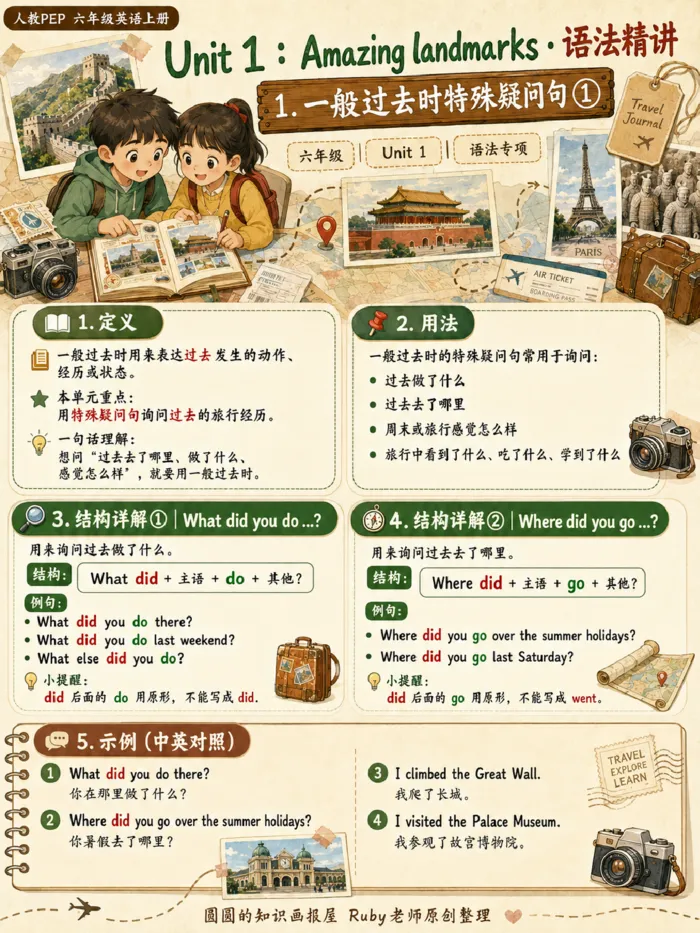
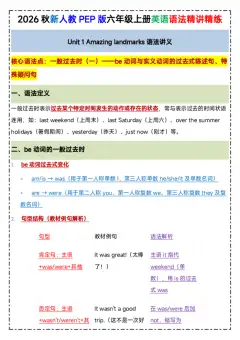
Unit 1:Amazing landmarks·语法精讲
1.一般过去时特殊疑问句①
Travel
Journal
六年级
Unit 1
语法专项
AI TICKE7
n
1.定义
2.用法
一般过去时用来表达过去发生的动作、
经历或状态。
一般过去时的特殊疑问句常用于询问:
● 过去做了什么
本单元重点:
用特殊疑问句询问过去的旅行经历。
●过去去了哪里
一句话理解:
想问“过去去了哪里、做了什么、
感觉怎么样’,就要用一般过去时。
●周末或旅行感觉怎么样
●旅行中看到了什么、吃了什么、学到了什么
3.结构详解①| What did you do..?
4.结构详解②| Where did you go.⋯?
用来询问过去做了什么。
用来询问过去去了哪里。
结构:
What did+ 主语 + do + 其他?
结构:Where did+主语+go+其他?
例句:
· What did you do there?
例句:
● What did you do last weekend?
· Where did you go over the summer holidays?
· What else did you do?
· Where did you go last Saturday?
小提醒:
小提醒;
did后面的 do 用原形,不能写成 did.
did后面的go 用原形,不能写成 went。
·5.示例(中英对照)
1 What did you do there?
你在那里做了什么?
③I climbed the Great Wall.
我爬了长城。
TRAVEL
EXPLORE
LEARN
2 Where did you go over the summer holidays?
你暑假去了哪里?
④ I visited the Palace Museum.
我参观了故宫博物院。
圆圆的知识画报屋 Ruby老师原创整理
人教PEP 六年级英语上册
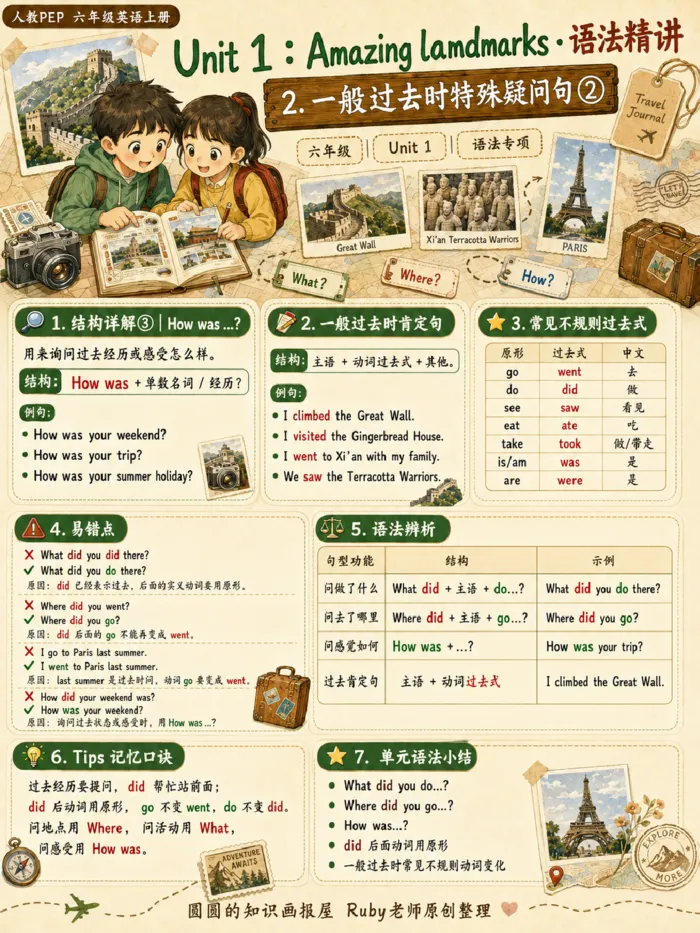
Unit 1:Amazing lamdmarks·语法精讲
2.一般过去时特殊疑问句②
Travel
Journal
六年级
Unit 1
语法专项
Great Wall
Xi'an Terracotta Warriors
PARIS
What?
Where?
How?
1.结构详解③|How was.⋯?
2.一般过去时肯定句
3.常见不规则过去式
用来询问过去经历或感受怎么样。
结构:主语+动词过去式+其他。
结构: How was +单数名词/经历?
例句:
例句:
●I climbed the Great Wall.
· How was your weekend?
·I visited the Gingerbread House.
· How was your trip?
●I went to Xi'an with my family.
·How was your summer holiday?
·We saw the Teracotta Warriors.
原形
过去式
中文
go
went
去
do
did
做
see
saw
看见
eat
ate
吃
take
took
做/带走
is/am
was
是
are
were
是
!4.易错点
5.语法辨析
× What did you did there?
√ What did you do there?
原因:did 已经表示过去,后面的实义动词要用原形。
X Where did you went?
√ Where did you go?
原因:did 后面的go不能再变成went。
×I go to Paris last summer.
√ I went to Paris last summer.
原因:last summer 是过去时问,动词go要变成went。
句型功能
结构
示例
问做了什么What did +主语+ do..?
What did you do there?
问去了哪里Where did+主语+go..? Where did you go?
问感觉如何How was +...?
How was your trip?
过去肯定句
主语+动词过去式
I climbed the Great Wall.
× How did your weekend was?
How was your weekend?
原因:询问过去状态或感受时,用How was .⋯?
6.Tips记忆口诀
7.单元语法小结
过去经历要提问,did帮忙站前面;
· What did you do..?
did 后动词用原形,go 不变went, do 不变did。
· Where did you go..?
问地点用 Where,问活动用 What,
· How was.⋯?
问感受用 How was。
● did后面动词用原形
AITS
●一般过去时常见不规则动词变化
圆圆的知识画报屋 Ruby老师原创整理
人教PEP 六年级英语上册
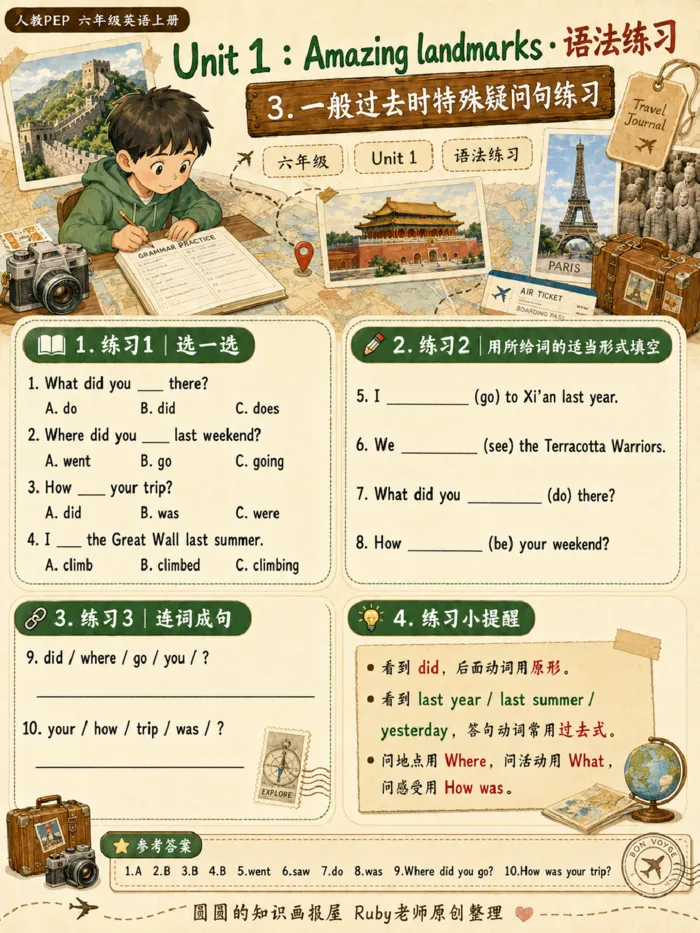
Unit1:Amazing landmarks·语法练习
3.一般过去时特殊疑问句练习
Travel
Journal
六年级
Unit 1
语法练习
Ic
PARIS
AIR
CKE
BOARDING
1.练习1|选一选
2.练习2|用所给词的适当形式填空
1. What did you__there?
A. do
B.did
C.does
5.I__
(go) to Xi'an last year.
2. Where did you__last weekend?
A. went
B.go
C.going
6. We____
(see) the Terracotta Warriors.
3. How__your trip?
A.did
B.was
C. were
7.What did you _____(do) there?
4.I__the Great Wall last summer.
A.climb
B.climbed
C.climbing
8.How
(be) your weekend?
3.练习3|连词成句
4.练习小提醒
9.did / where /go / you/?
●看到did,后面动词用原形。
10.your / how / trip /was /?
●看到 last year / last summer /
yesterday,答句动词常用过去式。
EXPLORE
●问地点用Where,问活动用What,
问感受用How was。
参考答案
1.A 2.B 3.B 4.B 5.went 6.saw 7.do 8.was 9.Where did you go?10.How was your trip?
圆圆的知识画报屋 Ruby老师原创整理
人教PEP六年级英语上册
MARATHON
CRDA
123
A56
BookFair
书
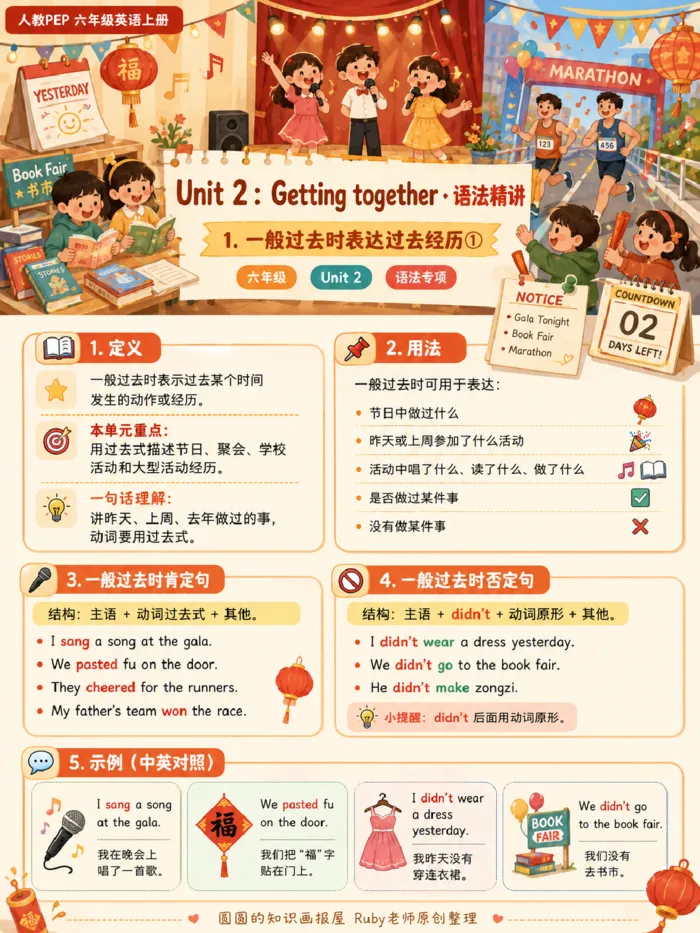
Unit 2:Getting together·语法精讲
1.一般过去时表达过去经历①
六年级
Unit 2
语法专项
NOTICE
COUNTDOWN
●Gala Tonight
●Book Fair
02
目1.定义
2.用法
●Marathon
DAYS LEFT!
一般过去时表示过去某个时间
一般过去时可用于表达:
发生的动作或经历。
●节日中做过什么
本单元重点:
用过去式描述节日、聚会、学校
活动和大型活动经历。
●昨天或上周参加了什么活动
●活动中唱了什么、读了什么、做了什么
一句话理解:
讲昨天、上周、去年做过的事,
动词要用过去式。
●是否做过某件事
●没有做某件事
×
3.一般过去时肯定句
4.一般过去时否定句
结构:主语+动词过去式+其他。
结构:主语+ didn't +动词原形+其他。
·I sang a song at the gala.
· I didn't wear a dress yesterday.
· We pasted fu on the door.
● We didn't go to the book fair.
· They cheered for the runners.
● He didn't make zongzi.
· My father's team won the race.
小提醒:didn't 后面用动词原形。
5.示例(中英对照)
I sang a song
at the gala.
我在晚会上
唱了一首歌。
We pasted fu
福
on the door.
我们把“福”字
贴在门上。
I didn't wear
a dress
yesterday.
我昨天没有
穿连衣裙。
We didn't go
BOOK to the book fair.
FAIR
我们没有
去书市。
圆圆的知识画报屋 Ruby老师原创整理
人教PEP六年级英语上册
GALA TICKET
Spring Festival Gala
Happy Together
福
MARATHON
B0OK FAIR
MARATHON
456
456
KEEP GOING!
Unit 2:Getting together·语法精讲
Let's read!
2.一般过去时表达过去经历②
YESTERDAY
六年级
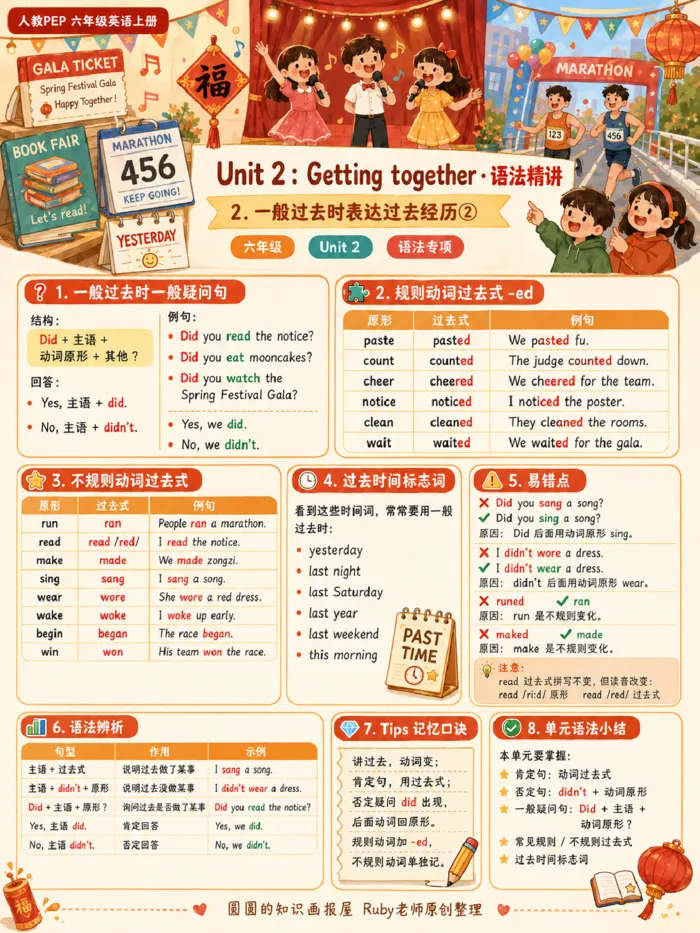
Unit 2
语法专项
? 1.一般过去时一般疑问句
2.规则动词过去式-ed
结构:
例句:
Did+主语+
·Did you read the notice?
动词原形+ 其他?
·Did you eat mooncakes?
回答:
· Did you watch the
· Yes,主语+ did.
Spring Festival Gala?
· No,主语+ didn't.
· Yes, we did.
· No, we didn't.
原形
过去式
例句
paste
pasted
We pasted fu.
count
counted
The judge counted down.
cheer
cheered
We cheered for the team.
notice
noticed
I noticed the poster.
clean
cleaned
They cleaned the rooms.
wait
waited
We waited for the gala.
3.不规则动词过去式
4.过去时间标志词
△5.易错点
原形
过去式
例句
run
ran
People ran a marathon.
read
read /red/
I read the notice.
make
made
We made zongzi.
sing
sang
I sang a song.
wear
wore
She wore a red dress.
wake
woke
I woke up early.
begin
began
The race began.
win
won
His team won the race.
看到这些时间词,常常要用一般
过去时:
×Did you sang a song?
√ Did you sing a song?
原因:Did 后面用动词原形 sing。
· yesterday
×1 didn't wore a dress.
√I didn't wear a dress.
原因:didn't 后面用动词原形wear。
·last night
·last Saturday
· last year
× runed
ran
PPe0
原因:run是不规则变化。
·last weekend
· this morning
× maked
 made
原因:make是不规则变化。
注意:
read过去式拼写不变,但读音改变:
read /ri:d/原形 read /red/过去式
6.语法辨析
句型
作用
示例
主语+过去式
说明过去做了某事
I sang a song.
主语+ didn't+原形
说明过去没做某事
I didn’t wear a dress.
Did+主语+原形?
询问过去是否做了某事Did you read the notice?
Yes,主语did.
肯定回答
Yes, we did.
No,主语 didn't.
否定回答
No, we didn't.
7. Tips记忆口诀
8.单元语法小结
讲过去,动词变;
本单元要掌握:
肯定句,用过去式;
★肯定句:动词过去式
否定疑问 did 出现,
★ 否定句:didn't+动词原形
后面动词回原形。
★一般疑问句:Did+ 主语+
动词原形?
规则动词加-ed,
★常见规则/不规则过去式
不规则动词单独记。
★过去时间标志词
☆
圆圆的知识画报屋 Ruby老师原创整理
0
人教PEP 六年级英语上册
Grammar
担
GALAT
Practice
Party!
Unit 2:
omo
田
Getting together·语法练习
B00K
FAIR
MARATHON
3.一般过去时动词变化练习
S
六年级
Unit 2
语法练习
NOTICE
●Gala Tonight
uuo9
aD13Dd
● Book Fair
● Marathon
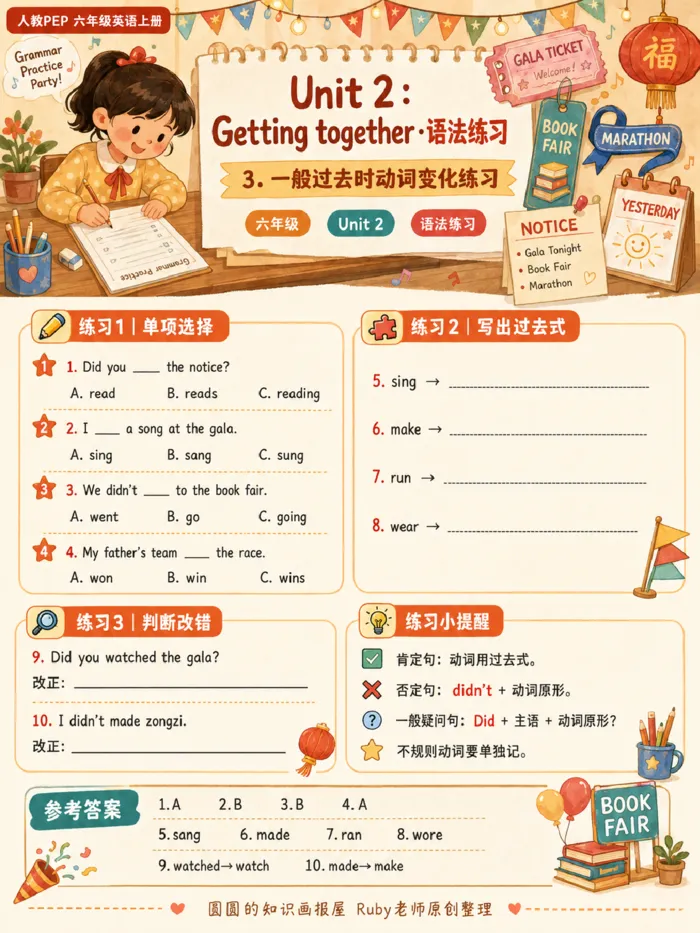
练习1|单项选择
练习2|写出过去式
1. Did you _the notice?
A. read
B. reads
C. reading
5. sing →__------------------
2.I_a song at the gala.
A. sing
B. sang
C. sung
6.make →__-------------------
3
7.run→_-------------------
3. We didn't_to the book fair.
A. went
B.go
C. going
8.wear→_------------------
4.My father's team_ the race.
A. won
B. win
C. wins
练习3|判断改错
练习小提醒
9. Did you watched the gala?
改正:
肯定句:动词用过去式。
否定句:didn't +动词原形。
10. I didn't made zongzi.
一般疑问句:Did +主语+动词原形?
改正:
不规则动词要单独记。
参考答案
1.A2.B 3.B 4.A
5.sang 6.made7.ran 8.wore
BOOK
FAIR
J
9.watched→watch
10.made→make
圆圆的知识画报屋 Ruby老师原创整理
人教PEP六年级英语上册
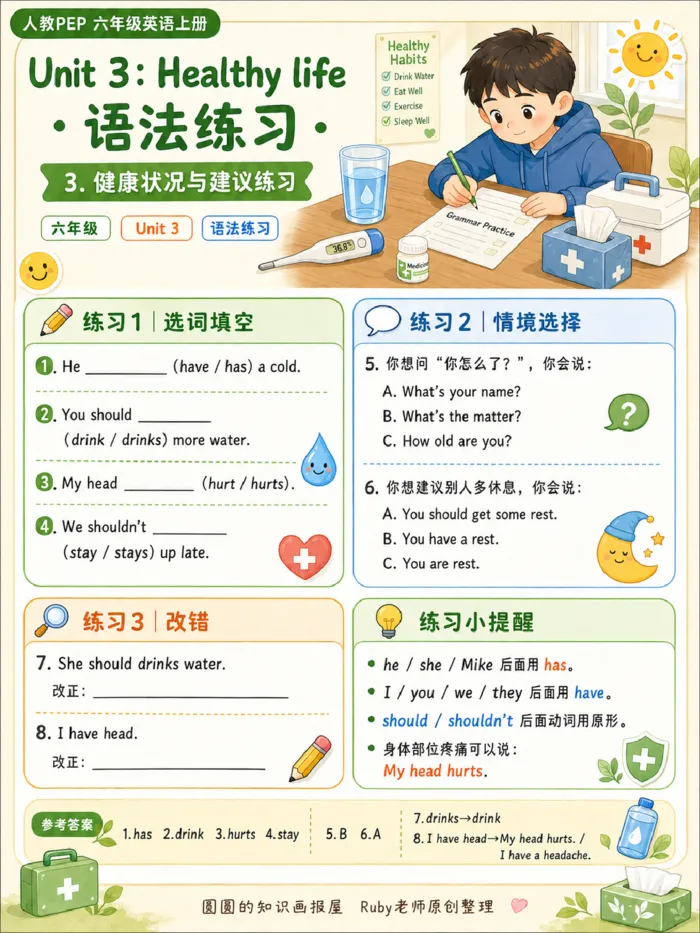
Healthy
Unit 3: Healthy life
·语法精讲·
Habits
Take care!
 Drink Water
 Eat Well
Exercise
Sleep Well
1.健康状况表达
六年级
Unit 3
语法专项
Healthy
Life
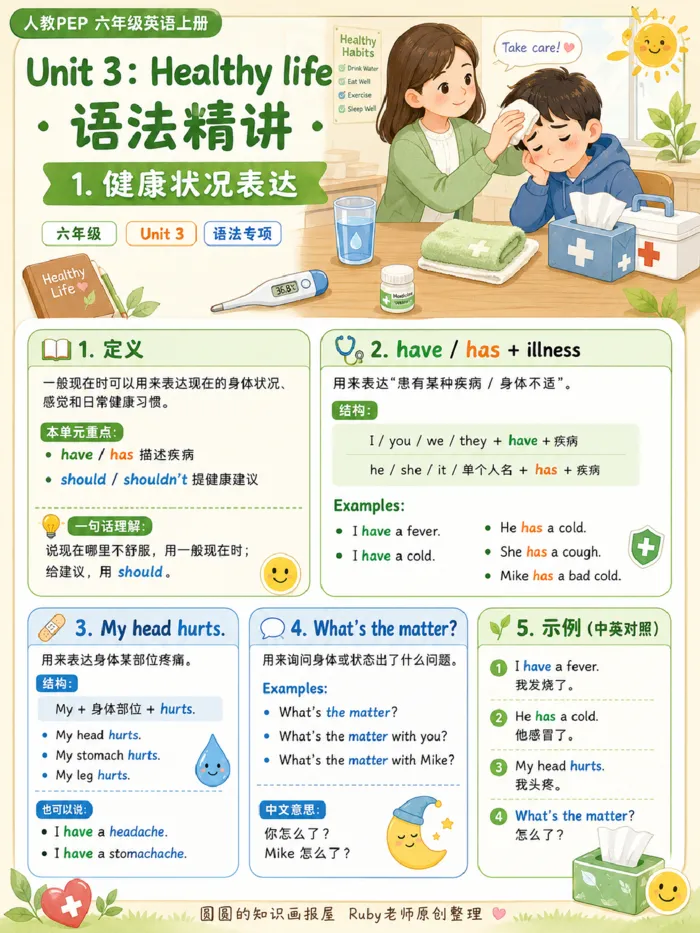
1.定义
O
用来表达“患有某种疾病/身体不适”。
结构:
I/ you/we / they + have+疾病
he / she / it/单个人名+ has +疾病
Examples:
● I have a fever.
● He has a cold.
● I have a cold.
·She has a cough.
● Mike has a bad cold.
2. have / has + illness
一般现在时可以用来表达现在的身体状况、
感觉和日常健康习惯。
本单元重点:
● have / has 描述疾病
· should / shouldn't提健康建议
一句话理解:
说现在哪里不舒服,用一般现在时;
给建议,用 should。
3. My head hurts.
4.What's the matter?
用来询问身体或状态出了什么问题。
Examples:
· What's the matter?
· What's the matter with you?
· What's the matter with Mike?
中文意思:
你怎么了?
Mike 怎么了?
5.示例(中英对照)
用来表达身体某部位疼痛。
结构:
①I have a fever.
我发烧了。
My+身体部位+ hurts.
· My head hurts.
②He has a cold.
他感冒了。
· My stomach hurts.
· My leg hurts.
③ My head hurts.
我头疼。
也可以说:
● I have a headache.
● I have a stomachache.
4What's the matter?
怎么了?
圆圆的知识画报屋 Ruby老师原创整理
人教PEP六年级英语上册
Unit 3:Healthy life
·语法精讲·
2.健康建议表达
六年级
Unit 3
语法专项
Healthy
Habits
You should...
? Drink Water
?Eat Well
Drink water
Exercise
√ SleepWel
Sleep well
Exercise
Eat well
Medicin
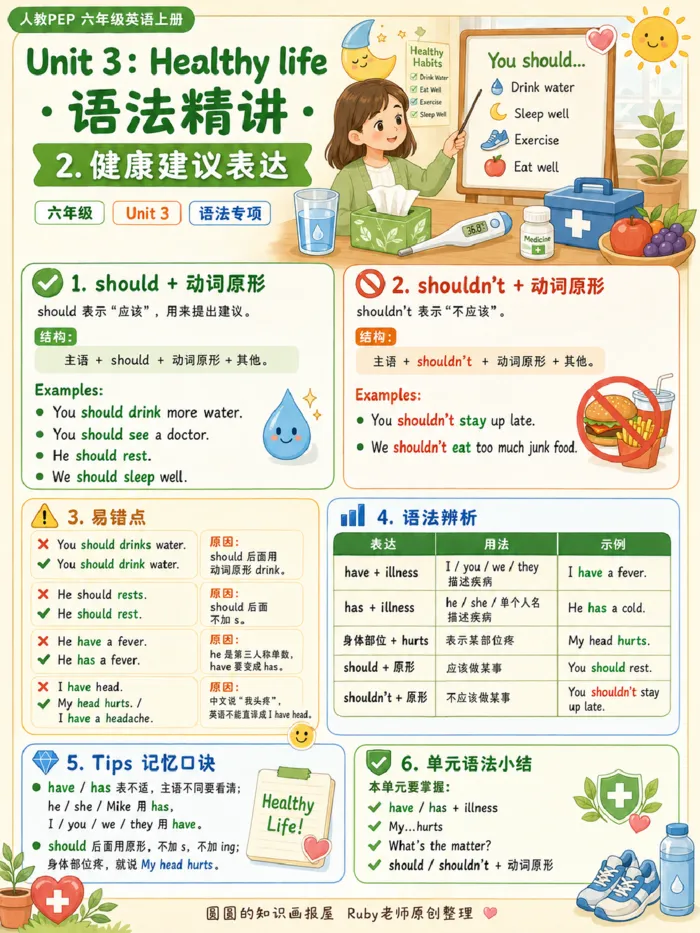
1. should +动词原形
should表示“应该”,用来提出建议。
结构:
主语 + should + 动词原形+ 其他。
Examples:
● You should drink more water.
● You should see a doctor.
● He should rest.
● We should sleep well.
!3.易错点
× You should drinks water.
 You should drink water.
× He should rests.
 He should rest.
原因:
原因:
should后面用
should后面
动词原形 drink。
不加s。
× He have a fever.
√ He has a fever.
原因:
he是第三人称单数,
have 要变成has。
× I have head.
√ My head hurts./
I have a headache.
原因:
中文说“我头疼”,
英语不能直译成I have head。
5.Tips 记忆口诀
● have / has 表不适,主语不同要看清;
he / she / Mike用has,
I / you / we / they用 have。
● should后面用原形,不加s,不加 ing;
身体部位疼,就说My head hurts。
Healthy
Life!
2. shouldn't+动词原形
shouldn't 表示“不应该”。
结构:
主语+ shouldn't + 动词原形+其他。
Examples:
● You shouldn’t stay up late.
● We shouldn't eat too much junk food.
4.语法辨析
表达
用法
示例
have + illness
I /you /we / they
I have a fever.
描述疾病
has + illness
he / she/单个人名
描述疾病
He has a cold.
身体部位+ hurts
表示某部位疼
My head hurts.
should +原形
应该做某事
You should rest.
shouldn't+原形
不应该做某事
You shouldn't stay
up late.
6.单元语法小结
本单元要掌握:
√ have / has + illness
√ M...hurts
√ What's the matter?
√ should / shouldn't + 动词原形
圆圆的知识画报屋 Ruby老师原创整理
人教PEP六年级英语上册
Healthy
Unit 3:Healthy life
Habits
 Drink Water
Eat Well
·语法练习·
 Exercise
 Sleep Well
3.健康状况与建议练习
六年级
Unit 3
语法练习
练习1|选词填空
练习2|情境选择
①.He_________ (have /has) a cold.
②.You should ___
(drink/drinks) more water.
5.你想问“你怎么了?”,你会说:
A.What's your name?
B. What's the matter?
C. How old are you?
③.My head___
(hurt / hurts).
④.We shouldn't.
(stay / stays) up late.
6.你想建议别人多休息,你会说:
A.You should get some rest.
B.You have a rest.
C.You are rest.
练习3|改错
7.She should drinks water.
8.I have head.
改正:
改正:
练习小提醒
· he / she / Mike 后面用has。
·I/you/we / they 后面用have。
· should / shouldn't 后面动词用原形。
●身体部位疼痛可以说:
My head hurts.
参考答案
7.drinks→drink
1.has 2.drink 3.hurts 4.stay
5.B 6.A
8.I have head→My head hurts./
I have a headache.
圆圆的知识画报屋 Ruby老师原创整理
人教PEP六年级英语上册
Unit 4:
Managing money well
·语法精讲
1.be going to 表计划
六年级
Unit 4
语法专项
Spending Plan
Need
? Save
? Spend
? Share
? Learn
Want
SALE
1. 定
2.用法
自3.结构详解
be going to 表示“打算做
某事”或“计划做某事”。
be going to常用于表达:
结构:
本单元重点:
●打算买什么
主语+ be going to+动词原形+其他。
用 be going to 谈论零花钱
使用计划。
●打算存多少钱
be 要根据主语变化:
●打算怎样花零花钱
I+ am going to
一句话理解:
he / she / it/单个人名+ is going to
还没做,但已经有计划,
(
●打算怎样管理自己的钱
就用 be going to。
you/we / they + are going to
0
4
0
4.例句
⋯5.示例(中英对照)
6.小提醒
6.小提醒
● I'm going to buy
a schoolbag.
●I'm going to buy a schoolbag.
我打算买一个书包。
be going to 里的be
be going to 里的be
不能丢。
不能丢。
She is going to
wait for a sale.
SALE
● She is going to wait for a sale.
她打算等打折。
I用am,
I用am,
· We are going to
make a spending plan.
● We are going to make
a spending plan.
我们打算制定花钱计划。
he / she / Mike用is,
he / she / Mike用is,
we / they用are。
we / they用are。
● Mike is going to save
up for a computer.
·How are you going to spend it?
你打算怎样花这笔钱?
Pocket
Pocket
Money
Money
圆圆的知识画报屋Ruby老师原创整理
人教PEP六年级英语上册
Unit 4:Managing money well·语法精讲
2.want to / need to / How much
SPENDING PLAN
六年级 | Unit 4 |语法专项
1. Save
NEED
2. Need
WANT
3. Want
SALE
4.Share
-20%
计划表SPENDING PLAN
Need
Want
Save
$20
$15
$10
oy
1. want to+动词原形
2. need to +动词原形
need to 表示“需要做某事”。
结构:
主语+ need / needs to +动词原形。
Examples:
·I need to save more.
·We need to think before buying. SAVE
·He needs to wait for a sale.
3. How much +不可数名词/钱数
want to 表示“想要做某事”。
结构:
How much 用来询问金额或不可数名词数量。
主语+ want / wants to+动词原形。
Examples:
Examples:
·How much pocket money do you have?
·I want to buy a microscope.
·How much money do you need?
·She wants to buy a pair of
sunglasses.
·How much is the dictionary?
4.money 不可数
money通常作不可数名词。
正确表达:
·much money
· some money
· enough money
Wrong warning:
X many money
?much money / some money /
enough money
·a lot of money
· pocket money
!
5.易错点
山
6.语法辨析
× I going to buy a book.
√ I'm going to buy a book.
原因: be going to 不能丢be,I后面用am。
× She going to wait for a sale.
√ She is going to wait for a sale.
原因:she 后面用 is going to。
× I want buy a microscope.
√ I want to buy a microscope.
原因:want 后面接动词时,要用want to do。
× I need save more.
√I need to save more.
原因:need后面接动词时,要用 need to do。
× many money
much money / some money/ enough money
原因:money 是不可数名词,不能用 many 修饰。
表达
含义
示例
be going to do
打算做某事
I’m going to
buy a book.
want to do
想要做某事
I want to buy
a microscope.
need to do
需要做某事
I need to
save more.
How much
询问钱数或
How much
不可数数量
money do
you have?
money
不可数名词
I have some
money.
7. Tips 记忆口诀
8.单元语法小结
本单元要掌握:
· be going to+动词原形
● want to / need to
POCKET
MONEY
● How much...
·money 为不可数名词
GOOD
PLAN
计划打算going to,
am / is/ are不能丢;
想做事情 want to,
需要事情 need to;
money 是不可数,
many money 不能用。
00p
圆圆的知识画报屋 Ruby老师原创整理
人教PEP六年级英语上册
Unit 4:Managing money well·-语法练习
SALE
3.计划与消费表达练习
SHOPPING LIST
六年级
Unit 4
语法练习
NEED
WANT
□ book
water bottl
notebool
SPENDING PLAN
D pen
1.Save first
ar Proctice
rammor
2.Need or want?
POCKET
MONEY
3.Spend wisely
WANT
NEED
练习1|单项选择
练习2 |改错
1.I_____going to buy a schoolbag.
A. am
B. is
C. are
5. I going to buy a book.
改正:
2. She wants____a pair of sunglasses.
A.buy
B. to buy
C. buying
3. I need
more.
A. save
B.to save
C. saved
6.He need to save more.
改正:_
4. How much_____do you have?
A.money
B.moneys
C. coinses
7. many money
改正:
练习3|连词成句
练习小提醒
8.going / buy / I’m/a schoolbag / to
· be going to 里的am / is / are不能丢。
· want 后接动词时,要用want to do。
9.much / how / pocket money/ do / you / have
· need 后接动词时,要用 need to do。
· money是不可数名词,不能说 many money
参考答案
1.A 2.B 3.B 4.A
8.I′m going to buy a schoolbag.
5.I'm going to buy a book.
6.He needs to save more.
7.much money
9.How much pocket money do you have?
圆圆的知识画报屋 Ruby老师原创整理 -
人教PEP六年级英语上册
Unit 5:
Earth 地球
约71??面被
Exploring space·语法精讲
水覆盖。
Moon 月球
1. There be 句型
地球唯一的
天然卫星。
六年级
Unit 5
语法专项
Mars 火星
被称为“红色星球”,
可能有水存在。
目1.定义
2.There be肯定句
There be句型表示“某地有某物”或“某地
结构:
没有某物”。
本单元重点:
There is + 单数名词/不可数名词。
There are + 复数名词。
用 There be描述太空和星球上的事物。
Examples:
一句话理解:
· There is water on Mars.
· There is a river.
想说“哪里有/没有什么”,就用 There be.
· There are large oceans on Earth.
· There are mountains and clouds.
3.There be疑问句
4.示例(中英对照)
结构:
Examples:
Is there any + 单数名词/不可数名词?
Are there any + 复数名词?
· Is there any water on Mars?
· Is there any life on Mars?
· Are there any aliens?
There is water on Mars.
火星上有水。
There are large oceans
on Earth.
地球上有大片海洋。
?
Is there any water on Mars? 火星上有水吗?
Are there any aliens?
有外星人吗?
·Are there any living things?
回答:
5.小提醒
·Yes, there is.
· Yes, there are.
water是不可数名词,要用 There is。
· No, there isn't.
·No, there aren't.
oceans / mountains / clouds是复数名词,
要用 There are。
? 问句里常用 any。
圆圆的知识画报屋 Ruby老师原创整理
人教PEP六年级英语上册Unit 5:
Exploring space·语法精讲
2.否定句+ can+科学事实表达
Earth travels
around the Sun.
六年级
Unit 5
语法专项
The Moon travels
around Earth.
Mars is red.
1. There be否定句
2.can +动词原形
结构:
can 表示“能看到、能做什么”。
There isn't any+单数名词/不可数名词。
There aren't any+ 复数名词。
结构:主语+ can +动词原形。
EXamples
Examples:
· There isn't any life on it.
· We can see the Sun, the Moon and the stars.
· There isn't any water on Mars.
· I can see the clouds.
· There aren't any living things.
· We can look into space with telescopes.
· There aren't any aliens.
4.易错点
3.一般现在时表达科学事实
科学事实、客观规律通常用一般现在时。
Examples:
· Earth is a planet.
· It travels around the Sun.
· The Moon travels around Earth.
· Mars is red.
· Satellites travel around Earth.
X There are water on Mars.
原因:water是
√ There is water on Mars.
不可数名词,
用There is。
X There is many oceans on Earth.
原因:oceans是
√ There are many oceans on Earth.
复数,用 There are。
X We can sees the Moon.
原因:can后面
√ We can see the Moon.
用动词原形see。
X Earth travel around the Sun.
原因:Earth 是第三人称
√ Earth travels around the Sun.
单数,一般现在时中
travel要变 travels。
l5.语法辨析
6.Tips 记忆口诀
表达
用法
示例
There is
后接单数或不可数名词
There is water on Mars.
There are
后接复数名词
There are oceans on Earth.
Is there any..?
询问单数或不可数
是否存在
Is there any water?
Are there any..? 询问复数是否存在
Are there any
living things?
can+原形
表示能看到、能做
We can see the Moon.
一般现在时
表达科学事实
Earth travels around
the Sun.
There is 接单个,也接不可数;
There are 接复数,many 后面常用are。
can 后动词用原形,科学事实现在时;
Earth travels around the Sun,
三单动词别忘s。
7.单元语法小结
本单元要掌握:
☆ There is/ There are
☆ Is there...? /Are there..?
★ There isn't / There aren't
can +动词原形
一般现在时表达
科学事实
圆圆的知识画报屋Ruby老师原创整理
人教PEP六年级英语上册
Unit 5:
Exploring space·语法练习
Earth & Moon
地球有一颗,
天然卫星——月球。
3. There be与科学事实练习
六年级
Unit 5
语法练习
Mars 火星
火星是红色的,
表面有山脉和,
峡谷。
练习1|选一选
练习2|判断改错
1. There___water on Mars.
A. is
B. are
C. be
5. There are water on Mars.
改正:
2. There____many oceans on Earth.
A. is
B. are
C. am
3.We can______the stars.
A. seesB. saw
C. see
6. There is many clouds.
改正:
4.Earth___around the Sun.
A. travel B.travels C.traveling
7. We can sees the Moon.
改正:
练习3|补全答语
练习小提醒
8. Is there any water on Mars?
→Yes,
☆ There is 接单数或不可数名词。
☆ There are 接复数名词。
9.Are there any aliens?
→No,
☆ can后面动词用原形。
☆科学事实常用一般现在时,
三单动词要加s。
参考答案
1.A2.B
3.C 4.B
5.are→is
6.is→are
7.sees→see
8.there is
9.there aren't
圆圆的知识画报屋 Ruby老师原创整理
-
人教PEP六年级英语上册
Unit 6:
Energy,nature and us
·语法精讲·
1.can/should表达能力与建议
LED
SOLAR
WIND
WATER
SAVE
POWER
POWER
POWER
ENERGY
REDUCE
REUSE
RECYCLE
自1.定义
2.can+动词原形
3. should+动词原形
情态动词can 表示“能够,可以”。
should表示“应该”。
can 表示“能够做某事”。
should 表示“应该做某事”。
结构:
结构:
本单元重点:
主语+ can+动词原形+其他。
主语+should+动词原形+其他。
●用can说明能源能做什么
●用should提出节能建议
Examples:
Examples:
· Water can make electricity.
·We should save energy.
一句话理解:
● Running water can make electricity.
●We should change our energy use.
介绍能源用 can,
·We can get power from the sea too.
· We should unplug computers and TVs.
提出建议用should。
·We can take quick showers.
●We should reduce, reuse and recycle.
·We can use LED lighting.
4.示例(中英对照)
5.小提醒
Water can make electricity.
水可以发电。
can和should都是情态动词。
它们后面的动词必须用原形。
We can use LED lighting.
我们可以使用 LED照明。
正确:
错误:
X
We should save energy.
我们应该节约能源。
can make
can makes
We should turn off the lights.
我们应该关灯。
should save
should saves
圆圆的知识画报屋 Ruby老师原创整理
人教PEP六年级英语上册
Use electricity
Turn off
Reduce, Reuse,
to light homes
the lights
Recycle
Unit 6:Energy, nature and us·语法精讲
2.use.⋯.to...与祈使句表达
LED
六年级 IUnit 6 I语法专项
女1.use.⋯.to⋯.
2.祈使句表达建议/号召
use...to...表示“用⋯⋯·⋯⋯”。
祈使句通常以动词原形开头,适合写环保建议、海报和口号。
结构:use + 名词+ to+动词原形
结构:动词原形+ 其他。
· We use electricity to light our homes.
● Reduce energy use.
· We use green energy to light, heat and cool our homes.
● Reuse bags.
· We use solar power to cook lunch.
● Recycle bottles and boxes.
· We use water power to make electricity.
● Turn off the lights.
● Take quick showers.
!3.易错点
I, 4.语法辨析
×Water can makes electricity.
Water can make electricity.
原因:can 后面用动词原形 make。
We should saves energy.
We should save energy.
原因:should 后面用动词原形 save。
We use electricity light our homes.
We use electricity to light our homes.
原因:use...to...中的to 不能丢。
结构
用法
示例
can +原形
能够、可以
Water can make electricity.
should+原形
应该
We should save energy.
use...to..
用⋯⋯·⋯⋯We use electricity
to light homes.
祈使句
建议/号召
Reuse bags.
We should to save energy.
We should save energy.
原因:should 后面直接接动词原形,不加 to。
Reduce
5.3R rules 表达
6.Tips记忆口诀
7.单元语法小结
减少
Reduce
● Use air conditioners less.
can和 should 都是情态动词,
本单元要掌握:
(减少)
●Walk more and drive less.
后面动词用原形;
● Take quick showers.
use 后放工具,
can + 动词原形
Reuse
再用
Reuse
· Bring our own bags to shops
to 后放动作,
√should+动词原形
(再用)
and markets.
环保建议可用祈使句,
use....o...
动词原形开头最有力。
Recycle
Recycle
● Recycle bottles and boxes.
Reduce少用,
祈使句表达建议
回收
(回收)
● Recycle old clothes, toys and books.
Reuse 再用,
√3R rules 绿色行动表达
Recycle 回收用。
圆圆的知识画报屋 Ruby老师原创整理
人教PEP六年级英语上册
Unit 6:Energy, nature and us·语法练习
3.节能建议表达练习
六年级Unit6
◆语法练习
REUSE
REDUCE
LED
RECYCLE
WATER
POWER
练习1|单项选择
练习2|改错
①Water can_____electricity.
A.makes
B.make
C.making
⑤ We should to save energy.
改正:
② We should_____energy.
A. saves
B. saving
C. save
③ We use electricity____light our homes.
A.to
B.for
C.at
⑥ Water can makes electricity.
改正:
④______bags.
A. Reuse
B. Reuses
C.Reused
⑦ We use solar power cook lunch.
改正:
练习3|连词成句
练习小提醒
8use / we / electricity / homes / to/
light / our
·can后面动词用原形。
炒·should后面动词用原形。
⑨ should /we / recycle / bottles
·use...to...表示“用.⋯⋯·⋯⋯”。
易·祈使句常用动词原形开头。
参考答案
1.B 2.C 3.A 4.A
000
5.去掉to:We should save energy.
6.makes→make
7.在power 后加 to:
We use solar power to cook lunch.
8.We use electricity to light our homes.
9.We should recycle bottles.
圆圆的知识画报屋 Ruby老师原创整理