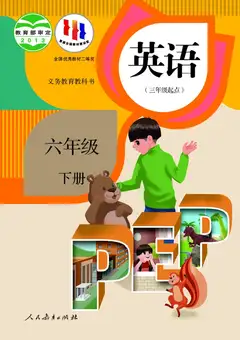
六年级 上册
英 语
(三年级起点)
义
务
教
育
教
科
书
六年级 上册
英 语
(三年级起点)
义
务
教
育
教
科
书
主 编:刘兆义
编 者:朱腊梅 雷 军
致 同 学
致 同 学
小朋友好!很高兴能成为你们的“老”朋友!真羡慕你们这么小就可以学
习英语了!
每个小朋友都希望爸爸妈妈和老师夸自己学习好,是个聪明的孩子。那么
怎么才能学好英语呢?其实,“聪明”这两个字已经给了我们答案。你看“聪”
字的左边是个“耳”,右边上面的“
”就像一对眼睛,中间是个“口”,下
面是个“心”。这是告诉我们,学英语啊,一要用耳多听,听是攻克英语城堡
的突破口;二要用眼多看、多阅读,注意观察;三要用口多说、认真模仿、出
声朗读、大胆地说;四要特别注意用心用脑,学习中要多动脑筋思考、勤记忆。
这些学习的好习惯,一定要从小就养成。而由“日”和“月”组成的“明”是
告诉大家,学英语是个循序渐进的过程,需要日积月累的坚持和努力。小朋友
只要记住这些道理,跟随Toby 这位新朋友积极参与教材上的听、说、读、写、演、
唱、玩等各种活动,就一定能够学好英语。
衷心祝愿小朋友,好好学习,天天向上,都成为聪明的好孩子!
你们的“老”朋友
刘兆义
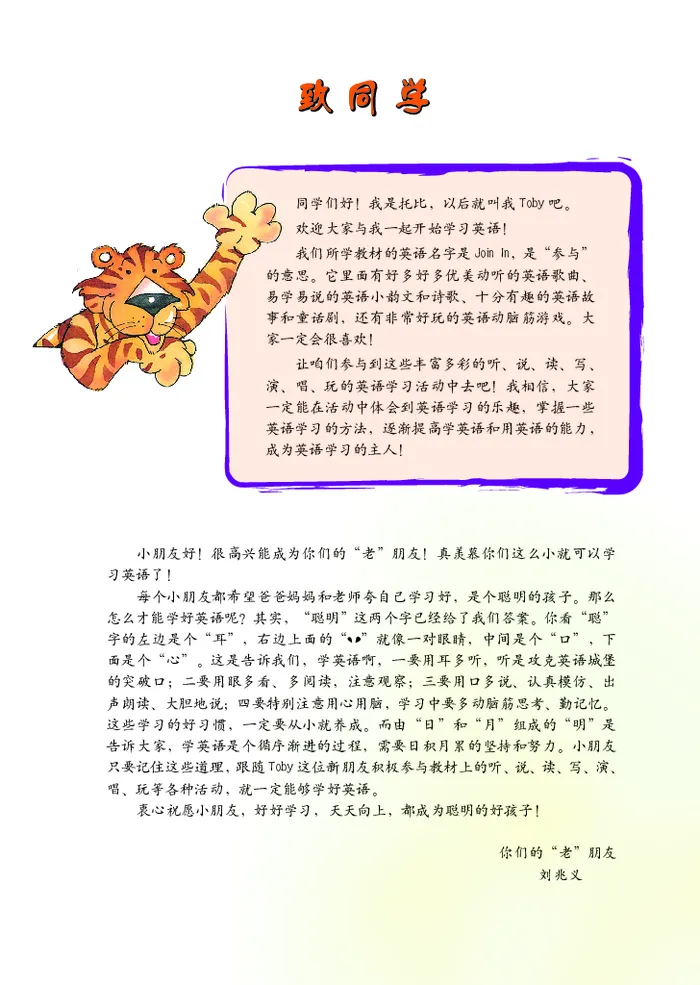
同学们好!我是托比,以后就叫我Toby 吧。
欢迎大家与我一起开始学习英语!
我们所学教材的英语名字是Join In,是“参与”
的意思。它里面有好多好多优美动听的英语歌曲、
易学易说的英语小韵文和诗歌、十分有趣的英语故
事和童话剧,还有非常好玩的英语动脑筋游戏。大
家一定会很喜欢!
让咱们参与到这些丰富多彩的听、说、读、写、
演、唱、玩的英语学习活动中去吧!我相信,大家
一定能在活动中体会到英语学习的乐趣,掌握一些
英语学习的方法,逐渐提高学英语和用英语的能力,
成为英语学习的主人!
致 同 学
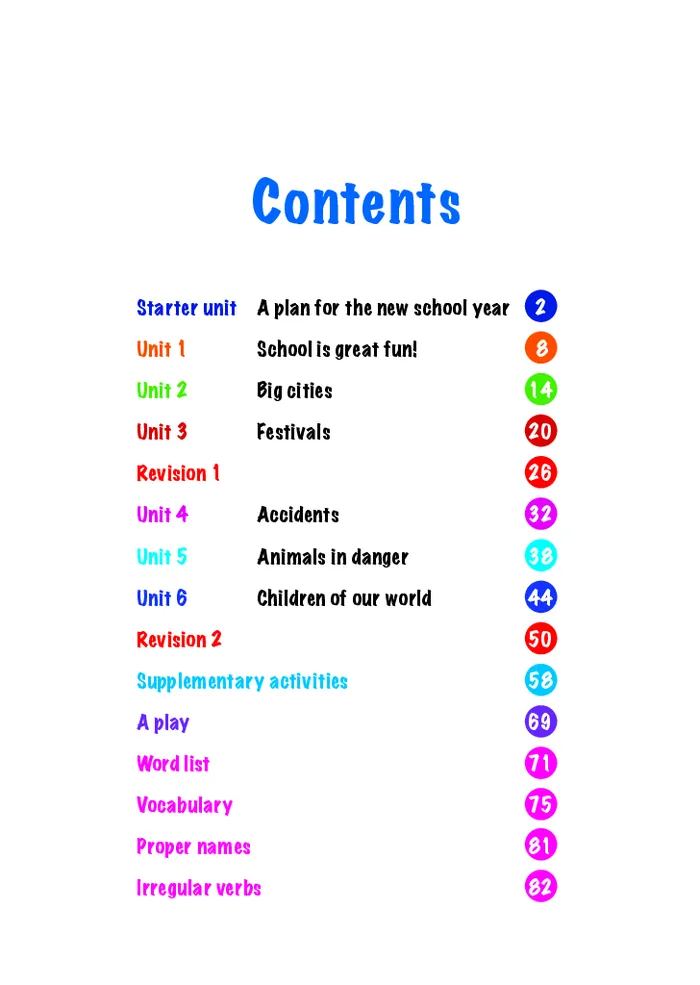
Contents
Starter unit A plan for the new school year 2
Unit 1 School is great fun!
8
Unit 2 Big cities
14
Unit 3 Festivals
20
Revision 1
26
Unit 4 Accidents
32
Unit 5 Animals in danger
38
Unit 6 Children of our world
44
Revision 2
50
Supplementary activities
58
A play
69
Word list
71
Vocabulary
75
Proper names
81
Irregular verbs
82
2
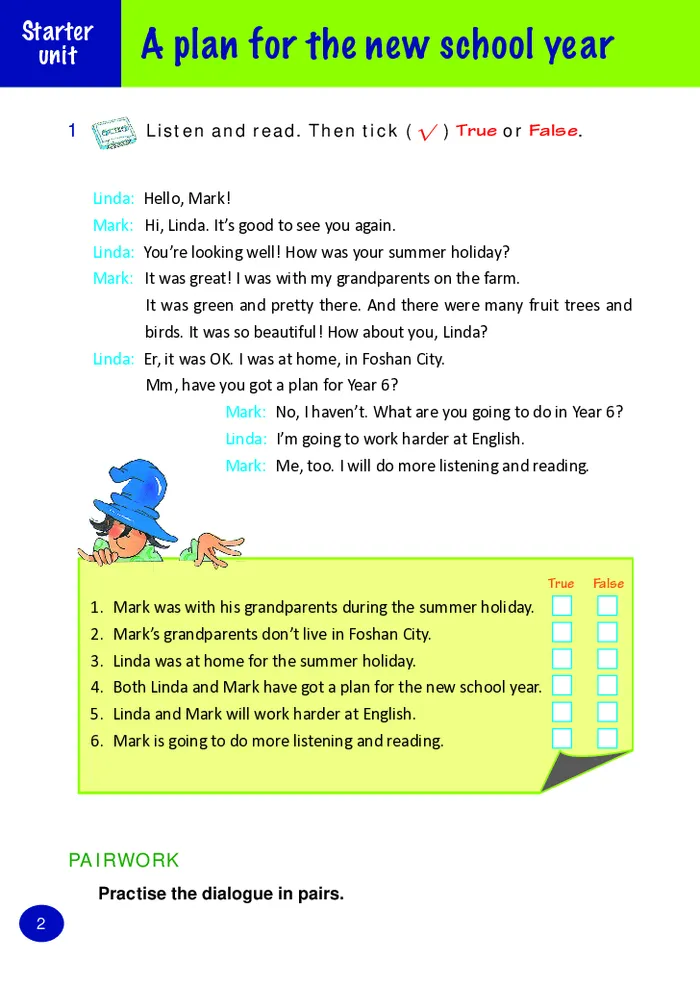
A plan for the new school year
Starter
unit
1. Mark was with his grandparents during the summer holiday.
2. Mark’s grandparents don’t live in Foshan City.
3. Linda was at home for the summer holiday.
4. Both Linda and Mark have got a plan for the new school year.
5. Linda and Mark will work harder at English.
6. Mark is going to do more listening and reading.
True False
1
Listen and read. Then tick (
) True or False.
Linda: Hello, Mark!
Mark: Hi, Linda. It’s good to see you again.
Linda: You’re looking well! How was your summer holiday?
Mark: It was great! I was with my grandparents on the farm.
It was green and pretty there. And there were many fruit trees and
birds. It was so beautiful! How about you, Linda?
Linda: Er, it was OK. I was at home, in Foshan City.
Mm, have you got a plan for Year 6?
Mark: No, I haven’t. What are you going to do in Year 6?
Linda: I’m going to work harder at English.
Mark: Me, too. I will do more listening and reading.
PAIRWORK
Practise the dialogue in pairs.
3
Starter
unit
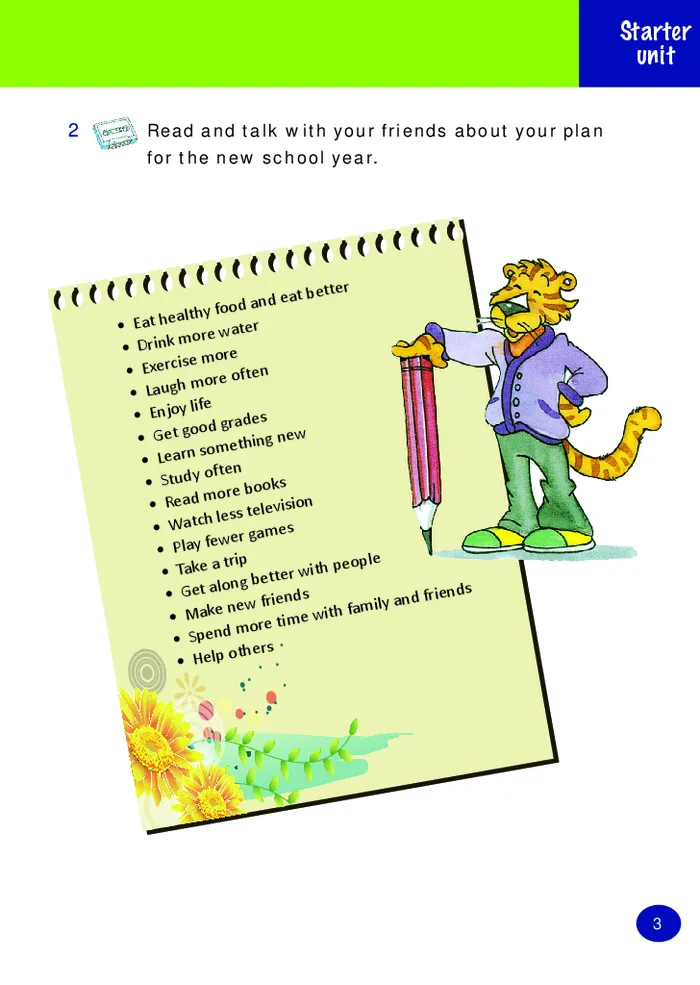
2
Read and talk with your friends about your plan
for the new school year.
• Eat healthy food and eat better
• Drink more water
• Exercise more
• Laugh more often
• Enjoy life
• Get good grades
• Learn something new
• Study often
• Read more books
• Watch less television
• Play fewer games
• Take a trip
• Get along better with people
• Make new friends
• Spend more time with family and friends
• Help others
4
A plan for the new school year
Starter
unit
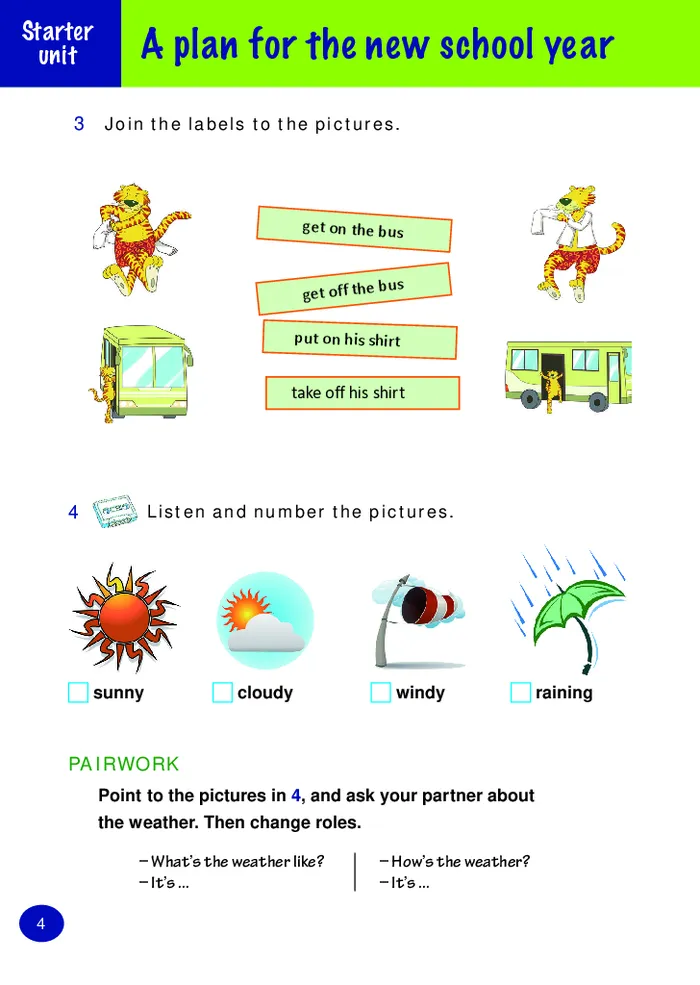
4
Listen and number the pictures.
PAIRWORK
Point to the pictures in 4, and ask your partner about
the weather. Then change roles.
sunny
cloudy
windy
raining
_ What’s the weather like?
_ How’s the weather?
_ It’s ...
_ It’s ...
3 Join the labels to the pictures.
get on the bus
get off the bus
put on his shirt
take off his shirt
5
Starter
unit
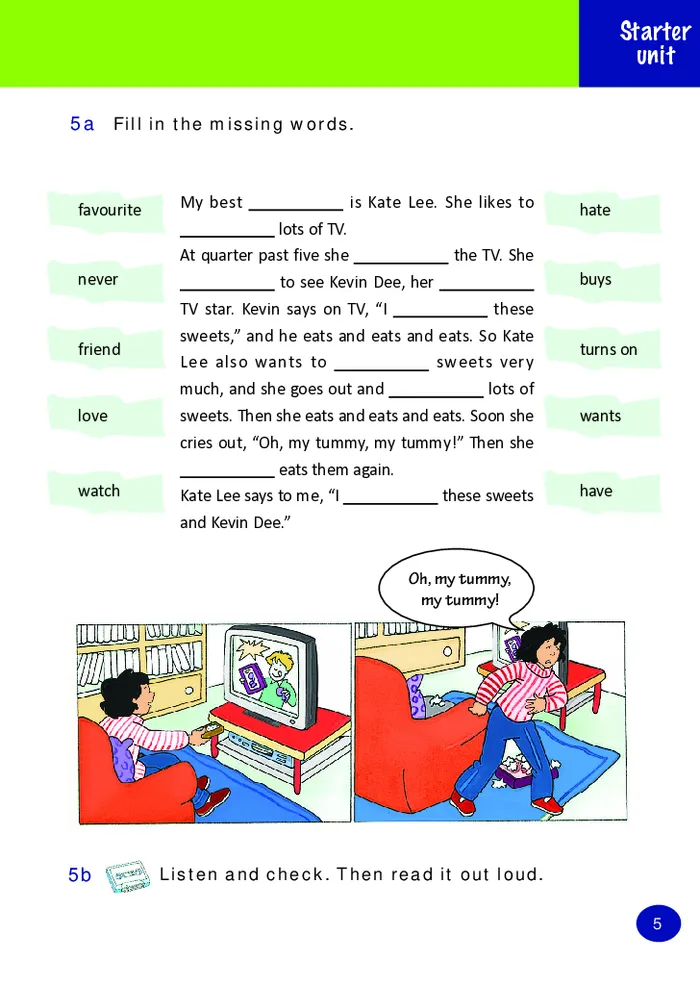
5a Fill in the missing words.
5b
Listen and check. Then read it out loud.
My best
is Kate Lee. She likes to
lots of TV.
At quarter past five she
the TV. She
to see Kevin Dee, her
TV star. Kevin says on TV, “I
these
sweets,” and he eats and eats and eats. So Kate
Lee also wants to
sweets very
much, and she goes out and
lots of
sweets. Then she eats and eats and eats. Soon she
cries out, “Oh, my tummy, my tummy!” Then she
eats them again.
Kate Lee says to me, “I
these sweets
and Kevin Dee.”
favourite
never
friend
love
watch
hate
buys
turns on
wants
have
Oh, my tummy,
my tummy!
6
A plan for the new school year
Starter
unit
6
Read and fill in the numbers on the map.
1. The tourist office is in the park.
2. The police station is beside the post office.
3. The school is opposite the police station.
4. The phone box is beside the museum.
5. The church is opposite the park.
6. The bus stop is opposite the museum.
7. The fruit shop is beside the train station.
8. The hospital is opposite the train station.
7
Starter
unit
7
Read and number. Then listen and check.
8
Make a dialogue. Put the sentences in the correct
order. Then listen and check.
Sorry, but where’s the supermarket?
Thank you. Bye-bye.
1 Excuse me, where’s the new cinema?
Bye-bye.
The new cinema? That’s easy. It’s opposite the supermarket.
Turn left, then right. You can see it.
PAIRWORK
Work in pairs. Practise the dialogues in 7 and 8.
1. Excuse me, where’s the post office?
Go straight ahead. Then turn right.
Thank you.
That’s OK.
2. Excuse me, where’s the hospital?
Turn left and then left again.
It’s on the left side of the street.
Thank you.
3.
Excuse me, where’s the museum?
Go straight ahead. It’s on the left, opposite the park.
Thank you.
That’s all right.
4. Excuse me, where’s the cinema?
Turn left and it's on the right. It’s next to the church.
Thank you.
That’s OK.
8
School is great fun!
Unit
1
1 Answer the questions.
2a
Read about Lake School.
SCHOOL IS GREAT FUN!
I come from China. I go to Lake School on North Island.
In our class there are 23 pupils: 12 girls and 11 boys.
This year we will have two new subjects, Drama and History.
Ms Howard will teach us Drama. I am her fan.
Mr Washington will teach us History.
We all love sports. Most pupils in our class like
pop music. Four boys and two girls have pets.
Our classroom is great. We like our teachers.
School is great fun!
1. Which school do you go to?
2. How many pupils are there in your class?
3. How many subjects do you have at school?
4. What is your favourite subject?
By Mary Chen
9
Unit
1
1. Mary is a Chinese girl, but she isn’t in China now.
2. There are 46 pupils in Mary’s class.
3. All the pupils in the class like sports.
4. Not many pupils in the class like pop music.
5. Half of the boys have got pets.
6. Mary has a great time at Lake School.
2b
Listen and read again. Tick (
) True or False.
3
Listen and learn the words for school subjects.
1. Which school does Mary Chen go to?
2. How many pupils are there in Mary’s class?
3. What new subjects will she have this year?
4. What does she write about her Drama teacher?
5. Do the pupils like their teachers?
GROUPWORK
Ask and answer questions about Mary Chen.
* PE = Physical Education
* ICT = Information and Communication Technology
Chinese
Maths English Science Music
Art
History
PE Drama French Geography
ICT
True False
10
School is great fun!
Unit
1
Kevin and Christine are in the
same class in Hove, in the
south of England.
1st French
2nd Physical Education
3rd Music
4th English
5th History
1st
Physical Education
2nd French
3rd Maths
4th English
5th Science
1st Geography
2nd Science
3rd Art
4th Music
5th Science
1st
Geography
2nd Information and
Communication Tech.
3rd Drama
4th English
5th Maths
1st Maths
2nd History
3rd Art
4th Drama
5th English
1st lesson 8:55 — 9:55
2nd lesson 10:00 — 11:00
3rd lesson 11:15 — 12:15
4th lesson
1:00 — 2:00
5th lesson
2:15 — 3:15
4a
Listen and fill in the days.
4b Play the game. Guess what day it is.
They’ve got French and History.
It’s Monday.
Monday
11
Unit
1
5 Read and guess. What are their favourite subjects?
Then write out the words.
I often listen to
classical music.
I love sports and games.
I love China. I like
learning its language.
l often go to the
Science Museum.
Alison loves Music. She often listens to classical music.
I love drawing pictures.
I like working with
numbers.
I love working
with my computer.
I love plays.
They are great fun.
PAIRWORK
Ask and answer.
1. What subjects do the children in 5 love?
2. What do they often do?
3. What do they like doing?
12
School is great fun!
Unit
1
6a
Read. Then listen and repeat.
6b Read again. Then complete the sentences.
1. Sandra
got black hair. English is
favourite subject.
She
reading stories and listening to cassettes best.
2. Mario
got brown eyes. Thursday is
favourite day at school.
He
History very much.
History teacher is very nice.
In English, he
singing songs and playing games best. He
English is great fun!
In my English class there are twelve
pupils: eight girls and four boys.
Our teacher's name is Mrs Blasco.
She is a very nice teacher.
English is my favourite subject.
I like reading stories and listening to
cassettes best.
Sandra
This year my favourite day at school is
Thursday. We have got History, English,
Maths and PE. I like History very much.
Our History teacher is very nice.
In English, I like singing songs and playing
games best. English is great fun!
Mario
13
Unit
1
7a Read and tell what Mario likes doing in English.
7b Talk in class.
8 Write your own timetable in English.
singing songs.
working in groups.
practising dialogues.
In English, I like learning new words.
saying chants.
reading stories.
watching cartoons.
acting in plays.
What do you like doing in English?
Monday
Tuesday
Wednesday
Thursday
Friday
1st
2nd
3rd
4th
5th
6th
Practice makes
perfect.
14
Big cities
Unit
2
1a
Listen and point.
1b
Listen and match.
1. Beijing is
2. London is
3. Washington DC is
the capital of the UK.
1 the capital of China.
the capital of the US.
the Great Wall the Palace Museum
Tower Bridge the London Eye
the White House the Smithsonian Castle
15
Unit
2
1c
Listen and read.
Beijing is in the north of China. It is
the capital of the country. There are
many interesting places in Beijing.
The Great Wall and the Palace
Museum are the most popular.
London is the capital of the UK. The
city is full of history and culture.
The British Museum, Tower Bridge,
Big Ben and the London Eye are
great fun to visit!
Washington DC is the capital of
the US. It is home to the famous
White House and the Smithsonian
Museums. You can feel the history
and culture of the country here.
16
Big cities
Unit
2
Dear Mike,
I like it here! Today we´re in
the middle of London. We´re
walking around Hyde Park.
It's so big. Next we are going
to Big Ben and Tower Bridge.
Love,
Emma
Mike Davis
136 Sandyard Road
Manchester
M16 ORA
Dear Mike,
It´s great!
There are so many big shops.
There are lots and lots of
people. Guess where we are
at the moment.
Love,
Emma
Mike Davis
136 Sandyard Road
Manchester
M16 ORA
Dear Mike,
Guess where we are today.
We are looking at the Palace.
It’s very big. The king of the UK
lives here. There’s a beautiful
garden with many flowers.
Love,
Emma
Mike Davis
136 Sandyard Road
Manchester
Ml6 ORA
2
Emma is in London. Match the pictures with the
postcards.
17
Unit
2
3a Read and learn.
3b
Who gets the correct answer? Listen and tick (
).
First look at the map. Emma and her parents are on Regent Street, where it
meets Oxford Circus. They want to walk to the National Gallery.
Emma, her dad and her mum ask for directions.
correct answer
wrong answer
Emma’s mum
Emma’s dad
Emma
go straight ahead
take the third left
take the third right
take the second left
take the second right
take the first left
take the first right
N
S
W
E
18
Big cities
Unit
2
4a Look at the photo and do the New York quiz.
4b
Read and check.
1. Is New York one of the biggest cities in the world?
2. Is it the capital of the US?
3. Is New York a city by the sea?
4. Are there many tall buildings in the city?
5. Do you think this photo of New York is new or old? Why?
New York City is a busy city by the sea in the
US. It is also one of the biggest cities in the
world. The twin towers in the photo were the
tallest buildings in the city. But they were hit
by two planes and fell down in 2001.
World Trade Centre
19
Unit
2
5b Read again and then tick (
) True or False.
1. Wuhan is one of the biggest cities in China.
2. The Han River joins the Changjiang River in Wuhan.
3. The Changjiang River runs across Wuhan from east to west.
4. The Han River divides Wuhan into three parts.
5. The Tangxun Lake is the biggest lake in the world.
5a
Listen and read.
Wuhan is a big city in China. It is a city of rivers. The Changjiang River
runs across the city from west to east, and the Han River enters the
Changjiang River here. The two rivers divide Wuhan into three parts –
Wuchang, Hankou and Hanyang. Wuhan is also a city of lakes because
there are many lakes in the city. And the Tangxun Lake is the biggest.
True False
20
Festivals
Unit
3
1
Read the texts about festivals. Then listen and repeat.
Mid-Autumn Festival
The 15th day of the Chinese lunar August is a very important
festival in China. It’s Mid-Autumn Festival.
On this day, the moon is full and bright.
Families get together and eat moon cakes.
People far from home look up at the
moon and think about their families.
Thanksgiving
The fourth Thursday in November is a holiday
in the USA. It’s Thanksgiving.
On this day, families get together and have a
big dinner. People usually eat turkey, sweet
potatoes and other vegetables.
Many people will meet in
the streets and enjoy their
holiday together. Everybody
has fun!
21
Unit
3
2
�Read the story and find out more about the Lantern
Festival.
Welcome,
Toby!
Time to go to
the lantern fair!
Come on, Toby.
Let's get our coats.
Wow! The lanterns
are so beautiful.
It's a lantern
riddle.
I get it!
I get it,
too!
…?
What's this?
Oh! They're
round, just like
the moon.
Hi, Yuanyuan.
Thank you for
inviting me.
It's the Lantern
Festival today. Let's
have some rice balls.
Yummy.
Look at your
teeth!
22
Festivals
Unit
3
3a
Listen and read the text.
3b Answer the questions.
Christmas Day
In the UK and the US, 25th December is Christmas Day. Children don’t go
to school. The night before, they hang up socks. The next morning, they
find presents inside the socks. Then, they open more presents under a
Christmas tree. Some people wear colourful sweaters.
During lunch, families pull crackers. Paper hats and jokes are in the
crackers. Most people eat turkey with lots of vegetables. Then they have
dessert, including a special kind of pudding. After lunch, people usually
play a board game or watch a film on TV.
1. When is Christmas Day?
2. What is inside the socks on Christmas Day?
3. What are inside the crackers?
4. What do most people eat for lunch?
5. What do people usually do after lunch?
22
23
Unit
3
4
Listen and sing the song.
Happy New Year
Happy New Year
Happy New Year
Happy New Year to you all
We are singing, we are dancing
Happy New Year to you all
Happy New Year
Happy New Year
Happy New Year to you all
We are singing, we are dancing
Happy New Year to you all
Happy New Year
Happy New Year
Happy New Year to you all
We are singing, we are dancing
Happy New Year to you all
We are singing, we are dancing
Happy New Year to you all
24
Festivals
Unit
3
5
A story — A surprise.
24
The Wangs are celebrating
the Mid-Autumn Festival.
A few minutes later
This is our first
Mid-Autumn
Festival in the UK.
Hmm, what's
going on there?
Let's call
the police!
What's the
matter?
There's a thief
in that house!
Look, someone
is coming out!
OK. We'll
check it out.
Stop! Don't move!
Wait, wait, officer!
I'm Paul Jones.
I live here. This is
my house!
Do you think
there's a thief?
25
Unit
3
25
Tell us what
happened.
I left my key in
the house and
locked myself out.
I used a ladder to
climb through the
window.
We saw him and
thought he was a
thief. Sorry, it was a
misunderstanding.
No problem. I understand.
Have a good evening!
We are sorry. Why don't
you come and eat moon
cakes with us? It's the
Mid-Autumn Festival.
Yes, please.
What a treat!
Don't forget
your key!
Wow, this is delicious!
Please tell me more about
the Mid-Autumn Festival.
1
26
REVISION
GROUPWORK
1 Discuss questions about school in groups.
1. Which school do you go to?
6. Who teaches you Maths?
2. Which class are you in?
7. Who does best in Maths in your class?
3. How many pupils are there
8. Do you like reading?
in your class?
9. What do you often do in English?
4. What subjects do you have?
10. Do you think school is great fun?
5. What subject do you like best?
subjects
places
festivals
foods
numbers
Art
capital
third
potato
vegetable
first
Maths
cinema
Christmas
fish
Science
sweets
classroom
museum
train station
PE
second
Thanksgiving
fourth
supermarket
Music
Spring Festival
2 Read the words. Then circle (
) in matching colours.
crayons
crayons
I like English best. We often listen
to recordings and read in English.
School is great fun!
1
27
REVISION
1st Chinese
2nd English
3rd Maths
4th PE
5th PE
1st
History
2nd Reading
3rd Science
4th English
5th Chinese
1st History
2nd Maths
3rd
Music
4th
ICT
5th
Art
1st
Geography
2nd ICT
3rd Drama
4th Reading
5th Science
1st
Science
2nd Chinese
3rd Music
4th Art
5th Maths
3b Answer the questions.
What lessons do they have on Wednesday?
What lessons do they have on Thursday?
Science is my favourite
subject. I also like singing
and drawing.
I like working with
computers and I like
working with numbers.
I also like drawing.
I love the theatre.
I also like reading.
I like sport.
Football is my
favourite.
3a Find their favourite days.
Monday
Thursday
Tuesday
Friday
Wednesday
1
28
REVISION
4a
Listen and read. Then number the pictures.
4b Fill in the place names.
1 _ Excuse me, where’s the
park, please?
_ Go straight ahead.
3 _ Excuse me, where’s the
supermarket?
_ Go ahead. Then take the
second left.
4 _ Excuse me, where’s the
cinema?
_ Go straight ahead. Take the
third right.
5 _ Excuse me, where’s the
No. 1 Hospital?
_ Take the first left.
6 _ Excuse me, where’s the
museum?
_ Go straight ahead. Then take
the second right.
2 _ Excuse me, where’s the
police station?
_ Take the first right.
park
1
29
REVISION
5 What’s wrong? Correct the sentences and write
them in your notebook.
6
Read and tick (
) True or False.
1. The Mid-Autumn Festival is always in August.
2. The moon is full and bright On New Year’s Day.
3. Thanksgiving is the fourth Thursday in December.
4. People usually eat a very simple meal at Thanksgiving.
5. Children hang up socks on the Lantern Festival.
6. On Christmas Day most people play a board game before lunch.
Sydney is not the capital of
Australia, but it is the biggest city
of the country. It is also the most
beautiful city in Australia. It has
got lots of interesting places to
visit. Sydney Opera House is the
most popular. Sydney is famous
for this opera house and the
2000 Summer Olympic Games.
1. Sydney is the biggest city in Australia.
2. Sydney is the capital of Australia.
3. Sydney is a very beautiful city.
4. There aren’t many good places to visit in Sydney.
5. Sydney Opera House is famous around the world.
Sydney Opera House
True False
1
30
REVISION
7a
Listen to the six questions. Then number the
answers.
7b
Listen and check. Then read.
8 Tick (
) the words which go together. Then read
all the expressions.
London is the capital of the UK.
They will go and visit Tower Bridge and the London Eye.
1 Shanghai is the biggest city in China.
They usually eat turkey, sweet potatoes and other vegetables.
It is in the south of England.
They are looking for a new home.
PAIRWORK
Read the sentences to your partner. Then change roles.
milk
the teacher
music
the bike
potatoes
listen to
get on
get off
drink
eat
1
31
REVISION
9a
Listen and read Xiao Yu’s composition.
Today’s Shenzhen
I live in Shenzhen, a city by the sea.
It is clean and beautiful. It is also
a busy city. There are many tall
buildings in the city. Kingkey 100
is the tallest. It is over 440 metres
high. I love my home city!
Yesterday’s Shenzhen
But more than 30 years ago, it was
a very small town. There were only
some small shops in the streets.
There were not any tall buildings.
Most people were fishermen. Life
was hard at that time.
1. Is Shenzhen a beautiful city by the sea?
2. Are there many tall buildings in Shenzhen?
3. Was it a big city more than 30 years ago?
4. Were there any tall buildings at that time?
9b Read again and then answer the questions.
32
Accidents
Unit
4
1
Look, listen and read.
2 Fill in he or his. Then read and check.
PAIRWORK
Ask and answer.
When I was eight, I had an accident
with my bike. I broke my leg and my
right arm. I was in hospital for four
weeks.
Joel
Last year I was on holiday with my
parents. One day I went swimming.
I cut my foot on a broken bottle.
My mum put a bandage round it.
Joseph
1. When Joel was eight, ____ had an accident with ____ bike.
____ broke ____ leg and ____ right arm. ____ was in hospital for four weeks.
2. Last year Joseph was on holiday with ____ parents. One day ____ went
swimming. ____ cut ____ foot on a broken bottle.
Did Joel have an accident
when he was eight?
Did he break his left arm?
Yes.
No. He broke his
right arm.
33
Unit
4
3b
Listen and check.
3c
Listen again and read.
3a Look at the pictures. Put the sentences in the correct
order.
PAIRWORK
Point to the pictures and tell your partner the story. Then change
roles.
The man broke his right leg.
They called the police.
The children went to Mr Snow’s house.
They put the ladder away.
The man wanted to get down the ladder.
They found a ladder in his garden.
The police came quickly.
The children and the police saw a man at the window.
He fell from the window.
34
Accidents
Unit
4
4
Listen and sing the song.
Take care
Listen, everybody
To what I have to say.
Listen well
And keep to these rules.
Hey, hey!
Take care when you ride your bike.
Wear your helmet so that you’re safe.
Take care when you rollerblade.
Don’t forget to put on your pads.
Listen, everybody
To what I have to say.
Listen well
And keep to these rules.
Hey, hey!
There’s another thing I want to say.
Please remember to put on your belt
When you ride in a car.
Oh, yeah!
And look left and right in the street.
Listen, everybody
To what I have to say.
Listen well
And keep to these rules.
Hey, hey!
35
Unit
4
Welcome.
Here's your key.
This is a lovely campsite.
Let's stay here
for a while.
Yes, let's do that.
The beach looks great
for snorkelling.
Several days later
I'm going
down to the beach.
OK.
I cut my foot
down at the beach.
Half an hour later
Oh, no!
There's blood
on your foot.
Excuse me,
is there a doctor
in the village?
The people in the village
didn't understand English.
Here's a bandage.
Let me see.
It's a deep cut.
You need a doctor.
Ouch, that
hurts!
5
A story — Bad luck for Tony.
35
36
Accidents
Unit
4
Excuse me,
is there a doctor
in the village?
That's
very kind.
I can come
with you
and show you.
No, there isn't,
but there is one in
the next village.
Your cut needs
five or six stitches.
It will hurt.
OK.
Thank you,
doctor.
Well ...
That's all right.
Was it bad?
No swimming
for a week, OK?
Don't forget
to write.
Two weeks later
No, I won't.
See you again
next year.
Tony couldn't go snorkelling,
but he wasn't unhappy. The boy
and the girl from the village often came
and played games with him.
Finally Tony's dad found a boy
and a girl who speak English.
37
Unit
4
7 Read the safety poster. Then design your own safety poster.
6
Complete the dialogues. Then listen and check.
Doctor: What’s the matter?
Sue: My knee hurts.
Doctor: What’s the matter?
Liz:
Doctor: What’s the matter?
Peter:
Doctor: What’s the matter?
Tony:
38
Animals in danger
Unit
5
1
Listen, read and guess what animals they are.
GROUPWORK
Play the guessing game.
It has got four legs.
It eats grass.
It lives on a farm.
People ride it.
It has got four legs.
It eats grass.
It’s smaller than a sheep.
Foxes like to eat it.
It has got four legs.
It eats grass.
It lives on a farm.
It gives us milk.
Has it got four legs?
Does it eat other animals?
Does it live on a farm?
Is it a cow?
Is it smaller than a horse?
Is it a horse?
Yes.
No.
Yes.
No.
No.
Yes.
It has got four legs.
It has got a long nose.
It’s a very big animal.
It lives in Africa and Asia.
It has got four legs.
It eats other animals.
It looks white.
It lives in the Arctic.
It has got four legs.
It eats other animals.
It’s smaller than a tiger.
It lives in Africa and Asia.
39
Unit
5
2
Listen and read. Then choose the best answer.
Kingfishers are beautiful birds. They live in many
countries of the world. They eat small fish.
Kingfishers are in danger. The water in many
rivers is dirty. There are no fish in them, so there
is no food for the kingfishers. There is also
another problem. Kingfishers build their nests in
holes in riverbanks. When people change the
rivers and build new riverbanks, there is no quiet
place for birds to make holes for their nests.
The kingfisher
1. The kingfisher is ________.
A. a very big fish
B. a small fish
C. a bird
2. The kingfisher eats ______.
A. small fish
B. big fish
C. small birds
3. Kingfishers _____ in holes in riverbanks.
A. catch fish
B. build their nests
C. eat their food
3 Look at the animals in danger below. Try to find out
why they are in danger.
40
Animals in danger
Unit
5
4
A story — The kingfishers.
There are no
kingfishers this year.
Let's find out
about kingfishers
on the web.
Good idea!
Where
are you going?
To the river.
We want to help
the kingfishers.
Let's start
digging here.
OK.
Why not?
I don't know.
The water is OK.
There are lots of fish.
Ah, here it says how
we can help the kingfishers.
Right. They need
holes in riverbanks
to make nests.
Why don't you come
and help us?
No, that's
boring.
See you.
41
Unit
5
Let's make
the hole for
the nest here.
Five hours later
That was
a lot of work.
Yeah.
Three months later
Who is
that behind
the bush?
I think it's
Emma
and Mike.
Wow,
baby birds.
Aren't they sweet?
All right.
Do you think
the kingfishers
will come here,
Emma?
I think so.
It's a quiet place.
Let's not
tell anyone.
OK.
What are you
doing here?
Be quiet and
have a look.
42
Animals in danger
Unit
5
Save China’s tigers!
We all know Toby the Tiger and love him.
But do you know the South China Tiger?
The South China Tiger lived in many parts of China.
But people can only see them in the zoo today.
Let’s help to save China’s tigers!
5
Listen and read the posters.
Let’s help pandas!
The panda lives in China.
It eats bamboo.
It has beautiful fur.
It is black and white.
People around the world love pandas.
But they are in great danger.
Let’s join in to help them.
43
Unit
5
6
Listen and read. Then tick (
) True or False.
The black rhino lives in East Africa. It eats
fruit and leaves. The black rhino is not black.
It is grey. Why is it called black?
Black rhinos love mud and they often take
baths in the mud. When they come out, they
look black. People kill rhinos and sell their
horns. Then other people make medicine out
of the horns and get a lot of money for it.
They say this medicine helps when you are
ill, but that is not true.
1. Black rhinos live in East Africa.
2. Black rhinos eat fruit and other animals.
3. The black rhino looks black, but it is not black.
4. The black rhino likes taking baths in mud.
5. Black rhinos are in danger.
The black rhino
7 Look at the pictures. Tell your partner what Li Ping did last
Saturday and what he didn’t do. Then change roles.
went to the
zoo
went to the
cinema
played
basketball
played
football
watched
cartoons
watched
sports
x
x
x
True False
44
Children of our world
Unit
6
1a
Listen and read.
1b Read again and match. Then read the sentences.
I’m Carlos. I live in Recife in Brazil.
I get up at half past seven every day.
Before I go to school, I feed my fish.
My fish are beautiful. They are very
precious to me.
I’m Ana. I’m from Tucuman, Argentina.
I love music. I have lots of CDs.
Sometimes some friends come to my place
and we listen to my CDs together. That’s great
fun! My CD player is my most precious thing.
Ana is
Ana enjoys
Ana’s CD player is
Carlos is
Carlos enjoys
Carlos’s fish are
feeding fish.
precious to her.
from Argentina.
listening to CDs.
precious to him.
from Brazil.
45
Unit
6
Who ...?
2
Read and match. Fill in the numbers. Then listen
and check.
3
Listen to the interviews. Then answer the questions.
loves playing the guitar.
is from London.
goes to the photo club.
wants to play in a band.
has a camera.
gets up at half past seven.
plays the guitar every afternoon.
loves taking photographs.
walks to school with a group of friends.
sometimes makes music.
1. Tom’s precious things are his books.
2. Sue’s precious things are her stamps.
3. Bill’s precious thing is his TV.
4. This old watch is precious to Carl.
5. Lily’s precious thing is her dog.
6. Granny’s precious things are her
old photos.
It was his grandfather’s.
It is so cute!
He loves reading.
She often looks at them and thinks
back to the things in the past.
She has got more than 300.
He likes watching sports and cartoons.
Erica
Jeff
46
Children of our world
Unit
6
4b Read and fill in the children’s names.
1. The child lives on a farm and has
2. The child’s family is very poor,
his lessons on TV in the morning.
so the child cannot go to school.
Samshaad is twelve. She lives in India. She gets
up at six o'clock in the morning. Then she helps
her mother in the garden behind their house. She
also feeds the chickens. At eight o'clock she walks
to school. In her class there are fifty-two children.
Samshaad loves learning. She wants to have a good
job when she is older, so school is very important for
her. There is no bookshop or library near Samshaad's
home, so her books are precious things.
Lena is from Ghana in Africa. She is thirteen. She gets
up at five o'clock. Then she starts working with her
father. At half past seven Lena gets on her bike. She
rides into town. She sells mangos and bananas in the
streets. Sometimes older boys take her fruit and run
away. Then Lena is very unhappy. Her family needs
the money. Lena has a dream. One day she wants to
have her own little shop.
NAME
NAME
4a
Listen and read. Then match the photos with
the texts.
47
Unit
6
3. The child loves football and wants
4. The child loves books and learning,
to play in the national team.
and dreams of a good job one day.
Mark is from Western Australia. He is twelve. He lives
on a farm. The nearest town is 400 kilometres away, so
Mark cannot go to school. Every morning, he gets up
at eight o'clock. His lessons on TV start at nine. Mark
learns the same things as the children in town. Once a
month, his teacher comes to the farm and studies with
him. Mark helps his father a lot on the farm. Mark has
his own horse called Sprinter. In the afternoon he often
rides around the farm. He loves his horse very much.
Jimmy is twelve. He is American. He lives in
Honolulu, Hawaii. His parents came to Hawaii from
China fourteen years ago. Jimmy was born in Hawaii.
He gets up at half past seven. School starts at nine.
He goes to school by bus. In the afternoon he always
plays soccer. He is in the boys' team at his school.
Jimmy dreams of playing in the American national
team one day. His most precious thing is a football
with the signature of a famous American player.
NAME
NAME
48
Children of our world
Unit
6
5a
Listen and sing the song.
We are the children of this world
We're the children of this world.
We're the grown-ups of tomorrow.
Let's make the world a better place
Without poverty and sorrow.
Why don't you stop the wars
And build more schools?
How can we learn
To live together?
We want to listen
To each other.
We want to live
In peace forever.
We're the children of this world.
We're the grown-ups of tomorrow.
Let's make the world a better place
Without poverty and sorrow.
49
Unit
6
5b
Listen and repeat the sentences.
1. Why don’t you stop the wars and build more schools?
2. We want to listen to each other.
3. We want to live in peace forever.
1 seven o’clock; half past seven; quarter to eight; quarter past eight ...
2 nine o’clock ...
3 play football; play with friends; read; listen to music ...
4 Tom; Mary; Yu Gang; Liu Yue ...
5 eleven; twelve; thirteen; fourteen ...
6 play table tennis; go swimming; go to the cinema; learn English ...
7 forty-eight; thirty-eight; fifty; fifty-two ...
8 English; pop songs; Art; PE ...
9 reading; singing; dancing; feeding fish; playing computer games;
collecting stamps ...
My day
I get up at ... 1
School starts at ... 2
In the afternoon I often ... 3
My class
There are ... pupils in my class. 7
Most pupils like ... 8
My friends
My good friend’s name is ... 4
He / She is ... years old. 5
We often ... together. 6
My hobbies
I like / love ... 9
GROUPWORK
Talk about yourself with each other.
2
50
REVISION
hair
ear
teeth
stomach
knee
foot
toe
elbow
eye
nose
shoulder
arm
feet
leg
head
finger
GROUPWORK
1
Listen and tick (
). Find the missing words.
2
51
REVISION
3 Think and match. Then read and keep to the rules.
2a
Listen and tick (
).
1. Where did the accident happen?
In Great Street.
In Green Street.
2. What accident did Xiaogang have?
A car accident.
A bike accident.
3. What problem did he have?
He broke his left leg.
He broke his right arm.
4. Where is the hospital?
Behind our school.
Beside our school.
First look,
Stop and wait
on the right of the street.
Ride your bike
then cross the street.
when the light is red.
He rode on the left of the street.
He fell off his bike and broke his right arm.
1 This morning Xiaogang went to work by bike.
The police took him to the hospital next to our school.
But he didn’t keep to the rules.
So he had an accident in Great Street.
2b
Listen again and fill in the numbers. Then read.
2
52
REVISION
4a
Listen and read. Colour the frames.
4c Fill in bigger than or smaller than. Then read.
4b Read and fill in the names of the animals.
cat
panda
rabbit
It’s black and white.
It has got two long ears
It has got bright eyes.
It eats bamboo.
and a small mouth.
It can see in the night.
It’s smaller than
It eats grass, and it
Its favourite food is fish.
the polar bear.
eats vegetables, too.
It likes eating mice, too.
It lives in China.
It runs fast.
Many people keep them
as pets.
1. The
lives in China. It eats bamboo.
2. The
likes eating fish. It likes eating mice, too.
3. The
runs fast. It eats grass and vegetables.
1. The panda is
the polar bear.
2. The panda is
the rabbit.
3. The rabbit is
the polar bear.
4. The polar bear is much
the rabbit.
It is the biggest of the three animals.
2
53
REVISION
5 Can you find the two hidden animals? Write the first
letter of each word.
PAIRWORK
Practise the dialogue with your partner.
6
Listen and read.
A: Who’s the girl in the picture?
B: She’s Lena.
A: Lena looks lovely. Is she an American girl?
B: No, she isn’t. She’s from Africa. She’s thirteen.
A: Oh, she’s as old as me.
B: Yes, but she can’t go to school like you. Her family
is very poor, so she has to work every day.
A: She is only thirteen, and has to work? What does she do then?
B: She gets up at five o'clock in the morning and starts working with her father.
Then she rides into town and sells fruit in the streets.
A: Poor Lena! I think she wants to go to school very much!
B: Yes, she often dreams of studying at school! And she’s got another dream.
A: What is it?
B: She wants to have her own little shop one day.
2
54
REVISION
8a
Listen and read the texts of 4a, Unit 6.
8b Read out the questions loud.
PAIRWORK
Ask and answer.
PAIRWORK
Suppose you are Samshaad, Lena, Mark or Jimmy.
Ask each other the questions in 8b.
1. What’s your name?
2. How old are you?
3. Where are you from?
4. When do you get up?
5. What do you often do?
6. What is your dream?
7 Fill in the words in their correct forms. Then tell
your partner the reasons.
1. like or likes
Sam and I are music lovers. We often listen to music after school.
I _________ pop music, and he ________ country music.
2. go or goes
Mary and her parents all love travelling in the summer holiday.
Mary usually _______ to big cities, but her parents often _______
to small towns.
3. study or studies
Dick, Hill and Fanny are children from Canada. They are at the same
school. They _______ English and French at school. Fanny also
________ Chinese. She wants to work in China some day.
Does Mary usually go
to small towns?
No, she doesn’t.
2
55
REVISION
9 Match the sentences. Fill in the numbers.
10
Listen and read. Talk with your friends about
how you can help save the animal.
1. Hakan’s most precious thing
is a book.
2. Sergi’s most precious thing
is his TV.
3. Jakub’s most precious things
are his mask and his flippers.
4. Carmen’s most precious thing
is her dog.
5. Pedro’s most precious things
are his stickers.
6. Christine’s most precious
thing is her necklace.
7. Katya’s most precious thing is
her computer.
She loves his dark brown fur.
He has got two hundred.
She has got a new CD-ROM.
1 He loves reading.
It’s made of gold.
He loves watching sports and
cartoons.
He loves the sea.
It is very difficult to see snow
leopards. They live up in the
mountains of the Himalayas.
The snow leopard has beautiful fur.
There is one big problem: people kill
snow leopards. They want to get the
beautiful fur and sell it.
2
56
REVISION
11 Read the two posters. Then tick (
) or cross ( ).
What do the posters want to say to people?
Poster 1 wants to say:
Poster 2 wants to say:
X Super Bat can’t help the bats.
Don’t keep wild animals as pets.
You can help Super Bat.
Don’t keep pets in a cage.
Save the bats.
The boy doesn’t want to live in a cage.
GROUPWORK
Make your own posters.
Protect birds!
They need a home.
DON'T KILL WILD ANIMALS!
Dogs are our friends.
2
57
REVISION
12 Read the signs. Then match.
1. Don’t swim here.
2. Don’t turn left.
3. Don’t use your mobile phone here.
4. Don’t walk this way.
5. Don’t enter.
He’s speaking on the phone
in the library.
She’s reading in the sun.
They’re talking loud
on the bus.
They’re playing football
on the road.
GROUPWORK
Discuss what we should say to them. Use: Don’t ...
58
Supplementary activities
Unit
1
Our English class
our class
are
twenty-three
: twelve girls
eleven boys.
year our
is
Mrs Navarro. Most pupils in
class like
.
Three collect stickers, four collect
and six
football pictures.
pupils have
.
Our classroom
great and
like our
teacher.
English
In
pupils
This
is
pets
our
and
there
teacher
collect
Four
comics
we
pop music
1 Write the missing words.
59
Unit
1
2 My ideal timetable.
Monday
Tuesday
Wednesday
Thursday
Friday
1st
2nd
3rd
4th
5th
6th
3 Write sentences about the children.
likes
doesn't like
using the computer
reading stories
writing texts
listening to music
Bob
Betty
Ann
Jim
Look at the subjects on page 9 again. Then fill in your ideal timetable.
Supplementary activities
Unit
2
60
1 Write the missing words.
2 Write the words.
turn left
take the second left
go straight ahead
take the first right
turn right
Mike,
It's
!
are
so many big
.
There are
and lots of
. Today we
at the
where
the
lives.
,
Emma
Mike Davis
136 Sandyard Road
Manchester
M16 ORA
dear
love
people
lots
king
great
shops
there
are
palace
Unit
2
61
3 Ask for directions. Write the dialogues.
Train
station
Hotel
Cinema
Bus
stop
Post
office
Dialogue 1
Tourist: Excuse me, where is the
cinema?
You:
Tourist: Thank you.
Tourist: Excuse me, where is the
post office?
You:
Tourist: Thank you.
Tourist: Excuse me, where is the
hotel?
You:
Tourist: Thank you.
Tourist: Excuse me, where is the
train station?
You:
Tourist: Thank you.
Dialogue 2
Dialogue 3
Dialogue 4
Supplementary activities
Unit
3
62
1 Write the missing words.
2 Guess the lantern riddles.
The ...................... Thursday in November
is a ........................... in the United States.
It's .............................. . On this day,
all the ...................... of a family come
................................. and have a big dinner.
People usually eat .............................. ,
......................... ............................ and
other ............................. .
members
together
Thanksgiving
holiday
sweet potatoes
fourth
turkey
vegetables
I’m tall when
I’m young,
and I’m short
when I’m old.
What am I?
What is black
when it is
clean and
white when
it is dirty?
I’ve got no
wings, but I
can fly. I’ve
got no eyes,
but I can cry.
What am I?
Unit
3
63
3 Write the numbers.
1
4
5
6
7
8
9
2
3
This is our first
Mid-Autumn
Festival in the UK.
1
Tell us what
happened.
Stop! Don't move!
Hmm, what's
going on there?
Why don't you
come and eat moon
cakes with us?
Please tell me more
about the Mid-Autumn
Festival.
There's a thief
in that house!
We saw him and thought
he was a thief. Sorry, it
was a misunderstanding.
I left my key in the house
and locked myself out.
I used a ladder to climb
through the window.
Supplementary activities
Unit
4
64
1
Listen and tick (
).
2 Write the missing words.
Situation 1
doctor
hospital
police
in the park
opposite the park
behind the station
earache
problem with his knee
broken leg
plaster
bandage
medicine
Situation 2
doctor
hospital
police
in Green Street
next to the station
next to the police station
earache
problem with her arm
broken knee
plaster
bandage
medicine
my
I
to
on my
holiday
the
plaster
in
went put
was
broke
in
doctor
When .................... .................. .................... ................... ..................... Spain,
I .................... ..................... arm. I ..................... ...................... ......................
hospital. The ............. ................... ................. arm ............... ............... .
Unit
4
65
3 Write the numbers.
I can come
with you and
show you.
OK.
No, I won't.
This is a lovely
campsite. Let's stay
here for a while.
1
13
12
Several days later
I'm going down
to the beach.
Excuse me,
is there a doctor
in the village?
Don't forget
to write.
Yes, let's do that.
The beach looks great
for snorkelling.
Your cut needs
five or six stitches.
It will hurt.
No, there isn't,
but there is one in the
next village.
See you again
next year.
That's very kind.
OK.
Two weeks later
2
3
7
4
8
10
11
9
6
5
65
Supplementary activities
Unit
5
66
1 Write the missing words.
There are ..............
...................... this year.
.................. .
The water is OK.
There ...................... .
Why ............ come and
help us?
No, that's
............ .
Let's ............
about kingfishers
on the ....... .
............... you going?
............. the
hole for the nest
here.
All right.
Why not?
Ah, here it .............. we can
help the kingfishers.
Good idea!
To the river.
We ............. help the
kingfishers.
Let's make
find out
web
want to
Where are
are lots of fish
don't you
boring
They need
no kingfishers
says how
I don't know.
Right. ........... holes
in riverbanks to
make nests.
1
2
3
4
5
6
Unit
6
67
1 What do you remember? Write the sentence numbers
beside the pictures.
1. His lessons on TV start at nine.
2. He is American.
3. She lives in lndia.
4. She lives in Ghana.
5. She helps her mother in the garden.
6. She sells bananas in the streets.
7. Once a month, his teacher comes to the farm
and studies with him.
8. In the afternoon he always plays soccer.
9. He gets up at half past seven.
10. One day she wants to have her own little shop.
11. In her class there are fifty-two children.
12. His horse is called Sprinter.
Mark
Samshaad
Jimmy
Lena
Supplementary activities
Unit
6
68
2 Write about yourself.
My day
My friends
Precious things
Hobbies
I get up at ...
School starts ...
In the afternoon I often ...
My best friend's name is ...
He / She is ... years old.
We sometimes ... together.
My most precious thing is ...
I like my ...
I got it from ...
Glue your photo or
draw a picture of yourself here.
I like ...
I collect ...
69
Nian the monster
Roles:
Narrator
Woman
Child 1
Child 2
Child 3
Child 4
Wise man
Man
Nian
You need:
a monster mask
boxes or buckets for the drums
chopsticks for the drumsticks
fireworks made of paper
pieces of red paper
red clothes (coats, jumpers or scarves)
torches
Narrator:
A long time ago, there was a monster named Nian. It lived in
the mountain. At the end of each year, Nian came down from
the mountain.
(The children are in the village. They are talking about Nian the monster.)
Child 1:
Nian is noisy.
Child 2:
Nian’s got big claws and big teeth.
Child 3:
Nian eats animals.
Child 4:
Nian eats people, too!
Children:
We’re scared of Nian!
Narrator:
One cold winter day, a wise man visits the village.
(Wise man walks into the village.)
Woman:
You can’t stay here. Nian is coming!
Child 1:
Nian is noisy.
Child 2:
Nian’s got big claws and big teeth.
Child 3:
Nian eats animals.
Child 4:
Nian eats people, too!
Children:
We’re scared of Nian!
A play
70
Wise man:
Don’t be scared. I’ve got an idea.
(Wise man and the villagers form a close circle. Whispering, they discuss
a plan.)
Man:
I’ve got some torches and fireworks.
Woman:
I’ve got some red paper.
Children:
And we’ve got some drums!
Wise man:
Good! Now go home.
(The villagers go home and bring out drums, torches, fireworks and red paper.
They stick the red paper on the windows of their houses. Then they go inside.)
Narrator:
Everyone goes home. They stick the red paper on the windows.
Then they wait for Nian the monster.
Narrator:
The day ends and night falls.
(The villagers chant louder and louder.)
Everyone:
Nian is coming. Nian is coming. Nian is coming. Nian is coming.
Shhhh!
Nian:
Grrrr! I’m Nian! I’m very hungry!
Wise man:
Ready? One, two, three!
(The villagers are wearing red clothes. They light torches. The windows shine red.)
Nian:
Oh, no! Bright, red light! My eyes hurt!
Man:
Quick, everyone! Play the drums!
(The villagers run outside and bang the drums.)
Nian:
Oh, no! Noisy drums! My ears hurt!
(The villagers light the fireworks.)
Woman:
Quick, everyone! Light the fireworks.
Nian:
Oh, no! Noisy, colourful fireworks! Help! I’m scared!
Narrator:
Nian runs away. He never comes back again.
Man:
Let’s celebrate!
Child 1:
Let’s light fireworks!
Child 2:
Let’s play the drums!
Child 3:
Let’s wear red clothes!
Child 4:
Let’s celebrate every year!
Narrator:
From then on, people call the celebration “Guo Nian”!
(Everyone dances and cheers.)
A play
71
Starter unit
cinema 电影院
cry out 大声喊叫
during
在……期间
exercise 运动,锻炼
get along 相处
grade 成绩,分数
left 左边的;左侧
plan 计划
so
如此,如是;因此,所以
spend 花〔时间〕
supermarket 超市
That’s all right. 别客气。
That’s OK. 没关系。
trip 旅行
turn on 打开
Unit 2
around 环绕
at the moment 此刻,目前
building 建筑〔物〕
busy 热闹的,忙碌的
by 靠近
capital 首都,首府
culture 文化
direction 方向
east 东,东方
famous 著名的
first 第一的
king
国王
map
地图
middle
中部
most
最
north
北,北方
palace
宫殿
right
右方,右侧
second
第二的
third
第三的
twin towers 双子塔
west
西,西面
Word list
Unit 1
act 演出
by 由……所做
dialogue 对话,对白
drama 戏剧
fan 狂热崇拜者,……迷
French 法语
geography 地理
history 历史
ICT 信息和通信技术
language 语言
nice 友好的
play 戏剧
pop 流行音乐
south 南,南方
(粗体单词是需要掌握的核心单词,标红星单词是超纲词)
72
Unit 3
awesome
很好的,了不起的
back
后面,后部
celebrate
庆祝
check
检查
check out
调查,核实
climb
攀登,爬
colourful
色彩丰富的
cracker
圣诞彩包爆竹
delicious
美味的,可口的
dessert
甜点
down
沿着
far
远
festival
节日
few
一些,几个
fourth
第四的
full
满的,完整的
get
去拿,去取;明白
hang
悬挂
huge
巨大的;程度深的
include
包括,包含
inside
在……里面
invite
邀请
joke
笑话
kind
种,类
lantern fair
灯会
Lantern Festival 元宵节
lock out
把〔某人〕锁在门外
loud
响亮的;大声的
lunar
农历的
Mid-Autumn Festival 中秋节
moon cake 月饼
move
〔使〕改变位置,〔使〕移动
myself
我自己
officer
警官
riddle
谜语
stripe
条纹
surprise
意想不到的事
sweet potato 甘薯,红薯
Thanksgiving 感恩节
treat
意外的乐事,幸事
turkey
火鸡
understand 懂得;理解
Word list
73
Unit 4
accident 事故,意外事件
bandage 绷带
belt 皮带;安全带
bottle 瓶子
campsite 〔野〕营地
cut 划伤;伤口
deep 深的
finally 最后,终于
helmet 头盔
keep 〔使〕保持
keep to 遵守
kind 体贴的
matter 事情,问题
pad 垫,护垫
put away 把〔某物〕收起来
right 右边的,右侧的
rule 规定,规则
safe 安全的
stay 停留
stitch 〔缝合伤口的〕一针
swimming 游泳
take care 当心,小心
unhappy 不快乐的
village 乡村,村庄
well 唔,噢〔用于停顿片刻或使
自己在说话前有时间考虑〕
Unit 5
anyone 任何人
bamboo 竹子
black rhino 黑犀牛
danger 危险
dig 挖〔土〕,掘〔洞〕
dirty 肮脏的
fur 毛皮
grass
草地
have a look 看,瞧
horn 〔牛、羊等头上的〕角
kill 杀死
kingfisher 翠鸟
leaf 叶子
medicine 药,药物
mud 泥,烂泥
nest 鸟巢,鸟窝
part 部分
rhino 〔非正式〕犀牛
riverbank 河岸
save 救,拯救
South China Tiger 华南虎
sweet 可爱的
web 网络
work 工作;事情
Word list
74
Unit 6
American 美国人
band 〔尤指演奏流行音乐的〕
乐队
bookshop 书店
camera 照相机
CD 激光唱片
CD player 激光唱机
chicken 鸡
club 俱乐部
cute 漂亮的,逗人喜爱的
dream 梦想,愿望
each other 互相,彼此
feed 喂养,饲养
forever 永远
grown-up 成年人
hobby 业余爱好
job 工作;职业
little 小的
mango 芒果
national 国家的
near 〔距离〕近的
once 一次
own 拥有
peace 和平
photograph 照片
player 选手,球员
poor 贫穷的
poverty 贫穷
precious 宝贵的,珍贵的
signature 签字,签名
soccer 足球
sorrow 悲伤,悲痛
war 战争
without 没有
Supplementary activities & A play
hotel
宾馆
make
制造
plaster
石膏
text
文字
then
那时
yourself
你自己
Word list
75
Vocabulary
Aa
accident
事故,意外事件
act
演出
American
美国人
anyone
任何人
around
环绕
at the moment 此刻,目前
awesome
很好的,了不起的
Bb
back
后面,后部
bamboo
竹子
band
〔尤指演奏流行音乐的〕
乐队
bandage
绷带
belt
皮带;安全带
black rhino
黑犀牛
bookshop
书店
bottle
瓶子
building
建筑〔物〕
busy
热闹的,忙碌的
by
由……所做;靠近
Cc
camera
照相机
campsite
〔野〕营地
capital
首都,首府
CD
激光唱片
CD player
激光唱机
celebrate
庆祝
check
检查
check out
调查,核实
chicken
鸡
cinema
电影院
climb
攀登,爬
club
俱乐部
colourful
色彩丰富的
cracker
圣诞彩包爆竹
cry out
大声喊叫
culture
文化
cut
划伤;伤口
cute
漂亮的,逗人喜爱的
76
Vocabulary
Dd
danger
危险
deep
深的
delicious
美味的,可口的
dessert
甜点
dialogue
对话,对白
dig
挖〔土〕,掘〔洞〕
direction
方向
dirty
肮脏的
down
沿着
drama
戏剧
dream
梦想,愿望
during
在……期间
Ee
each other
互相,彼此
east
东,东方
exercise
运动,锻炼
Ff
famous
著名的
fan
狂热崇拜者,……迷
far
远
feed
喂养,饲养
festival
节日
few
一些,几个
finally
最后,终于
first
第一的
forever
永远
fourth
第四的
French
法语
full
满的,完整的
fur
毛皮
Gg
geography
地理
get
去拿,去取;明白
get along
相处
grade
成绩,分数
grass
草地
grown-up
成年人
77
Vocabulary
Hh
hang
悬挂
have a look 看,瞧
helmet
头盔
history
历史
hobby
业余爱好
horn
〔牛、羊等头上的〕角
hotel
宾馆
huge
巨大的;程度深的
Ii
ICT
信息和通信技术
include
包括,包含
inside
在……里面
invite
邀请
Jj
job
工作;职业
joke
笑话
Kk
keep
〔使〕保持
keep to
遵守
kill
杀死
kind
种,类;体贴的
king
国王
kingfisher
翠鸟
78
Ll
language
语言
lantern fair
灯会
Lantern Festival 元宵节
leaf
叶子
left
左边的;左侧
little
小的
lock out
把〔某人〕锁在门外
loud
响亮的;大声的
lunar
农历的
Mm
make
制造
mango
芒果
map
地图
matter
事情,问题
medicine
药,药物
Mid-Autumn Festival 中秋节
middle
中部
moon cake
月饼
most
最
move
〔使〕改变位置,〔使〕移动
mud
泥,烂泥
myself
我自己
Nn
national
国家的
near
〔距离〕近的
nest
鸟巢,鸟窝
nice
友好的
north
北,北方
Oo
officer
警官
once
一次
own
拥有
Vocabulary
79
Vocabulary
Pp
pad
垫,护垫
palace
宫殿
part
部分
peace
和平
photograph 照片
plan
计划
plaster
石膏
play
戏剧
player
选手,球员
poor
贫穷的
pop
流行音乐
poverty
贫穷
precious
宝贵的,珍贵的
put away
把〔某物〕收起来
Ss
safe
安全的
save
救,拯救
second
第二的
signature
签字,签名
so
如此,如是;因此,所以
soccer
足球
sorrow
悲伤,悲痛
south
南,南方
South China Tiger 华南虎
spend
花〔时间〕
stay
停留
stitch
〔缝合伤口的〕一针
stripe
条纹
supermarket 超市
surprise
意想不到的事
sweet
可爱的
sweet potato 甘薯,红薯
swimming
游泳
Rr
rhino
〔非正式〕犀牛
riddle
谜语
right
右方,右侧;
右边的,右侧的
riverbank
河岸
rule
规定,规则
80
Tt
take care
当心,小心
text
文字
Thanksgiving
感恩节
That’s all right. 别客气。
That’s OK.
没关系。
then
那时
third
第三的
treat
意外的乐事,幸事
trip
旅行
turkey
火鸡
turn on
打开
twin towers
双子塔
Uu
understand
懂得;理解
unhappy
不快乐的
Yy
yourself
你自己
Vv
village
乡村,村庄
Ww
war
战争
web
网络
well
唔,噢〔用于停顿片刻
或使自己在说话前有
时间考虑〕
west
西,西面
without
没有
work
工作;事情
Vocabulary
81
Names
Ana 安娜
Christine 克里斯蒂娜
Davis 戴维斯
Erica 埃丽卡
Fanny 范妮
Hill 希尔
Joel 乔尔
Joseph 约瑟夫
Lena 莉娜
Mario 马里奥
Mr Snow 斯诺先生
Mr Washington 华盛顿先生
Mrs Blasco 布拉斯科夫人
Mrs Navarro 纳瓦罗夫人
Ms Coward 科沃德女士
Patrick 帕特里克
Paul Jones
保罗·琼斯
Sally 萨莉
Samshaad 萨姆夏得
Places
Asia 亚洲
Big Ben 大本钟
British Museum 大英博物馆
Changjiang River 长江
East Africa 东非
England 英格兰
Ghana 加纳
Honolulu 火奴鲁鲁(檀香山)
Hove 霍夫
Hyde Park 海德公园
India 印度
London Eye 伦敦眼
Manchester 曼彻斯特
National Gallery 英国国家美术馆
New York 纽约
North Island 北岛
Oxford Circus 牛津广场
Palace Museum 故宫博物院
Recife 累西腓
Regent Street 摄政街
Smithsonian Castle 史密森城堡(史密
森博物馆总部)
Smithsonian Museums 史密森博物馆
Spain 西班牙
Tangxun Lake 汤逊湖
the US
美国
Tower Bridge 伦敦塔桥
Tucuman 图库曼省
United States 美国
Washington DC 华盛顿(哥伦比亚
特区)
Western Australia 西澳大利亚州
White House 白宫
World Trade Centre 世界贸易中心
Proper names
82
Infinitive
be (am, is, are)
become
begin
blow
break
bring
build
buy
can
catch
choose
come
cut
dig
do
draw
dream
drink
drive
eat
fall
feed
feel
fight
find
fly
get
give
go
Past tense
was, were
became
began
blew
broke
brought
built
bought
could
caught
chose
came
cut
dug
did
drew
dreamt/dreamed
drank
drove
ate
fell
fed
felt
fought
found
flew
got
gave
went
Irregular verbs
Infinitive
hang(悬挂)
have (has)
hear
hide
hold
hurt
keep
know
learn
leave
let
lie ( 躺)
light
make
may
meet
must
put
read [ri:d]
ride
ring
run
say
see
sell
send
set
shake
shall
Past tense
hung
had
heard
hid
held
hurt
kept
knew
learnt/learned
left
let
lay
lit/lighted
made
might
met
must
put
read [red]
rode
rang
ran
said
saw
sold
sent
set
shook
should
83
Irregular verbs
Infinitive
sing
sit
sleep
speak
spell
stand
stick
swim
take
teach
Past tense
sang
sat
slept
spoke
spelt/spelled
stood
stuck
swam
took
taught
Infinitive
tell
think
throw
understand
wake
wear
will
win
write
Past tense
told
thought
threw
understood
woke
wore
would
won
wrote
84
后 记
《英语》(Join In) 是依据教育部《义务教育 英语课程标准(2011
年版)》的教育理念和教学目标要求,吸纳现代外语教育在非英语
国家对少年儿童实施英语教学的研究成果,并根据我国小学英语教
育的实际,由外语教学与研究出版社开发的一套小学三年级起点的
英语教材。
本教材以国际教育心理学、认知心理学与语言教学理论的最新
成果——加德纳多元智能理论作为编写的主导思想。该理论认为,
每个人都具有八种智能特征,即语言、数学逻辑、音乐、空间、身
体运动、人际、自我认知和自然认知等智能。本教材特别注重少年
儿童认知系统与心理机制的开发,力图让小学生的各种智能特征在
英语学习过程中得以表现,使教材的教学成为对小学生各种外显的
语言学习活动与智能开发以及综合语言运用能力培养的优化整合过
程,从而实现小学英语教育人文性和工具性的统一。
教材三年级上册至四年级下册依据《义务教育 英语课程标准
(2011 年版)》一级教学目标要求设计;五年级上册至六年级下册
依据课程标准二级教学目标要求设计。教材编排关注学习过程,凸
现以听的方式导入,强调活动与实践,按“理解—识记—学习—掌
握—运用”的层次推进,注重复现,体现学习的渐进性和持续性。
北京师范大学程晓堂教授和北京外国语大学张连仲教授等为本
教材编写指导专家。