ARTICLE · 1012435
讲座 | Can AI Be Creative? Examples from Research in Computer Graphics
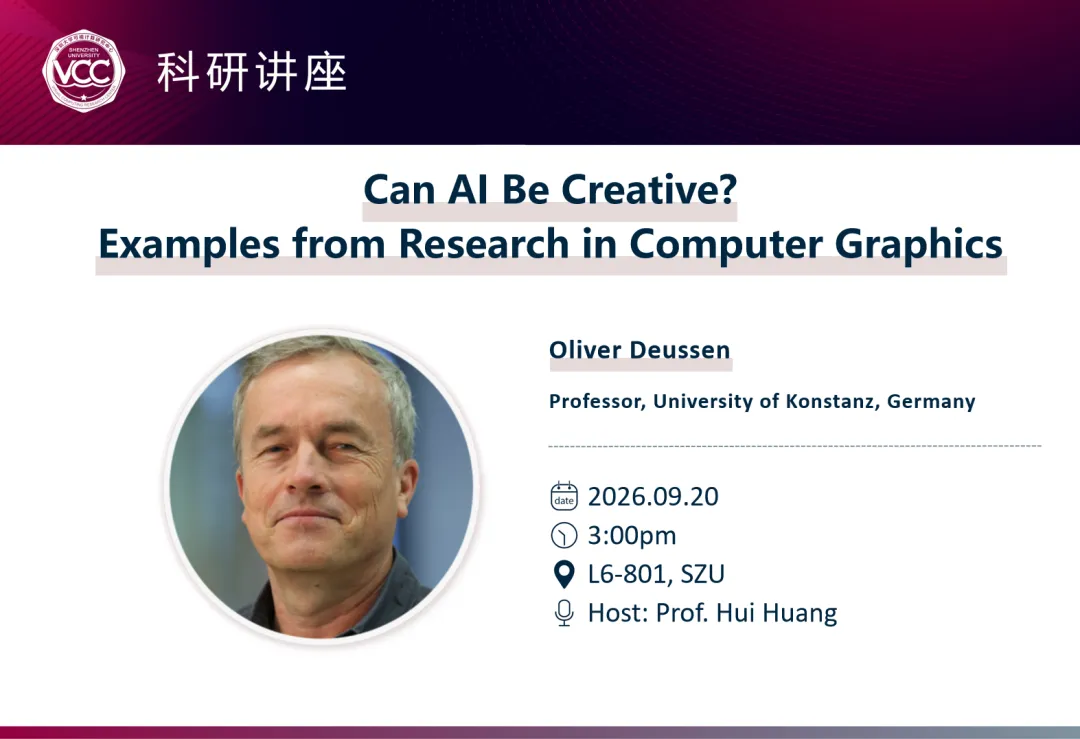
报告人:Prof. Oliver Deussen
地点:深圳大学致真楼801
Abstract
Recent advances in GenAI have revived an old question: can machines be creative, or do they merely reproduce and recombine what humans have created before? Computer graphics provides an interesting experimental ground for studying this question, since computational systems can now participate in several stages of the artistic process from perception and abstraction to conceptualization and physical production. I will examine machine creativity through examples from our research. Our painting machines initially translated digital images into physical paintings through computationally generated brush strokes and visual feedback. More recent approaches use semantic information and visual saliency to decide what should be preserved, simplified, or emphasized when an image is transformed into a robotic painting. This already raises a fundamental question: when does algorithmic optimization become an aesthetic decision? I will then discuss recent work, which moves from visual appearance toward conceptual creativity. Rather than simply transferring style or image content, our system extracts the abstract structure underlying a visual metaphor and transfers this structure to a new semantic domain using multiple cooperating AI agents. These examples illustrate a progression from machines that execute artistic decisions, to systems that make aesthetic decisions, and finally to systems that attempt to construct new visual concepts.
Bio
Prof. Deussen graduated at Karlsruhe Institute of Technology and is professor for Visual Computing at University of Konstanz (Germany). He is one of the speakers of the Excellence Cluster "Centre for the Advanced Study of Collective Behavior" and from 2015 to 2021 he was vice speaker of the SFB Transregio "Quantitative Methods for Visual Computing", a large research project conducted together with University of Stuttgart. From 2019-2020 he was President of the Eurographics Association, from 2012 to 2015 he served as Co-Editor in Chief of Computer Graphics Forum. In 2026 he won the Eurographics Gold medal. From 2010-2020 he was visiting professor at the Shenzhen Institute of Applied Technology (Chinese Academy of Science), he was awarded the 1000 talents plan and the Guandgong talents plan. His areas of interest are modeling and rendering of complex biological systems, non-photorealistic rendering as well as Information Visualization. He also contributed papers to geometry processing, sampling methods, and image-based modelling.

