ARTICLE · 1058809
混模板 PCR 中压低异源双链比的两条“杠杆”
1
背景:混模板 PCR 里的"幽灵双链"
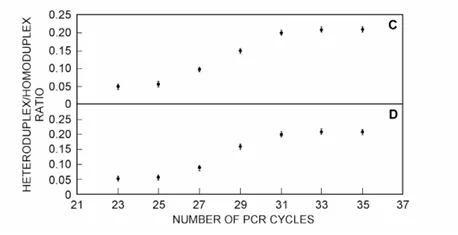
The ratio of heteroduplexes to homoduplexes increases rapidly in the later PCR cycles. The most rapid increase is between the cycles 26 - 31.
As Thompson et al. (2002) hypothesized, heteroduplex formation could be caused by a low concentration of primers in the later PCR cycles.
它的危害是实质性的:克隆进 E. coli 后,宿主 MutHLS 错配修复会把异源双链"修"成嵌合序列;Thompson 等建模显示,假序列数随差异位点数与原始变种数指数级爆炸;在 DGGE / CDCE 上异源双链因构象差异被误判成"新变种";直接测序则峰图混乱、碱基读错。(参考2)
2
核心发现:两个降异源双链比的杠杆
Thompson等(2002)提出,将扩增产物稀释10倍,随后进行三个循环的再扩增(“复原条件PCR”,reconditioning PCR)可以有效地从模板扩增中去除异源双链。
Thompson et al. (2002) proposed that a 10-fold dilution of the amplification product, followed by a three cycle re-amplification (“reconditioning”) could effectively remove heteroduplexes from template amplifications.
而在本文献中给出了两种方法:
2.1、补加 Taq 聚合酶
研究者尝试通过在第27个循环后添加2 U的Taq DNA聚合酶或2 U的Taq DNA聚合酶加8 pmol的每种引物(加入已含有Taq DNA聚合酶和8 pmol每种引物的标准PCR混合物中)来减少异源双链DNA的量,PCR在第28、29和30个循环后终止,通过Sau96I限制性消化检测异源双链DNA。
其观察到在添加Taq聚合酶后的第二个循环(第30个循环)异源双链与同源双链比率下降了30%。添加Taq聚合酶在两种情况下都增加了同源双链分子的绝对数量,因此降低了异源双链与同源双链的比率。
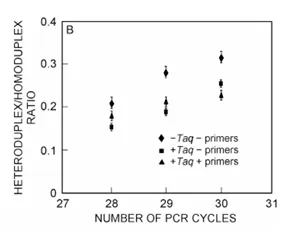
异源双链与同源双链比率的分析清楚地表明,与未添加额外Taq聚合酶的实验相比,添加Taq聚合酶降低了异源双链与同源双链的比率。
2.2、 减少 PCR 循环数
研究者观察到在少数PCR循环后异源双链与同源双链的比率较低,因此当PCR产物量不是很高时,复原条件PCR可能是消除异源双链形成的合适方法。
We have observed that the heteroduplex to homoduplex ratio is low after a few PCR cycles and that the ratio rapidly increases in the later PCR cycles.
Therefore, reconditioning PCR may be a suitable method to eliminate heteroduplex formation when the quantity of PCR products is not very high.
总之:发现表明异源双链的形成最可能取决于Taq聚合酶分子与PCR产物的比率。异源双链与同源双链的比率可以通过添加Taq聚合酶和减少PCR循环数来降低。然而,这种解决方案限制了PCR产量,因此通常不太有吸引力,但它避免了异源双链分子的形成。
Appropriate combination of both (a higher number of PCR cycles + the addition of Taq polymerase in the later PCR cycles) can be a method generally applicable to avoid, or at least decrease the formation of heteroduplexes.
1:Michu E, Mráčková M, Vyskot B, Žlůvová J. Reduction of heteroduplex formation in PCR amplification. Biologia Plantarum. 2010;54(1):173-176. DOI: 10.1007/s10535-010-0029-8;
2:Thompson JR, Marcelino LA, Polz MF. Heteroduplexes in mixed-template amplifications: formation, consequence and elimination by 'reconditioning PCR'. Nucleic Acids Research. 2002;30(9):e43. PMID: 11972349;
END