ARTICLE · 1318077
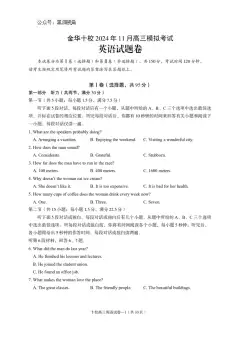
金华十校11月英语试题+听力(附领取)
知不知英语 · ENGLISH TEACHING & LEARNING|金华十校2026年11月高三模拟考试英语试题完整文字版(满分150分,120分钟)。为方便老师打印组卷与考后讲评,本文提供试题全文;试卷DOCX、听力音频、参考答案、全卷解析(备课版)与应用文评分细则已打包,公众号后台回复「金华十校」即可领取。
卷首
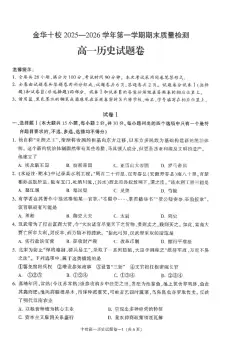
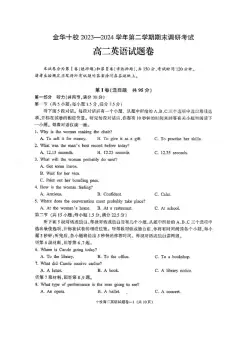
金华十校2026年11月高三模拟考试 英语试题卷 2026年11月 注意事项:
1.答卷前,考生务必将自己的姓名、准考证号填写在答题卡上。
2.回答选择题时,选出每小题答案后,用铅笔把答题卡上对应题目的答案标号涂黑。如需改动,用橡皮擦干净后,再选涂其他答案标号。回答非选择题时,将答案写在答题卡上,写在本试卷上无效。
3.考试结束后,将本试卷和答题卡一并交回。
第一部分 听力(共两节,满分30分)
第一部分 听力(共两节,满分30分) 做题时,先将答案标在试卷上,录音内容结束后,你将有两分钟的时间将试卷上的答案转涂到答题卡上。 第一节(共5小题:每小题1.5分,满分7.5分)
听下面5段录音。每段录音后有一个小题,从题中所给的A、B、C三个选项中选出最佳选项。听完每段录音后,你都有10秒钟的时间来回答有关小题和阅读下一小题。每段录音播放两遍。
1. What does the man want to do?
A. Play football. B. Watch sports on TV.
C. Use the running machine.
2. What animal is the man afraid of?
A. Mice. B. Snakes. C. Rabbits.
3. What will the man probably do next?
A. Read books about ball game skills.
B. Teach the woman to play a ball game.
C. Learn strategies of playing table tennis.
4. What does the woman probably do?
A. A singer. B. A doctor. C. A teacher.
5. What is the man probably doing?
A. Testing a camera. B. Taking photographs.
C. Trying on new clothes.
第二节(共15小题:每小题1.5分,满分22.5分)
听下面5段录音。每段录音后有几个小题,从题中所给的A、B、C三个选项中选出最佳选项。听每段录音前,你将有时间阅读各个小题,每小题5秒钟;听完后,每小题都有5秒钟的作答时间。每段录音播放两遍。
听第6段录音,回答第6、7题。
6. What is the woman doing now?
A. Getting dressed. B. Organizing a party. C. Watching online videos.
7. What is the man’s attitude towards make-up?
A. Casual. B. Unfavorable. C. Understanding.
听第7段录音,回答第8至10题。
8. How does the woman feel at first?
A. Anxious. B. Refreshed. C. Confused.
9. What is the woman preparing for?
A. A debate competition. B. A graduation speech. C. A school play.
10. What does the man suggest the woman do?
A. Take deep breaths. B. Work hard on her study. C. Bring her notes with her.
听第8段录音,回答第11至13题。 11. What does the woman admire most about the man?
A. His courage. B. His generosity. C. His confidence.
12. Why does the man decide to jump?
A. To challenge himself. B. To get on a radio show. C. To help earthquake victims.
13. What’s the date today?
A. June 2nd. B. June 23rd. C. July 14th.
听第9段录音,回答第14至17题。 14. Why is the woman visiting the area?
A. To learn skiing. B. To take a holiday. C. To see the man’s hometown.
15. Where are the speakers?
A. At a ski resort. B. In a forest house. C. On a mountain top.
16. Which season does the man think is the best there?
A. Spring. B. Summer. C. Winter.
17. What will the speakers probably do tomorrow?
A. Help with farm work. B. Play snow sports. C. Go hiking.
听第10段材料,回答第18至20题。 18. What is the talk mainly about?
A. How nature inspires technology.
B. How technology affects daily life.
C. How technology can save the planet.
19. Which invention was inspired by sea creatures?
A. Energy-efficient drones. B. High-speed Japanese trains. C. Underwater sound wave technology.
20. Who is the speaker?
A. An inventor. B. An engineer. C. A student.
第二部分 阅读理解(共两节,满分50分)
第二部分 阅读理解(共两节,满分50分) 第一节(共15小题:每小题2.5分,满分37.5分) 阅读下列短文,从每题所给的A、B、C和D四个选项中,选出最佳答案。 A Repair Café What is a Repair Café?
Repair Cafés are free meeting places and they’re all about repairing things (together). Visitors bring their broken items from home. There, they’ll find tools and materials to help make any repairs they need. On clothes, furniture, electrical appliances, bicycles, toys etc. They’ll also find expert volunteers, with repair skills in all kinds of fields. Together with the specialists they start making their repairs. It’s an ongoing learning process.
Why a Repair Café?
We throw away vast amounts of stuff, even things with almost nothing wrong, and which could get a second life after a simple repair. The trouble is, lots of people have forgotten that they can repair things themselves. Especially younger generations no longer know how to do that. This is a threat to a lasting future and to the circular economy, in which raw materials can be reused again and again.
That’s why there’s a Repair Café! People with repair skills get the appreciation they deserve. Invaluable practical skills are passed on. Things are being used for longer and don’t have to be thrown away. This reduces the volume of raw materials and energy needed to make new products.
Join the Repair Café!
● All Repair Cafés need handy volunteers to act as repair experts, especially those handy with clothing, electrical appliances, bicycles and furniture.
● Repair Cafés often have room for volunteers who can act as host or hostess. In this role, you provide everyone with coffee and tea and you help new visitors at the reception table.
● There is frequently demand for people skilled at computers. You keep the website of your Repair Café up to date and feature your initiative on Instagram, Facebook and Twitter.
21. What can visitors do in a Repair Café?
A. Get free second-hand items.
B. Buy repair tools and materials.
C. Repair things with expert help.
D. Exchange broken items for new ones.
22. What is the aim of a Repair Café?
A. To preserve valuable items.
B. To promote the repair profession.
C. To pass down traditional customs.
D. To contribute to a sustainable future.
23. Which of the following is a suitable volunteer in the Repair Café?
A. Tom, who is an online sales promoter.
B. Jack, who likes making tea and coffee.
C. Lily, who is an experienced receptionist.
D. Amy, who longs to pick up repair skills.
B
When Robert Taylor got the idea to liquify hand soap(肥皂), he knew he had found a big idea — and so did everyone else.
In the late 70’s and early 80’s, Taylor’s small company, The Minnetonka Corporation, had developed a small reputation for coming up with innovative ideas like fruit-scented shampoo, scented candles, and bubble baths. Others saw these ideas as winners also, and the ideas were quickly copied by larger competitors like Procter & Gamble. Soon after the liquid soap, Softsoap, hit store shelves, it became the bestselling soap on the market. And while many people might enjoy this kind of success, Taylor knew all it meant was that his competitors were now breathing down his neck.
Instead of competing with the “big dogs” head-to-head, Taylor stuck to what he was good at and looked for a more innovative solution. He went to the company that manufactured(制造) the plastic pumps used in his product and placed an order for 100 million units.
One of the benefits of being first to market is that Taylor knew what kind of manufacturing options were available for the product. At the time, there was only one company who could make plastic pumps that could sustain mass-market production. By purchasing such a substantial amount of plastic pumps, he prevented them from supplying his competitors. While it didn’t eliminate the competition, it gave him exclusive control of the liquid soap market for an entire year.
Robert Taylor’s bold move bought something money usually can’t: time. For a full year, while competitors struggled to find another manufacturer or make their own pumps, Softsoap sat alone on store shelves. By the time the big players finally caught up, the brand had already sunk its roots deep into the market. Taylor never tried to outspend Procter & Gamble; he simply outthought them. And when Colgate-Palmolive came knocking in 1987 with a $61-million offer, he walked away with a fortune — proof that in business, the smartest move isn’t always the loudest one, but the one that quietly shuts the door behind you.
24. What was The Minnetonka Corporation known for?
A. Launching creative products.
B. Adopting flexible sales strategies.
C. Cooperating with large companies.
D. Conducting targeted market research.
25. What was Taylor worried about after Softsoap reached the market?
A. It would make little profit.
B. It would be in short supply.
C. It would be badly received.
D. It would face fierce competition.
26. Why did Taylor order 100 million units of plastic pumps?
A. To secure a lower price.
B. To mass-produce liquid soap.
C. To block access to the pumps.
D. To start a manufacturing company.
27. What can be a suitable title for the text?
A. Rising from Nothing
B. Outsmarting the Giants
C. Liquid Soap Making a Hit
D. Small Business Doing Well
C
Two years ago, “fix what the AI got wrong” wasn’t a service anyone advertised. Today, this kind of work is listed as a separate job on freelance(自由职业) platforms. For independent designers, writers, and editors, AI cleanup work — fixing and improving low-quality Al-generated content — has become a new source of income.
Graphic(图形的) design accounts for more of the Freelancer.com postings than any other category, with video editing, proofreading, and content writing rounding out the top four. According to Freelancer.com chief executive Matt Barrie, the typical client behind this demand is a small business owner who used an AI tool to produce a fast first draft and then discovered they couldn’t turn it into something usable on their own. Whatever time the AI draft saved gets spent right back on fixing it.
That dynamic creates a mismatch in how clients expect the fix to be priced. A Florida-based illustrator, Todd Van Linda, was offered roughly $500 to correct thirteen to fifteen AI-generated illustrations for a children’s book. The client had worked out this price assuming each picture would only take around 15 minutes to fix. But too often, AI-generated illustrations turn out to be much more time-consuming than expected. So Van Linda turned down the project; his minimum rate is $65 per hour and won’t negotiate below it.
Opinions differ on how long this new type of work sticks around. Kym Dunbar, an Australian writer and editor, expects most of this corrective work to taper off over the next five to ten years as the underlying AI models get better. A graphic designer based in Spain, however, predicts that AI will be able to match her logo and packaging work within a year or two.
Yet there is another related trend worth noticing. Van Linda stepped away from AI cleanup jobs late last year, and since then, clients who were dissatisfied with AI-generated results have come back to hire him for original, hand-drawn work instead.
28. What phenomenon does the author point out in paragraph 1?
A. AI services are becoming unreliable.
B. There is a big increase in freelance income.
C. There is a growing demand for freelance jobs.
D. AI cleanup work is emerging as a new service.
29. According to paragraph 3, there is a mismatch between .
A. the AI cleanup rates and the original work rates
B. the time AI drafts save and the time to fix them
C. the pay clients offer and the pay freelancers charge
D. the quality of AI drafts and the quality clients expect
30. What does the underlined phrase “taper off” in paragraph 4 mean?
A. fade away. B. Catch on. C. Take shape. D. Pay off.
31. What does the author imply in the last paragraph?
A. Clients become harder to satisfy.
B. AI-generated content is of little value.
C. AI cleanup jobs are here to stay.
D. Original work is winning clients back.
D
Think about the last time you instantly liked someone because they reminded you of a friend, or felt oddly tense around a stranger who seemed “different.” That premature judgment probably felt personal and specific, but psychology suggests something bigger is happening: your brain is quietly sorting the world into people who are with you, and people who are not. It is fast, and you do not even notice it happening.
This “minimal group” effect is not a modern glitch(缺陷). It is an ancient mental shortcut built into how human groups survived. Imagine living tens of thousands of years ago in a small band of hunter-gatherers. Your survival depends on the people around you: the ones who share resources, warn you of danger, and defend you when things go bad. In that world, quickly recognizing who is “one of us” could literally mean the difference between life and death. Trusting the ingroup and being cautious of outsiders was, in many contexts, a survival strategy, not a moral failing.
One of the most striking findings in social psychology is how little it takes to set off “us versus them” behavior. In classic lab experiments, people are randomly split into groups — based on something as meaningless as preference for a painting — and then asked to assign rewards. Over and over, participants favor their own group, even when it costs them the chance to maximize total benefit for everyone.
The “minimal group” effect shows that group loyalty switches on with almost no substance behind it. You do not need deep history or real conflict; your brain just needs a label. That is a bit terrifying, because it means biases can form around almost anything: sports teams, fandoms, brands, even whether you prefer cats or dogs.
But it is also hopeful: the lines between “us” and “them” are not carved in stone; they are changeable. One practical strategy is to intentionally expose yourself to stories and voices from outside your usual circles. Another concrete move is to work with someone from a “them” group on a project. Over time, your idea of “us” will grow into something much larger than the version you started with.
32. What do we know about the judgment mentioned in paragraph 1?
A. It occurs randomly.
B. It happens automatically.
C. It is specific to certain people.
D. It is based on careful reasoning.
33. What does paragraph 2 mainly talk about?
A. The origin of the “minimal group” effect.
B. The survival challenges of hunter-gatherers.
C. The ancient methods of recognizing insiders.
D. The drawbacks of the “minimal group” effect.
34. According to classic lab experiments, what is the key to group loyalty?
A. Common goals.
B. Similar preferences.
C. The act of grouping.
D. The sharing of rewards.
35. What does the author suggest readers do in the last paragraph?
A. Expand their circle of “us”.
B. Distinguish “us” from “them”.
C. Identify hidden biases in groups.
D. Make their stories and voices heard.
第二节(共5小题;每小题2.5分,满分12.5分) 阅读下面短文,从短文后的选项中选出能填入空白处的最佳选项。选项中有两项为多余选项。
Can you exercise your brain the way you exercise your body? ___36___ We solve crossword puzzles, download brain-training apps, and take up new hobbies in the hope of preserving our memory and thinking skills. Increasingly, researchers are pointing to another activity that challenges the brain in a particularly powerful way: learning a new language.
Unlike many activities that exercise a single mental skill, language learning engages almost every major cognitive(认知的) system at once. It calls on memory, attention, problem-solving, pattern recognition, and mental flexibility. ___37___
One reason scientists are fascinated by bilingualism(双语能力) is its relationship with cognitive reserve, which is the brain’s ability to cope with age-related changes while continuing to function effectively. ___38___ If one road is blocked, a well-connected network offers plenty of other ways to reach the destination. Likewise, a brain with greater cognitive reserve may be better able to counteract damage. Studies have found that bilinguals may experience the symptoms of dementia(老年痴呆) several years later than their monolingual(单语的) peers.
The encouraging news is that these benefits are not limited to people who learned two languages in childhood. ___39___ They form new neural pathways as they master unfamiliar sounds, grammar, and vocabulary. With repeated use, those pathways become more efficient, allowing the brain to process information with increasing ease.
___40___ Genetics, education, physical activity, sleep and diet all play important roles. But learning another language stands out because it challenges the mind, rewards curiosity, fosters human connection, and may even help build a brain that’s better prepared for the years ahead.
A. Adults enjoy the potential as well.
B. The answer is not straight-forward.
C. No single activity can promise a healthy brain forever.
D. Few everyday activities ask quite so much of the brain.
E. As we age, many of us look for ways to stay mentally sharp.
F. Think of cognitive reserve as alternative routes through a busy city.
G. The benefits of learning language can transfer beyond language itself.
第三部分 语言知识运用(共两节,满分30分)
第三部分 语言知识运用(共两节,满分30分) 第一节(共15小题;每小题1分,满分15分) 阅读下面短文,从短文后各题所给的A、B、C和D四个选项中,选出可以填入空白处的最佳选项。
Most parents wait years before handing their kids kitchen duties. Deanna Knight ___41___ her son Russ was ready by his first birthday.
Knight and her son became popular online when she started filming the little child helping her in the kitchen. “We began with really simple things like ___42___ vegetables and fruits,” she said in an interview. “As he’s gotten older, we’ve slowly given him more ___43___.” Knight noted that her son ___44___ being involved. “He gets so excited when he gets to help and is always eager to ___45___.” she said.
The mother believes that involving children in kitchen tasks gives them a chance to develop ___46___ skills, such as basic cooking methods, while also building confidence and independence. “But beyond that, it gives us meaningful time together and allows him to ___47___ our family,” said Knight.
Still, she ___48___ that the process takes longer and gets ___49___ than if she did it herself. “It can be tempting(诱人的) to just do something yourself because it’s faster, but the extra ___50___ is worth it,” she shared.
Knight regularly ___51___ Russ’ progress on her social media account, hoping to ___52___ other parents not to wait until their children are “old enough”. “You don’t need a complicated recipe. Give them one ___53___ job and gradually build from there,” Knight said. “And ___54___ a little mess! After all, the goal isn’t ___55___ — it’s giving them the opportunity to practice.”
41. A. insisted B. pretended
C. decided D. hoped
42. A. cooking B. eating
C. washing D. growing
43. A. responsibility B. praise
C. advice D. inspiration
44. A. suggested B. loved
C. imagined D. missed
45. A. share B. change
C. play D. participate
46. A. business B. survival
C. communication D. management
47. A. contribute to B. stand for
C. count on D. talk about
48. A. admits B. fears
C. regrets D. remembers
49. A. funnier B. messier
C. simpler D. safer
50. A. expense B. service
C. time D. demand
51. A. assesses B. checks
C. observes D. documents
52. A. warn B. beg
C. require D. encourage
53. A. interesting B. manageable
C. meaningful D. specific
54. A. expect B. avoid
C. create D. leave
55. A. recognition B. innovation
C. perfection D. competition
第二节(共10小题;每小题1.5分,满分15分) 阅读下面短文,在空白处填入1个适当的单词或括号内单词的正确形式。
Fang Shanfei never thought his village, Gaotiankeng, was special, ___56___ did he understand technical terms like the Bortle scale. But things changed when strangers arrived in 2017, eager to stare at the stars he had seen all his life.
In the largely mountainous province, Zhejiang, farmers in remote areas rely mainly on selling homegrown produce and rural specialties, ___57___ bring them limited incomes. Fang’s village, however, possesses something rare: ___58___ sky dotted with stars. Gaotiankeng is one of the few ___59___ (remain) places in eastern China free of light pollution. ___60___ (professional) classify it as a Class 2 dark-sky zone.
In 2024, it was ___61___ (official) added to the world list of dark sky protected areas. A year later, the Beijing Planetarium(天文馆) set up a permanent astronomical observation site there, the first in the Yangtze River Delta(三角洲) ___62___ (join) the top institution’s official observation system. The Hangzhou Astronomical Society has also set up a monitoring station there. On the mountaintop, an astronomy museum, equipped with professional instruments and a dome theater, ___63___ (stand) alongside a stargazing camping base.
Actually, before dark-sky tourism took off, Gaotiankeng was almost an empty village. Young people migrated to cities ___64___ more opportunities, leaving much of the farmland ___65___ (abandon). Today, villagers are returning and farmland is reclaimed. Five villager-operated homestays(民宿) are in business, each generating an annual income of more than 100,000 yuan.
第四部分 写作(共两节,满分40分)
第四部分 写作(共两节,满分40分) 第一节(满分15分)
假定你是李华,你校英文报正在征集毕业季专刊的栏目主题,旨在记录高中三年的故事和感悟。目前已确定的栏目有“Fun Moments”。请给编辑部写一封信,再推荐一个栏目并说明理由。
注意: 写作词数应为80左右。 请按如下格式在答题纸的相应位置作答。 Dear Editor,
I’m glad to hear that you’re collecting column themes for the upcoming graduation special issue.
Yours, Li Hua 第二节(满分25分) 阅读下面材料,根据其内容和所给段落开头语续写两段,使之构成一篇完整的短文。
This year’s state fair finally came to an end, and to Molly’s greatest delight, her family’s homemade apple sauce claimed the first prize. Staring at the shining medal in her hand, Molly couldn’t help recalling the special Apple Day.
Molly woke up early that day. A cool breeze blew down from the mountains and chilled her feet. Downstairs, Dad dragged the big blackened pot out of the basement, and then handed Molly a basket. “Pick enough so we can share our sauce this year!” Mom called from the door.
The apple orchard(果园) was a short walk away. Apples hung on branches, gleaming in the sun. Dad always said their sauce was “almost the best.” Almost. And every year, it was the same kind of apple, the same recipe, the same second place. There was just something missing from their sauce, Molly thought as she picked. If only they could figure out what it was, they might win the first place this year.
CRASH! Molly fell to the ground. It was Sam, her messy little cousin who lived next door. He had run into her and knocked her over. “Molly, I came to pick apples, too!” He waved a dirty old bag above his head.
Molly shouted at Sam to pick apples from an ancient tree, whose tiny apples were too sour to eat. Molly sighed. She hoped Sam would stay out of the way. But Sam did not care. He stuffed his bag full of apples anyway.
Back home, Dad got the apple sauce mill(碾磨机) ready, which was used to turn cooked apples into smooth sauce while Molly washed the apples, which were then poured into the big pot on the stove(炉子). Mom stood by the stove, ready to stir the pot. Suddenly, Sam shook his bag of tiny sour apples into the boiling pot, too.
注意: 续写词数应为150左右。 请按如下格式在答题卡的相应位置作答。
Paragraph 1: “No!” Molly screamed, her heart sinking as the sour apples mixed with the sweet ones.
Paragraph 2: Dad held a spoon of the freshly-made apple sauce to Molly’s lips.
知不知英语 · ENGLISH TEACHING & LEARNING|资料仅供教学交流使用