ARTICLE · 1401496
2025 年英语一· Text 1 真题精讲
发布时间:2026-11-23 08:24:08 最近访问:2026-11-23 08:24:09
2025 年英语一· Text 1 真题精讲
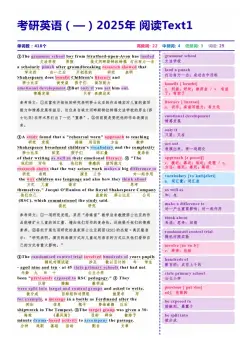
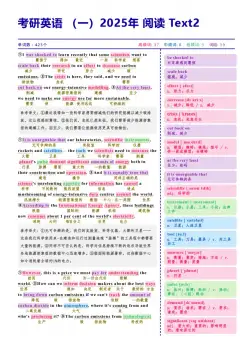
莎士比亚进课堂:戏剧化教学如何提升儿童的语言与情感素养全文翻译 · 长难句拆解 · 逐段词汇 · 做题全流程The grammar school boy from Stratford-upon-Avon has landed a scholarly punch after groundbreaking research showedthat Shakespeare does benefit children's literacy and emotional development. But only if you act him out.| 主句 | The grammar school boy ... has landed a scholarly punch(主+谓+宾)。land a punch 字面"打出一拳",这里比喻"有力的一击"。 |
| 状语从句 | after groundbreaking research showed ... |
| 宾语从句 | that Shakespeare does benefit children's literacy and emotional development — 作 showed 的宾语;does 是助动词,用于强调谓语动词。 |
| 省略句 | But only if you act him out. = 但(这一效果)只有在你把他"演出来"时才成立。承前省略了主句。 |
这位来自埃文河畔斯特拉特福的文法学校男生,在开创性研究表明莎士比亚确实有益于儿童的读写能力和情感发展之后,打出了一记"学术重拳"。但前提是——你得把他演出来。 | |
| |
| |
| scholarly / groundbreaking | |
| |
| |
A study foundthat a "rehearsal room" approach to teaching Shakespeare broadened children's vocabulary and the complexity of their writing as well as their emotional literacy. "The research showsthat the way actors workmakes a big difference to the way children use language and also how they think about themselves," Jacqui O'Hanlon of the Royal Shakespeare Company (RSC), whichcommissioned the study, said.| 句①宾语从句 | that ... a "rehearsal room" approach ... broadened A and B as well as C — 三个并列宾语:vocabulary/complexity/emotional literacy。 |
| 句②主干 | 引号内主句为 The research shows + 宾语从句;主句谓语 said 因引号前置而后置,形成 "..., ... said" 结构。 |
| 省略型定从 | the way (that/in which) actors work、the way (that/in which) children use language — 两个定语从句均省略了关系词。 |
| 并列宾从 | and also how they think about themselves — 与 that 从句并列,共同作 shows 的宾语。 |
| 非限定定从 | whichcommissioned the study — 补充修饰 Royal Shakespeare Company (RSC)。 |
一项研究发现,采用"排练室"方式教授莎士比亚,能够扩大儿童的词汇量、提升其写作的复杂程度,同时提高他们的情感素养。委托这项研究的皇家莎士比亚剧团(RSC)成员 Jacqui O'Hanlon 说:"研究表明,演员的工作方式会极大影响儿童使用语言的方式,也会影响他们如何看待自己。" | |
| |
| |
| |
| |
| commission / the way (that) | |
The randomised control trial involved hundreds of year 5 pupils—aged nine and ten—at 45 state primary schools thathad not been exposed to RSC pedagogy. They were split into target and control groups and were asked to write, for example, a message in a bottle as Ferdinand after the shipwreck in The Tempest. The target group was given a 30-minute drama-based activity to accompany the passage.| 主句 | The randomised control trial involved hundreds of year 5 pupils at 45 state primary schools;破折号中间 aged nine and ten 为插入成分,补充说明年龄。 |
| 定语从句 | thathad not been exposed to RSC pedagogy — 修饰 schools,说明这些学校此前未接触过 RSC 教学法(过去完成时的被动语态)。 |
| 并列谓语 | They were split ... and were asked to write ...(两个并列被动谓语)。 |
这项随机对照试验涉及 45 所公立小学的数百名五年级学生(年龄九到十岁),这些学校此前均未接触过皇家莎士比亚剧团的教学法。学生被分为目标组与对照组,并被要求以《暴风雨》中船只失事后费迪南德的身份写一封"瓶中信"。目标组还额外获得一项 30 分钟的戏剧活动来配合这段文字。 | |
| involve / state primary school | |
| |
| |
| target group / control group | |
| |
The peer-reviewed results showedthat the target group of pupils drew on a wider vocabulary, used words "classed as more sophisticated or rarer", and wrote at greater length. They also "appear to be more comfortable writing in role … while[control] pupils imaginehow they themselves would react to being shipwrecked, [target] children put themselves in the shoes of a literary character and express that character's emotion".| 句①三并列谓语 | 宾语从句中 drew on / used / wrote 为三个并列谓语,共同说明实验组表现。classed as ... 为过去分词短语作后置定语修饰 words。 |
| 句②对比结构 | while[control] pupils imagine ..., [target] children put ... — while 表"然而",对比两组差异,是本题核心信息。 |
| 嵌套宾从 | how they themselves would react to being shipwrecked — 作 imagine 的宾语;being shipwrecked 为动名词被动式作介词 to 的宾语。 |
经同行评议的结果显示,目标组学生运用了更广泛的词汇,使用了被"归类为更复杂或更罕见"的词语,且写作篇幅更长。他们还"在角色写作中显得更自在……对照组学生想象自己遭遇海难会作何反应,而目标组学生则设身处地站在文学角色的立场上,表达该角色的情感"。 | |
| |
| |
| |
| |
| put oneself in the shoes of | |
The Time to Act study also foundthatwhilecontrol pupils relied on "desert island clichés" such as palm trees, target pupils were "more expansive [giving] a broader picture of the sky, the sea and the atmospheric conditions".| 宾语从句 | that + 主谓结构 |
| 状语从句 | while control pupils relied on "desert island clichés" — while 引导让步/对比状语从句,形成"对照组 vs 目标组"的鲜明反差,是第 23 题的直接依据。 |
| 补充成分 | [giving] a broader picture of ... 为现在分词短语作伴随说明,解释 more expansive 的具体表现。 |
"行动时刻"(Time to Act)研究还发现,尽管对照组学生依赖"荒岛老套写法",比如棕榈树,但目标组学生则"描写更加铺展,对天空、海洋和大气状况呈现出更开阔的画面"。O'Hanlon said she had been most surprised by the "emotional literacy thatwas evident in the [target] children's writing" and that they were "more resilient in their writing, more hopeful". Sheadded: "The emotional understandingwasvery evident and itisprobably related to the [rehearsal room process]where you are used to trying to imagine your way through. Theywerecomfortable in describing different emotional states and part of what you do in dramaisput yourself in different shoes." The studyshowedthe importance of embedding arts in education, shesaid.| 双宾语从句 | she had been most surprised ... and that they were ... — said 后接两个并列的宾语从句,第一个省略了 that,第二个保留 that。 |
| 定语从句① | thatwas evident in ... |
| 定语从句② | where you are used to trying to imagine your way through — where 引导定从修饰 the rehearsal room process(抽象地点名词)。 |
| 主语从句 | part of what you do in dramais put yourself in different shoes — what 引导名词性从句作 of 的宾语;不定式 put ... 作表语(省略 to,因主语含实义动词 do)。 |
O'Hanlon 说,最令她意外的是"目标组儿童写作中显露出的情感素养",以及他们"在写作中更有韧性、更满怀希望"。她补充道:"情感理解非常明显,这很可能与排练室过程有关——在那里,你习惯于试着靠想象把事情推进下去。他们能够自如地描述不同的情绪状态,而戏剧中你要做的一部分事情,就是换位思考。"她说,这项研究显示了把艺术融入教育的重要性。 | |
| |
| 习惯于做某事(区别 used to do 过去常常) |
| |
| |
| |
But could the results be replicated with any old dramatist? O'Hanlon said more research would be needed but suggestedthat Shakespeare's use of 20,000 words, compared with the everyday 2,000 words, gave a "massive expansion of language into children's lives", whichwas combined with children "using their whole bodies to bring words to life".| 设问句 | But could the results be replicated with any old dramatist? — 情态动词 + 被动语态,提出"能否推广到其他剧作家"的疑问,为推断题设题点。 |
| 并列谓语 | O'Hanlon said ... but suggested ...;compared with the everyday 2,000 words 为过去分词短语作插入语,修饰 20,000 words。 |
| 非限定定从 | whichwas combined with children "using their whole bodies ..." — which 指代前面整句内容,补充说明"语言扩展"还与全身表演相结合。 |
但这些结果能否在任何一位老牌剧作家身上复制呢?O'Hanlon 表示还需要更多研究,但她认为:与日常使用的 2000 个词相比,莎士比亚所用的 2 万个词,为儿童的生活带来了"语言上的大规模扩展";这一点又与儿童"调动整个身体让文字鲜活起来"结合在一起。第二部分 阅读做题精讲(定位词 → 定位句 → 精读定位句 → 匹配选项)解题四步法① 找定位词:抓题干中的专有名词、数字、核心名词/形容词,回原文锁定段落。② 找定位句:在锁定段落中找到与定位词直接对应、意思最贴近的一句话(或几句)。③ 精读定位句:分析句子主干与转折点(while / but / 比较级),提炼出"作者真正想说的"。④ 匹配选项:与原文同义改写一致者入选;含无中生有、偷换概念、反向表述者排除。21. The "rehearsal room" approach requires pupils to ________.| ① 定位词 | 专有概念 "rehearsal room" approach;返回第 2 段。 |
| ② 定位句 | 第 2 段:a "rehearsal room" approach to teaching Shakespeare broadened ...;第 3 段:The target group was given a 30-minute drama-based activity to accompany the passage;第 1 段末:only if you act him out。 |
| ③ 精读定位句 | 三处信息共同指向:这一方法的核心是"像演员一样进入角色",即 act him out = drama-based = put themselves in the shoes of a literary character。学生在活动中"扮演"莎士比亚笔下的人物。 |
| ④ 匹配选项 | [C] play the roles in Shakespeare ✔[A] rewrite the lines:原文写的是"瓶中信",并非改写台词,偷换概念。[B] watch RSC actors' performances:只提 RSC 委托研究,未说看演出,无中生有。[D] study drama under RSC artists:未说师从 RSC 艺术家,无中生有。 |
22. The study divided the pupils into two groups to find whether ________.| ① 定位词 | divided ... into two groups |
| ② 定位句 | 第 3 段:The randomised control trial ... They were split into target and control groups ...;第 2 段:the way actors work makes a big difference to the way children use language。 |
| ③ 精读定位句 | 随机对照试验(RCT)的唯一目的:实验组多接受 30 分钟戏剧活动(教学方式的改变),对照组没有,然后比较写作结果。因此验证的是"教学干预能否改善学习成果"。 |
| ④ 匹配选项 | [A] the change in instruction enhances learning outcomes ✔(instruction=教学方式;learning outcomes=词汇、写作、情感素养的提升)[B] reading fluency:全文谈 writing 与 vocabulary,未测阅读流利度。[C] emotion affects understanding:因果倒置,文中是戏剧教学影响情感表达。[D] stimulates interest in the arts:未测"对艺术的兴趣"。 |
23. Control pupils' reliance on "desert island clichés" shows their ________.| ① 定位词 | 引号内容 "desert island clichés";返回第 5 段。 |
| ② 定位句 | 第 5 段:while control pupils relied on "desert island clichés" such as palm trees, target pupils were "more expansive [giving] a broader picture of the sky, the sea and the atmospheric conditions". |
| ③ 精读定位句 | while 构成对比:对照组只会套用"棕榈树"式套路化表达,实验组却能展开描写天空、海洋、大气状况。cliché(陈词滥调)+more expansive / broader(更铺展、更开阔)→ 对照组在描写上单薄、缺乏变化。 |
| ④ 匹配选项 | [A] weakness in description ✔[B] omission of small details:对照组不是漏掉细节,而是仅有套路,偏离重点。[C] casual style of writing:cliché 指"陈旧套路",不等于"随意"。[D] preference for big words:与第 4 段实验组使用 sophisticated/rarer words 正好张冠李戴。 |
24. What can promote children's emotional literacy according to O'Hanlon?| ① 定位词 | 人名 + 核心词 O'Hanlon / emotional literacy;返回第 6 段。 |
| ② 定位句 | 第 6 段:it is probably related to the [rehearsal room process] where you are used to trying to imagine your way through; ... part of what you do in drama is put yourself in different shoes。 |
| ③ 精读定位句 | be related to 直接给出原因:排练室过程中"靠想象推进"+"把自己放进不同的鞋子"。再结合第 4 段 put themselves in the shoes of a literary character,可知关键是代入文学角色、与之认同。 |
| ④ 匹配选项 | [B] Identifying with literary characters ✔(identify with=put oneself in the shoes of)[A] Writing in an imaginative manner:这是情感素养带来的结果,题干问的是"促进因素",因果倒置。[C] Drawing inspiration from nature:对应的第 5 段天空海洋描写属于语言层面,不是情感素养成因。[D] Concentrating on real-life situations:原文强调进入"文学角色",恰与"自身真实处境"(对照组)相反。 |
25. It can be inferred from the last paragraph that ________.| ① 定位词 | 题干明示 the last paragraph;直奔第 7 段。 |
| ② 定位句 | 第 7 段:But could the results be replicated with any old dramatist? O'Hanlon said more research would be needed but suggested that Shakespeare's use of 20,000 words, compared with the everyday 2,000 words, gave a "massive expansion of language into children's lives", which was combined with children "using their whole bodies to bring words to life". |
| ③ 精读定位句 | 作者用设问质疑"能否推广到任何老牌剧作家",O'Hanlon 回应"需要更多研究"(态度保留),随后给出莎士比亚的两项独特优势:2 万词的巨大语言量+全身表演让文字鲜活。合理推断:这套方法在莎士比亚身上效果最好,未必能简单复制到其他剧作家。 |
| ④ 匹配选项 | [A] the new teaching method may work best with Shakespeare ✔(may 语气委婉,与推断题要求一致)[B] language ... may be formidable:文中说语言带来"大规模扩展",是积极评价,未说"令人生畏"。[C] other old dramatists may be included:与"需要更多研究"的保留态度相悖,过度推理。[D] pupils may be reluctant ...:全文未提学生的抵触情绪,无中生有。 |
本篇答案速查:21.C 22.A 23.A 24.B 25.A命题特点小结:本文 5 题中有 3 题(21、23、24)可直接定位,2 题(22、25)需要在定位基础上做适度概括与推断。高频陷阱集中在因果倒置(24A)、无中生有(21B/D、25D)与张冠李戴(23D);抓住 while / but / be related to 三类信号词即可快速破解。