 夜雨聆风
夜雨聆风高中数学试卷LaTeX模板
biscuits,公众号:Biscuits饼高中数学试卷LaTeX模板
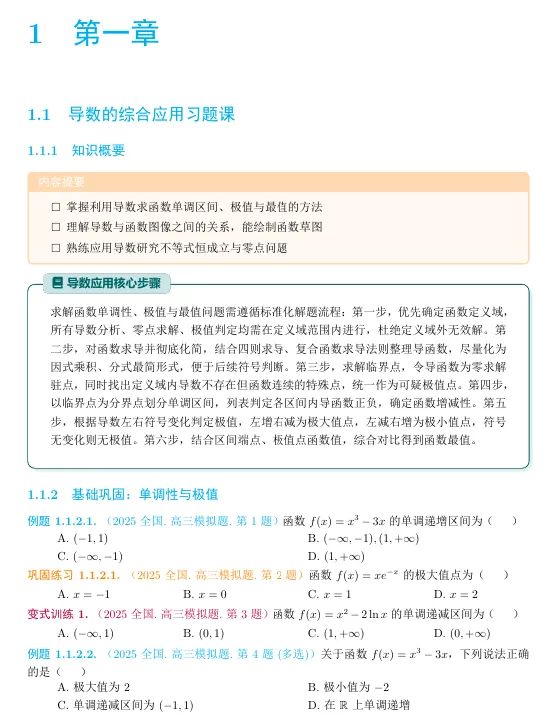
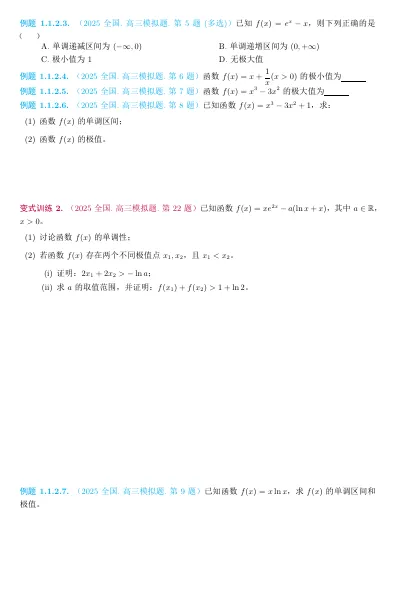
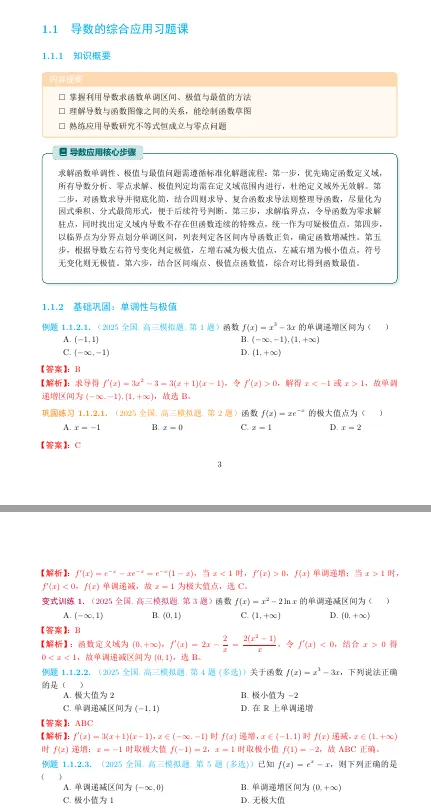
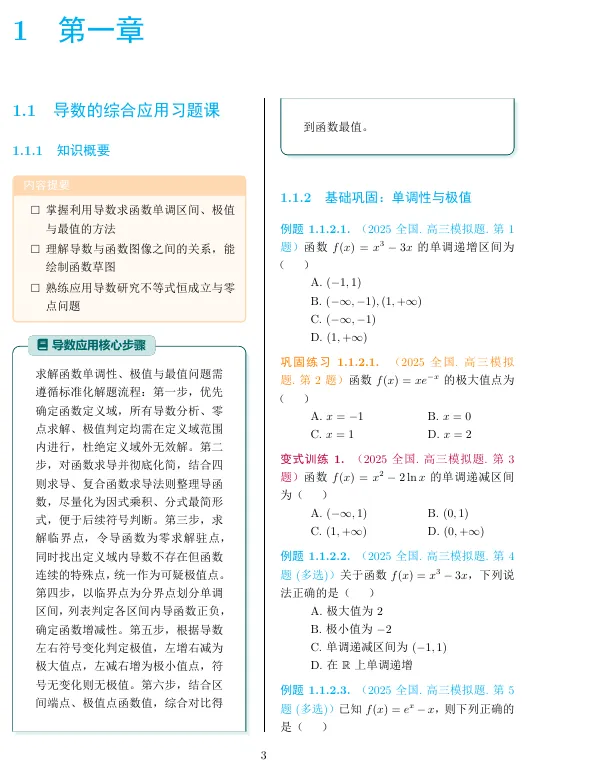
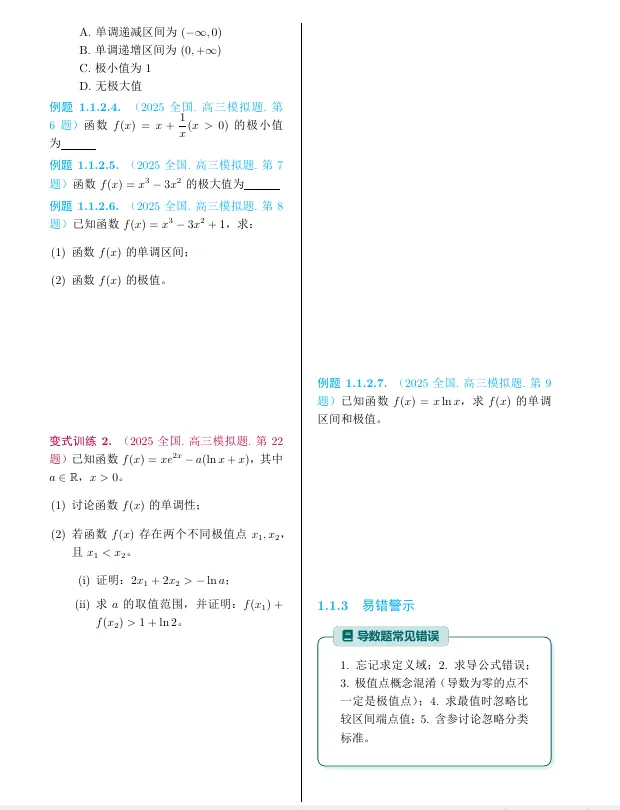
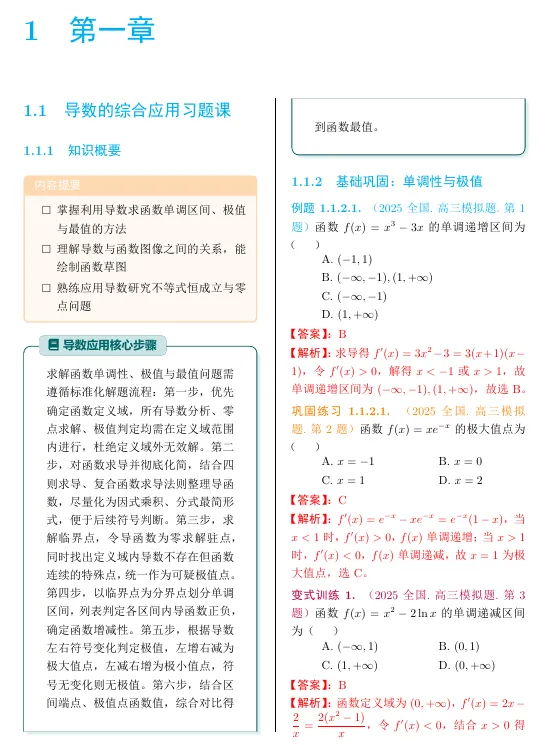
\documentclass[showanswers, % 显示答案answercolor=red, % 答案颜色paper=a4, % 纸张大小sectioncolor=cyan, % 控制section颜色subsectioncolor=cyan,exercisecolor=orange, % 练习题颜色examplecolor=cyan, % 例题颜色bianshicolor=purple, % 变式题颜色twocolumn]{biscuits}% ============== 双栏间距控制 ==============\setlength{\columnsep}{3em}\setlength{\columnseprule}{0.4pt}\usepackage{amssymb} % 提供 \square 命令\usepackage{tcolorbox} % 提供彩色文本框\tcbuselibrary{breakable} % 允许文本框跨页\newenvironment{introduction}{%\begin{tcolorbox}[colback=orange!5, % 背景色浅灰colframe=orange!30, % 边框色深灰title=内容提要, % 标题fonttitle=\bfseries, % 标题加粗left=2mm, right=2mm,top=2mm, bottom=2mm,breakable % 允许跨页]\renewcommand{\labelitemi}{$\square$} % 将 itemize 标签改为方框\begin{itemize}\setlength{\itemsep}{2pt} % 调整条目间距\setlength{\parskip}{0pt}}{%\end{itemize}\end{tcolorbox}}\usepackage{fontawesome5}\newtcolorbox{knowledge}[2][]{enhanced,breakable,arc=6pt,boxrule=0.8pt,colback=white,colframe=teal!70!black,colbacktitle=teal!20,coltitle=teal!80!black,fonttitle=\sffamily\bfseries,title={\faBook\ #2},attach boxed title to top left={yshift=-3mm,xshift=5mm},boxed title style={boxrule=0pt,colback=teal!20,arc=4pt},drop fuzzy shadow=teal!30,left=6mm, right=6mm, top=6mm, bottom=6mm,#1}\begin{document}% ========== 标题 ==========\title{ 一份适合高中数学题目排版的\LaTeX}\author{Biscuits}\date{2025.8}\maketitle\tableofcontents\newpage\chapter{第一章}\section{导数的综合应用习题课}\subsection{知识概要}\begin{introduction}\item 掌握利用导数求函数单调区间、极值与最值的方法\item 理解导数与函数图像之间的关系,能绘制函数草图\item 熟练应用导数研究不等式恒成立与零点问题\end{introduction}\begin{knowledge}{导数应用核心步骤}求解函数单调性、极值与最值问题需遵循标准化解题流程:第一步,优先确定函数定义域,所有导数分析、零点求解、极值判定均需在定义域范围内进行,杜绝定义域外无效解。第二步,对函数求导并彻底化简,结合四则求导、复合函数求导法则整理导函数,尽量化为因式乘积、分式最简形式,便于后续符号判断。第三步,求解临界点,令导函数为零求解驻点,同时找出定义域内导数不存在但函数连续的特殊点,统一作为可疑极值点。第四步,以临界点为分界点划分单调区间,列表判定各区间内导函数正负,确定函数增减性。第五步,根据导数左右符号变化判定极值,左增右减为极大值点,左减右增为极小值点,符号无变化则无极值。第六步,结合区间端点、极值点函数值,综合对比得到函数最值。\end{knowledge}\subsection{基础巩固:单调性与极值}\begin{example}{1}[2025][全国][高三][模拟题][第1题]函数$f(x)=x^3-3x$的单调递增区间为\blankbox\begin{choices}\choice{$(-1,1)$}\choice{$(-\infty,-1),(1,+\infty)$}\choice{$(-\infty,-1)$}\choice{$(1,+\infty)$}\end{choices}\begin{proof}\begin{answer}B\end{answer}\begin{solutions}求导得$f'(x)=3x^2-3=3(x+1)(x-1)$,令$f'(x)>0$,解得$x<-1$或$x>1$,故单调递增区间为$(-\infty,-1),(1,+\infty)$,故选B。\end{solutions}\end{proof}\end{example}\begin{exercise}{1}[2025][全国][高三][模拟题][第2题]函数$f(x)=xe^{-x}$的极大值点为\blankbox\begin{choices}\choice{$x=-1$}\choice{$x=0$}\choice{$x=1$}\choice{$x=2$}\end{choices}\begin{proof}\begin{answer}C\end{answer}\begin{solutions}$f'(x)=e^{-x}-xe^{-x}=e^{-x}(1-x)$,当$x<1$时,$f'(x)>0$,$f(x)$单调递增;当$x>1$时,$f'(x)<0$,$f(x)$单调递减,故$x=1$为极大值点,选C。\end{solutions}\end{proof}\end{exercise}\begin{bianshi}{1}[2025][全国][高三][模拟题][第3题]函数$f(x)=x^2-2\ln x$的单调递减区间为\blankbox\begin{choices}\choice{$(-\infty,1)$}\choice{$(0,1)$}\choice{$(1,+\infty)$}\choice{$(0,+\infty)$}\end{choices}\begin{proof}\begin{answer}B\end{answer}\begin{solutions}函数定义域为$(0,+\infty)$,$f'(x)=2x-\dfrac{2}{x}=\dfrac{2(x^2-1)}{x}$,令$f'(x)<0$,结合$x>0$得$0<x<1$,故单调递减区间为$(0,1)$,选B。\end{solutions}\end{proof}\end{bianshi}\begin{example}{2}[2025][全国][高三][模拟题][第4题][多选]关于函数$f(x)=x^3-3x$,下列说法正确的是\blankbox\begin{choices}\choice{极大值为$2$}\choice{极小值为$-2$}\choice{单调递减区间为$(-1,1)$}\choice{在$\mathbb{R}$上单调递增}\end{choices}\begin{proof}\begin{answer}ABC\end{answer}\begin{solutions}$f'(x)=3(x+1)(x-1)$,$x\in(-\infty,-1)$时$f(x)$递增,$x\in(-1,1)$时$f(x)$递减,$x\in(1,+\infty)$时$f(x)$递增;$x=-1$时取极大值$f(-1)=2$,$x=1$时取极小值$f(1)=-2$,故ABC正确。\end{solutions}\end{proof}\end{example}\begin{example}{2}[2025][全国][高三][模拟题][第5题][多选]已知$f(x)=e^x-x$,则下列正确的是\blankbox\begin{choices}\choice{单调递减区间为$(-\infty,0)$}\choice{单调递增区间为$(0,+\infty)$}\choice{极小值为$1$}\choice{无极大值}\end{choices}\begin{proof}\begin{answer}ABCD\end{answer}\begin{solutions}$f'(x)=e^x-1$,令$f'(x)=0$得$x=0$;$x<0$时$f'(x)<0$,$f(x)$递减;$x>0$时$f'(x)>0$,$f(x)$递增;故$x=0$取极小值$f(0)=1$,无极大值,ABCD正确。\end{solutions}\end{proof}\end{example}\begin{example}{3}[2025][全国][高三][模拟题][第6题]函数$f(x)=x+\dfrac{1}{x}(x>0)$的极小值为\blankline\begin{proof}\begin{answer}$2$\end{answer}\begin{solutions}$f'(x)=1-\dfrac{1}{x^2}=\dfrac{x^2-1}{x^2}$,令$f'(x)=0$得$x=1$,$0<x<1$时$f(x)$递减,$x>1$时$f(x)$递增,故极小值$f(1)=1+1=2$。\end{solutions}\end{proof}\end{example}\begin{example}{3}[2025][全国][高三][模拟题][第7题]函数$f(x)=x^3-3x^2$的极大值为\blankline\begin{proof}\begin{answer}$0$\end{answer}\begin{solutions}$f'(x)=3x^2-6x=3x(x-2)$,令$f'(x)=0$得$x=0,x=2$,$x\in(-\infty,0)$递增,$(0,2)$递减,$(2,+\infty)$递增,极大值$f(0)=0$。\end{solutions}\end{proof}\end{example}\begin{example}{4}[2025][全国][高三][模拟题][第8题]已知函数$f(x)=x^3-3x^2+1$,求:\begin{enumerate}\item 函数$f(x)$的单调区间;\item 函数$f(x)$的极值。\end{enumerate}\begin{proof}\begin{answer}(1)单调递增区间$(-\infty,0),(2,+\infty)$,单调递减区间$(0,2)$;(2)极大值$1$,极小值$-3$\end{answer}\begin{solutions}$f'(x)=3x^2-6x=3x(x-2)$,令$f'(x)=0$,得$x=0,x=2$。当$x<0$或$x>2$时,$f'(x)>0$,$f(x)$单调递增;当$0<x<2$时,$f'(x)<0$,$f(x)$单调递减。故极大值$f(0)=1$,极小值$f(2)=-3$。\end{solutions}\end{proof}\end{example}\begin{bianshi}{4}[2025][全国][高三][模拟题][第22题]已知函数$f(x)=xe^{2x}-a(\ln x+x)$,其中$a\in\mathbb{R}$,$x>0$。\begin{enumerate}\item 讨论函数$f(x)$的单调性;\item 若函数$f(x)$存在两个不同极值点$x_1,x_2$,且$x_1<x_2$。\begin{enumerate}\item 证明:$2x_1+2x_2>-\ln a$;\item 求$a$的取值范围,并证明:$f(x_1)+f(x_2)>1+\ln2$。\end{enumerate}\end{enumerate}\begin{proof}\begin{answer}(1) 当$a\leq 2$时,$f(x)$在$(0,+\infty)$上单调递增;当$a>2$时,$f(x)$在$(0,x_1)$单调递增,在$(x_1,x_2)$单调递减,在$(x_2,+\infty)$单调递增;(2)(i) 不等式得证;(ii) $a\in(2,+\infty)$,不等式得证。\end{answer}\begin{solutions}\begin{enumerate}\item 函数定义域为$(0,+\infty)$,求导得$f'(x)=(2x+1)e^{2x}-a\left(\dfrac{1}{x}+1\right)=\dfrac{x(2x+1)e^{2x}-a(x+1)}{x}$。令$g(x)=x(2x+1)e^{2x}$,则$g'(x)=(4x^2+6x+1)e^{2x}$,$x>0$时$g'(x)>0$,故$g(x)$在$(0,+\infty)$单调递增。当$a\leq 2$时,$x(2x+1)e^{2x}>2(x+1)\geq a(x+1)$,$f'(x)>0$,$f(x)$在$(0,+\infty)$单调递增;当$a>2$时,存在$0<x_1<x_2$满足$g(x_1)=a(x_1+1),g(x_2)=a(x_2+1)$,故$f(x)$在$(0,x_1)$递增,$(x_1,x_2)$递减,$(x_2,+\infty)$递增。\item \begin{enumerate}\item 由$\begin{cases}x_1(2x_1+1)e^{2x_1}=a(x_1+1)\\x_2(2x_2+1)e^{2x_2}=a(x_2+1)\end{cases}$,两式取对数相加,结合$x_1x_2>\dfrac14$,整理放缩得$2x_1+2x_2>-\ln a$。\item 由(1)得$a\in(2,+\infty)$,代入化简得$f(x_1)+f(x_2)=2a-a\ln(x_1x_2)$,结合$x_1x_2>\dfrac14$与$a>2$,得$f(x_1)+f(x_2)>1+\ln2$。\end{enumerate}\end{enumerate}\end{solutions}\end{proof}\end{bianshi}\begin{example}{4}[2025][全国][高三][模拟题][第9题]已知函数$f(x)=x\ln x$,求$f(x)$的单调区间和极值。\begin{proof}\begin{answer}单调递减区间$\left(0,\dfrac{1}{e}\right)$,单调递增区间$\left(\dfrac{1}{e},+\infty\right)$;极小值$-\dfrac{1}{e}$,无极大值\end{answer}\begin{solutions}定义域$(0,+\infty)$,$f'(x)=\ln x+1$,令$f'(x)=0$得$x=\dfrac{1}{e}$。$0<x<\dfrac{1}{e}$时$f'(x)<0$,$f(x)$递减;$x>\dfrac{1}{e}$时$f'(x)>0$,$f(x)$递增。极小值$f\left(\dfrac{1}{e}\right)=-\dfrac{1}{e}$,无极大值。\end{solutions}\end{proof}\end{example}\subsection{易错警示}\begin{knowledge}{导数题常见错误}1. 忘记求定义域;2. 求导公式错误;3. 极值点概念混淆(导数为零的点不一定是极值点);4. 求最值时忽略比较区间端点值;5. 含参讨论忽略分类标准。\end{knowledge}\end{document}