夜雨聆风
夜雨聆风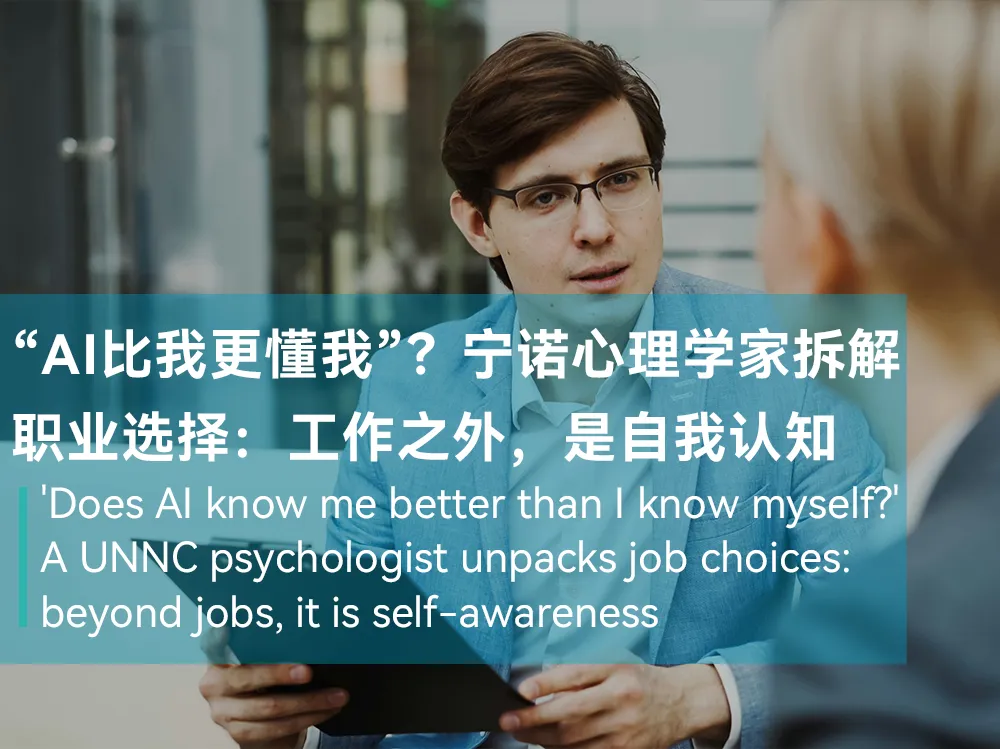
如今,大语言模型迭代加速,关于未来职业形态的讨论日益增多。然而,许多年轻人的难题并非“没有工作机会”,而是“不知道自己适合什么”。传统的自我认知工具如:MBTI、霍兰德测评、亲友经验等各有其价值,而在快速变化的就业环境中,个体往往需要更综合的信息与实践来辅助判断。
宁波诺丁汉大学(简称“宁诺”)应用心理学副教授袁帅,长期聚焦大数据与AI在人格与组织心理学中的应用。他从心理科学视角剖析了AI在“帮助人认识自己”上的能力与边界,为人们提供自我认识与安顿内心的思路。

宁诺应用心理学副教授袁帅

认识自己,
从看见内心开始
人们的困惑根源到底是什么?袁帅指出,职业困惑不仅仅是“职位变化”或“一职难求”等因素,其背后常涉及一种更深层的心理机制——控制感的减弱。研究显示,人们对生活走向的预期,会影响其内心的安定感。
当前,AI与机器人技术的快速迭代正在重塑职业结构,增加不确定性;同时,社交平台上的成功经验分享多呈现“高光时刻”,个体可能会因此产生比较和落差感。这种由外部不确定性与信息选择性暴露共同导致的失控体验,是焦虑情绪的重要来源。

求职
面对不确定的外部环境,识别自身优势与职业兴趣的“向内探索”是一种值得尝试的应对策略。然而,许多人在此环节面临现实障碍:成长过程中系统学习自我认知方法的机会有限,且来自家庭与社会的期望常被无意识内化,干扰真实自我判断。这些因素使得个体在认识自己时容易偏离内在感受,从而影响判断。
虽然常见的自评问卷(如MBTI、霍兰德)可作为梳理个人倾向的参考,亲友建议也能提供不同视角,但综合多方面和多维度信息,并结合持续实践与反思,或许能更接近真实的自我。

自我报告 vs 数字痕迹:
AI测评的优势与边界
不难发现,传统的心理测评往往依赖个体主动报告“自己是什么样”。这种方式能直接获取个体的主观体验,但人们可能因社会期待、自我认知盲区或回忆偏差,无法完全准确地描述自己。

求职现场
AI则提供了一条不同的路径:它观察人们留下的数字行为痕迹如:社交媒体用词、语速语调、微表情等,这些痕迹本质上是个体在日常互动中无意识释放的非语言信号。心理学研究证实,这些信号往往比(在很多情况下容易受到社会期许和自身期待所影响的)刻意表达更能反映真实的人格与情绪状态。AI可以量化分析这些信号,捕捉那些连个体自己都未必意识到的行为模式。例如,发言者的语言特征可推测某些人格倾向,语速、语调等非语言信息,也可能与听众的感知形成某种关联。这类信号本人难以察觉,但AI可将其转化为可分析的数据。
然而,AI评估的结论需要谨慎解读。有不少心理学研究指出,外界的判断,无论来自人还是算法,都可能对个体产生暗示效应,潜移默化地影响其行为与自我认知。因此,AI评估应被视为基于统计的概率预测,而非不可更改的命运判定。最终的职业选择,仍需结合个人实践与思考。

“
人的可塑性很强,从青少年到成年,兴趣与能力都可能发生变化。AI难以给出‘你适合做宇航员’这类绝对化判断,也容易将表面关联误判为因果关系(你高中的数学成绩很好可能是因为你很喜欢高中的数学老师,而并非你有怎样卓绝的数学天赋),从而忽略行为背后的情境与发展阶段。此外,将个体简化为少数标签,还会忽视人的多元性和成长潜力。这些都是AI评估目前难以充分处理的复杂性。
”

超越算法:
看到人的独特优势
AI看似“无所不能”,那有没有什么是它难以取代的?袁帅认为,有两类能力目前难以被AI模拟:一是真正的共情,二是复杂人际互动中的创造性火花。
真正的共情,不仅是对他人情绪的识别,更涉及大脑在面对面交流时产生的脑间同步。这是一种神经层面的共振,也是深度沟通与信任建立的生理基础。AI可以输出“我理解你”,但它没有情感体验,也无法与人实现这种同步。
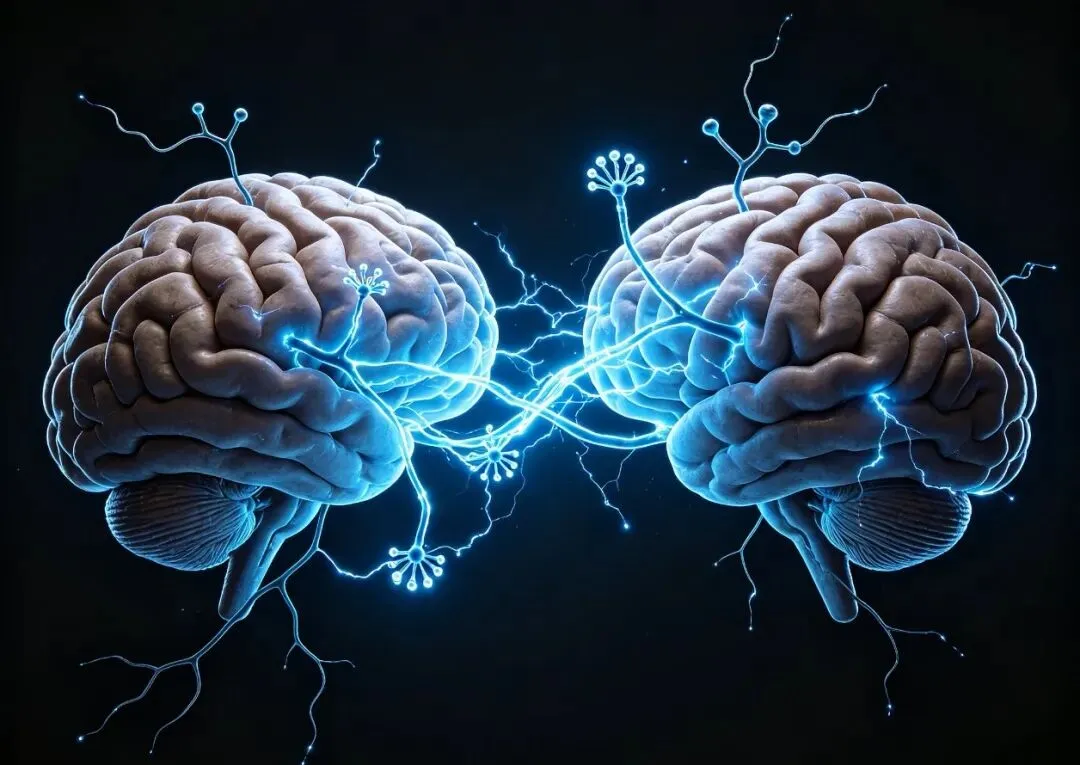
脑间同步(AI生成)
至于人际互动中的共鸣和创造力“迸发”,认知科学指出,许多新想法并非来自单一个体的灵光一现,而是在开放、即兴的对话中“涌现”出来的。这种依赖共享注意、即时反馈和情绪共鸣的协同创造过程,目前尚无法被算法复现。
AI擅长从数据中寻找规律,而人可以在复杂的互动中创造新的可能。技术可以优化决策,但无法替代真实的人际连接与情感共鸣。在算法之外,人的独特价值恰恰体现在那些难以被算法捕捉和预测的维度上。

人际连接
当我们认识到AI的能与不能,那又该如何在现实中找到自己的位置呢?针对处于职业探索期的年轻人,袁帅提出三条建议:
01
将AI作为参考工具,而非决策主体。AI提供的是概率评估,而非确定性结论。职业选择宜综合多方信息,并通过行动加以验证。例如:选修相关课程或参与实践项目,来检验自身兴趣与能力的匹配度。此外,动机心理学中的成就、亲和与权力三类动机,可作为理解个人内驱力的参考框架。
02
主动管理信息负荷。在信息高密度环境中,有意识地减少屏幕使用时间,为深度社交、自然接触与静思留出空间。研究表明,人与自然的连接及深度社会互动,是提升幸福感与自我认知清晰度的有效路径。
03
避免对单一判断的绝对依赖。无论是AI还是网络上的观点,都只是多元信息之一。自我认知是一个持续建构的过程,保持开放比固守标签更重要。此外,广泛阅读、汲取有智慧的思想,并结合实践思考,也是提升自我认知的重要路径。

通过阅读提升自我认知
自我认知没有终点,技术是工具而非答案。真正的答案,往往藏在你的行动与思考中。 这一过程无法外包给算法。每一次有意识的实践与审视,都是对自我画像的修正。最终,每个人都是自己生命方向的书写者。

R
K
E

‘Does AI know me better than I know myself?’ A UNNC psychologist unpacks job choices: It's not about a lack of jobs, but a lack of self-awareness
Today, with large language models evolving at speed, discussions about job choices are on the rise. Yet for many young people, the real challenge isn't a shortage of opportunities but not knowing what suits them. Traditional self‑awareness tools such as the MBTI, Holland's vocational assessments, and advice from family and friends all have their value, but in a fast‑changing job market, individuals often need more comprehensive information and hands‑on experience to guide their decisions.
Dr Shuai Yuan, Associate Professor in Applied Psychology at the University of Nottingham Ningbo China (UNNC), has long focused on the application of big data and AI in personality and organisational psychology. From a psychological science perspective, he analyses AI's ability and its limits in helping people understand themselves, offering insights into how we can build self‑awareness and find inner stability.
To know yourself, look inward first
What lies at the root of people's anxiety? Dr Yuan points out that job‑seeking anxiety is not merely about an oversupply of graduates or a scarcity of positions. Beneath the surface, there is often a deeper psychological mechanism – a diminished sense of control. Research shows that people's expectations about the trajectory of their lives strongly influence their inner sense of stability.
Today, the rapid iteration of AI and robotics is reshaping occupational structures and adding uncertainty. At the same time, the success stories shared on social media tend to highlight only 'highlight reels', which can make individuals feel inadequate by comparison. The sense of losing control which is fuelled by external uncertainty and selective exposure to information is a major source of anxiety.
Faced with an unpredictable environment, turning inward to identify one's strengths and career interests is a coping strategy worth trying. Yet many people encounter real obstacles at this stage: during their formative years, they may have had limited opportunities to learn systematic methods of self‑awareness, and the expectations of family and society are often unconsciously internalised, interfering with authentic self‑judgement. These factors make it easy for individuals to drift away from their inner feelings when trying to know themselves, thus distorting their self‑assessment.
While self‑report questionnaires (such as the MBTI and Holland codes) can serve as useful references for sorting out personal tendencies, and advice from family and friends can offer different perspectives, integrating multiple sources of information and combining them with continuous practice and reflection may bring us closer to a true picture of ourselves.
Self‑report vs digital traces: the strengths and limits of AI assessment
Traditional psychological assessments have long relied on individuals actively reporting 'what they are like'. This approach directly captures subjective experience, but people may not be able to describe themselves fully accurately due to social desirability bias, blind spots in self‑awareness, or memory lapses.
AI offers a different path: it observes the digital behavioural traces people leave behind like the word choices on social media, speech rate and tone, micro‑expressions, and so on. These traces are essentially the non‑verbal signals that individuals emit unintentionally in everyday interactions. Psychological research confirms that such signals often reveal personality and emotional states more accurately than deliberate self‑report, which is frequently influenced by social desirability and one's own expectations. AI can quantify these signals and capture behaviour patterns that even the individuals themselves may not be aware of. For example, a speaker's linguistic features can be used to infer certain personality traits, and non‑verbal cues such as speech rate and intonation may correlate with how listeners perceive them. Such signals are hard for a person to notice, but AI can turn them into analysable data.
Nevertheless, the conclusions drawn from AI assessments must be interpreted with caution. A substantial body of psychological research suggests that external judgements, whether from people or from algorithms, can have a suggestive effect on individuals, subtly influencing their behaviour and self‑perception. Therefore, AI‑based assessments should be seen as statistical predictions, not as unchangeable verdicts of fate. The final career choice should combine personal practice and reflection.
"Human beings are highly malleable. From adolescence to adulthood, both interests and abilities can change. AI struggles to give absolute statements like 'you are suitable to become an astronaut'. It can also easily mistake surface correlations for causal relationships. For instance, your good grades in high school maths might simply be because you really liked your maths teacher, not because you have some extraordinary mathematical talent. This means AI can overlook the context and developmental stage behind behaviour. Moreover, reducing an individual to a handful of labels ignores the richness of human potential and growth. These are complexities that AI assessments currently cannot handle well," says Dr Yuan.
Beyond algorithms: recognising humans' unique strengths
AI may seem 'all‑powerful', but is there anything it struggles to replace? Dr Yuan believes two types of abilities are currently difficult for AI to simulate: genuine empathy, and the creative spark that emerges within complex interpersonal interactions.
True empathy is not just recognising another person's emotions, and it also involves the interbrain synchrony that occurs during face‑to‑face communication. This is a form of neural resonance, a physiological foundation for deep communication and the building of trust. AI can output the words 'I understand you', but it has no emotional experience of its own and cannot achieve this synchrony with another human being.
As for the rapport and creative 'spark' that arise in human interaction, cognitive science suggests that many novel ideas do not come from a single individual's flash of insight, but rather emerge in the process of open, unscripted dialogue. This kind of collaborative creation, which relies on shared attention, real‑time feedback, and emotional resonance, cannot yet be replicated by algorithms.
AI excels at finding patterns in data while humans can create new possibilities in complex interactions. Technology can optimise decision‑making, but it cannot replace genuine human connection and emotional resonance. Beyond algorithms, the unique value of humans lies precisely in those dimensions that algorithms struggle to capture and predict.
Once we understand what AI can and cannot do, how can we find our own place in reality? For young people navigating their career exploration period, Dr Yuan offers three pieces of advice:
First, treat AI as a reference tool, not the decision‑maker. AI provides probabilistic assessments, not definitive answers. Career choices are best made by integrating information from multiple sources and testing them through action. For example, you can take relevant courses or join practical projects to see where your interests and abilities match. Additionally, the three motivational needs from motivational psychology: achievement, affiliation and power can serve as a useful framework for understanding your inner drives.
Second, actively manage your information load. In a high‑density information environment, consciously reduce screen time to make space for deep social interaction, contact with nature, and quiet reflection. Research shows that connecting with nature and engaging in deep social interactions are effective ways to enhance well‑being and clarity of self‑awareness.
Third, avoid over‑reliance on any single source of judgement. Whether it's AI or opinions found online, each is just one of many sources of information. Self‑awareness is an ongoing process of construction, thus staying open is more important than clinging to fixed labels. Reading widely, drawing on thoughtful wisdom, and reflecting through practice are also key paths to deepening self‑knowledge.
There is no end point to self‑awareness. Technology is a tool, not the answer. The real answers are often hidden in your own actions and reflections. This process cannot be outsourced to an algorithm. Every intentional act of practice and re‑evaluation revises your self‑portrait. In the end, each of us is the author of our own life direction.
文字来源:Marcomm
图片来源:袁帅,网络(Unsplash, FreePik)及AI生成。如有侵权,请联系删除。
图文设计:郭雨函(实习生)


公众号


官网