 夜雨聆风
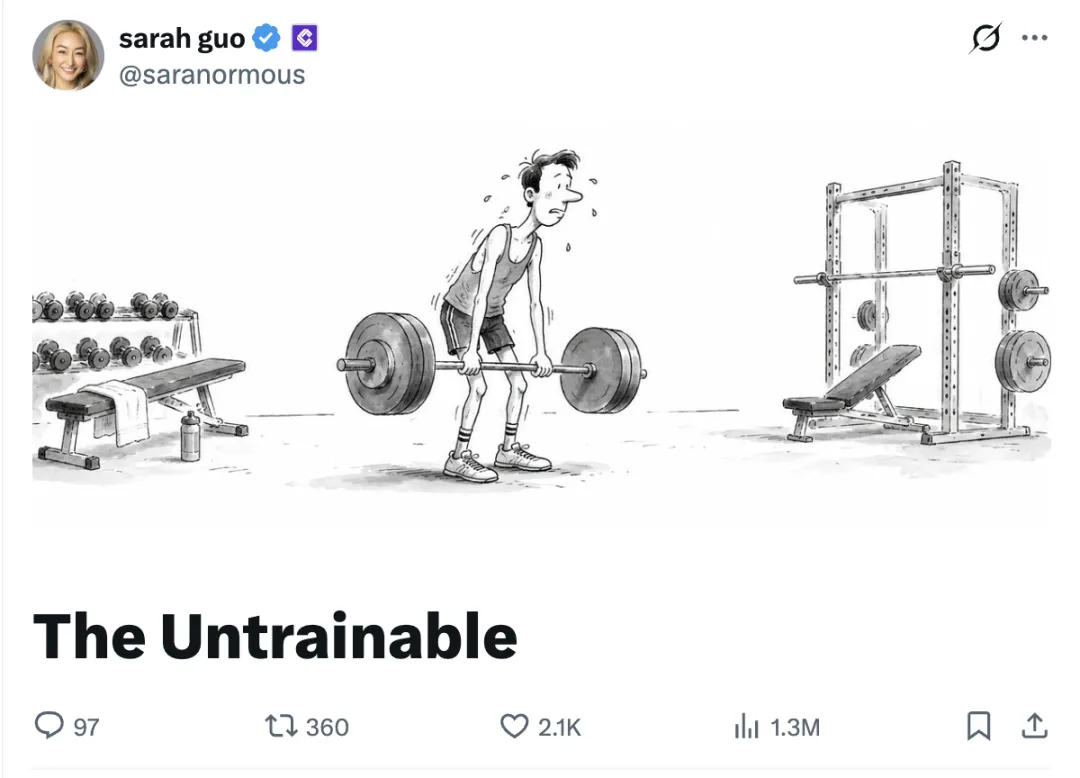
夜雨聆风硅谷著名的投资人 Sarah Guo 最近写了一篇长文,题目叫 《The Untrainable》。这个标题挺妙,直译是“不可被训练的东西”。但它真正想问的是一个很现实的问题,当大模型越来越强,AI 应用公司是不是都没戏了?
这也是最近很多人心里的疑问。
模型在变强,代码能写,流程能跑,Agent 也越来越像样。于是市场上有一种越来越强的悲观情绪,未来是不是只剩 Anthropic、Nvidia 这样的模型和算力公司值得押注?其他应用公司,不过是在模型外面套了一层壳,迟早都会被吃掉?
Sarah 的回答不是简单乐观。
她承认,很多“薄包装层”确实会被模型吸收。尤其是那些容易被衡量、容易被 benchmark、容易被训练优化的工作,最终都会越来越便宜,甚至商品化。
但她真正想提醒的是 AI 不是把所有价值都吸走了,而是把价值推向了更深、更难、更不容易被外部看见的地方。
这些包括私有数据、客户现场、系统权限、责任归属、用户信任、组织习惯,以及那些必须在真实业务里长期运行之后才知道到底好不好的判断标准。
心有戚戚焉。
在一个传统行业从私有数据的沉淀走到 AI 工程化落地,真是一件非常不性感的事。
模型很强,但真实世界不会因为模型变强就自动变简单。很多工作仍然要有人去拆流程、对字段、接系统、理解历史包袱,也要一遍遍和客户确认,什么才算真正的好结果。这也是为何大模型公司会派驻FDE工程师进驻客户现场的原因OpenAI 派了150名工程师,开始亲自做 AI 部署了。
这些工作不酷,也不适合做成漂亮 demo。
但它们可能才是 AI 应用真正的护城河。
所以不要只盯着模型能力本身,也不要轻易觉得应用层没有机会。
真正值得关注的,可能是那些愿意进入客户现场、做脏活累活、并且慢慢写下行业判断标准的团队。
真正值得关注的,可能是技术以外的东西。
如果你也是 AI 创业者,或者正在负责 AI 落地项目,不妨从这篇文章了解一下投资人的观点,它特别适合在没那么浮躁的时候读一读。
附录
《 The Untrainable 》原文及注释
以下是原文和注释,Sarah Guo 原文很密,抽象词、隐喻、长句很多。注释是在尽量保留核心观点的前提下,对部分内容进行了重新组织,并增加了必要的背景解释、案例说明和个人思考。
The mid-2026 investor's version of AI psychosis is a despair that nothing is investable, that we should put all our money into Anthropic and Nvidia and go home. I have never felt it. I have been sure the models are smarter than me for several sub-versions now, I’d be a happy buyer of Anthropic and Nvidia at the market price, and all my smartest friends are quite convinced that self-improvement is soon to work – and I still don't feel it. The despair isn't stupid. The logic runs: if the model keeps getting better at everything, then every company built on top of one is a thin wrapper waiting to be absorbed, and the only value that survives is the compute and the frontier weights.
到 2026 年中,AI投资圈里有一种很典型的悲观情绪,好像已经没有什么公司值得投了,大家只要把钱押在Anthropic 和 Nvidia 上就行。但我从来没有这种感觉。
我承认模型比我聪明,如果能按市场价买Anthropic 和 Nvidia,我也会愿意买。
我身边很多聪明朋友也相信,模型的自我改进很快会变得有效。可即便如此,我还是不觉得其他AI应用公司都没戏了。
当然这种悲观情绪是有一定的道理,它的理由是如果模型什么都会、而且越来越强,那么所有基于模型做出来的公司,都可能只是薄薄一层包装,其产品或服务迟早被会模型公司内化。最后能留下价值的,可能只有算力和最前沿的模型权重。
Take software, the case the despair leans on hardest. Devin shipped in 2024 solving thirteen percent of the tasks on the standard software benchmark, and was largely dismissed. A year and a half later the best agents hit the high eighties, and they're doing real work inside Goldman Sachs and the U.S. Army. Nearly everyone drew the same wrong lesson: the model ate software engineering. But as the model swallowed the part of software engineering you can best measure, we’re relearning what many teams knew – engineering has always resisted measurement, and the most measurable parts may not be the only important ones.
软件是最先被冲击的领域。Devin 在 2024 年发布时,只完成了标准软件benchmark 里 13% 的任务,当时很多人并不看好它。可一年半后,最好的 agent 已经能做到 80% 多,而且开始在 Goldman Sachs 这样的真实环境里工作。
很多人于是得出一个结论,模型已经吃掉了软件工程。
但这个结论下得太快了。模型确实吃掉了软件工程里最容易被衡量的部分,可这也让我们重新看见一件很多工程团队早就知道的事,工程本来就很难衡量,而最容易被模型衡量的那一部分,不一定是最重要的部分。
Mert Demirer and coauthors at MIT finally put numbers on it: across more than 100,000 developers, the latest coding agents lifted how much code got written by roughly 180%, and how much actually shipped by about 30%. Writing got cheap. The rest still runs through a person, and it matters. The net impact is, of course, still amazing.
MIT 的 Mert Demirer 和合作者举了一些例子。他们研究了超过 10 万名开发者后发现,最新的 coding agent 让大家写出来的代码量大约增加了 180%,但真正被合并并且交付出去的代码,大约只增加 30%。
也就是说,写代码这件事变容易了,但后面的判断、交付、维护等仍然要经过人。这一点很关键。当然,coding agent 带来的总体影响仍然非常惊人。
A benchmark is a thing you can measure, and a thing you can measure is a thing you can train against. Thus, coding agents matured first: a compiler is a free verifier, a test suite is a free verifier, and when the answer checks itself for nothing you can grind against the check until you beat it. But passing the test never told you the change was the right one for a decade-old codebase with three undocumented reasons that module exists and a deploy pipeline held together by a cron job no one will admit to writing.
一旦某项能力可以被 benchmark 衡量,它就会变成模型可以针对性训练和优化的对象。
所以 coding agent 这个领域最先脱颖而出并不奇怪。编译器会告诉你这段代码能不能跑,测试会告诉你有没有过。只要系统能自动判分,模型就可以一遍遍训练,直到把分数刷上去。
但问题是,测试通过,只能说明代码在某个可验证标准下没出错,但它不能证明这个改动真的适合一个复杂、陈旧的真实系统。
某个看起来多余的模块,可能背后有好几条没有写进文档的历史原因。
整套部署流程,也可能靠一个没人愿意承认是自己写的定时脚本勉强撑着。
模型能过测试,但未必懂这些真正的历史原因。
That kind of correctness can't be read off a leaderboard, and it can't really be read off anything. You find out whether a system that complex works by running it in the world long enough to learn, and a smarter model doesn't make the world run faster. Nobody unit-tests something the size of Google and trusts the green check; you trust it because it survived years of real load. Correctness like that isn't only private, it's the slow kind of moat capital can't collapse. Even the optimists grant the clock can't be skipped: Noam Brown, who has pioneered OpenAI's reasoning models, wrote recently that the only sure way to evaluate an agent over a one-year horizon may be to run it…for a year.
一个复杂系统到底能不能用,不是跑一次 benchmark、看一眼排行榜,或者通过一组测试就能证明的。它必须放到真实世界里,经过足够长时间的运行,才能慢慢验证出来。
模型再聪明,也不能让这个过程凭空加速。
没有人会因为 Google 这样规模的系统单元测试全绿,就立刻相信它万无一失。大家信任它,是因为它已经经受了很多年真实流量和复杂场景的考验。
很多事情就是需要时间。
比如,一个系统是否稳定,一个 agent 能不能长期完成任务,一个组织是否愿意真正信任它,都不是模型回答得更好就能立刻证明的。
再具体一点,一个代码改动在某家公司老系统里到底对不对,某个 agent 在真实业务流程里能不能长期稳定工作,某个工具是否符合这家公司内部的流程、权限和责任边界,最终结果能不能被内部团队、客户、合规和管理层接受,这些都不是公开 benchmark 能测出来的。
因为它们只存在于某个具体公司、具体系统、具体业务环境里。外部的人看不到,也拿不到完整数据来验证。
Noam Brown 是 OpenAI 推理模型的重要推动者。他举过一个例子,也是在说同一件事,如果你要评估一个 agent 在一年里的表现,最可靠的办法,可能就是让它真的跑一年。
你不能用一个短期 benchmark,替代长期的现实检验。
这些能力和信任,都是靠时间慢慢长出来的护城河。
再多钱,也很难跳过这个积累过程。
As Gabe Pereyra says, real automation isn't only the model getting better. It's the product, the model, the workflow, and the firm moving together, and three of those four move at the speed of an organization. Moving people is the part no benchmark touches: getting a skeptical partner to change how she runs her matters, holding a team together through a rebuild. It's why, when we hire a CEO, the ability to deal with people weighs at least as much as the analytical horsepower, and a smarter model doesn't change that weighting. The feedback is ambiguous, the horizon is years, and the trust belongs to a person. Every company I know has every engineer on frontier coding models, and not one has changed its eng org at anything close to that speed. Adoption took a quarter, and what a magical quarter of token growth it was! But the rebuild is taking years.
正如 Gabe Pereyra 所说,真正的自动化,不是模型单方面变强就够了。
要让 AI 在一家公司里真正跑起来,产品要跟上,模型要够强,工作流要重新设计,组织本身也要愿意改变。这里面,除了模型之外,其他几项基本上都只能按照组织自己的进化速度往前走。
而组织的进化速度,通常很慢。
Benchmark 测不到的,恰恰是最难的部分,如何让人改变。
比如,怎么让一个原本怀疑 AI 的合伙人,真的改变她处理客户事务的方式;怎么在系统重建时期稳住团队;怎么让大家愿意接受新的流程和责任边界。
这也是为什么我们招聘 CEO 时,带团队的能力很重要,至少和分析能力一样重要。
公司真实业务中,很多问题不是想清楚答案就OK了,还要推动人接受、协作和执行。
模型再聪明,也不会改变这一点。
这些变化很难立刻看到结果,往往要过很久才知道有没有用。而能不能推动下去,最终还是取决于人和人之间的信任。
AI 工具的普及也许只需要一个季度,而且那一季度的 token 增长一定会很漂亮。
但真正的组织重建,需要好几年。
What's legible is what's leaving. The valuable work is illegible by construction: anything you can put on a leaderboard, you can train against, so anything measurable is already on its way to commodity. The process takes time and is never total, but the direction never reverses. Put it in money terms, the way my friend Matt MacInnis at Rippling does: a token spent answering a generic question is worth almost nothing, since anyone's model can answer it, while a token spent reasoning over your company's data is worth much more, because it does the thing you actually want, not just the plausible thing.
凡是容易被衡量、容易被打分的工作,都会逐渐被模型吃掉。
真正有价值的部分,往往是藏在外部很难判断的地方。
只要一项任务可以被放到排行榜上比较,就可以被模型反复训练;只要它可以被清楚衡量,就会一步步走向商品化。
这个过程不会一夜完成,也不会覆盖所有工作,但整个方向很难逆转。
Rippling 的 Matt MacInnis 有个很直观的说法。
如果一个 token 只是用来回答通用问题,它的价值就很低,因为现在任何模型都能给出差不多的答案。
但如果这个 token 是被用来理解你公司自己的数据、流程和上下文,它的价值就高得多。
因为它解决的是你真正需要解决的问题,而不是给出一个看似合理的通用回答。
The legible work gets eaten from two directions. From below, tasks saturate: once a job can be checked cheaply, the buyer stops asking which model did it and starts asking what it costs, and the work falls to whatever open or distilled model is cheapest that week. Everywhere they can matter, margins eventually matter. From above, the labs are trying to get the models to swallow their own scaffolding. The retrieval, the routing between cheap and expensive calls, the tool use, even the reasoning policy, all the apparatus that used to wrap a model is being pulled into the weights, until the wrapper is the model. This is the absorption frontier. Margin pressure cuts the other way too: a general agent has to be ready for anything, which is expensive, while a focused application can tune one workflow until it runs on a fraction of the token spend, and unlike the lab selling those tokens, it keeps the difference.
一旦一类工作可以被清楚打分,它的价值就会被两边同时挤压。
一边是模型价格的竞争。
如果一个任务很容易判断对错,客户很快就会发现,只要结果差不多,用谁家的模型其实变得没那么重要了。那接下来大家比的就是价格。
这类任务最后往往会流向更便宜的开源模型,或者经过压缩、蒸馏的小模型。
说白了,只要一件事变得标准化,利润就会被不断压薄。
另一边,是大模型公司自己也在往应用层走。
过去很多 AI 应用公司主要做的事是在模型外面包装一层能力,比如帮模型检索资料、判断什么时候调用便宜模型,什么时候调用贵模型,什么时候使用工具,甚至怎么安排推理步骤。
但现在这些能力,模型公司也在一点点内化进模型里。
所以,有些原本看起来像产品功能的东西,过一段时间可能就变成模型的基础能力了。
这就是应用层最担心的地方,今天你包装出来的能力,明天可能就被底层模型吸收。
这就是所谓的 absorption frontier。
不过,事情也不完全站在模型公司那边。
垂直应用的优势在于,它可以把一个具体场景吃得很深。它不必每一步都调用最贵的通用模型,而是可以把规则、缓存、小模型、人工审核和前沿模型组合起来,用更合适的成本交付同样甚至更好的结果。
换句话说,它赚的不是 token 差价,而是把一个业务结果稳定交付出来的能力。只要交付质量不变、客户愿意为结果付费,成本控制得越好,它的利润空间就越大。
举个简单的例子( 这里只是为了说明机制,当然现实里是没这么线性的):
假设一个垂直 AI 应用不是按 token 卖,而是按业务结果收费,比如:
每处理一张发票收 1 元;
每解决一个客服问题收 5 元;
每完成一次合规审查收 100 元;
每生成一份可用报告收 500 元。
客户关心的是结果,不关心你背后用了多少 token。
那么对这家公司来说,收入相对固定,但成本可以优化。
一开始处理一个客服问题,需要调用大模型很多次,token 成本是 3 元。
它向客户收费 5 元。那毛利是 2 元。
后来它把这个客服流程优化得很细,减少不必要的模型调用、简单问题用小模型、常见问题用缓存、复杂问题才调用贵模型、把提示词、路由、工具链都调顺。
于是处理同一个问题,token 成本从 3 元降到 1 元。
但它向客户收费仍然是 5 元。那毛利就从 2 元变成 4 元。
So, we may ask two things of any kind of work. Is its correctness private and expensive to establish, the kind of truth that exists only inside someone's data? And is it walled off, locked inside a system you can't get into? Set those against how saturated the task is, and you get a 2x2. Saturated work with public answers is commodity tokens, and open models own it. Frontier work with public answers, where coding benchmarks live, is where the labs win, because when the eval is free, owning it counts for nothing. The prize is the last corner, the untrainable one: frontier work whose correctness exists only in private. You can see it in the inference clouds hosting the AI-native pioneers, where the vast majority of tokens are generated by custom models, not generic open ones.
所以,判断一种 AI 工作有没有价值,可以先问两个问题。
第一,这件事做得对不对,判断标准是不是只有客户自己的数据和业务环境里才知道?换句话说,它的“正确答案”是不是很私有,而且验证成本很高?
第二,这件事是不是只存在于内部系统里?也就是说,模型再聪明,如果没有权限、集成和信任,也无法真正进去做事。
再把这两个问题,和任务本身是否已经被模型做得很成熟放在一起看,价值分布就会很清楚。

比如上图左上角,如果一项工作已经很成熟,答案又是公开可验证的,那它很快会变成便宜的 token 服务,最后往往由开源模型吃掉。
上图左下角,如果一项工作很前沿,但答案仍然是公开的,比如很多 coding benchmark,那更容易赢的是大模型实验室。因为这类任务可以被反复训练、反复刷分;一旦 eval 是公开的,单独拥有它就没有太大价值。
真正有价值的,是最后那个 untrainable 角落,任务本身还很难,但判断它做得好不好,只能在客户的私有环境里完成(上图右下角)。
不是模型永远学不会,而是外部模型拿不到那些数据、权限、流程和判断标准,没法只靠公开训练把它吃掉。
你也可以在 AI-native 公司的推理云里看到这个趋势,大量 token 并不是通用模型产生的,而是来自为具体客户、具体场景定制过的模型。
The walls into that last corner vary in height. A single developer's toy codebase is portable and standardized, so the climb is short. A bank's production systems are neither, and you don't get root by being 2% more clever on SWE-Bench Verified.
不同领域的护城河是不一样的。
对于一个开发者自己维护的小型代码库来说,代码结构通常比较标准,也容易迁移,因此 AI 很容易理解和接入这类系统。
但银行的核心系统完全是另一回事。这些系统往往经过几十年演化,架构复杂、数据封闭、流程高度定制化。
即便你的模型在公开编程测试中领先几个百分点,也不意味着你就能真正理解和操作这些系统。
Capability eats many things, but a better model does not make private ground truth public. It does not hold the license, sign off on the liability, or own the firm's files, and it cannot be the party that gets sued when the answer is wrong. Intelligence is not the bottleneck here. Permission is, and so is accountability. You can imagine a model far smarter than any person, and it still has to be let in the door, and someone still has to put their name on what it does.
模型能力越来越强,确实能够取代越来越多的工作。但再强的模型,也不会因此自动获得企业内部的数据和信息。
它没有执业资格,不能承担法律责任,也不掌握企业长期积累的文件、数据和业务知识。
如果判断出了问题,最终承担后果的也不会是模型本身。
因此,在很多真实业务场景里,限制 AI 的从来不只是能力。
更关键的是,企业是否愿意让它进入系统、接触数据,以及谁来为它产生的结果承担责任。
即使未来出现一个比所有人都聪明得多的模型,它依然需要被企业接纳、被允许进入业务流程。而当它参与决策时,也仍然需要有人站出来对结果负责。
That door has a lock and a deadbolt. The lock is the environment: you only get to verify whether AI did something useful inside a system once you're trusted inside it, after the security review, the integration, the contract with your name on the outcome. The deadbolt is the user. A majority of American doctors now open OpenEvidence every day, and no amount of compute buys that. A lab can train a flawless medical model tomorrow and still have no way into the physician's habit, or into the decision flow of UCSF, because trust is built slowly, on relationships, with user’s acquiescence, not gradient descent that erases them.
这里有两重门槛。
一重门槛是来自企业环境本身。只有获得客户信任,通过安全审查,完成系统集成,并签下对结果负责的商业合同之后,AI 才真正有机会进入业务流程,并证明自身价值。
第二重门槛来自用户。
如今,OpenEvidence 已经成为许多美国医生日常工作中的固定工具。这种地位不是靠堆更多算力就能获得的。
即便某家实验室明天推出一个能力更强、准确率更高的医疗模型,也不意味着医生会立刻改用它,更不意味着它能够直接进入像 UCSF 这样的顶级医疗机构的诊疗和决策流程。
因为医疗行业真正稀缺的,从来不只是模型能力,而是长期积累的信任、成熟的工作流程,以及组织对风险和责任的认可。
因为信任的建立遵循完全不同的规律。
它来自长期积累的合作关系,来自用户一次次主动选择使用,来自组织对风险和责任的认可。模型可以通过梯度下降不断提升能力,却无法通过训练直接获得这些东西。
This is also the job. An application earns its place in the untrainable corner by doing unglamorous work: arranging a company's private reality so a model can act on it, handing the model the tools to act, working with the customer to change the reality of its workforce. A company that brings the translation is tough to copy – and the translation never ends. Integration and maintenance run as long as the relationship does, won by teams that put domain-specialized engineers and tools next to the customer.
这恰恰也是应用层公司的能够胜出的机会。
本质上,这些应用公司扮演的是翻译者的角色。
一边是企业内部复杂而私有的数据、流程和组织规则,另一边是具备推理能力的 AI 模型。应用公司的价值,在于把前者转化为后者能够理解和执行的形式。
这种能力并不体现在一次产品演示里,而体现在长期的系统对接、流程重构和组织协同之中。
而且这项翻译工作永远没有终点。企业在变化,业务在变化,AI 能力也在变化,因此系统集成和运营维护会伴随整个客户生命周期持续进行。
最终建立护城河的,往往是那些深耕行业、长期驻扎在客户现场、能够持续解决实际问题的团队。
As one example, at a top white-shoe law firm, the M&A practice alone runs close to a thousand deals a year. You can't have hundreds of associates each downloading client files to a desktop and asking a general agent to rip through them, for confidentiality reasons and a dozen others, and even if you could, what you'd learn would be fragments, one associate's corrections at a time, with no view of how a whole deal flows. The signal that matters lives at the level of the deal, and a deal has a shape: for M&A the NDA, the term sheet, diligence, the purchase agreement, the ancillaries, the closing checklist; for IP litigation, motions, discovery, prior art, more motions. Each practice area has its own, and neither the lawyers nor the tools interchange across them. And the problem the firm is actually solving sits a level above all of it: running every practice area in parallel, the way a top partner runs hundreds of matters at once while bringing in new ones and training associates. Transforming a firm like that isn't a single task you can write an eval for. It takes an operator to moneyball it, with extremely ambiguous intermediate goals and incomplete feedback, over very long horizons, in an environment that won't hold still.
举个例子,一家顶级律师事务所,仅并购业务(M&A)一年就可能处理近千笔交易。
你不可能让几百名律师把客户文件下载到本地,再交给一个通用 Agent 去分析。保密要求只是其中一个原因,更现实的问题在于,即便这样做了,你获得的也只是零散的信息碎片。你看到的可能只是某位律师修改了一份文件、补充了一条条款,却无法理解一笔交易是如何从头推进到尾的。
而真正有价值的信息,恰恰存在于“整笔交易”这个层面。
因为每一笔交易都有自己的完整流程和内在结构。
对于并购业务来说,从保密协议(NDA)、意向书(Term Sheet)、尽职调查,到收购协议、配套法律文件,再到最终交割,每个环节彼此关联,共同构成一笔完整交易。
对于知识产权诉讼,则完全是另一套流程:动议、证据开示、现有技术检索、庭审准备,以及持续不断的诉讼攻防。
每个业务领域都有自己独特的工作体系、专业知识和协作方式。负责并购的律师,很难直接去处理知识产权诉讼。支撑这些业务的软件工具同样如此。
但即便理解了这些流程,你仍然没有触及问题的核心。
因为律所真正管理的,从来不是某一份文件,也不是某一个案件,而是整个组织。
一家顶级律所需要同时运营多个业务部门、管理数百个项目,既要服务现有客户,也要持续拓展新业务,还要培养年轻律师成长。
这更像是在经营一家复杂的企业,而不是完成某个单独任务。
因此,改造这样的机构,并不是设计一个评测指标(eval)就能解决的问题。
它更像是一场长期经营。
目标往往并不清晰,反馈也不完整。很多决策要经过数月甚至数年才能看到结果。与此同时,客户需求、市场环境和组织结构还在不断变化。
在这样的环境里,需要的不是一个能够完成单项任务的模型,而是能够持续优化整个系统的操盘者。
Illegible value is unfortunately also complicated to sell, for the same reason it's hard to commoditize: a company can't tell from the outside whether AI will transform its operations any better than the benchmark can. So the strongest businesses stop trying to prove it externally, get in, and price the outcome instead. Sierra charges when its agent resolves a customer's issue and nothing when it kicks the problem to a human, so the price becomes the evaluation, and it works only because Sierra owns the definition of resolved. Cognition's Devin makes the same move in software with a “performance guarantee,” which you can only offer for outcomes in a system you're trusted inside.
正因为这类价值深藏在企业内部,它往往也更难销售。
原因很简单,在真正使用之前,没有人能够准确判断 AI 是否会给企业带来实质性的改变。企业看不出来,各种公开 Benchmark 也看不出来。
因此,头部的 AI 公司逐渐不再执着于向客户证明自己的模型有多强,而是先进入客户的业务流程,再用实际结果证明价值。
例如,Sierra 采用的就是结果付费模式。
只有当 AI Agent 独立解决了客户问题时,Sierra 才会收费。如果问题最终需要转交人工处理,则不收费。
在这种模式下,价格本身就成了最直接的评估指标。
但这种模式成立的前提条件,是因为 Sierra 不只是提供模型,它还掌握着标准的定义(即什么算问题解决的定义),并深度嵌入客户的业务流程。
同样,Cognition 的 Devin 也在软件开发领域采取了类似策略,通过“Performance Guarantee(效果保证)”向客户承诺交付结果。
但这种承诺并不是任何模型公司都能做到的。
只有真正进入客户系统、理解客户流程,并获得客户信任之后,企业才有资格对最终结果负责。
Even serving tokens, the layer everyone loved to call a pure commodity, doesn't behave like one. The best AI-native companies concentrate their serving on one or two providers (Baseten or Fireworks) because cost per token commoditizes on schedule while reliability under real traffic and guaranteed access to scarce compute do not. Where you serve is a different choice from which models you use. Price is the only part of inference that acts like a commodity.
很多人以为推理服务(Inference)以后会像水、电、云服务器一样变成纯商品。
但企业购买的从来不只是 Token。
当用户规模达到百万级、千万级时,决定产品成败的往往不是每百万 Token 能省多少钱,而是在流量高峰时是否还能稳定运行,在 GPU 紧缺时是否还能获得足够资源。
因此,对于企业来说,选择用什么基础模型是一回事,选择谁来承载和运行这些基础模型又是另一回事。
在推理服务市场,真正越来越趋同的只有价格。至于稳定性、资源保障、运维能力和服务质量,各家之间依然存在明显差异。
One objection often raised is that the lab is your supplier – why won't it run its own first-party product below cost to bleed you out, or revoke your API access and take the market itself? That is the real version of the despair, and it only works if the model layer is a single-player game. It clearly isn't – it looks more like a three-and-a-half-way death match with a crop of international players six months of training behind, and a development league 5X the size it was last year. Customers want competition among their suppliers, and the labs want market share more than they want any one application dead.
一个常见的担忧是模型公司既然是上游供应商,为什么不会自己下场做应用、压低价格甚至关闭 API,直接吃掉应用层?
这个逻辑只有在模型市场是单一垄断结构时才成立。但现实更像一个高度竞争的多极市场,主流实验室彼此竞争,同时还有大量玩家快速追赶,开发者生态也在持续扩大。
在这样的环境下,客户需要的是供应商之间的竞争,而不是垄断。模型公司追求的也是市场份额,而不是消灭某一个应用层玩家。
You can watch this in the markets where the labs compete head to head. In consumer chat, the best model has never simply won. ChatGPT held its lead through years of real competition, and the share it is losing now is going to Gemini on the strength of Android and Search, not a better model. Anthropic, which the prediction markets (and internet vibes) currently rate as having the best model, is barely a factor in consumer chat and built its business in enterprise and coding instead. If a better model can't take a rival's users in the most central application there is, it isn't going to integrate its way through a hospital's records or a bank's liability. The public chooses on more than coding today. If the frontier remains crowded, the layer above will be valuable.
在消费级 AI 市场,技术领先从来不等于市场领先。
ChatGPT 的领先更多来自产品与分发,而 Gemini 的增长也主要依赖 Android 与 Search,而不是纯粹依赖模型的能力。
即使是目前被认为模型能力最强的 Anthropic,在消费者端也并未占据主导,而是转向企业与编程市场。
这说明一个事实,模型能力提升,并不会自动转化为用户迁移。
如果连消费者场景都无法被“更强模型”轻易改写,那么在医院、银行这样的高门槛系统中,模型替换就更不可能是一件简单的事情。
现在用户选择 AI 产品,早就不只看“谁更会写代码”。如果模型层始终保持多方竞争、没有一家独大,那么模型之上的应用层依然会有长期价值。
If the work can't be scored from outside, someone on the inside has to decide what a good answer even is, and that decision is the whole game. Enough of those decisions, written down, become a benchmark. Harvey publishes one for law, and Sierra publishes one for voice agents. You earn the right to define what good means for a field by being the one it already uses, and these companies earned that through the struggle of real adoption.
当外部无法对某项工作客观评分时,评价标准就必然转移到内部用户手中,而“什么是好结果”的定义,本身就构成了这类系统的核心权力。
随着大量实际使用中的决策被记录和固化,它们会反过来形成新的 benchmark。
Harvey 在法律领域,Sierra 在语音 agent 领域,都是通过真实落地的产品使用,逐步获得了定义评价标准的能力。
在一个行业中拥有定义标准的能力,并不来自模型能力本身,而来自你是否已经成为被持续使用的基础设施。
The evaluation that decides real money is private and per-firm: what this firm, on this kind of matter, will accept as good work, and it is nowhere near finished, because the depth of the law dwarfs any public test. OpenEvidence is settling what a safe clinical answer looks like. None of this is really measurement, it is judgment about what is true and what is good, written down until it becomes the standard everyone else is measured against, and a foundation lab can't author it however smart it gets, because that standing only exists inside the field. That authority tends to land where it already sat. The senior lawyer writes the legal benchmark. Defining a safe clinical answer falls to a physician. And resolved means whatever the company that already owns the customer says it does.
真正决定商业价值的评估标准,往往还是掌握在企业内部,而且每家公司都不一样。
对于同一类业务,不同机构的标准往往有不同答案。而这些答案,很少能够从公开 benchmark 中找到。
以法律行业为例,一家顶级律所对于法律意见书的要求,远比任何公开测试复杂得多。医疗行业也是如此。OpenEvidence 真正参与塑造的,并不只是模型评测,而是在定义什么样的临床建议足够安全,能够被医生采纳并用于实际决策。
从投资角度看,这些都已经超出了“模型测评”的范畴。
因为真正重要的,不是判断模型能力有多强,而是在定义什么才算一个好的结果。
当这些判断被持续记录、不断沉淀,它们最终会演变成行业标准,并成为未来衡量其他产品和模型的依据。
而这恰恰是基础模型公司最难获得的东西。
模型能力可以通过训练提升,但行业标准的制定权来自长期实践、客户关系和专业信誉。
因此,这种权威往往最后还是会由资深行业专家来定义。
法律行业的评价体系最终由律师制定,医疗行业对于安全性的判断最终由医生决定;客户服务领域对于满意度的定义,也通常掌握在已经拥有客户关系的平台手中。
从这个角度看,未来最有价值的公司未必是拥有最强模型的公司,而是那些能够定义行业标准的公司。
The absorption frontier keeps rising, because we keep learning to measure more of the work, and the measurable gets eaten. The untrainable ground shrinks under whoever's standing on it, so you can't find a defensible spot and rest. You keep stepping toward whatever can't yet be scored, and you re-underwrite constantly. On a narrow task, with your private data and your own evals, you can train to the frontier and beat the general models where it counts, and that specialized model becomes part of the moat. On the other hand, competing on the general model is a capital war you lose to whoever owns the most compute, and the trap for a company with shallow access and a legible task. The day it commits to out-training the frontier in a general swath of tasks to survive, the winner seems most decided by datacenter size, and the ending is usually not an independent champion but a sale to someone compute-rich.
AI 应用公司的护城河,不是站在模型前沿,而是不断向模型尚未进入的领域迁移。
能被量化的工作,最终都会被模型吸收;能被标准化的能力,最终都会趋于廉价。
因此,投资 AI 应用,本质上是在寻找那些拥有独特数据、深度工作流和行业评价体系的公司。
相反,如果一家公司的核心价值只是模型比别人强一点,那么它实际上是在和 OpenAI、Anthropic、Google 以及未来所有拥有海量算力的玩家竞争。
这不是产品竞争,而是资本竞争。
在这样的赛道里,最常见的终局不是独立成长为巨头,而是在算力优势面前被收购或被边缘化。
All of that is defense. Even harder is offense, choosing what to build in the first place. That's what I spend the year looking for, and I find it maybe three times. The model is no help there. It will do whatever you point it at and can't tell you what's worth pointing it at, and you can't benchmark that, so you can't train it. It's also the reason the incumbents don't take everything: they keep the ground they have, and the next thing comes from someone who finds a use before the rest of us. Maybe intent is an even scarcer input than compute.
前面讨论的更多是防守能力,而真正更稀缺的是进攻能力,也就是在一开始判断“应该做什么”。
但真正有价值的方向性机会极其稀少。
模型在这里几乎无能为力。它可以执行任何被明确提出的任务,但无法告诉你哪些任务值得被提出。
而这类问题既无法被 benchmark,也无法通过训练优化。
这也是为什么行业巨头不会垄断所有创新机会,它们能够持续优化已有业务,但新的机会,往往来自那些最先意识到“某个用途成立”的人。
从这个角度看,意图(intent)可能比算力更稀缺。
The despair is half right. The thin wrapper layer really is being absorbed, and a lot of what looks like a company today is a thin wrapper. It is wrong about what that leaves. The mechanism is clear; the destination isn't. What I'd bet on is the direction: intelligence keeps getting cheaper, and value keeps sliding toward the few places a model can't reach. The untrainable is value with history. So get inside one, do the unglamorous translation, and start writing down what good means there, because someone is going to. The most cited benchmark score of the year is a map of territory about to be worthless, and a notice of who is about to lose the right to say what counts as good.
总结一下。
AI 不会消灭价值,它只会改变价值所在的位置。
模型能力会持续扩散,数据、流程、信任和行业认知却不会。
当所有人都在比较模型分数时,真正值得关注的,也许已经不是谁的模型更强,而是谁正在定义行业里的“好答案”。
因为最终留下来的护城河,不一定是技术本身,而是定义标准的能力。
阅读说明:
文章中的观点仅代表作者及笔者在当前时间点的理解与思考,不构成任何投资建议。