ARTICLE · 987291
说课 | 小学英语《Whose dog is it?》说课稿

后台回复「人工」,咨询课程及考情答疑

01
说课稿
Good morning, dear judges, I’m candidate No. 5. Well, It’s my great honor to have a chance to stand here and interpret my lesson to you all. Today, my topic is unit 5 Whose dog is it. My whole presentation consists of several aspects, analysis of teaching material and students, analysis of teaching aims and so on.
I Analysis of teaching materials
Firstly, I want to say something about my teaching material. This lesson I’m going to talk about today is from PEP English for primary school, the second semester of Grade 5, unit 5, section B, let’s talk. In this lesson, students are going to learn a conversation between Sam and Chen Jie talking about Chen Jie’s dog. After learning this lesson, their ability of listening and speaking will be enhanced through listening for different purposes.
II Analysis of students
Then, as for my students, They are primary school students, and they have learned English for only 2 years, so they have little English background with limited vocabulary and expressions as well as poor listening and speaking ability. So in my class, I will provide them more chance and arrange diversified activities for them to practice themselves.
III Analysis of teaching aims
According to the new curriculum standard and the above analysis, as well as the syllabus, I set the following three-dimensional teaching aims:
Students would understand the conversation between Sam and Chen Jie talking about Fido.
Students will pick up some sentences, for example: “where is...?” “Is he drinking water?” “Can you take him to the park?”
Students could answer the questions more actively in class.
Students can have more interest and confidence in learning and speaking English well.
Students can cultivate kindness towards the lovely animals.
IV Analysis of teaching key points and difficult points
Thus, accordingly, the key and difficult points of this lesson are that students should really understand the conversation and pick up the target knowledge. And students can apply the target knowledge into a practical situation and enhance the confidence in learning and speaking English, also.
V Analysis of teaching methods and learning methods
In order to achieve teaching aims and breakthrough key and difficult points, I will adopt some teaching methods, for example, communicative language teaching approach, task-based language teaching method and so on to march on the instruction, with the help of PPT, tape recorder and pictures. And I will encourage my students to work independently and be more active to learn English better.
VI Analysis of teaching procedures
Step 1 Warming up
Now, let’s come to the most important part the analysis of teaching procedures. It includes certain steps:
At first, I will give my students a daily greeting, and then I will play a video of a cute dog, and ask them: “do you love dogs?”. The majority of my students may tell me: “Yes”, then I will tell them that Chen Jie has a dog also. Chen Jie and Sam are talking about the dog, do you want to know what they are talking about? By doing so, students’ curiosity will be aroused. This can help me lead in my class naturally and smoothly.
Step 2 Pre- listening
In this step, I will show three pictures on PowerPoint asking what the dog is doing. Then I’ll write the key sentence patterns on the blackboard and explain them by pictures. Displaying animal pictures is easier to attract students’ attention and to make learning vivid.
Step 3 While listening
Then we will come to the listening part. I will play the tape of let’s talk. For the first listening, they should find out “what’s the name of the dog?”. It is very easy, so after listening students may get the answer that his name is Fido. Then I will play the tape again. This time, they should finish the exercises on the blackboard:
(1) Fido is in the Kitchen/ Living room/ Bedroom.
(2) Fido is drinking water/ eating/ sleeping.
(3) Can you take him to the hospital/ Zoo/ Park?
After listening, I will invite some volunteers to speak out their answers. I will praise them for their correct answer and I will remind them they should be more careful when listening if anyone is incorrect. At last, the tape would be played for the third time. This time, students are supposed to read after the tape and pay attention to the pronunciation and intonation. Listening for different purposes can be helpful for training their listening ability.
Step 4 Post listening
To encourage them to open their mouth and speak English more, I will give them a chance to communicate and speak English with others. I will send out diversified pictures of different animals that are doing different things, and students should describe the picture by using “Is he...? Yes, he is/ No, he isn’t. Can you take him to the...?”. During this time, I will go into the students, listen to their talking and encourage them to speak more bravely. I will give them 6 minutes to finish this task. After that, some volunteers will be invited to show their group work before the whole class. Some positive evaluations will be given to them with the purpose to enhance their confidence in speaking English in front of the public.
Step 5 Summary and homework
At the end of the class, I will invite one student to summarize what we have learned today together with the teacher. Then I will leave them homework, that is, they should practice the target conversation with their parents in English after class, and write down one conversation in their notebook. Homework can be seemed as the extension of class activities, and can deepen their impression about the new knowledge.
VIII Analysis of blackboard design
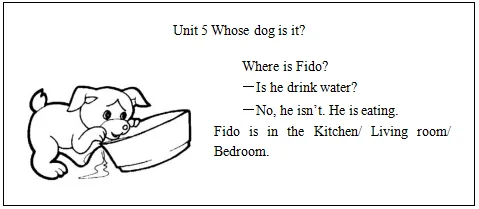
Now, please look at the blackboard. Here is my blackboard design, and I think it is very concise. Such a delicate blackboard design can help the students to catch the most important content of the class. That’s all for my presentation. Thanks for your listening.
16学科面试示范课(广告)