ARTICLE · 988811
2027年高考英语第一轮复习——必修二 Unit 6 Topic Talk, Lesson 2, Workbook Unit 6Listening课本二次开发(对标真题“听力”)
【原创听力试题】
普通高等学校招生全国统一考试(全国卷)英语听力试题、听力原文及命题分析
英语听力部分
注意事项
1.本试卷听力部分分为两节,满分30分。
2.答题前,考生务必将本人姓名、准考证号准确填写在答题卡指定位置。
3.作答选择题时,选出每小题答案后,用2B铅笔将答题卡上对应题目的答案标号涂黑。如需改动,须用橡皮擦干净后,再重新填涂其他答案标号。
4.听力考试结束后,考生需将本试卷与答题卡一并上交。
第一节(共5小题;每小题1.5分,满分7.5分)
听下面5段简短对话。每段对话后有一个小题,从题中所给的A、B、C三个选项中选出最佳选项。听完每段对话后,你有10秒钟的时间作答小题并阅读下一题。每段对话播放两遍。
1.What does the woman think makes firefighters admirable?
A.Their intelligence.
B.Their bravery and helpfulness.
C.Their creativity.
2.According to the man, what quality makes scientists admirable?
A.Being fearless.
B.Being hard-working and creative.
C.Being wealthy.
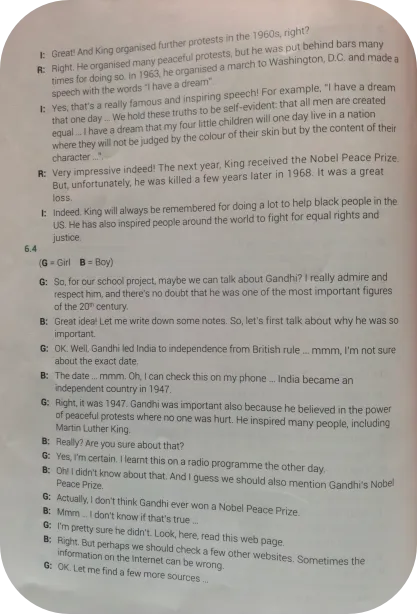
3.Why does the girl suggest Gandhi as the topic for their school project?
A.He led India to independence.
B.He inspired Martin Luther King.
C.He won the Nobel Peace Prize.
4.What does the boy imply about Gandhi and the Nobel Peace Prize?
A.He is certain Gandhi won it.
B.He doubts Gandhi ever won it.
C.He thinks Gandhi was nominated for it.
5.What do the two speakers agree is a typical quality of an admirable person?
A.Fighting against evil only.
B.Overcoming personal weaknesses.
C.Being famous worldwide.
第二节(共15小题;每小题1.5分,满分22.5分)
听下面5段较长对话或独白。每段材料后有若干小题,从题中所给的A、B、C三个选项中选出最佳选项。听每段材料前,你有5秒钟阅读对应小题;听完后,各小题将给出5秒钟的作答时间。每段材料播放两遍。
听第6段材料,回答第6、7题。
6.What important event happened to Martin Luther King in 1963?
A.He organized a bus protest.
B.He delivered the "I Have a Dream" speech.
C.He was assassinated.
7.How did Martin Luther King respond to racial discrimination in his childhood?
A. He accepted it reluctantly.
B. He firmly believed in equal treatment.
C. He ignored it completely.
听第7段材料,回答第8至10题。
8.What is the relationship between the two speakers?
A.Teacher and student.
B.Classmates working on a project.
C.Radio host and guest.
9.What does the boy advise them to do to verify facts about Gandhi?
A. Ask their history teacher.
B. Look up information in a book.
C. Refer to more than one website.
10.What is the girl completely certain about concerning Gandhi?
A.The exact date of India's independence.
B.His influence on Martin Luther King.
C.His winning a Nobel Prize.
听第8段材料,回答第11至13题。
11.What is the man's attitude towards firefighters?
A.He thinks they are over-praised.
B.He believes they deserve great respect.
C.He considers their job easy.
12.How many people received medical help from the rescue team in Nepal?
A. Two.
B. Sixty.
C. Over two thousand.
13.What is the woman's core duty as a rescue worker?
A.To gain media attention.
B.To reduce suffering and save lives.
C.To train new team members.
听第9段材料,回答第14至16题。
14.What belief did Gandhi and Martin Luther King share?
A.Violence is sometimes necessary.
B.Peaceful protest is powerful and effective.
C.Only leaders can create social change.
15.What does the woman think of King's "I Have a Dream" speech?
A.It was too long and boring.
B.It was inspiring and well-known.
C It was written by other people.
16.Why does the boy quote "all men are created equal"?
A.To show King's dream of social justice.
B.To criticize American social problems.
C.To compare it with Gandhi's ideas.
听第10段材料,回答第17至20题。
17.Who is the speaker most probably?
A.A tour guide.
B.A student delivering a class presentation.
C.A famous writer.
18.Which Chinese role model is mentioned in the speech?
A.Karl Marx.
B.Lei Feng.
C.Annie Gee.
19.Which quote is used to stress the value of helping others?
A."I have a dream."
B."The aim of living is making better lives for others."
C."Peace begins with a smile."
20.What is the main message of the speech?
A.Outstanding history makers are always famous.
B.Ordinary people can also be admirable.
C.Only political leaders can change history.
【听力原文】(完整版·高考标准语速文稿)
第一节
Text 1
W: Firefighters are truly admirable, aren't they?
M: Absolutely. They rush into dangerous situations without any hesitation.
W: Exactly. I deeply admire them for their bravery and their willingness to help people in danger.
Text 2
W: What kind of people do you admire most in daily life?
M: I have great respect for scientists. They work diligently and creatively, devoting themselves to improving people's lives. They change the world through wisdom and hard work rather than power.
Text 3
W: For our school project on admirable figures, shall we choose Gandhi as our topic?
M: That’s a wonderful choice. What makes you pick him?
W: He not only led India to independence, but also had a far-reaching influence on many world leaders, especially Martin Luther King.
Text 4
W: We can add the Nobel Peace Prize to Gandhi's achievements in our project.
M: I’m not so sure. As far as I know, Gandhi never received the Nobel Peace Prize at all.
Text 5
W: I think people who fight against evil and rescue lives are the most admirable.
M: That’s true, but it is also admirable for people to overcome their own weaknesses. Take Helen Keller for example. She fought against her physical disabilities and achieved great success.
W: I totally agree with you.
第二节
Text 6
W: Professor, could you talk about Martin Luther King’s early experience?
M: Sure. King suffered racial discrimination from an early age. In 1943, he was forced to give up his bus seat to white people, which made him deeply upset. Since then, he has firmly believed that all people should enjoy equal treatment regardless of race.
W: So he started to fight for racial equality later?
M: Yes. He organized a bus protest in 1955. In 1963, he led the March on Washington and delivered the world-famous "I Have a Dream" speech, which greatly promoted the civil rights movement in America.
Text 7
W: Let’s continue to polish our project about great history makers. We’ve decided to focus on Gandhi, right?
M: Yes. Let’s sort out key information about him.
W: Gandhi successfully led India to independence, but I can’t remember the exact year.
M: I’ve checked it online. It was 1947. And I’ve learned that Gandhi’s ideas greatly influenced Martin Luther King.
W: That’s what I want to confirm. I’m completely certain about this point after watching a relevant radio program.M: What about the Nobel Peace Prize? Did he win it?
W: I don’t think he did, but I’m not 100% sure.
M: Online information is not always accurate. We’d better check several different websites to verify all the facts.
W: Good idea. This can make our project more reliable.
Text 8
M: Your work as a rescue worker must be extremely tough and risky.
W: It is indeed challenging, but it is our bounden duty to reduce people’s suffering and save lives in disasters.
M: Have you ever taken part in any large-scale rescue mission?
W: Of course. I participated in the Nepal earthquake rescue operation. A team of over sixty members and six rescue dogs worked continuously for twelve days. We successfully rescued two trapped people and provided professional medical assistance for more than two thousand local residents.
M: That’s really impressive. Firefighters and rescue workers like you are brave and selfless, and you fully deserve people’s respect.
Text 9
W: I find Gandhi and Martin Luther King have a lot in common.
M: Definitely. The most important similarity is that they both stuck to non-violent protests. They proved that peaceful ways can also create great social changes.
W: King was greatly inspired by Gandhi’s thoughts. His 1963 "I Have a Dream" speech is extremely inspiring and has spread widely around the world.
M: Right. In the speech, he put forward the famous idea that all men are created equal, which fully reflected his dream of a fair and just society.
W: He was awarded the Nobel Peace Prize in 1964. Though he was killed in 1968, his spirit and legacy have always encouraged people to fight for justice.
Text 10
Good morning, everyone. Today I’m going to give a speech on admirable people. Many people assume that only famous historical figures can be admirable, but I hold a different opinion.
Admirable qualities lie in ordinary people from all walks of life. Take Lei Feng as an example. As an ordinary Chinese soldier, he devoted his whole life to helping others and has become a timeless role model in China. He once said, "The aim of living is making better lives for others."
This spirit is consistent with the idea of Karl Marx, who believed that the happiest people are those who bring happiness to the majority of others.
From my perspective, being admirable has nothing to do with fame or power. It lies in dedication, kindness and the willingness to contribute to others. Every ordinary person who spreads warmth and positivity is worthy of our admiration. Thank you for listening.
【参考答案】
第一节:1.B 2.B 3.B 4.B 5.B
第二节:6.B 7.B 8.B 9.C 10.B11.B 12.C 13.B 14.B 15.B16.A 17.B 18.B 19.B 20.B
【试题与教材、课标融合深度分析】
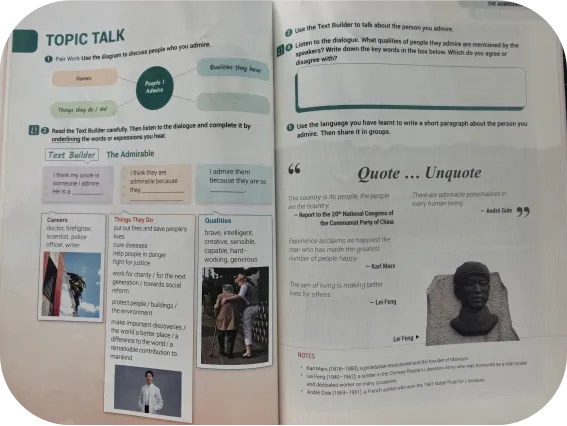
一、对接教材Topic Talk(1-5板块)
本套试题第1至5题完全依托单元主题对话素材命题,精准贴合教材核心内容。第1、2题聚焦单元核心话题,考查考生对消防员、科学家优秀品质的听力抓取能力,对应教材核心形容词词汇brave、helpful、hard-working、creative,落实单元词汇学习目标。第3、4题围绕甘地的人物事迹设问,重点考查高中核心功能意念——确认与不确定的口语表达,贴合教材功能句式训练重点。第5题突破表层认知,考查学生对admirable人物内涵的深度理解,对接教材中海伦·凯勒战胜自我缺陷的案例,引导学生全面认知优秀品质的多元内涵。
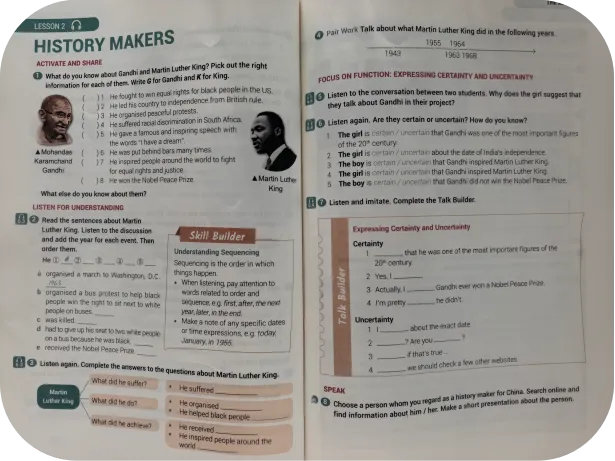
二、对接教材Lesson 2 History Makers(1-8板块)
第6、7题依托马丁·路德·金的生平史实素材,以时间线为线索,考查学生对关键历史事件、人物态度的听力理解能力,完全匹配教材听力任务中“梳理人物生平时间节点、抓取人物情感态度”的训练要求。第8至10题还原高中生课堂项目研讨的真实场景,复刻教材中“多方查证、辨别信息真伪”的对话内容,聚焦课标批判性思维培养,引导学生树立严谨的信息求证意识。第14至16题侧重人物对比分析,考查学生对甘地与马丁·路德·金非暴力抗争核心思想的归纳理解,深化对单元“时代伟人”主题的认知。
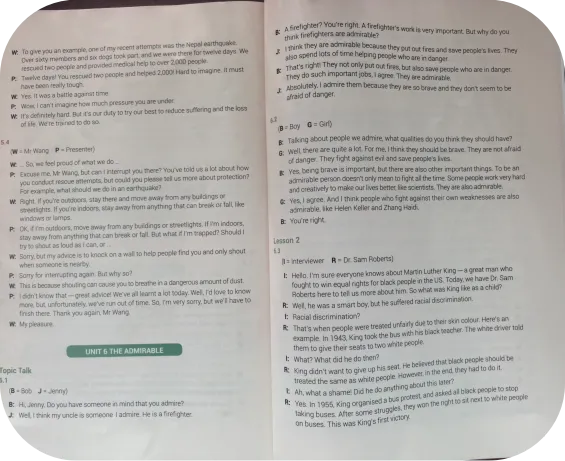
三、对接教材P104单元听力救援访谈素材
第11至13题取材教材原版尼泊尔地震救援访谈材料,精准考查数字细节、职业职责、人物态度等高频高考听力考点。试题保留教材原始数据,涵盖救援人数、时长、救助范围等关键信息,同时深挖救援人员无私奉献、坚守责任的职业精神,将语言考查与社会责任、敬业奉献的价值教育有机结合,落实教材育人目标。
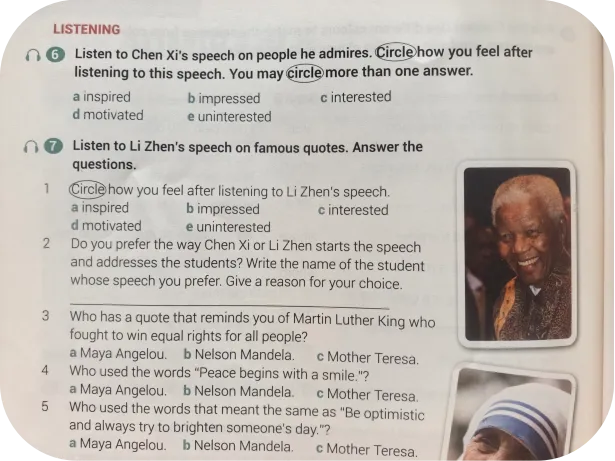
四、对接教材P88 Listening 6-7名人名言板块
第17至20题以课堂演讲为载体,整合教材Notes注释、经典名言Quote板块内容,融入雷锋、马克思等中外榜样人物及经典论述。试题打破单一人物考查模式,聚焦平凡人的可贵品质,呼应教材“平凡亦伟大”的核心主旨,既考查学生对名言、人物身份的细节辨识能力,也渗透中国榜样文化,落实文化意识培养目标。
五、紧扣2025版高中英语课标核心素养
语言能力:整套试题语速、题型、设问方式完全对标全国卷高考标准,重点考查学生在真实口语语境中抓取细节信息、推断人物态度、梳理语篇逻辑的核心听力能力,覆盖数字、时间、观点、主旨等高频考点。
文化意识:素材融合中外杰出人物事迹,兼顾国际视野与中国情怀,既介绍甘地、马丁·路德·金等国际伟人的进步思想,也重点融入雷锋等中国榜样形象,帮助学生尊重多元文化、认同本土优秀精神品质。
思维品质:试题设置信息辨析、人物对比、主旨归纳等多层次设问,摒弃单一浅层细节考查,着重训练学生的逻辑分析、归纳总结、批判性思考能力,契合课标高阶思维培养要求。
学习能力:依托时间标记词、逻辑连接词、功能句式等教材核心知识点命题,引导学生掌握听力语篇梳理技巧,养成结构化听力学习习惯。
六、命题特色与立德树人价值体现
整套试题坚守高考立德树人核心导向,价值立意积极正向。所有正确选项均围绕勇敢奉献、勤奋进取、平等正义、无私助人等正向品质设置,干扰项均为功利化、片面化、事实错误的内容,规避消极、负面价值导向。试题有机融合思政元素,将中国榜样精神、人类共同正义理念融入语言考查,实现语言测评与价值引领的统一。同时,全部素材均源于教材,无超纲内容、无脱离学情的偏难怪设问,贴合高中日常教学实际,兼具测评性与教学导向性。
请在微信客户端打开