英语考后巩固卷
高三 2025 年 12 月版
姓名: 班级:
强化记忆
举一反三 步步为赢 点石成金
点石联考出题中心点石联考
巩固卷采集了所有学生的考试数据,运用人工智能技术诊断出
每道题的知识点,通过“算法推荐+专家干预”精准推送习题,
提供与试卷同结构的巩固卷供您追踪效果,巩固卷每道原题衍
生1道基础题、3到巩固题、1道提升题,助力您精准高效提升!
1.及时分析,明确薄弱点
错题复盘:逐题分析错误原因(审题不清、知识点遗忘、计算失误等),用不同颜色标注错题类型。
统计归类:按知识点或题型分类整理错题(如函数、几何、语法、实验设计),统计高频失分模块,
明确需优先突破的薄弱环节。
2. 针对性突破 , 夯实基础
知识补漏:针对错题涉及的课本概念、公式、定理,重新梳理核心内容,结合例题理解应用场景。
专项训练:根据错题类型,精选同类题目进行限时练习(如每天10道同类题),强化解题思维和熟练
度。
3. 构建思维框架 , 提炼方法
思路对比:对比参考答案与自己的解题步骤,标注关键思路差异(如是否遗漏隐含条件、逻辑跳步)。
总结模板:针对高频题型(如阅读理解主旨题、数学压轴题),归纳通用解题步骤或答题模板。
4. 模拟应用 , 检验效果
变式训练:将原题条件或设问方式稍作改动,自主改编1-2道同类题,测试是否真正掌握核心逻辑。
限时重测:1-2周后重做巩固卷,对比正确率变化,重点关注反复出错的题目。
5. 长期规划 , 动态调整
建立档案:将错题整理成电子文档或活页本,标注错误日期和重做结果,形成个人学习轨迹。
定期回顾:每周抽取10分钟复习错题本,考前集中筛查易错点,避免重复点石联考
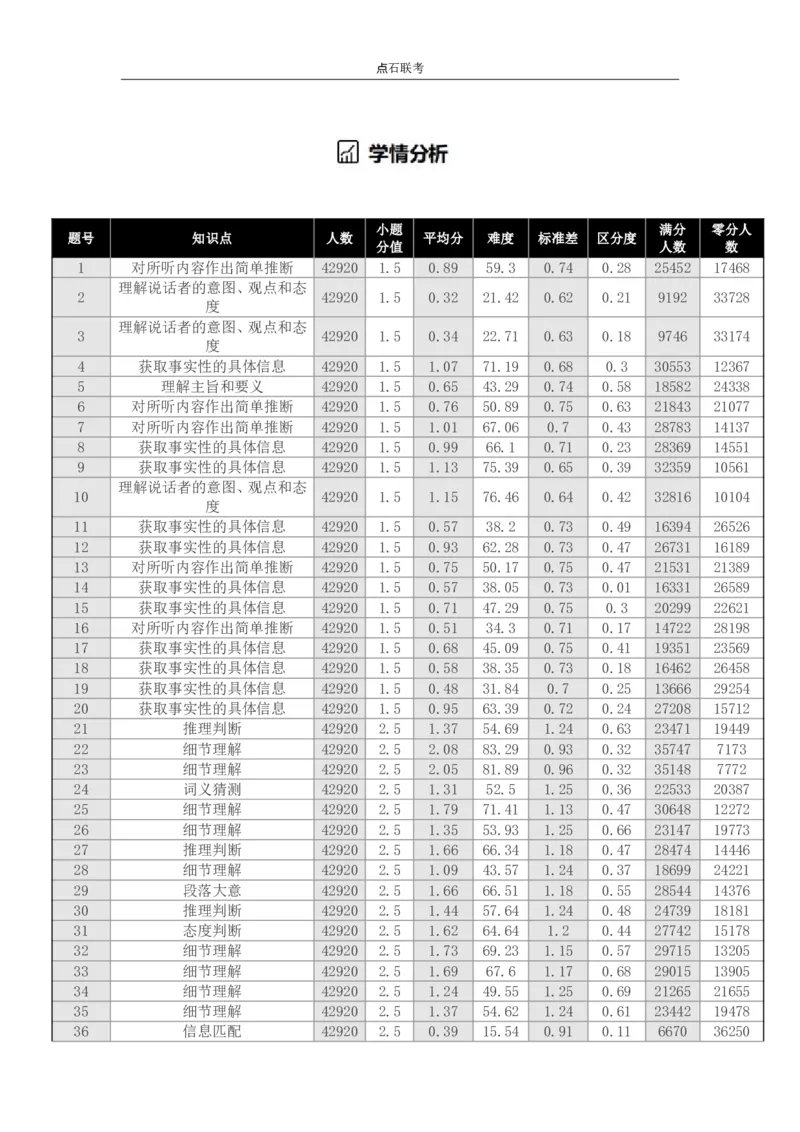
小题 满分 零分人
题号 知识点 人数 平均分 难度 标准差 区分度
分值 人数 数
1 对所听内容作出简单推断 42920 1.5 0.89 59.3 0.74 0.28 25452 17468
理解说话者的意图、观点和态
2 42920 1.5 0.32 21.42 0.62 0.21 9192 33728
度
理解说话者的意图、观点和态
3 42920 1.5 0.34 22.71 0.63 0.18 9746 33174
度
4 获取事实性的具体信息 42920 1.5 1.07 71.19 0.68 0.3 30553 12367
5 理解主旨和要义 42920 1.5 0.65 43.29 0.74 0.58 18582 24338
6 对所听内容作出简单推断 42920 1.5 0.76 50.89 0.75 0.63 21843 21077
7 对所听内容作出简单推断 42920 1.5 1.01 67.06 0.7 0.43 28783 14137
8 获取事实性的具体信息 42920 1.5 0.99 66.1 0.71 0.23 28369 14551
9 获取事实性的具体信息 42920 1.5 1.13 75.39 0.65 0.39 32359 10561
理解说话者的意图、观点和态
10 42920 1.5 1.15 76.46 0.64 0.42 32816 10104
度
11 获取事实性的具体信息 42920 1.5 0.57 38.2 0.73 0.49 16394 26526
12 获取事实性的具体信息 42920 1.5 0.93 62.28 0.73 0.47 26731 16189
13 对所听内容作出简单推断 42920 1.5 0.75 50.17 0.75 0.47 21531 21389
14 获取事实性的具体信息 42920 1.5 0.57 38.05 0.73 0.01 16331 26589
15 获取事实性的具体信息 42920 1.5 0.71 47.29 0.75 0.3 20299 22621
16 对所听内容作出简单推断 42920 1.5 0.51 34.3 0.71 0.17 14722 28198
17 获取事实性的具体信息 42920 1.5 0.68 45.09 0.75 0.41 19351 23569
18 获取事实性的具体信息 42920 1.5 0.58 38.35 0.73 0.18 16462 26458
19 获取事实性的具体信息 42920 1.5 0.48 31.84 0.7 0.25 13666 29254
20 获取事实性的具体信息 42920 1.5 0.95 63.39 0.72 0.24 27208 15712
21 推理判断 42920 2.5 1.37 54.69 1.24 0.63 23471 19449
22 细节理解 42920 2.5 2.08 83.29 0.93 0.32 35747 7173
23 细节理解 42920 2.5 2.05 81.89 0.96 0.32 35148 7772
24 词义猜测 42920 2.5 1.31 52.5 1.25 0.36 22533 20387
25 细节理解 42920 2.5 1.79 71.41 1.13 0.47 30648 12272
26 细节理解 42920 2.5 1.35 53.93 1.25 0.66 23147 19773
27 推理判断 42920 2.5 1.66 66.34 1.18 0.47 28474 14446
28 细节理解 42920 2.5 1.09 43.57 1.24 0.37 18699 24221
29 段落大意 42920 2.5 1.66 66.51 1.18 0.55 28544 14376
30 推理判断 42920 2.5 1.44 57.64 1.24 0.48 24739 18181
31 态度判断 42920 2.5 1.62 64.64 1.2 0.44 27742 15178
32 细节理解 42920 2.5 1.73 69.23 1.15 0.57 29715 13205
33 细节理解 42920 2.5 1.69 67.6 1.17 0.68 29015 13905
34 细节理解 42920 2.5 1.24 49.55 1.25 0.69 21265 21655
35 细节理解 42920 2.5 1.37 54.62 1.24 0.61 23442 19478
36 信息匹配 42920 2.5 0.39 15.54 0.91 0.11 6670 36250点石联考
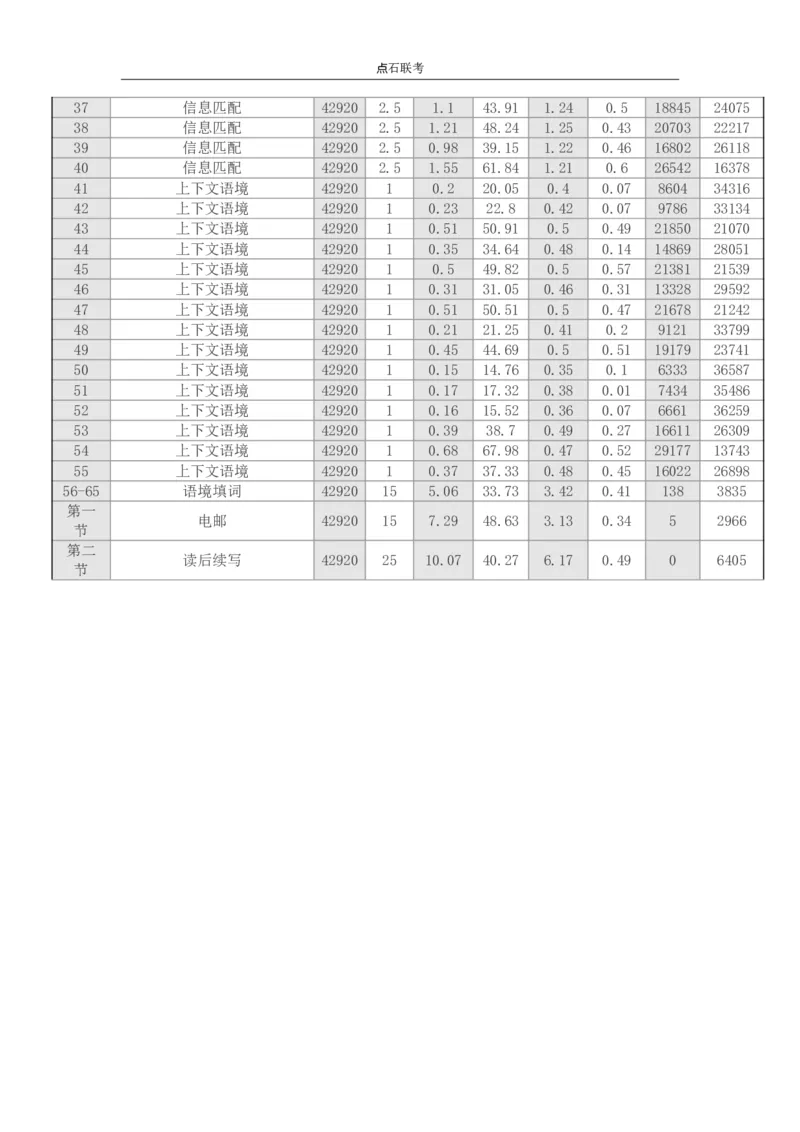
37 信息匹配 42920 2.5 1.1 43.91 1.24 0.5 18845 24075
38 信息匹配 42920 2.5 1.21 48.24 1.25 0.43 20703 22217
39 信息匹配 42920 2.5 0.98 39.15 1.22 0.46 16802 26118
40 信息匹配 42920 2.5 1.55 61.84 1.21 0.6 26542 16378
41 上下文语境 42920 1 0.2 20.05 0.4 0.07 8604 34316
42 上下文语境 42920 1 0.23 22.8 0.42 0.07 9786 33134
43 上下文语境 42920 1 0.51 50.91 0.5 0.49 21850 21070
44 上下文语境 42920 1 0.35 34.64 0.48 0.14 14869 28051
45 上下文语境 42920 1 0.5 49.82 0.5 0.57 21381 21539
46 上下文语境 42920 1 0.31 31.05 0.46 0.31 13328 29592
47 上下文语境 42920 1 0.51 50.51 0.5 0.47 21678 21242
48 上下文语境 42920 1 0.21 21.25 0.41 0.2 9121 33799
49 上下文语境 42920 1 0.45 44.69 0.5 0.51 19179 23741
50 上下文语境 42920 1 0.15 14.76 0.35 0.1 6333 36587
51 上下文语境 42920 1 0.17 17.32 0.38 0.01 7434 35486
52 上下文语境 42920 1 0.16 15.52 0.36 0.07 6661 36259
53 上下文语境 42920 1 0.39 38.7 0.49 0.27 16611 26309
54 上下文语境 42920 1 0.68 67.98 0.47 0.52 29177 13743
55 上下文语境 42920 1 0.37 37.33 0.48 0.45 16022 26898
56-65 语境填词 42920 15 5.06 33.73 3.42 0.41 138 3835
第一
电邮 42920 15 7.29 48.63 3.13 0.34 5 2966
节
第二
读后续写 42920 25 10.07 40.27 6.17 0.49 0 6405
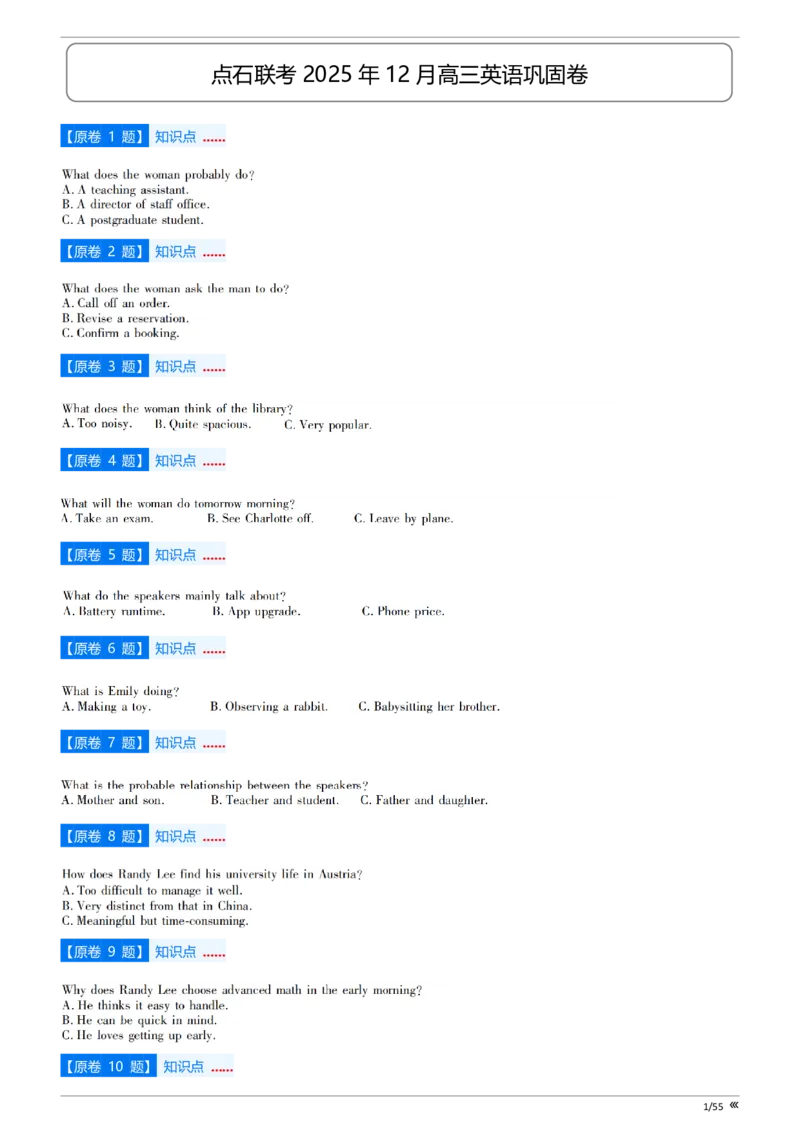
节点石联考 2025 年 12 月高三英语巩固卷
【原卷 1 题】 知识点 ......
【原卷 2 题】 知识点 ......
【原卷 3 题】 知识点 ......
【原卷 4 题】 知识点 ......
【原卷 5 题】 知识点 ......
【原卷 6 题】 知识点 ......
【原卷 7 题】 知识点 ......
【原卷 8 题】 知识点 ......
【原卷 9 题】 知识点 ......
【原卷 10 题】 知识点 ......
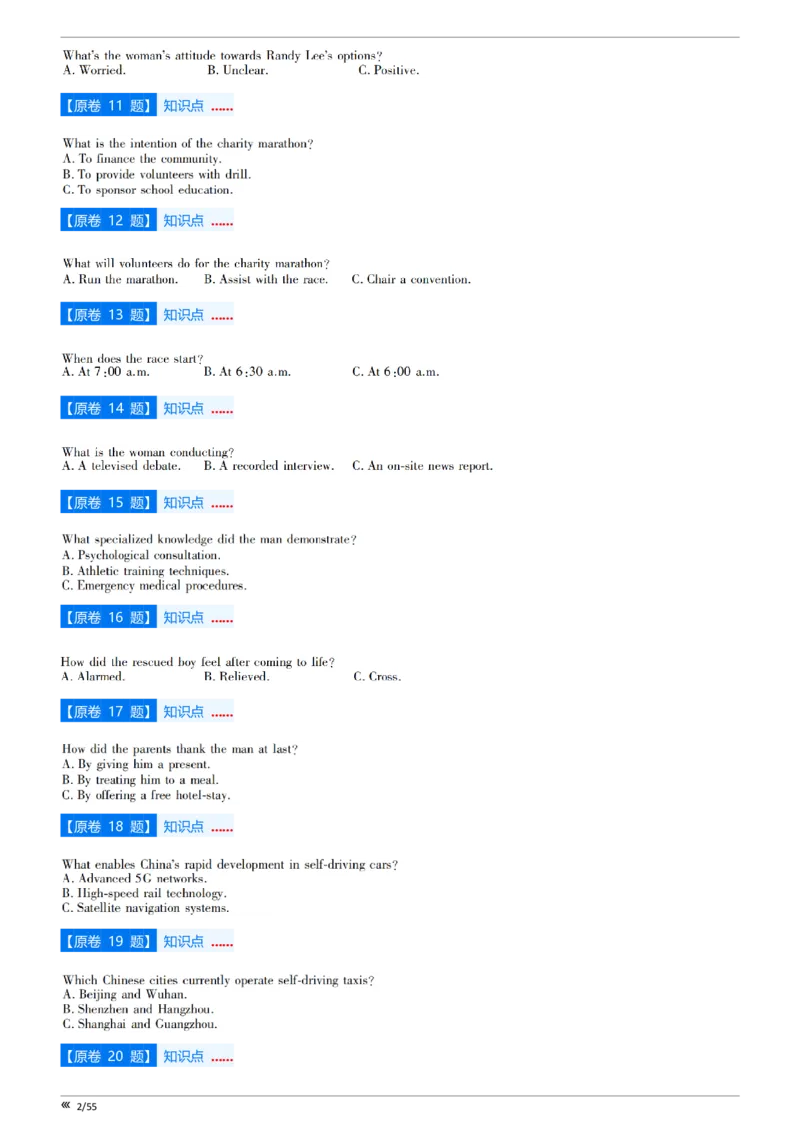
1/55【原卷 11 题】 知识点 ......
【原卷 12 题】 知识点 ......
【原卷 13 题】 知识点 ......
【原卷 14 题】 知识点 ......
【原卷 15 题】 知识点 ......
【原卷 16 题】 知识点 ......
【原卷 17 题】 知识点 ......
【原卷 18 题】 知识点 ......
【原卷 19 题】 知识点 ......
【原卷 20 题】 知识点 ......
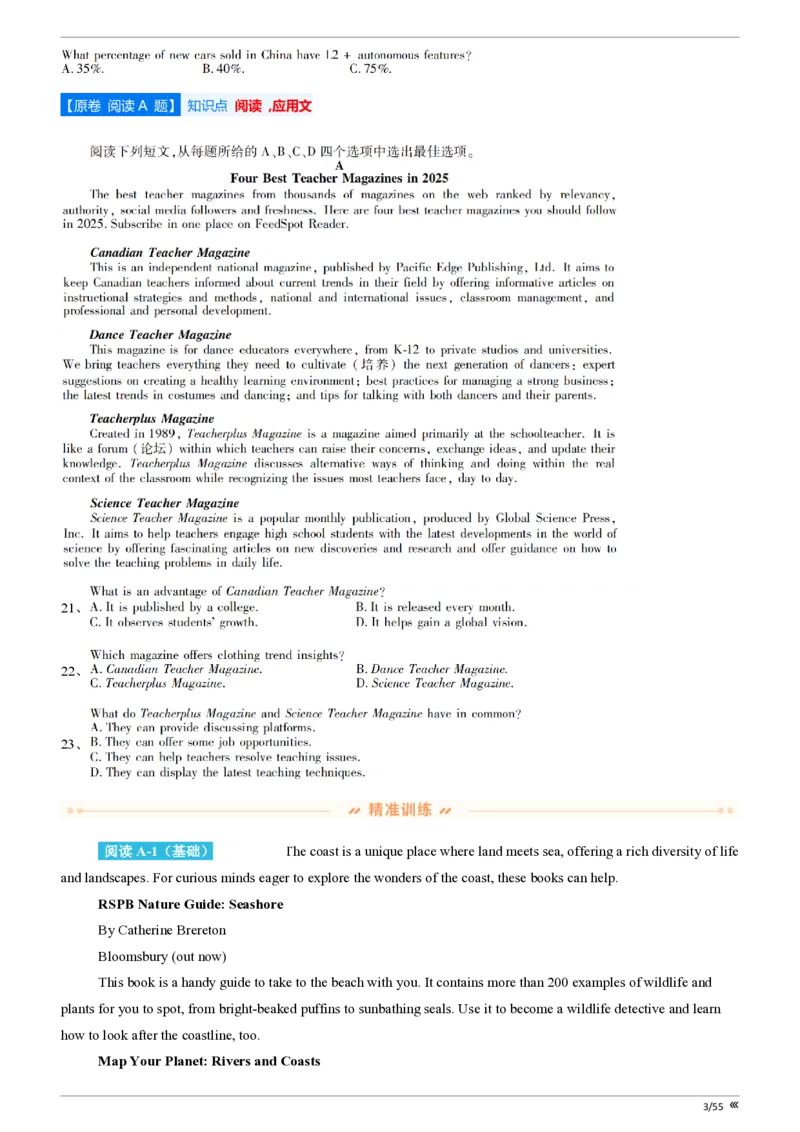
2/55【原卷 阅读A 题】 知识点 阅读 ,应用文
21、
22、
23、
阅读A-1(基础)[29596588] The coast is a unique place where land meets sea, offering a rich diversity of life
and landscapes. For curious minds eager to explore the wonders of the coast, these books can help.
RSPB Nature Guide: Seashore
By Catherine Brereton
Bloomsbury (out now)
This book is a handy guide to take to the beach with you. It contains more than 200 examples of wildlife and
plants for you to spot, from bright-beaked puffins to sunbathing seals. Use it to become a wildlife detective and learn
how to look after the coastline, too.
Map Your Planet: Rivers and Coasts
3/55By Amy Chapman
Franklin Watts (out now)
Find out more about rivers and coasts with the help of maps. Find out the path a river takes from its source to its
mouth and how the force of water shapes the coastline. It’s the perfect resource for understanding the dynamic
relationship between freshwater systems and the coastal environments they create.
The Pebble (鹅卵石) Spotter’s Guide
By Clive Mitchell
National Trust Books (out now)
You see all sorts of pebbles at the beach, but have you ever wanted to know more about them? This guidebook
will help you uncover the history and secrets of different pebble types. Once you start, you’ll leave no stone unturned!
Geology Rocks! Weathering and Erosion (侵蚀)
By Claudia Martin
Wayland (out now)
Learn about weathering and erosion and how these processes break down rocks, with fun jokes, cartoons and
hands-on activities. You’ll also find out about the incredible forms that rocks can take.
1.Which book is the most helpful for a geography project on rivers?
A.The Pebble Spotter’s Guide. B.Map Your Planet: Rivers and Coasts.
C.RSPB Nature Guide: Seashore. D.Geology Rocks! Weathering and Erosion.
2.What is a feature of Geology Rocks! Weathering and Erosion?
A.Detecting wildlife species. B.Exploring pebble formation.
C.Combining fun with learning. D.Offering maps of ocean currents.
3.Who are the intended readers of the passage?
A.Officials designing conservation policies. B.Nature enthusiasts planning coastal visits.
C.Historians researching maritime trade routes.D.Marine biologists studying deep-sea ecosystems.
阅读A-2(巩固)[29886288] As the end of the year draws closer, we have rounded up four novels for any
determinedly bookish folk who still have an end-of-year reading target to hit.
Dusk. By Robbie Arnott.
A puma (美洲狮) wanders the Tasmanian highlands, killing sheep and their shepherds. Iris and Floyd, the
homeless twins, join the hunt in hope of making a fortune. This brings them into contact with another tracker, Patrick,
who is tricky and dangerous. This is a novel of survival and betrayal, enriched by arresting description of nature.
Drayton and Mackenzie. By Alexander Starritt.
Two very different men, James and Roland, meet as young adults. Both seek success, first as management
consultants, then as entrepreneurs in the field of green energy. As they suffer private pain and the financial crash of
2007, they increasingly value their friendship. Both characters are expertly drawn in this funny, touching story.
Flashlight. By Susan Choi.
One night, while on holiday in Japan, ten-year-old Louisa and her father go for a walk along a beach. The next
day she is found half-dead and her parent has disappeared. At home in America, Louisa and her mother attempt to make
sense of the mystery that rocked their lives. A reflection on identity and displacement that is full of twists and turns.
Sympathy Tower Tokyo. By Qudan Rie. Translated by Jesse Kirkwood.
4/55The winner of Japan’s top Akutagawa prize, this novel is set in an imagined future and develops around Sara
Machina, an architect tasked with designing a tall building in which criminals can live in comfort. Sara, a victim of
street violence, is uncomfortable with the mission and seeks guidance from a chatbot. A bold exploration of crime,
punishment and self-help.
1.Why do Iris and Floyd join the hunt for the puma in Dusk?
A.To get a sum of money.
B.To protect the sheep and shepherds.
C.To make friends with tracker Patrick.
D.To enjoy the natural scenery of Tasmania.
2.Which novel takes place in a fictional future world?
A.Dusk B.Flashlight
C.Sympathy Tower Tokyo D.Drayton and Mackenzie
3.Where is this article most probably taken from?
A.A textbook on literature.
B.An official notice from a library.
C.A personal diary about reading.
D.A book review column in a magazine.
阅读A-3(提升)[29868510] At the end of 2024 a survey found that one of Americans’ top resolutions for the
coming year was to read more. By this point, however, most will have given up on that aspiration, along with their
dreams of perfectly toned muscles or a completed list of DIY projects. But all is not lost as the end of the year draws
closer. We have rounded up four favourite novels published recently. Among our choices are a number of slim
volumes: perfect for any determinedly bookish folk who still have an end-of-year reading target to hit.Drayton and
Mackenzie. By Alexander Starritt.
Two very different men meet as young adults. Both seek success, first as management consultants, then as
entrepreneurs (企业家) in the field of green energy. As they navigate private pain and the unrest of the global financial
crash, they increasingly value their friendship. Both characters are expertly drawn in this funny, touching
story.Flashlight. By Susan Choi.
One night, while on holiday in Japan, ten-year-old Louisa and her father go for a walk along a beach. The next day she
is found half-dead and her parent has disappeared. At home in America, Louisa and her mother attempt to make sense
of the mystery that rocked their lives. A story full of twists and turns.Sympathy Tower Tokyo. By Qudan Rie.
Translated by Jesse Kirkwood.
The winner of Japan's prestigious Akutagawa Prize, this novel is set in an imagined future and revolves around Sara, an
architect tasked with designing a skyscraper in which convicted criminals can live in comfort. A bold interrogation of
crime, punishment and redemption.What We Can Know. By Ian McEwan.
A celebrated poet reads his latest work, dedicated to his wife, at her birthday party. Then the poem goes missing.
Later an academic search through archives is launched to track down the lost poem. His discovery yields an account of
passion, murder and guilt. Ian McEwan combines a love story and a thrilling mystery to great effect.
1.Which is one of Americans’ top resolutions in 2025 according to the survey?
A.Reading more volumes. B.Designing DIY items.
5/55C.Reading books as slim as possible. D.Spending less time working out.
2.What is recommended if you like reading something amusing?
A.Flashlight. B.Drayton and Mackenzie.
C.Sympathy Tower Tokyo. D.What We Can Know.
3.What do the last two books have in common?
A.Both are award-winners.
B.Both are concerned with crimes.
C.Both talk about touching love stories.
D.Both are set in an imaginary future world.
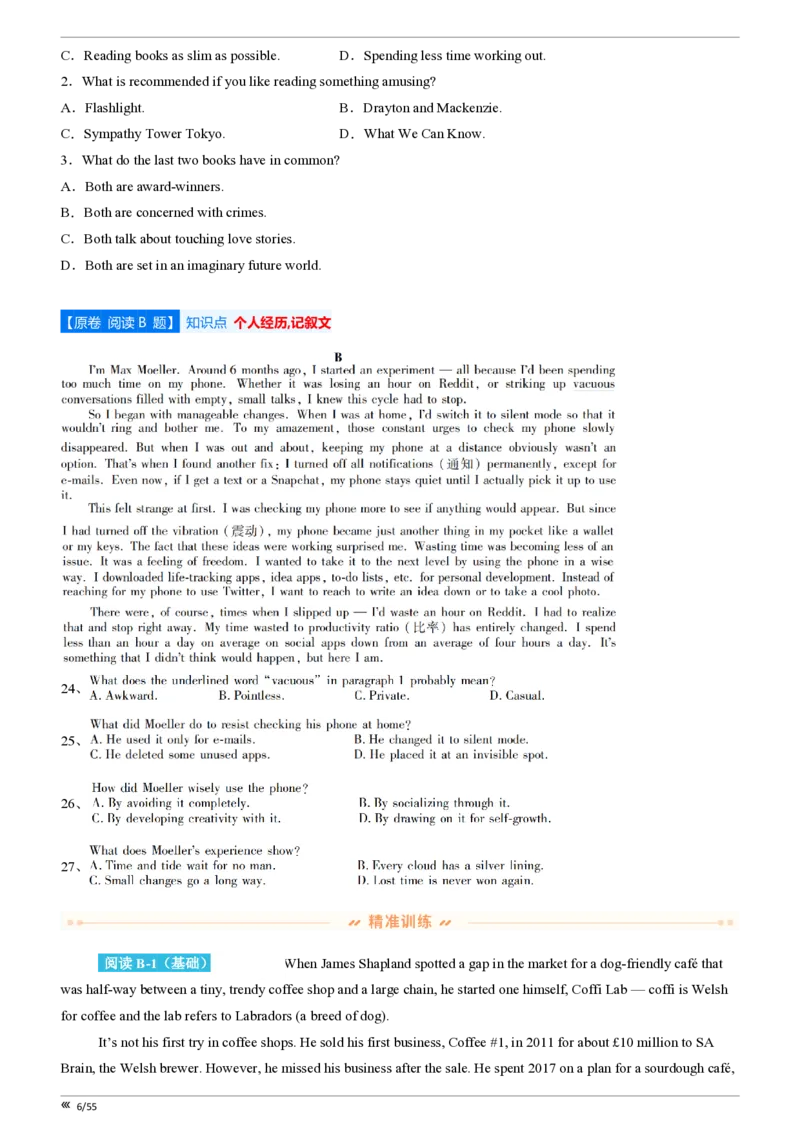
【原卷 阅读B 题】 知识点 个人经历,记叙文
24、
25、
26、
27、
阅读B-1(基础)[29989153] When James Shapland spotted a gap in the market for a dog-friendly café that
was half-way between a tiny, trendy coffee shop and a large chain, he started one himself, Coffi Lab — coffi is Welsh
for coffee and the lab refers to Labradors (a breed of dog).
It’s not his first try in coffee shops. He sold his first business, Coffee #1, in 2011 for about £10 million to SA
Brain, the Welsh brewer. However, he missed his business after the sale. He spent 2017 on a plan for a sourdough café,
6/55inspired by the success of the pizza chain Franco Manca, but shelved the idea because “the market seemed a little too
good to be true”.
In 2020, he sensed an unmet need for cafés that had enough “space to take my labrador in”. His plan was to open
coffee shops big enough for dogs and their owners, with friendly staff selling good food and coffee. Coffi Lab also
donates the profits from the homemade dog biscuits it sells, plus first-day takings from each store it opens. So far, it has
raised more than £100,000 for Guide Dogs charity and sponsored 11 dogs in training.
Coffi Lab now has 11 sites, with number 12 opening soon in Pontcanna, and three more over the next year in
Wiltshire and Shropshire, all within 100 miles from its base in Cardiff. “I feel quite strongly about being able to visit
frequently, so it’s not going to become a one-a-week blind expansion,” he said.
Coffi Lab began doing its own baking in 2023, when Shapland decided that buying in pre-packaged baked goods
and sandwiches wouldn’t keep customers coming back. “When you do that, you end up with average food that you’re
selling for £5 and it’s not what people want” — especially when they are paying £ 4 for a coffee.
1.What can we learn about Coffi Lab from the first two paragraphs?
A.It represents an emerging business.
B.It was modeled on a pizza chain.
C.It is a sub-brand of Coffee #1.
D.It began as sourdough café.
2.What does Coffi Lab do besides serving food and coffee?
A.Provide dog training sessions.
B.Run a dog welfare foundation.
C.Donate dog biscuits to charity.
D.Fund a dog charitable organization.
3.Which word best describes Shapland’s business approach?
A.Daring. B.Strategic. C.Idealistic. D.Traditional.
4.What does the underlined part in the last paragraph mean?
A.Coffee prices have been rising.
B.Food shouldn’t cost more than coffee.
C.Food and coffee should be priced reasonably.
D.Customers expect better food for their money.
阅读B-2(巩固)[29986735] At first sight, Easthope doesn’t seem much like a Cassandra (希腊神话人物). She
smiles a lot. Her manner is kind and motherly; pushed to name her profession, you might guess at nurse or teacher. But
look closer.
Easthope is an emergency planner whose job is to support the survivors of major disasters, in which capacity she
acted following the 2004 Indian Ocean tsunami and the fire at Grenfell Tower. For two decades, the public knew
nothing about this vital work, which went on behind the scenes, though she was hugely admired in what we might call
professional disaster circles: a voice of calm and a fountain of wisdom. But in 2023, she published a best-selling book
about her career, When the Dust Settles, and that changed. People became very interested in what she did.
“At literary festivals, most authors get questions about their writing process,” Easthope says. “But I wouldn’t get
those. What people wanted from me was to know how I lived with the knowledge that I have. Wasn’t I afraid? How did
7/55I handle it? I would tell them that I didn’t live afraid, and I would give them basic advice. But this wasn’t enough.” In
the end, she felt she had no choice but to write a second book, one in which she would try to cover all that she has
learned for the benefit of each individual.
While her publisher describes Come What May as a road map for resilience (韧性), the word is one Easthope
dislikes. Ready, she suggests, is a better one. Easthope also reminds people that small things, like losing hair during
illness or consuming too much food after someone dies, still matter. She encourages people to remember, not to forget,
what happened during disasters, because such events leave a long-lasting effect.
1.What might a Cassandra be like according to paragraph 1?
A.Friendly and energetic. B.Competent and cautious.
C.Cheerful and easy-going. D.Serious and unapproachable.
2.What led to increased public awareness of Easthope’s work in 2023?
A.The publication of a best seller.
B.Her involvement in 2004 tsunami relief.
C.The growth of professional disaster circles.
D.Her sudden rise to fame through media.
3.Why are readers’ questions cited in paragraph 3?
A.To reveal Easthope’s personal fears.
B.To explain Easthope’s writing process.
C.To showcase Easthope’s writing motivation.
D.To present public doubts about Easthope’s work.
4.What does Easthope agree on handling disasters?
A.Forgetting aids recovery.
B.Resilience matters most.
C.Positive thinking takes the lead.
D.Minor sufferings deserve attention.
阅读B-3(提升)[29962585] Eighteen miles into the walk, both of my legs screamed. I was a few months into
training for a 30-mile walking challenge to celebrate the final year of my Ph. D., and now my carefully laid plans
seemed on shaky ground. The setback came on top of bad news on another front: my job hunt. I applied to positions
broadly, confident I would land something soon. But the rejections started to roll in. In both cases I would soon have to
make a choice: Should I stay the course, or adjust my plans?
Looking for a way to take my mind off the stresses of finishing my Ph. D. and the job search, I decided to
organize a 30-mile walking challenge. I’d ease the burden of long hours working on thesis chapters and job applications
by being out in the countryside, among the members of the walking group I had joined a year ago. Soon, though, I was
finding I had less time to train. I pushed myself harder than I should have, setting the stage for my leg injury.
My professional prospects weren’t looking any better. And my injury only worsened my mood. For months I
stuck doggedly to my previously laid plans — but maybe it was time to try a new path.
I previously considered government jobs but had been discouraged by the complicated application process, very
different from that at private companies. But the employment policies seemed friendly toward those undertaking career
transitions, and the work seemed in line with my career goals. I decided to give it a try, learning new vocabulary s to
8/55explain how my academic experience qualified me for the jobs — and was excited to get interviews, and eventually
offers, for two different positions. The weight I had felt for months finally lifted.
At the same time, I was still struggling with my walk plans. With the stress of my job search behind me, I
learned I could find satisfaction by revising my goal: a shortened walk of 14 miles, a distance I could manage
comfortably.
One month later, I successfully defended my thesis and started my new job.
1.What can we learn about the author from paragraph 1?
A.He was faced with life difficulties. B.He had clear goals for his future.
C.He was making academic progress. D.He had given up on his sports plans.
2.What did the author expect of the 30-mile walking challenge?
A.Mental relief. B.New friendships. C.Job opportunities. D.Fitness improvement.
3.Why did the author apply for government jobs?
A.There were various position options. B.The application procedure was familiar.
C.They allowed for a long career transition. D.They matched his professional objectives.
4.What message does the author most want to send in the text?
A.Plans can be adjusted to better suit ourselves.B.Success often comes after tolerating failures.
C.Exercise can contribute to our mental capacities. D.Overcoming challenges is a necessary part of life.
【原卷 阅读C 题】 知识点 发明与创造 ,说明文
28、
29、
9/5530、
31、
阅读C-1(基础)[29723328] AI Suitcase is a smart suitcase developed by a blind computer scientist to aid the
visually impaired (有缺陷的). It can navigate (导航) their surroundings more efficiently without the aid of guide dogs.
65-year-old Chieko Asakawa has been completely blind since she was only 14, following an accident. She is a
computer scientist. Having long struggled with navigating unfamiliar and crowded places, Asakawa came up with an
idea to help the visually impaired get around easier.
In 2017, her own experiences inspired her to put forward the idea of a smart suitcase that could guide its user
with the help of built-in sensors and cameras. Six years later, the Al Suitcase is almost ready for entering the market.
“AI guides me as it replaces the sight I have lost. It is a dream to be able to go out freely by myself,” Asakawa
said during a 2020 interview when her invention first made international news headlines.
After the user inputs their destination on their smartphone, the Al Suitcase can plan the best route to that point.
The smart suitcase then relies on a set of sensors and a GPS system to assess its surroundings to avoid running into
other people and blocks on its route.
This smart device is now available for testing by any visually impaired person in front of the Miraikan Museum.
Asakawa and the companies that financed her work over the last few years want to make the AI Suitcase available for
hire at airports, shopping centers, and train stations in the near future.
1.What can we know about Chieko Asakawa?
A.She is not totally blind. B.She sets foot in computer science.
C.She raises some guide dogs. D.She dreams to stay indoors quietly.
2.When was the AI suitcase ready for market?
A.In 2014. B.In 2017. C.In 2020. D.In 2023.
3.How can the AI suitcase assess its surroundings?
A.By analyzing the data given by designers.
B.By responding to the users’ voice.
C.By relying on sensors and GPS system.
D.By showing the destinations on screen.
4.What is a suitable title for the text?
A.A Female Computer Scientist Fought against Blindness
B.Chieko Asakawa Did Her Own Business Successfully
C.Asakawa and Her Company Financed the Visually Impaired
D.A Scientist Created AI-Powered Suitcase for the Visually Impaired
阅读C-2(巩固)[30002736] Stanford assistant professor Ruike Zhao published a groundbreaking medical
breakthrough in Nature: using a tiny 2 mm microrobot, she increased the success rate of blood clot (血块) removal from
a mere 11% to an amazing 90%, sending shockwaves through the medical world.
10/55In modern society, about one in every dozen people may experience a blood clot in their lifetime. It is widely
known that blood clots are the leading cause of strokes and heart attacks. During treatment, the ability to quickly and
effectively restore blood flow becomes a matter of life and death.
Unfortunately, traditional mechanical methods have a low success rate. The process is like trying to pick up
broken tofu with chopsticks— not only is success unlikely, but the situation may even worsen. Blood clots may break
apart while being deformed, resulting in small pieces stuck in hard-to-reach areas.
However, Professor Zhao’s 2 mm micro-robot enters blood vessels (血管) and, using high-speed rotation (旋转),
generates forces to reduce the clot size to 5%. It’s like when you press and rub soft things, like hair, between your
hands. The force makes them stick together into a small ball. The micro-robot works similarly, using pressure to bring
the clot components together, making them easier to remove. This process requires no drugs, causes no vessel damage,
and effectively releases trapped red blood cells back into blood.
What’s astonishing is that this innovation is inspired from subway TBMs, tunnel-boring machines (盾构机). The
way tunnel-boring machines efficiently handle hard soil and rock in narrow spaces inspired the creation. This brilliant
Chinese researcher miniaturized the enormous underground machine to a size tens of thousands of times smaller and
adapted it for use in human blood vessels.
Currently, the technology has been successfully tested on pigs. While most of these studies remain in the
laboratory phase, the breakthrough itself is exciting. This technology may soon extend beyond blood clots to address
issues like kidney stones or gallstones.
1.What’s the function of Paragraph 1?
A.To lead into the topic. B.To explain a common phenomenon.
C.To introduce a famous scientist. D.To criticize a new study.
2.What can we know about Zhao’s micro-robot?
A.It usually increases the clot size.
B.It prevents clots from forming again.
C.It has been carried out on real patients.
D.It raises success rate and reduces side effects.
3.What does the author try to illustrate by mentioning TBMs?
A.The cost of medical robotics. B.The reason behind the numerous trials.
C.The inspiration behind the innovation. D.The importance of modern machinery.
4.Where can we probably read the passage?
A.In a geography textbook. B.In a medical magazine.
C.On a culture website. D.In a travel guide.
阅读C-3(提升)[29604594] The tiny worm Caenorhabditis elegans has a brain just about the width of a human
hair, yet it can coordinate and calculate complex movements as it hunts for food. Daniela Rus, a computer scientist at
MIT, was so deeply impressed by the elegance and efficiency of this worm’s brain that she co-founded a company,
Liquid AI, to build a new type of artificial intelligence.
Many researchers including Rus think making traditional AI more brainlike could create flexible and perhaps
smarter technology. “To improve AI truly, we need to absorb insights from neuroscience (神经科学),” says Kanaka
Rajan, a computational neuroscientist at Harvard University.
11/55Mike Davies, who directs the Neuromorphic Computing Lab, notes such technology won’t fully replace ordinary
computers or traditional AI models — instead, many systems will coexist in the future. Imitating brains is not a new
idea. In the 1950s, Frank Rosenblatt created the perceptron, a highly simplified model of brain nerve cell
communication with a single layer of connected artificial neurons. This basic design later helped inspire deep learning.
Yet consuming vast amounts of data and energy, most today’s AI models are unable to adapt easily to new situations or
learn from single experiences like a brain, and are criticized as “brute force and inefficient.” Currently, AI development
has two paths — “scale-up” vs. “efficiency-focused” — with an uncertain future while brain-inspired neuromorphic
computing progress hasn’t joined mainstream AI.
Inspired by the worm, Rus worked with Ramin Hasani’s team to create liquid neural networks. Unlike traditional
deep learning with fixed post-training settings, these networks are more flexible and can learn like living things. By
copying worm neurons with mathematical formulas and solving computing problems, they can work in real time. Tests
showed with just 34 artificial neurons a small liquid network worked better than a traditional AI with 250,000 settings
in drone tasks. Liquid AI has worked with DARPA to test aircraft models and launched the 7-billion-setting LFM-7B,
which performs better than similar traditional language models.
Though needing much computing power and not necessarily more energy-saving, liquid neural networks are an
important step toward realistic, brain-like AI. As Rus says, “I’m excited about Liquid AI because I believe it could
change the future of AI and computing.”
1.What mainly inspired Daniela Rus to establish Liquid AI?
A.The limitations of traditional AI models.
B.The efficiency of the tiny worm’s brain.
C.The worm’s cooperative food-hunting skills.
D.The pursuit of more flexible and smarter technology.
2.What does Mike Davies suggest about future AI development?
A.Brain-like technology has little practical value.
B.Neuromorphic computing will dominate the AI field.
C.Different AI systems may work together in the future.
D.Traditional AI models will be completely abandoned.
3.What makes liquid neural networks special?
A.They have fixed settings after training.
B.They depend on few mathematical formulas.
C.They work worse than traditional AI in tasks.
D.They can learn flexibly like living creatures.
4.What is the main idea of the last paragraph?
A.Liquid AI has both limits and value.
B.Brain-like AI has been fully achieved.
C.Traditional AI is more reliable than liquid AI.
D.Liquid AI will definitely control the AI market.
【原卷 阅读D 题】 知识点 生态旅游,说明文
12/5532、
33、
34、
35、
阅读D-1(基础)[29746073] Cryptocurrencies have taken the financial world by storm in recent years.
Bitcoin, the first and most well-known cryptocurrency, was introduced in 2009. Cryptocurrencies are digital or virtual
currencies that use cryptography for security.
One of the main features of cryptocurrencies is their decentralized nature. Unlike traditional currencies that are
regulated by central banks, cryptocurrencies operate on a technology called blockchain. A blockchain is a distributed
ledger that records all transactions across a network of computers. This means that no single entity has control over the
currency.
However, the rise of cryptocurrencies also brings several issues. Their value can be extremely volatile. For
example, the price of Bitcoin has experienced wild fluctuations, sometimes rising or falling by thousands of dollars in a
short period. Additionally, the lack of regulation makes them vulnerable to illegal activities such as money laundering
and fraud. There are also concerns about the environmental impact of cryptocurrency mining, as it requires a large
13/55amount of energy.
1.What are cryptocurrencies?
A.Traditional paper currencies.
B.Digital or virtual currencies using cryptography for security.
C.Currencies only used in illegal activities.
D.Currencies regulated by central banks.
2.What is the main feature of cryptocurrencies?
A.They are controlled by central banks.
B.They are always stable in value.
C.They are decentralized and operate on blockchain.
D.They are only used for online shopping.
3.What are the problems with cryptocurrencies?
A.Volatile value, lack of regulation, and environmental impact.
B.They are too easy to use.
C.They are only used by a few people.
D.They are too expensive to mine.
4.Why are cryptocurrencies vulnerable to illegal activities?
A.Because they are too popular.
B.Because they lack regulation.
C.Because they are digital.
D.Because they are too valuable.
阅读D-2(巩固)[29602101] Recently, Venice has started charging €5 for day-trippers and limiting the size of tour
groups. Rome is considering a €2 fee to see the Trevi fountain. New Zealand has upped fees for visitors.
Researchers, led by Ya-Yen Sun at the University of Queensland, in Australia, found that between 2009 and
2020, global emissions (排放) from tourism grew by an average of 3.5% a year, double the rate of emissions in general.
Many other industries have managed to break the dependency of growth on emissions. However, tourism’s “carbon
intensity” in 2019 was 30% higher than the global economy’s average, and four times greater than that of the services
sector as a whole, despite international attempts to reduce tourism’s environmental harm. That failure, in part, seems to
be the result of airlines’ lobbying (游说). Initiatives designed to make them greener often prove ineffective: carriers can
sometimes avoid them entirely by using small amounts of sustainable fuel. Moreover, tourists typically behave in a
more emissions-intensive way than at home, eating out, shopping and living the high life. Because their emissions come
from so many sources, it is hard for countries to know how to account for it all.
Dr. Sun also found that tourism, and its emissions, are not distributed evenly. The 20 countries with the most
tourism emissions per person were responsible for three-quarters of the global footprint, with rich countries
unsurprisingly having far greater per-head emissions from tourism than poorer ones.
All these lead the researchers to argue that — as well as tightening regulation for aviation (航空) — governments
must do a better job in adding up the emissions that tourists generate, and setting limits for the numbers they allow in.
That could be unpopular with places that are keen to attract travellers who want to spend money.
But policymakers can help in other ways, too: the best way to reduce tourism’s footprint is to speed up the
14/55change to renewable-energy sources, so those activities lead to as few emissions as possible.
1.Why are Venice, Rome and New Zealand mentioned in paragraph 1?
A.To compare different standards of travel fees.
B.To highlight the economic benefits of tourism.
C.To reflect the attempts to control tourism wave.
D.To criticize the high fees charged by tourist destinations.
2.Which of the following is supported by Dr. Sun’s findings?
A.Rich nations cause more per-person tourism emissions.
B.Tourism emissions have decreased due to global efforts.
C.Domestic travel produces more emissions than travelling abroad.
D.International commitment to reduce emission turns out a failure.
3.What is the most effective method to reduce tourism emissions?
A.Setting limits on air travel frequency.
B.Speeding up renewable energy adoption.
C.Making strict rules for tourism in rich nations.
D.Increasing entrance fees for all tourist attractions.
4.What is the best title for the text?
A.The Annoying Visits B.The Troubling Aviation
C.The Growing Emissions D.The Alarming Environment
阅读D-3(提升)[29999666] Fooled by Randomness is a famous book in Nassim Nicholas Taleb’s landmark Incerto
series, an investigation of luck, uncertainty, probability, human error, risk, and decision-making in a world we don’t
understand.
Now in a striking new hardcover edition, Fooled by Randomness is the word-of-mouth sensation that will change
the way you think about business and the world. Nassim Nicholas Taleb — seasoned trader, renowned risk expert,
knowledgeable scholar, and New York Times bestselling author of The Black Swan — has written a modern classic that
turns on its head what we believe about luck and skill.
This book is about luck — or more precisely, about how we perceive and deal with luck in life and business. Set
against the backdrop of the most notable forum in which luck is mistaken for skill — the world of trading — Fooled by
Randomness provides captivating insight into one of the least understood factors in all our lives. Writing in an
entertaining narrative style, the author tackles major intellectual issues related to the underestimation of the influence of
happenstance on our lives.
The book is populated with a number of characters, some of whom have grasped, in their own way, the
significance of chance: the baseball legend Yogi Berra; the philosopher of knowledge Karl Popper; the modern
financier George Soros; and the Greek voyager Odysseus. We also meet the fictional Nero, who seems to understand
the role of randomness in his professional life but falls victim to his own irrational foolishness.
However, the most recognizable character of all remains unnamed — the lucky fool who happens to be in the
right place at the right time — he embodies the “survival of the least fit.” Such individuals attract devoted followers
who believe in their mentor’s (导师) insights and methods. But no one can copy what is obtained by chance.
Are we capable of distinguishing the fortunate charlatan (冒充内行的人) from the genuine innovator? Must we
15/55always try to uncover nonexistent messages in random events? It may be impossible to guard ourselves against the
unpredictability of the goddess Fortuna, but after reading Fooled by Randomness we can be a little better prepared.
1.What is Fooled by Randomness mainly about?
A.The success of modern traders.
B.The importance of skill in trading.
C.The role of luck in life and business.
D.The impact of human errors on decision-making.
2.What’s the purpose of mentioning the characters in paragraph 4?
A.To highlight the significance of their achievements.
B.To emphasize their success in the trading world.
C.To illustrate how foolishness always leads to failure.
D.To show examples of those who understood randomness.
3.What does “lucky fool” in paragraph 5 really refer to?
A.A trader known for their skill and achievements.
B.A scholar famous for their insights and methods.
C.Someone who owes their success to skill, ignoring luck.
D.A person who foolishly undervalues hard work and devotion.
4.According to the passage, what mistake do people often make?
A.They overestimate their personal abilities.
B.They fail to see how chance affects their success.
C.They depend heavily on guidance from mentors.
D.They overlook significant events in daily life.
【原卷 36-40 题】 知识点 科普知识 ,说明文
16/5536、
37、
38、
39、
40、
36-40-1(基础)[26052437] Winter blues (冬季忧郁) are very common and are marked by experiencing a
mood change as the weather becomes cold and dark. The signs of winter blues can be generally seen around the end of
fall and the beginning of winter. These signs include feeling low and sleeping for longer. 1
Call on your support system
Loneliness and isolation tend to make the effects of the winter blues worse. That’s why your support system,
including friends and family, should be on speed dial (快速拨号). 2 You can take walks outdoors, talk on the
phone, or have coffee dates.
3
Being indoors more often means an increase in screen time. And if this time is spent on a non-stop news cycle,
you may feel an increase in the winter blues.
To help reduce stress and sadness from the news, try to limit the amount of your screen time. 4 You can
watch this in one sitting or break it up into chunks (段),
Seek out the sun
5 Since winter blues are worsened by a lack of sun exposure (暴露), soaking up (晒) the sun is
important.
If you cannot get out doors, move a chair next to a window that gets sunlight. Aim to sit in this location for at
least one to two hours a day.
A.Let’s develop a “fight off winter blues plan”.
B.Keep away from bad news
C.Take a break from the news
D.Physical activity is always good for health.
E.If possible, schedule one hour for watching news.
F.Spending time with supportive people improves your mood.
G.Getting outside needs to be the first choice during the winter months.
36-40-2(巩固)[29999557] With life getting more demanding and hectic all the time, it seems there’s only one way
to cope — multitasking! But can we actually multitask? The term was first used in the 1960s to describe computer
performance. 1 Our brain is not designed to handle too many tasks at the same time.
17/55Some psychologists model visual attention as being like a spotlight. It can only be shone in one direction at any
one time. Our primary focus — what we’re paying most attention to — is like the brightly lit area in the centre of the
spotlight.
2 For instance, in the Counting Balls experiment, when concentrating on counting bouncing balls, most
observers miss obvious elements like the smiley face on one of the balls. This shows just how powerful focused
attention is, but it also means we can miss things that right under our noses — an effect known as inattention blindness.
The famous Invisible Monkey Experiment further confirms this. When asked to concentrate exclusively on how
often basketball players in white pass the ball, most people completely miss the monkey walking across the screen.
3
This is a particular problem when we try to multitask. We can switch attention between tasks, but overloaded
attention leads to mistakes. This doesn’t mean all dual-tasking is impossible, though. 4 for example, it’s
achievable to read a book and listen to music at the same time. However, driving while on the phone even hands-free is
risky: phone calls create mental images, using the same visual resources needed for driving, making us miss dangers.
5 If you’re feeling like you should be doing seventeen things at once, remember, that’s just not the way
your brain is wired.
A.Divided attention results in errors.
B.Human attention is a very precious resource.
C.The human brain, however, functions differently.
D.It works if the two tasks rely on different mental resources.
E.Multitasking makes us inefficient at best, dangerous at worst.
F.People just don’t have the capacity to process everything at once.
G.Though we take in vast information, only a little catches our attention.
36-40-3(提升)[29170418] Sweating is often dismissed as a mere bodily function, yet it plays a critical role in
various aspects of health and behaviour. The following dives into the cultural perceptions (认知) of it.
Sweating is not only a bodily reaction but also a practice in cultural beliefs and social values. 1 In many
cultures, sweat is regarded as a sign of hard work and devotion. For instance, in some Asian cultures, sweating is
associated with physical labour and perseverance (坚持不懈) . But in certain Western societies, too much sweating may
carry a negative meaning like stress or discomfort.
In cultures that emphasize traditional gatherings or sporting events, sweat symbolizes togetherness and collective
effort. Here, sweat promotes bonds among individuals participating in shared activities. 2 The perceptions
surrounding cleanliness and sweat significantly influence societal attitudes. In many societies, sweat is often viewed as
an undesirable element. This belief can lead to the practice of managing and masking sweat. 3 The emphasis
on cleanliness can develop a sense of personal responsibility in managing one’s body, reflecting cultural values
surrounding self-discipline.
4 The negative understanding of sweat ignores its natural role in cooling the body. Making sense of the
biological functions of sweat can promote a more positive view of this process. It deserves attention, encouraging
dialogue about acceptance and body positivity.
Sweat carries significant social stigmas (污名) in many circles. Too much sweating is often viewed with
judgment and individuals may feel embarrassed by this natural response. 5 It indicates a lack of control or
18/55fitness, adding pressure on individuals to meet social standards.
Hopefully, by reshaping perceptions of sweat, societies can develop a more understanding and inclusive
perspective.
A.However, this perception can be limiting.
B.Across the globe, sweating is perceived differently.
C.People may go to great lengths to prevent sweat from becoming visible.
D.Therefore, sweat shapes interpersonal relationships and cultural identities.
E.The stigma can affect social interactions, leading to anxiety and discomfort.
F.Modern science has proven that sweating helps remove poison from our bodies.
G.Some cultures consider sweat to have magical healing properties in certain situations.
【原卷 41-55 题】 知识点 记叙文,个人经历
41、
42、
43、
44、
45、
46、
47、
48、
49、
50、
51、
52、
53、
54、
55、
19/5541-55-1(基础)[29263277] At my last check-up, the doctor mentioned that my blood pressure was a little
high — not dangerous, but higher than before. Rather than put me on medication, the doctor 1 that I purposely
relax every day. I had never put “purposely relax” on my daily schedule, but I decided to try it 2 .
I considered various relaxation 3 — meditation, yoga, deep-breathing exercises, but decided on
something more 4 : I bought a hammock (吊床).
I 5 a good site in the backyard for the hammock. I tried several times to find the perfect 6 to
comfortably lie in the hammock without tipping over (倾倒).
I found myself reading a novel, enjoying the cool shade, and taking a nap.
My cat Jasper joined me, and his sudden 7 caused the hammock to sway (摇晃) like a(n) 8 in
stormy seas. I quickly held the edges to steady myself. Once we 9 rocking, both Jasper and I relaxed. As I lay
there with my book and my cat, gently swaying in the light wind, I 10 that hammocks are much like life. They
teach you to 11 balance, relax, and let go to truly enjoy yourself. When something 12 rocks your
world, you need to 13 quickly to stay balanced.
Now, despite the busyness of daily life, I 14 time each day to relax in my hammock, 15 a more
balanced and enjoyable life.
1.A.noticed B.explained C.suggested D.forced
2.A.seriously B.honestly C.gently D.silently
3.A.challenges B.methods C.areas D.organisations
4.A.unclear B.untraditional C.unfair D.unhealthy
5.A.sold B.left C.chose D.lost
6.A.plan B.advice C.test D.balance
7.A.weight B.fun C.energy D.anger
8.A.boat B.eagle C.tower D.island
9.A.enjoyed B.avoided C.stopped D.began
10.A.reminded B.wrote C.stressed D.realised
11.A.combine B.keep C.deliver D.destroy
12.A.accidental B.expensive C.positive D.secret
13.A.click B.act C.run D.replace
14.A.think about B.wait for C.call for D.set aside
15.A.admiring B.introducing C.living D.measuring
41-55-2(巩固)[29549429] This is such a minor thing but it means so much to me.
It occurred when I was 14. Back then, I was a(n) 1 . teenager struggling with a disturbing home
environment and not having close friends made me feel 2 .
I live in Sweden, where 3 is a standard school curriculum (课程). I had invested a considerable amount
of time and great effort into a project we were completing. Upon finishing, we were permitted to take our 4
home.
Usually I would feel so incredibly 5 with others seeing what I had put my heart into, and would
consequently 6 it in my backpack. This time, however, our project was too large, 7 me to carry it by
hand. While putting on my jacket, I overheard another student behind me 8 to her friend about how cool my
20/55wooden work was. She sounded genuinely 9 and that was the first time I had been 10 in a positive
way.
I felt 11 like never before and it boosted my confidence. I made a decision to stop hiding my project and
walked home with a newfound sense of 12 . Ever since then I’ve never had issues showing people my art or
things I’ve created. While it certainly did not cure my anxiety or 13 my deeper issues, it provided a crucial
confirmation of my 14 .
I’m not sure whether the girl ever knew her simple comment gave me an invaluable driving force, but I believe
one should never underestimate the 15 of a kind remark.
1.A.average B.unhealthy C.troubled D.quiet
2.A.let down B.left out C.held back D.burnt out
3.A.sewing B.drawing C.gardening D.woodworking
4.A.assignments B.rewards C.tools D.creations
5.A.unsatisfied B.bored C.uneasy D.annoyed
6.A.pack B.hide C.store D.drop
7.A.forcing B.guiding C.reminding D.urging
8.A.remarking B.responding C.announcing D.explaining
9.A.surprised B.amused C.impressed D.inspired
10.A.expected B.chosen C.known D.seen
11.A.energetic B.proud C.relaxed D.calm
12.A.accomplishment B.direction C.security D.belonging
13.A.avoid B.analyze C.resolve D.reflect
14.A.personality B.identity C.popularity D.self-worth
15.A.beauty B.power C.source D.habit
41-55-3(提升)[29992483] As a child, I was convinced that a career in global health was for me. I dreamed of
becoming a doctor and biomedical researcher, 1 myself creating groundbreaking cures and treating patients
worldwide.
But as the years progressed, my dream seemed increasingly 2 . During college, I was one of the few
Black students in my STEM courses. It was 3 to study in a field with so few people from my background. As a
first-generation student, I also struggled to find 4 because I did not have family members who were doctors or
scientists. My advisers doubted my 5 goal of becoming both a neuroimmunology researcher and a
neurosurgeon and suggested I focus on just one field. These 6 shook my confidence and left me 7 my
plans, even when I started my Ph.D.
But everything changed after I joined my college’s rowing team. 8 , I saw it as a way to engage with
campus life, but soon I found out how 9 it was. Rowing has the same problem as biomedical research. It
10 diversity, with very few Black women rowers at my university. I was nervous that I would stand out. However,
I was 11 by my fellow rowers, who encouraged me and made me feel valued. This sense of 12
boosted my confidence, reminding me that I was already doing something I once thought impossible.
Rowing taught me discipline and a new 13 to tackling challenges. At first, the goal of rowing nonstop
for 2 kilometers seemed unattainable, but I broke it down into smaller steps, making it more manageable. I applied a
21/5514 strategy in my Ph.D.: turning overwhelming tasks into a series of small, achievable goals. Every time, I just
15 how I could make sure each step of my lab experiment was successful. Within a couple of months, I’d found a
newfound confidence — both on the water and in the lab. My career as a physician-scientist finally began to seem
attainable, too.
1.A.watching B.pretending C.picturing D.finding
2.A.distant B.practical C.confusing D.achievable
3.A.hard B.surprising C.natural D.inspiring
4.A.protection B.identification C.evidence D.guidance
5.A.clear B.ambitious C.immediate D.meaningful
6.A.shortcomings B.memories C.lessons D.experiences
7.A.explaining B.revising C.clarifying D.questioning
8.A.Fortunately B.Accidentally C.Initially D.Generally
9.A.tiring B.empowering C.relaxing D.boring
10.A.lacks B.protects C.exhibits D.weakens
11.A.educated B.embraced C.avoided D.judged
12.A.belonging B.ownership C.achievement D.pride
13.A.direction B.attitude C.approach D.journey
14.A.simple B.traditional C.similar D.random
15.A.prepare for B.focus on C.rely on D.wait for
【原卷 56-65 题】 知识点 商品
56-65-1(基础)[24750933] 阅读下面短文, 在空白处填入1个适当的单词或括号内单词的正确形式.
A shop sells games and gadgets (小玩意) to members of the older population with a sense of fun, Yang Yang
ports.
Being old, when bus passengers may give up their seats for you, does have 1 (it) benefits. But one thing
not 2 (normal) associated with the loss or graying of hair is toys. That is changing. Despite the fact 3
22/55China now has about 254 million people aged 60 or above, it is not until recently that arguably the first toy shop 4
(target) at this population group was opened.
The shop, named Lao You Suo Wan Toy Shop for Elders, 5 (locate) at a corner in Beijing’s Tongzhou
district.
As usual, the 6 (found), 42-year-old Song Delong, opens the door of the 180-square-meter shop at 9 am
on Friday. 7 (enter) the door, one will see two rows of green plants on the right hand. Caged birds sing at the
back of the shop.
Following the idea to build 8 typical traditional Chinese study, Song furnishes the space with traditional
Chinese-style wooden 9 (shelf), on which he displays more than 400 kinds of toys that are divided 10
four major categories-classic, nostalgic(怀旧的), educational, and exercising, in addition to 16 other categories such as
digital and novel ones, says Song.
56-65-2(巩固)[27388725] 阅读下面短文,在空白处填入1个适当的单词或括号内单词的正确形式。
Over 80 Chinese toy suppliers brought more than 1,000 products to the 2025 North America International Toy
Fair in New York. The four-day event drew hundreds of participants, even 1 (professional) from the global toy
industry. Among them, the China Pavilion (中国馆) stood out with its unique exhibits, many 2 (inspire) by
traditional Chinese culture.
One standout brand was Bazuuyu, 3 Chinese soft toy brand by Dongguan Yuankang Toy
Manufacturing Co., Ltd. It transformed a 4 (vary) of hotpot ingredients (原料) into playful toy designs,
creating an interactive experience that mirrored the process of frying Chinese hotpot. The brand’s creativity 5
(recognize) with the Powerfully Playful Award from the Toy Fair.
Similarly, Beijing-based 52Toys presented trendy toys featuring Chinese cultural elements, such as blind boxes
with the style of pandas 6 (row) a dragon boat at the Dragon Boat Festival and Chinese traditional ink
painting. The brand also integrated mythological (神话的) images like the Green Dragon, White Tiger, and Red
Phoenix 7 its toy designs.
While some regions 8 (see) a decline in traditional toy sales over recent years, the global toy industry is
experiencing a renewal of interest in 9 (cultural) influenced and innovative products. These successes of
Chinese toy brands at the fair reflect the broader trend in the global toy industry, 10 innovation and cultural
integration are becoming increasingly important. Chinese toys continue to bridge cultures, blending tradition with
global appeal.
56-65-3(提升)[27351578] 阅读下面短文,在空白处填入一个适当的单词或括号内单词的正确形式。
Since 1 (discover) Chinese toy company Pop Mart a year ago, Carrillo has bought nearly 100 of its
products, many of which she gives as gifts to friends and family. Her love for the brand has sent her on a hunt for its
characters, including travelling to Singapore for just 24 hours in hopes of finding a limited edition.
And Carrillo isn’t alone. 2 search of “Pop Mart” on TikTok renders hundreds of thousands of hauls and
unboxing videos. Fans have flocked overseas to look for sold out or 3 (exclude) products at different Pop Mart
stores and some groups of lovers on Facebook and We Chat trade 4 (update) on when the brand comes out
with new lines or restocks its products.
5 Pop Mart distinguishes itself from both domestic and international competitors is in reading the mood
23/55of its consumers, Ashley Dudarenok, who runs a consumer research consultancy, tells us. Whether it’s a desire to
escape, or exhaustion from work or school, Pop Mart customers are buying more than just a toy, they’re buying
something 6 (symbol) of themselves. “They’re often essentially useless”, says scholar Erica Kanesaka, “but
they add a sense of 7 (vibrant) and imagination to our mundane activities and environments.” Relatability
seems to be a big part of cultivating fandom for different characters. Carillo says she 8 (draw) to the CryBaby
series because she thinks of herself as a cry baby.
Pop Mart’s strengths fit into the very client-oriented marketing model 9 incorporates client psychology
and storytelling. “ 10 truly matters is how a brand makes clients feel.” luxury brand strategy expert Daniel
Langer wrote last August.
【原卷 66 题】 知识点 学校活动
66-1(基础)[29553428] 上周你校组织开展了校园劳动周(Campus Labor Week)活动,请你就此写一篇报道,
并向校英文报投稿,内容包括:
(1)活动目的及内容;
(2)活动反响。
注意:(1)词数80左右;
(2)可以适当增加细节,以使行文连贯。
________________________________________________________________________________________________
________________________________________________________________________________________________
________________________________________________________________________________________________
________________________________________________________________________________________________
_____________________________________________________________________
66-2(巩固)[30002749] 假设你是李华,上周五你校举办了“Cook with Heart, Show Your Skills”的劳动实践活
动,请你给你的英国好友George写一封邮件分享这次经历,内容包括:
(1) 活动内容;
(2) 你的感想。
注意:
24/55(1) 写作词数应为80个左右;
(2) 请按如下格式在答题卡的相应位置作答。
Dear George,
________________________________________________________________________________________________
________________________________________________________________________________________________
________________________________________________________________________________________________
________________________________________________________________________________________________
____________________________________________________________________________
Yours,
Li Hua
66-3(提升)[30000932] 假设你是晨光中学的李津,新加坡友好校将派师生来你校参加为期五天的“青年与城
市发展”交流活动。活动期间,新方将安排一场关于“青年与天津发展”的专题讲座。现就讲座内容征求你校学
生的意见。请根据以下提示给新方教师代表Mr. Watson写一封电子邮件:
1.你建议的讲座话题(从中学生志愿服务行动、青年在科技创新中的作用、海河生态保护中任选其一);
2.选择该话题的原因及关于该话题你感兴趣的具体内容;
3.谈谈你希望从此次讲座的收获。
注意:
1.词数不少于100;
2.可适当加入细节,使内容充实、行文连贯;
3.开头和结尾已给出,不计入总词数。
参考词汇:
中学生志愿服务行动 Volunteer Activities by Middle School Students;
青年在科技创新中的作用 The Role of Youth in Technological Innovation
海河生态保护 Ecological Protection of the Haihe River
Dear Mr. Watson,
________________________________________________________________________________________________
________________________________________________________________________________________________
________________________________________________________________________________________________
________________________________________________________________________________________________
________________________________________________________________________________________________
________________________________________________________________________________________________
________________________________________________________________________________________________
_________________________________________________
Yours sincerely
Li Jin
【原卷 67 题】 知识点 善行义举(个人),记叙文
25/5567-1(基础)[29684737] 阅读下面材料,根据其内容和所给段落开头语续写两段,使之构成一篇完整的短
文。
It was a rough week. The price of oil skyrocketed as the temperature fell suddenly and quickly in Maine. I had
missed three days of work so my paycheck was going to be lower than normal. I was stressed, to say the least. I
shopped strategically, looking for every possible way to cut pennies so I could buy groceries and keep the house warm.
My eight-year-old son, Mason, didn’t understand when I told him we were struggling that week. He wanted a
special kind of yogurt, but I didn’t have the extra three dollars to buy it for him. It was the kind of yogurt with a cartoon
kid riding a skateboard on the front of the box, and a mere two spoonfuls in each cup. It was the kind of product that
wastes a parent’s money and made me hate advertising.
I felt inadequate (不够好的) as a parent when Mason looked at me with confusion, as if to say, “It’s just yogurt.
What’s the big deal?” So I found a way. I put something back as single mothers often did. He got his yogurt.
On the way back from the grocery store, I noticed a homeless man holding a sign by the side of the road. My
heart hurt, and I tried not to look at him. I watched people avoid him by quickly moving aside on the street and walk by
without even meeting his eyes. I looked at him closely then—bare hands clutching (紧握) a piece of cardboard, a torn
jacket. And there I was struggling because I had to buy oil—to heat my home.
I reached into my wallet where I had some money already folded and ready for rent and oil. I had calculated what
we needed to the penny.
注意:
1. 续写词数应为150个左右;
26/552. 请按如下格式在答题卡的相应位置作答。
Eventually, I gave the man a five-dollar bill.
________________________________________________________________________________________________
________________________________________________________________________________________________
________________________________________________________________________________________________
________________________________________________________________________________________________
_________________________________
Then Mason took his yogurt from the bag and handed it to the man.
________________________________________________________________________________________________
________________________________________________________________________________________________
________________________________________________________________________________________________
________________________________________________________________________________________________
_________________________________
67-2(巩固)[29999838] 阅读下面材料,根据其内容和所给段落开头语续写两段,使之构成一篇完整的短
文。
It was late December several years ago, and I was sitting alone in my office, tired out after a long day of work. I
scrolled (滚动) aimlessly through the screen of my phone. That was when I came across a news story that caught my
attention. It was about two children in Atlanta, Georgia, who had one simple wish for Christmas: a kidney (肾). But it
was not for themselves — for their beloved grandmother, Beverly. Unfortunately, no one in the family was a match, so
with the help of their mother, they had set up a page online titled “A Kidney for Gran”, hoping to find a stranger who
would help.
I was struck by these kids’ selfless nature, but I was also deeply moved by their decision to reach out to a world
full of strangers. I couldn’t help but imagine what it would be like to be in their shoes. What if I needed a kidney, and
no one I knew was a match? How desperate would I feel? And who, I wondered, would be willing to go through the
process of donating a kidney to a complete stranger?
That kind of person turned out to be me. I was an average 48-year-old woman from California, a mother of four.
I had always believed in doing for others what I would hope they would do for me. When I saw that I shared a blood
type with Beverly, something inside me clicked. A quiet voice in my head said, “You know of the need, and you can
meet it. You’ll be fine.”
That night, I picked up my phone and called the Piedmont Transplant Center in Atlanta. I left my contact
information, and within a week, I heard from a transplant coordinator (协调员). She walked me through the initial
steps, and after a thorough review of my medical history, I learned that I was a suitable candidate. Thus began a long
journey of testing and evaluations that would take months.
注意:1.续写词数应为150个左右;
2.请按如下格式在答题卡的相应位置作答。
Throughout the process, I heard a lot of opinions from friends and family.
________________________________________________________________________________________________
________________________________________________________________________________________________
________________________________________________________________________________________________
27/55________________________________________________________________________________________________
________________________________________________________________________________________________
________________________________________________________________________
The match finally came, and after further testing, everything was set.
________________________________________________________________________________________________
________________________________________________________________________________________________
________________________________________________________________________________________________
________________________________________________________________________________________________
________________________________________________________________________________________________
________________________________________________________________________
67-3(提升)[29999561] 阅读下面材料,根据其内容和所给段落开头语续写两段,使之构成一篇完整的短
文。
It was a busy afternoon in a London restaurant. Sunlight streamed through the windows, spilling over the white
tablecloths. Mia, an 11-year-old student, had just finished her school’s first-aid class and now sat in a corner, flipping
through her notes from the lesson.
Her mom chatted on the phone nearby, tasting coffee. Laughter and clattering dishes filled the air. Suddenly, a
strange sound cut through the noise. Mia looked up, curious.
A woman in a blue dress had been drinking bubble tea. Now she froze, her eyes wide. She couldn’t breathe, and
panic flooded her face. She held her throat tightly with both hands — the exact universal sign of choking in Mia’s
notebook.
She tried to nod toward her bubble tea, then attempted to cough — but no sound escaped. A waiter passing by
noticed and leaned in, confused. “You alright? Want some water?” He reached for her half-empty glass. Shc shook her
head violently, tapping her chest in short bursts. But he just patted her back gently, thinking she’d swallowed wrong —
unaware some hard food in the bubble tea was blocking her airway. Her face turned red, then purple, and she started to
collapse forward.
Mia’s heart raced. This was exactly like her first-aid lesson at school. Another waiter hurried over. The two stood
there, one grabbing a water glass, the other reaching for his phone to call an ambulance, both panicking. “What do we
do?” one asked. “Pat her harder?” the other replied hesitantly, hands hanging uselessly in the air.
Mia shot to her feet, her chair making a loud noise against the floor. “I know first aid!” she shouted. The waiters
spoke nervously, too panicked to hear. She stepped closer, voice cracking with urgency, “I can help—I learned this in
school!” They glanced at her, then turned back to the woman, dismissing the 11-year-old out of hand.
The woman slid down in her chair, her lips fading to a sickly blue. Mia’s eyes fixed on the woman’s worsening
condition. Every second felt like a lifetime—she had to act, and fast.
注意:
1. 续写词数应为150左右;
2. 请按如下格式在答题卡的相应位置作答。
“She’s choking — let me help!” Mia shouted, pushing past onlookers.
________________________________________________________________________________________________
28/55________________________________________________________________________________________________
________________________________________________________________________________________________
________________________________________________________________________________________________
____________________________________________________________________________
With a sudden cough, the food was instantly forced out.
________________________________________________________________________________________________
________________________________________________________________________________________________
________________________________________________________________________________________________
________________________________________________________________________________________________
____________________________________________________________________________
29/55