2020年 12月大学英语四级考试真题(第 1 套)
扫码获音频
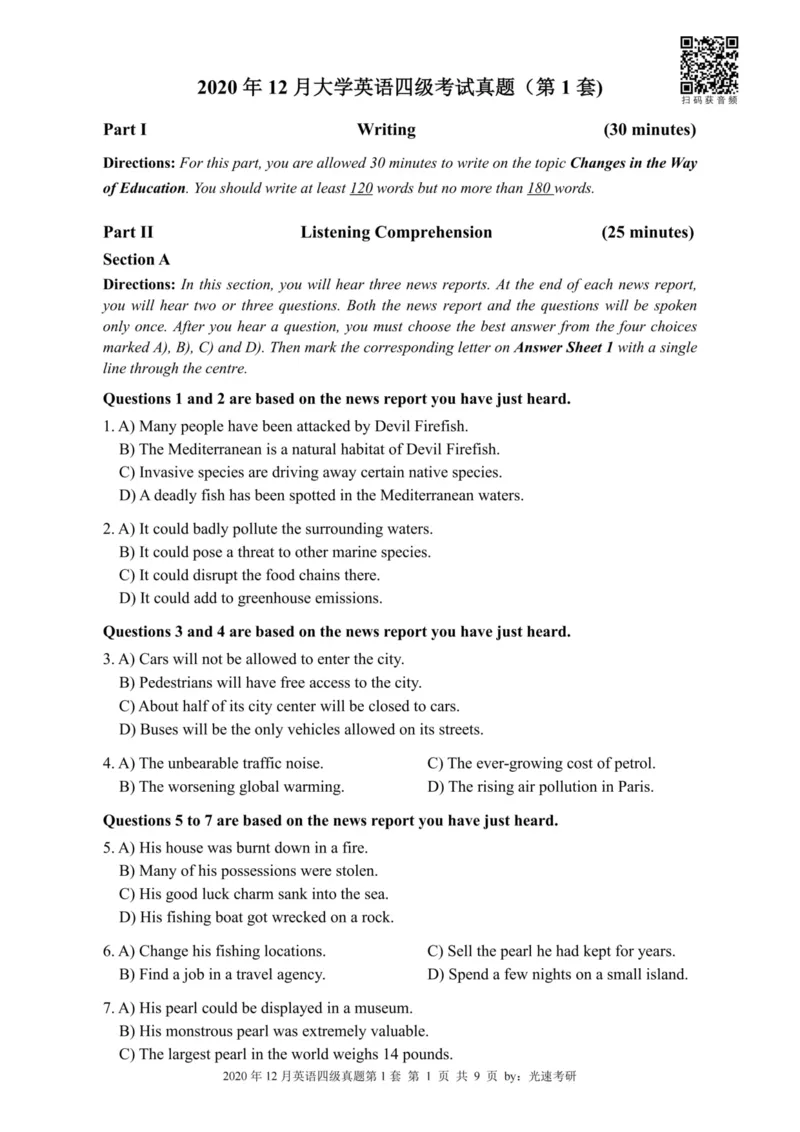
Part I Writing (30 minutes)
Directions: For this part, you are allowed 30 minutes to write on the topic Changes in the Way
of Education. You should write at least 120 words but no more than 180 words.
Part II Listening Comprehension (25 minutes)
Section A
Directions: In this section, you will hear three news reports. At the end of each news report,
you will hear two or three questions. Both the news report and the questions will be spoken
only once. After you hear a question, you must choose the best answer from the four choices
marked A), B), C) and D). Then mark the corresponding letter on Answer Sheet 1 with a single
line through the centre.
Questions 1 and 2 are based on the news report you have just heard.
1. A) Many people have been attacked by Devil Firefish.
B) The Mediterranean is a natural habitat of Devil Firefish.
C) Invasive species are driving away certain native species.
D) A deadly fish has been spotted in the Mediterranean waters.
2. A) It could badly pollute the surrounding waters.
B) It could pose a threat to other marine species.
C) It could disrupt the food chains there.
D) It could add to greenhouse emissions.
Questions 3 and 4 are based on the news report you have just heard.
3. A) Cars will not be allowed to enter the city.
B) Pedestrians will have free access to the city.
C) About half of its city center will be closed to cars.
D) Buses will be the only vehicles allowed on its streets.
4. A) The unbearable traffic noise. C) The ever-growing cost of petrol.
B) The worsening global warming. D) The rising air pollution in Paris.
Questions 5 to 7 are based on the news report you have just heard.
5. A) His house was burnt down in a fire.
B) Many of his possessions were stolen.
C) His good luck charm sank into the sea.
D) His fishing boat got wrecked on a rock.
6. A) Change his fishing locations. C) Sell the pearl he had kept for years.
B) Find a job in a travel agency. D) Spend a few nights on a small island.
7. A) His pearl could be displayed in a museum.
B) His monstrous pearl was extremely valuable.
C) The largest pearl in the world weighs 14 pounds.
2020年12月英语四级真题第1套 第 1 页 共 9 页 by:光速考研D) A New York museum has the world's biggest pearl.
Section B
Directions: In this section, you will hear two long conversations. At the end of each
conversation, you will hear four questions. Both the conversation and the questions will be
spoken only once. After you hear a question, you must choose the best answer from the four
choices marked A), B), C) and D). Then mark the corresponding letter on Answer Sheet 1 with
a single line through the centre.
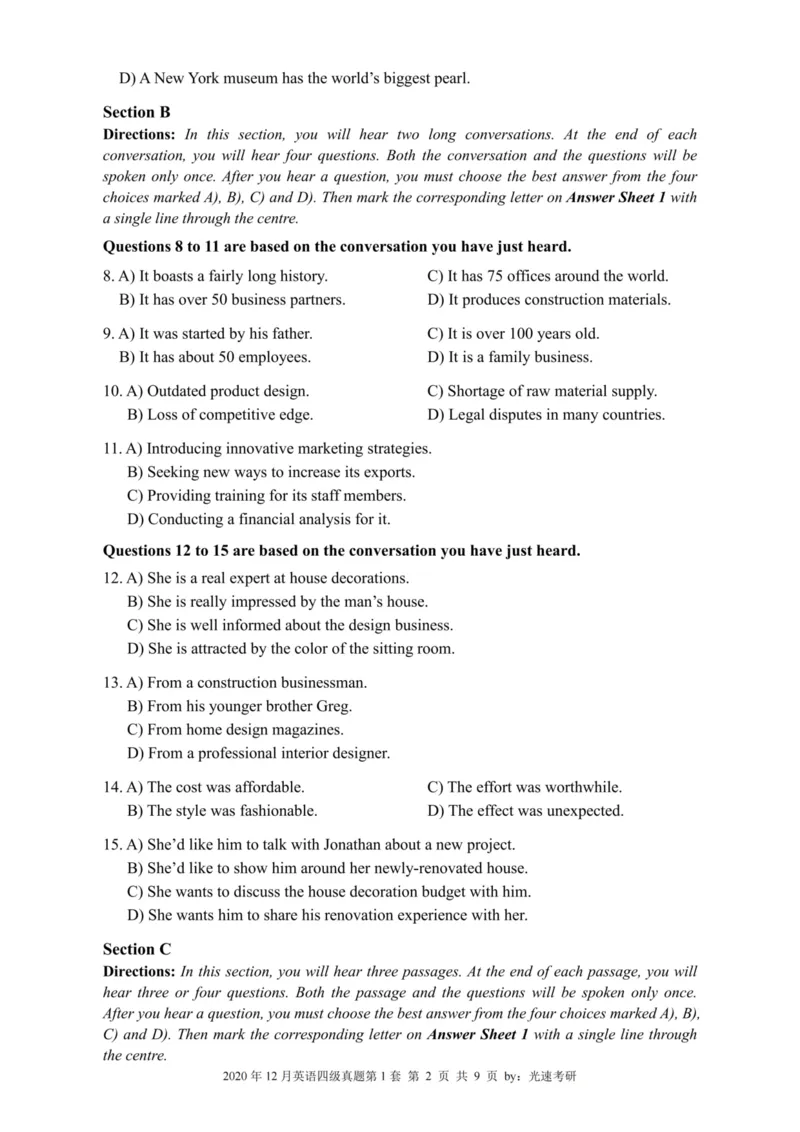
Questions 8 to 11 are based on the conversation you have just heard.
8. A) It boasts a fairly long history. C) It has 75 offices around the world.
B) It has over 50 business partners. D) It produces construction materials.
9. A) It was started by his father. C) It is over 100 years old.
B) It has about 50 employees. D) It is a family business.
10. A) Outdated product design. C) Shortage of raw material supply.
B) Loss of competitive edge. D) Legal disputes in many countries.
11. A) Introducing innovative marketing strategies.
B) Seeking new ways to increase its exports.
C) Providing training for its staff members.
D) Conducting a financial analysis for it.
Questions 12 to 15 are based on the conversation you have just heard.
12. A) She is a real expert at house decorations.
B) She is really impressed by the man's house.
C) She is well informed about the design business.
D) She is attracted by the color of the sitting room.
13. A) From a construction businessman.
B) From his younger brother Greg.
C) From home design magazines.
D) From a professional interior designer.
14. A) The cost was affordable. C) The effort was worthwhile.
B) The style was fashionable. D) The effect was unexpected.
15. A) She'd like him to talk with Jonathan about a new project.
B) She'd like to show him around her newly-renovated house.
C) She wants to discuss the house decoration budget with him.
D) She wants him to share his renovation experience with her.
Section C
Directions: In this section, you will hear three passages. At the end of each passage, you will
hear three or four questions. Both the passage and the questions will be spoken only once.
After you hear a question, you must choose the best answer from the four choices marked A), B),
C) and D). Then mark the corresponding letter on Answer Sheet 1 with a single line through
the centre.
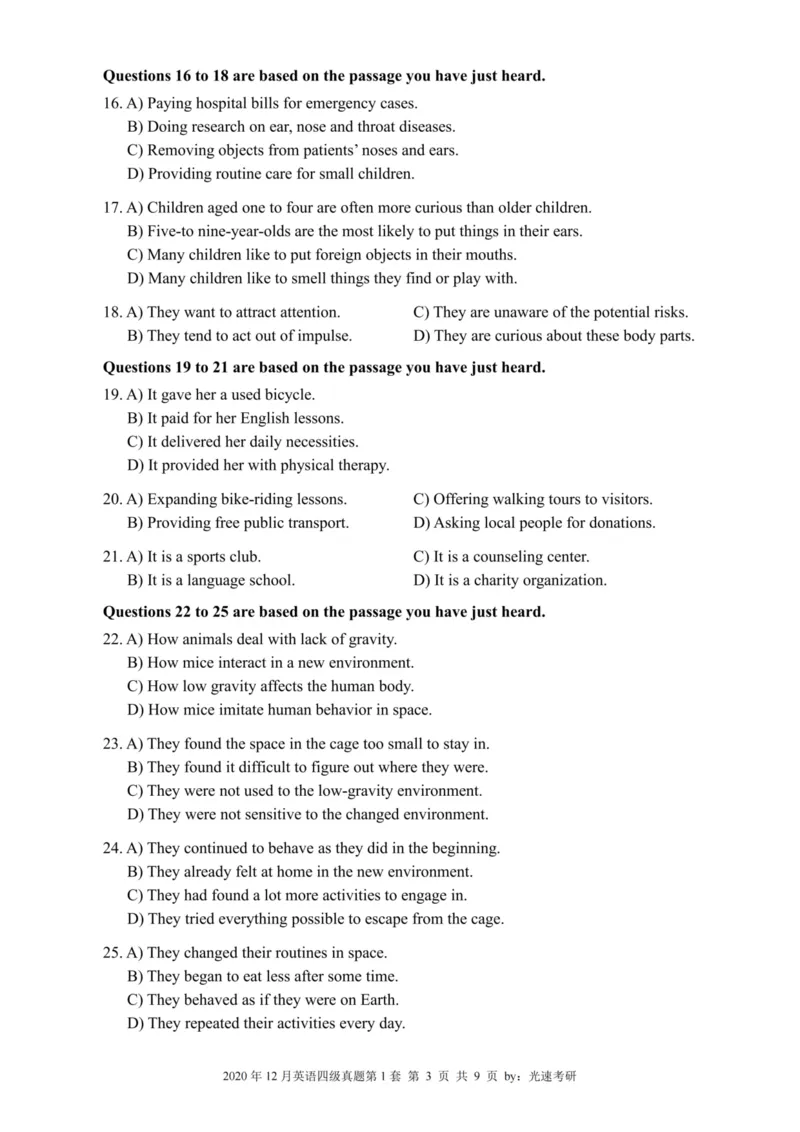
2020年12月英语四级真题第1套 第 2 页 共 9 页 by:光速考研Questions 16 to 18 are based on the passage you have just heard.
16. A) Paying hospital bills fbr emergency cases.
B) Doing research on ear, nose and throat diseases.
C) Removing objects from patients5 noses and ears.
D) Providing routine care for small children.
17. A) Children aged one to four are often more curious than older children.
B) Five-to nine-year-olds are the most likely to put things in their ears.
C) Many children like to put foreign objects in their mouths.
D) Many children like to smell things they find or play with.
18. A) They want to attract attention. C) They are unaware of the potential risks.
B) They tend to act out of impulse. D) They are curious about these body parts.
Questions 19 to 21 are based on the passage you have just heard.
19. A) It gave her a used bicycle.
B) It paid fbr her English lessons.
C) It delivered her daily necessities.
D) It provided her with physical therapy.
20. A) Expanding bike-riding lessons. C) Offering walking tours to visitors.
B) Providing free public transport. D) Asking local people for donations.
21. A) It is a sports club. C) It is a counseling center.
B) It is a language school. D) It is a charity organization.
Questions 22 to 25 are based on the passage you have just heard.
22. A) How animals deal with lack of gravity.
B) How mice interact in a new environment.
C) How low gravity affects the human body.
D) How mice imitate human behavior in space.
23. A) They found the space in the cage too small to stay in.
B) They found it difficult to figure out where they were.
C) They were not used to the low-gravity environment.
D) They were not sensitive to the changed environment.
24. A) They continued to behave as they did in the beginning.
B) They already felt at home in the new environment.
C) They had found a lot more activities to engage in.
D) They tried everything possible to escape from the cage.
25. A) They changed their routines in space.
B) They began to eat less after some time.
C) They behaved as if they were on Earth.
D) They repeated their activities every day.
2020年12月英语四级真题第1套 第 3 页 共 9 页 by:光速考研Part III Reading Comprehension (40 minutes)
Section A
Directions: In this section, there is a passage with ten blanks. You are required to select one
word for each blank from a list of choices given in a word bank following the passage. Read the
passage through carefully before making your choices. Each choice in the bank is identified by
a letter. Please mark the corresponding letter for each item on Answer Sheet 2 with a single
line through the centre. You may not use any of the words in the bank more than once.
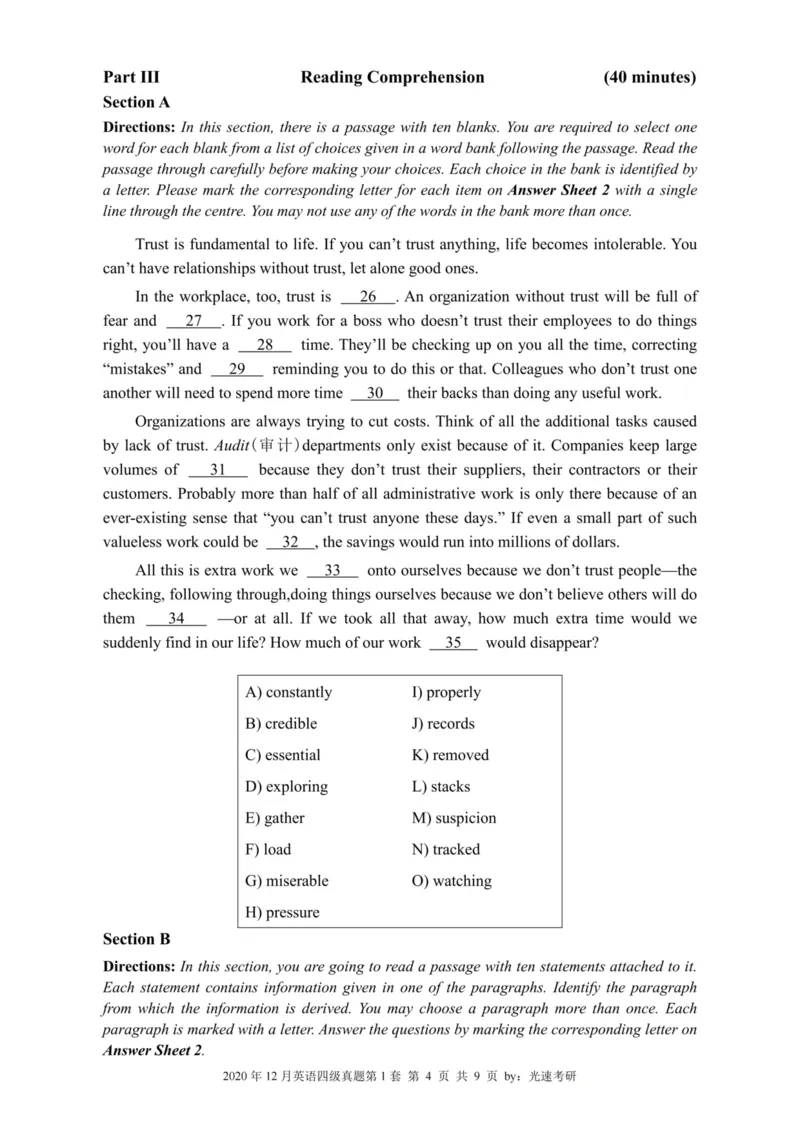
Trust is fundamental to life. If you can,t trust anything, life becomes intolerable. You
can't have relationships without trust, let alone good ones.
In the workplace, too, trust is 26 . An organization without trust will be full of
fear and 27 . If you work for a boss who doesn,t trust their employees to do things
right, you511 have a 28 time. They'll be checking up on you all the time, correcting
“mistakes” and 29 reminding you to do this or that. Colleagues who don't trust one
another will need to spend more time 30 their backs than doing any useful work.
Organizations are always trying to cut costs. Think of all the additional tasks caused
by lack of trust. A u d it计)departments only exist because of it. Companies keep large
volumes of 31 because they don't trust their suppliers, their contractors or their
customers. Probably more than half of all administrative work is only there because of an
ever-existing sense that “you can't trust anyone these days." If even a small part of such
valueless work could be 32 , the savings would run into millions of dollars.
All this is extra work we 33 onto ourselves because we don't trust people一the
checking, following through,doing things ourselves because we don't believe others will do
them 34 - or at all. If we took all that away, how much extra time would we
suddenly find in our life? How much of our work 35 would disappear?
A) constantly I) properly
B) credible J) records
C) essential K) removed
D) exploring L) stacks
E) gather M) suspicion
F) load N) tracked
G) miserable 0) watching
H) pressure
Section B
Directions: In this section, you are going to read a passage with ten statements attached to it.
Each statement contains information given in one of the paragraphs. Identify the paragraph
from which the information is derived. You may choose a paragraph more than once. Each
paragraph is marked with a letter. Answer the questions by marking the corresponding letter on
Answer Sheet 2.
2020年12月英语四级真题第1套 第 4 页 共 9 页 by:光速考研The Place Where the Poor Once Thrived
A) This is the land of opportunity. If that weren,t already implied by the landscape一
rolling green hills, palm trees, sun-kissed flowers- then ifs evident in the many stories
of people who grew up poor in these sleepy neighborhoods and rose to enormous
success. People like Tri Tran, who fled Vietnam on a boat in 1986, showed up in San
Jose with nothing, made it to MIT, and then founded the food-delivery start-up
Munchery, which is valued at $ 300 million.
B) Indeed, data suggests that this is one of the best places to grow up poor in America. A
child bom in the early 1980s into a low-income family in San Jose had a 12.9 percent
chance of becoming a high earner as an adult, according to a landmark study released in
2014 by the economist Raj Chetty and his colleagues from Harvard and Berkeley. That
number- 12.9 percent- may not seem remarkable, but it was: Kids in San Jose whose
families fell in the bottom quintile (五分位数)of income nationally had the best shot in
the country at reaching the top quintile.
C) By contrast, just 4.4 percent of poor kids in Charlotte moved up to the top; in Detroit
the figure was 5.5 percent. San Jose had social mobility comparable to Denmark's and
Canada's and higher than other progressive cities such as Boston and Minneapolis.
D) The reasons kids in San Jose performed so well might seem obvious. Some of the
world's most innovative companies are located here, providing opportunities such as the
one seized by a 12-year-old Mountain View resident named Steve Jobs when he called
William Hewlett to ask for spare parts and subsequently received a summer job. This is
a city of immigrants- 38 percent of the city's population today is fbreign-born- and
immigrants and their children have historically experienced significant upward mobility
in America. The city has long had a large foreign-bom population (26.5 percent in
1990), leading to broader diversity, which, the Harvard and Berkeley economists say, is
a good predictor of mobility.
E) Indeed, the streets of San Jose seem,in some ways, to embody the best of America. It's
possible to drive in a matter of minutes from sleek (光亮的)office towers near the
airport where people pitch ideas to investors, to single-family homes with orange trees
in their yards, or to a Vietnamese mall. The libraries here offer programs in 17
languages, and there are areas filled with small businesses owned by Vietnamese
immigrants, Mexican immigrants, Korean immigrants, and Filipino immigrants, to
name a few.
F) But researchers aren't sure exactly why poor kids in San Jose did so well. The city has
a low prevalence of children growing up in single-parent families, and a low level of
concentrated poverty, both factors that usually mean a city allows for good
intergenerational mobility. But San Jose also performs poorly on some of the
measures correlated with good mobility. It is one of the most unequal places out of the
741 that the researchers measured, and it has high degrees of racial and economic
segregation (B的离).Its schools underperform based on how much money there is in
the area, said Ben Scuderi, a predoctoral fellow at the Equality of Opportunity Project
at Harvard,which uses big data to study how to improve economic opportunities for
low-income children. "There's a lot going on here which we don't totally understand,,,
he said. "It's interesting, because it kind of defies our expectations.
G) The Chetty data shows that neighborhoods and places mattered for children bom in the
2020年12月英语四级真题第1套 第 5 页 共 9 页 by:光速考研San Jose area of the 1980s. Whether the city still allows for upward mobility of poor
kids today, though, is up fbr debate. Some of the indicators such as income inequality,
measured by the Equality of Opportunity Project for the year 2000, have only worsened
in the past 16 years.
H) Some San Jose residents say that as inequality has grown in recent years, upward
mobility has become much more difficult to achieve. As Silicon Valley has become
home to more successful companies, the flood of people to the area has caused housing
prices to skyrocket. By most measures, San Jose is no longer a place where low-income,
or even middle-income families, can afford to live. Rents in San Jose grew 42.6 percent
between 2006 and 2014, which was the largest increase in the country during that time
period. The city has a growing homelessness problem,which it tried to address by
shutting down “The Jungle,5, one of the largest homeless encampments (临时住地)in
the nation, in 2014. Inequality is extreme. The Human Development Index- a measure
of life expectancy, education and per capita (人均的)income—gives East San Jose a
score of 4.85 out of 10, while nearby Cupertino, where Apple's headquarters sits,
receives a 9.26. San Jose used to have a happy mix of factors- cheap housing,
closeness to a rapidly developing industry, tightly-knit immigrant communities- that
together opened up the possibility of prosperity for even its poorest residents. But in
recent years, housing prices have skyrocketed, the region's rich and poor have
segregated, and middle-class jobs have disappeared. Given this, the future fbr the
region's poor doesn't look nearly as bright as it once did.
I) Leaders in San Jose are determined to make sure that the city regains its status as a
place where even poor kids can access the resources to succeed. With Silicon Valley in
its backyard, it certainly has the chance to do so. "I think there is a broad consciousness
in the Valley that we can do better than to leave thousands of our neighbors behind
through a period of extraordinary success,San Jose Mayor Sam Liccardo said.
J) But in today's America- a land of rising inequality, increasing segregation, and
stagnating (不增长的)middle-class wages—can the San Jose region really once again
become a place of opportunity?
K) The idea that those at the bottom can rise to the top is central to America's ideas about
itself. That such mobility has become more difficult in San Jose raises questions about
the endurance of that foundational belief. After all, if the one-time land of opportunity
can't be fixed, what does that say for the rest of America?
36. According to some people living in San Jose, it has become much harder for the poor to
get ahead due to the increased inequality.
37. In American history,immigrants used to have a good chance to move upward in society.
38. If the problems of San Jose can't be solved, one of America's fundamental beliefs about
itself can be shaken.
39. San Jose was among the best cities in America for poor kids to move up the social ladder.
40. Whether poor kids in San Jose today still have the chance to move upward is
questionable.
41. San Jose's officials are resolved to give poor kids access to the resources necessary for
success in life.
42. San Jose appears to manifest some of the best features of America.
2020年12月英语四级真题第1套 第 6 页 共 9 页 by:光速考研43. As far as social mobility is concerned, San Jose beat many other progressive cities in
America.
44. Due to some changes like increases in housing prices in San Jose, the prospects fbr its
poor people have dimmed.
45. Researchers do not have a clear idea why poor children in San Jose achieved such great
success several decades ago.
Section C
Directions: There are 2 passages in this section. Each passage is followed by some questions
or unfinished statements. For each of them there are four choices marked A),B),C)and D).You
should decide on the best choice and mark the corresponding letter on Answer Sheet 2 with a
single line through the centre.
Passage One
Questions 46 to 50 are based on the following passage.
Three children in every classroom have a diagnosable mental health condition. Half of
these are behavioural disorders, while one third are emotional disorders such as stress,
anxiety and depression, which often become outwardly apparent through self-harm. There
was an astonishing 52 per cent jump in hospital admissions fbr children and young people
who had harmed themselves between 2009 and 2015.
Schools and teachers have consistently reported the scale of the problem since 2009.
Last year, over half of teachers reported that more of their pupils experience mental health
problems than in the past. But teachers also consistently report how ill-equipped they feel
to meet pupils' mental health needs, and often cite a lack of training, expertise and support
from the National Health Service (英国国家医疗服务体系).
Part of the reason for the increased pressure on schools is that there are now fewer 'early
intervention (干预)'and low-level mental health services based in the community. Cuts to
local authority budgets since 2010 have resulted in a significant decline of these services,
despite strong evidence of their effectiveness in preventing crises further down the line.
The only way to break the pressures on both mental health services and schools is to
reinvest in early intervention services inside schools.
There are strong arguments fbr why schools are best placed to provide mental health
services. Schools see young people more than any other service, which gives them a unique
ability to get to hard-to-reach children and young people and build meaningful relationships
with them over time. Recent studies have shown that children and young people largely
prefer to see a counsellor in school rather than in an outside environment. Young people
have reported that for low-level conditions such as stress and anxiety, a clinical setting can
sometimes be daunting (令人却步的).
There are already examples of innovative schools which combine mental health and
wellbeing provision with a strong academic curriculum. This will, though, require a huge
cultural shift. Politicians, policymakers,commissioners and school leaders must be brave
enough to make the leap towards reimagining schools as providers of health as well as
education services.
2020年12月英语四级真题第1套 第 7 页 共 9 页 by:光速考研46. What are teachers complaining about?
A) There are too many students requiring special attention.
B) They are under too much stress counselling needy students.
C) Schools are inadequately equipped to implement any intervention.
D) They lack the necessary resources to address pupils5 mental problems.
47. What do we learn from the passage about community health services in Britain?
A) They have deteriorated due to budget cuts.
B) They facilitate local residents' everyday lives.
C) They prove ineffective in helping mental patients.
D) They cover preventative care for the local residents.
48. Where does the author suggest mental health services be placed?
A) At home. B) At school. C) In hospitals. D) In communities.
49. What do we learn from the recent studies?
A) Students prefer to rely on peers to relieve stress and anxiety.
B) Young people are keen on building meaningful relationships.
C) Students are more comfortable seeking counselling in school.
D) Young people benefit from various kinds of outdoor activities.
50. What does the author mean by a cultural shift (Line 2, Para. 6)?
A) Simplification of schools' academic curriculums.
B) Parents9 involvement in schools5 policy-making.
C) A change in teachers5 attitudes to mental health.
D) A change in the conception of what schools are.
Passage Two
Questions 51 to 55 are based on the following passage.
Picture this: You5re at a movie theater food stand loading up on snacks. You have a
choice of a small, medium or large soda. The small is $3.50 and the large is $5.50. Ifs a
tough decision: The small size may not last you through the whole movie, but $5.50 for some
sugary drink seems ridiculous. But there's a third option, a medium soda for $5.25. Medium
may be the perfect amount of soda for you, but the large is only a quarter more. If you're like
most people, you end up buying the large (and taking a bathroom break midshow).
If you're wondering who would buy the medium soda, the answer is almost no one. In
fact, there's a good chance the marketing department purposely priced the medium soda as
a decoy (诱饵),making you more likely to buy the large soda rather than the small.
I have written about this peculiarity in human nature before with my friend Dan Ariely,
who studied this phenomenon extensively after noticing pricing for subscriptions (订 I阅)to
The Economist. The digital subscription was $59, the print subscription was $125, and the
print plus digital subscription was also $125. No one in their right mind would buy the print
subscription when you could get digital as well for the same price, so why was it even an
option? Ariely ran an experiment and found that when only the two “real" choices were
offered, more people chose the less-expensive digital subscription. But the addition of the bad
option made people much more likely to choose the more expensive print plus digital option.
Brain scientists call this effect “asymmetric dominance^^ and it means that people
2020年12月英语四级真题第1套 第 8 页 共 9 页 by:光速考研gravitate toward the choice nearest a clearly inferior option. Marketing professors call it the
decoy effect, which is certainly easier to remember. Lucky fbr consumers, almost no one in
the business community understands it.
The decoy effect works because of the way our brains assign value when making
choices. Value is almost never absolute; rather, we decide an objecfs value relative to our
other choices. If more options are introduced, the value equation changes.
51. Why does the author ask us to imagine buying food in the movie theater?
A) To illustrate people's peculiar shopping behavior.
B) To illustrate the increasing variety of snacks there.
C) To show how hard it can be to choose a drink there.
D) To show how popular snacks are among movie fans.
52. Why is the medium soda priced the way it is?
A) To attract more customers to buy it.
B) To show the price matches the amount.
C) To ensure customers drink the right amount of soda.
D) To make customers believe they are getting a bargain.
53. What do we learn from Dan Ariely's experiment?
A) Lower-priced goods attract more customers.
B) The Economistpromotional strategy works.
C) The Economisfs print edition turns out to sell the best.
D) More readers choose the digital over the print edition.
54. For what purpose is “the bad option” (Line 8, Para.3)added?
A) To cater to the peculiar needs of some customers.
B) To help customers to make more rational choices.
C) To trap customers into buying the more pricey item.
D) To provide customers with a greater variety of goods.
55. How do we assess the value of a commodity, according to the passage?
A) By considering its usefulness.
B) By comparing it with other choices.
C) By taking its quality into account.
D) By examining its value equation.
Part IV Translation (30 minutes)
Directions: For this part, you are allowed 30 minutes to translate a passage from Chinese into
English. You should write your answer on Answer Sheet 2.
生活在中国不同地区的人们饮食多种多样。北方人主要吃面食,南方人大多吃来饭。在沿海
地区,海鲜和淡水水产品在人们饮食中占有相当大的比例,而在其他地区人们的饮食中,肉类和奶
制品更为常见。四川、湖南等省份的居民普遍爱吃辛辣食物,而江苏和浙江人更喜欢甜食。然而,
因为烹任方式各异,同类食物的味道可能会有所不同。
2020年12月英语四级真题第1套 第 9 页 共 9 页 by:光速考研2020年 12月大学英语四级考试真题(第 2 套)
扫码获音频
Part I Writing (30 minutes)
Directions: For this part, you are allowed 30 minutes to write on the topic Changes in the Way
of Transportation. You should write at least 120 words but no more than 180 words.
Part II Listening Comprehension (25 minutes)
Section A
Directions: In this section, you will hear three news reports. At the end of each news report,
you will hear two or three questions. Both the news report and the questions will be spoken
only once. After you hear a question, you must choose the best answer from the four choices
marked A), B), C) and D). Then mark the corresponding letter on Answer Sheet 1 with a single
line through the centre.
Questions 1 and 2 are based on the news report you have just heard.
1. A) He wanted to buy a home. C) He lost a huge sum of money.
B) He suffered from a shock. D) He did an unusual good deed.
2. A) Invite the waiter to a fancy dinner. C) Give some money to the waiter.
B) Tell her story to the Daily News. D) Pay the waiter5s school tuition.
Questions 3 and 4 are based on the news report you have just heard.
3. A) Whether or not to move to the state's mainland.
B) How to keep the village from sinking into the sea.
C) Where to get the funds for rebuilding their village.
D) What to do about the rising level of the seawater.
4. A) It takes too long a time.
B) It costs too much money.
C) It has to wait for the state's final approval.
D) It faces strong opposition from many villagers.
Questions 5 to 7 are based on the news report you have just heard.
5. A) To investigate whether people are grateful for help.
B) To see whether people hold doors open for strangers.
C) To explore ways of inducing gratitude in people.
D) To find out how people express gratitude.
6. A) They induced strangers to talk with them.
B) They helped 15 to 20 people in a bad mood.
C) They held doors open for people at various places.
D) They interviewed people who didn't say thank you.
7. A) People can be educated to be grateful.
B) Most people express gratitude for help.
2020年12月英语四级真题第2套 第 1 页 共 9 页 by:光速考研C) Most people have bad days now and then.
D) People are ungrateful when in a bad mood.
Section B
Directions: In this section, you will hear two long conversations. At the end of each
conversation, you will hear four questions. Both the conversation and the questions will be
spoken only once. After you hear a question, you must choose the best answer from the four
choices marked A), B), C) and D). Then mark the corresponding letter on Answer Sheet 1 with
a single line through the centre.
Questions 8 to 11 are based on the conversation you have just heard.
8. A) To order a solar panel installation.
B) To report a serious leak in his roof.
C) To enquire about solar panel installations.
D) To complain about the faulty solar panels.
9. A) He plans to install solar panels. C) He saves $ 300 a year.
B) He owns a four-bedroom house. D) He has a large family.
10. A) The service of the solar panel company.
B) The cost of a solar panel installation.
C) The maintenance of the solar panels.
D) The quality of the solar panels.
11. A) One year and a half. C) Roughly six years.
B) Less than four years. D) About five years.
Questions 12 to 15 are based on the conversation you have just heard.
12. A) At a travel agency. C) At an airline transfer service.
B) At an Australian airport. D) At a local transportation authority.
13. A) She would be able to visit more scenic spots.
B) She wanted to save as much money as possible.
C) She would like to have everything taken care of.
D) She wanted to spend more time with her family.
14. A) Four days. C) One week.
B) Five days. D) Two weeks.
15. A) Choosing some activities herself.
B) Spending Christmas with Australians.
C) Driving along the Great Ocean Road.
D) Learning more about wine making.
Section C
Directions: In this section, you will hear three passages. At the end of each passage, you will
hear three or four questions. Both the passage and the questions will be spoken only once.
2020年12月英语四级真题第2套 第 2 页 共 9 页 by:光速考研After you hear a question, you must choose the best answer from the four choices marked A), B),
C) and D). Then mark the corresponding letter on Answer Sheet 1 with a single line through
the centre.
Questions 16 to 18 are based on the passage you have just heard.
16. A) Bring their own bags when shopping. C) Dispose of their trash properly.
B) Use public transport when traveling. D) Pay a green tax upon arrival.
17. A) It has not been doing a good job in recycling.
B) It has witnessed a rise in accidental drowning.
C) It has not attracted many tourists in recent years.
D) It has experienced an overall decline in air quality.
18. A) To charge a small fee on plastic products in supermarkets.
B) To ban single-use plastic bags and straws on Bali Island.
C) To promote the use of paper bags for shopping.
D) To impose a penalty on anyone caught littering.
Questions 19 to 21 are based on the passage you have just heard.
19. A) It gives birth to several babies at a time.
B) It is the least protected mammal species.
C) Its breeding grounds are now better preserved.
D) Its population is now showing signs of increase.
20. A) Global warming. C) Commercial hunting.
B) Polluted seawaters. D) Decreasing birthrates.
21. A) To mate. C) To escape hunters.
B) To look for food . D) To seek breeding grounds.
Questions 22 to 25 are based on the passage you have just heard.
22. A) They prefer to drink low-fat milk. C) They consume less milk these days.
B) They think milk is good for health. D) They buy more milk than the British.
23. A) It is not as healthy as once thought. C) It benefits the elderly more.
B) It is not easy to stay fresh for long. D) It tends to make people fat.
24. A) They drink too many pints every day.
B) They are sensitive to certain minerals.
C) They lack the necessary proteins to digest it.
D) They have eaten food incompatible with milk .
25. A) It is easier for sick people to digest.
B) It provides some necessary nutrients.
C) It is healthier than other animal products.
D) It supplies the body with enough calories.
2020年12月英语四级真题第2套 第 3 页 共 9 页 by:光速考研Part III Reading Comprehension (40 minutes)
Section A
Directions: In this section, there is a passage with ten blanks. You are required to select one
word for each blank from a list of choices given in a word bank following the passage. Read the
passage through carefully before making your choices. Each choice in the bank is identified by
a letter. Please mark the corresponding letter for each item on Answer Sheet 2 with a single
line through the centre. You may not use any of the words in the bank more than once.
When my son completes a task, I can't help but praise him. Ifs only natural to give
praise where praise is due, right? But is there such a thing as too much praise?
According to psychologist Katherine Phillip, children don't benefit from 26 praise
as much as we'd like to think. "Parents often praise, believing they are building their child's
self-confidence. However, over-praising can have a 27 effect,5, says Phillip. 4'When
we use the same praise 28 , it may become empty and no longer valued by the child. It
can also become an expectation that anything they do must be 29 with praise. This
may lead to the child avoiding taking risks due to fear of 30 their parents.5,
Does this mean we should do away with all the praise?Phillip says no."The key to
healthy praise is to focus on the process rather than the 31 . It is the recognition of a
child's attempt, or the process in which they achieved something, that is essential,she says.
“Parents should encourage their child to take the risks needed to learn and grow.^^
So how do we break the 32 of praise we're all so accustomed to? Phillip says it's
important to 33 between “person praise" and "process praise". “Person praise is
34 saying how great someone is. It's a form of personal approval. Process praise is
acknowledgement of the efforts the person has just 35 . Children who receive person
praise are more likely to feel shame after losing,5, says Phillip.
A)choose I) pattern
B) constant J) plural
C) disappointing K) repeatedly
D) distinguish L) rewarded
E) exhausting M) separately
F) experienced N) simply
G) negative 0) undertaken
H) outcome
Section B
Directions: In this section, you are going to read a passage with ten statements attached to it.
Each statement contains information given in one of the paragraphs. Identify the paragraph
from which the information is derived. You may choose a paragraph more than once. Each
paragraph is marked with a letter. Answer the questions by marking the corresponding letter on
Answer Sheet 2.
Poverty is a story about us, not them
A) Too often still, we think we know what poverty looks like. It's the way we've been
taught, the images we've been fbrce-fed for decades. The chronically homeless. The
undocumented immigrant. The urban poor, usually personified as a woman of color, the
"welfare queen^^ politicians still too often reference.
B) But as income inequality rises to record levels in the United States, even in the midst
of a record economic expansion, those familiar images are outdated, hurtful, and
2020年 12月英语四级真题第2套 第 4 页 共 9 页 by:光速考研counterproductive to focusing attention on solutions and building ladders of opportunity.
C) Today's foces of income inequality and lack of opportunity look like all of us. It's Anna
Landre, a disabled Georgetown University student fighting to keep health benefits that
allow her the freedom to live her life. Ifs Tiflanie Standard, a counselor for young
women of color in Philadelphia who want to be tech entrepreneurs- but who must
work multiple jobs to stay afloat. Ifs Ken Outlaw, a welder in rural North Carolina
whose dream of going back to school at a local community college was dashed by
Hurricane Florence- just one of the extreme weather events that have tipped the
balance for struggling Americans across the nation.
D) If these are the central characters of our story about poverty, what layers of perceptions,
myths, and realities must we unearth to find meaningful solutions and support? In
pursuit of revealing this complicated reality, Mothering Justice, led by women of color,
went last year to the state capital in Lansing, Michigan, to lobby on issues that affect
working mothers. One of the Mothering Justice organizers went to the office of a state
representative to talk about the lack of affordable childcare- the vestiges (痕迹)of a
system that expected mothers to stay home with their children while their husbands
worked. A legislative staffer dismissed the activist5s concerns, telling her“my husband
took care of that- I stayed home.”
E) That comment, says Mothering Justice director Danielle Atkinson,44was meant to shame^^
and relied on the familiar notion that a woman of color concerned about income
inequality and programs that promote mobility must by definition be a single mom,
probably with multiple kids. In this case, the Mothering Justice activist happened to be
married. And in most cases in the America of 2019, the images that come to mind when
we hear the words poverty or income inequality fail miserably in reflecting a
complicated reality: poverty touches virtually all of us. The face of income inequality,
for all but a very few of us, is the one we each see in the mirror.
F) How many of us are poor in the U.S.? It depends on who you ask. According to the
Census Bureau, 38 million people in the U.S. are living below the official poverty
thresholds. Taking into account economic need beyond that absolute measure, the
Institute for Policy Studies found that 140 million people are poor or low-income.
Thafs almost half the U.S. population.
G) Whatever the measure,within that massive group, poverty is extremely diverse. We
know that some people are more affected than others, like children, the elderly, people
with disabilities, and people of color.
H) But the fact that 4 in 10 Americans can't come up with $ 400 in an emergency is a
commonly cited statistic for good reason: economic instability stretches across race,
gender, and geography. It even reaches into the middle classes, as real wages have
stagnated (不增长)fbr all but the very wealthy and temporary spells of financial
instability are not uncommon.
I) Negative images remain of who is living in poverty as well as what is needed to move
out of it. The big American myth is that you can pull yourself up by your own efforts
and change a bad situation into a good one. The reality is that finding opportunity
without help from families, friends, schools, and community is virtually impossible.
And the playing field is nothing close to level.
J) The FrameWorks Institute, a research group that focuses on public framing of issues,
2020年12月英语四级真题第2套 第 5 页 共 9 页 by:光速考研
」has studied what sustains stereotypes and narratives of poverty in the United Kingdom.
“People view economic success and wellbeing in life as a product of choice, willpower,
and drive,5, says Nat Kendall-Taylor, CEO of FrameWorks. "When we see people who
are struggling,he says, those assumptions “lead us to the perception that people in
poverty are lazy, they don't care, and they havenmade the right decisions.
K) Does this sound familiar?Similar ideas surround poverty in the U.S. And these
assumptions give a false picture of reality. "When people enter into that pattern of
thinking,says Kendall-Taylor, "ifs cognitively comfortable to make sense of issues of
poverty in that way. It creates a kind of cognitive blindness- all of the factors external to
a person's drive and choices that they've made become invisible and fade from view.^^
L) Those external factors include the difficulties accompanying low-wage work or structural
discrimination based on race, gender, or ability. Assumptions get worse when people who
are poor use government benefits to help them survive. There is a great tension between
“the poor“ and those who are receiving what has become a dirty word: "welfare.”
M) According to the General Social Survey,7 1 percent of respondents believe the country is
spending too little on ''assistance to the poor”. On the other hand, 22 percent think we
are spending too little on “welfare”: 37 percent believe we are spending too much.
N) "Poverty has been interchangeable with people of color- specifically black women and
black mothers,says Atkinson of Mothering Justice. Ifs true that black mothers are
more affected by poverty than many other groups, yet they are disproportionately the
face of poverty. For example, Americans routinely overestimate the share of black
recipients of public assistance programs.
O) In reality, most people will experience some form of financial hardship at some point in
their lives. Indeed, people tend to dip in and out of poverty, perhaps due to unexpected
obstacles like losing a job, or when hours of a low-wage job fluctuate.
P) Something each of us can do is to treat each other with the dignity and sympathy that is
deserved and to understand deeply that the issue of poverty touches all of us.
36. One legislative staffer assumed that a woman of color who advocated affordable
childcare must be a single mother.
37. People from different races, genders and regions all suffer from a lack of financial
security.
38. According to a survey, while the majority believe too little assistance is given to the
poor, more than a third believe too much is spent on welfare.
39. A research group has found that Americans who are struggling are thought to be lazy
and to have made the wrong decisions.
40. Under the old system in America, a mother was supposed to stay home and take care of
her children.
41. It was found that nearly 50% of Americans are poor or receive low pay.
42. Americans usually overestimate the number of blacks receiving welfare benefits.
43. It is impossible fbr Americans to lift themselves out of poverty entirely on their own.
44. Nowadays, it seems none of us can get away from income inequality.
45. Assumptions about poor people become even more negative when they live on welfare.
2020年12月英语四级真题第2套 第 6 页 共 9 页 by:光速考研Section C
Directions: There are 2 passages in this section. Each passage is followed by some questions
or unfinished statements. For each of them there are four choices marked A),B),C)and D). You
should decide on the best choice and mark the corresponding letter on Answer Sheet 2 with a
single line through the centre.
Passage One
Questions 46 to 50 are based on the following passage.
Boredom has, paradoxically, become quite interesting to academics lately. In early
May, London's Boring Conference celebrated seven years of delighting in dullness. At this
event, people flocked to talks about weather, traffic jams, and vending-machine sounds,
among other sleep-inducing topics.
What, exactly, is everybody studying? One widely accepted psychological definition
of boredom is “the distasteful experience of wanting, but being unable, to engage in
satisfying activity.^^ But how can you quantify a person's boredom level and compare it
with someone else's? In 1986, psychologists introduced the Boredom Proneness Scale,
designed to measure an individual's overall tendency to feel bored. By contrast, the
Multidimensional State Boredom Scale, developed in 2008, measures a person's feelings of
boredom in a given situation.
Boredom has been linked to behavior issues including inattentive driving, mindless
snacking, excessive drinking, and addictive gambling. In fact, many of us would choose
pain over boredom. One team of psychologists discovered that two-thirds of men and a
quarter of women would rather self-administer electric shocks than sit alone with their
thoughts for 15 minutes. Researching this phenomenon, another team asked volunteers to
watch boring, sad, or neutral films, during which they could self-administer electric shocks.
The bored volunteers shocked themselves more and harder than the sad or neutral ones did.
But boredom isn't all bad. By encouraging self-reflection and daydreaming, it can spur
creativity. An early study gave participants abundant time to complete problem-solving and
word-association exercises. Once all the obvious answers were exhausted, participants gave
more and more inventive answers to combat boredom. A British study took these findings
one step further, asking subjects to complete a creative challenge (coming up with a list of
alternative uses for a household item). One group of subjects did a boring activity
first,while the others went straight to the creative task. Those whose boredom pumps had
been primed were more productive.
In our always-connected world, boredom may be a hard-to-define state, but it is a
fertile one. Watch paint dry or water boil, or at least put away your smartphone for a while,
and you might unlock your next big idea.
46. When are people likely to experience boredom, according to an accepted psychological
definition?
A) When they don't have the chance to do what they want.
B) When they don't enjoy the materials they are studying.
C) When they experience something unpleasant.
D) When they engage in some routine activities.
47. What does the author say boredom can lead to?
A) Determination. C) Mental deterioration.
2020年12月英语四级真题第2套 第 7 页 共 9 页 by:光速考研B) Concentration. D) Harmful conduct.
48. What is the finding of one team of psychologists in their experiment?
A) Volunteers prefer watching a boring movie to sitting alone deliberating.
B) Many volunteers choose to hurt themselves rather than endure boredom.
C) Male volunteers are more immune to the effects of boredom than females.
D) Many volunteers are unable to resist boredom longer than fifteen minutes.
49. Why does the author say boredom isn't all bad?
A) It stimulates memorization. C) It may promote creative thinking.
B) It allows time for relaxation. D) It may facilitate independent learning.
50. What does the author suggest one do when faced with a challenging problem?
A) Stop idling and think big. C) Look around oneself for stimulation.
B) Unlock one's smartphone. D) Allow oneself some time to be bored.
Passage Two
Questions 51 to 55 are based on the following passage.
Forests in countries like Brazil and the Congo get a lot of attention from
environmentalists, and it is easy to see why. South America and sub-Saharan Africa are
experiencing deforestation on an enormous scale: every year almost 5 million hectares are
lost. But forests are also changing in rich Western countries. They are growing larger, both in
the sense that they occupy more land and that the trees in them are bigger. What is going on?
Forests are spreading in almost all Western countries, with the fastest growth in places
that historically had rather few trees. In 1990 28% of Spain was forested; now the
proportion is 37%. In both Greece and Italy, the growth was from 26% to 32% over the
same period. Forests are gradually taking more land in America and Australia. Perhaps
most astonishing is the trend in Ireland. Roughly 1% of that country was forested when it
became independent in 1922. Now forests cover 11% of the land, and the government
wants to push the proportion to 18% by the 2040s.
Two things are fertilising this growth. The first is the abandonment of farmland,
especially in high, dry places where nothing grows terribly well. When farmers give up
trying to earn a living from farming or herding, trees simply move in. The second is
government policy and subsidy. Throughout history, governments have protected and
promoted forests fbr diverse reasons, ranging from the need for wooden warships to a
desire to promote suburban house-building. Nowadays forests are increasingly welcome
because they suck in carbon pollution from the air. The justifications change; the desire for
more trees remains constant.
The greening of the West does not delight everyone. Farmers complain that land is
being taken out of use by generously subsidised tree plantations. Parts of Spain and
Portugal suffer from terrible forest fires. Others simply dislike the appearance of forests
planted in neat rows. They will have to get used to the trees, however. The growth of
Western forests seems almost as unstoppable as deforestation elsewhere.
51. What is catching environmentalists9 attention nowadays?
A) Rich countries are stripping poor ones of their resources.
B) Forests are fast shrinking in many developing countries.
2020年12月英语四级真题第2套 第 8 页 共 9 页 by:光速考研C) Forests are eating away the fertile farmland worldwide.
D) Rich countries are doing little to address deforestation.
52. Which countries have the fastest forest growth?
A) Those that have newly achieved independence.
B) Those that have the greatest demand fbr timber.
C) Those that used to have the lowest forest coverage.
D) Those that provide enormous government subsidies.
53. What has encouraged forest growth historically?
A) The government's advocacy. C) The favourable climate.
B) The use of wood for fuel. D) The green movement.
54. What accounts fbr our increasing desire fbr forests?
A) Their unique scenic beauty. C) Their capability of improving air quality.
B) Their use as fruit plantations. D) Their stable supply of building materials.
55. What does the author conclude about the prospects of forestation?
A) Deserts in sub-Saharan Africa will diminish gradually.
B) It will play a more and more important role in people's lives.
C) Forest destruction in the developing world will quickly slow down.
D) Developed and developing countries are moving in opposite directions.
Part IV Translation (30 minutes)
Directions: For this part, you are allowed 30 minutes to translate a passage from Chinese into
English. You should -write your answer on Answer Sheet 2.
春节前夕吃团圆饭是中国人的传统。团圆饭是一年中最重要的晚餐,也是家庭团聚的最佳时机,
家人生活在不同地方的家庭尤其如此。团圆饭上的菜肴丰富多样,其中有些菜肴有特殊含义。例如,
鱼是不可缺少的一道菜,因为汉语中的“鱼”字 和 “余”字听上去一样。在中国的许多地方,饺子
也是一道重要的佳肴,因为饺子象征着财富和好运。
2020年12月英语四级真题第2套 第 9 页共9 页 by:光速考研2020年 12月大学英语四级考试真题(第3 套)
Part I Writing (30 minutes)
Directions: For this part, you are allowed 30 minutes to write on the topic Changes in the Way
of Communication. You should write at least 120 words but no more than 180 words.
Part II Listening Comprehension (25 minutes)
淘宝店铺【光速考研工作室】温馨提示:2020年 12月大学英语四级考试共考了两套听力,本套的听力
内容与第二套相同,因此本套试题听力部分不再重复给出。
Part III Reading Comprehension (40 minutes)
Section A
The things people make, and the way they make them, determine how cities grow and
decline, and influence how empires rise and fall. So, any disruption to the world's factories
26 . And that disruption is surely coming. Factories are being digitised, filled with new
sensors and new computers to make them quicker, more 27 , and more efficient.
Robots are breaking free from the cages that surround them, learning new skills and
new ways of working. And 3D printers have long 28 a world where you can make
anything, anywhere, from a computerised design. That vision is 29 closer to reality.
These forces will lead to cleaner factories, producing better goods at lower prices,
personalised to our individual needs and desires. Humans will be 30 many of the dirty,
repetitive, and dangerous jobs that have long been a 31 of factory life.
Greater efficiency 32 means fewer people can do the same work. Yet factory
bosses in many developed countries are worried about a lack of skilled human
workers- and see 33 and robots as a solution. But economist Helena Leurent says
this period of rapid change in manufacturing is a 34 opportunity to make the world a
better place. 4'Manufacturing is the one system where you have got the biggest source of
innovation, the biggest source of economic growth, and the biggest source of great jobs in
the past. You can see it changing. Thafs an opportunity to 35 that system differently,
and if we can, it will have tremendous significance.
A) automation I) interaction
B) concerns J) leaning
C) enormously K) matters
D) fantastic L) moving
E) fascinated M) promised
F) feature N)shape
G) flexible O) spared
H) inevitably
Section B
Directions: In this section, you are going to read a passage with ten statements attached to it.
Each statement contains information given in one of the paragraphs. Identify the paragraph
from which the information is derived. You may choose a paragraph more than once. Each
paragraph is marked with a letter. Answer the questions by marking the corresponding letter on
Answer Sheet 2.
2020年12月英语四级真题第3套 第 1 页 共 6 页 by:光速考研The History of the Lunch Box
A) It was made of shiny, bright pink plastic with a Little Mermaid sticker on the front, and
I carried it with me nearly every single day. My lunch box was one of my first prized
possessions, a proud statement to everyone in my kindergarten: "1 love Mermaid-Ariel
on my lunch box.^^
B) That bulky container served me well through my first and second grades, until the
live-action version of 101 Dalmatians hit theaters, and I needed the newest red plastic
box with characters like Pongo and Perdita on the front. I know I'm not alone here一I
bet you loved your first lunchbox, too.
C) Lunch boxes have been connecting kids to cartoons and TV shows and super-heroes for
decades. But it wasn't always that way. Once upon a time, they weren,t even boxes. As
schools have changed in the past century, the midday meal container has evolved right
along with them.
D) Lefs start back at the beginning of the 20th century- the beginning of the lunch box
story, really. While there were neighborhood schools in cities and suburbs, one-room
schoolhouses were common in rural areas. As grandparents have been saying for
generations, kids would travel miles to school in the countryside (often on foot).
E) “You had kids in rural areas who couldn't go home from school for lunch, so bringing
your lunch wrapped in a cloth, in oiled paper, in a little wooden box or something like
that was a very long-standing rural tradition,says Paula Johnson, head of food history
section at the Smithsonian National Museum of American History in Washington, D.C.
F) City kids, on the other hand, went home for lunch and came back. Since they rarely
carried a meal, the few metal lunch buckets on the market were mainly fbr tradesmen
and factory workers.
G) After World War II, a bunch of changes reshaped schools- and lunches. More women
joined the workforce. Small schools consolidated into larger ones, meaning more
students were farther away from home. And the National School Lunch Act in 1946
made cafeterias much more common. Still, there wasn't much of a market for lunch
containers一yet. Students who carried their lunch often did so in a re-purposed bucket
or tin of some kind.
H) And then everything changed in the year of 1950. You might as well call it the Year of
the Lunch Box, thanks in large part to a genius move by a Nashville-based manufacturer,
Aladdin Industries. The company already made square metal meal containers, the kind
workers carried, and some had started to show up in the hands of school kids.
I) But these containers were really durable, lasting years on end. That was great for the
consumer, not so much fbr the manufacturer. So executives at Aladdin hit on an idea
that would harness the newfound popularity of television. They covered lunch boxes
with striking red paint and added a picture of TV and radio cowboy Hopalong Cassidy
on the front.
J) The company sold 600,000 units the first year. It was a major ”Ah-ha!” moment, and a
wave of other manufacturers jumped on board to capitalize on new TV shows and
movies. "The Partridge Family, the Addams Family, the Six Million Dollar Man, the
Bionic Woman- everything that was on television ended up on a lunch box,“ says Allen
Woodall. He's the founder of the Lunch Box Museum in Columbus, Georgia. "It was a
2020年12月英语四级真题第3套 第 2 页 共 6 页 by:光速考研great marketing tool because kids were taking that TV show to school with them, and
then when they got home they had them captured back on TV,“ he says.
K) And yes, you read that right: There is a lunch box museum, right near the
Chattahoochee River. Woodall has more than 2,000 items on display. His favorite? The
Green Hornet lunch box, because he used to listen to the radio show back in the 1940s.
L) The new trend was also a great example of planned obsolescence, that is, to design a
product so that it will soon become unfashionable or impossible to use and will need
replacing. Kids would beg for a new lunch box every year to keep up with the newest
characters, even if their old lunchbox was perfectly usable.
M) The metal lunch box craze lasted until the mid-1980s, when plastic took over. Two
theories exist as to why. The first- and most likely- is that plastic had simply become
cheaper. The second theory- possibly an urban myth- is that concerned parents in
several states proposed bans on metal lunch boxes, claiming kids were using them as
“weapons“ to hit one another. There's a lot on the internet about a state-wide ban in
Florida, but a few days worth of digging by a historian at the Florida State Historical
Society found no such legislation. Either way, the metal lunch box was out.
N) The last few decades have brought a new lunch box revolution, of sorts. Plastic boxes
changed to lined cloth sacks, and eventually, globalism brought tiffin containers from
India and bento boxes from Japan. Even the old metal lunch boxes have regained
popularity. "I don't think the heyday (鼎盛时期)has passed,says D. J. Jayasekara,
owner and founder of lunchbox.com, a retailer in Pasadena, California. "I think it has
evolved. The days of the ready-made, 'you stick it in a lunchbox and carry it to school'
are kind of done.”
O) The introduction of backpacks changed the lunch box scene a bit, he adds. Once kids
started carrying book bags, that bulky traditional lunch box was hard to fit inside. 4tBut
you can't just throw a sandwich in a backpack,“ Jayasekara says. "It still has to go into
a container.^^ That is, in part,why smaller and softer containers have taken off_they fit
into backpacks.
P) And don't worry- whether ifs a plastic bento box or a cloth bag, lunch containers can
still easily be covered with popular culture. t4We keep pace with the movie industries so
we can predict which characters are going to be popular for the coming months,,,
Jayasekara says. "You know, kids are kids.”
36. Lunch containers were not necessary for school kids in cities.
37. Putting TV characters on lunch boxes proved an effective marketing strategy.
38. Smaller lunch boxes are preferred because they fit easily into backpacks.
39. Lunch boxes have evolved along with the transformation of schools.
40. Around the beginning of the nineteen fifties, some school kids started to use metal meal
containers.
41. School kids are eager to get a new lunch box every year to stay in fashion.
42. Rural kids used to walk a long way to school in the old days.
43. The author was proud of using a lunch box in her childhood.
2020年12月英语四级真题第3套 第 3 页 共 6 页 by:光速考研44. The most probable reason for the popularity of plastic lunch boxes is that they are less
expensive.
45. The durability of metal meal containers benefited consumers.
Section C
Directions: There are 2 passages in this section. Each passage is followed by some questions
or unfinished statements. For each of them there are four choices marked A),B),C)and D). You
should decide on the best choice and mark the corresponding letter on Answer Sheet 2 with a
single line through the centre.
Passage One
Questions 46 to 50 are based on the following passage.
A growing number of U.S. bike riders are attracted to electric bikes for convenience,
health benefits and their fun factor. Although ebikes first appeared in the 90s, cheaper
options and longer-lasting batteries are breathing new life into the concept.
Established bike companies and startups are embracing ebikes to meet demand. About
34 million ebikes were sold worldwide last year, according to data from eCycleElectric
Consultants. Most were sold in Europe and China,where the bikes already have exploded in
popularity. Recently, the U.S. market has grown to 263,000 bikes, a 25% gain from the
prior year.
The industry is benefiting from improved batteries as suppliers over the years
developed technology for laptops, smartphones and electric cars. In 2004, the price of
batteries used on ebikes fell, spurring European sales.
But lower cost options are emerging, too. This month, three U.S. bikeshare companies,
Motivate, LimeBike and Spin, announced electric bicycles will be added to their fleets.
New York-based Jump Bikes is already operating an electric bikeshare in Washington, D.C.,
and is launching in San Francisco Thursday. Rides cost $ 2 for 30 minutes.
The system works like existing dockless bikeshare systems, where riders unlock bikes
through a smartphone app. "This is the beginning of a long-term shift away from regular
pedal (踏板)to electric bikes,“ said Jump Bikes CEO Ryan Rzepecki. "When people first
jump on an ebike, their face lights up. Ifs exciting and joyful in a way that you don't get
from a regular bike.”
Two years ago, CEO Chris Cocalis of Pivot Cycles,which sells high-end mountain
bikes,found that U.S. bike shops weren't interested in stocking ebikes. Some retailers
warned Cocalis that they'd drop the brand if it came out with an electric bike.
Now that sales are taking off, the vast majority of bike dealers are asking Cocalis
when he'll make an ebike available. "There's tremendous opportunity to get a generation of
people for whom suffering isn,t their thing,“ Cocalis said. "Ebike riders get the enjoyable
part of cycling without themassive suffering of climbing huge hills.,,
46. What do we learn from the passage about ebikes?
A) Their health benefits and fun values outweigh their cost.
B) They did not catch public attention in the United States until the 1990s.
C) They did not become popular until the emergence of improved batteries.
D) Their widespread use is attributable to people's environmental awareness.
2020年12月英语四级真题第3套 第 4 页 共 6 页 by:光速考研47. What brought about the boost in ebike sales in Europe at the beginning of the century?
A) Updated technology of bike manufacture.
B) The falling prices of ebike batteries.
C) Changed fashion in short-distance travel.
D) The rising costs for making electric cars.
48. What is the prospect of the bike industry according to Ryan Rzepecki?
A) More will be invested in bike battery research.
B) The sales of ebikes will increase.
C) It will profit from ebike sharing.
D) It will make a difference in people's daily lives.
49. What prevented Chris Cocalis from developing ebikes sooner?
A) Retailers5 refusal to deal in ebikes.
B) High profits from conventional bikes.
C) Users'concern about risks of ebike riding.
D) His fbcus on selling costly mountain bikes.
50. What makes Chris Cocalis believe there is a greater opportunity for ebike sales?
A) The further lowering of ebike prices.
B) The public's concern fbr their health.
C) The increasing interest in mountain climbing.
D) The younger generation's pursuit of comfortable riding.
Passage Two
Questions 51 to 55 are based on the following passage.
The terms 4'global warming^^ and “climate change“ are used by many, seemingly
interchangeably. But do they really mean the same thing?
Scientists shaped the history of the temis while attempting to accurately describe how
humans continue to alter the planet. Later, political strategists adopted the terms to
influence public opinion.
In 1975, geochemist Wallace Broecker introduced the terni “climate change^^ in an
article published by Science. In 1979, a National Academy of Sciences report used the term
“global warming^^ to define increases in the Earth's average surface temperature, while
“climate change^^ more broadly referred to the numerous effects of this increase, such as
sea-level rise and ocean acidification (酸化).
During the following decades, some industrialists and politicians launched a campaign
to sow doubt in the minds of the American public about the ability of fossil-fuel use,
deforestation and other human activities to influence the planet?s climate.
Word use played a critical role in developing that doubt. For example, the language
and polls expert Frank Luntz wrote a memo encouraging the use of “climate change^^
because the phrase sounded less scary than “global warming,55 reported the Guardian.
However, Luntz's recommendation wasn't necessary. A Google Ngram Viewer chart
shows that by 1993 climate change was already more commonly used in books than global
warming. By the end of the next decade both words were used more frequently, and climate
change was used nearly twice as often as global warming.
2020年12月英语四级真题第3套 第 5 页 共 6 页 by:光速考研NASA used the term “climate change^^ because it more accurately reflects the wide
range of changes to the planet caused by increasing amounts of greenhouse gases in the
atmosphere.
The debate isn't new. A century ago, chemist Svante Arrhenius started one of the first
debates over the potential for humans to influence the planet's climate. Arrhenius calculated
the capability of carbon dioxide to trap heat in the Earth's atmosphere, but other chemists
disagreed. Some argued that humans weren't producing enough greenhouse gases, while
others claimed the effects would be tiny. Now, of course, we know that whatever you call it,
human behavior is warming the planet, with grave consequences ahead.
51. Why did politicians use the two terms “global warming" and "climate change”?
A) To sway public opinion of the impact of human activities on Earth.
B) To more accurately describe the consequences of human activities.
C) To win more popular votes in their campaign activities.
D) To assure the public of the safety of existing industries.
52. As used in a National Academy of Sciences report, the term “climate change“ differs
from “global warming^^ in that .
A) it sounds less vague C) it covers more phenomena
B) it looks more scientific D) it is much closer to reality
53. What did industrialists of the late 20th century resort to in order to mislead Americans?
A) Made-up survey results. C) False research findings.
B) Hired climate experts. D) Deliberate choice of words.
54. Why did NASA choose the term "climate change” ?
A) To obtain more funds. C) For political needs.
B) For greater precision. D) To avoid debate.
55. What is the author's final conclusion?
A) Global warming is the more accurate term.
B) Accuracy of terminology matters in science.
C) Human activities have serious effects on Earth.
D) Politics interferes with serious scientific debate.
Part IV Translation (30 minutes)
Directions: For this part, you are allowed 30 minutes to translate a passage from Chinese into
English. You should write your answer on Answer Sheet 2.
鱼是春节前夕餐桌上不可或缺的一道菜,因为汉语中“鱼”字的发音与“余”字的发音相同。
正由于这个象征性的意义,春节期间鱼也作为礼物送给亲戚朋友。鱼的象征意义据说源于中国传
统文化。中国人有节省的传统,他们认为节省得愈多,就感到愈为安全。今天,尽管人们愈来愈富
裕了,但他们仍然认为节省是一种值得弘扬的美德。
2020年12月英语四级真题第3套 第 6 页 共 6 页 by:光速考研