2025 年普通高等学校招生全国统一考试(全国一卷)
英语学科
本试卷满分150分, 考试用时120分钟。第一部分听力(共两节, 满分30分)
第二部分阅读(共两节, 满分50分)
第一节(共15小题; 每小题2.5分, 满分37.5分)
阅读下列短文, 从每题所给的A、B、C、D四个选项中选出最佳选项。
A
The greening of planes, trains and automobiles
Moving goods and people around the world is responsible for a large part of
global CO emissions (排放). As the world races to decarbonize everything, it faces
2
particular problems with transportation — which accounts for about a quarter of our
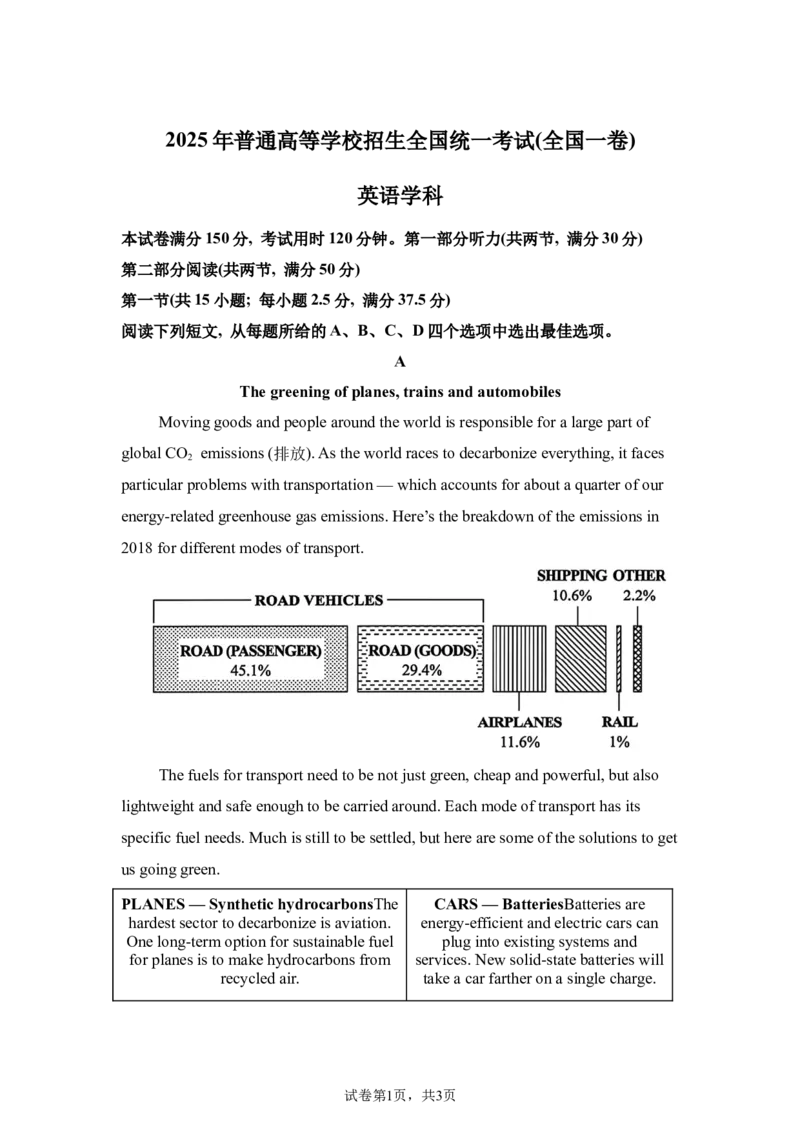
energy-related greenhouse gas emissions. Here’s the breakdown of the emissions in
2018 for different modes of transport.
The fuels for transport need to be not just green, cheap and powerful, but also
lightweight and safe enough to be carried around. Each mode of transport has its
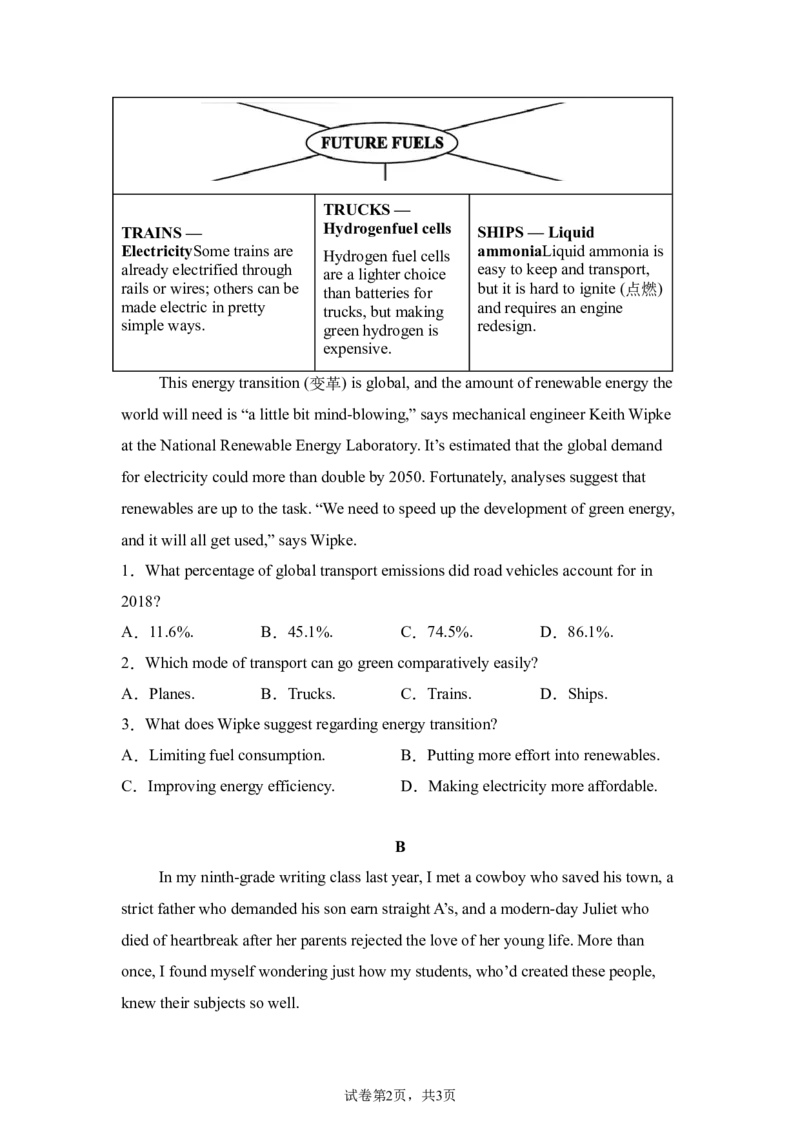
specific fuel needs. Much is still to be settled, but here are some of the solutions to get
us going green.
PLANES — Synthetic hydrocarbonsThe CARS — BatteriesBatteries are
hardest sector to decarbonize is aviation. energy-efficient and electric cars can
One long-term option for sustainable fuel plug into existing systems and
for planes is to make hydrocarbons from services. New solid-state batteries will
recycled air. take a car farther on a single charge.
试卷第1页,共3页TRUCKS —
Hydrogenfuel cells
TRAINS — SHIPS — Liquid
ElectricitySome trains are ammoniaLiquid ammonia is
Hydrogen fuel cells
already electrified through easy to keep and transport,
are a lighter choice
rails or wires; others can be but it is hard to ignite (点燃)
than batteries for
made electric in pretty and requires an engine
trucks, but making
simple ways. redesign.
green hydrogen is
expensive.
This energy transition (变革) is global, and the amount of renewable energy the
world will need is “a little bit mind-blowing,” says mechanical engineer Keith Wipke
at the National Renewable Energy Laboratory. It’s estimated that the global demand
for electricity could more than double by 2050. Fortunately, analyses suggest that
renewables are up to the task. “We need to speed up the development of green energy,
and it will all get used,” says Wipke.
1.What percentage of global transport emissions did road vehicles account for in
2018?
A.11.6%. B.45.1%. C.74.5%. D.86.1%.
2.Which mode of transport can go green comparatively easily?
A.Planes. B.Trucks. C.Trains. D.Ships.
3.What does Wipke suggest regarding energy transition?
A.Limiting fuel consumption. B.Putting more effort into renewables.
C.Improving energy efficiency. D.Making electricity more affordable.
B
In my ninth-grade writing class last year, I met a cowboy who saved his town, a
strict father who demanded his son earn straight A’s, and a modern-day Juliet who
died of heartbreak after her parents rejected the love of her young life. More than
once, I found myself wondering just how my students, who’d created these people,
knew their subjects so well.
试卷第2页,共3页But things were different for their first essay, which was about the question:
“Why is writing important?” Most of the essays filled less than one page, and few
contained a sentence that could be interpreted as a thesis (论点) statement. I was
shocked. Then I realized that the problem was the question itself. They could have
written pages on the necessity of computers, but writing, in and of itself, simply didn’t
strike them as important. This would have to change.
As a new unit started, I asked everyone to write a persuasive piece on a health-
related topic of their choice. This time they found the exercise much more interesting.
For the next two assignments, a personal-narrative unit followed by a creative-writing
workshop, I only required that the piece meet the specifications of its genre (体裁)
and that it contain a thesis. The results were staggering. The students took on diverse
topics and turned in stories, 10 to 20 pages each, with characters that broadened my
view and touched my heart.
I walked into class believing that writing is important as a means of
communication. However, my students demonstrated something more important to
me. When the final bell rang in June, I walked away with a yearbook full of messages
about writing’s most powerful significance — the ability to connect people, to put us
in another’s skin, to teach us what it means to be human.
4.Who are the people mentioned at the beginning of paragraph 1?
A.Ninth graders. B.Students’ parents.
C.Modern writers. D.Fictional characters.
5.Why did the students perform poorly in writing their first essay?
A.They were not given enough time. B.They had a very limited vocabulary.
C.They misunderstood the question. D.They had little interest in the topic.
6.What does the underlined word “staggering” in paragraph 3 mean?
A.Mixed. B.Amazing. C.Similar. D.Disturbing.
7.What does the author’s experience show?
A.Teaching is learning. B.Still waters run deep.
C.Knowledge is power. D.Practice makes perfect.
试卷第3页,共3页C
While safety improvements might have been made to our streets in recent years,
transport studies also show declines in pedestrian (行人) mobility, especially among
young children. Many parents say there’s too much traffic on the roads for their
children to walk safely to school, so they pack them into the car instead.
Dutch authors Thalia Verkade and Marco te Brömmelstroet are bothered by
facts like these. In their new book Movement: How to Take Back Our Streets and
Transform Our Lives, they call for a rethink of our streets and the role they play in our
lives.
Life on city streets started to change decades ago. Whole neighbourhoods were
destroyed to make way for new road networks and kids had to play elsewhere. Some
communities fought back. Most famously, a Canadian journalist who had moved her
family to Manhattan in the early 1950s led a campaign to stop the destruction of her
local park. Describing her alarm at its proposed replacement with an expressway, Jane
Jacobs called on her mayor (市长) to champion “New York as a decent place to live,
and not just rush through.” Similar campaigns occurred in Australia in the late 1960s
and 1970s as well.
Although these campaigns were widespread, the reality is that the majority of
the western cities were completely redesigned around the needs of the motor car. The
number of cars on roads has been increasing rapidly. In Australia we now have over
twenty million cars for just over twenty-six million people, among the highest rate of
car ownership in the world.
We invest a lot in roads that help us rush through, but we fail to account for the
true costs. Do we really recognise what it costs us as a society when children can’t
move safely around our communities? The authors of Movement have it right: it’s
time to think differently about that street outside your front door.
8.What phenomenon does the author point out in paragraph 1?
A.Cars often get stuck on the road. B.Traffic accidents occur frequently.
C.People walk less and drive more. D.Pedestrians fail to follow the rules.
9.What were the Canadian journalist and other campaigners trying to do?
试卷第4页,共3页A.Keep their cities livable. B.Promote cultural diversity.
C.Help the needy families. D.Make expressways accessible.
10.What can be inferred about the campaigns in Australia in the late 1960s and
1970s?
A.They boosted the sales of cars. B.They turned out largely ineffective.
C.They won government support. D.They advocated building new parks.
11.What can be a suitable title for the text?
A.Why the Rush? B.What’s Next?
C.Where to Stay? D.Who to Blame?
D
Microplastics have become a common source of pollution across the Earth —
they have settled in the deep sea and on the Himalayas, stuck inside volcanic rocks,
filled the stomachs of seabirds and even fallen in fresh Antarctic snow. They are even
appearing inside humans.
Now, new research suggests that a simple, cheap measure may significantly
reduce the level of microplastics in water from your tap (水龙头): boiling and
filtering (过滤) it. In a study published Wednesday in Environmental Science &
Technology Letters, researchers from China found that boiling tap water for just five
minutes — then filtering it after it cools — could remove at least 80 percent of its
microplastics.
Crucially, this process relies on the water containing enough calcium carbonate
(碳酸钙) to trap the plastics. In the study, boiling hard water containing 300
milligrams of calcium carbonate led to an almost 90 percent drop in plastics. But in
samples with less than 60 milligrams of calcium carbonate, boiling reduced the level
of plastics by just 25 percent. Additionally, the research didn’t include all types of
plastics. The team focused only on three common types — polystyrene, polyethylene
and polypropylene — and they didn’t study other chemicals previously found in water
such as vinyl chloride.
Still, the findings show a potential path forward for reducing microplastic
试卷第5页,共3页exposure — a task that’s becoming increasingly difficult. Even bottled water,
scientists found earlier this year, contains 10 to 1,000 times more microplastics than
originally thought.
Scientists are still trying to determine how harmful microplastics are — but
what they do know has raised concerns. The new study suggests boiling tap water
could be a tool to limit intake. “The way they demonstrated how microplastics were
trapped through the boiling process was nice,” Caroline Gauchotte-Lindsay, an
environmental engineer of the University of Glasgow in Scotland who was not
involved in the research, tells New Scientist. “We should be looking into upgrading
drinking water treatment plants so they remove microplastics.”
12.How does the author present the issue in the first paragraph?
A.By quoting an expert. B.By defining a concept.
C.By giving examples. D.By providing statistics.
13.What determines the effectiveness of trapping microplastics in water?
A.The hardness of water. B.The length of cooling time.
C.The frequency of filtering. D.The type of plastic in water.
14.What does the author try to illustrate by mentioning bottled water in paragraph
4?
A.The importance of plastic recycling. B.The severity of the microplastic
problem.
C.The danger in overusing pure water. D.The difficulty in treating polluted
water.
15.What is Gauchotte-Lindsay’s suggestion about?
A.Choice of new research methods. B.Possible direction for further study.
C.Need to involve more researchers. D.Potential application of the findings.
第二节(共5小题; 每小题2.5分, 满分12.5分)
阅读下面短文, 从短文后的选项中选出可以填入空白处的最佳选项。选项中有
两项为多余选项。
试卷第6页,共3页An Unsung Hero
Need a break between classes or just a quick pick-me-up in the morning? The
College Cafe has just that, and more. 16
Catherine Murphy, a cafe worker in a green shirt and black hat, makes sure that
each customer gets exactly what they order. She goes back and forth between
machines to make the drinks. 17 As the customer grabs the drink from her
hand, she smiles and says, “Hello, how is your day?” Even when the line is getting
longer, she doesn’t let it get in the way of her genuine conversations.
Murphy gets up at a quarter to five and drives thirty minutes every day to get to
work on time. 18 “I do so because I like to make coffee for the students. I
know they need it in the morning,” Murphy said. Being a mother and wife has helped
her become the woman she is. She believes she is here to serve.
One thing Murphy may not know is that her smile is contagious (有感染力) and
can be the difference in a student having a much better day than they were having
before seeing her. Joanna Wright, a senior political science major, loves coffee and
goes to the cafe at least six days a week. 19 “Catherine always has a huge
smile on her face, which always puts me in a cheerful mood,” Wright said.
“I enjoy working in the cafe,” Murphy said. 20 She has every
intention of staying and continuing doing what she loves.
A.The cafe closes at 9 pm every day.
B.She has two children aged eight and four.
C.Sometimes she arrives early to serve the students early.
D.After finishing an order, she calls out the name on the cup.
E.Not only does this cafe serve up drinks, it also serves up smiles.
F.Going to the cafe starts her day off good and gets her ready for class.
G.She has served here for 17 years and can’t imagine working anywhere else.
第三部分语言运用(共两节, 满分30分)
第一节(共15小题; 每小题1分, 满分15分)
试卷第7页,共3页阅读下面短文, 从每题所给的A、B、C、D四个选项中选出最佳选项。
One August afternoon, I sat in my kitchen staring at a glass vase that hadn’t seen
daylight since my wedding.
My husband and I had just sold our house and we were busy the
beloved home our family had spent 23 years filling up. We had decided on key items
for the we were moving to in town, donated what we could, and rented a
place to our supposedly important objects. That left a house still with
things that, while not particularly , didn’t belong in a landfill (垃圾填埋场).
I took a picture of the vase and posted it online, for $10. A couple of messages
came in, one wanting additional , another asking for a price cut. As our
day drew near, I settled on a new price ($0) and reposted it. The : “I hate this
vase. Maybe you won’t.” In an instant, a woman raced into my house and left happily
with the vase.
, I posted more. My daily posts and the I received became a
precious ray of light in the chaos of my house. Each exchange provided a chance to
the landfill and to please another person I might not otherwise have .
I sit in my apartment today, loving each of the that share our small
space. I take in knowing that, somewhere nearby, someone is
something that couldn’t come with us.
21.A.painting over B.looking around C.emptying out
D.pulling down
22.A.hotel B.office C.cottage D.apartment
23.A.store B.display C.sell D.repair
24.A.covered B.decorated C.stuffed D.equipped
25.A.conventional B.valuable C.complicated
D.tolerable
26.A.fees B.photos C.receipts D.models
27.A.move B.pay C.market D.work
28.A.warning B.request C.description D.reply
29.A.Confused B.Interested C.Disappointed D.Encouraged
试卷第8页,共3页30.A.visits B.reports C.advice D.money
31.A.remove B.spare C.find D.check
32.A.investigatedB.recognized C.encountered D.recommended
33.A.giveaways B.posts C.contributions D.belongings
34.A.joy B.part C.care D.time
35.A.anticipatingB.appreciating C.delivering D.withdrawing
第二节(共10小题; 每小题1.5分, 满分15分)
阅读下面短文, 在空白处填入1个适当的单词或括号内单词的正确形式。
An exhibition at the Jiushi Art Museum in Shanghai is featuring artwork
inspired by Go, or weiqi in Chinese, 36 originated in China more than 4,000
years ago.
Go is one of 37 earliest binary-based (基于二元的) games. The
movements of the black and white pieces reflect the basic ideas of Eastern philosophy,
according to Tu Ningning, who is in charge of the exhibition.
“The exhibition brings together Go culture, cutting-edge technology and
contemporary art,” says Tu. “We hope 38 (present)the rather abstract Go
game and AI in a visual context, and initiate dialogues with minimalist art, conceptual
art and expressionism.”
“In a Go game, each move should serve a long-term goal. You try to lead the
opponent into your trap and force them to follow your ‘ 39 (guide)’ till they
lose,” explains Wang Wei, a Go player among the visitors to the exhibition.
“The players’ personalities 40 (reveal) during the game, and one’s
weaknesses are exposed to the opponent,” she adds. “A decent winner always 41
(try) to beat the opponent 42 no more than one or two points as a gesture (姿
态) of respect for the other side. ”
Tu says that the balance between the black and white pieces, the beauty in the
43 (strategy) placement of the pieces, 44 the energy flow following
each move inspired artists to create oil paintings, sculptures, 45 (digital)
试卷第9页,共3页generated pictures and silk-screen prints for the exhibition.
第四部分 写作(共两节, 满分40分)
第一节(满分15分)
46.假定你是李华,你班的英语报要增设一个栏目。外教 Jenny 提出“Fun at
my school”和“Guess who I am”两个选项供大家选择。请给Jenny写一封邮件,
内容包括:
(1)你的选择;
(2)说明理由。
注意:
(1)写作词数应为80个左右;
(2)请按如下格式在答题卡的相应位置作答。
Dear Jenny,
I really like the idea of adding a new column to our English newspaper.
_____________________________________________________________________
_____________________________________________________________________
_____________________________________________________________________
_____________________________________________________________________
_____________________________________________________________________
_____________________________________________________________________
_____________________________________________________________
Yours,
Li Hua
第二节(满分25分)
47.阅读下面材料,根据其内容和所给段落开头语续写两段,使之构成一篇完
整的短文。
My wife and I wanted to share our new home with family and friends by hosting
a small gathering in the early summer. She had prepared lots of snacks, while my job
试卷第10页,共3页was to have the backyard in order.
There was plenty of space for the kids to run and play. There was just one thing
I hadn’t counted on: My brother chose to bring his dog Toby, a 50-pound ball of fire.
Though friendly, he could easily knock over my niece’s small boys and my six-
month-old granddaughter. So, when my brother showed up, I asked him to watch
Toby and keep him outside.
My plan was working out just fine. Toby was using up his energy by running
back and forth in the backyard and giving the kids plenty of room. Unexpectedly, after
supper, the weather changed. It started to rain and everyone went indoors.
It was an awkward moment. I didn’t want Toby to be running around in the
house, and my brother wasn’t happy with driving home with a wet dog. Eventually,
my brother decided to leave rather than force the issue.
A few days passed, and I hadn’t heard anything from my brother. I texted him
and expressed wishes for him to come out again. His reply came as a surprise — a
shock, actually: “Not a chance.” Clearly, he was unhappy over the way we had parted.
After all, I had left him little choice. Well, he’ll get over it, I reasoned.
Two months passed. My wife suggested I get in touch with my brother, but I
resisted, thinking he should call first. However, my conscience (良心) kept bothering
me. I tried to put myself in my brother’s shoes. He was facing health issues and his
wife of thirty-five years had passed away a few months earlier. Toby was his constant
companion, the one who kept him going.
注意:
(1)续写词数应为150个左右;
(2)请按如下格式在答题卡的相应位置作答。
I realized it was me who was at fault.
_____________________________________________________________________
_____________________________________________________________________
_____________________________________________________________________
_____________________________________________________________________
_____________________________________________________________________
试卷第11页,共3页_____________________________________________________________________
_____________________________________________________________
With the biscuits my wife had made, I arrived at my brother’s door.
_____________________________________________________________________
_____________________________________________________________________
_____________________________________________________________________
_____________________________________________________________________
_____________________________________________________________________
_____________________________________________________________________
_____________________________________________________________
试卷第12页,共3页1.C 2.C 3.B
【导语】本文是一篇应用文。文章主要介绍了2018年不同交通方式的温室气体排放占比,
以及飞机、汽车等各类交通工具的未来绿色燃料路径。
1.细节理解题。根据图表信息ROAD VEHICLES部分中“ROAD (PASSENGER) 45.1%
(道路(客运)45.1%)”以及“ROAD (GOODS) 29.4% (道路(货运)29.4%)”可知,道路车辆总占
比为45.1%+29.4%=74.5%,即道路车辆在2018年全球交通排放中占比74.5%。故选C项。
2.细节理解题。根据图表信息TRAINS — Electricity部分中“Some trains are already
electrified through rails or wires; others can be made electric in pretty simple ways. (一些列车已
经通过轨道或电线实现了电气化;其他火车可以通过非常简单的方式实现电动化)”可知,
火车相较其他交通方式更易实现绿色化。故选C项。
3.细节理解题。根据最后一段中““We need to speed up the development of green energy
and it will all get used,” says Wipke. (Wipke说:“我们需要加速绿色能源的开发,而且这些
能源都会被利用起来。”)”可知,Wipke建议加大对可再生能源的投入,即加大对绿色能
源的投入。故选B项。
4.D 5.D 6.B 7.A
【导语】本文是一篇记叙文。文章主要讲述了作者作为一名写作课老师,通过教学实践逐
渐认识到学生写作动力的来源以及写作真正意义的成长故事。
4.细节理解题。根据文章第一段中“In my ninth-grade writing class last year, I met a cowboy
who saved his town, a strict father who demanded his son earn straight A’s, and a modern-day
Juliet who died of heartbreak after her parents rejected the love of her young life. More than once,
I found myself wondering just how my students, who’d created these people, knew their subjects
so well. (去年,在我九年级的写作课上,我结识了一位拯救了自己小镇的牛仔、一位要求
儿子门门功课全得A的严厉父亲,还有一位现代版的朱丽叶——她在父母拒绝其年少挚爱
后心碎而逝。不止一次,我暗自琢磨,这些塑造了这些人物的学生,究竟是如何如此深谙
他们笔下的角色的)”可知,这里提到的牛仔、严厉的父亲和现代版的朱丽叶都是学生在写
作中创造出来的虚构人物。故选D。
5.推理判断题。根据文章第二段中“Most of the essays filled less than one page, and few
contained a sentence that could be interpreted as a thesis (论点) statement. I was shocked. Then I
realized that the problem was the question itself. They could have written pages on the necessity
of computers, but writing, in and of itself, simply didn’t strike them as important. (大多数文章篇
答案第1页,共2页幅不足一页,几乎没有包含可被视为论点的句子。我感到震惊。随后我意识到问题出在题
目本身。他们本可以就电脑的必要性写下数页内容,但写作本身根本没让他们觉得重要)”
可推知,学生们在写第一篇作文时表现不佳,是因为他们对写作这个话题本身不感兴趣。
故选D。
6.词句猜测题。根据文章第三段中划线词下文“The students took on diverse topics and
turned in stories, 10 to 20 pages each, with characters that broadened my view and touched my
heart. (学生们选取了多样的主题,交上来的故事每篇都有10到20页长,其中的人物拓宽
了我的视野,也触动了我的心)”可推知,此处指学生们写出了内容丰富、打动人心的故事,
与之前的表现形成强烈对比。划线词“staggering”意为“令人惊叹的、惊人的”,与B选
项“Amazing (惊人的)”语义一致。故选B。
7.推理判断题。通读全文,再根据文章最后一段中“I walked into class believing that
writing is important as a means of communication. However, my students demonstrated
something more important to me. When the final bell rang in June, I walked away with a yearbook
full of messages about writing’s most powerful significance — the ability to connect people, to put
us in another’s skin, to teach us what it means to be human. (我走进教室时坚信写作作为一种交
流方式至关重要。然而,学生们向我展示了更为重要的东西。当六月的下课铃响起时,我
带着一本满是留言的年鉴离开——这些留言诉说着写作最强大的意义:它能连接人与人,
让我们换位思考,教会我们身为人类的真谛)”结合全文内容可知,文章通过作者的教学经
历,说明她在教导学生的同时,自己也领悟到写作的真正意义,这一过程体现了“教学相
长”的理念。选项A“Teaching is learning (教学相长)”符合文中描述的作者通过教学获得的
新认识。故选A。
8.C 9.A 10.B 11.A
【导语】本文是一篇议论文。文章主要介绍了西方城市过度围绕汽车设计导致行人流动性
下降,尤其是儿童步行减少的现象,并通过历史案例和现状分析呼吁反思街道功能,重视
城市宜居性。
8.细节理解题。根据文章第一段“While safety improvements might have been made to our
streets in recent years, transport studies also show declines in pedestrian (行人) mobility,
especially among young children. Many parents say there’s too much traffic on the roads for their
children to walk safely to school, so they pack them into the car instead. (虽然近年来我们的街道
可能已经改善了安全性,但交通研究也表明行人的流动性下降,尤其是年轻儿童。许多家
答案第2页,共2页长说,路上的交通太拥挤,他们的孩子无法安全步行上学,所以他们把孩子塞进车里)”可
知,作者指出的现象是人们步行减少、开车增多。故选C。
9.推理判断题。根据文章第三段“Most famously, a Canadian journalist who had moved her
family to Manhattan in the early 1950s led a campaign to stop the destruction of her local park.
Describing her alarm at its proposed replacement with an expressway, Jane Jacobs called on her
mayor (市长) to champion “New York as a decent place to live, and not just rush through.” (最著
名的是,一位加拿大记者在20世纪50年代初举家迁往曼哈顿,她领导了一场阻止当地公
园被毁的运动。在描述她对用高速公路取代公园的提议感到震惊时,Jane Jacobs呼吁她的
市长捍卫“纽约作为适宜居住的地方,而不仅是匆匆穿过的通道”)”可推知,加拿大记者
和其他运动参与者旨在保持城市宜居性。故选A。
10.推理判断题。根据文章倒数第二段“Although these campaigns were widespread, the
reality is that the majority of the western cities were completely redesigned around the needs of
the motor car. The number of cars on roads has been increasing rapidly. (尽管这些运动很普遍,
但现实是大多数西方城市完全围绕汽车需求重新设计。道路上的汽车数量一直在迅速增
加)”可推知,20世纪60年代末和70年代澳大利亚的竞选活动未能阻止汽车发展,基本上
没有效果。故选B。
11.主旨大意题。通读全文,并根据文章最后一段“We invest a lot in roads that help us rush
through, but we fail to account for the true costs. Do we really recognise what it costs us as a
society when children can’t move safely around our communities? (我们在帮助我们快速通过的
道路上投入了大量资金,但我们没有考虑到真正的成本。我们真的认识到当孩子们不能在
我们的社区安全地移动时,我们作为一个社会将会付出什么代价吗)”可推知,本文批判城
市过度追求交通效率、忽视行人需求的现象,A项“Why the Rush? (为何匆匆?)”质问
“rush through (匆匆通行)”的规划理念,契合主旨,最适合作为本文标题。故选A。
12.C 13.A 14.B 15.D
【导语】本文是说明文。文章主要介绍了一项关于减少自来水中微塑料污染的新研究。微
塑料污染已遍及全球,甚至进入人体。中国研究人员发现,将自来水煮沸五分钟并冷却后
过滤可能会显著降低自来水中的微塑料含量。研究虽未涵盖所有塑料类型和化学物质,但
揭示了一种潜在解决方案。苏格兰环境工程师指出,该研究展示了煮沸法的有效性,并建
议升级饮用水处理厂以推广应用。
12.推理判断题。根据文章第一段中“Microplastics have become a common source of
答案第3页,共2页pollution across the Earth — they have settled in the deep sea and on the Himalayas, stuck inside
volcanic rocks, filled the stomachs of seabirds and even fallen in fresh Antarctic snow. They are
even appearing inside humans. (微塑料已经成为地球上常见的污染源——它们出现在在深海
和喜马拉雅山上,被困在火山岩中,填满海鸟的胃,甚至落在南极的新雪中。它们甚至出
现了在人类体内)”可推知,作者通过举例提出微塑料污染的问题。故选C。
13.细节理解题。根据文章第二段中“Crucially, this process relies on the water containing
enough calcium carbonate (碳酸钙) to trap the plastics. In the study, boiling hard water containing
300 milligrams of calcium carbonate led to an almost 90 percent drop in plastics. But in samples
with less than 60 milligrams of calcium carbonate, boiling reduced the level of plastics by just 25
percent. (至关重要的是,这一过程依赖于含有足够碳酸钙的水来截留塑料。在这项研究中,
将含有300毫克碳酸钙的硬水煮沸后,塑料含量下降了近90%。但在碳酸钙含量低于60毫
克的样品中,煮沸只降低了25%的塑料含量)”可知,决定在水中截留微塑料的有效性的是
水的硬度。故选A。
14.推理判断题。根据文章第四段中“Still, the findings show a potential path forward for
reducing microplastic exposure — a task that’s becoming increasingly diffcult. Even bottled water,
scientists found earlier this year, contains 10 to 1,000 times more microplastics than originally
thought. (尽管如此,研究结果显示了减少微塑料接触的潜在途径——这一任务正变得越来
越困难。今年早些时候,科学家们发现,即使是瓶装水,其微塑料含量也比原先想象的高
出10到1000倍。)”可推断,作者提到瓶装水是为了说明微塑料污染的严重性。故选B。
15.推理判断题。根据文章最后一段中““The way they demonstrated how microplastics
were trapped through the boiling process was nice,” Caroline Gauchotte-Lindsay, an
environmental engineer of the University of Glasgow in Scotland who was not involved in the
research, tells New Scientist. “We should be looking into upgrading drinking water treatment
plants so they remove microplastics.” (苏格兰格拉斯哥大学的环境工程师Caroline Gauchotte-
Lindsay没有参与这项研究,她告诉《新科学家》杂志:“他们展示微塑料如何在煮沸过程
中被截留的方式很不错。”“我们应该考虑升级饮用水处理厂,以便它们能去除微塑
料”)”可推知,Caroline Gauchotte-Lindsay的建议是关于这项研究结果的潜在应用,即升级
饮用水处理厂。故选D。
16.E 17.D 18.C 19.F 20.G
【导语】本文是一篇记叙文。文章主要讲述大学咖啡馆工作人员凯瑟琳·墨菲用真诚的服务
答案第4页,共2页和热情的微笑为学生带来温暖的故事,展现了这位平凡英雄的动人之处。
16.根据上文“Need a break between classes or just a quick pick-me-up in the morning? The
College Cafe has just that, and more. (课间需要休息或早上快速提神?大学咖啡馆提供这些,
还有更多。)”可知,开篇引出咖啡馆的功能,空格处需揭示“更多”的内涵。E选项“Not
only does this cafe serve up drinks, it also serves up smiles. (这家咖啡馆不仅提供饮品,还提供
微笑。)”通过“Not only...also...”结构,既承接“drinks”,又引出下文核心——墨菲的微笑
服务,符合语境。故选E项。
17.根据上文“She goes back and forth between machines to make the drinks. (她在机器之间
来回制作饮品。)”及下文“As the customer grabs the drink from her hand, she smiles and says,
“Hello, how is your day?” Even when the line is getting longer, she doesn’t let it get in the way of
her genuine conversations. (当顾客从她手中接过饮品时,她微笑着说:“你好,今天过得怎
么样?”即使队伍越来越长,她也不会让这影响到她真诚的交流。)”可推知,设空处需补
充制作饮品后的环节。D选项“After finishing an order, she calls out the name on the cup. (完
成订单后,她会喊出杯子上的名字。)”中的“finishing an order”衔接“make the
drinks”,“calls out the name”引出顾客接饮品的场景,形成“制作—叫号—交付”的完整
流程。故选D项。
18.根据上文“Murphy gets up at a quarter to five and drives thirty minutes every day to get to
work on time. (墨菲每天四点四十五起床,开车三十分钟准时上班。)”及下文“I do so
because I like to make coffee for the students. (我这样做是因为我喜欢为学生煮咖啡。)”可推
知,设空处需进一步体现她对工作的投入。C选项“Sometimes she arrives early to serve the
students early. (有时她会提前到达,提前为学生服务。)”中的“arrives early”补充了“准时上
班”之外的主动性,“serve the students early”呼应“like to make coffee for the students”,展
现其敬业精神。故选C项。
19.根据上文“Joanna Wright, a senior political science major, loves coffee and goes to the cafe
at least six days a week. (乔安娜・赖特是政治学专业的大四学生,她热爱咖啡,每周至少去
这家咖啡馆六天。)”及下文““Catherine always has a huge smile on her face, which always
puts me in a cheerful mood,” Wright said. (赖特说“凯瑟琳总是笑容满面,这总能让我心情愉
快。”)”可推知,设空处需说明她频繁去咖啡馆的原因。F选项“Going to the cafe starts her
day off good and gets her ready for class. (去咖啡馆让她一天有个好的开始,并为上课做好准
备。)”中的“starts her day off good”解释了“每周去六天”的动机,且“cheerful mood”与墨
答案第5页,共2页菲的微笑服务形成因果关系。故选F项。
20.根据下文“She has every intention of staying and continuing doing what she loves. (她完全
打算留下来,继续做自己喜欢的事。)”可推知,设空处需体现她对工作的长期投入。G选
项“She has served here for 17 years and can’t imagine working anywhere else. (她已经在这里
服务了17年,无法想象在其他地方工作。)”中的“17 years”凸显服务年限之长,“can’t
imagine working anywhere else”强化对咖啡馆的情感联结,与“staying”形成直接呼应。故选
G项。
21.B 22.D 23.A 24.C 25.B 26.B 27.A 28.C 29.
D 30.A 31.B 32.C 33.D 34.A 35.B
【导语】本文是一篇记叙文。文章主要讲述了作者在搬家过程中通过免费赠送旧物获得快
乐的故事。
21.考查动词短语辨析。句意:我和丈夫刚刚卖掉了我们的房子,我们正忙着清空我们一
家人花了23年时间建造的心爱的房子。A. painting over 粉刷覆盖;B. looking around 环顾
四周;C. emptying out 清空;D. pulling down 拆除。根据上文“My husband and I had just
sold our house”和下文“the beloved home our family had spent 23 years filling up”可推知,此
处指作者卖掉了房子,忙着清空房子里的多年来堆积的东西。故选C。
22.考查名词词义辨析。句意:我们已经为即将搬到城里的公寓选定了关键物品,尽可能
捐赠了能捐的东西,并租了一个地方来存放我们自认为重要的物品。A. hotel 酒店;B.
office 办公室;C. cottage 小屋;D. apartment 公寓。根据文章最后一段“I sit in my
apartment today”可推知,此处指作者一家人搬到了公寓。故选D。
23.考查动词词义辨析。句意:我们已经为即将搬到城里的公寓选定了关键物品,尽可能
捐赠了能捐的东西,并租了一个地方来存放我们自认为重要的物品。A. store 储存;B.
display 展示;C. sell 出售;D. repair 修理。根据上文“rented a place”以及下文“our
supposedly important objects”可推知,此处指租地方是为了存放重要物品。故选A。
24.考查形容词词义辨析。句意:这使得房子里仍然堆满了那些虽然不是特别值钱,但不
应该放在垃圾填埋场的东西。A. covered 覆盖的;B. decorated 装饰的;C. stuffed 塞满的;
D. equipped 配备的。根据上文“rented a place to 3 our supposedly important objects”以及
下文“with things”可推知,此处指房子里仍塞满物品。故选C。
25.考查形容词词义辨析。句意:这使得房子里仍然堆满了那些虽然不是特别值钱,但不
答案第6页,共2页应该放在垃圾填埋场的东西。A. conventional 传统的;B. valuable 有价值的;C.
complicated 复杂的;D. tolerable 可容忍的。根据上文“while not particularly”以及下文
“didn’t belong in a landfill”可推知,此处指虽不贵重但不应丢弃的物品。故选B。
26.考查名词词义辨析。句意:有几条信息进来了,一条想要更多的照片,另一条请求降
价。A. fees 费用;B. photos 照片;C. receipts 收据;D. models 模型。根据上文“I took a
picture of the vase”及“additional”可推知,此处指有人索要更多照片。故选B。
27.考查名词词义辨析。句意:随着搬家日的临近,我确定了一个新的价格(0美元)并
重新发布了它。A. move 搬家;B. pay 支付;C. market 市场;D. work 工作。根据前文搬
家背景及下文“day drew near”可推知,此处指搬家日临近。故选A。
28.考查名词词义辨析。句意:描述:“我讨厌这个花瓶。也许你不会。”A. warning 警
告;B. request 请求;C. description 描述;D. reply 回复。根据上文“I took a picture of the
vase and posted it online”以及下文“I hate this vase. Maybe you won’t.”可推知,此处指是重
新发布的对花瓶的描述。故选C。
29.考查形容词词义辨析。句意:受到鼓励,我发布了更多。A. Confused 困惑的;B.
Interested 感兴趣的;C. Disappointed 失望的;D. Encouraged 受鼓励的。根据上文“In an
instant, a woman raced into my house and left happily with the vase.”以及作者后文持续发帖的
行为,可推知,此处指作者受到鼓舞。故选D。
30.考查名词词义辨析。句意:我每天收到的帖子和来我家里的拜访,在我混乱的房子里
变成了一束珍贵的光芒。A. visits 拜访;B. reports 报告;C. advice 建议;D. money 钱。
根据上文“In an instant, a woman raced into my house”以及“My daily posts”和后文的互动,
可推知,此处指去作者家里拜访。故选A。
31.考查动词词义辨析。句意:每一次交换都提供了一个避免垃圾填埋的机会,也让我得
以取悦另一个原本可能不会遇到的人。A. remove 移除;B. spare 省得;免去;C. find 发
现;D. check 检查。根据上文语境以及下文“the landfill”可推知,此处指作者用免费赠送
旧物来代替丢掉旧物垃圾填埋,此处spare引申为“免去”表示免得去垃圾填埋场丢东西。
故选B。
32.考查动词词义辨析。句意:每一次交换都提供了一个避免垃圾填埋的机会,也让我得
以取悦另一个原本可能不会遇到的人。A. investigated 调查;B. recognized 认出;C.
encountered 遇见;D. recommended 推荐。根据上文“another person I might not otherwise”
可推知,此处指免费赠送旧物让原本不会遇见的人感到高兴。故选C。
答案第7页,共2页33.考查名词词义辨析。句意:今天我坐在我的公寓里,爱着我们小空间里的每一件所有
物。A. giveaways 赠品;B. posts 帖子;C. contributions 贡献;D. belongings 所有物。结
合语境,再根据上文“I sit in my apartment today”以及下文“share our small space”可推知,
此处指现在拥有的物品。故选D。
34.考查名词词义辨析。句意:知道就在附近的某个地方,有人正在欣赏着这件无法随我
们一起走的东西,我感到很快乐。A. joy 快乐;B. part 部分;C. care 关心;D. time 时间。
结合语境,再根据上文“loving each of the 13 that share our small space.”以及下文“in
knowing that, somewhere nearby”可推知,此处指作者免费赠送旧物,也从中获得了快乐。
故选A。
35.考查动词词义辨析。句意:知道就在附近的某个地方,有人正在欣赏着这件无法随我
们一起走的东西,我感到很快乐。A. anticipating 期待;B. appreciating 欣赏;C. delivering
递送;D. withdrawing 撤回。根据上文“I take 13 in knowing that, somewhere nearby”以
及下文“something that couldn’t come with us”可推知,此处指他人在欣赏这些作者带不走的,
赠予的物品。故选B。
36.which 37.the 38.to present 39.guidance 40.are revealed 41.
tries 42.by 43.strategic 44.and 45.digitally
【导语】本文是一篇说明文。文章主要讲述了上海久事美术馆举办的一场以围棋为灵感的
艺术展览。
36.56. 考查定语从句。句意:上海久事美术馆正在举办一场展览,展出的艺术品灵感来
自围棋(中文称为“围棋”),它起源4000多年前的中国。本空引导非限制性定语从句,
修饰先行词为Go, or weiqi in Chinese,指物,且关系词代替先行词在从句中作主语,所以
用关系代词which引导。故填which。
37.考查冠词。句意:围棋是最早的基于二元的棋类游戏之一。形容词最高级前用定冠词
the。故填the。
38.考查非谓语动词。句意:我们希望在一个视觉语境中呈现相当抽象的围棋游戏和人工
智能,并与极简主义艺术、观念艺术和表现主义展开对话。本句谓语为hope,此处为非谓
语动词,hope to do sth.“希望做某事”,所以此处需用动词present“呈现”的不定式,作宾
语。故填to present。
39.考查名词。句意:你试图引导对手进入你的陷阱,迫使他们跟随你的“引导”直到他
答案第8页,共2页们输掉。此处作follow的宾语,用名词guidance“引导”,不可数名词。故填guidance。
40.考查动词语态。句意:她补充说:“玩家的个性在游戏中显露出来,一个人的弱点会
暴露给对手。”本句描述一般事实,时态用一般现在时,且主语The players’ personalities
与动词reveal“揭示,显示”为被动关系,所以空处需用一般现在时态的被动语态,主语为
复数,be动词用are。故填are revealed。
41.考查时态和主谓一致。句意:一个不错的赢家总是尽力以仅仅一两分的优势击败对手,
以表示对对方的尊重。根据always可知,本句描述一般事实,时态用一般现在时,主语a
decent winner为第三人称单数,所以谓语需用try“尽力”的第三人称单数tries。故填tries。
42.考查介词。句意同上。“by+具体数值”表示“以(某一差值)”,此处指“以一到
两分的优势”,符合语境。故填by。
43.考查形容词。句意:屠宁宁说,黑白棋子之间的平衡,棋子在策略布局上的美感,以
及每一步棋所蕴含的能量流动,都激发了艺术家们为展览创作油画、雕塑、数字生成的图
片和丝网版画。此处修饰名词placement,需用形容词strategic“战略性的,策略的”,作定
语。故填strategic。
44.64. 考查连词。句意同上。the balance between the black and white pieces, the beauty in
the strategic placement of the pieces, the energy flow following each move三者为并列关系,作
并列主语,所以空处需用连词and。故填and。
45.考查副词。句意同上。此处修饰形容词generated,需用副词digitally“数字地”,作状
语。故填digitally。
46.One possible version:
Dear Jenny,
I really like the idea of adding a new column to our English newspaper. I’m writing to
express that my predilection goes to “Guess who I am”, which capitalizes on an object clause to
signal its potential contents.
The column will serve as a catalyst for closer bonds between students. Redoubling efforts to
boost academic performance, we pay little heed to other classmates’ personalities, hobbies,
strengths, and even aspirations. Such an inviting column, adopting a “description and guess”
approach, must expose everyone to others’ characteristics, thus strengthening mutual
understanding. More importantly, more friendships will be forged, since the column enables us to
befriend someone on the same wavelength.
答案第9页,共2页This eye-catching column, I’m firmly convinced, won’t fail to grant the whole class a
harmonious atmosphere.
Yours,
Li Hua
【导语】本篇书面表达属于应用文。要求考生就外教Jenny提出的校英文报增设一个栏目,
在“Fun at my school”和“Guess who I am”两个选项中给出自己的推荐,并说明理由。
【详解】1.词汇积累
表达:express → convey
利用:capitalize on → use
担当:serve as → act as
注意:pay heed to → take notice of
2.句式拓展
简单句变复合句
原句:Such an inviting column, adopting a “description and guess” approach, must expose
everyone to others’ characteristics, thus strengthening mutual understanding.
拓展句:Such an inviting column, which adopts a “description and guess” approach, must expose
everyone to others’ characteristics, thus strengthening mutual understanding.
【点睛】【高分句型1】I’m writing to express that my predilection goes to “Guess who I am”,
which capitalizes on an object clause to signal its potential contents.(运用了that引导的宾语从
句,which引导的定语从句)
【高分句型2】More importantly, more friendships will be forged, since the column enables us to
befriend someone on the same wavelength.(运用了since引导的状语从句)
47.One possible version:
I realized it was me who was at fault. I had been so focused on keeping the party under
control that I failed to consider how important Toby was to my brother during this difficult time.
My pride had kept me from reaching out, and now months had passed without a proper
conversation. One evening, I picked up the phone and left him a voice message, apologizing for
my behavior and asking if we could meet. To my relief, he called back the next day, and we agreed
to get together soon.
With the biscuits my wife had made, I arrived at my brother’s door. He opened it with a
surprised smile, and for a moment, neither of us spoke. Then we hugged — something we hadn’t
答案第10页,共2页done since before his wife passed away. We sat on the porch with Toby resting beside us, and I
handed him the box of biscuits. “Thank you,” he said quietly. We talked for hours, laughing,
remembering old times, and slowly rebuilding what had been lost. As I watched Toby gently rest
his head on my brother’s leg, I knew we were finally on the path to healing.
【导语】本文以人物为线索展开,讲述了作者因担心弟弟的狗Toby影响聚会,要求弟弟看
好狗,后因天气变化导致弟弟提前离开并心生芥蒂。两个月后作者意识到自己的过错,主
动带着妻子做的饼干登门道歉,最终兄弟俩和解的故事,展现了亲情中理解与包容的重要
性。
【详解】1. 段落续写:
①由第一段首句内容“我意识到是我错了。” 可知,第一段可描写作者反思自己在聚会上
只顾控制局面,忽视了Toby对弟弟的重要性,因骄傲迟迟未联系弟弟,最终通过电话留言
道歉并约定见面。
②由第二段首句内容“带着妻子做的饼干,我来到了弟弟家门口。”可知,第二段可描写
弟弟开门时的惊讶与沉默,兄弟俩拥抱和解,坐在门廊上谈心,看着Toby依偎在弟弟腿边,
明白亲情修复的意义。
2. 续写线索:反思过错——电话留言道歉——约定见面——带饼干登门——拥抱沉默——
谈心和解——领悟亲情
3. 词汇激活
行为类
①道歉:apologize/say sorry/make an apology
②拥抱:hug/embrace
③重建:rebuild/restore/reconstruct
情绪类:
①宽慰:relief/comfort/satisfaction/ease
②惊讶:surprised /shocked/astonished
【点睛】[高分句型1] I had been so focused on keeping the party under control that I failed to
consider how important Toby was to my brother during this difficult time.(运用了“so...that...”
引导结果状语从句以及how引导宾语从句)
[高分句型2] One evening, I picked up the phone and left him a voice message, apologizing for
my behavior and asking if we could meet.(运用了现在分词短语作状语以及if引导的宾语从
句)
答案第11页,共2页[高分句型 3] As I watched Toby gently rest his head on my brother’s leg, I knew we were finally
on the path to healing.(运用了as引导时间状语从句以及省略that的宾语从句)
答案第12页,共2页