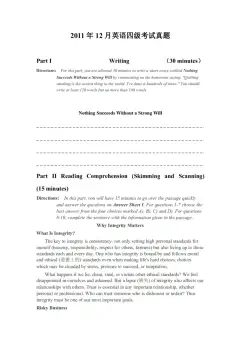
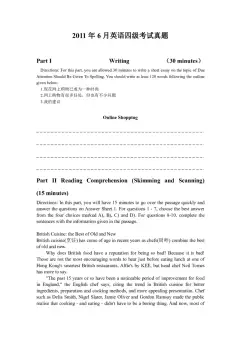
2011 年 6 月英语四级考试真题
Part I Writing (30 minutes)
Directions: For this part, you are allowed 30 minutes to write a short essay on the topic of Due
Attention Should Be Given To Spelling. You should write at least 120 words following the outline
given below:
1.现在网上购物已成为一种时尚
2.网上购物有很多好处,但也有不少问题
3.我的建议
Online Shopping
Part II Reading Comprehension (Skimming and Scanning) (15
minutes)
Directions: In this part, you will have 15 minutes to go over the passage quickly and
answer the questions on Answer Sheet 1. For questions 1 - 7, choose the best answer
from the four choices marked A), B), C) and D). For questions 8-10, complete the
sentences with the information given in the passage.
British Cuisine: the Best of Old and New
British cuisine(烹饪) has come of age in recent years as chefs(厨师) combine
the best of old and new.
Why does British food have a reputation for being so bad? Because it is bad! Those
are not the most encouraging words to hear just before eating lunch at one of Hong
Kong's smartest British restaurants, Alfie's by KEE, but head chef Neil Tomes has
more to say.
"The past 15 years or so have been a noticeable period of improvement for food in
England," the English chef says, citing the trend in British cuisine for betteringredients, preparation and cooking methods, and more appealing presentation. Chef
such as Delia Smith, Nigel Slater, Jamie Oliver and Gordon Ramsay made the public
realise that cooking - and eating - didn't have to be a boring thing. And now, most of
the British public is familiar even with the extremes of Heston Blumenthal's
molecular gastronomy, a form of cooking that employs scientific methods to create
the perfect dish.
"It's no longer the case that the common man in England is embarrassed to show he
knows about food," Tomes says.
There was plenty of room for improvement. The problems with the nation's cuisine
can be traced back to the Second World War. Before the war, much of Britain's food
was imported and when German U-boats began attacking ships bringing food to the
country, Britain went on rations(配给).
"As rationing came to an end in the 1950s, technology picked up and was used to
mass-produce food," Tomes says. "And by then people were just happy to have a
decent quantity of food in their kitchens."
They weren't looking for cured meats, organic produce or beautiful presentation;
they were looking for whatever they could get their hands on, and this prioritisation of
quantity over quality prevailed for decades, meaning a generation was brought up
with food that couldn't compete with neighbouring France, Italy, Belgium or Spain.
Before star chefs such as Oliver began making cooking fashionable, it was
hard to find a restaurant in London that was open after 9pm. But in recent
years the capital's culinary(烹饪的) scene has developed to the point that it is
now confident of its ability to please the tastes of any international visitor.
With the opening of Alfie's in April, and others such as The Pawn, two years ago,
modern British food has made its way to Hong Kong. "With British food, I think that
Hong Kong restaurant are keeping up," says David Tamlyn, the Welsh executive chef
at The Pawn in Wan Chai. "Hong Kong diners are extremely responsive to new ideas
or presentations, which is good news for new dishes."
Chefs agree that diners in Hong Kong are embracing the modern British
trend. Some restaurants are modifying the recipes(菜谱)of British dishes to
breathe new life into the classics, while other are using better quality
ingredients but remaining true to British traditional and tastes.
Tamlyn is in the second camp. "We select our food very particulary. We use
US beef, New Zealand lamb and for our custards(牛奶蛋糊) we use Bird's
Custard Powder," Tamlyn says. "Some restaurants go for custard made fresh
with eggs, sugar and cream, but British custard is different, and we stay true to
that."
Matthew Hill, senior manager at the two-year-old SoHo restaurant Yorkshire
Pudding, also uses better ingredients as a means of improving dishes. "There are a lot
of existing perceptions about British food and so we can't alter these too much. We're
a traditional British restaurant so there are some staples(主菜) that will remain
essentially unchanged."
These traditional dishes include fish and chips, steak and kidney pie and large
pieces of roasted meats. At Alfie's, the newest of the British restaurants in town andperhaps the most gentlemen's club-like in design, Neil Tomes explains his passion for
provenance(原产地). "Britain has started to become really proud of the food
it's producing. It has excellent organic farms, beautifully crafted cheeses, high-
quality meats."
However, the British don't have a history of exporting their foodstuffs, which
makes it difficult for restaurants in Hong Kong to source authentic ingredients.
"We can get a lot of our ingredients once a week from the UK," Tamlyn explains.
"But there is also pressure to buy local and save on food miles, which means we take
our vegetables from the local markets, and there are a lot that work well with British
staples."
The Phoenix, in Mid-Levels, offers the widest interpretation of "British cuisine",
while still trying to maintain its soul. The gastro-pub has existed in various locations
in Hong Kong since 2002. Singaporean head chef Tommy Teh Kum Chai offers daily
specials on a blackboard, rather than sticking to a menu. This enables him to
reinterpret British cuisine depending on what is available in the local markets.
"We use a lot of ingredients that people wouldn't perhaps associate as British, but
are presented in a British way. Bell peppers stuffed with couscous, alongside
ratatouille, is a very popular dish."
Although the ingredients may not strike diners as being traditional, they can be found
in dishes across Britain.
Even the traditional chefs are aware of the need to adapt to local tastes and
customs, while maintaining the Brutishness of their cuisine.
At Yorkshire Pudding, Hill says that his staff asks diners whether they would like to
share their meals. Small dishes, shared meals and "mixing it up" is not something
commonly done in Britain, but Yorkshire Pudding will bring full dished to the table
and offer individual plates for each dinner. "That way, people still get the presentation
of the dishes as they were designed, but can carve them up however they like," Hill
says.
This practice is also popular at The Pawn, although largely for
rotisseries(烤肉馆), Tamlyn says. "Some tables will arrive on Sunday, order a
whole chicken and a shoulder of lamb or a baby pig, and just stay for hours
enjoying everything we bring out for them."
Some British traditions are too sacred(神圣的) to mess with, however,
Tomes says. "I'd never change a full English breakfast."
1. What is British food generally known for?
A) Its unique flavor. B) Its bad taste.
C) Its special cooking methods D) Its organic ingredients.
2. The Second World War led to ____ in Britain.
A) an inadequate supply of food B) a decrease of grain production
C) an increase in food import D) a change in people's eating habits
3. Why couldn't Britain compete with some of its neighboring countries in terms of
food in the post-war decades?
A) Its food lacked variety. B) Its people cared more for quantity.
C) It was short of well-trained chefs. D) It didn't have flavorful foodingredients.
4. With culinary improvement in recent years, London's restaurants are now able to
appeal to the tastes of ____.
A) most young people B) elderly British diners
C) all kinds of overseas visitors D) upper-class customers
5. What do Hong Kong diners welcome, according to Welsh executive chef David
Tamlyn?
A) Authentic classic cuisine. B) Locally produced ingredients.
C) New ideas and presentations. D) The return of home-style dishes.
6. While using quality ingredients, David Tamlyn insists that the dishes should ____.
A) benefit people's health B) look beautiful and inviting
C) be offered at reasonable prices D) maintain British traditional tastes
7. Why does Neil Tomes say he loves food ingredients from Britain?
A) They appeal to people from all over the world. B) They are produced on excellent
organic forms.
C) They are processed in a scientific way. D) They come in a great
variety.
8. Tamlyn says that besides importing ingredients from Britain once a week, his
restaurant also buys vegetables from ____________________.
9. The Phoenix in Mid-Levels may not use British ingredients, but presents its dishes
________________.
10. Yorkshire Pudding is a restaurant which will bring full dishes to the table but offer
plates to those diners who would like to ___________________________.
Part III Listening Comprehension (35 minutes)
Section A
Directions: In this section, you will hear 8 short conversations and 2 long
conversations. At the end of each conversation, one or more questions will be asked
about what was said. Both the conversation and the questions will be spoken only
once. After each question there will be a pause. During the pause, you must read the
four choices marked A), B), C) and D), and decide which is the best answer. Then
mark the corresponding letter on Answer Sheet 2 with a single line through the centre.
11. A) He is careless about his appearance.
B) He is ashamed of his present condition.
C) He changes jobs frequently.
D) He shaves every other day.
12. A) Jane may be caught in a traffic jam.
B) Jane should have started a little earlier.
C) He knows what sort of person Jane is.
D) He is irritated at having to wait for Jane.
13. A) Training for the Mid-Atlantic Championships.
B) Making preparations for a trans-Atlantic trip.
C) Collecting information about baseball games.D) Analyzing their rivals' on-field performance.
14. A) He had a narrow escape in a car accident.
B) He is hospitalized for a serious injury.
C) He lost his mother two weeks ago.
D) He has been having a hard time.
15. A) The woman has known the speaker for a long time.
B) The man had difficulty understanding the lecture.
C) The man is making a fuss about nothing.
D) The woman thinks highly of the speaker.
16. A) He has difficulty making sense of logic.
B) Statistics and logic are both challenging subjects.
C) The woman should seek help from the tutoring service.
D) Tutoring services are very popular with students.
17. A) Her overcoat is as stylish as Jill's.
B) Jill missed her class last week.
C) Jill wore the overcoat last week.
D) She is in the same class as the man.
18. A) A computer game.
B) An imaginary situation.
C) An exciting experience.
D) A vacation by the sea.
Questions 19 to 21 are based on the conversation you have just heard.
19. A) Beautiful scenery in the countryside.
B) Dangers of cross-country skiing.
C) Pain and pleasure in sports.
D) A sport he participates in.
20. A) He can't find good examples to illustrate his point.
B) He can't find a peaceful place to do the assignment.
C) He doesn't know how to describe the beautiful country scenery.
D) He can't decide whether to include the effort part of skiing.
21. A) New ideas come up as you write.
B) Much time is spent on collecting data.
C) A lot of effort is made in vain.
D) The writer's point of view often changes.
Questions 22 to 25 are based on the conversation you have just heard.
22. A) Journalist of a local newspaper.
B) Director of evening radio programs.
C) Producer of television commercials.
D) Hostess of the weekly "Business World".
23. A) He ran three restaurants with his wife's help.
B) He and his wife did everything by themselves.
C) He worked both as a cook and a waiter.
D) He hired a cook and two local waitresses.
24. A) He hardly needs to do any advertising nowadays.B) He advertises a lot on radio and in newspapers.
C) He spends huge sums on TV commercials every year.
D) He hires children to distribute ads in shopping centers.
25. A) The restaurant location.
B) The restaurant atmosphere.
C) The food variety.
D) The food price.
Section B
Directions: In this section, you will hear 3 short passages. At the end of each passage,
you will hear some questions. Both the passage and the questions will be spoken only
once. After you hear a question, you must choose the best answer from the four
choices marked A), B), C) and D). Then mark the corresponding letter on Answer
Sheet 2 with a single line through the centre.
Passage One
26. A) Its protection is often neglected by children.
B) It cannot be fully restored once damaged.
C) There are many false notions about it.
D) There are various ways to protect it.
27. A) It may make the wearer feel tired.
B) It will gradually weaken the eyes of adults.
C) It can lead to the loss of vision in children.
D) It can permanently change the eye structure.
28. A) It can never be done with high technology.
B) It is the best way to restore damaged eyesight.
C) It is a major achievement in eye surgery.
D) It can only be partly accomplished now.
Passage Two
29. A) They think they should follow the current trend.
B) Nursing homes are well-equipped and convenient.
C) Adult day-care centers are easily accessible.
D) They have jobs and other commitments.
30. A) They don't want to use up all their life savings.
B) They fear they will regret it afterwards.
C) They would like to spend more time with them.
D) They don't want to see their husbands poorly treated.
31. A) Provide professional standard care.
B) Be frank and seek help from others.
C) Be affectionate and cooperative.
D) Make use of community facilities.
Passage Three
32. A) Health and safety conditions in the workplace.
B) Rights and responsibilities of company employees.
C) Common complaints made by office workers.
D) Conflicts between labor and management.33. A) Replace its out-dated equipment.
B) Improve the welfare of affected workers.
C) Follow the government regulations strictly.
D) Provide extra health compensation.
34. A) They requested to transfer to a safer department.
B) They quit work to protect their unborn babies.
C) They sought help from union representatives.
D) They wanted to work shorter hours.
35. A) To show how they love winter sports.
B) To attract the attention from the media.
C) To protect against the poor working conditions.
D) To protect themselves against the cold weather.
Section C
Directions: In this section, you will hear a passage three times. When the passage is
read for the first time, you should listen carefully for its general idea. When the
passage is read for the second time, you are required to fill in the blanks numbered
from 36 to 43 with the exact words you have just heard. For blanks numbered from 44
to 46 you are required to fill in the missing information. For these blanks, you can
either use the exact words you have just heard or write down the main points in your
own words. Finally, when the passage is read for the third time, you should check
what you have written.
Contrary to the old warning that time waits for no one, time slows down
when you are on the move. It also slows down more as you move faster,
which means astronauts(宇航员) someday may (36)__________ so long in
space that they would return to an Earth of the (37)__________ future. If you
could move at the speed of light, your time would stand still. If you could move faster
than light, your time would move (38)__________ .
Although no form of matter yet (39)__________ moves as fast as or faster than
light, (40)__________ experiments have already confirmed that accelerated
(41)__________ causes a traveler's time to be stretched. Albert Einstein
(42)__________ this in 1905, when he (43)__________ the concept of relative time
as part of his Special Theory of Relativity. A search is now under way to confirm the
suspected existence of particles of matter
(44)_______________________________________________
__________________________________________ .
An obsession( 沉 迷 )with time-saving, gaining, wasting, losing, and
mastering it-
(45)_________________________________________________________________
__________________________________________________ . Humanity also has
been obsessed with trying to capture the meaning of time. Einstein
(46)___________________________________________________________
____________________________________. Thus, time and time's relativity are
measurable by any hourglass, alarm clock, or an atomic clock that can measure a
billionth of a second.Part Ⅳ Reading Comprehension (Reading in Depth) (25 minutes)
Section A
Directions: In this section, there is a passage with ten blanks. You are required to
select one word for each blank from a list of choices given in a word bank following
the passage. Read the passage through carefully before making your choices. Each
choice in the bank is identified by a letter. Please mark the corresponding letter for
each item on Answer Sheet 2 with a single line through the centre. You may not use
any of the words in the bank more than once.
The popular notion that older people need less sleep than younger adults is a myth,
scientists said yesterday.
While elderly people 47 to sleep for fewer hours than they did when they were
younger, this has a(n) 48 effect on their brain's performance and they would benefit
from getting more, according to research.
Sean Drummond, a psychiatrist (心理医生) at the University of California,
San Diego, said that older people are more likely to suffer from broken sleep,
while younger people are better at sleeping 49 straight through the night.
More sleep in old age, however, is 50 with better health, and most older people
would feel better and more 51 if they slept for longer periods, he said.
"The ability to sleep in one chunk (整块时间) overnight goes down as we
age but the amount of sleep we need to 52 well does not change," Dr
Drummond told the American Association for the Advancement of Science
conference in San Diego.
"It's 53 a myth that older people need less sleep. The more healthy an older adult
is, the more they sleep like they did when they were 54 . Our data suggests that
older adults would benefit from 55 to get as much sleep as they did in their 30s.
That's 56 from person to person, but the amount of sleep we had at 35 is probably
the same amount we need at 75."
A) alert B) associated C) attracting D) cling
E) continuing F) definitely G) different H) efficiently
I) formally J) function K) mixed L) negative
M) sufficient N) tend O) younger
Section B
Directions: There are 2 passages in this section. Each passage is followed by some
questions or unfinished statements. For each of them there are four choices marked
A), B), C) and D). You should decide on the best choice and mark the corresponding
letter on Answer Sheet 2 with a single line through the centre.
Passage One
Several recent studies have found that being randomly (随机地) assigned to a
roommate of another race can lead to increased tolerance but also to a greater
likelihood (可能性) of conflict.
Recent reports found that lodging with a student of a different race may decrease
prejudice and compel students to engage in more ethnically diverse friendships.
An Ohio State University study also found that black students living with a white
roommate saw higher academic success throughout their college careers. Researchersbelieve this may be caused by social pressure.
In a New York Times article, Sam Roakye-the only black student on his freshman
year floor-said that "if you're surrounded by whites, you have something to prove."
Researchers also observed problems resulting from pairing interracial students in
residences.
According to two recent studies, randomly assigned roommates of different race are
more likely to experience conflicts so strained that one roommate will move out.
An Indiana University study found that interracial roommates were three times as
likely as two white roommates to no longer live together by the end of the semester.
Grace Kao, a professor at Penn said she was not surprised by the findings. "This may
be the first time that some of these students have interacted, and lived, with someone
of a different race," she said.
At Penn, students are not asked to indicate race when applying for housing.
"One of the great things about freshman housing is that, with some exceptions, the
process throws you together randomly," said Undergraduate Assembly chairman Alec
Webley. "This is the definition of integration."
"I've experienced roommate conflicts between interracial students that have both
broken down stereotypes and reinforced stereotypes," said one Penn resident advisor
(RA). The RA of two years added that while some conflicts "provided more
multicultural acceptance and melding (融合)," there were also "jarring cultural
confrontations."
The RA said that these conflicts have also occurred among roommates of the same
race.
Kao said she cautions against forming any generalizations based on any one of the
studies, noting that more background characteristics of the students need to be studies
and explained.
57. What can we learn from some recent studies?
A) Conflicts between studies of different races are unavoidable.
B) Students of different races are prejudiced against each other.
C) Interracial lodging does more harm than good.
D) Interracial lodging may have diverse outcomes.
58. What does Sam Boakye's remark mean?
A) White students tend to look down upon their black peers.
B) Black students can compete with their white peers academically.
C) Black students feel somewhat embarrassed among white peers during the
freshman year.
D) Being surrounded by white peers motivates a black student to work harder to
succeed.
59. What does the Indians Univerisity study show?
A) Interracial roommates are more likely to fall out.
B) Few white students like sharing a room with a black peer.
C) Roommates of different races just don't get along.
D) Assigning students' lodging randomly is not a good policy.
60. What does Alec Webley consider to be the "definition of integration"?A) Students of different races are required to share room.
B) Interracial lodging is arranged by the school for freshmen.
C) Lodging is assigned to students of different races without exception.
D) The school randomly assigns roommates without regard to race.
61. What does Grace Kao say about interracial lodging?
A) It is unscientific to make generalizations about it without further study.
B) Schools should be cautious when making decisions about student lodging.
C) Students' racial background should be considered before lodging is assigned.
D) Experienced resident advisors should be assigned to handle the problems.
Passage Two
Global warming is causing more than 300,000 deaths and about $125 billion in
economic losses each year, according to a report by the Global Humanitarian Forum,
an organization led by Kofi Annan, the former United Nations secretary general.
The report, to be released Friday, analyzed data and existing studies of
health, disaster, population and economic trends. It found that human-influenced
climate change was raising the global death rates from illnesses including
malnutrition (营养不良) and heat-related health problems.
But even before its release, the report drew criticism from some experts on climate
and risk, who questioned its methods and conclusions.
Along with the deaths, the report said that the lives of 325 million people, primarily
in poor countries, were being seriously affected by climate change. It projected that
the number would double by 2030.
Roger Pielke Jr., a political scientist at the University of Colorado, Boulder, who
studies disaster trends, said the Forum's report was " a methodological
embarrassment" because there was no way to distinguish deaths or economic losses
related to human driven global warming amid the much larger losses resulting
from the growth in populations and economic development in vulnerable (易受
伤害的) regions. Dr. Pielke said that "climate change is an important problem
requiring our utmost attention." But the report, he said, "will harm the cause
for action on both climate change and disasters because it is so deeply flawed
(有瑕疵的)"
However, Soren Anderasen, a social scientist at Dalberg Global Development
Partners who supervised the writing of the report, defended it, saying that it was clear
that the numbers were rough estimates. He said the report was aimed at world leaders,
who will meet in Copenhagen in December to negotiate a new international climate
treaty.
In a press release describing the report, Mr. Annan stressed the need for the
negotiations to focus on increasing the flow of money from rich to poor regions to
help reduce their vulnerability to climate hazards, while still curbing the emissions of
the heat-trapping gases. More than 90% of the human and economic losses from
climate change are occurring in poor countries, according to the report.
62. What is the finding of the Global Humanitarian Forum?
A) Global temperatures affect the rate of economic development.
B) Rates of death from illness have risen due to global warming.C) Malnutrition has caused serious health problems in poor countries.
D) Economic trends have to do with population and natural disasters.
63. What do we learn about the Forum's report from the passage?
A) It was challenged by some climate and risk experts.
B) It aroused a lot of interest in the scientific circles.
C) It was warmly received by environmentalists.
D) It caused a big stir in developing countries.
64. What does Dr. Pielke say about the Forum's report?
A) Its statistics look embarrassing.
B) It is invalid in terms of methodology.
C) It deserves our closest attention.
D) Its conclusion is purposely exaggerated.
65. What is Soren Andreasen's view of the report?
A) Its conclusions are based on carefully collected data.
B) It is vulnerable to criticism if the statistics are closely examined.
C) It will give rise to heated discussions at the Copenhagen conference.
D) Its rough estimates are meant to draw the attention of world leaders.
66. What does Kofi Annan say should be the focus of the Copenhagen conference?
A) How rich and poor regions can share responsibility in curbing global warming.
B) How human and economic losses from climate change can be reduced.
C) How emissions of heat-trapping gases can be reduced on a global scale.
D) How rich countries can better help poor regions reduce climate hazards.
Part Ⅴ Cloze (15 minutes)
Directions: There are 20 blanks in the following passage. For each blank there are
four choices marked A), B), C) and D) on the right side of the paper. You should
choose the ONE that best fits into the passage. Then mark the corresponding letter on
Answer Sheet 2 with a single line through the centre
When it comes to eating amart for your heart, stop thinking about short-term fixes and
simplify your life with a straightforward approach that will serve you well for years to
come.
Smart eating goes beyond analyzing every bite of food you lift 67
your mouth. "In the past we used to believe that 68 amounts of
individual nutrients (营养物) were the 69 to good health," says Linda Van
Horn, chair of the American Heart Association's Nutrition Committee. "But now
we have a 70 understanding of healthy eating and the kinds of food necessary to
71 not only heart disease but disease 72 general," she adds.
Scientists now 73 on the broader picture of the balance of food eaten
74 several days or a week 75 than on the number of milligrams (毫克)
of this or that 76 at each meal. Fruits, vegetables and whole grains, for
example, provide nutrients and plant-based compounds 77 for good health. "The
more we learn, the more 78 we are by the wealth of essential substances they
79 ," Van Horn continues, "and how they 80 with each other to keep us
healthy."
You'll automatically be 81 the right heart-healthy track if vegetables, fruits andwhole grains make 82 three quarters of the food on your dinner plate. 83 in the
restaurant one quarter with lean meat or chicken, fish or eggs.
The foods you choose to eat as well as those you choose to 84 clearly contribute
to your well-being. Without a 85 , each of the small decisions you make in this
realm can make a big 86 on your health in the years to come.
67. A) between B) through C) inside D) to
68. A) serious B) splendid C) specific D) separate
69. A) key B) point C) lead D) center
70. A) strict B) different C) typical D) natural
71. A) rescue B) prevent C) forbid D) offend
72. A) in B) upon C) for D) by
73. A) turn B) put C) focus D) carry
74. A) over B) along C) with D) beyond
75. A) other B) better C) rather D) sooner
76. A) conveyed B) consumed C) entered D) exhausted
77. A) vital B) initial C) valid D) radical
78. A) disturbed B) depressed C) amazed D) amused
79. A) retain B) contain C) attain D) maintain
80. A) interfere B) interact C) reckon D) rest
81. A) at B) of C) on D) within
82. A) out B) into C) off D) up
83. A) Engage B) Fill C) Insert D) Pack
84. A) delete B) hinder C) avoid D) spoil
85. A) notion B) hesitation C) reason D) doubt
86. A) outcome B) function C) impact D) commitment
Part VI Translation (5 minutes)
87.The university authorities did not approve the regulation,
____________________________________ (也没有解释为什么).
88. Jane is tired of dealing with customer complaints and wishes that she
__________________________
__________________ (能被分配做另一项工作).
89.John rescued the drowning child _____________________________________
(冒着自己生命危险).
90.George called his boss from the airport but it
_______________________________________ (接电话的却是他的助手).
91.Although he was interested in philosophy,
_______________________________ (他的父亲说服他) majoring in law.