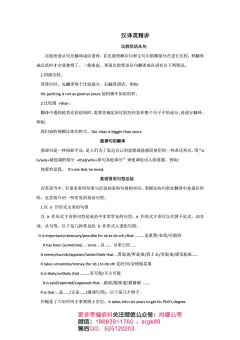
汉译英精讲
比较状语从句
比较状语从句在翻译成汉语时,首先要理解从句和主句中的哪部分在进行比较,样翻
译成汉语时才会清楚明了。一般来说,英语比较状语从句翻译成汉语有以下两情况。
1.同级比较。
英译汉时,先翻译两个比较成分,后翻译谓语。例如:
His painting is not as good as yours他的画不如你的好。
2.比较级 +than。
翻译中遇到此类比较结构时,需要先确定所比较的内容在整个句子中的成分,再进行翻
译。例如:
我们班的规模比你们的大。Our class is bigger than yours.
强调句的翻译
强调句是一种修辞手法,是人们为了表达自己的意愿或情感而使用的一种表达形式,用
“It is/was+被强调的部分 +that/who+原句其他部分”来强调说话人的意愿。例如:
他爱的是我。 It's me that he loved.
英语常用句型总结
在英语当中,有很多常用句型与汉语的某些句型相对应,掌握这些句型在翻译中是很有
用的。这里将介绍一些常见的英语句型。
1.以 it 作形式主语的句型
以 it 作形式主语的句型是英语中非常常见的句型。it 作形式主语可以代替不定式,动
名词、从句等。以下是几种常见的 it 作形式主语的句型:
It is important/necessary/possible for sb.to do sth./that .........是重要/必需/可能的
It has been (sometime) ... since ...自...... 以来已经......
It seems/sounds/appears/tastes/feels that ...看起来/听起来/看上去/尝起来/感觉起来......
It takes sometime/money (for sb.) to do sth花时间/金钱做某事
It is likely/unlikely that .........有可能/不大可能
It is said/reported/supposed that ...据说/据报道/据猜测 .......
It is that ...是....../正是......(强调句型)。以下是几个例子:
约翰花了六年时间才拿到博士学位。It takes John six years to get his PhD's degree
看起来他好像麻烦很大。It appears that he's in great trouble.不溺爱孩子是很重要的。It is important that children should not be spoiled
他不大可能当选。It is unlikely that he would be elected.
据说俄罗斯总统将秘密访问日本。It is said that the Russian President will pay a
secret visit to Japan.
杰克昨天是在公园碰到他的老朋友的。It was in the park that Jack met his old friend
yesterday.
2.there 句型
最常用的there 句型就是there be 句型,表示“有”,be后的名词为真正的主语,动
词变化形式要跟真正的主语保持一致,例如:
房里有一台电视机。There is a television in the room.
墙上有几幅画。There are a few pictures on the wall.
另一个常用的 there 句型是“there is/was no+ 动名词”,表示“没法......”。例如:
没法知道他什么时候回来。There was no telling when he would be back.
他脾气暴躁又很自私,这是不容否认的。He's bad-tempered and selfish; there is no
denying of it.
3.其他句型
从这两年的真题中不难看出英语常用句型是考试的重点之一。以下列举了一些其他的英
语常用句型。
(not) as ... as 跟......一样/不一样;不如
他们今年建的房子和去年一样多。They build as many houses this year as last year.
too ... to 太......而不能
这项工作太难了,你干不了。This job is too difficult to be done by you .
enough to 足够
他够大了,可以照顾自己了。He is old enough to take care of himself.
no matter; whatever; however 不管,不论
无论多么困难,我都不会失去信心。No matter how difficult it is, I will not lose my
confidence.
the more ... the more ... 越...... 越......
物体离我们越远,看起来就越小。The farther away an object is from us, the smaller
it looks.
so that; so ... that 以便;如此......以至于......您能说话大声点好让每个人都听得见吗?Can you speak louder so that everyone can
hear you?
早点儿睡觉,这样明早你就能按时起床了。Go to bed early so that you can get up
on time tomorrow.
他如此傲慢,以至于没人愿意跟他说话。He is so arrogant that nobody wants to talk
with him.
in order to 为了,目的是......
他起得很早为的是赶上第一班公共汽车。 He got up early in order to catch the first
bus. instead 而是
他没去学校,而是去了电影院。He didn't go to school; instead, he went to the
cinema.
rather than 宁愿 ...... 也不......
我宁愿自由地死去,也不愿意过被奴役的生活。 I'd rather die free than live an
enslaved life.
as soon as 一...... 就......
他一拿到成绩,就去告诉父母。
As soon as he got his marks he went to tell his parents.
hardly ... when; no sooner ... than 一...... 就......
我刚离开,那个地方就爆炸了。Hardly had I left the place when it blew up.
not ... until 直到...... 才......
他直到很晚才回家。He didn't return home until late at night.
in case/otherwise/unless/or 以免/否则/除非
带着伞,免得下雨。Take the umbrella with you in case it rains.
either ... or; neither ... nor 或者......或者;既不......也不......
不管最后决定如何,结果不是这样就是相反。No matter what the final decision is, the
result is either this way or the opposite.
not only ... but also 不仅 ...... 而且
他不仅会弹钢琴,歌也唱得很好。Not only does he play the piano, but he sings very
well.
used to do/be used to do/be used to doing 过去常常/用于/习惯于
我过去喜欢画画。I used to like painting.这把刷子是用来画画的。 The brush is used to paint.
我习惯了每天画一幅画。I am used to painting a picture every day.
汉译英精讲例题
1.污染是我们必须解决的一个迫切问题。
2.二十一世纪中国的购物习惯发生了很大改变。
3.我们应该早点动身,以便中午前赶到那儿。
4.他参加不参加会议没有多大关系。
5.李明回答说,他在晚饭前就把作业做完了。
6.如果你愿意,我就把这辆车送给你。
7.他的包里装满了英语考试方面的书。
8.这个问题不像我想象得那么难。
9.正是那本书的作者获得了茅盾文学奖。
10 .我们发现在今晚不可能完成这项工作。
11.他比我们想象的成功。
12.这个故事使我想起了我的母亲。
13.我向你保证我有能力解决这个问题。
14.等我们赶到那里时,天渐渐黑下来了。
15.英国人和美国人不但说同一种语言,而且有很多相同的风俗习惯。
16.他昨天写了一封信。
17.我不记得在哪儿见过他了。
18.这音乐让每个人都想跳舞。
19.她花了很长时间读这本书。
20.我们需要的是自由。
21.这部电影值得一看。
22.正是他们昨天清扫的教室。
23.该公司承认,前方的道路困难重重。
24.我们期待和你一起工作。
25.无论经济形势有多糟糕,这家公司都能盈利。
例题答案及解析:
1.答案:Pollution is a pressing problem which we must deal with.
解析:首先,需要知道“污染”的英文表达“pollution”和形容词“迫切的”英文
表达“pressing”。其次,分析句子结构“......的”联想到用定语从句。
2.答案:Shopping habits in China have changed greatly in the 21th century.解析:首先,需要知道“购物习惯”用英文表达是“shopping habits”。其次,注
意选择合适的时态,即现在完成时。最后,为了更加符合英文表达习惯,将时间状语放到
句末。
3.答案: We should start early so that we might get there before noon.
解析:看到中文“以便”应使用目的状语从句,可用“so that”“in order to”等
引导目的状语从句。
4.答案:It doesn't make much difference whether he attends the meeting or not.
解析:首先,要知道“会议”的英文表达“meeting”。其次,翻译时可以选择用
whether引导的主句放在句首,也可以用it作形式主语放句首,代指后面whether引导的
整个句子。为了更加符合英文表达习惯,此处选择用it形式主语放句首。
5.答案:Li Ming replied that he had finished his homework before supper.
解析:首先,要知道“回答”的英文表达为“reply”。注意整个句子翻译成英文时
将宾语从句放在动词“回答”之后。其次,注意整个句子的时态,主句用一般过去时,从
句选用过去完成时。
6.If you like, I will give this car to you.
解析:把某物给某人的英文表达为 give something to somebody 。表假设时,主句用
一般将来时,从句用一般现在时。
7.His bag was filled with books about English examinations.
解析:整个句子用被动语态,“装满……”的英文表达用“ be filled with ”。
“考试”用英语表达应是“ examination ”。
8.This question is not as difficult as I imagined.
解析:首先,划分句子结构,找出句子主要成分,选用合适的句型。其次,主语为“这个
问题”,采用主系表结构。“像…”翻译为“ as .… as ..”
9.It was the writer of that book that won the Maodun Prize for Literature.
解析:首先,确定此句是强调句翻译,强调的内容是“那本书的作者”,应伸!强调句
型,即“ it is that / who ”。其次,叙述的事实是过去发生的事情,所以整个旬之应选用
过去时。茅盾文学奖对应的英文翻译为“ Maodun Prize for Literature ”。
10.We found it impossible to finish the job tonight.
解析:这个句子的主干是“我们发现不可能……”,用 it 作形式宾语是“ we find
it impossible ”,然后用 to do 来表示 it 的真正内容,即“ to finish the job ”,最
后将时间状语放置于句末。
11.He' s more successful than we thought.
解析:翻译时注意形容词比较级“ be + adj .(比较级)+ than ”,这里的 than 之
后接“我们想象的”,是将现在与过去所想象的进行对比,动词用过去式,翻译为“ we
thought ”。
12.This story reminds me of my mother.
解析:“ remind somebody of somebody ”意为“使某人想起某人”。“这个故
事”作主语,谓语动词应用第三人称单数形式。
13. I assure you that I have the ability to solve the problem.
解析:“向某人保证……”译为“ assure somebody that …”。“有能力做某事”
译为“ have the ability to do something ”。14.By the time we got there, it was already getting dark.
解析:首先,翻译时间状语时此句用“ by the time ”引导。其次,由主句“天渐渐
黑下来了”可以推断出应选用过去进行时。
15.The British and the Americans not only speak the same language but also share
a large number of social customs.
解析:首先,根据汉语句子中的“不仅…而且…”可推断出翻译成英文的句子结构为“
not only .… but also ”。其次,“英国人和美国人”可译为“ the British and the
Americans ”,“很多”翻译时可用短语“ a large number of ”。
16.He wrote a letter yesterday.
解析:首先,找出该简单句的主谓宾“他写信”,确定时态为一般过去时。其次,将时
间状语“ yesterday ”置于句末。
17.I can't remember where I have seen him.
解析:首先,根据汉语意思确定使用 where 引导的宾语从句,然后根据句意可知“我
曾经见过他”这一宾语从句的时态为现在完成时,翻译为“ I have seen him ”。
18.This music makes everyone want to dance.
解析:“让某人想做某事”翻译时可用“ make / let somebody want to do
Something ”。然后根据主语 the music 确定谓语动词使用第三称单数形式。
19.It took her a long time to read this book.
解析:“某人花费时间做某事”用结构“ it takes somebody some time to do
something ”,根据“花了"可确定谓语动词用一般过去时。
20.What we need is freedom.
解析:根据中文“我们需要的”可推断并选用“ what we need ”作为主语从句,整
个句子采用主系表结构,谓语动词用单数 is 。
21.The film is worth seeing.
解析:“值得做某事”翻译为固定短语“ be worth doing ”。
22.It was they that (who) cleaned the classroom yesterday.
解析:首先,句子开头的“正是”表示这是一个强调句,翻译成英文时用强调句型,即
“ it was / is .. that / who .…”。其次,根据句意确定时态为一般过去时。最后,翻
译时将时间状语置于句末。
23.The company admits that the road ahead is full of difficulties.
解析:“承认某事”可使用“ admit that +宾语从句”。“困难重重”表示“充满
困难”,可翻译为“ be full of difficulties ”。
24.We are looking forward to working with you.
解析:“期待做某事”翻译为“ Iook forward to something / doing something
”,后面接名词或动名词短语。
25.The company makes a profit no matter how bad the economic situation is.
解析:由“无论…”想到用 no matter how 引导从句。盈利翻译为“ make a
profit ”。