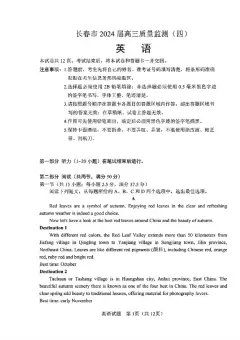
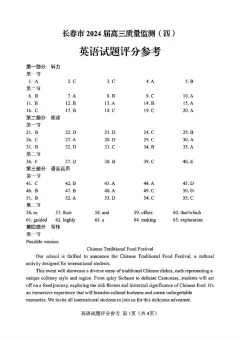
长春市 2024 届高三质量监测(四)
英 语
本试卷共 12 页。考试结束后,将本试卷和答题卡一并交回。
注意事项:1.答题前,考生先将自己的姓名、准考证号码填写清楚,将条形码准确 粘
贴在考生信息条形码粘贴区。
2.选择题必须使用 2B 铅笔填涂;非选择题必须使用 0.5 毫米黑色字迹
的签字笔书写,字体工整、笔迹清楚。
3.请按照题号顺序在答题卡各题目的答题区域内作答,超出答题区域书
写的答案无效;在草稿纸、试卷上答题无效。
4.作图可先使用铅笔画出,确定后必须用黑色字迹的签字笔描黑。
5.保持卡面清洁,不要折叠,不要弄破、弄皱,不准使用涂改液、修正
带、刮纸刀。
第一部分 听力(1~20 小题)在笔试结束后进行。
第二部分 阅读(共两节,满分 50 分)
第一节(共 15 小题;每小题 2.5 分,满分 37.5 分)
阅读下列短文,从每题所给的 A、B、C 和 D 四个选项中,选出最佳选项。
A
Red leaves are a symbol of autumn. Enjoying red leaves in the clear and refreshing
autumn weather is indeed a good choice.
Now let's have a look at the best red leaves around China and the beauty of autumn.
Destination 1
With different red colors, the Red Leaf Valley extends more than 50 kilometers from
Jiefang village in Qingling town to Yanjiang village in Songjiang town, Jilin province,
Northeast China. Leaves are like different red pigments (颜料), including Chinese red, orange
red, ruby red and bright red.
Best time: October
Destination 2
Tachuan or Tashang village is in Huangshan city, Anhui province, East China. The
beautiful autumn scenery there is known as one of the four best in China. The red leaves and
clear spring add beauty to traditional houses, offering material for photography lovers.
Best time: early NovemberDestination 3
As a result of low temperatures, maple leaves in areas south of the Yangtze River are like
shy girls, gradually showing their beauty, turning from green to gold, gold to orange and finally
to red. And as it changes slowly, different colors can be seen on the same trees called “colorful
maple trees”. Viewing at the mountainside is the best choice.
Best time: October to November
Destination 4
For Guangdong province in South China, autumn always comes a little late and lasts
longer. Through the end of January, you can see the red leaves any time you want. If you feel
pity at saying good-bye to red leaves in North China, you can head to South China to view the
beautiful scenery again.
Best time: late November to end of January
21.Which of the tourist spots has the shortest best-viewing period?
A. Destination 1. B. Destination 2. C. Destination 3. D. Destination 4.
22.What can we learn from the text?
A.Tachuan has the best red leaves in China.
B.Tourists can enjoy the most colourful leaves in Jilin province.
C.In Guangdong province, red leaves can be seen at any time throughout the year.
D.Maple leaves in areas south of the Yangtze take on more colors because of weather.
23.What is the purpose of writing this text?
A.To attract photography lovers.
B.To introduce different places of interest.
C.To give advice on how to spend autumn.
D.To recommend some red leaves viewing places.
B
Raised in a fatherless home, my father was extremely tightfisted towards us children. His
attitude didn’t soften as I grew into adulthood and drifted away to college. I had to ride the bus
whenever I came home. Though the bus stopped about two miles from home, Dad never met
me, even in cold weather. If I grumbled ( 嘟 囔 ), he’d say in his loudest father voice, “That’s
what your legs are for!”
The walk didn’t bother me as much as the fear of walking alone along the highway and
country roads. I also felt less than valued that my father didn’t seem concerned about my safety.
That feeling was canceled one spring evening.
It had been a particularly difficult week at college after long hours in labs. I longed for
home. When the bus reached a stop, I stepped off and dragged my suitcase to begin the long
journey home.A row of hedge (篱笆) edged the driveway that climbed the hill to our house. Once I had
turned off the highway to start the last lap of my journey, I was always relieved to see the
hedge because it meant that I was almost home. On that particular evening, the hedge had just
come into view when I saw something gray moving along the top of the hedge, moving toward
the house. Upon closer observation, I realized it was the top of my father’s head. Then I knew,
each time I’d come home, he had stood behind the hedge, watching, until he knew I had arrived
safely. I swallowed hard against the threatening tears. He did care, after all.
On later visits, that spot of gray became my watchtower. I could hardly wait until I was
close enough to watch for its secret movement above the greenery. Upon reaching home, I
would find my father sitting innocently in his chair. “So! My son, it’s you!” he’d say, his face
lengthening into pretended surprise.
I replied, “Yes, Dad, it’s me. I’m home.”
24.What did the author think of the two-mile walk home?
A.It reflected his value.
B.It was the most troublesome.
C.It wasn’t ranked number one in his concerns.
D.It was extremely unbearable in cold weathers.
25.How did the author feel when he saw the hedge?
A. Disappointed. B. Hopeful. C. Frustrated. D. Regretful.
26.Why did the author’s father watch behind the hedge?
A.The author often changed routes back home.
B.He wanted to help the author build up courage.
C.He was really concerned about his son’s safety.
D.That was the only way he could express his love.
27.Which of the following can be the best title for the text?
A. Father’s Secret. B. My Childhood Life.
C. Terrible Journey Home. D. Riding Bus Alone.
C
Were you to join a marathon, you might think you’d wander into a nightmare. Mouths
kept shut, runners cover miles breathing just through their noses—sometimes holding their
breath for quite a while.
Beyond adopting a new technique, marathon runners can expect to see an improvement by
reviewing on the breathing basics. Studies suggest that 10 percent to 14 percent of women are
shallow breathers, over-breathers or mouth-breathers, all of which could restrict movement of
the ribcage (胸腔) and create a build-up of tension in the upper body and tightness in the chest.And while this may not bother you when you’re sitting at your desk, it’s a different story when
you begin a workout. The biggest mistake that Professor Dickinson sees is when athletes want
to maintain-or pick up- speed. “When you’re working harder, you don’t tell your heart to beat
faster. It just knows that it needs to,” he says, adding that the same is true of your breathing. He
explains that your body is built with neurons called chemoreceptors, which tell your muscles
when they need to breathe more.
So how should you be breathing during an intense workout? Professor Dickinson
recommends athletes take basic breath pattern mastery, before moving on to respiratory muscle
(呼吸肌) training.
“Some people accept that the breathlessness they experience when exercising is just their
norms and that they’ve reached the limit they can push themselves to in their workouts,” says
Professor Dickinson. But committing to these techniques, he explains, could be impactful on
your performance. However, those who have high blood pressure, should check their
conditions before getting to work on their breath. “In some cases, it could be that you’re only
breathing at 80 percent of your capacity, so increasing that percentage by practicing breathing
exercises can have a huge impact on your fitness performance,” Professor Dickinson adds. The
results just might be breathtaking.
28.Why does the author compare a marathon to a nightmare?
A.Because they are both long in distance.
B.Because they are both time-consuming.
C.Because people in both situations need a new technique.
D.Because people in both situations breathe in similar ways.
29.According to Professor Dickinson, what will happen when you’re working out harder?
A.You will make the biggest mistake.
B.You will adjust your heartbeat intentionally.
C.Neurons will tell your muscles to breathe more.
D.The heart will know it needs to work.
30.What should high blood pressure patients do before working on their breath?
A. Have a health check. B. Make a workout plan.
C. Track their performances. D. Check their blood pressure meters.
31.Who is the passage intended for?
A. People with high blood pressure. B. Marathon enthusiasts.
C. Office ladies. D. Health consultants.
D
Travellers arriving at or leaving from Stuttgart’s main railway station should be warned.
They must allow an extra 10-15 minutes to get out of the building or get to the platforms tocatch a train, because of an ugly maze of detours ( 绕 路 ) around Germany’s biggest
construction site. “It has been like this since I was at school 13 years ago,” shrugs the barista at
a nearby coffee shop.
The ambitious plan for a new station in the capital of Baden-Württemberg, one of
Germany’s most prosperous states and home to Daimler-Benz, Bosch and Porsche, was to be
an advertisement for the state’s engineering prowess. By relocating tracks and platforms largely
underground, it was supposed to speed up journeys to other places in Germany and all over
Europe, while reclaiming (开拓) space for shops, housing and parkland in the centre of town.
The city picked a design by Christoph Ingenhoven, a cool modernist architect from Düsseldorf,
and the late Frei Otto, winner of the prestigious Pritzker prize for architecture.
But its fate has been similar to that of Berlin’s new airport, which was completed after a
nine-year delay in 2020, having exceeded its budget by more than €4bn ($4.7bn). “Stuttgart
21” (named for the 21st century) was meant to be completed by the end of 2019 at a cost of
€4.5bn. It is now forecast to be finished by 2025, and the cost may rise to nearly €12bn. The
mega-site currently employs some 6,000 construction workers, who even have their own priest,
Peter Maile, to provide (much-needed) pastoral care. The bosses of Deutsche Bahn may need
the consolation of religion too. The loss-making German railway operator is in court, fighting
the state, city, region and airport over who will cover Stuttgart 21’s exorbitant additional costs.
For some, Stuttgart 21 remains an awesome engineering masterpiece in the making; for
others it is a bottomless pit wasting more and more taxpayers’ cash. In June the station could
have celebrated the topping-out ceremony of its main building. Oddly enough, no one felt
much like an underground party, or indeed any party at all.
32.What phenomenon does the author describe at the beginning of the text?
A.Security checks at the station are very strict.
B.Trains in Stuttgart are often about ten minutes late.
C.Cafes near the station are very popular with travellers.
D.The construction of the station has presented inconvenience.
33. Why does the author mention Berlin’s new airport in paragraph 3?
A.To emphasize the urgent need for the new airport.
B.To explain the potential function of the new station.
C.To stress the additional large price of the new station.
D.To introduce the outstanding designers of the new airport.
34.What do the underlined words “consolation” in paragraph 3 mean?
A. Punishment. B. Comfort. C. Influence. D. Memory.
35.What is the author’s attitude toward the new station?
A. Critical. B. Objective. C. Approving. D. Unclear.第二节(共 5 小题;每小题 2.5 分,满分 12.5 分)
阅读下面短文,从短文后的选项中选出能填入空白处的最佳选项,选项中有两项为
多余选项。
Many people desire stronger, more authentic friendships as an adult. 36 . How do
you skip the awkward chit-chat phase and hit the fast-forward button on a potential friendship?
I’ve learned a few things.
Give yourself permission to bore people
We all know the safe topics to broach ( 引 入 ) when you first meet someone. But this
tendency to play it safe can delay knowing whether you are compatible (志趣相投的) with a
potential friend. 37 . “What do you think is the best television finale of all time?” This
is a great conversation starter as long as it interests you. And if the other person slowly backs
away, then you’ve just saved yourself hours of chatting.
38
Often our friendships feel superficial because they are built on a foundation of gossip.
This is because it’s human nature to focus on a third person when we are anxious. We share
spicy updates about former classmates with our high school friends, or grab a drink with
colleagues and complain about the boss. But a friendship built on gossip can leave both people
feeling exhausted and depressed after they hang out.
If a friend starts to give you updates on other people you know, it can be helpful to say, “I
want to hear about what’s going on with you.” Or you can ask yourself, “What would I share
about myself if I were with my best friend right now?” 39 .
Be curious about who people are, and who they want to be
40 . They are also able to share their struggles without fear of judgment. A great
way to deepen a friendship is to ask someone, “What has been challenging for you the last
year?” Or “What’s a belief you have that has changed over the course of your life?” These are
questions we rarely ask each other, but they reveal so much about who we are, and who we’re
trying to be.
A.Focus on the gossip
B.Cut back on the gossip
C.Then jump to the heart of things
D.Rather than sticking with superficial chatter, go straight to what excites you
E.True friends strive to know each other’s thinking about difficult subjects
F.But the process of building these relationships can prove slow and frustrating
G.Ask yourself what’s worth sharing about yourself and knowing about others第三部分 语言运用(共两节, 满分 30 分)
第一节(共 15 小题;每小题 1 分,满分 15 分)
阅读下面短文, 从每题所给的 A、B、C、D 四个选项中选出可以填入空白处的最佳
选项。
A father saw that his 11 year old son was crying silently. He asked him, “What’s the
matter, son?” The young boy replied, “My rich classmates laughed at me and called me
son of the 41 . They said that my father lived only on the
money he earns from watering and feeding plants for people”. The father 42 for a
moment and then said, “Come with me, son. Let’s plant some flowers. It might cheer you up.”
He held his hand and 43 him to the garden. Then he took out some flower seeds and
said, “Let’s 44 an experiment. We will plant two flowers 45 . I will care for one and
you will care for the other. I will water mine with the clean water from the lake while you will
water yours with 46 water from the pond. We shall see the 47 in the weeks to
come.” The son was 48 as he joined his father in planting the flowers. It took them some
days to finely sprout the flower seeds. They cared for them and watched them grow.
Later on, the father brought his son to the garden and said to him, “Look at the two
flowers and tell me your 49 .” The boy responded, “My flower looks better and healthier
than yours. How is that 50 when your water is cleaner?” The father smiled and then said,
“That’s because dirty water doesn’t 51 a plant from growing. Rather, it 52 as
organic fertilizer to help it flourish. So don’t let the harsh words from people 53 you.
Instead, let it 54 you into being a better person and doing so, you will be like the plant
and will flourish even in the midst of dirt like 55 and harsh words.”
41. A. explorer B. salesman C. gardener D. biologist
42. A. waited B. paused C. cried D. sighed
43. A. walked B. admitted C. drove D. exposed
44. A. carry out B. work out C. bring out D. make out
45. A. secretly B. casually C. patiently D. separately
46. A. cold B. dirty C. warm D. clear
47. A. fruit B. outcome C. benefit D. effort
48. A. delighted B. qualified C. satisfied D. determined
49. A. lesson B. feeling C. observation D. expectation
50. A. necessary B. available C. vital D. possible
51. A. protect B. stop C. remove D. save
52. A. serves B. ends C. starts D. passes
53. A. warn B. persuade C. move D. affect
54. A. force B. persuade C. encourage D. cheat
55. A. conflict B. tension C. negativity D. dilemma第二节 (共 10 小题;每小题 1.5 分,满分 15 分)
阅读下面短文, 在空白处填入 1 个适当的单词或括号内单词的正确形式。
Looking for the best vegetarian vacations in China? We’ve arranged China tours for
vegetarians with acceptable cuisine. Eating out while traveling 56 a vegetarian
won’t be tricky; instead, you can enjoy inspiring destinations and various cultures.
Previously most Chinese vegetarians were Buddhists & Taoists; but now more and more
Chinese people focus more on 57 (they) health. By 2018, there had been more than
50 million veggies in China, 58 the number is still increasing. The vast land of
China 59 (offer) many fresh vegetables, seasonal fruits, noodles, rice, tofu and
yummy dishes 60 are all fine for vegetarians.
On our 61 (guide) vegetarian food tours of China, you don’t need to worry
about anything. There are many solutions if you’d like to focus on a meat-free trip. We select
clean and 62 (high) rated vegetarian restaurants at every destination. Furthermore,
your local guide will take you to discover and sample 63 wide range of unique
vegan snacks and street foods at the traditional wet market and back streets, 64 (make)
your vegetarian travel to China full of delights.
The other wonderful thing about vegan vacations in China, of course, is that immersive
cultural 65 (explore) and real life adventure are always on the menu.
第四部分 写作(共两节,满分 40 分)
第一节 (满分 15 分)
假定你是李华,你校将举办一场面向留学生的中国传统美食节。请你向学校英文报
投稿,介绍并宣传此次活动,内容包括:
(1)活动内容;
(2)活动意义;
(3)邀请留学生参与。
注意: 1. 写作词数应为 80 个左右;
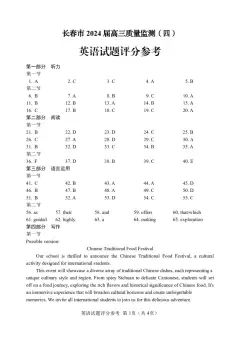
2. 请按如下格式在答题卡的相应位置作答。Chinese Traditional Food Festival
第二节 (满分 25 分)
阅读下面材料,根据其内容和所给段落开头语续写两段,使之构成一篇完整的短文。
I remember a time when I learned the true meaning of forgiveness. It was a period in my
life that tested my patience and my ability to understand others.
It all started when I was in middle school. I had a close friend named Emily, and we spent
a lot of time together. One day, Emily introduced me to a new girl in our class, named Olivia.
Olivia was quiet and shy, but we quickly became friends as well.
One afternoon, after school, we were all working on a project in the classroom. As we
were discussing our ideas, Olivia suddenly exclaimed out something that completely
contradicted what I had been saying. I was shocked and felt a little embarrassed. I tried to
explain my point of view, but Olivia was very stubborn and insisted on her own idea.
Emily, who was sitting next to me, tried to mediate ( 调 节 ) the situation. But Olivia got
angry and said some unkind words to me. I was hurt and angry, and I couldn’t believe that
Olivia would treat me like that. I stormed out of the classroom, leaving Emily and Olivia
behind.
The next few days were very difficult for me. I avoided Olivia as much as possible, and
our friendship with Emily seemed to be stressed. I felt like I had been betrayed by Olivia, and I
couldn’t understand why she would do such a thing.
One day, I asked Emily why she was still friends with Olivia after what she had done.
Emily looked at me with a sad expression and said, “You know, Olivia has been through a lotlately. Her parents are going through a divorce, and she’s really struggling. Maybe she was
rude to you because she was feeling overwhelmed and insecure.”
Hearing this, I felt a surge of guilt. I realized that I hadn’t taken the time to understand
Olivia’s situation. I had been too quick to judge her and too focused on my own feelings of hurt.
I decided to talk to Olivia and apologize for my behavior.
注意:
1. 续写词数应为 150 个左右;
2. 请按如下格式在答题卡的相应位置作答。
When I found Olivia, she was sitting alone in the hallway.
Olivia accepted my apology and we had a long conversation.英语听力
注意事项:英语听力共两节,共 20 小题,每小题 1.5 分,满分 30 分。
做题时,先将答案标在试卷上。录音内容结束后,你将有两分钟的时间将试卷上的
答案转涂到答题卡上。
第一节(共 5 小题;每小题 1.5 分,满分 7.5 分)
听下面 5 段对话。每段对话后有一个小题,从题中所给的 A、B、C 三个选项中选出
最佳选项,并标在试卷的相应位置。听完每段对话后,你都有 10 秒钟的时间来回答有关
小题和阅读下一小题。每段对话仅读一遍。
例:How much is the shirt?
A. £ 19.15. B. £ 9.18. C. £ 9.15.
答案是 C。
1.What will the woman do?
A. Brush teeth properly. B. Have an operation. C. Go to the dentist.
2.Where will the woman probably go next?
A. To her house. B. To a gym. C. To a store.
3.What does the man suggest the woman do?
A. Take a walk outside. B. Drive home slowly. C. Stay at his house.
4.How does the man get his money?
A.By doing housework.
B.By asking his grandfather for it.
C.By washing dishes in a restaurant.
5.How many people are going to the cinema in total?
A. One. B. Two. C. Three.
第二节(共 15 小题;每小题 1.5 分,满分 22.5 分)
听下面 5 段对话或独白。每段对话或独白后有几个小题,从题中所给的 A、B、C 三
个选项中选出最佳选项,并标在试卷的相应位置。听每段对话或独白前,你将有时间阅读
各个小题,每小题 5 秒钟;听完后,各小题将给出 5 秒钟的作答时间。每段对话或独白
读两遍。
听第 6 段材料,回答第 6、7 题。
6.Where does the conversation take place?
A. In the speakers’ kitchen. B. In a restaurant. C. In a hotel.
7.How does the man sound?
A. Impatient. B. Sorry. C. Surprised.
听第 7 段材料,回答第 8、9 题。
8.Where is the woman from?
A. Japan. B. China. C. Denmark.9.What is the man’s favorite thing about Shanghai?
A. The transport. B. The people. C. The food.
听第 8 段材料,回答第 10 至 12 题。
10.What is the woman doing?
A.Interviewing an Olympic gold medal winner.
B.Training a group of athletes.
C.Attending a competition.
11.What is the man probably best at?
A. Swimming. B. Running. C. Boxing.
12.What will the man probably do next?
A. Talk to his fans. B. Accept an award. C. Meet with his coach.
听第 9 段材料,回答第 13 至 16 题。
13.What is the relationship between the speakers?
A. Fellow students. B. Fellow teachers. C. Teacher and student.
14.What should be the result of the experiment?
A.The liquid will boil.
B.It should produce a purple gas.
C.It should create a new chemical.
15.What did the woman do wrong?
A.She didn’t heat the liquid.
B.She added the wrong chemicals.
C.She made a mistake in the order.
16.What will the speakers probably do next?
A. Give up. B. Ask for help. C. Repeat the procedure.
听第 10 段材料,回答第 17 至 20 题。
17.What is the main topic of the talk?
A.Different educational systems around the world.
B.The disadvantages of much homework.
C.Children’s mental health.
18.What grade is Younus in?
A. 2nd grade. B. 3rd grade. C. 4th grade.
19.Which country has the lowest high school graduation rate?
A. Canada. B. Finland. C. The US.
20.What suggestion does the speaker make?
A.The school should give children no homework.
B.The school should improve kids’ performance.
C.The school should work with parents.
学科网(北京)股份有限公司