










文档内容
龙岩一中 2024 届高三上学期第一次月考
(满分:150分 时间:120分钟)
第一部分 听力(共两节,满分30分)
第一节 (共 5 小题;每小题 1.5 分,满分 7.5 分)
听下面 5 段对话。每段对话后有一个小题,从题中所给的 A、B、C 三个选项中选出最佳选
项。
1. When will the speakers meet?
A. At 2:50. B. At 3:00. C. At 4:00.
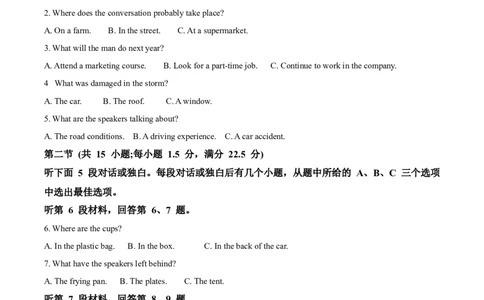
2. Where does the conversation probably take place?
A. On a farm. B. In the street. C. At a supermarket.
3. What will the man do next year?
A. Attend a marketing course. B. Look for a part-time job. C. Continue to work in the company.
.
4 What was damaged in the storm?
A. The car. B. The roof. C. A window.
5. What are the speakers talking about?
A. The road conditions. B. A driving experience. C. A car accident.
第二节 (共 15 小题;每小题 1.5 分,满分 22.5 分)
听下面 5 段对话或独白。每段对话或独白后有几个小题,从题中所给的 A、B、C 三个选项
中选出最佳选项。
听第 6 段材料,回答第 6、7 题。
6. Where are the cups?
A. In the plastic bag. B. In the box. C. In the back of the car.
7. What have the speakers left behind?
A. The frying pan. B. The plates. C. The tent.
听第 7 段材料,回答第 8、9 题。
8. How does the woman feel about the dance competition?
A. Excited. B. Nervous. C. Confident.
9. What is the woman looking forward to most?
A. Dancing in front of many people.
B. Watching good dancers on stage.
C. Making some good new friends.
听第 8 段材料,回答第 10 至 12 题。
第1页/共11页
学科网(北京)股份有限公司10. What did the man do today?
A. He watched Pamela Anderson’s new movie.
B. He took photos with Pamela Anderson.
C. He got Pamela Anderson’s signature.
11. What did the man get for the woman?
A. A photo. B. A poster. C. A magazine.
12. What does the man think of Pamela Anderson?
A. She is a great actress.
B. She looks younger than on the screen.
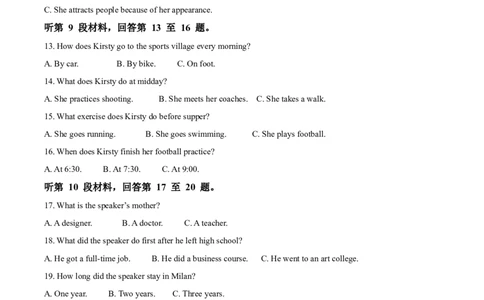
C. She attracts people because of her appearance.
听第 9 段材料,回答第 13 至 16 题。
13. How does Kirsty go to the sports village every morning?
A. By car. B. By bike. C. On foot.
14. What does Kirsty do at midday?
A. She practices shooting. B. She meets her coaches. C. She takes a walk.
15. What exercise does Kirsty do before supper?
A. She goes running. B. She goes swimming. C. She plays football.
16. When does Kirsty finish her football practice?
A. At 6:30. B. At 7:30. C. At 9:00.
听第 10 段材料,回答第 17 至 20 题。
17. What is the speaker’s mother?
A. A designer. B. A doctor. C. A teacher.
18. What did the speaker do first after he left high school?
A. He got a full-time job. B. He did a business course. C. He went to an art college.
19. How long did the speaker stay in Milan?
A. One year. B. Two years. C. Three years.
20. What difficulty did the speaker have in New York?
A. He was homesick. B. His parents didn’t support him. C. He could not start a company there.
第二部分 阅读(共两节,满分50分)
第一节(共15小题;每小题2.5分,满分37.5分)
阅读下列短文,从每题所给的A、B、C、D四个选项中选出最佳选项。
A
The magical world of The Little Prince brought to life!
第2页/共11页
学科网(北京)股份有限公司About the exhibition
French visual artist Arnaud Nazare-Aga has worked with Antoine de Saint-Exupéry Youth Foundation, and
together they have designed a unique touring art exhibition of sculptures inspired by the original watercolor illustrations
of Antoine de Saint-Exupéry’s book, The Little Prince, as well as photos, manuscripts (手稿) and drawings.
The exhibition will be presented for the very first time in Auckland from 1st June to 25th June, 2023 to celebrate
the 80th anniversary of the publication of The Little Prince.
Entitled “The Little Prince in the Dark”, the exhibition attempts to bring Saint-Exupéry’s illustrations to life in
a different way. The artist has created 13 all-white sculptures with relief (浮雕). They are displayed in the dark to be
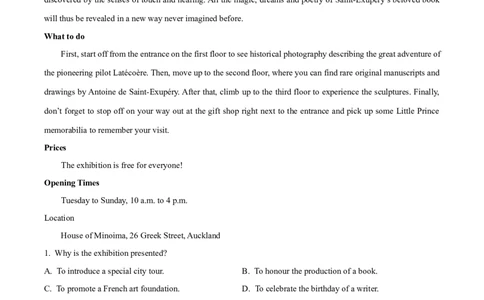
discovered by the senses of touch and hearing. All the magic, dreams and poetry of Saint-Exupery’s beloved book
will thus be revealed in a new way never imagined before.
What to do
First, start off from the entrance on the first floor to see historical photography describing the great adventure of
the pioneering pilot Latécoère. Then, move up to the second floor, where you can find rare original manuscripts and
drawings by Antoine de Saint-Exupéry. After that, climb up to the third floor to experience the sculptures. Finally,
don’t forget to stop off on your way out at the gift shop right next to the entrance and pick up some Little Prince
memorabilia to remember your visit.
Prices
The exhibition is free for everyone!
Opening Times
Tuesday to Sunday, 10 a.m. to 4 p.m.
Location
House of Minoima, 26 Greek Street, Auckland
1. Why is the exhibition presented?
A. To introduce a special city tour. B. To honour the production of a book.
C. To promote a French art foundation. D. To celebrate the birthday of a writer.
2. What is special about the exhibition?
A. It presents the illustrations in the dark. B. It can be explored with hands and ears.
C. It offers a unique night-time experience. D. It displays sculptures of the little prince.
3. On which floor(s) can visitors buy gifts?
A. The first floor. B. The second floor.
C. The third floor. D. All floors.
B
第3页/共11页
学科网(北京)股份有限公司Wildlife photographer Sam Turley and his wife Vera found a two-week-old blesbok (南非白面大羚羊)—whom
they named Meme—on her own. She was spotted wandering around on her own after her mother passed away.
The pair took Meme in and raised the animal themselves for seven months before releasing her back out into
the wild. Neither of them had ever raised a blesbok before. So it required a huge amount of patience and compassion to
keep her fit and healthy but it deserved the effort. Meme would follow Vera wherever she went and sometimes the
couple would have a blesbok, a dog and a cat all walking together. In the right areas, the blesbok is a really common
antelope to see and is therefore often overlooked and under-appreciated. It was a privilege to be let into the blesbok’s
secret world and they learned more about the blesbok than they thought was ever possible.
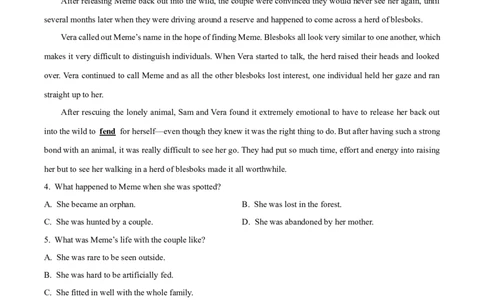
After releasing Meme back out into the wild, the couple were convinced they would never see her again, until
several months later when they were driving around a reserve and happened to come across a herd of blesboks.
Vera called out Meme’s name in the hope of finding Meme. Blesboks all look very similar to one another, which
makes it very difficult to distinguish individuals. When Vera started to talk, the herd raised their heads and looked
over. Vera continued to call Meme and as all the other blesboks lost interest, one individual held her gaze and ran
straight up to her.
After rescuing the lonely animal, Sam and Vera found it extremely emotional to have to release her back out
into the wild to fend for herself—even though they knew it was the right thing to do. But after having such a strong
bond with an animal, it was really difficult to see her go. They had put so much time, effort and energy into raising
her but to see her walking in a herd of blesboks made it all worthwhile.
4. What happened to Meme when she was spotted?
A. She became an orphan. B. She was lost in the forest.
C. She was hunted by a couple. D. She was abandoned by her mother.
5. What was Meme’s life with the couple like?
A. She was rare to be seen outside.
B. She was hard to be artificially fed.
C. She fitted in well with the whole family.
D. She was under-appreciated in the family.
6. Which word can best explain the underlined word “fend” in the last paragraph?
A. Look. B. Care.
C. Search. D. Hunt.
7. Which of the following can best describe the act of rescuing the blesbok?
A. Effortless. B. Unsatisfactory.
C. Rewarding. D. Heartbreaking.
第4页/共11页
学科网(北京)股份有限公司C
Insurance companies are starting to use smartbox technology, so good drivers can benefit from cheap insurance
rates.
The smartbox, similar to a black box for airplanes, records details about how your car is driven, which can result
in cheap car insurance for responsible drivers. The device is connected to the electronics in your car and collects a
wide criterion of information such as time, speed, braking, cornering, acceleration and location. It’s like having an
insurance agent sitting beside you while driving.
The smartbox data is wireless transferred in real time to the insurance company and provides a profile of when,
where and how you drive. This profile is then used to compare insurance rates and to reward low-risk driving behavior
with cheap insurance rates.
Drivers are high-risk when they drive irresponsibly such as speeding, frequent lane changing, driving in high-
risk locations or at high-risk times such as in heavy traffic or late at night.
These new electronic inventions are intended to replace the standard practice of categorizing drivers into group
behavior to determine insurance coverage and premium (保费) payments. For example, young drivers are more likely
to drive fast, drive at night and use a cell phone while driving. Statistically, young drivers are more likely to cause an
accident, so insurance companies charge them higher rates to cover the costs of accident claims. So even if you’re a
young, responsible driver, you will pay high insurance rates because of group behavior.
This technology allows you to provide proof that your driving behavior doesn’t fit the pattern of your demographic
(统计) group.
All the information collected about your driving can be viewed online — including what you’re doing well and
what could be improved. Your insurance premium is then calculated according to your driving profile.
8. What will a good driver benefit from the smartbox?
A. Fewer traffic accidents. B. Better traffic order.
C. Lower insurance payment. D. Less petrol used in driving.
9. How does the insurance company monitor the driving?
A. By checking the device in the car. B. By sitting beside the driver.
C. By watching the traffic on the roads. D. By collecting the driving data online.
10. What will the use of smartboxes bring about?
A. Better service for cars. B. Lower prices of petrol.
C. More convenient transport. D. More reasonable insurance charge.
11. What can we infer about the smartbox from the text?
A. It requires better driving habits. B. It saves the drivers a lot of time.
第5页/共11页
学科网(北京)股份有限公司C. It helps the drivers use less energy. D. It takes the place of the traffic police.
D
The rapid pace of global warming and its effects on habitats raise the question of whether species are able to
keep up so that they remain in suitable living conditions. Some animals can move fast to adjust to a quickly
changing climate. Plants, being less mobile, rely on means such as seed dispersal (传播) by animals, wind or water
to move to new areas, but this redistribution typically occurs within one kilometer of the original plant. Writing in
Nature, Juan P. González-Varo sheds light on the potential capacity of migratory birds to aid seed dispersal.
González-Varo and colleagues report how plants might be able to keep pace with rapid climate change through
the help of migrating birds. They analyzed an impressive data set of 949 different seed-dispersal interactions
between bird and plant communities, together with data on entire fruiting times and migratory patterns of birds
across Europe.
Perhaps the most striking feature of these inferred seed movements is the observation that 35 percent of plant
species across European communities, which are closely related on the phylogenetic tree (进化树谱), might benefit
from long-distance dispersal by the northward journey of migratory birds. This particular group of plants tends to
fruit over a long period of time, or has fruits that persist over the winter. This means that the ability of plants to
keep up with climate change could be shaped by their evolutionary history – implying that future plant
communities in the Northern Hemisphere will probably come from plant species that are phylogenetically closely
related and that have migrated from the south.
This study provides a great example of how migratory birds might assist plant redistribution to new locations
that would normally be difficult for them to reach on their own, and which might offer a suitable climate.
12. What can we learn from the first paragraph?
A. Plants can better adapt to global warming than animals.
B. Quickly changing climate doesn’t have great effects on animals.
C. Some animals and plants move to continue their species ‘ survival.
D. Wind and water contribute to plants' long-distance redistribution.
13. How did González-Varo and his colleagues carry out the research?
A. By studying related data. B. By doing comprehensive surveys.
.
C By interviewing plant experts. D. By conducting field research .
14. What can we infer from the third paragraph?
A. The majority of plant species benefit a lot from long-distance dispersal.
.
B Plants with longer fruiting times adapt better when they are transported farther.
C. Plants have a better chance of survival if their seeds are dispersed across Europe.
第6页/共11页
学科网(北京)股份有限公司D. Plant communities in different hemispheres will be phylogenetically less related.
15. What could be the best title for the text?
A. Ways to Redistribute Plants to New Climates
B. Impacts of Climate Change on Migratory Birds
.
C Migratory Birds Aid the Redistribution of Plants
D. Plants Struggle to Keep Pace with Climate Change
第二节 (共5小题; 每小题2.5分, 满分12.5分)
阅读下面短文, 从短文后的选项中选出能填入空白处的最佳选项, 选项中有两项为多余选项。
As the proverb goes, beauty is in the eye of the beholder. ____16____ A paper published two years ago in
Nature found a connection between people’s sense of well-being and the scenicness (美景) of where they lived. The
paper’s authors measured scenicness by conducting a survey among volunteers.
The connection, the paper’s authors found, held true whether a neighborhood was urban or rural. ____17____
Nor did levels of air pollution have any influence on it. The authors also discovered that differences in volunteers’
health were better explained by the scenicness of where they lived than by the amount of green space around them.
____18____ The team behind that Nature paper have nevertheless decided to have a go. They have adapted a
computer program to recognize beautiful landscapes, whether natural or artificial, using the criteria that a human
beholder would employ. The program’s task was to work out, by analyzing each photograph’s features in the
context of its Scenic-or-Not ratings, what it is that makes a landscape scenic.
Most of the results are not surprising. Lakes and horizons scored well. So did valleys and snowy mountains. In
artificial landscapes, castles, churches and cottages were seen as scenic. ____19____ The analysis did, however,
confirm one important finding from the team’s previous study, which is also a message for town planners. Green
的
spaces alone are not scenic. To be so they need to involve contours (高低起伏 轮廓) and trees. ____20____
A. But surroundings matter.
B. Hospitals, garages and motels were not so much.
C. So people have a deep affection for where they live.
D. It bore no relation to volunteers’ social and economic status.
E. Therefore, less grass and more trees and bushes would be welcome.
F. Natural landscapes are rated as scenicness as opposed to artificial landscapes.
G. Determining what scenicness is, though, has always been frustrating for scientists.
第三部分 语言运用(共两节,满分30分)
第一节(共15小题;每小题1分,满分15分)
第7页/共11页
学科网(北京)股份有限公司阅读下面短文从每题所给的A、B、C、D四个选项中选出可以填入空白处的最佳选项。
Volunteering has been a way of life for me for the past five years since I was fifteen.
In 2020 I ___21___ with a newly founded social enterprise, which ___22___cooking lessons for visually
impaired (视障) trainee chefs. I absolutely loved it as it involved meaningful ___23___ with people and I was
fully ___24___ throughout the entire time I was there. This was unlike some other types of volunteering, which
may involve mostly behind-the-scenes work that can get ___25___ after a while.
We called ourselves “sighted assistants” and each of us was ___26___ with a visually impaired trainee chef.
As a volunteer, I would walk with the trainee to the Enabling Village ___27___, and then ensure their ___28___
as they learned to cook a new dish. This included helping them ___29___ the position of the sink, ensuring proper
use of electrical appliances, ____30____ boiling and hot objects, as well as being careful with knives among other
things.
Being there with them made me truly ____31____ how difficult life can be when you are ____32____or
completely blind. Every tiny task ____33____ massive effort. There are so many people with ____34____, I
realised. While medicine still does not have the power to cure all of these conditions, we are never short of ways to
empower these individuals by making life ____35____ and more meaningful for them.
21. A. met B. cooperated C. started D. volunteered
22. A. learned B. took C. conducted D. prepared
23. A. interaction B. appointment C. greeting D. conflict
24. A. confused B. engaged C. surprised D. disturbed
25. A. promising B. frightening C. challenging D. boring
26. A. faced B. compared C. paired D. equipped
27. A. lesson B. enterprise C. room D. kitchen
28. A. satisfaction B. safety C. pleasure D. success
29. A. leave out B. miss out C. figure out D. point out
30. A. avoiding B. touching C. approaching D. feeling
31. A. appreciate B. imagine C. predict D. think
32. A. temporarily B. partly C. accidentally D. originally
33. A. simplifies B. causes C. takes D. offers
34. A. disabilities B. difficulties C. determination D. power
35. A. luckier B. tougher C. happier D. easier
第二节(共10小题;每小题1.5分,满分15分)
阅读下面短文,在空白处填入1个适当的单词或括号内单词的正确形式。
第8页/共11页
学科网(北京)股份有限公司Every day, Duan Lianru spends several hours sitting in her office in Hunchun, Jilin province to make a
____36____ (compare) of hundreds of photos of Siberian tigers on the computer.
“It seems a little boring, but ____37____ (basic) I enjoy the work, which makes a connection between me and the
big cats,” said the 36-year-old monitor from there search monitoring center of the Northeast China Tiger and Leopard
National Park. The park ____38____ (stretch) across the provinces of Jilin and Heilongjiang.
Duan is responsible for identifying the tigers according to patterns on ____39____ (they) fur and giving them
something like ____40____ identity card.
The park, ____41____ size exceeds (超过) 1.4 million hectares, is the most important habitat for wild Siberian
tigers and Amur leopards in China.
The Siberian tigers’ “ID cards” come ____42____ a lot of important basic data that aids scientific
conservation. ____43____ (base) on such information, Duan draws the family trees of the tigers.
Recent years ____44____ (see) a remarkable increase in the variety and number of wild animals and more tiger
families have been found, including some back two or three generations.
“I feel quite honored to be involved in such significant work.” Duan said. “ _____45_____ (create) a more
beautiful world, humans and wild animals, I hope, can live in harmony.”
第四部分 写作(共两节,满分40分)
第一节(满分15分)
46. 假设你是红星中学高三学生李华。你与交换生Jim要共同完成一篇项目学习的论文,他建议用AI完成
初稿。请你用英语给他写一封电子邮件,内容包括:
1. 委婉拒绝并说明理由;
2. 你的建议及计划。
注意:1. 词数100左右;
2. 开头和结尾已给出,不计入总词数。
提示词语:项目学习—project-based learning
Dear Jim,
____________________________________________________________________________________________
____________________________________________________________________________________________
____________________________________________________________________________________________
____________________________________________________________________________________________
____________________________________________________________________________________________
_______________
Yours,
第9页/共11页
学科网(北京)股份有限公司Li Hua
第二节(满分25分)
47. 阅读下面材料,根据其内容和所给段落开头语续写两段,使之构成一篇完整的短文。
Seema boarded on a tourist train with her 5-year-old daughter. It was her first travel by train. The train was
very crowded. Seema grabbed hands of her daughter, fearing that the crowd could pull her daughter away. When
the train started to move, a snack vendor (小贩) came through the crowd, holding on to his bag and trying to sell
snacks. The vendor seemed very poor, covered in old and broken clothes.
Passing by Seema, that vendor handed out a pack of snacks toward her, saying, “Only 10 cents, madam.”
Seema looked at him with disgust, then refused and asked him to move ahead but her daughter said, “Mom, please
buy one for me.” The vendor was still standing there. Seema looked at him with anger and said, “Go away.”
The vendor left. Her daughter waved goodbye toward that vendor with her bracelet (手镯) shinning, and he
waved back. Seema was very angry because of all the discomfort she had to go through while traveling on a train
and now her daughter was sad about not buying that snack.
After some time, the train reached another station. While walking out of the train, the girl saw that vendor
sitting by the train door. She said to her mother, “Mother, can we give him some money? He seems hungry.” Seema
refused, saying, “Ignore him. He is not a good person. These people take away little girls in their bags.”
Seema and her daughter got off the tourist train and walked a bit. Just then they heard a voice calling them.
When Seema turned back she saw that vendor was waving his hands toward them and started to walk toward them.
Seema thought of him as a stalker (跟踪狂) and started running with her daughter, ignoring shouts from
behind. She was near the exit and saw that vendor was still following them. Seema walked faster and stopped a
taxi. She hurriedly pushed her daughter inside the taxi and then got seated. She closed the door of the taxi and
asked the driver to go.
注意: 1. 续写词数应为 150 左右;
2. 请按如下格式在答题卡的相应位置作答。
The vendor reached them just before the taxi could take off.
____________________________________________________________________________________________
____________________________________________________________________________________________
____________________________________________________________________________________________
____________________________________________________________________________________________
___________________________
Having got back her daughter’s bracelet, Seema didn’t feel happy but sorry.
第10页/共11页
学科网(北京)股份有限公司____________________________________________________________________________________________
____________________________________________________________________________________________
____________________________________________________________________________________________
____________________________________________________________________________________________
___________________________
听力答案:1-5 CAACB 6-10 BAACC 11-15 BCABA 16-20 BCBCA
第11页/共11页
学科网(北京)股份有限公司