大学英语四级考试15选10专项训练
Unit One
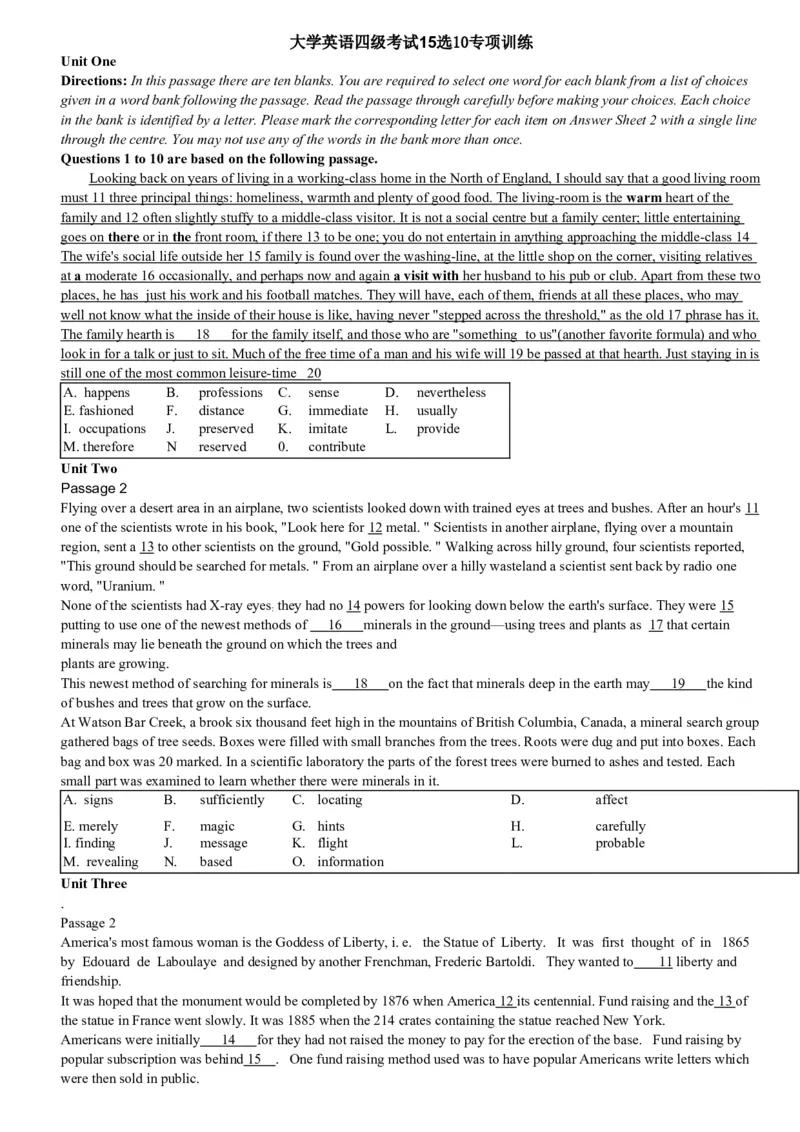
Directions: In this passage there are ten blanks. You are required to select one word for each blank from a list of choices
given in a word bank following the passage. Read the passage through carefully before making your choices. Each choice
in the bank is identified by a letter. Please mark the corresponding letter for each item on Answer Sheet 2 with a single line
through the centre. You may not use any of the words in the bank more than once.
Questions 1 to 10 are based on the following passage.
Looking back on years of living in a working-class home in the North of England, I should say that a good living room
must 11 three principal things: homeliness, warmth and plenty of good food. The living-room is the warm heart of the
family and 12 often slightly stuffy to a middle-class visitor. It is not a social centre but a family center; little entertaining
goes on there or in the front room, if there 13 to be one; you do not entertain in anything approaching the middle-class 14
The wife's social life outside her 15 family is found over the washing-line, at the little shop on the corner, visiting relatives
at a moderate 16 occasionally, and perhaps now and again a visit with her husband to his pub or club. Apart from these two
places, he has just his work and his football matches. They will have, each of them, friends at all these places, who may
well not know what the inside of their house is like, having never "stepped across the threshold," as the old 17 phrase has it.
The family hearth is 18 for the family itself, and those who are "something to us"(another favorite formula) and who
look in for a talk or just to sit. Much of the free time of a man and his wife will 19 be passed at that hearth. Just staying in is
still one of the most common leisure-time 20
A. happens B. professions C. sense D. nevertheless
E. fashioned F. distance G. immediate H. usually
I. occupations J. preserved K. imitate L. provide
M. therefore N reserved 0. contribute
Unit Two
Passage 2
Flying over a desert area in an airplane, two scientists looked down with trained eyes at trees and bushes. After an hour's 11
one of the scientists wrote in his book, "Look here for 12 metal. " Scientists in another airplane, flying over a mountain
region, sent a 13 to other scientists on the ground, "Gold possible. " Walking across hilly ground, four scientists reported,
"This ground should be searched for metals. " From an airplane over a hilly wasteland a scientist sent back by radio one
word, "Uranium. "
None of the scientists had X-ray eyes they had no 14 powers for looking down below the earth's surface. They were 15
:
putting to use one of the newest methods of 16 minerals in the ground—using trees and plants as 17 that certain
minerals may lie beneath the ground on which the trees and
plants are growing.
This newest method of searching for minerals is 18 on the fact that minerals deep in the earth may 19 the kind
of bushes and trees that grow on the surface.
At Watson Bar Creek, a brook six thousand feet high in the mountains of British Columbia, Canada, a mineral search group
gathered bags of tree seeds. Boxes were filled with small branches from the trees. Roots were dug and put into boxes. Each
bag and box was 20 marked. In a scientific laboratory the parts of the forest trees were burned to ashes and tested. Each
small part was examined to learn whether there were minerals in it.
A. signs B. sufficiently C. locating D. affect
E. merely F. magic G. hints H. carefully
I. finding J. message K. flight L. probable
M. revealing N. based O. information
Unit Three
.
Passage 2
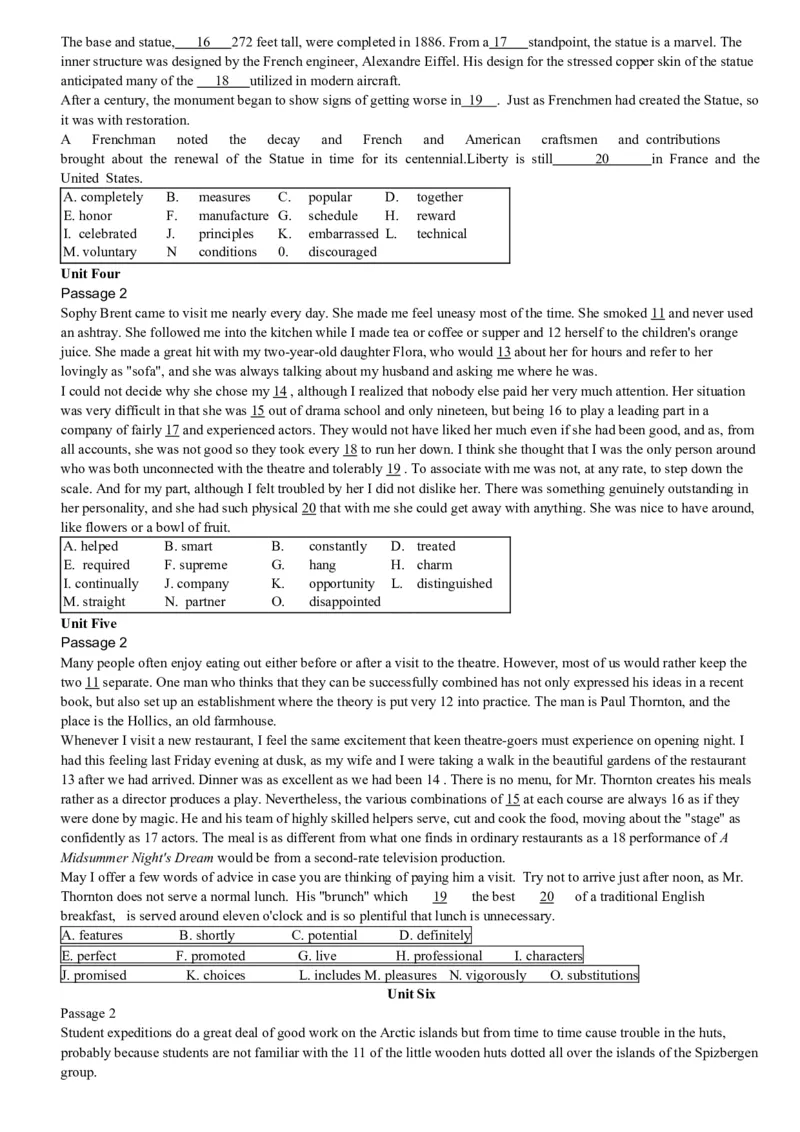
America's most famous woman is the Goddess of Liberty, i. e. the Statue of Liberty. It was first thought of in 1865
by Edouard de Laboulaye and designed by another Frenchman, Frederic Bartoldi. They wanted to 11 liberty and
friendship.
It was hoped that the monument would be completed by 1876 when America 12 its centennial. Fund raising and the 13 of
the statue in France went slowly. It was 1885 when the 214 crates containing the statue reached New York.
Americans were initially 14 for they had not raised the money to pay for the erection of the base. Fund raising by
popular subscription was behind 15 . One fund raising method used was to have popular Americans write letters which
were then sold in public.The base and statue, 16 272 feet tall, were completed in 1886. From a 17 standpoint, the statue is a marvel. The
inner structure was designed by the French engineer, Alexandre Eiffel. His design for the stressed copper skin of the statue
anticipated many of the 18 utilized in modern aircraft.
After a century, the monument began to show signs of getting worse in 19 . Just as Frenchmen had created the Statue, so
it was with restoration.
A Frenchman noted the decay and French and American craftsmen and contributions
brought about the renewal of the Statue in time for its centennial.Liberty is still 2 0 in France and the
United States.
A. completely B. measures C. popular D. together
E. honor F. manufacture G. schedule H. reward
I. celebrated J. principles K. embarrassed L. technical
M. voluntary N conditions 0. discouraged
Unit Four
Passage 2
Sophy Brent came to visit me nearly every day. She made me feel uneasy most of the time. She smoked 11 and never used
an ashtray. She followed me into the kitchen while I made tea or coffee or supper and 12 herself to the children's orange
juice. She made a great hit with my two-year-old daughter Flora, who would 13 about her for hours and refer to her
lovingly as "sofa", and she was always talking about my husband and asking me where he was.
I could not decide why she chose my 14 , although I realized that nobody else paid her very much attention. Her situation
was very difficult in that she was 15 out of drama school and only nineteen, but being 16 to play a leading part in a
company of fairly 17 and experienced actors. They would not have liked her much even if she had been good, and as, from
all accounts, she was not good so they took every 18 to run her down. I think she thought that I was the only person around
who was both unconnected with the theatre and tolerably 19 . To associate with me was not, at any rate, to step down the
scale. And for my part, although I felt troubled by her I did not dislike her. There was something genuinely outstanding in
her personality, and she had such physical 20 that with me she could get away with anything. She was nice to have around,
like flowers or a bowl of fruit.
A. helped B. smart B. constantly D. treated
E. required F. supreme G. hang H. charm
I. continually J. company K. opportunity L. distinguished
M. straight N. partner O. disappointed
Unit Five
Passage 2
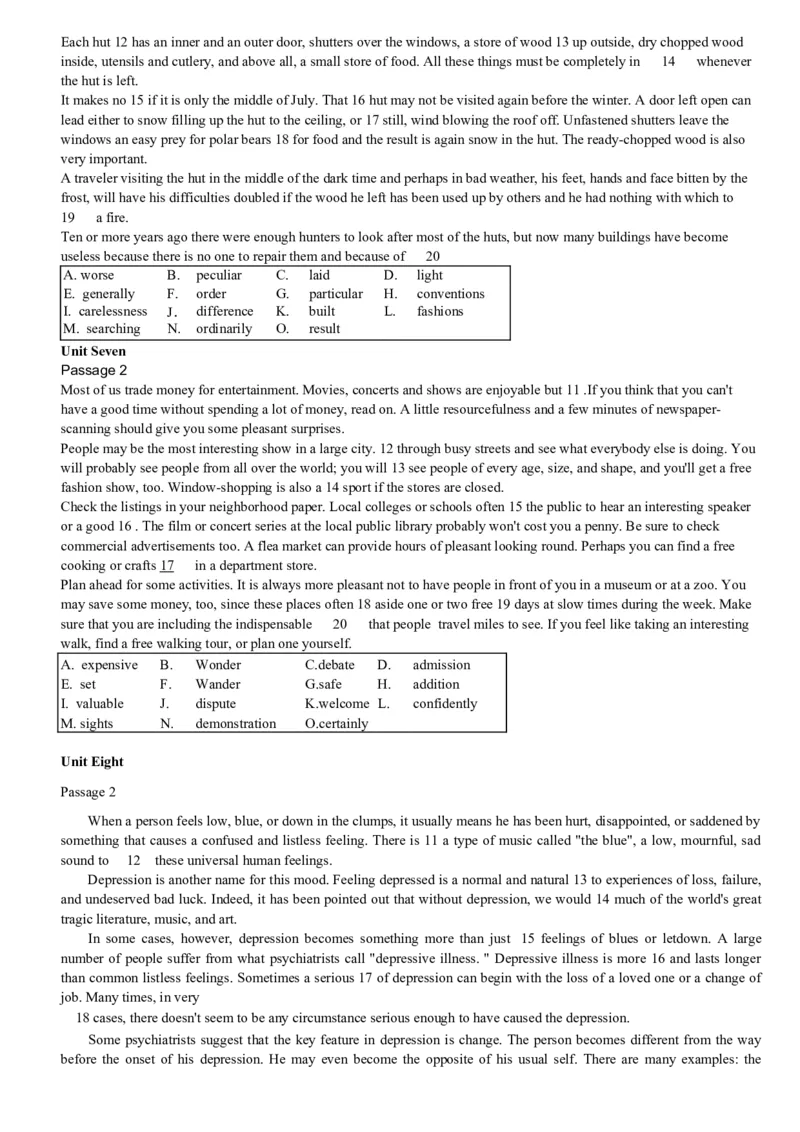
Many people often enjoy eating out either before or after a visit to the theatre. However, most of us would rather keep the
two 11 separate. One man who thinks that they can be successfully combined has not only expressed his ideas in a recent
book, but also set up an establishment where the theory is put very 12 into practice. The man is Paul Thornton, and the
place is the Hollics, an old farmhouse.
Whenever I visit a new restaurant, I feel the same excitement that keen theatre-goers must experience on opening night. I
had this feeling last Friday evening at dusk, as my wife and I were taking a walk in the beautiful gardens of the restaurant
13 after we had arrived. Dinner was as excellent as we had been 14 . There is no menu, for Mr. Thornton creates his meals
rather as a director produces a play. Nevertheless, the various combinations of 15 at each course are always 16 as if they
were done by magic. He and his team of highly skilled helpers serve, cut and cook the food, moving about the "stage" as
confidently as 17 actors. The meal is as different from what one finds in ordinary restaurants as a 18 performance of A
Midsummer Night's Dream would be from a second-rate television production.
May I offer a few words of advice in case you are thinking of paying him a visit. Try not to arrive just after noon, as Mr.
Thornton does not serve a normal lunch. His "brunch" which 19 the best 20 of a traditional English
breakfast, is served around eleven o'clock and is so plentiful that lunch is unnecessary.
A. features B. shortly C. potential D. definitely
E. perfect F. promoted G. live H. professional I. characters
J. promised K. choices L. includes M. pleasures N. vigorously O. substitutions
Unit Six
Passage 2
Student expeditions do a great deal of good work on the Arctic islands but from time to time cause trouble in the huts,
probably because students are not familiar with the 11 of the little wooden huts dotted all over the islands of the Spizbergen
group.Each hut 12 has an inner and an outer door, shutters over the windows, a store of wood 13 up outside, dry chopped wood
inside, utensils and cutlery, and above all, a small store of food. All these things must be completely in 14 whenever
the hut is left.
It makes no 15 if it is only the middle of July. That 16 hut may not be visited again before the winter. A door left open can
lead either to snow filling up the hut to the ceiling, or 17 still, wind blowing the roof off. Unfastened shutters leave the
windows an easy prey for polar bears 18 for food and the result is again snow in the hut. The ready-chopped wood is also
very important.
A traveler visiting the hut in the middle of the dark time and perhaps in bad weather, his feet, hands and face bitten by the
frost, will have his difficulties doubled if the wood he left has been used up by others and he had nothing with which to
19 a fire.
Ten or more years ago there were enough hunters to look after most of the huts, but now many buildings have become
useless because there is no one to repair them and because of 20
A. worse B. peculiar C. laid D. light
E. generally F. order G. particular H. conventions
I. carelessness J. difference K. built L. fashions
M. searching N. ordinarily O. result
Unit Seven
Passage 2
Most of us trade money for entertainment. Movies, concerts and shows are enjoyable but 11 .If you think that you can't
have a good time without spending a lot of money, read on. A little resourcefulness and a few minutes of newspaper-
scanning should give you some pleasant surprises.
People may be the most interesting show in a large city. 12 through busy streets and see what everybody else is doing. You
will probably see people from all over the world; you will 13 see people of every age, size, and shape, and you'll get a free
fashion show, too. Window-shopping is also a 14 sport if the stores are closed.
Check the listings in your neighborhood paper. Local colleges or schools often 15 the public to hear an interesting speaker
or a good 16 . The film or concert series at the local public library probably won't cost you a penny. Be sure to check
commercial advertisements too. A flea market can provide hours of pleasant looking round. Perhaps you can find a free
cooking or crafts 17 in a department store.
Plan ahead for some activities. It is always more pleasant not to have people in front of you in a museum or at a zoo. You
may save some money, too, since these places often 18 aside one or two free 19 days at slow times during the week. Make
sure that you are including the indispensable 20 that people travel miles to see. If you feel like taking an interesting
walk, find a free walking tour, or plan one yourself.
A. expensive B. Wonder C.debate D. admission
E. set F. Wander G.safe H. addition
I. valuable J. dispute K.welcome L. confidently
M. sights N. demonstration O.certainly
Unit Eight
Passage 2
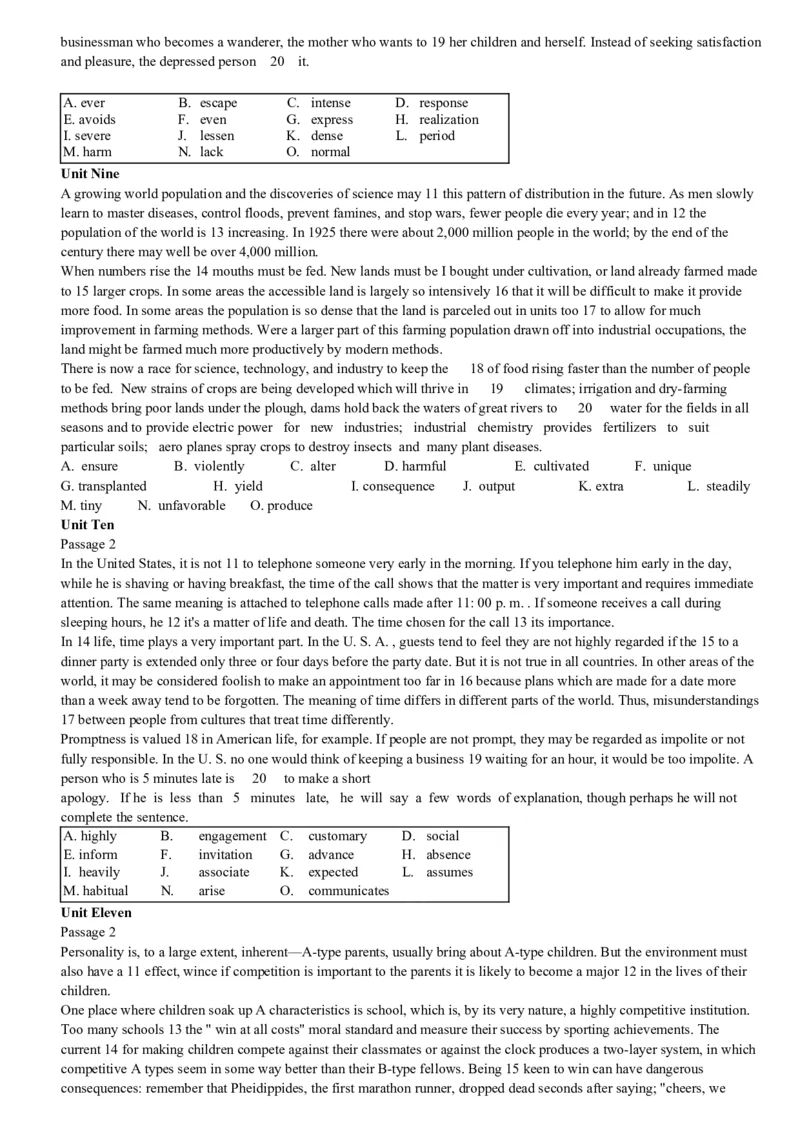
When a person feels low, blue, or down in the clumps, it usually means he has been hurt, disappointed, or saddened by
something that causes a confused and listless feeling. There is 11 a type of music called "the blue", a low, mournful, sad
sound to 12 these universal human feelings.
Depression is another name for this mood. Feeling depressed is a normal and natural 13 to experiences of loss, failure,
and undeserved bad luck. Indeed, it has been pointed out that without depression, we would 14 much of the world's great
tragic literature, music, and art.
In some cases, however, depression becomes something more than just 15 feelings of blues or letdown. A large
number of people suffer from what psychiatrists call "depressive illness. " Depressive illness is more 16 and lasts longer
than common listless feelings. Sometimes a serious 17 of depression can begin with the loss of a loved one or a change of
job. Many times, in very
18 cases, there doesn't seem to be any circumstance serious enough to have caused the depression.
Some psychiatrists suggest that the key feature in depression is change. The person becomes different from the way
before the onset of his depression. He may even become the opposite of his usual self. There are many examples: thebusinessman who becomes a wanderer, the mother who wants to 19 her children and herself. Instead of seeking satisfaction
and pleasure, the depressed person 20 it.
A. ever B. escape C. intense D. response
E. avoids F. even G. express H. realization
I. severe J. lessen K. dense L. period
M. harm N. lack O. normal
Unit Nine
A growing world population and the discoveries of science may 11 this pattern of distribution in the future. As men slowly
learn to master diseases, control floods, prevent famines, and stop wars, fewer people die every year; and in 12 the
population of the world is 13 increasing. In 1925 there were about 2,000 million people in the world; by the end of the
century there may well be over 4,000 million.
When numbers rise the 14 mouths must be fed. New lands must be I bought under cultivation, or land already farmed made
to 15 larger crops. In some areas the accessible land is largely so intensively 16 that it will be difficult to make it provide
more food. In some areas the population is so dense that the land is parceled out in units too 17 to allow for much
improvement in farming methods. Were a larger part of this farming population drawn off into industrial occupations, the
land might be farmed much more productively by modern methods.
There is now a race for science, technology, and industry to keep the 18 of food rising faster than the number of people
to be fed. New strains of crops are being developed which will thrive in 19 climates; irrigation and dry-farming
methods bring poor lands under the plough, dams hold back the waters of great rivers to 20 water for the fields in all
seasons and to provide electric power for new industries; industrial chemistry provides fertilizers to suit
particular soils; aero planes spray crops to destroy insects and many plant diseases.
A. ensure B. violently C. alter D. harmful E. cultivated F. unique
G. transplanted H. yield I. consequence J. output K. extra L. steadily
M. tiny N. unfavorable O. produce
Unit Ten
Passage 2
In the United States, it is not 11 to telephone someone very early in the morning. If you telephone him early in the day,
while he is shaving or having breakfast, the time of the call shows that the matter is very important and requires immediate
attention. The same meaning is attached to telephone calls made after 11: 00 p. m. . If someone receives a call during
sleeping hours, he 12 it's a matter of life and death. The time chosen for the call 13 its importance.
In 14 life, time plays a very important part. In the U. S. A. , guests tend to feel they are not highly regarded if the 15 to a
dinner party is extended only three or four days before the party date. But it is not true in all countries. In other areas of the
world, it may be considered foolish to make an appointment too far in 16 because plans which are made for a date more
than a week away tend to be forgotten. The meaning of time differs in different parts of the world. Thus, misunderstandings
17 between people from cultures that treat time differently.
Promptness is valued 18 in American life, for example. If people are not prompt, they may be regarded as impolite or not
fully responsible. In the U. S. no one would think of keeping a business 19 waiting for an hour, it would be too impolite. A
person who is 5 minutes late is 20 to make a short
apology. If he is less than 5 minutes late, he will say a few words of explanation, though perhaps he will not
complete the sentence.
A. highly B. engagement C. customary D. social
E. inform F. invitation G. advance H. absence
I. heavily J. associate K. expected L. assumes
M. habitual N. arise O. communicates
Unit Eleven
Passage 2
Personality is, to a large extent, inherent—A-type parents, usually bring about A-type children. But the environment must
also have a 11 effect, wince if competition is important to the parents it is likely to become a major 12 in the lives of their
children.
One place where children soak up A characteristics is school, which is, by its very nature, a highly competitive institution.
Too many schools 13 the " win at all costs" moral standard and measure their success by sporting achievements. The
current 14 for making children compete against their classmates or against the clock produces a two-layer system, in which
competitive A types seem in some way better than their B-type fellows. Being 15 keen to win can have dangerous
consequences: remember that Pheidippides, the first marathon runner, dropped dead seconds after saying; "cheers, weconquer!"
By far the worst form of competition in schools is the extreme 16 on examinations. It is a rare school that allows pupils to
17 on those things they do well. The merits of competition by examination are somewhat 18 , but competition in the certain
knowledge of failure is positively harmful.
Obviously, it is neither 19 nor desirable that all A youngsters change into B's. The world needs types, and schools
have an important duty to try to 20 a child's personality to his possible future employment. It is top management.
A. enough B. fit C. emphasis D. practical
E. innumerable F. concentrate G. adopt H. questionable
I. profound J. factor K. too L. substance
M. passion N. emotion O. fix
UNIT 12
Passage 2
As the 11 of life continues to increase, we are fast losing the art of relaxation. Once you are in habit of rushing through life,
being on the go from morning till night, it is hard to slow down. But relaxation is essential for a healthy mind and body.
Stress is a natural part of everyday life and there is no way to avoid it. In fact, it is not the bad thing it is often 12 to be. A
certain amount of stress is 13 to provide motivation and give purpose to life. It is only when the stress gets out of control
that it can lead to poor 14 and ill health.
The amount of stress a person can 15 depends very much on the individual. Some people are not afraid of stress, and such
characters are 16 prime material for managerial responsibilities. Others lose heart at the first signs of 17 difficulties. When
exposed to stress, in whatever form, we react both chemically and physically. In fact we make choice between "fight" or
"flight" and in more primitive days the choices made the difference between life or death. The crises we meet today are
unlikely to be so 18 , but however little the stress, it involves the same response. It is when such a reaction lasts long,
through continued 19 to stress, that health becomes endangered. Such serious conditions as high blood pressure and heart
disease have established links with stress. Since we cannot 20 stress from our lives(it would be unwise to do so even if we
could) , we need to find ways to deal with it.
A. cancel B. pace C. extreme D. automatically
E. remove F. vital G. performance H. supposed
I. rate J. exposure K. achievement L. unusual
M obviously N withstand O harsh
Unit Thirteen
Passage 2
What is your favorite color? Do you like yellow, orange, red? If you do, you must be an optimist, a leader, an active person
who 11 life, people and excitement. Do you prefer greys and blues? Then you are probably quiet, shy, and you would rather
follow than lead. You 12 to be a pessimist. At least, this is what psychologists tell us, and they should know, because they
have been seriously studying the meaning of color preference, as well as the effect that colors have on human beings. They
tell us, among other 13 , that we do not choose our favorite color as we grow up—we are born with our preference. If you
happen to love brown, you did so, as soon as you opened your eyes, or at least as soon as you could see clearly.
Colors do 14 our moods—there is no doubt about it. A yellow room makes most people feel more cheerful and more
relaxed than a dark green one; and a red dress brings warmth and cheer to the saddest winter day. On the other hand, black
is 15 .A black bridge over the Thames River, near London, used to be the 16 of more suicides than any other bridge in the
area—until it was repainted green. The number of suicide attempts immediately fell 17 ; perhaps it would have fallen even
more if the bridge had been done in pink or baby blue.
Light and 18 colors make people not only happier but more active. It is
an 19 fact that factory workers work better, harder, and have fewer 20 when their machines are painted orange
rather than black or grey.
A. bright B. scene C. wholly D. favor
E. facts F. depressing G. accidents H. interfere
I. established J. incidents K. disgusting L. sharply
M. enjoys N. tend O. influence
Unit Fourteen
Passage 2
Women are also underrepresented in the administration and this is because there are so few women 11 professors. In 1985,
Regent Beryl Milburn produced a report blasting the University of Texas System administration for not 12 women. The
University was rated among the lowest for the system. In a 1587 update, Milburn 13 and praised the progress that was made
and called for even more 14One of the positive results from her study was a system-wide program to inform women of available administrative jobs.
College of Communication Associate Dean, Patricia Witherspoon, said it is important that woman be 15 when it comes to
relocating if they want to 16 in the ranks.
Although a woman may face a chilly 17 on campus, many times in order for her to succeed, she must rise above the
problems around her and concentrate on her work.
Until women make up a greater 18 of the senior positions in the University and all academia, inequalities will exist.
"Women need to spend their energies and time doing scholarly activities that are important here at the University. "
Spirduso said. "If they do that they will be 19 in this system. If they spend their time in little groups mourning the sexual
discrimination that they think exists here, they are 20 wasting valuable study time. "
A. full B. recalled C. improvement D. rise
E. encouraging F. flexible G. recognized H. idly
I. ratio J. persuading K. movable L. possibly
M. successful N. climate O. percentage
Unit Fifteen
Passage 2
In October 1987, the National Board for Professional Teaching Standards began its work to set new standards of
accomplishment for the teaching profession and to improve the 11 of education available to all children in the
United States.
Teachers are 12 to students and their learning. They must act on the belief that all students can learn. They must recognize
13 differences in their students and adjust their practice 14 . They must know that their mission extends beyond developing
the cognitive capacity of their students. They must be 15 with their students' self-concept, with their motivation, and with
the development of character.
Teachers must know the subjects they teach and how to teach them. They must 16 specialized knowledge of how to convey
a subject to students. Teachers are responsible for managing and monitoring student learning. They must call on 17 methods
to meet their goals, knowing and being able to 18 a variety of instructional skills. Teachers must think systematically about
their practice and learn from experience, seeking the 19 of others and drawing on education research and scholarship to
improve their practice.
As members of learning communities, teachers contribute to school effectiveness by collaborating with other professionals.
They take ___20 of
community resources, cultivating knowledge of their school's community as a powerful resource for learning.
A. employ B. advice C. quantity D. committed
E. command F. consulted G. manual H. approximately
I. concerned J. advantage K. multiple L. accordingly
M. individual N. embrace O. quality
Unit Sixteen
Passage 2
If you are looking for information, library shelves are a good place to start. But if you need up-to-the-minute data or have
specialized needs, you may find a computerized database more useful, less expensive, and less time 11 .A database, a file of
information on one subject or family of subjects, can be stored and 12 in a computer's memory. The speed of the computer
then 13 you to recall any item in this file almost 14
The three main types of databases are statistical, bibliographic, and full text. Statistical databases store 15 amounts of
numerical data, such as wage and price indexes, census information, foreign 16 rates and bond prices. Bibliographic
databases store references to and summaries of articles in periodicals and newspapers. Full-text databases offer the complex
texts of such 17 as newspaper, magazine, and journal articles.
Thousands of databases exist today, and their numbers are growing. Many companies have their in-house database, which is
18 to employees through computer terminals or microcomputers. In addition, several hundred commercial databases are
now available to the 19 , with literally millions of items of information readily obtainable. These databases 20 specific
fields, such as law and financial forecasting, or general information, such as sports and weather data.
A. exchange B. public C. instantly D. cover
E. enables F. consuming G. remained H. materials
I. hide J. intensively K. vast L. communication
s
M. exhausting N. accessible 0. maintained
Unit SeventeenPassage 2
No one knows exactly how many disabled people there are in the world, but 11 suggest the figure is over 450 million.
The number of disabled people in
India 12 is probably more than double the total population of Canada.
In the United Kingdom, about one in ten people have some disability. Disability is not just something that happens to other
people: as we get older, many of us will become less 13 , hard of hearing or have failing eyesight.
Disablement can take many forms and occur at any time of life. Some people are born with disabilities. Many others
become disabled as they get older. There are many 14 disabling diseases. The longer time goes on, the worse they become.
Some people are disabled in accidents. Many others may have a period of disability in the form of a mental illness. All are
affected by people's attitude towards them.
Disabled people face many 15 barriers. Next time you go shopping or to work or to visit friends, imagine how you would
16 if you could not get up steps, or on to buses and trains. How would you cope if you could not see where you were going
or could not hear the traffic? But there are other barriers; 17 can be even harder to break down and ignorance 18 represents
by far the greatest barrier of all. It is almost impossible for the able-bodied to fully appreciate what the severely disabled go
through, so it is important to 19 attention to these barriers and show that it is the individual person and their ability, not their
disability, which 20
A. inevitably B. evaluations C. estimates D. manage
E. alone F. counts G. prejudice H. physical
I. mobile J. indifferently K. withdraw L. progressive
M. regular N. accounts O. draw
Unit Eighteen
Passage 2
Social customs and ways of behaving change. Things which were considered impolite many years ago are now 11 .
Just a few years ago, it was 12 impolite behavior for a man to smoke on the street. No man who thought of himself as
being a gentleman would make a 13 of himself by smoking when a lady was in a room.
Customs also differ from country to country. Does a man walk on the left or the right of a woman in your country? Or
doesn't it 14 ? What about table manners? Should you use both hands when you are eating? Should you leave one in your
lap, or on the table?
The Americans and the British not only speak the same language but also 15 a large number of social customs. For
example, in both America and England people shake hands when they meet each other for the first time. Also, most
Englishmen will open a door for a woman or offer their seat to a woman, and so will most Americans. 16 is important both
in England and in America. That is, if a dinner invitation is for 7 o'clock, the dinner guest either arrives 17 to that time
or calls up to explain his 18
The important thing to remember about social customs is not to do anything that might make other people feel
uncomfortable— 19 if they are your guests. There is an old story about a man who gave a formal dinner party. When the
food was served, one of the guests started to eat his peas with a knife. The other guests were amused or shocked, but the
20 calmly picked up his knife
and began eating in the same way.
A. especially B. attainable C. close D. delay
E. considered F. host G. delivery H. Preparation
I. share J. fool K. specifically L. acceptable
M. matter N. Promptness 0. care
Unit Nineteen
Passage 2
The economy of the United States after 1952 was the economy of a well-fed, almost fully employed people. Despite 11
alarms, the country escaped any postwar depression and lived in a 12 of boom. An economic survey of the year 1955, a
typical year of the 1950's, may be typical as 13 the rapid economic growth of the decade. The national output was 14 at 10
percent above that of 1954(1955 output was estimated at 392 billion dollars). The production of manufactures was about 40
percent more than it had 15 in the years immediately following World War I . The country's business spent about 30 billion
dollars for new factories and machinery. National income 16 for spending was almost a third greater than it had been in
1950. Consumers spent about 256 billion dollars; that is about 700 million dollars a day, or about twenty-five million
dollars every hour, all round the 17 . Sixty-five million people held jobs and only a little more than two million wanted jobs
but could not find them. Only agriculture 18 that it was not sharing in the boom. To some observers this was a sad
reflection of the mid-1920's. As farmers' share of their products 19 , marketing costs rose. But there were, among the
observers of the national economy, a few who were not as confident as the majority. Those few seemed to fear that theboom could not last long and would
20 lead to the opposite—depression.
A. eventually B. averaged C. gradually D. state
E. valued F. form G. declined H. occasional
I. casual J. argued K. descended L. complained
M. clock N. available O. illustrating
Unit Twenty
Passage 2
Growth of trade will depend greatly on availability of energy sources. There may still be a trillion barrels of recoverable oil
in the Middle East. But the oil crisis of 1974 has 11 to renewed interest in coal and to a search for 12 sources of
energy. Solar, geothermal, and nuclear energy will play a large role in the years to come.
Solar energy is available in 13 forms. Buildings can be heated and cooled by direct use of solar radiation, crops and trees,
which are the most efficient converters of sunlight into energy, can be grown for their energy potential, wastes can be
burned as 14 , sunlight can be converted into DC (direct current) electricity, electric power can be 15 from the sun-warmed
surface waters of the ocean, and lastly, solar radiation can be converted into heat that will drive electric power generators.
Serious problems still remain as to 16 and storage of solar energy.
Geothermal energy is the energy contained within the earth. Heat is abundantly available deep in the earth's core and
is constantly being produced. However, this heat is usually located at too deep a level for 17 exploitation. In short,
very little is known on the use of geothermal energy, and it has 18 been exploited.
Nuclear energy is produced in nuclear power plants. At these plants atoms of uranium are split, thus 19 masses of
energy. Another source of energy
under development is the nuclear fusion of certain atoms of hydrogen. This could eventually 20 natural gas as a
source of energy.
A. rarely B. transformation C. fuel D. replace
E. led F. alternative G. commercial H. briefly
I. derived J. various K. relieving L. releasing
M. transportation N. financial O. described
UNIT 21
Like most parents, geologist Brain Atwater worries about his daughter's safety. But these days, he has an unusual concern;
The public school she 11 in Seattle has unreinforced brick walls, a 12 being easy to collapse during earthquakes.
The same 13 of walls crushed hundreds of thousands of people during the 1976 Tangshan quake in China.
A decade ago, Atwater would have paid little notice to schoolroom walls. But over the last several years, he and other
scientists have found 14 signs that the Pacific Northwest has experienced giant quakes in the distant past and that the area
may be headed for a destructive shock in the near future.
At a meeting of the American Geophysical Union in December, researchers discussed the 15 uncovered evidence of quake
potential in the Pacific Northwest. While some remain unconvinced that huge earthquakes—with magnitudes of 8 or higher
—do indeed 16 this region, a growing number consider such shocks a serious possibility.
What's worrisome, they say, is that northwestern cities such as Portland, Seattle and Vancouver have not prepared for
earthquakes of this magnitude, which could shake the region's 17 centers with enough force to make the recent San
Francisco area damage seem 18 in comparison.
"I think it's quite true to say that nothing has really been designed with one of these earthquakes in mind," says seismologist
Paul Somerville of Woodward. At the meeting, Somerville and his colleagues 19 estimates of the degree of shaking.
Portland and Seattle would suffer during such a 20 earthquake.
A. massive B. recently C. construction D. displayed
E. relatively F. attends G. type H. strike
I. structure J. participates K. excessive L. mild
M. disturbing N. population 0. presented
Unit Twenty-Two
Passage 2
During the nineteenth and twentieth centuries, migrations have taken place within 11 countries; the cities with their
industries have attracted people away from the country. The possibility of earning a fixed 12 in a factory or office was more
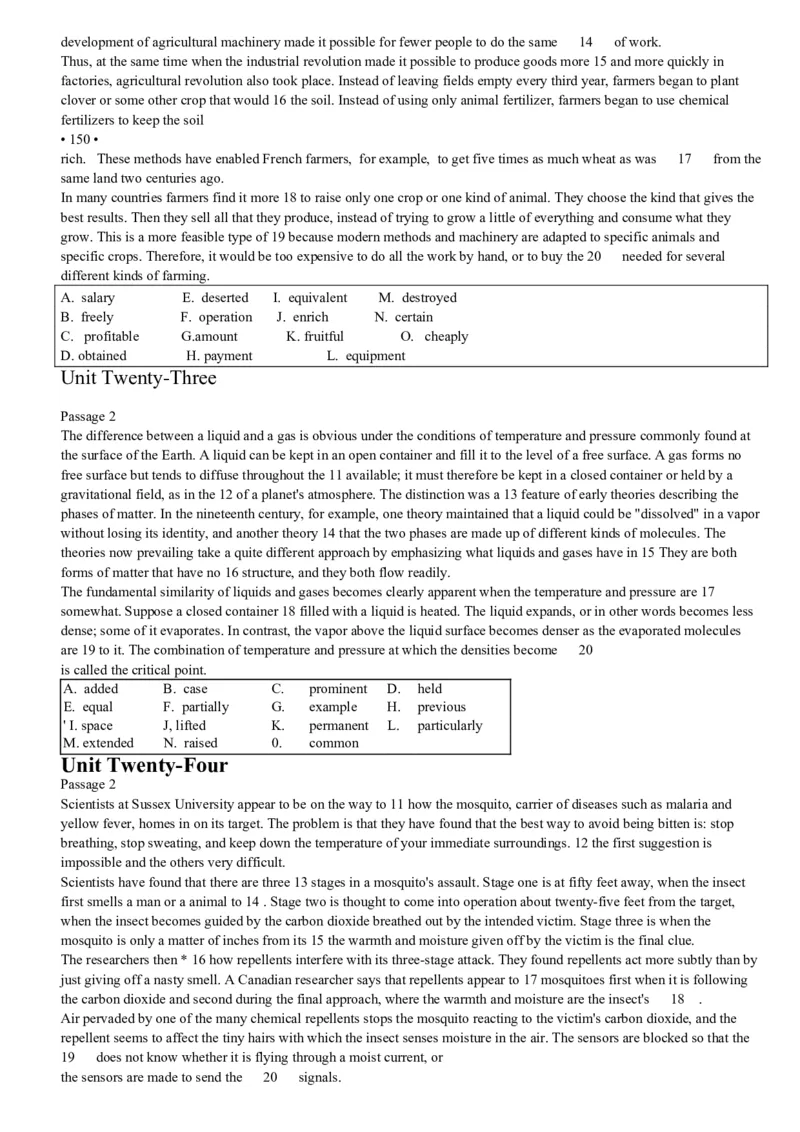
attractive than the possibility of staying on the farm and having one's work 13 by frost, storms, or
droughts. Furthermore, thedevelopment of agricultural machinery made it possible for fewer people to do the same 14 of work.
Thus, at the same time when the industrial revolution made it possible to produce goods more 15 and more quickly in
factories, agricultural revolution also took place. Instead of leaving fields empty every third year, farmers began to plant
clover or some other crop that would 16 the soil. Instead of using only animal fertilizer, farmers began to use chemical
fertilizers to keep the soil
• 150 •
rich. These methods have enabled French farmers, for example, to get five times as much wheat as was 17 from the
same land two centuries ago.
In many countries farmers find it more 18 to raise only one crop or one kind of animal. They choose the kind that gives the
best results. Then they sell all that they produce, instead of trying to grow a little of everything and consume what they
grow. This is a more feasible type of 19 because modern methods and machinery are adapted to specific animals and
specific crops. Therefore, it would be too expensive to do all the work by hand, or to buy the 20 needed for several
different kinds of farming.
A. salary E. deserted I. equivalent M. destroyed
B. freely F. operation J. enrich N. certain
C. profitable G.amount K. fruitful O. cheaply
D. obtained H. payment L. equipment
Unit Twenty-Three
Passage 2
The difference between a liquid and a gas is obvious under the conditions of temperature and pressure commonly found at
the surface of the Earth. A liquid can be kept in an open container and fill it to the level of a free surface. A gas forms no
free surface but tends to diffuse throughout the 11 available; it must therefore be kept in a closed container or held by a
gravitational field, as in the 12 of a planet's atmosphere. The distinction was a 13 feature of early theories describing the
phases of matter. In the nineteenth century, for example, one theory maintained that a liquid could be "dissolved" in a vapor
without losing its identity, and another theory 14 that the two phases are made up of different kinds of molecules. The
theories now prevailing take a quite different approach by emphasizing what liquids and gases have in 15 They are both
forms of matter that have no 16 structure, and they both flow readily.
The fundamental similarity of liquids and gases becomes clearly apparent when the temperature and pressure are 17
somewhat. Suppose a closed container 18 filled with a liquid is heated. The liquid expands, or in other words becomes less
dense; some of it evaporates. In contrast, the vapor above the liquid surface becomes denser as the evaporated molecules
are 19 to it. The combination of temperature and pressure at which the densities become 20
is called the critical point.
A. added B. case C. prominent D. held
E. equal F. partially G. example H. previous
' I. space J, lifted K. permanent L. particularly
M. extended N. raised 0. common
Unit Twenty-Four
Passage 2
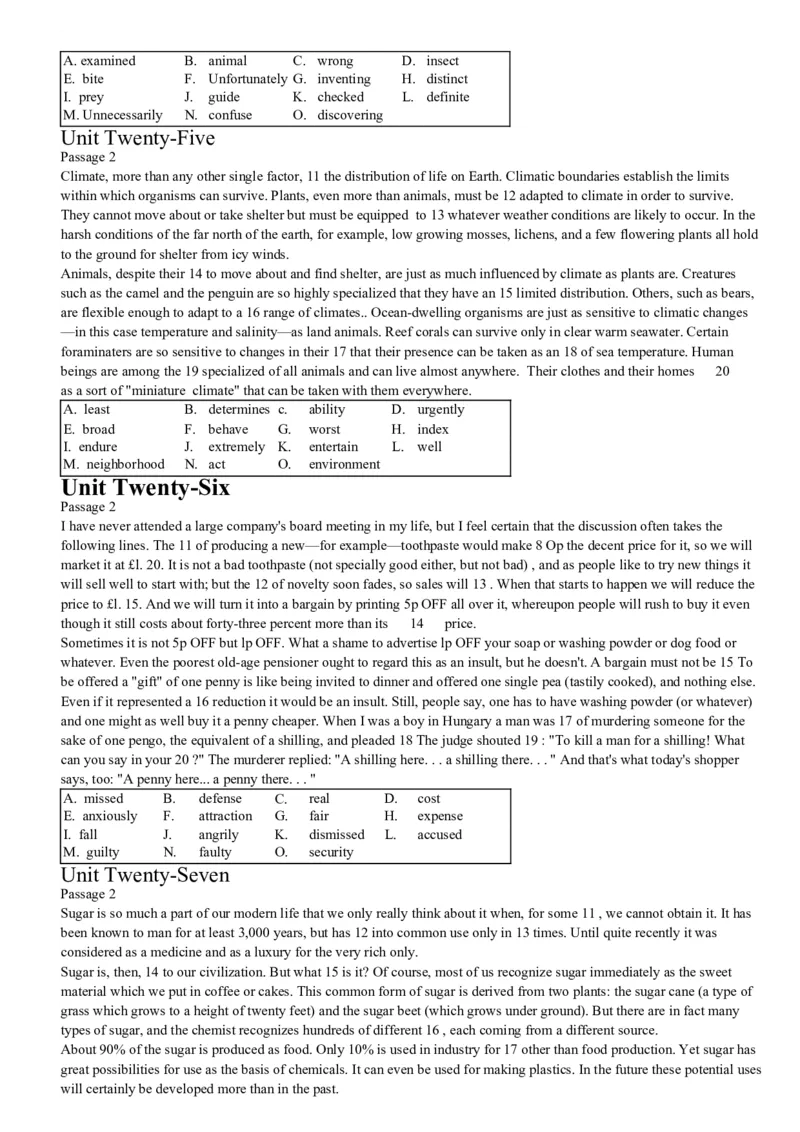
Scientists at Sussex University appear to be on the way to 11 how the mosquito, carrier of diseases such as malaria and
yellow fever, homes in on its target. The problem is that they have found that the best way to avoid being bitten is: stop
breathing, stop sweating, and keep down the temperature of your immediate surroundings. 12 the first suggestion is
impossible and the others very difficult.
Scientists have found that there are three 13 stages in a mosquito's assault. Stage one is at fifty feet away, when the insect
first smells a man or a animal to 14 . Stage two is thought to come into operation about twenty-five feet from the target,
when the insect becomes guided by the carbon dioxide breathed out by the intended victim. Stage three is when the
mosquito is only a matter of inches from its 15 the warmth and moisture given off by the victim is the final clue.
The researchers then * 16 how repellents interfere with its three-stage attack. They found repellents act more subtly than by
just giving off a nasty smell. A Canadian researcher says that repellents appear to 17 mosquitoes first when it is following
the carbon dioxide and second during the final approach, where the warmth and moisture are the insect's 18 .
Air pervaded by one of the many chemical repellents stops the mosquito reacting to the victim's carbon dioxide, and the
repellent seems to affect the tiny hairs with which the insect senses moisture in the air. The sensors are blocked so that the
19 does not know whether it is flying through a moist current, or
the sensors are made to send the 20 signals.A. examined B. animal C. wrong D. insect
E. bite F. Unfortunately G. inventing H. distinct
I. prey J. guide K. checked L. definite
M. Unnecessarily N. confuse O. discovering
Unit Twenty-Five
Passage 2
Climate, more than any other single factor, 11 the distribution of life on Earth. Climatic boundaries establish the limits
within which organisms can survive. Plants, even more than animals, must be 12 adapted to climate in order to survive.
They cannot move about or take shelter but must be equipped to 13 whatever weather conditions are likely to occur. In the
harsh conditions of the far north of the earth, for example, low growing mosses, lichens, and a few flowering plants all hold
to the ground for shelter from icy winds.
Animals, despite their 14 to move about and find shelter, are just as much influenced by climate as plants are. Creatures
such as the camel and the penguin are so highly specialized that they have an 15 limited distribution. Others, such as bears,
are flexible enough to adapt to a 16 range of climates.. Ocean-dwelling organisms are just as sensitive to climatic changes
—in this case temperature and salinity—as land animals. Reef corals can survive only in clear warm seawater. Certain
foraminaters are so sensitive to changes in their 17 that their presence can be taken as an 18 of sea temperature. Human
beings are among the 19 specialized of all animals and can live almost anywhere. Their clothes and their homes 20
as a sort of "miniature climate" that can be taken with them everywhere.
A. least B. determines c. ability D. urgently
E. broad F. behave G. worst H. index
I. endure J. extremely K. entertain L. well
M. neighborhood N. act O. environment
Unit Twenty-Six
Passage 2
I have never attended a large company's board meeting in my life, but I feel certain that the discussion often takes the
following lines. The 11 of producing a new—for example—toothpaste would make 8 Op the decent price for it, so we will
market it at £l. 20. It is not a bad toothpaste (not specially good either, but not bad) , and as people like to try new things it
will sell well to start with; but the 12 of novelty soon fades, so sales will 13 . When that starts to happen we will reduce the
price to £l. 15. And we will turn it into a bargain by printing 5p OFF all over it, whereupon people will rush to buy it even
though it still costs about forty-three percent more than its 14 price.
Sometimes it is not 5p OFF but lp OFF. What a shame to advertise lp OFF your soap or washing powder or dog food or
whatever. Even the poorest old-age pensioner ought to regard this as an insult, but he doesn't. A bargain must not be 15 To
be offered a "gift" of one penny is like being invited to dinner and offered one single pea (tastily cooked), and nothing else.
Even if it represented a 16 reduction it would be an insult. Still, people say, one has to have washing powder (or whatever)
and one might as well buy it a penny cheaper. When I was a boy in Hungary a man was 17 of murdering someone for the
sake of one pengo, the equivalent of a shilling, and pleaded 18 The judge shouted 19 : "To kill a man for a shilling! What
can you say in your 20 ?" The murderer replied: "A shilling here. . . a shilling there. . . " And that's what today's shopper
says, too: "A penny here... a penny there. . . "
A. missed B. defense C. real D. cost
E. anxiously F. attraction G. fair H. expense
I. fall J. angrily K. dismissed L. accused
M. guilty N. faulty O. security
Unit Twenty-Seven
Passage 2
Sugar is so much a part of our modern life that we only really think about it when, for some 11 , we cannot obtain it. It has
been known to man for at least 3,000 years, but has 12 into common use only in 13 times. Until quite recently it was
considered as a medicine and as a luxury for the very rich only.
Sugar is, then, 14 to our civilization. But what 15 is it? Of course, most of us recognize sugar immediately as the sweet
material which we put in coffee or cakes. This common form of sugar is derived from two plants: the sugar cane (a type of
grass which grows to a height of twenty feet) and the sugar beet (which grows under ground). But there are in fact many
types of sugar, and the chemist recognizes hundreds of different 16 , each coming from a different source.
About 90% of the sugar is produced as food. Only 10% is used in industry for 17 other than food production. Yet sugar has
great possibilities for use as the basis of chemicals. It can even be used for making plastics. In the future these potential uses
will certainly be developed more than in the past.There are many reasons why we should 18 the production of sugar. Most important is that it is one of the most highly
concentrated of energy foods.
Thus sugar cane and beet produce an average of 7,000,000 calories per acre. In this way they have the advantage over
potatoes which give only 4, 000, 000, while the 19 for wheat and beans is 2 ,000,000 each. So three acres of land growing
wheat, beans and potatoes give only 20 more energy than one acre
of sugar.
A. slightly B. intention C. reason D. modern
E. strongly F. figure G. come H. significant
I. exactly J. increase K. proposals L. turn
M. purposes N. varieties O. serious
Unit Twenty-Eight
Passage 2
The birth of computers has brought with it a new set of opportunities for mischief and crime. Today, computers are easy to
come by and many people know how computer technology 11 . More importantly, the growing use of computer networks
can multiply the violation of security, making large numbers of people more vulnerable than would be the case if they were
using 12 , stand-alone computers.
What's more, computer experts agree that—despite recent widespread publicity-computer viruses are 13 one of the many
computer security problems facing the nation.
The U. S. Defense Advanced Research Project Agency has requested that the Research Council's Science and Technology
Board 14 the security problems posed by computer technology, see what 15 may already exist, review research efforts 16 at
avoiding security problems in the future, and evaluate existing policies 17 to computer security. The study committee will
examine the 18 of security for a broad spectrum of users, including the business, national security, and academic
communities, as well as the 19 public.
David. Clark, senior research scientist, Laboratory for Computer Science, Massachusetts Institute of Technology, will chair
the 20 of experts in
electronic security, net-work security, computer law, software engineering ? and operating systems. The committee will
also include computer users from the defense and banking industries.
A. only B. works C. solutions D. general
E. issue F. fundamentally G. universal H. assess
I. aimed J. single K. committee L. generates
M. relevant N. question O. community
Unit Twenty-Nine
Passage 2
Leonardo da Vinci was the first man to suggest that growing trees add a new ring in their trunks each year. The 11
in these rings relates to the physical conditions which the tree experiences. Thus, trees grown in a 12 area and time each
develop a pattern or configuration of their rings.
This 13 was of little significance until Andrew E. Douglas began to study tree rings in Arizona in 1900. Using a technique
called cross dating, he was able to employ tree rings to the study of archaeological sites and date the ruins with 14 . Some
were as old as 6700 B. C. ! This study of tree rings is called dendrochronology.
In time the cross dating was 15 by a carbon 14 process. This approach measured the amount of carbon 14 radiating from a
piece of wood and 16 to determine the age of that wood. Further use of the carbon 14 technique has shown that the radiation
process is more complex and less 17 than had been at first thought.
The most 18 aspect of tree ring research is now called
dendroclimatology. This 19 of the reconstruction of climates and climatic cycles and events from the evidence found in the
tree rings. From this it is hoped that a 20 of drought cycles can be determined in the American Southwest. Such information
will be of great help in determining the life and ecology of that region of the United States.
A. thus B. model C. variation D. concept
E. accuracy F. exciting G. consists H. given
I. proposition J. composes K. further L. pattern
M. supplemented N. reliable O. excellent
Unit Thirty
Passage 2
Gary Finkle had his backbone severely 11 in a swimming-pool accident seven years ago. A heavy-set, bearded man of 27,
he is one of thousands of Americans who have lost 12 all feeling and movement from their shoulders down. He lives with
his wife, Micky, and a female monkey named Jo outside the village of Andes, N. Y.Gary is a participant in a remarkable 13 called Helping Hands: Simian Aides for the disabled. The nonprofit organization 14
the disabled with trained monkeys that reduce the disabled person's 15 on family, friends and hired attendants.
Using his mouth, Gary controls a small laser pointer mounted on his wheelchair. With it, he directs Jo to change books or
cassette player. She brings him drinks from a refrigerator and 16 away empties.
When asked, Jo will fetch the remote control for the TV and place it on Gary's working table where he can operate it with
his mouth-stick. The mouth-stick is his 17 tool. It can be used for practically everything: turning the pages of a book, 18 the
telephone, changing channels on the TV, working at a typewriter or computer. If Gary's mouth-stick drops to the floor, Jo
will pick it up and 19 reinsert it into his mouth.
"I can't imagine living without her," Gary says. He will always need 20 assistance for such things as getting in or out of
bed, bathing or changing his clothes. A. human B. dependency C. humble D. virtually
E. injured F. clears G. visibly H. agent
I. cleans J. supplies K. wounded L. primary
M. dialing N. enterprise O. gently
Unit Thirty-One
Passage 2
Ever since humans have lived on the 11 , they have made use of various forms of communication. Generally, this
expression of thoughts and feelings has been in the form of 12 speech. When there is a language barrier,
communication is "13 through sign language in which motions 14 for letters, words, and ideas. Tourists and the people
unable to hear or speak have had to 15 to this form of expression. Many of these symbols of whole words are very 16
and exact and can be used 17 ; spelling, however, cannot.
Body language 18 ideas or thoughts by certain actions, either
• 212 •
intentionally or unintentionally. A wink can be a way of indicating that the party is only joking. A nod signifies approval,
while shaking the head indicates a 19 reaction.
Other forms of nonlinguistic language can be found in Braille (a system of raised dots read with the fingertips) , signal
flags, Morse code, and smoke signals. Road maps and 20 signs also guide, warn, and instruct people.
While language is the most common form of communication, other systems and techniques also express human thoughts
and feelings.
A. picture B. oral C. stand D. world
E. internationally F. optional G. resort H. vivid
I. earth J. accomplished K. transmits L. represent
M. negative N. intelligently O. translates
Unit Thirty-Two
Passage 2
Perhaps it was only during the dawn of the human race that women 11 stood equal with men. At the beginning, I think both
sexes shared equal responsibility for the 12 of the race. Men and women shared in the hunt and in wars. Traces of this
ancient tradition can be found, for example, in the Achinese society in North Sumatra, where women fought alongside men
against the invading Dutch colonial 13 during the Achinese wars in the 19th century. Some women even became admirals
of the Achinese fleet. Other cultures in other parts of the world have had the 14 tradition.
Perhaps the invention of agriculture 15 the beginning of a
differentiation between men's and women's roles. Men continued to hunt, and women became food gatherers and tended the
field. Men 16 became agriculturists as well, when the hunt no longer provided enough sustenance for the community. The
biological fact that women 17 children, and that each time they give birth they are 18 , for a time, fully to play their role in
the provision of sustenance and other work for the family, slowly gave rise to more distinct men's and women's roles. Men
who are physically stronger 19 on such " natural" roles as warriors, and in most cases men became chiefs, commanders, and
kings. In the 20 of history, as matriarchal systems became minorities in many cultures, the roles of men and women in
many societies became increasingly gender-oriented and differentiated.
A. really B. police C. bear D. course
E. survival F. later G. forces H. unable
I. lately J. process K. remarked L. marked
M. same N. took O. unstable
Unit Thirty-Three
Passage 2
Southern Californians would love to find some way of knowing a month in• 226 •
advance whether a 11 earthquake will likely strike. One meteorologist suggests atmospheric pressure patterns might provide
some 12 . Jerome Namias of the Scripps Institution of Oceanography in La Jolla, Calif. , proposed this 13 in 1988 when he
reported that an unusually strong high-pressure system developed in the North Pacific before quakes struck southern
California in 1986 and 1987. Now Namias has 14 expanded his analysis by studying the summers between 1947 and 1987.
From a 15 of all southern California earthquakes with magnitudes of 4- 5 or greater during that period, Namias 16 out the
summers with many quakes and those with no quakes. His analysis of the meteorology during these summers shows that
quakes were more 17 under a particular set of conditions; a stronger-than-normal North Pacific high pressure, a low-
pressure ridge over the 18 interior. Summers with no quakes usually had a weak Pacific high and a poorly developed
continental high, he reports in the Dec. 10 JOURNAL OF GEOPHYSICAL RESEARCH. Namias cannot 19 the apparent
correlation between pressure and seismicity, but he 20 that variations in seafloor pressure or in sea-surface temperature
might influence both the atmospheric pressure and the ground stress in California.
A. damaging B. idea C. trace D. greatly
E. picked F. clue G. explain H. forcefully
I. detects J. plan K. continental L. list
M. predicts N. managing O. likely
Unit Thirty-Four
Passage 2
It is estimated that 11 seven hundred million people—about half of the world's population—are unable to read and write,
and there are probably two hundred and fifty million more whose level of attainment is so slight that it 12 qualifies a
literacy.
Recently the attack on illiteracy has been 13 up. A world plan has been drawn up by a committee of UNESCO experts in
Paris, as part of the UNESCO Nations Development Decade, and an international conference on the 14 has also been held.
UNESCO stresses that functional literacy is the aim. People must learn the 15 skills of responsible 16 : the ability to read
notices, newspapers, timetables, letters, pricelists, to keep simple records and accounts, to 17 out the significance of
the information gathered, and to fill in forms.
The 18 areas of illiteracy are in Asia, Africa, and Central and South America. In Africa there are at least one
hundred million illiterates, 19 eighty to eighty-five per cent of the 20 population. In Europe the figure is
about twenty-four million, most of them in Southern Europe, with Spain, Italy, Portugal, and Yugoslavia heading the list
(the United Kingdom has about seven hundred thousand).
A. basic B. citizenship C. stepped D. some
E. major F. barely G. sort H. membership
I. superior J. entire K. scarcely L. constituting
M. total N. subject O. comprising
Unit Thirty-Five
Passage 2
On my arrival in America, the one thing I noticed more than anything else • 240 •
was the , 11 amount of advertising that went on,—on the radio, on television, on billboard and signposts, and in magazines.
In the last three years, I have become accustomed to this fact in American life, for I believe that it is a creative and
necessary part of an industrial 12 .1, too, want to improve my life-style and to buy better products, so I 13 to advertising to
show me how to do it.
Deciding what to believe in advertising, however, isn't easy. It seems to me that a person must 14 things with a lot of care.
As a consumer, I want to get the best for my money, but I really have to understand the techniques of advertising.
Otherwise, manufacturers will be able to sell me anything, no matter what its quality may be.
More and more people are becoming 15 , like me, of the ways in which advertising can affect them. The creative aspects of
commercials, for instance, often cover up defects or problems in products. I have learned this well, since I have made
purchases and lost money because the 16 were of poor quality.
The future of advertising will most likely involve a much greater 17 of
public participation. I intend to become involved in consumer groups that want to
18 people from misleading advertising. But I also want to see Americans
keep their high 19 of living in the process. In the future, if consumers like
me really care about the quality of something as well as the quantity, 20
advertisers will begin to care more about what they are trying to sell.
A. consequent B. protect C. standards D. tremendousE. grade F. society G. degree H. look
I. protest J. items K. purchase L. association
M. conscious N. maybe 0. whereas
Unit Thirty-Six
Passage 2
Resources can be said to be scarce both in an absolute and in a 11 sense: the surface of the Earth is limited, 12
absolute scarcity, but the scarcity that concerns economists is the relative scarcity of resources in 13 uses. Materials
used for one purpose cannot at the same time be used for other purposes; if the quantity of an input is limited, the increased
use of it in one manufacturing process must cause it to become less available for other uses.
The cost of a product in 14 of money may not measure its true cost to society. The true cost of, say, the construction of a
supersonic jet is the value of the schools and refrigerators that will never be built as a result. Every act of production uses
up some of society's available resources; it means the foregoing of an opportunity to produce something else. In deciding
how to use resources most effectively to 15 the wants of the community, this opportunity cost must 16 be taken into
account.
In a market 17 the price of a commodity and the quantity supplied depend on the cost of making it, and that cost,
ultimately, is the cost of not making other goods. The market mechanism enforces this 18 . The cost of, say, a pair of shoes
is the price of the leather, the labor, the fuel, and other elements used up in producing them. But the price of these inputs, in
turn, 19 on what they can produce elsewhere—if the leather can be used to produce handbags that are valued highly by
consumers, the price of leather will be bid up
20
A. fulfill B. correspondingly C.terms D. relative
E. imposing F. depends G.reverse H. ultimately
I. different J. relationship K.satisfy L. finance
M. considerably N. emphasizing O.economy
Unit Thirty-Seven
Passage 2
Does a bee know what is going on in its mind when it navigates its way to 11 food sources and back to the hive, using
polarized sunlight and the tiny magnet it carries as a navigational aid? Or is the bee just a machine, unable to do its
mathematics and dance its language in any other way? To use Donald Griffin's term, does a bee have "awareness", or to use
a 12 I like better, can a bee think and imagine?
There is an experiment for this, or at least an 13 , made long ago by Karl Von Frisch and more recently 14 by James Gould
at Princeton. Biologists who wish to study such things as bee navigation, language, and behavior in general have to 15 their
bees to fly from the hive to one or another special place. To do this, they begin by placing a source of sugar very close to
the hive so that the bees (considered by their trainers to be very dumb beasts) can learn what the game is about. Then, at
regular intervals, the dish or whatever is moved 16 farther and farther from the hive, increasing about 25 percent at each
move. Eventually, the 17 is being moved 100 feet or more at a jump, very far from the hive. Sooner or later, while this
process is going on, the biologists 18 the dish of sugar will find the bees are out there waiting for them, 19 where the
20 position had been planned. This is
an uncomfortable observation to make.
A. confirmed B. phrase C. next D. shifting
E. observation F. remote G. progressively H. confronted
I. distant J. precisely K. quotation L. target
M. train N. proficiently 0. investigation
Unit Thirty-Eight
Passage 2
Americans always have different opinions in their 11 toward education. On the one hand, free and universal public
education was seen as necessary in a democracy, for how else would citizens learn how to 12 themselves in a responsible
way? On the other hand, America was always a country that offered financial opportunities for which education was not
needed • on the road from
rags to riches, ___13 —beyond the basics of reading, writing, and arithmetic—was an 14 detour.
Even today, it is still possible for people to 15 financial success without much education, but the number of 16 in which this
is possible is decreasing. In today's more complex world, the opportunities for financial success are 17 related to the
need for education, especially higher education.
Our society is rapidly becoming one whose 18 product is information, and dealing with this information requires more and
more 19 education. In other words, we grow up learning more and more about fewer and fewer subjects.In the future, this trend is likely to 20 . Tomorrow's world will be even more complex than today's world, and, to manage
this complexity, even more specialized education will be needed.
A. realize B. schooling c chief D. unnecessary
E. altitudes F. closely G. specialized H. attitudes
I. govern J. achieve K. situations L. continue
M. strictly N. positions O. manage
Unit Thirty-Nine
Passage 2
Bulbs are ideal for new gardeners, including children, because they are easy to plant and they always flower well in their
first season. They need 11 little attention, provided that the soil has been properly 12 , and the place where they are planted
is chosen with care. They will last for many years and give you an 13 show of flowers that are often so richly colored or
beautifully formed.
However, it is a mistake to buy bulbs without any plan of what effect you
really want from them. I have written this book to help in selecting the most
14 bulbs for the typical, small, modern garden of the non-specialist
gardener, and have made some 15 to help readers who may not have had a
garden before.
Too many books for beginners tell new gardeners to grow a few "sensible" kinds of plants and 16 the more interesting kinds
to adventurous experts. For the first few years of one's gardening life one should, it seems, concentrate on learning simple
techniques while 17 the gardens of more experienced neighbors.
In fact, as a learner-gardener you need not 18 that your efforts will necessarily show your inexperience, because (and here I
give away a most closely-guarded secret) , provided the bulbs come from a really reliable 19 , it is
possible to produce as good results in your first year of gardening as in your eightieth. Therefore, plant bulbs, they are a
20 investment for any garden.
A. judgments B. comparatively C.prepared D. source
E. annual F. leave G.suggestions H. sound
I. abandon J. suitable K.admiring L. absorbing
M. surprisingly N. healthy O.fear
Passage 3
Unit Forty
Passage 2
The old idea that talented children "burn themselves out" in the early years, • 274 •
and therefore, are 11 to failure and at worst, mental illness is probable. As a matter of fact, the outstanding thing that
happens to right kids is that they are very likely to grow into bright adults.
To find this out, 15,000 12 persons were followed up to their thirty-fifth year with results:
On adult intelligence tests, they 13 as high as they had as children. They were, as a group, in good 14 , physically and
mentally. 84 percent of their group were married and seemed 15 with their lives.
About 70 percent had graduated from college, though 30 percent had graduated with honors. A few had even 16 out, but
nearly half of these had returned to graduate.
Of the men, 80 percent were in one of the professions or in business management or semiprofessional jobs. The women
who had remained single had office, business, or professional occupation.
The group had 17 90 books and 1,500 articles in scientific, scholarly, and literary magazines and had collected more than
100 patents.
In a material way they did not do 18 either. Average income was considerably higher among the gifted people, especially
the men, than for the country as a 19 , despite their comparative youth.
In fact, far from being strange, most of the gifted were turning their early 20 into practical reality.
A. madly B. subjected C. shape D. learned
E. whole F. dropped G. published H. promise
I. scored J. content K. gifted L. health
M. badly N. retreated O. objected
Unit Forty-One
Passage 2
Considered as a continuous body of fluid, the atmosphere is another kind of ocean. Yet, in 11 of the total amount of rainand snow on land areas in the course of a year, one of the most 12 facts is the very small amount of water in the atmosphere
at any given 13 . The volume of the lower seven miles of the atmosphere—the realm of weather events—is 14 four times
the volume of the world's oceans. But the atmosphere 15 very little water. It is chiefly in the form of 16 vapor, some of
which is carried over land by air currents. If all vapor 17 fell, it would form a layer only about one inch thick. A heavy
rainstorm on a given area may use up only a small percentage of the water from the air mass that passes over.
How, then, can some land areas receive more than 400 inches of rain per year? How can several inches of rain fall during a
single storm in a few minutes or hours? The answer is that rain-yielding air masses are in 18 , and as the driving air mass
moves on, new mist air takes its place.
The basic source of most water vapor is the ocean. Evaporation, vapor transport, and rainfall make up the 19 movement of
water from ocean to atmosphere to land and back to the sea. Rivers return water to the sea. In an underground area of the
cycle, flowing bodies of water 20 some water
directly into rivers and some directly to the sea.
A. contains B. view C. discard D. movement
E. time F. amazing G. continuous H. roughly
I. amusing J. motion K. rudely L. vision
M. invisible N. suddenly O. discharge
Unit Forty-Two
Passage 2
Nowadays, the standard for measuring power has changed. These changes foretell a new standard for measuring power. No
longer will a nation's political influence be based 11 on the strength of its military forces. Of course, military 12 will remain
a primary measure of power. But political influence is also closely 13 to industrial competitiveness. It's often said that
without its military the Soviet Union would really be a third-world 14 . The new standard of power and influence that is
evolving now places more emphasis on the ability of a country to 15 effectively in the economic markets of the
world.
America must recognize this new course of events. Our success in shaping world events over the past 40 years has been the
direct result of our ability to adapt 16 and to take advantage of the capabilities of our people for the purpose of maintaining
peace. Our industry over most of this period was 17 .It is ironic that it is just this industry that has enabled other countries to
prosper and in turn to threaten our industrial leadership.
The competitiveness of America's industrial base is an issue bigger than the
Department of Defense and is going to require the efforts of the major 18
forces in our society—government, industry, and education. That is not to say
that the Defense Department will not be a 19 force in the process. But we
20 cannot be, nor should we be, looked upon by others as the savior of American industry.
A. effectiveness B. tied C. institutional D. solely
E. nation F. exclusiveness G. surely H. complete
I. unchanged J. strong K. compete L. simply
M. unchallenged N. technology O. synthetical
Unit Forty-Three
Passage 2
Data from the pioneer spacecraft of the National Aeronautics and Space Administration (NASA) 11 prove the theory that
the burning 900-degree Fahrenheit surface temperature of Venus is 12 to an atmospheric greenhouse effect caused mainly
by a blanket of carbon dioxide. Such a greenhouse effect is created when energy in the form of sunlight easily passes
through a planet's atmosphere, warms its surface, and is 13 to heat radiation that is then held in by the atmosphere. The
orbiting spacecraft 14 Venus' atmosphere from top to 15 , enabling NASA'S scientists to establish the exact amount of
sunlight absorbed at various places in the planet's atmosphere and on its surface. Measurements of atmosphere composition,
temperature profiles, and radiative heating predicted Venus' surface temperature very 16 . The planet is closer to the Sun
than is Earth, and it has a relatively thin atmosphere, but Venus' atmosphere consists of more than ninety percent carbon
dioxide, 17 to less than four percent in that of Earth. Because of its 18 percentage of carbon dioxide, Venus' atmosphere
traps much more heat radiation than does Earth's. Thus, the Venus studies are 19 to be important to the understanding of
possible adverse effects on Earth's agriculture and sea 20 that could result from the long-term use of fossil fuels, which add
carbon dioxide to the atmosphere.
A. levels B. converted C. accurately D. simplified
E. owing F. conveyed G. bottom H. sampled
I. due J. higher K. vainly L. comparedM. end N. believed O. apparently
Unit Forty-Five
Passage 2
Women in Britain are without doubt better off today than they 11 to be. At the beginning of the nineteenth century women
seem to have had almost no rights at all. They could not vote, or even sign 12 . Their marriages were arranged by their
parents, and once they were married they could not 13 property. Most of the time they were never given responsible jobs. It
is 14 to think that, as far as we know, most women were happy with this situation.
Today the position is quite different. Women can now vote, and choose their own husbands. In 1970 a law was 15 to give
them an equal share of property in the case of divorce, and in the same year the Equal Pay Act gave them the right to equal
pay with men for work of equal value.
Yet despite these changes, there is no doubt that there are still great differences in 16 between men and women. Many
employers—maybe even the majority—seem to ignore the Equal Pay Act, and the average working woman is likely to earn
only about half what a man earns for the same job. Most women who do work still do 17 jobs. Only a small proportion of
the country's workers are in fact women. This small percentage is partly because of a-shortage of nurseries. If there were 18
nurseries, up to twice as many women might well go out to work. There is also great 19 in education.
Only a quarter of all university students are women. And at present boys' schools are 20 much better than girls'
schools.
A. unselected B. desired C. undoubtedly D. used
Unit Forty-Six
E. contracts F. passed G. statue H. strange
I. sufficient J. inequality K. own L. status Passage 2
M. unsuspiciously N. concluded O. unskilled Most people have heard of
Shakespeare and probably know
something of the plays that he wrote. However, not everybody knows much about the life of this remarkable man, except 11
that he was born in the market town of Stratford-upon—Avon and that he married a woman called Anne Hathaway. We
know nothing of his school life. We do not know, for example, how long it lasted, but we 12 that he attended the local
grammar school, where the 13 subject taught was Latin.
Nothing certain is known of what he did between the time he left school and his 14 for London. According to a local
legend, he was beaten and even put in prison for stealing rabbits and deer from the estate of a neighboring landowner, Sir
Thomas Lucy. It is said that because of this he was forced to run away from his 15 place. A different legend says that he
was apprenticed to a Stratford butcher, but did not like the life and for this reason 16 to leave Stratford.
Whatever caused him to leave the town of his birth, the world can be 17 that he did so. What is certain is that he set his foot
on the roadjto 18 when he arrived in London. It is said that at first he was without money or friends there, but that he earned
a little by taking care of the horses of the gentlemen who attended the plays at the theatre. In time, as he became a 19 figure
to the actors in the theatre, they stopped and spoke to him. They found his conversation so brilliant that finally he was
invited to 20 their company.
A. fame B. graceful C. join D. perhaps
E. forecast F. departure G. somehow H. presume
I. native J. familiar K. decided L. meaningful
M. principal N. grateful O. rejection
Unit Forty-Seven
Passage 2
Sylvester and I are watching television advertisements because we need information for a class 11 project. We have to
discuss realism and distortion in television advertising, and so we are looking for examples of distortions and falsehoods in
television commercials. The question we are asking is, "Is the commercial 12 to life, or does it 13 an unreal
picture of the product?"
Sylvester is keeping track of the distortions, and he already has quite a long list. He says that all housewives seem to live in
lovely homes, dress beautifully, and love their household chores. They smile and 14 about floor waxes and 15 display their
dirty 16 , dusty tabletops, and dirty ovens. In addition, he had never seen men doing housework. Sylvester thinks that this
view of family life is filled with distortions.
I am keeping track of the people who appear in the advertisements. I have found handsome men courting the All-American
Girl, and they are always 17 brand X toothpaste or brand Y cologne. I see teenagers and children surrounded by their
friends, having 18 times at parties and at school, and they are usually enjoying large harmonious family 19 .I
think that these advertisements are also filled with distortions.Sylvester and I have concluded that much of American life is pictured 20 in commercials.
A. appreciating E. laundry I. proudly M. consistently D. true
B. gatherings C. offer F. boast G. actual H. resource L. research
J. recommending K. wonderful N. unrealistically O. assigning
Unit Forty-Eight
Passage 2
Not so long ago it was assumed that the dangers man would meet in space would be 11 , the main ones being radiation and
the danger of being hit by meteors. It is perhaps 12 remembering that less than two centuries ago, the dangers of train travel
seemed 13 terrible. A man would certainly die, it was thought, if carried along at a speed of 30 m. p. h.
There are two sorts of radiation man must fear in space. The first is from the sun, which is 14 The second, less harmful
form, comes from the so-called Van Allen Belts. These two kinds of radiation are as far as about 1,500 miles away from the
earth. Neither of these forms of 15 is dangerous to us on the earth, since we are protected by our atmosphere. Specifically, it
is that part of our atmosphere 16 as the ozonosphere which protects us. This is a belt of the chemical ozone between 12 and
21 miles from the 17 which absorbs all the radiation.
Once outside the atmosphere, however, man is no longer protected, and radiation can be harmful in a number of ways. A
distinction must be drawn between the short and long-term effects of radiation. The 18 are merely unpleasant, but just
because an astronaut 19 from a journey in space does
not seem to have been greatly harmed, we cannot assume that he is safe. The long-term effects can be extremely serious,
even 20 to death.
A. guiding B. terrible C. leading D. worthy
E. known F. similarly G. deadly H. projection
I. returning J. formal K. radiation L. worth
M. ground N. meanwhile O. former
Unit Forty-Nine
Passage 2
John Hunter had three advantages. He had a brother who was a doctor and he was thus able to learn about 11 and their
effects. His 12 curiosity led him to observe and study the lives of wild animals in the countryside and he had strong and
skillful hands, so 13 to a surgeon. In fact he became in a short time so famous that he was asked to lecture, but John 14 the
practical work of the surgeon.
Soon after becoming a surgeon Hunter joined the army. He learnt a great deal from his 15 of dealing with soldiers' wounds.
In particular, he studied how to 16 a wounded man from bleeding too much, learning thereby how the nerve system 17 in
the bodies of animals and humans. But there were many things he did not know about and which could only be learnt by
dissection. And this came to be a problem.
The Christian church whose authority was complete on many matters frowned on dissection. Surgeons had to pay grave-
diggers to steal bodies for dissection. Hunter once paid $ 7, 000 for the body of an eight-foot Irishman whose skeleton can
18 be seen in the Royal College of Surgeons' museum. To be a surgeon was thought so 19 an occupation that many
operations were carried out by barbers.
But Hunter continued with his 20 , all the time learning more about how our bodies worked, and he found new ways
of operating on people so as to save both their limbs and their lives.
A. already B. preferred C. experience D. inferior
E. functioned F. diseases G. efficient H. still
I. essential J. experiments K. prevent L. natural
M. prevailed N. explanation O. referred
Unit Fifty
Passage 2
Some years ago industries had more freedom than they have now, and they did not need to be as careful as they must today.
They did not need to worry a lot about the safety of the new products that they 11 . They did not have to pay much attention
to the health and safety of the people who worked for them. Often new products were 12 for the people who used them;
often conditions in the work place had very bad 13 on the health of the workers.
Of course 14 there were real disasters which attracted the attention of governments and which showed the need for changes.
Also scientists who were doing research into the health of workers sometimes produced information which governments
could not 15 . At such times, there were inquiries into the 16 of the disasters or the problems. New safety rules were often
17 as a result of these inquiries; however, the new rules came too late to protect the people who died or who became 18
ill.Today many governments have special departments which protect 19 and workers. In the U. S. , for example, there is a
department which tests new airplanes and gives warnings about possible problems. It also makes the rules that aircraft
producers must 20 . Another department controls the foods and
drugs that companies sell. A third department looks at the places where people work, and then reports any companies that
are breaking the laws which protect the health and safety of workers.
A. effects B. follow C. necessarily D. regulate
E. dangerous F. developed G. efforts H. seriously
I. introduced J. causes K. sometimes L. customers
M. invented N. technicians O. ignore
大学英语四级考试15选10专项训练答案(包含大学英语四级考试仔细阅读专项训练答案)
Unit one
I. Y 2. N 3. Y 4. NG 5. N 6. Y 7. N
8. to bargain over the price 9. brake and transmission 10. a new-car dealer
11. L 12. M 13. A 14. C 15. G 16. F 17. E 18. N 19. H 20. I 21. B 22. A 23. D 24. B 25. D 26. C 27. A 28. C 29. D
30. B
Unit Two
I. NG 2. Y 3. N 4. N 5. N 6. Y 7. Y
8. in developing countries 9. smoke free seat 10. encouraged
II. K 12. L 13. J 14. F 15. E 16. C 17. A 18. N 19. D 20. H 21. B 22. C 23. B 24. C 25. C 26. A 27. D 28. A 29. A
30. A
Unit Three
I. Y 2. Y 3. N 4. N 5. Y 6. N 7. NG 8. 80,000,000 9. split the ranks 10. 40%
II. E 12. I 13. F 14. K 15. G 16. D 17. L 18. J 21. D 22. A 23. B 24. D 25. D 26. A 27. A 28. D
Unit Four
I. Y 2. Y 3. N 4. Y 5. N 6. NG 7. N 8. 528,431 9. liberalized 10. public charges
II. I 12. A 13. G 14. J 15. M 16. E 17. L 18. K 19. B 20. H 21. C 22. D 23. C 24. D 25. C 26. A 27. C 28. A 29. B
30. C
Unit Five
I. N 2. Y 3. N 4. Y 5. Y 6. N 7. NG 8. protein 9. less important 10. beta carotene
II. M 12. D 13. B 14. J ' 15. K 16. E 17. H 18. G 19. L 20. A 21. D 22. C 23. D 24. B 25. D 26. B 27. D 28. C 29. B
30. A
Unit Six
1. N 2. Y 3. Y 4. N 5. N 6. Y 7. NG • 364 •
19. N 20. C 29. B 30. C
8. failed to perform properly 9. the highest salaries 10. 1960s
11. H 12. E 13. C 14. F 15. J 16. G 17. A 18. M 19. D 20. I
21. D 22. B 23. B 24. A 25. D 26. A 27. B 28. D 29. B 30. C
Unit Seven
I. Y 2. N 3. Y 4. N 5. Y 6. N 7. NG
8. hydroponics 9. purifying sea water 10. transmitting communications across the globe
II. A 12. F 13. O 14. G 15. K 16. C 17. N 18. E 19. D 20. M 21. C 22. A 23. B 24. C 25. A 26. B 27. D 28. A 29. B
30. D
Unit Eight
I. N 2. Y 3. Y 4. N 5. Y 6. N 7. NG
8. comprehensive high schools 9. John Dewey 10. preschool training
II. F 12. G 13. D 14. N 15. O 16. C 17. L 18. I 19. M 20. E 21. B 22. B 23. B 24. C 25. A 26. C 27. D 28. C 29. A 30.
B
Unit Nine
I. Y 2. N 3. N 4. Y 5. NG 6. Y 7. N 8. show respect 9. give up 10. punting
II. C 12. I 13. L 14. K 15. H 16. E 17. M 18. J 19. N 20. A 21. C 22. B 23. B 24. B 25. B 26. C 27. C 28. C 29. B 30.
D
Unit TenI. N 2. Y 3. NG 4. N 5. Y 6. N 7. N 8. take breaks 9. positive 10. under-exertion
II. C 12. L 13. O 14. D 15. F 16. G 17. N 18. A 19. J 20. K 21. A 22. C 23. A 24. B 25. A 26. B 27. C 28. C 29. D 30.
A
Unit Eleven
I. N 2. NG 3. Y 4. N 5. Y 6. Y 7. N
8. persuasive spoken word 9. distract 10. fails to stick
II. I 12. J 13. G 14. M 15. K 16. C 17. F 18. H 19. D 20. B 21. D 22. B 23. C 24. A 25. D 26. D 27. B 28. C 29. A 30.
C
Unit Twelve
1. N 2. Y 3. Y 4. Y 5. NG 6. N 7. N 8. had to form 9. found in the clouds 10. tiny bits of dust
11. B 12. H 13. F 14. G 15. N 16. M 17. L 18. C 19. J 20. E
21. C 22. D 23. B 24. A 25. D 26. C 27. A 28. D 29. B 30. C
Unit Thirteen
I. Y 2. N 3. Y 4. Y 5. N 6. NG 7. N
8. sanitation, lighting 9. $25 to $30 10. Hamlin Garland
II. M 12. N 13. E 14. O 15. F 16. B 17. L 18. A 19. I 20. G 21. C 22. A 23. B 24. D 25. D 26. D 27. C 28. C 29. A
30. D
Unit Fourteen
I. N 2. Y 3. N 4. Y 5. Y 6. N 7. NG
8. barred the way 9. possessiveness 10. certainty and continuity
II. A 12. E 13. G 14. C 15. F 16. D 17. N 18. O 19. M 20. H 21. C 22. A 23. B 24. C 25. C 26. C 27. D 28. B 29. D
30. B
Unit Fifteen
I. NG 2. N 3. Y 4. Y 5. Y 6. N 7. N 8. one acre 9. rate of increase 10. 1/5
II. O 12. D 13. M 14. L 15. I 16. E 17. K 18. A 19. B 20. J 21. C 22. C 23. A 24. D 25. A 26. A 27. C 28. C 29.
D 20. D
Unit Sixteen
I. N 2. Y 3. Y 4. NG 5. N 6. N 7. Y 8. learn to stand 9. similar to 10. two
II. F 12. O 13. E 14. C 15. K 16. A 17. H 18. N 19. B 20. D 21. A 22. A 23. C 24. A 25. A 26. B 27. D 28. A 29. C
30. B
Unit Seventeen
I. Y 2. N 3. Y 4. NG 5. N 6. Y 7. N 8. uninterested 9. sibling relationship 10. energy
II. C 12. E 13. I 14. L 15. H 16. D 17. G 18. A 19. O 20. F 21. C 22. A 23. D 24. A 25. B 26. C 27. D 28. A 29. A
30. A
Unit Eighteen
1. N 2. Y 3. N 4. Y 5. N 6. N 7. NG 8. 400 years 9. satellites 10. be objective
11. L 12. E 13. J 14. M 15. I 16. N 17. C 18. D 19. A 20. F 21. B 22. C 23. D 24. B 25. C 26. B 27. D 28. A 29. D
30. C
Unit Nineteen
I. N 2. Y 3. Y 4. N 5. Y 6. NG 7. N
8. little influence 9. three elements 10. twelfth-century Provence, France
II. H 12. D 13. O 14. E 15. B 16. N 17. M 18. L 19. G 20. A 21. A 22. C 23. B 24. D 25. A 26. A 27. C 28. B 29. D
30. B
Unit Twenty
I. Y 2. NG 3. Y 4. Y 5. N 6. N 7. N
8. computer languages 9. human teachers 10. database manipulation packages
II. E 12. F 13. J 14. C 15. I 16. M 17. G 18. A 19. L 20. D 21. D 22. B 23. C 24. C 25. B 26. B 27. A 28. D 29. D
30. A
Unit Twenty-One
I. N 2. Y 3. N 4. N 5. NG 6. Y 7. N
8. avoiders, deniers 9. denial is not the best approach 10. signs of illness
II. F 12. C 13. G 14. M 15. B 16. H 17. N 18. L 19. O 20. A 21. A 22. D 23. B 24. C 25. A 26. B 27. D 28. C 29. C
30. D
Unit Twenty-Two
I. N 2. Y 3. Y 4. N 5. NG 6. N 7. Y
8. smokestack 9. which decayed 10. supports combustion
II. N 12. A 13. M 14. G 15. O 16. J 17. D 18. C 19. F 20. L 21. B 22. D 23. A 24. D 25. C 26. D 27. A 28. C 29. B
30. A
Unit Twenty-Three
I. Y 2. Y 3. N 4. Y 5. Y 6. NG 7. N 8. 25 9. 1850 10. inoculation
II. I 12. B 13. C 14. D 15. O 16. K 17. N 18. F 19. A 20. E 21. A 22. C 23. D 24. B 25. C 26. D 27. B 28. A 29. C
30. A
Unit Twenty-Four
1. NG 2. N 3. Y 4. N 5. Y 6. Y 7. N
8. international 9. what they are missing 10. attentions of native speakers
11. O 12. F 13. H 14. E 15. I 16. A 17. N 18. J 19. D 20. C 21. A 22. C 23. B 24. B 25. D 26. A 27. A 28. D 29. B 30.B
Unit Twenty-Five
I. Y 2. Y 3. N 4. N 5. Y 6. N 7. NG 8. drinking 9. far from happy 10. miscarriage
II. B 12. L 13. I 14. C 15. J 16. E 17. O 18. H 21. A 22. C 23. C 24. D 25. C 26. D 27. A 28. B
Unit Twenty-Six
I. Y 2. Y 3. Y 4. N 5. N 6. NG 7. N 8. which way heat moves 9. heat and light 10. easy to use
II. D 12. F 13. I 14. G 15. A 16. C 17. L 18. M 19. J 21. A 22. A 23. C 24. B 25. D 26. C 27. C 28. D 29. C
Unit Twenty-Seven
I. Y 2. Y 3. NG 4. N 5. N 6. N 7. Y
8. his major 9. public institutions 10. deciding which students to accept
II. C 12. G 13. D 14. H 15. I 16. N 17. M 18. J 19. F 20. A 21. D 22. C 23. D 24. C 25. A 26. C 27. A 28. A 29. B
30. B
Unit Twenty-Eight
I. N 2. NG 3. N 4. N 5. Y 6. Y 7. Y 8. flying across the Atlantic 9. flight 10. flying
II. B 12. J 13. A 14. H 15. C 16. I 17. M 18. E 19. D 20. K 21. A 22. D 23. D 24. A 25. C 26. D 27. A 28. C 29. D 30.
C
Unit Twenty-Nine
I. Y 2. N 3. Y 4. Y 5. N 6. N 7. NG
8. basal metabolic rate 9. prevent coronary heart disease 10. weight problem
II. C 12. H 13. D 14. E 15. M 16. A 17. N 18. F 19. G 20. L 21. C 22. A 23. A 24. B 25. D 26. C 27. C 28. B 29. D
30. B
Unit Thirty
I. Y 2. Y 3. N 4. N 5. Y 6. NG 7. N 8. approximation 9. distance 10. Qualitative ,
II. E 12. D 13. N 14. J 15. B 16. F 17. L 18. M 19. O 20. A
19. A 20. N 29. C 30. C
21. A 22. C 23. D 24. D 25. D 26. C 27. B 28. B 29. A 30. C
Unit Thirty-One
I. Y 2. Y 3. Y 4. NG 5. N 6. N 7. N
8. properly 9. alternates with 10. profession (or work)
II. I 12. B 13. J 14. C 15. G 16. H 17. E 18. K 19. M 20. A 21. B 22. C 23. B 24. A 25. C 26. D 27. B 28. C 29.
C 30. C
Unit Thirty-Two
I. Y 2. N 3. NG 4. N 5. Y 6. Y 7. N • 8. 270,000,000 9. non-violent 10. narrowing
II. A 12. E 13. G 14. M 15. L 16. F 17. C 18. H 19. N 20. D 21. D 22. D 23. C 24. B 25. A 26. D 27. B 28. B 29. C
30. A
Unit Thirty-Three
I. NG 2. Y 3. Y 4. Y 5. N 6. N 7. N 8. moisture saturation 9. gravity 10. composition
II. A 12. F 13. B 14. D 15. L 16. E 17. O 18. K 19. G 20. M 21. C 22. C 23. D 24. C 25. C 26. C 27. D 28. A 29. A
30. C
Unit Thirty-Four
I. Y 2. NG 3. Y 4. N 5. N 6. Y 7. Y
8. advances one more vital step 9. Girdling/Chipping 10. synthetic resins
II. D 12. F 13. C 14. N 15. A 16. B 17. G 18. E 19. O 20. M
21. A 22. D 23. C 24. A 25. C 26. C 27. B 28. B 29. C 30. D
Unit Thirty-Five
I. Y 2. Y 3. N 4. N 5. Y 6. N 7. NG 8. level 9. the force of gravity 10. small gullies
II. D 12. F 13. H 14. K 15. M 16. J 17. G 18. B 19. C 20. N
21. D 22. C 23. C 24. C 25. B 26. C 27. A 28. C 29. B 30. A
Unit Thirty-Six
I. Y 2. N 3. N 4. N 5. NG 6. Y 7. Y 8. living things 9. the selling price 10. striking
II. D 12. E 13. I 14. C 15. K 16. H 17. O 18. J 19. F 20. B
21. B 22. A 23. D 24. A 25. B 26. D 27. B 28. C 29. D 30. B
Unit Thirty-Seven
I. Y 2. N 3. Y 4. Y 5. N 6. NG 7. N 8. teacher/professor 9. his research 10. 1914
x
II. I 12. B 13. E 14. A 15. M 16. G 17. L 18. D 19. J 20. C
21. C 22. B 23. A 24. C 25. A 26. B 27. A 28. C 29. B 30. D
Unit Thirty-Eight
I. Y 2. N 3. Y 4. N 5. N 6. NG 7. Y
8. turkey and pumpkin pie 9. a family holiday 10. September, 1789
II. H 12. I 13. B 14. D 15. J 16. K 17. F 18. C 19. G 20. L
21. B 22. D 23. B 24. A 25. C 26. B 27. A 28. C 29. D 30. D
Unit Thirty-Nine
I. N 2. Y 3. N 4. N 5. N 6. Y 7. NG
8. one ounce of absolute alcohol 9. macho or socially "in" 10. alcohol abuse
II. B 12. C 13. E 14. J 15. G 16. F 17. K 18. O 19. D 20. H
21. D 22. B 23. C, 24. D 25. A 26. B 27. C 28. D 29. D 30. CUnit Forty
I. Y 2. NG 3. Y 4. Y 5. N 6. N 7. N
8. need 9. would have felt much better 10. more caring person
II. B 12. K 13. I 14. L 15. J 16. F 17. G 18. M 19. E 20. H
21. C 22. D 23. A 24. A 25. B 26. C 27. A 28. A 29. B 30. D
Unit Forty-One
I. Y 2. Y 3. N 4. N 5. NG 6. N 7. Y 8. 2805 9. 5 10. the automobile
II. B 12. F 13. E 14. H 15. A 16. M 17. N 18. J 19. G 20. O
21. A 22. D 23. C 24. C 25. B 26. B 27. C 28. B 29. B 30. C
Unit Forty-Two
I. Y 2. Y 3. N 4. Y 5. NG 6. N 7. N
8. $3,000 9. variations 10. the individual worker's
II. D 12. A 13. B 14. E 15. K 16. N 17. M 18. C 19. J 20. L
21. D 22. D 23. B 24. C 25. B 26. B 27. D 28. D 29. D 30. B
Unit Forty-Three
I. Y 2. N 3. Y 4. N 5. N 6. Y 7. NG
8. integrated pest management 9. faded away 10. 14 and more than 500
II. O 12. I 13. B 14. H 15. G 16. C 17. L 18. J 19. N 20. A
21. D 22. D 23. B 24. C 25. A 26. D 27. B 28. C 29. C 30. B
Unit Forty-Four
I. N 2. Y 3. Y 4. N 5. Y 6. N 7. NG
8. increasing temperature 9. the greenhouse effect 10. absorb more of heat
II. D 12. F 13. L 14. J 15. G 16. I 17. H 18. C 19. M 20. B
21. D 22. A 23. A 24. C 25. D 26. A 27. B 28. D 29. B 30. A
Unit Forty-Five
I. Y 2. Y 3. N 4. NG 5. N 6. N 7. Y 8. 16 9. new joys in their life 10. shy and nervous
II. D 12. E 13. K 14. H 15. F 16. L 17. O 18. I 19. J 20. C
21. D 22. B 23. B 24. D 25. A 26. C 27. A 28. D 29. C 30. A
Unit Forty-Six
I. Y 2. Y 3. Y 4. Y 5. N 6. N 7. NG
8. bet on the outcome 9. participating in some sports 10. snows
II. D 12. H 13. M 14. F 15. I 16. K 17. N 18. A 19. J 20. C
21. C 22. D 23. A 24. A 25. C 26. C 27. B 28. A 29. D 30. D
Unit Forty-Seven
I. Y 2. Y 3. Y 4. NG 5. N 6. N 7. N
8. accomplishment 9. entire environment and nature 10. an important man
II. L 12. D 13. C 14. F 15. I 16. E 17. J 18. K 19. B 20. N
21. A 22. C 23. C 24. C 25. C 26. D 27. A 28. B 29. D 30. C
Unit Forty-Eight
I. Y 2. Y 3. N 4. N 5. Y 6. N 7. NG 8. microbes 9. the whole blood stream 10. antiseptic
II. B 12. L 13. F 14. G 15. K 16. E 17. M 18. O 19. I 20. C
21. C 22. B 23. C 24. B 25. D 26. B 27. C 28. C 29. A 30. A
Unit Forty-Nine
I. Y 2. Y 3. N 4. N 5. N 6. Y 7. NG
8. mother tongue 9. spoken and written usage 10. modified
II. F 12. L 13. I 14. B 15. C 16. K 17. E 18. H 19. D 20. J
21. D 22. C 23. D 24. C 25. C 26. A 27. A 28. C 29. D 30. D
Unit Fifty
I. Y 2. N 3. Y 4. Y 5. N 6. N 7. NG 8. saturated 9. operating 10. the fewer
II. F 12. E 13. A 14. K 15. O 16. J 17. I 18. H 19. L 20. B
21. B 22. D 23. B 24. A 25. C 26. B 27. A 28. D 29. D 30. B